May 18

What was advertised in a revolutionary American newspaper 250 years ago today?
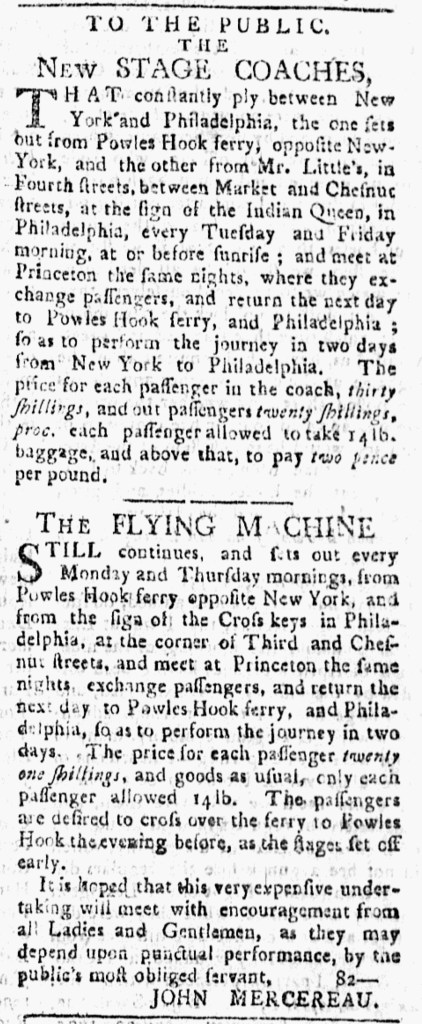
New-York Journal (May 18, 1775).

“THE FLYING MACHINE.”

When it came to stagecoaches that connected New and York and Philadelphia at the beginning of the American Revolution, travelers had more than one option.  One line, the “NEW STAGE COACHES,” left the Powles Hook ferry, on the New Jersey side of the Hudson River “opposite New-York,” and “the sign of the Indian Queen” in Philadelphia on Tuesday and Friday mornings at sunrise.  They met at Princeton in the evening, exchanged passengers, and returned to their respective points of departure the next day.  Another line, the “FLYING MACHINE,” followed a similar route, one stagecoach leaving from Powles Hook ferry and the other from the “sign of the Cross keys” in Philadelphia.  They also met in Princeton, exchanged passengers, and completed the journey in two days.  That did not, however, include crossing the Hudson River.  John Mercereau instructed passengers departing from New York that they should “cross over the ferry to Powles Hook the evening before, as the stages set off early.”  With coaches departing from each city four mornings each week, customers could choose which line best fit their schedules.

Not unlike passengers traveling by bus, train, or airplane today, stagecoach customers considered the prices of each service.  The New Stage cost thirty shillings “for each passenger in the coach,” but “out passengers” paid a bargain rate of only twenty shillings.  Each had to decide if the comfort of an inside seat was worth the additional cost and fit their budget.  The weather on the day of travel likely influenced the choices made by some travelers.  The Flying Machine charged twenty-one shillings per passenger, presumably for inside seats.  That made it a good deal compared to the New Stage for those who traveled with little luggage.  Each passenger was allowed up to fourteen pounds, with no mention of arrangements for anything in excess.  The New Stage, on the other hand, allowed fourteen pounds of baggage as part of the fare and then charged two pence per pound for anything above that.  Like passengers checking luggage at airports today, travelers apparently went through a process of having their bags weighed and potentially assessed additional fees prior to departure.  Those taking more than the allotted amount may have opted for the New Stage over the Flying Machine, resigned to paying more for the excess weight.  Like marketing for modern travel that highlights on-time rates, Mercereau promised “punctual performance.”  The mode for getting from one place to another has evolved over time, but the many of the considerations that passengers take into account have remained quite similar.
May 4

What was advertised in a revolutionary American newspaper 250 years ago today?

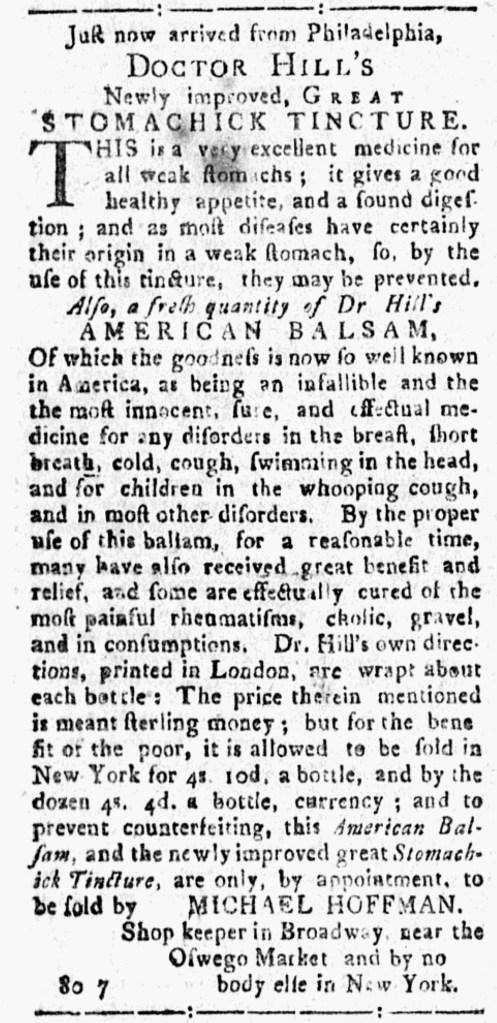
New-York Journal (May 4, 1775).

“To be sold by MICHAEL HOFFMAN … and by no body else in New-York.”

In the spring of 1775, Michael Hoffman took to the pages of the New-York Journal to advertise two patent medicines, “DOCTOR HILL’S Newly improved, GREAT STOMACHICK TINCTURE” and “Cr. Hill’s AMERICAN BALSAM.”  Even though he asserted that the goodness of that second remedy “is now so well known in America, as being an infallible … end effectual medicine” for a variety of “disorders,” Hoffman listed symptoms that it alleviated.  He also advised that the tincture prevented “most diseases” since they tended to have “their origin in a weak stomach.”

Hoffman declared that his supply had “Just now arrived from Philadelphia.”  He likely received it from William Young, an associate who advertised both the tincture and the balsam in the Pennsylvania Journal in November 1774 and in the first issue of Story and Humphreys’s Pennsylvania Mercury in April 1775.  Those advertisements included a short list of five local agents who sold Dr. Hill’s medicines in Philadelphia, Germantown, Kingsessing, Lancaster, and New York.  The shopkeeper did not incorporate that list into his notice, but he did underscore that “to prevent counterfeiting” the remedies were sold “only, by appointment … by MICHAEL HOFFMAN … and by no body else in New-York.”  Judging by an advertisement in the Pennsylvania Packet in May 1772, he held that exclusive “appointment” for at least three years.  As another means of guaranteeing authenticity, “Dr. Hill’s own directions, printed in London, are wrapt about each bottle.”

In addition to the patent medicines, Hoffman apparently received copy for his advertisement from Young.  Much of it repeated the notices that ran in Philadelphia’s newspapers word for word.  In the initial advertisement in November, Young stated that the medicines had been “Lately imported from London.”  Hoffman updated that to “Just now arrived from Philadelphia,” not mentioning when his associate there imported them even though he could have affirmed that Young had received the shipment before the Continental Association went into effect on December 1, 1774.  Perhaps he depended on his own reputation as sufficient testimony that he did not sell goods in violation of the nonimportation agreement.

April 6

What was advertised in a colonial American newspaper 250 years ago today?

Supplement to the New-York Journal (April 6, 1775).

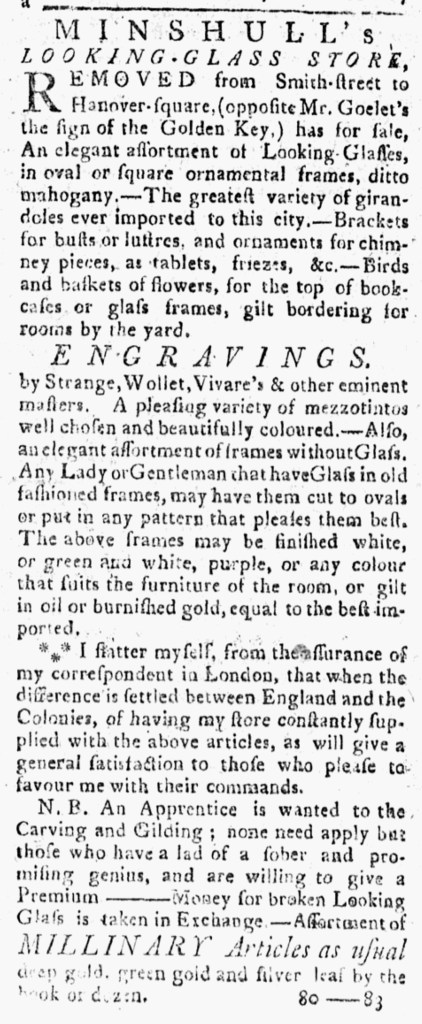
“Assurance … that when the difference is settled between England and the colonies, of having my store constantly supplied.”

In the spring of 1775, the proprietor of “MINSHULL’s LOOKING-GLASS STORE” ran a newspaper advertisement to announce that he had “REMOVED” from Smith Street to a new location “opposite Mr. Goelet’s [at] the sign of the Golden Key” on Hanover Square in New York.  In addition to an “elegant assortment” of looking glasses, he stocked other items for decorating homes and offices, including brackets for displaying busts, arrangements of flowers and birds “for the top of bookcases,” and the “greatest variety of girandoles” or candleholders “ever imported to the city.”  He also devoted a separate paragraph, with its own headline, to a “pleasing variety” of mezzotint “ENGRAVINGS” and the choices for frames.

John Minshull confided that he had “assurances of my correspondent in London, that when the difference is settled between England and the Colonies, of having my store constantly supplied with the above articles, as will give a general satisfaction” to his customers.  Readers realized that he referred to the imperial crisis and the effects of the Continental Association, the nonimportation agreement devised by the First Continental Congress in response to the Coercive Acts.  Minshull did not state that he imported his inventory before that pact went into effect on December 1, 1774.  Instead, he allowed readers to make that assumption, especially when he noted that he would not receive any new merchandise from England until the colonies and Parliament reached an accord.

That did not happen.  Within weeks of Minshull placing his advertisement, the Revolutionary War began with the Battles of Lexington and Concord in Massachusetts.  A little over a year later, the British occupied New York and remained in the city until 1783.  Yet Minshull persevered, continued operating his shop, and, according to an advertisement in the November 8, 1780, edition of the Royal Gazette, “imported in the Fleet from England, A large Assortment of LOOKING GLASSES, adapted to the present mode of Town and Country.”  He apparently managed to maintain his connections with his correspondents and suppliers in London.

Perhaps Minshull abided by the Continental Association in 1775 as a matter of political principle.  Perhaps he did so merely to stay in the good graces of his customers and the community.  The latter seems more likely since, according to Luke Beckerdite, “a ‘John Michalsal’ was included in a list of Loyalists” in 1775 and “a ‘John Minchull’ subsequently fled to Shelburne, Nova Scotia,” a haven for Loyalists during and immediately after the war.  From August 1782 through February 1783, ran an advertisement in the Royal Gazette for his “remaining Stock” that he sold “Cheap! Cheap! Cheap!”  It appears that Minshull had a going-out-of-business sale before evacuating from New York when the war ended.  Before that, he resumed business as usual when circumstances changed under the British occupation, weathering the storm and attempting to earn his livelihood during uncertain times.  When the “difference [was] settled between England and the Colonies,” he no longer sold looking glasses or anything else in New York.

March 19

What was advertised in a colonial American newspaper 250 years ago this week?

New-York Journal (March 16, 1775).

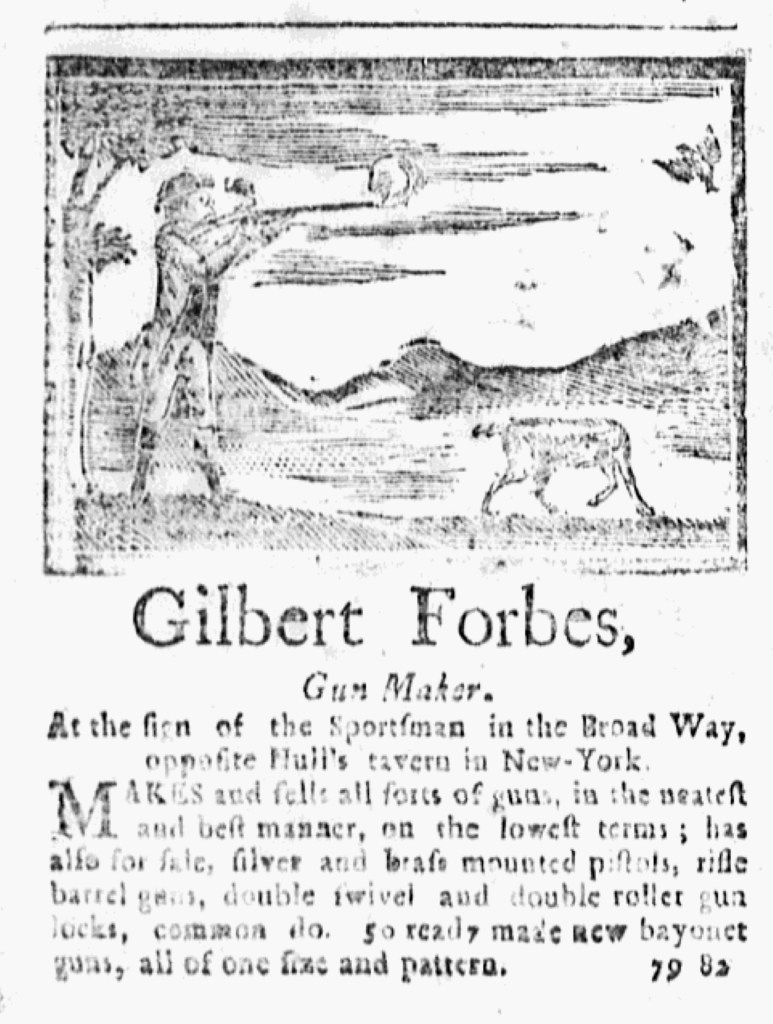
“Gilbert Forbes, Gun Maker, At the sign of the Sportsman.”

Gilbert Forbes, “Gun Maker, At the sign of the Sportsman in the Broad Way,” took to the pages of the New-York Journal to advertise “all sorts of guns” that he made “in the neatest and best manner “and sold “on the lowest terms” as spring approached in 1775.  He made some of the standard appeals deployed by artisans – quality and price – yet those were not the focal point of his advertisement.  A woodcut dominated his notice, accounting for more than half the space he purchased in the newspaper.

Commissioning the woodcut may very well have been worth the investment.  It almost certainly attracted the attention of readers, not only because it appeared on the first page of the March 16 edition.  The image depicted a scene of a well-dressed gentleman firing a gun, a bird plummeting out of the sky, and a hunting dog waiting below.  A puff of smoke wafted out of the barrel of the gun, capturing the moment just after the gentleman pulled the trigger.  Such a scene differed dramatically from other images that appeared in newspaper advertisements during the era of the American Revolution.  When advertisers commissioned woodcuts, they usually requested static images that corresponded to some aspect of their business, most often replicating their shop sign or showing an item that they made or sold at their shop.  For instance, an image of a fish adorned an advertisement for “CORNISH’s New-England FISH HOOKS” in the Massachusetts Spy and an image of a spinning wheel appeared in James Cunning’s advertisement for dry goods he sold “At the Sign of the SPINNING-WHEEL” in the Pennsylvania Journal.  In contrast, Forbes provided a scene in motion, distinguishing his advertisement from others.

Relatively few advertisements featured images at all.  Those that did most often incorporated stock images of ships at sea, houses, horses, or enslaved people, each of them provided by the printer.  Occasionally, advertisers commissioned woodcuts intended exclusively for their own use.  Among that small number, an image of a scene, one that invited viewers to imagine events in motion, was exceptionally rare.  As such, it demanded attention.

March 12

What was advertised in a colonial American newspaper 250 years ago this week?

New-York Journal (March 9, 1772).

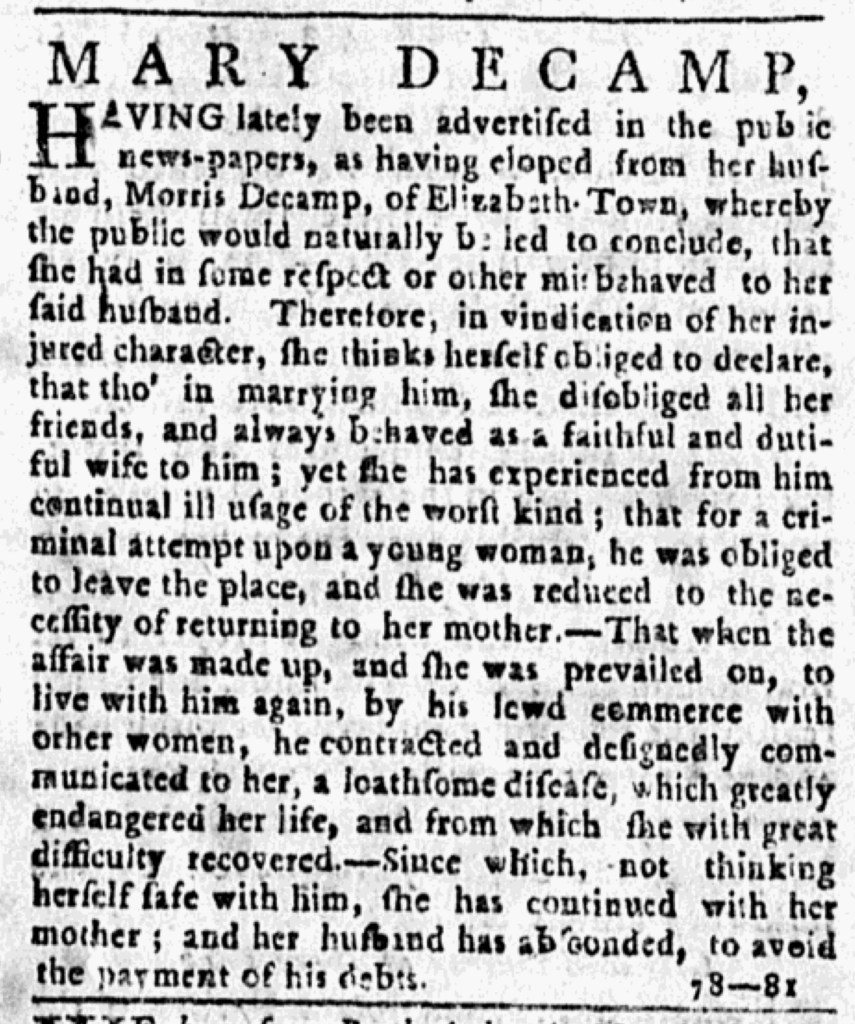
“Her husband has absconded, to avoid the payment of his debts.”

It began as a standard “runaway wife” advertisement in the January 19, 1775, edition of the New-York Journal.  “WHEREAS my Wife Mary has lately eloped from me, and my perhaps endeavour to run me into Debt,” Morris Decamp proclaimed, “these are therefore to warn all Persons not to Trust or entertain her on my Account, as I will pay no Debts she may contract.”  That advertisement ran for four weeks, but not without going unnoticed or unanswered by Mary.

Most women who appeared in the public prints as the subject of such advertisements did not have the means or opportunity to respond.  Mary, however, did, perhaps with assistance from some of her relations.  Her own advertisement began its run in the March 2 edition of the New-York Journal, placing it before the eyes of the same readers who saw her husband’s missive.  She acknowledged that “the public would naturally be led to conclude, that she had in some respect or other misbehaved to her said husband” based on what they knew from his advertisement.  On the contrary, she asserted, she “always behaved as a faithful and dutiful wife to him.”  The misbehavior had been solely on his part.  Mary “experienced from him continual ill usage of the worst kind,” yet his villainy extended beyond their household.  The aggrieved wife alleged that Morris committed “a criminal attempt upon a young woman” that resulted in him having to leave town.  Abandoned by her husband, Mary “was reduced to the necessity of returning to her mother.”  Morris somehow managed to resolve that situation; Mary did not provide details but reported that “when the affair was made up, … she was prevailed on, to live with him again,” much to her regret.  Her husband remained unreformed: “by his lewd commerce with other women, he contracted and designedly communicated to [Mary], a loathsome disease, which greatly endangered her life, and from which she with great difficulty recovered.”

The real story, Mary insisted, reflected poorly on her husband, not on her.  She took to the pages of the New-York Journal“in vindication of her injured character.”  Rather than “eloping” from Morris, she had returned to her mother because she did not consider herself safe with him.  It was actually Morris who “has absconded, to avoid the payment of his debts.”  Even as he tried to cut her off from his credit, her notice likely prompted others to think twice about doing business with him.  Wives rarely placed rebuttals to the advertisements published by their husbands.  In the rare instances that they did, women like Mary Decamp attempted to harness the power of the press to defend their reputations by setting the record straight.

March 5

What was advertised in a colonial American newspaper 250 years ago this week?

Supplement to the New-York Journal (March 2, 1775).

“PARCHMENT … Made and sold … [in] Philadelphia.”

In the early 1770s, Robert Wood made and sold parchment in Philadelphia, yet he did not confine his marketing or distribution of his product to that city and its hinterland.  As spring approached in 1775, he ran an advertisement in the supplement that accompanied the March 2 edition of the New-York Journal, advising prospective customers that they could acquire his parchment from local agents.  John Holt, the printer of the New-York Journal, and Hugh Gaine, the printer of the New-York Gazette and Weekly Mercury, each stocked Wood’s parchment along with books, stationery, and writing supplies at their printing offices.  In addition, Joseph Dunkley, a painter and glazier, also supplied Wood’s parchment at his workshop “opposite the Methodist Meeting House.”  The New-York Journal circulated beyond the city, so some prospective customers would have found it more convenient to acquire Wood’s parchment from Isaac Collins, a printer in Burlington, New Jersey.  According to previous advertisements, Collins had been peddling Wood’s parchment to “friends to American Manufactures” for several years.

Wood asserted that the “Demand for this Parchment [was] much increased of late,” though he left it to readers to imagine why that was the case.  Most would assume that the Continental Association, a nonimportation agreement that went into effect on December 1, 1774, played a role in increased demand for parchment produced in the colonies.  Wood likely intended for prospective customers to draw the conclusion that the quality of his product, not merely its availability, contributed to the demand.  He declared that “those who have tried it … esteemed [it] superior to most imported from England.”  He was bold enough to resort to superlatives, claiming that customers considered his parchment better than any imported to the colonies, yet he offered firm assurances about it quality.  Wood had recently met with so much demand for his parchment that he “extend[ed] his Works … to be able to supply his Customers in a manner more satisfactory than heretofore, without Fear of a Disappointment.”  In other words, he stepped up production to expand his inventory so every customer who wished to purchase his parchment could do so.  Wood answered the call of the eighth article of the Continental Association with his own “Industry” in producing “Manufactures of this Country” as alternatives to imported goods.

January 15

What was advertised in a colonial American newspaper 250 years ago this week?

Supplement to the New-York Journal (January 12, 1775).

“All kinds of business will be transacted on commission.”

John Holt included a significant amount of content – news, editorials, advertisements – in each issue of the New-York Journal.  Like other colonial newspapers, his publication consisted of four pages published once a week.  Most featured three columns per page, but the New-York Journal had four.  Even then, that often was not enough space for everything submitted to Holt’s printing office, prompting him to distribute supplements with even more content.

Such was the case with the January 12, 1775, edition.  In addition to the standard issue, Holt printed a four-page supplement that featured both news and advertising.  Some of that advertising, however, had an unusual format as the result of Holt using a smaller sheet that accommodated only three columns.  That left enough space to insert advertisements in the right margins, though they had to be divided into shorter segments and printed perpendicular to the rest of the content.

For instance, William Tongue’s advertisement for a “MERCHANT BROKER’S OFFICE” that previously ran in a single column appeared in five short segments in the right margin on the second page.  In addition to maximizing the use of space in the supplement, it saved the compositor time because the type had already been set.  On other pages, the right margins contained multiple shorter advertisements, such as Jonathan Durrell’s advertisement for locally produced “EARTHEN WARE” divided into three segments and a notice concerning Isaac Adolphus’s estate divided into two segments on the first page.  In total, Holt managed to squeeze eight advertisements of various lengths, including one offering an enslaved woman for sale, into the margins of the supplement, following a strategy commonly used by colonial printers.

Supplement to the New-York Journal (January 12, 1775).

Apparently, the printer made a calculated decision about the size of the sheets to use for the supplement; it was not the result of a disruption in his paper supply caused by current events.  A week earlier on January 5, he used the larger sheet for both the standard issue and a supplement with four full columns, but on January 19 used the larger sheet for the standard issue and, once again, the slightly smaller sheet for the supplement.  On that occasion, he used only a half sheet, distributing a two-page supplement devoted entirely to paid notices.  That suggests that he carefully managed his resources rather than resorting to whatever paper came to hand.  Advertisements and other content sometimes appeared in the margins out of necessity when printers had difficulty acquiring paper during the imperial crisis, but seemingly that was not the case in this instance.  Instead, Holt shrewdly balanced how much content to print against anticipated revenues from advertising.

Supplement to the New-York Journal (January 12, 1775).

January 12

What was advertised in a colonial American newspaper 250 years ago today?

Supplement to the New-York Journal (January 12, 1775).

“A GENERAL and complete assortment of MUFFS and TIPPETS.”

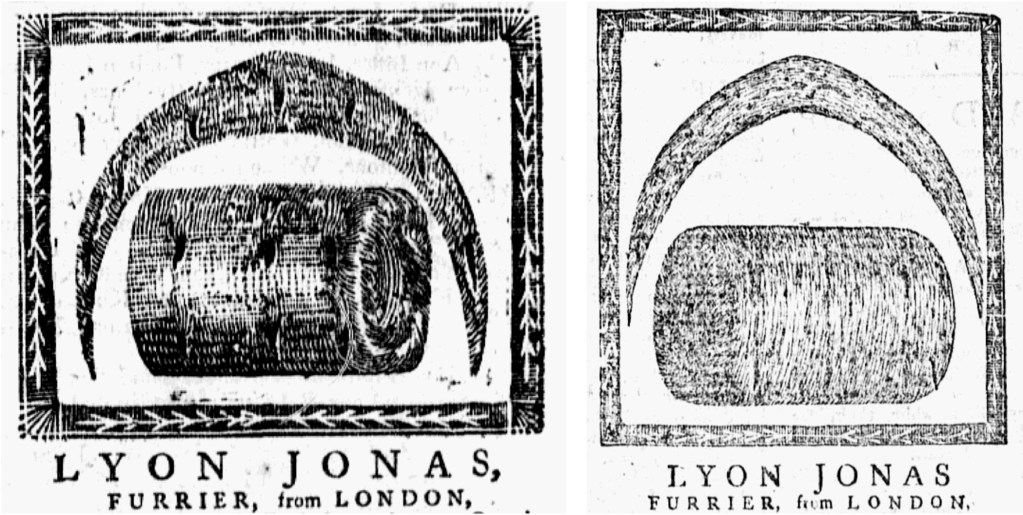
Lyon Jonas, a “FURRIER, from LONDON,” was consistent in his advertising in two newspapers published in New York on the eve of the American Revolution.  He ran notices with identical copy in the New-York Gazette and Weekly Mercury in November 1774 and the New-York Journal in January 1775.  As was often the case when advertisers purchased space in more than one publication, the notices featured variations in format at the discretion of the compositor, including line breaks and capitalization.  Otherwise, the copy in Jonas’s advertisement was identical.  Rather than writing it out twice, the furrier may very well have clipped his advertisement from one newspaper to submit to the printing office of the other.

The two notices featured another striking similarity.  Both were adorned with a woodcut depicting a muff and a tippet enclosed within a decorative border, the size of the image accounting for approximately half of the space of the advertisement and certainly drawing attention.  Advertisers commissioned such distinctive woodcuts to promote their businesses, making additional investments in their marketing efforts.  In most instances that they incorporated images into advertisements in more than one newspaper, they collected their woodcut from one printing office and delivered it to another.

Jonas, however, commissioned a second woodcut.  Though similar at a glance, enough so that consumers would recognize the devise that represented Jonas’s business, the woodcuts had several variations.  The one in the New-York Gazette and Weekly Mercury was rectangular while the one in the New-York Journal was nearly a square.  The borders had different decorative elements, especially the corners.  The muffs faced opposite directions.  The ends of the tipped almost touched the border in the woodcut in the New-York Journal, but much more space appeared between the ends and the border in the version in the New-York Gazette and Weekly Mercury.

Most advertisers who adorned their newspaper notices with custom images limited their investment to one woodcut, transferring it from printing office to printing office when they wished to include those images in more than one publication.  Jonas, however, opted for a second woodcut.  Doing so allowed him, if he wished, to circulate advertisements with identical copy accompanied by distinctive images in two newspapers simultaneously without having to worry about the logistics of the printing offices sharing a single woodcut.

Left: New-York Gazette and Weekly Mercury (November 21, 1774); Right: Supplement to the New-York Journal (January 12, 1775).

December 22

What was advertised in a colonial American newspaper 250 years ago today?

New-York Journal (December 22, 1774).

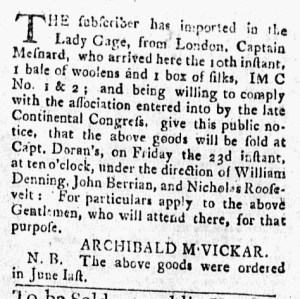
“Willing to comply with the association entered into by the late Continental Congress.”

When a shipment of “1 bale of woolens and 1 box of silks” arrived in New York via the Lady Gage on December 10, 1774, Archibald McVickar surrendered the good to the local Committee of Inspection and placed an advertisement to that effect in the New-York Journal.  He declared that he was “willing to comply with the association entered into by the late Continental Congress.”  Accordingly, those goods “will be sold … under the direction of William Denning, John Berrian, and Nicholas Roosevelt.”  Anyone wishing to learn more about the sale should “apply to the above Gentlemen” rather than to the McVickar.

McVickar abided by the Continental Association, a nonimportation agreement enacted by the First Continental Congress in response to the Coercive Acts.  In particular, the tenth article stated, “In Case any Merchant, Trader, or other Persons, shall import any Goods or Merchandise after the first Day of December [1774], and before the first Day of February next, the same ought forthwith, at the Election of the Owner, to be either reshipped or delivered up to the Committee of the County or town wherein they shall be imported, to be stored at the Risk of the Importer, until the Non-importation Agreement shall cease, or be sold under the Direction of the Committee aforesaid.”  In other words, McVickar had three options since his shipment arrived on December 10.  He could return it, turn the goods over to the committee to store until the nonimportation agreement ended, or turn the goods over to the committee to sell.

McVickar chose the final option.  The Continental Association made further provisions that he would be reimbursed for the cost of the goods yet could not earn any profit on them.  Instead, any profit was to be applied to relief efforts for Boston where the harbor had been closed and blockaded since the Boston Port Act went into effect on June 1.  McVickar added a nota bene to clarify that the “goods were ordered in June last.”  At that time, colonizers suspected that a nonimportation agreement might go into effect in the future, but the First Continental Congress had not yet met or composed and disseminated the Continental Association.  McVickar suggested that he had not deliberately attempted to get around that agreement, as he further demonstrated in asserting that he was “willing to comply with the association.”  Whatever he lost in profit, he gained in staying in the good graces of members of the community who supported the Patriot cause.

December 15

What was advertised in a colonial American newspaper 250 years ago today?

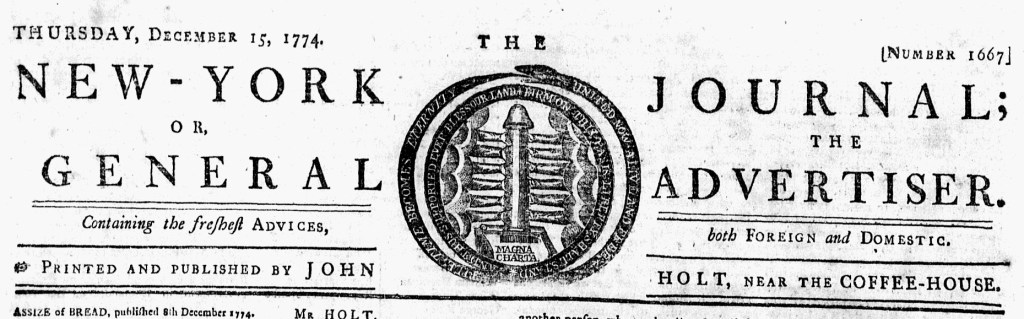
New-York Journal (December 15, 1774).

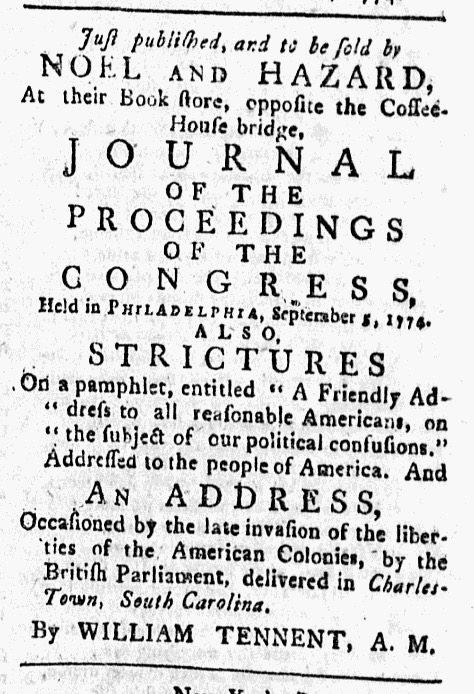
“JOURNAL OF THE PROCEEDINGS OF THE CONGRESS.”

According to their advertisement in the December 15, 1775, edition of the New-York Journal, Garrat Noel and Ebenezer Hazard stocked the “JOURNAL OF THE PROCEEDINGS OF THE CONGRESS, Held in PHILADELPHIA” at their bookstore.  They also marketed “STRICTURES On a pamphlet, entitled ‘A Friendly Address to all reasonable Americans, on the subject of our political confusions’” by Charles Lee and “AN ADDRESS, Occasioned by the late invasion of the liberties of the American Colonies, by the British Parliament, delivered in Charles-Town, South Carolina” by William Tennent.  The booksellers provided the public access to news and commentary about current events beyond what appeared in the public prints, though they privileged perspectives expressed by Patriots rather than Loyalists.

Noel and Hazard may have sold Hugh Gaine’s New York edition of the Proceedings of the First Continental Congress, though the other titles in their advertisement suggest that they could have sold the Philadelphia edition printed by William Bradford and Thomas Bradford.  The Bradfords also published Lee’s Strictures and Tennent’s Address, possibly sending copies of all three titles to Noel and Hazard.  Either  way, the masthead of the newspaper that featured the booksellers’ advertisement suggested that the Bradfords’ edition of the Proceedings made their way to New York.  Six months earlier, John Holt, the printer of the New-York Journal, incorporated a political cartoon depicting a severed snake, each segment representing one of the colonies, with the motto “UNITE OR DIE” into the masthead.  On December 15, he replaced it with a woodcut depicting twelve hands, one for each colony represented at the First Continental Congress, grasping a liberty pole with a liberty cap perched atop it on a pedestal inscribed “MAGNA CHARTA.”  A similar image appeared on the title page of the Bradfords’ edition of the Proceedings, described in Princeton University Library’s online catalog as “the first wood-cut device of the 12 colonies intended to symbolize the need for the true political unity of the colonies.”  Holt enhanced that image, having an ouroboros twice encircle the hands and pillar.  A message on the ouroboros proclaimed, “UNITED NOW – ALIVE AND FREE – AND THUS SUPPORTED EVER – BLESS OUR LAND – FIRM ON THIS BASIS LIBERTY SHALL STAND – TILL TIME BECOMES ETERNITY.”  This addition to his newspaper set the tone for readers to peruse Noel and Hazard’s advertisement, other paid notices, and the news and editorials selected by Holt.

New-York Journal (December 15, 1774).