September 28

What was advertised in a revolutionary American newspaper 250 years ago today?

New-York Journal (September 28, 1775).

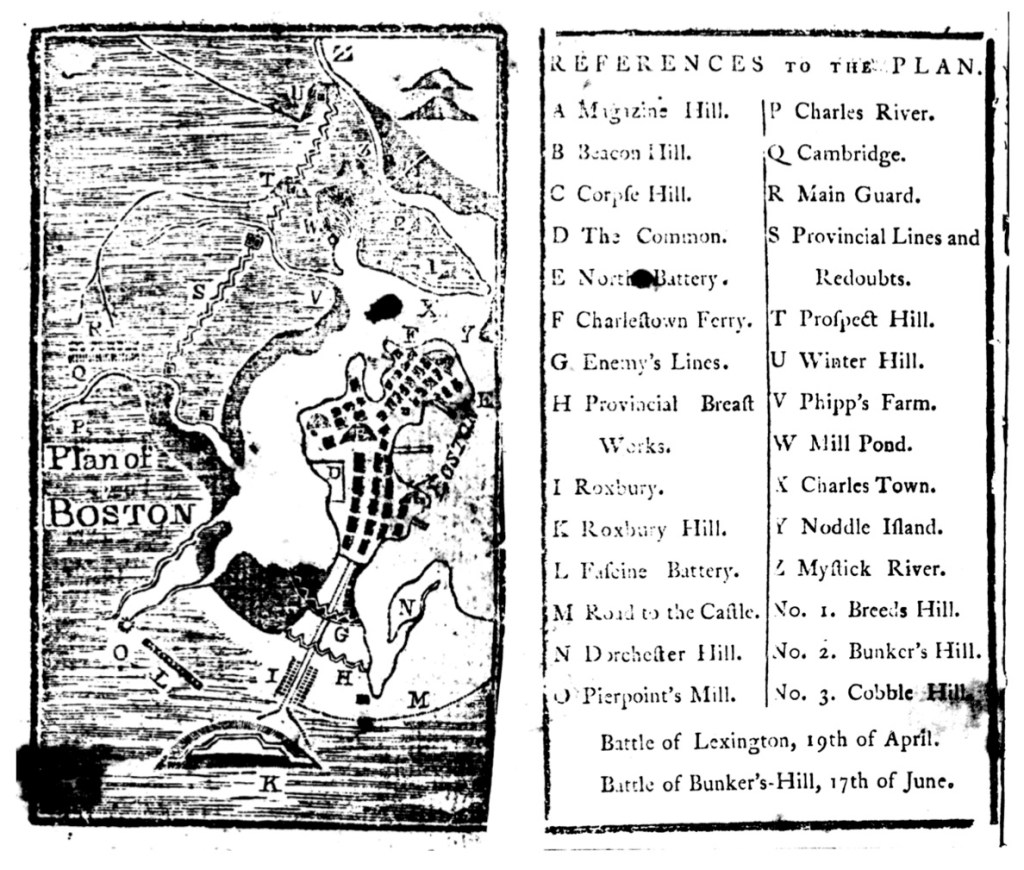
“The Words of Command used in the Manual Exercise, and an accurate Plan of Boston.”

Almost simultaneously with Hugh Gaine announcing in the New-York Gazette and Weekly Mercury that he had “Just PUBLISHED … HUTCHIN’s Improv’d; BEING AN ALMANACK … For the Year of our LORD 1776,” Frederick Shober and Samuel Loudon inserted an advertisement in the New-York Journal to alert the public that they had “Just published … The NEW-YORK and COUNTRY ALMANACK, For the Year of our Lord 1776.”  It included “all the necessary Articles usual in an Almanac, with the Addition of many curious Anecdotes, Receipts [or Recipes], [and] poetical Pieces.”  Unlike Gaine, Shober and Loudon did not provide an extensive list of the contents.  As printer of the New-York Gazette and Weekly Mercury, Gaine had access to as much space as he wished to devote to promoting an almanac he published.  Shober and Loudon, on the other hand, paid to run their advertisement in the New-York Journal.

The partners did, however, specify two items that they wanted prospective customers to know they would find in the New-York and Country Almanack: “the Words of Command used in the Manual Exercise, and an accurate Plan of Boston with the different Situations of the Provincials, and the Ministerial Armies.”  Both reflected current events.  The “REFERENCES TO THE PLAN” (or legend for the map of Boston) in the almanac highlighted the “Battle of Lexington, 19th of April,” and the “Battle of Bunker’s-Hill, 17th of June.”  For readers beyond Massachusetts who did not directly experience those battles, that helped solidify in their minds the dates that they occurred.  By the time that Shober and Loudon took their almanac to press, maps of Boston had circulated widely in the July issue of the Pennsylvania Magazine (and Loudon had been among the booksellers to advertise them).  Nicholas Brooks and Bernard Romans also collaborated on a map that they likely distributed by the end of summer.  Those may have served as models for the “Plan of Boston” that Sober and Loudon commissioned for their almanac.  Gaine also directed attention to the “beautiful Plan of Boston, and the Provincial Camp” in his almanac.  The “whole Process of making SALT PETRE, recommended by the Hon. the Continental Congress” and a “Method of making Gun-Powder” accompanied their map.  In Shober and Loudon’s almanac, the “Words of Command,” taken from the widely published Manual Exercise, supplemented the map.  In both cases, the events of the Revolutionary War inspired the contents of the almanacs and became selling points in marketing them.

“Plan of Boston” [left] and “References to the Plan” [right], in The New-York and Country Almanack for the Year of Our Lord 1776 (New York: Shober and Loudon, 1775). Courtesy American Antiquarian Society.

September 24

What was advertised in a revolutionary American newspaper 250 years ago this week?

New-York Journal (September 21, 1775).

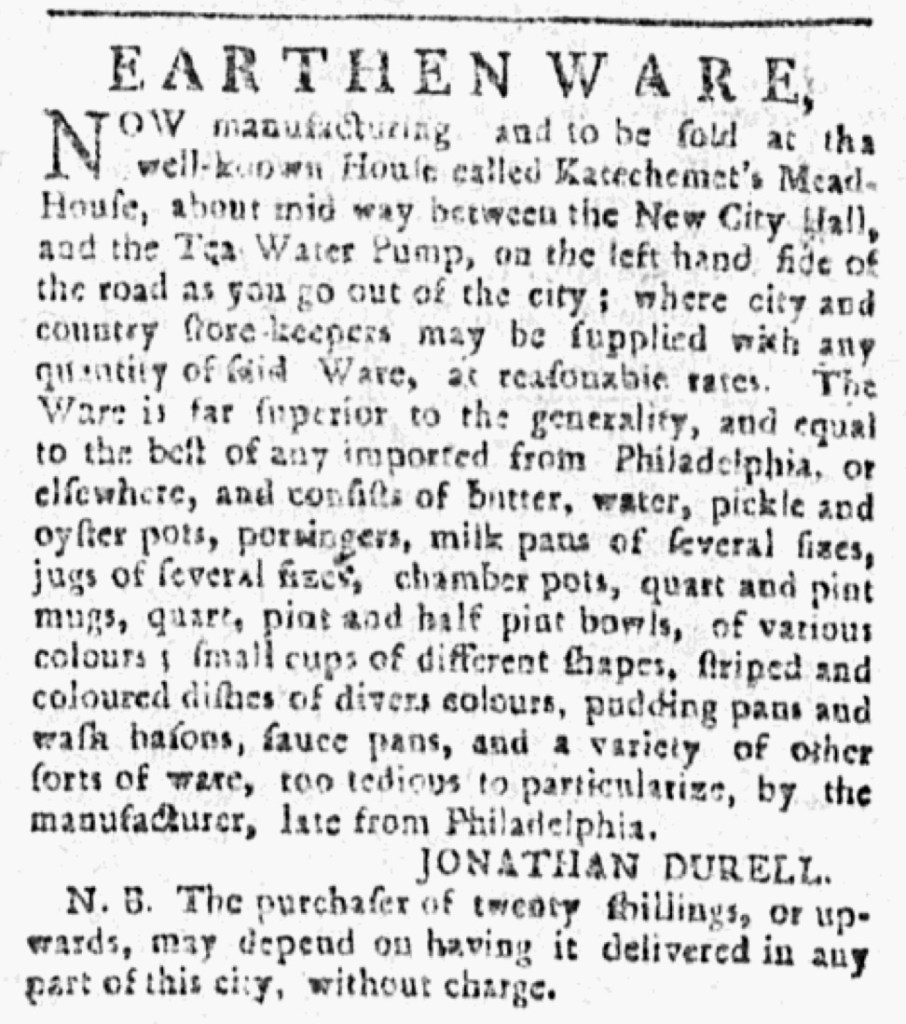
“EARTHENWARE … equal to the best of any imported from Philadelphia, or elsewhere.”

As fall arrived in 1775, Jonathan Durell took to the pages of the New-York Journal to advertised “EARTHENWARE” that he made locally and sold “at the well-known House called Katechemet’s Mead-House” on the outskirts of the city.  The potter offered a variety of items, including, “butter, water, pickle and oyster pots, porringers, milk pans of several sizes, jugs of several sizes, chamber pots,” and “a variety of other sorts of ware, too tedious to particularize.”  Durrel promoted these items as “far superior to the generality, and equal to the best of any imported from Philadelphia, or elsewhere.”  He also reported that he had migrated to New York from Philadelphia.

Mentioning Philadelphia twice in his advertisement was intentional.  When Durell compared the quality of his earthenware to items imported into New York, he did not refer only to goods arriving from English manufactories, though looking to alternatives would have been on the minds of consumers while the Continental Association remained in effect.  Colonizers who wished to purchase “domestic manufactures” in support of their political principles knew that Philadelphia was an important center for pottery production.  Deborah Miller, an archaeologist, notes that Philadelphia Style earthenware “became recognized across the colonies for its quality and durability” by the middle of the eighteenth century.  Citing Durell’s advertisement, Edwin Atlee Barber states that “it would appear that even before the Revolution the wares made in Philadelphia had acquired a reputation abroad for excellence.”[1]  Durell’s pottery was not made in Philadelphia, but he had resided there and presumably used the same techniques to produce his earthenware.  As both consumers and “city and country store-keepers” sought goods made in the colonies, he presented an attractive option.

To increase his chances of making sales, Durell mentioned the “reasonable rates” he charged for his earthenware and provided a convenient service.  In a nota bene, he declared, “The purchaser of twenty shillings, or upwards, may depend on having it delivered in any part of this city, without charge.”  The potter hoped that free delivery would entice customers to take a chance on earthenware that he asserted matched any others, including products from Philadelphia, in its quality.

**********

[1] Edwin Atlee Barber, The Pottery and Porcelain of the United States: An Historical Review of American Ceramic Art from the Earliest Times to the Present Day (New York: G.P. Putnam’s Sons, 1893).

September 14

What was advertised in a revolutionary American newspaper 250 years ago today?

New-York Journal (September 14, 1775).

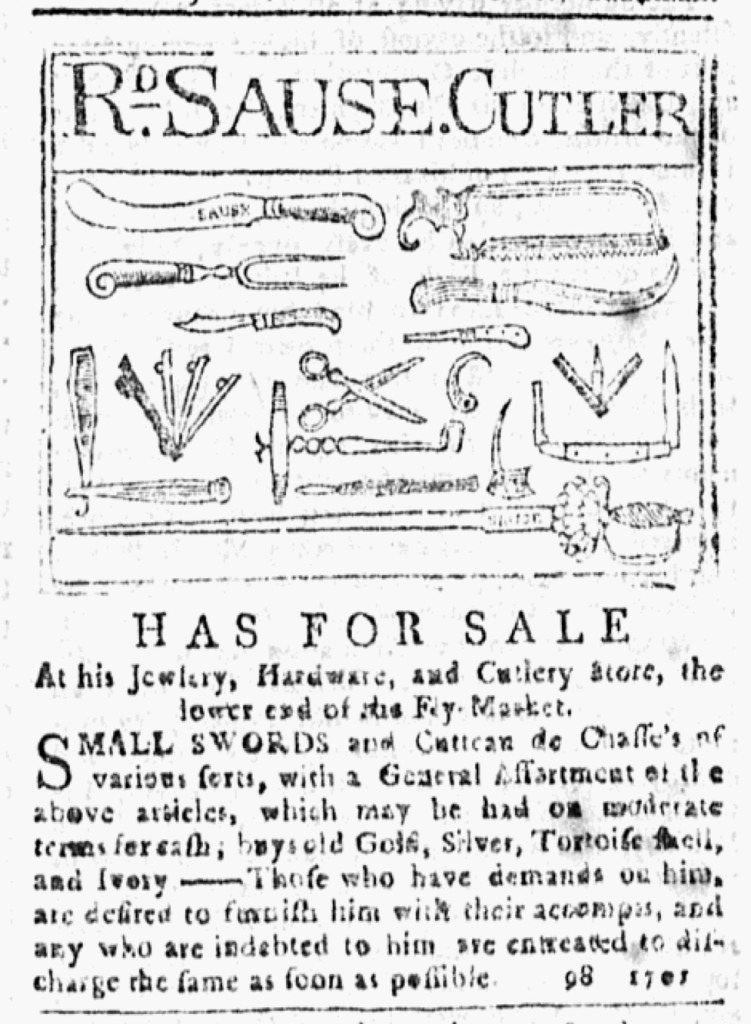
“SMALL SWORDS … of various sorts.”

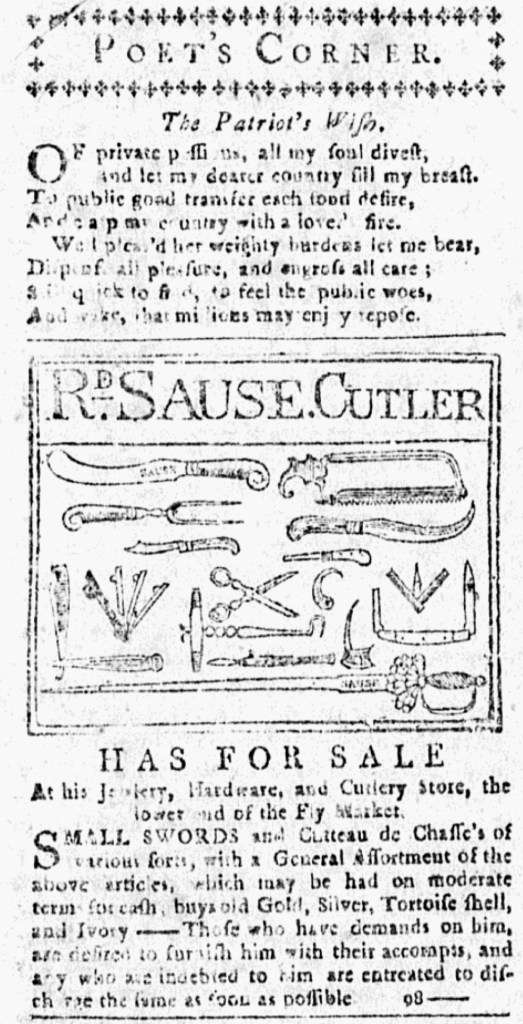
Richard Sause’s advertisement for “SMALL SWORDS” and other items available at his “Jewelery, Hardware, and Cutlery Store” became a familiar sight for readers of the New-York Journal in the summer of 1775.  The woodcut depicting a shop sign with Sause’s name and an array of cutlery, including a sword, made his notice even easier to spot.

On September 14, his notice happened to appear near the top of the left column on the final page of the newspaper, immediately below a regular feature called “POET’S CORNER.”  For that issue, John Holt, the printer, selected a short poem, “The Patriot’s Wish.”

OF private passions, all my soul divest,
and let my dearer country fill my breast,
To public good transfer each fond desire,
And clasp my country with a lover’s fire.
Well pleas’d her weighty burdens let me bear
Dispense all pleasure, and engross all care;
[ ] quick to [ ], to feel the public woes,
And wake, that millions may enjoy repose.

The strained verses were heartfelt even if not especially graceful or elegant.  Perhaps a reader submitted the poem as their way of contributing to the struggle that colonizers endured throughout the imperial crisis and then intensified with the outbreak of hostilities at Lexington and Concord the previous spring.  Sause aimed to make his own contribution by supplying “SMALL SWORDS and Cutteau de Chasse’s,” a type of sword, to the gentlemen of New York who prepared for the possibility that they would have to join the fight.  Although Sause’s advertisement appeared below “The Patriot’s Wish” almost certainly by coincidence, the cutler may have been pleased with the happy accident.  After all, the poem primed readers to think about their duty and to contemplate how to make their own contributions to the cause.  For many, that could have included outfitting themselves with weapons and other military equipment.

September 10

What was advertised in a revolutionary American newspaper 250 years ago this week?

New-York Journal (September 7, 1775).

“Several packages of their Spring goods, are yet unopened.”

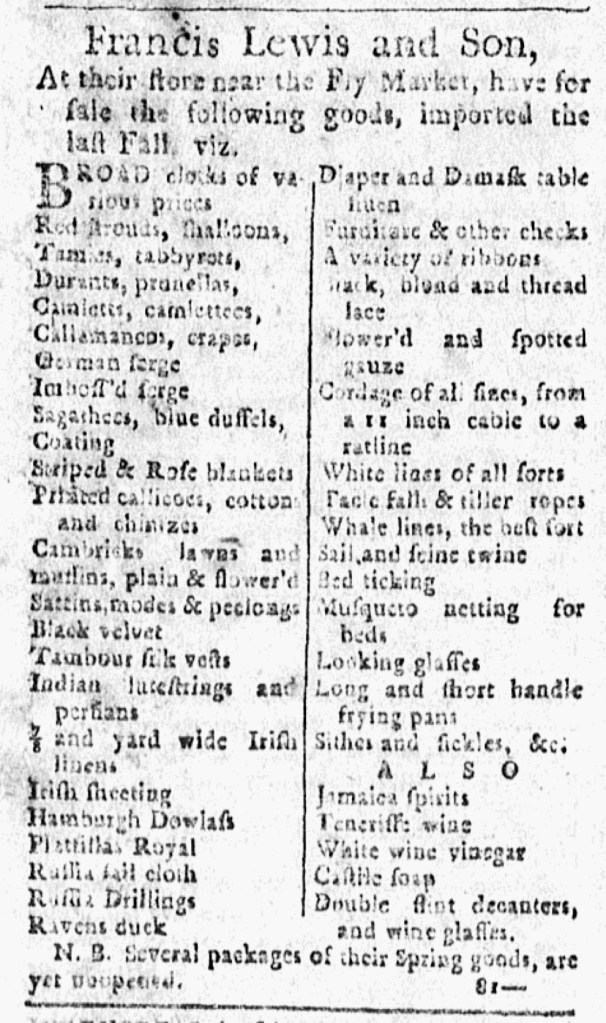
As fall arrived in 1775, Francis Lewis and Son took to the pages of the New-York Journal to advertise an array of imported goods that they stocked and sold at their store.  As many merchants and shopkeepers did, they demonstrated the choices they made available to consumers with a list of their inventory.  Their catalog featured two columns with one or two items per line, enumerating “Red strouds, shalloons,” “Printed callicoes, cotton and chintzes,” “A variety of ribbons,” “Musqueto netting for beds,” “Looking glasses,” and “Long and short handle frying pans.”  That popular format for newspaper advertisements did not appear with the same frequency once the Continental Association went into effect on December 1, 1774.  Recognizing that the nonimportation pact devised by the First Continental Congress in response to the Coercive Acts remained in place, Lewis and Son signaled that they abided by it.

The savvy entrepreneurs specified that their wares had been “imported last Fall.”  Under other circumstances, retailers did not boast that their merchandise had been on the shelves for nearly a year.  Instead, they emphasized how recently they received shipments from London and other English ports, sometimes even naming which vessels had transported the goods so readers who followed the shipping news could confirm that sold new items.  In this instance, however, Lewis and Son needed to assure the public, especially prospective customers, that they did not deviate from the Continental Association.  Patriots could not fault shopkeepers and consumers for selling and buying goods “imported the last Fall.” To underscore that they made a deliberate choice, Lewis and Son added a nota bene: “Several Packages of their Spring goods, are yet unopened.”  That note had even greater in significance in September 1775, following the outbreak of hostilities at Lexington and Concord, than it did when the advertisement first appeared in the March 23, 1775, edition of the New-York Journal.  Lewis and Son highlighted their own restraint in placing goods in the marketplace even as they suggested to prospective customers that they barely had to restrain themselves in their purchases because the shopkeepers offered so many choices.

August 10

What was advertised in a revolutionary American newspaper 250 years ago today?

New-York Journal (August 10, 1775).

“Stockings made in the best manner, for those that bring their own stuff.”

In an advertisement that first ran in the August 10, 1775, edition of the New-York Journal, James Wallace informed the “Ladies and Gentry” of the city that he “makes and sells, black and white silk patent lace for ladies aprons, handkerchiefs, &c.” and “hoods, aprons and tippets, and several other things in that way.”  In addition, he made and sold “silk and thread gloves and mitts, the silk of which is American produce.”  On that point, Wallace made an additional pitch: “He therefore hopes to be honoured with the commands of those who wish to encourage their own manufacture.”  It was not clear whether the silk for his lace to adorn aprons, handkerchiefs and other items was produced in the colonies or just the lace for his gloves and mitts.

Either way, Wallace expected his marketing would resonate with prospective customers who certainly knew about the provisions of the Continental Association without him explicitly invoking it.  That nonimportation agreement also called on American producers to supply alternatives and American consumers to support their endeavors.  The eighth article stated, “That we will, in our several Stations, encourage Frugality, Economy, and Industry; and promote Agriculture, Arts, and the Manufactures of this Country.”  Wallace made it easy for the “Ladies and Gentry” of New York to do so.

Wallace also noted that he made stockings “in the best manner, for those that bring their own stuff.”  In other words, customers could reduce the prices they paid for stocking by supplying their own materials, paying only for the labor.  Once again, consumers had an opportunity to put their political principles into practice in the choices they made in the marketplace.  In supplying their “own stuff,” the “Ladies and Gentry” could opt for thread spun in their own homes, either by themselves or by servants, or for thread that they knew for certain had been produced in the colonies.  Wallace did not merely offer a chance to save money for customers who provided their own materials; he also signaled that they could support the American cause through their own industry in producing those materials.

July 20

What was advertised in a revolutionary American newspaper 250 years ago today?

New-York Journal (July 20, 1775).

“SMALL SWORDS.”

Richard Sause resorted to a familiar image to adorn his advertisement in the July 20, 1775, edition of the New-York Journal.  It included his name and occupation, “RD. SAUSE. CUTLER,” and depictions of more than a dozen kinds of knives and other blades available at his “Jewlery, Hardware, and Cutlery Store.”  Some of the items, a table knife and a sword, even had his name on the blade, suggesting that Sause marked the items he made.  The image had periodically appeared in various newspapers published in New York since the early 1770s.  Personalized woodcuts, commissioned by advertisers, belonged to those advertisers to submit to printing offices as they saw fit.

In Sause’s previous advertisements, the woodcut accounted for a relatively small amount of space compared to the copy that Sause composed to promote his business.  This time, however, the image and the copy took up the same amount of space.  Sause noted that he sold “a General Assortment of the above articles,” perhaps referring to the “Jewelry, Hardware, and Cutlery” listed in the name of his store or perhaps referring to the many items in the woodcut.  In the copy, he highlighted only one sort of item: “SMALL SWORDS and Cutteau de Chasse’s of various sorts.”  (See Steve Rayner and Jim Mullins’s extensively researched “Cuttoe Knives: A Material Culture Study” for more on “a variety of short swords known as cutteau de Chasse.”  It includes an engraved trade card from 1739 for John Cargill, “Instrument Maker, at ye Saw & Crown in Lombard Street, London,” that featured an image of various blades and other instruments similar to Sause’s woodcut.)  It made sense that Sause emphasized swords in an advertisement placed in the summer of 1775.  Men in New York and other places prepared for the possibility that the fighting that began at Lexington and Concord in April and continued with the siege of Boston and the Battle of Bunkers Hill could occur in their own colonies.  They formed new companies to defend their liberties.  Merchants, shopkeepers, and artisans marketed military equipment while printers and booksellers published and sold military manuals.  Under those circumstances, Sause made a savvy decision to promote “SMALL SWORDS” in his advertisement.

July 6

What was advertised in a revolutionary American newspaper 250 years ago today?

New-York Journal (July 6, 1775).

“Removed next door to the white corner house … a dial plate over the window.”

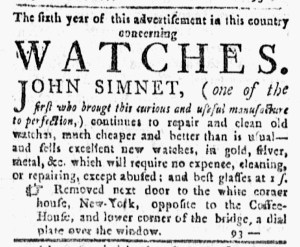
John Simnet, a cantankerous watchmaker who frequently advertised in New York’s newspapers in the early 1770s, once again took to the pages of the New-York Journal in the summer of 1775.  In this notice, he announced that he “continues to repair and clean old watches … and sells new watches.”  He took a neutral tone in that notice compared to the derogatory declarations he sometimes made about his competitors in other advertisements.  Simnet did state that he cleaned and repaired watches “much cheaper and better than is usual,” comparing the price and quality of his services to those offered by other watchmakers, but he did not denounce any competitors by name or launch into a diatribe about the general incompetence of those who followed an occupation he often claimed as solely his own.  He also described himself as “one of the first who brought this curious and useful manufacture to perfection,” but limited that comment to promoting his own work rather than denigrating other watchmakers.

Perhaps Simnet was more interested in drawing attention to his new location.  He moved from a shop “at the Dial, next Beekman’s Slip, in Queen Street” to a shop “next door to the white corner house, New-York, opposite to the Coffee-House, and lower corner of the bridge.”  Detailed directions were necessary.  Neither New York nor any other town had standardized street numbers in the 1770s, though some of the largest port cities would begin assigning them by the end of the century.  Sinnet resorted to landmarks to direct customers to his shop.  Like many other entrepreneurs, he also marked his location with a device that represented his business, “a dial plate over the window.”  It may have been the same “Dial” that had adorned his previous location.  If Simnet did transfer the “dial plate” from one shop to another, he maintained a consistent visual image for customers and others to associate with his business.  Other entrepreneurs who placed advertisements in the July 6, 1775, edition of the New-York Journal also used images to mark their locations, including James Wallace, a lacemaker and tailor “At the SIGN of the HOOD,” and William Pearson, a clock- and watchmaker “At the Dial, in HANOVER-SQUARE.”  That a competitor displayed a dial made Simnet’s elaborate directions imperative.  He did not want prospective customers stopping by another shop by mistake.

July 2

What was advertised in a revolutionary American newspaper 250 years ago this week?

New-York Journal (June 29, 1775).

“Artillery Company.”

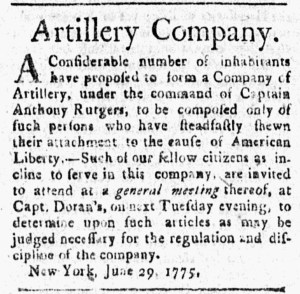
One advertisement in the June 29, 1775, edition of the New-York Journal seems to stand out from the others, at least to this reader perusing that issue 250 years later.  The colonizers who placed the advertisement no doubt hoped that readers would take note and heed its call, intending that the headline, “Artillery Company,” would resonate differently with readers than the headlines for other notices that promoted goods and services, such as “FURRS,” “CLOCKS,” “WATCHES,” and “PUBLIC AUCTION.”  This advertisement certainly served a different purpose once the imperial crisis boiled over into the battles at Lexington and Concord and the siege of Boston that followed.  It may have seemed even more urgent and imperative appearing in the same issue as an “account of the engagement between the Provincials and Regulars on Saturday the 17th,” now known as the Battle of Bunker Hill.

That issue also featured an “Address of the Provincial Congress of the Colony of New-York. To his Excellency GEORGE WASHINGTON, Generalissimo of all the Forces raised, and to be raised, in the Confederated Colonies of America.”  The advertisers sought to do their part in raising forces to defend against British troops.  “[A]n atmosphere of patriotic fervor,” Alan C. Aimone and Eric I. Manders argue, “brought forth a spate of volunteer companies” in the spring and early summer of 1775, companies that “were to be the city’s independent militia.”  Some volunteers had previous experience serving in the colonial militia.  “A Considerable number of inhabitants have proposed to form a Company of Artillery, under the command of Captain Anthony Rutgers,” the advertisement reported.  Aimone and Manders note, “Membership in the independent companies was restricted.  All new volunteers were prosperous city men.”[1]  The advertisement stated other qualifications.  The ranks of this company would be limited to “only … such persons who have steadfastly shewn their attachment to the cause of American Liberty.”  Accordingly, “Such of our fellow citizens as incline to serve in this company, are invited to attend at a general meeting … to determine upon such articles as may be judged necessary for the regulation and discipline of the company.”  Several other independent companies had formed in the city by the time this advertisement appeared in the New-York Journal, yet updates about events unfolding in New England underscored the need to continue recruiting “fellow citizens” devoted “to the cause of American Liberty.”

**********

[1] Alan C. Aimone and Eric I. Manders, “A Note on New York City’s Independent Companies, 1775-1776,” New York History 63, no. 1 (January 1982): 59, 61.

June 4

What was advertised in a revolutionary American newspaper 250 years ago this week?

New-York Journal (June 1, 1775).

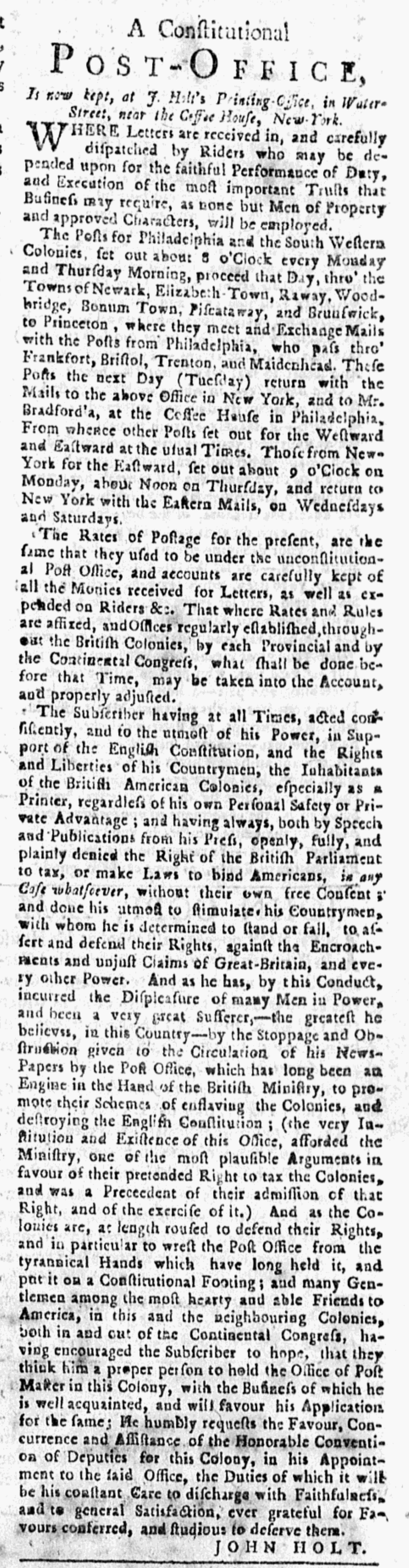
“A Constitutional POST-OFFICE, Is now kept, at J. Holt’s Printing-Office, in … New-York.”

William Goddard’s Pennsylvania Chronicle had a reputation for supporting the Patriot cause, so much so that the Crown Post drove it out of business by refusing to deliver it.  That prompted Goddard to establish the Constitutional Post, independent of British authority, as an alternative.  That service began with a route that connected Baltimore and Philadelphia in the summer of 1773.  The network expanded, yet the First Continental Congress decided to table Goddard’s plan rather than endorse it when he submitted it for consideration in the fall of 1774.  The Second Continental Congress took it up again following the battles at Lexington and Concord, adopting the plan on July 16, 1775.  To Goddard’s disappointment, the delegates named Benjamin Franklin as the first Postmaster General; he settled for serving as Riding Surveyor.

By the time that the Second Continental Congress acted on the measure, Goddard and others had already made progress putting an infrastructure in place.  For instance, newspaper advertisements confirm that “CONSTITUTIONAL Post-Riders” operated in Connecticut in the summer of 1774 and Massachusetts in the spring of 1775.  In June 1775, John Holt, the printer of the New-York Journal, advertised that a “Constitutional POST-OFFICE, Is now kept” at his printing office in New York.  He provided a schedule and noted that the “Rates of Postage for the present, are the same that they used to be under the unconstitutional Post Office.”  He would adjust the “Rates and Rules” as provincial congresses in the several colonies and the Continental Congress approved them.  In addition, “accounts are carefully kept of all the Monies received for Letters, as well as expended on Riders” and other costs.  Holt anticipated that the Continental Congress would indeed adopt Goddard’s plan for the Constitutional Post in the aftermath of Lexington and Concord.  Seeking an appointment as postmaster for New York, he devoted half of his advertisement to giving his credentials in hopes of attracting the attention of the delegates and other who might influence them:

“The Subscriber having at all Times, acted consistently, and to the utmost of his Power, in Support of the English Constitution, and the Rights and Liberties of his Countrymen, the Inhabitants of the British American Colonies, especially as a Printer, regardless of his own Personal Safety or Private Advantage; and having always, both by Speech and Publications from his Press, openly, fully, and plainly denied the Right of the British Parliament to tax, or make Laws to bind Americans, in any Case whatsoever, without their own free Consent; and done his utmost to stimulate his Countrymen, with whom he is determined to stand or fall, to assert and defend their Rights, against the Encroachment and unjust Claims of Great-Britain, and every other Power.”

That rationale corresponded to arguments advanced far and wide by Patriots.  Holt continued making his case with a review of the consequences he endured for his devotion to the cause:  “And as he has, by this Conduct, incurred the Displeasure of many Men in Power, and been a very great Sufferer,– the greatest he believes, in this Country – by the Stoppage and Obstruction given to the Circulation of his News-Papers by the Post Office, which has long been an Engine in the Hands of the British Ministry, to promote their Schemes of enslaving the Colonies, and destroying the English Constitution.”

With the siege of Boston continuing, Holt asserted that “the Colonies are, at length roused to defend their Rights, and in particular to wrest the Post Office from the tyrannical Hands which have long held it, and put it on a Constitutional Footing.”  Having established a Constitutional Post Office in New York, Holt hoped that the Continental Congress would appoint him “Post Master in this Colony.”  To that end, he “humbly requests the Favour, Concurrence and Assistance of the Honorable Convention of Deputies for this Colony, in his Appointment to the said Office,” pledging that “it will be his constant Care to discharge” the duties “with Faithfulness.”  From Holt’s perspective, there was no better candidate for the position.

The printer’s lengthy advertisement served two purposes.  He attempted to attract customers for the Constitutional Post Office now that New York had a branch at his printing office.  He did so by deploying familiar rhetoric that outlined the stance taken by those who supported the American cause against the abuses of Parliament.  He intended that as both a reason for colonizers to entrust their letters to the Constitutional Post Office and a demonstration of his devotion to the cause that merited an appointment as postmaster for the colony.  Holt supplemented familiar arguments with his own experience, further demonstrating that he deserved to be appointed as postmaster.  He sought the patronage of those who could award him the position while simultaneously seeking patrons for the Constitutional Post Office.

May 28

What was advertised in a revolutionary American newspaper 250 years ago this week?

New-York Journal (May 25, 1775).

He has settled a Correspondence in London, whereby he acquires the first fashions of the Court.”

Richard Norris, a “STAY MAKER, from LONDON,” regularly placed advertisements in New York’s newspapers during the era of the American Revolution.  Even as the imperial crisis heated up following the battles at Lexington and Concord in the spring of 1775, he emphasized his connections to London and knowledge of the current fashions there as he marketed the corsets he made.  After all, most colonizers still looked to the largest and most cosmopolitan city in the empire for the latest trends even if they happened to have concerns with how the Coercive Acts and other abuses perpetrated by Parliament.

In an advertisement in the May 25, 1775, edition of the New-York Journal, for instance, Norris declared that he fitted his clients “by methods approved by the Society of Stay Makers in London” and noted that he “has had the honour of working for several ladies of distinction, both in England and this City, with universal applause.”  By that time, he had been in New York for nearly a decade.  He placed an advertisement in the New-York Mercury on March 3, 1776.  The Adverts 250 Project first featured Norris with his advertisement that ran in the New-York Journal on June 23, 1768.  Even though he continued to describe himself as a “STAY MAKER, from LONDON” in 1775, it had been quite some time since he practiced his trade there.  Yet his clients did not need to worry about that because Norris “has settled a Correspondence in London, whereby he acquires the first fashions of the Court.”  That being the case, he proclaimed with confidence that he delivered the “newest fashions from London.”  In addition, he asserted “his work to be as good as any done in these parts, for neatness [and] true fitting.”

Norris also resorted to a familiar marketing strategy, encouraging women to feel anxious about their appearance, especially the shape of their bodies, to convince them to seek out his services.  He addressed “Ladies who are uneasy in their shapes” and emphasized that wearing his stays “prevents the casts and risings in the hips and shoulders of young Ladies and growing Misses, to which they are often subject.”  Norris considered this copy so effective that he recycled it several times over the years, honing a strategy that eventually became a staple of marketing in the modern beauty industry.