What was advertised in a colonial American newspaper 250 years ago today?
“THE first number of the ROYAL AMERICAN MAGAZINE is come to hand.”
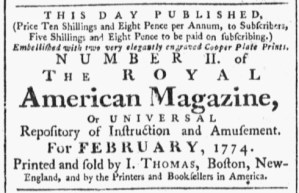
It took time to distribute copies of Isaiah Thomas’s new Royal American Magazine to subscribers beyond Boston. For months, the industrious printer advertised the project in newspapers from New Hampshire to Maryland, calling on prospective subscribers to add their names to the roster and prospective contributors to forward their “LUCUBRATIONS” to include among its contents. Misfortune delayed publication of the first issue. Thomas finally announced that the January 1774 issue was available on February 7. It was not the inaugural issue alone that fell behind schedule. A month later, Thomas informed subscribers that “NUMBER II. Of THE ROYAL American Magazine” was “THIS DAY PUBLISHED” and sold at his printing office and “by the Printers and Booksellers in America.”
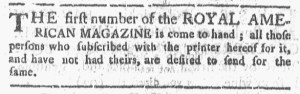
The same day that notice ran in the Massachusetts Gazette and Boston Post-Boy, the Newport Mercury carried a short advertisement about the previous issue: “THE first number of the ROYAL AMERICAN MAGAZINE is come to hand; all those persons who subscribed with the printer hereof for it, and have not had theirs, are desired to send for the same.” It was the first time that an advertisement for the magazine appeared in a newspaper outside of Massachusetts since Thomas took the Royal American Magazine to press. He advertised widely in Boston’s newspapers and the Essex Journal, a newspaper he operated in partnership with Henry-Walter Tinges in Newburyport, but not elsewhere. Solomon Southwick, the printer of the Newport Mercury, became the first of Thomas’s associates to mention the magazine in the public prints after publication commenced.
Subscribers in Boston may have expected to receive the January issue sometime in January and the February issue sometime in February, but subscribers who lived at any distance had no such expectation. Southwick’s notice suggests that some subscribers likely received the January issue sometime in February, but others did not get their hands on it until March. Given the logistics of shipping books, pamphlets, newspapers, and magazines to other cities and towns, subscribers in Connecticut, New York, Pennsylvania, Maryland, and other colonies understood they would experience some delay in receiving their copies of the Royal American Magazine. Subscribers in many places eventually had access to the same content as their counterparts in Boston, but that imagined community of readers consumed the essays and poetry in the new magazine on a staggered schedule.