June 7

What was advertised in a colonial American newspaper 250 years ago today?

Supplement to the Newport Mercury (June 7, 1773).

“A general Assortment of English and India GOODS.”

For the third week in a row, Solomon Southwick, the printer of the Newport Mercury, distributed an advertising supplement because he did not have sufficient space to print all the news and notices submitted to his printing office on Queen Street.  As usual, the standard issue consisted of four pages, created by printing two pages on each side of a broadsheet and then folding it in half.  The supplement consisted of only two pages, one on each side of a smaller sheet … but not simply half a sheet of the paper used for printing the standard issue.

Instead, Southwick conserved his paper supply by resorting to an even smaller sheet.  Rather than accommodating three columns, the smaller sheet allowed for only two columns of the same width.  Southwick left it at that for the supplement that accompanied the May 31, 1773, edition.  For the May 24 and June 7 supplements, however, he managed to find room for a few more advertisements by creating a third column that ran perpendicular to the other two columns.  The printer placed shorter advertisements in this narrow column.

That worked well for the two lines that advised “Choice red CEDAR POSTS to sell, by THOMAS TRIPP” or the three lines about “CASH given for clean LINEN RAGES, coarse or fine, at the PRINTING-OFFICE in Newport.”  John Bours, on the other hand, ran a longer advertisement for a “general Assortment of English and India GOODS … at his shop, the sign of the golden eagle.”  To fit it in the narrow column without breaking down the type and setting it again, Southwick merely divided the advertisement in half and placed the two halves next to each other.  He did the same for a similar advertisement placed by George Lawton and Robert Lawton and his own notice about imported writing paper.  That facilitated reconstituting the advertisements when necessary to appear as usual in columns that had not been rotated when space permitted.

Bours’s advertisement did feature a slight variation on the usual practice.  When it ran in the standard issue on June 14, the printer replaced the smaller font for “GOODS” with a larger font to help attract attention.  The smaller font had been necessary to make the advertisement fit in the narrow column, but the notice received new consideration when space permitted.  Such was the exception rather than the rule when printers squeezed advertisements into what would have otherwise been margins.

Colonial printers often published advertising supplements that made such use of the space available to them.  Southwick and his counterparts in other towns devised a means of serving the advertisers who placed notices and the subscribers who read them while simultaneously minimizing the costs of producing and disseminating their newspapers.
March 10

What was advertised in a colonial American newspaper 250 years ago today?

Mar 10 - 3:10:1767 South-Carolina Gazette and Country Journal Page 6
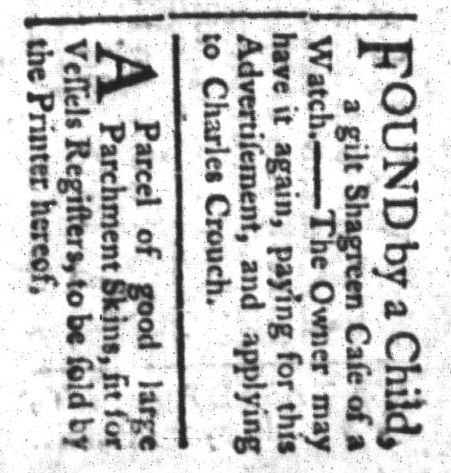
This is the orientation of these advertisements in the Supplement to the South-Carolina Gazette and Country Journal (March 10, 1767).

“A Parcel of good large Parchment Skins, for for Vessels Registers, to be sold by the Printer hereof.”

Advertising supplements were a fairly common feature of newspapers in the 1760s, especially publications printed in the largest American cities. Between news items, commercial notices, and paid announcements of various sorts, printers frequently ran out of space in the standard four-page issue. It made a lot of sense to distribute two-page supplements comprised solely of advertisements since it was advertising, rather than subscription fees, which really paid the bills.

Still, printers had to be careful in allocating resources to the advertising supplements. They had to weight the labor, time, and supplies they would expend against how quickly for frequently they published advertisements. Sometimes printers had more material than would fit in the standard issue but not enough to justify devoting an entire half sheet to a supplement. In such instances, they could opt to print the supplement on smaller sheets.

Mar 10 - South-Carolina Gazette and Country Journal Page 5
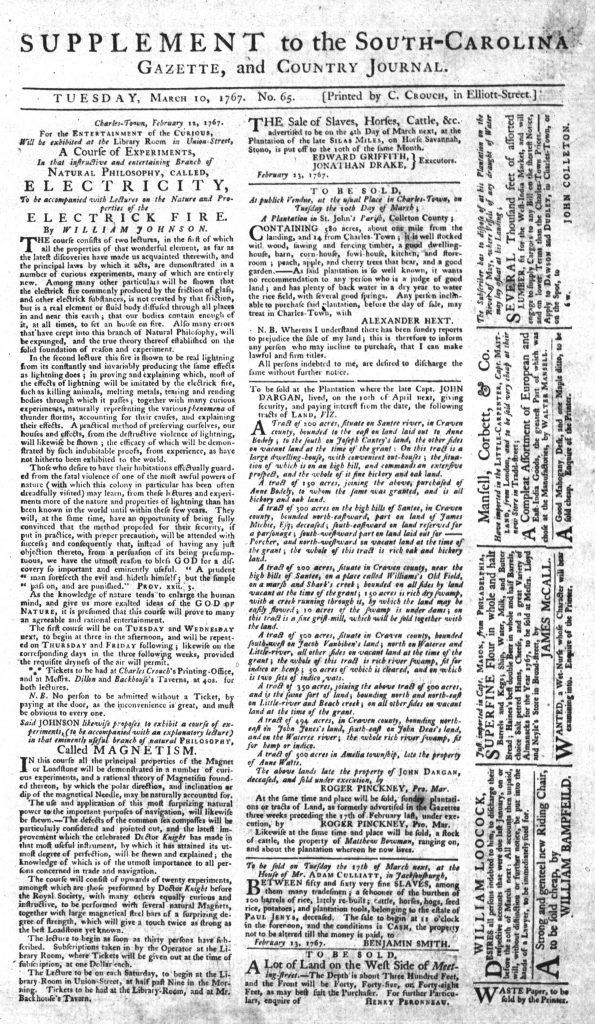
First page of Supplement to the South-Carolina Gazette and Country Journal (March 10, 1767).

Such appears to have been the case with the Supplement to the South-Carolina Gazette and Country Journal from March 10, 1767. It is impossible to say so definitively based solely on digitized images of the newspaper from Accessible Archives. No provider of digital surrogates of eighteenth-century newspapers includes metadata concerning the dimensions of the page or columns relative to individual images. Doing so would be time consuming and prohibitively expensive, resulting in scholars and others having significantly less access to digitized sources at all.

Although I do not have access to original copies of the South-Carolina Gazette and Country Journal from 1767, the layout of the March 10 supplement contains all the indications of a smaller sheet that I have been able to confirm when working between digital surrogates and original copies of other newspapers. The regular issue contains three columns, but the supplement has two columns along with a third column of advertisements rotated to fit in the remaining space. The rotated advertisements are the same width as the others, indicating that type had not been reset, nor would it need to be reset to move any of the advertisements back into future editions of the regular issue.

Mar 10 - South-Carolina Gazette and Country Journal Page 6
Second Page of the Supplement to the South-Carolina Gazette and Country Journal (March 10, 1767).

In this instance, however, Charles Crouch engaged in even greater economy of space than his counterparts who adopted this trick in other newspapers. Rather than provide space between the rotated advertisements in the third column, he squeezed them together in order to fit in very short advertisements. On the front of the supplement, this resulted in a two-line advertisement oriented in a different direction than the others in the third column. On the other side, where he did not have to take space for the masthead into consideration, Crouch found room for two advertisements rotated in the same direction as the others in the additional column.

Charles Crouch worked to fill the March 10 supplement of his newspaper with as much advertising as he could possible fit on its pages. In so doing, he made room to promote products he sold (“WASTE Paper” and “good large Parchment Skins”) that otherwise would not have fit in the regular issue or the supplement.