March 30

GUEST CURATOR:  Mary Aldrich

What was advertised in a colonial newspaper 250 years ago this week?

Mar 30 - 3:27:1766 Massachusetts Gazette
Massachusetts Gazette (March 27, 1766).

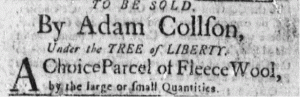
TO BE SOLD, By Adam Collson, Under the TREE of LIBERTY.”

The “TREE of LIBERTY” is a symbol famous to this day for the events that took place under it less than a year before this advertisement. It became a landmark in colonial Boston in the decade before the Revolution. On August 14, 1765, the elm tree near the commons became famous. A gathering of colonists dissatisfied with the Stamp Act hung an effigy of Andrew Oliver, the newly appointed stamp commissioner of Boston. The rebellious political leaders of the day named it the Liberty Tree and during the era of the American Revolution, many protests and demonstrations began or were conducted under it.

By setting up shop under the “TREE of LIBERTY,” Collson let potential customers know that he supported the actions that had taken place there. If others wanted to support those actions as well, they could buy “Fleece Wool” from him under the “TREE of LIBERTY.” Just buying and selling fleece made a political statement in this situation because of the political symbolism attached to this particular tree.

Visit Mapping Revolutionary Boston to learn more about the “TREE of LIBERTY” and other eighteenth-century landmarks.

**********

ADDITIONAL COMMENTARY:  Carl Robert Keyes

Once again, Mary has chosen an advertisement that mobilized politics in the service of marketing consumer goods. Like Monday’s advertisement that indicated Barnabas Clarke’s shop was located “Near Liberty-Bridge,” Adam Collson incorporated recent protests against the Stamp Act into the directions he gave potential customers.

Under the TREE of LIBERTY” offers an explicit political message, but Collson’s wares may have also resonated with colonists angered by the Stamp Act. What would colonists have done with “Fleece Wool” once they purchased it? In order to eventually transform this raw material into textiles (perhaps to substitute for those many colonists refused to import from England), the fleece would have been spun into yarn or thread on a spinning wheel, itself a symbol of industry. The colonists valued their spirit of industriousness as they opposed the oppressive acts of Parliament.

Furthermore, as the imperial crisis developed over the next decade, colonists of various backgrounds found themselves involved in a variety of acts of resistance. Some demonstrated in the streets. Some expressed their political opinions via the choices they made as consumers. Women, barred from formal political participation, took up the American cause by sitting at their spinning wheels and transforming “Fleece Wool” and other raw materials into the thread that was then woven into homespun.

Both yesterday and today Mary selected advertisements that contain layers of meaning not always readily apparent to modern readers but which likely resonated with colonists who were very familiar with the relationship between politics and consumption in the age of the Stamp Act.

March 18

What was advertised in a colonial newspaper 250 years ago this week?

Mar 18 - 3:17:1766 Newport Mercury
Newport Mercury (March 17, 1766).

“The Encouragement of Manufactures in our own Country is of the greatest Advantage.”

Jonathan Wilson did not sell just any “Packing Paper by the Ream.” His paper was “the Manufacture of this Colony.” As colonists continued to oppose the Stamp Act (as of yet unaware that the king would give royal assent to its repeal the day after this advertisement was published, though it would take several more weeks for word to cross the Atlantic), many advertisers imbued the goods they sold with patriotic value. After all, the success of boycotts and nonimportation agreements depended in part on colonists finding alternate means to supply themselves with goods that previously came from Britain.

In case the initial appeal was too subtle to resonate with some readers, Wilson inserted a final sentence about the value of purchasing domestically produced goods: “As the Encouragement of Manufactures in our Country is of the greatest Advantage, the Paper Mill in this Colony, for which Rags are now wanted, will doubtless be chearfully encouraged by the Public.” In so doing, Wilson not only promoted the paper he sold; he also encouraged consumers to considering buying any sort of “Manufactures” originating in the colonies. He mobilized a “Buy American” message for his own goods, but recommended that consumers should “chearfully encourage” similar endeavors.

Advertisements like this one supplemented public debates about the connections between politics and consumer behaviors that over time forced early Americans to clarify their positions on the relationship between Great Britain and the colonies.

March 11

What was advertised in a colonial newspaper 250 years ago this week?

Mar 11 - 3:10:1766 Connecticut Courant
Connecticut Courant (March 10, 1766).

“Just Published … The Necessity of Repealing the American STAMP-ACT.”

Protesting the Stamp Act continued to occupy many American colonists in March 1766. It was certainly a primary concern of the printer of the Connecticut Courant and many of that newspaper’s readers. The Connecticut Courant was a more modest publication than some of its counterparts in larger cities – its four pages featured only two columns rather than three – but it opposed the Stamp Act with the same vigor as many more robust publications.

The first two (of four total) pages of the March 10, 1766, issue were devoted to coverage of the Stamp Act, including a letter from London (dated November 1 and reprinted from the Public Ledger), an extract of another letter from London (dated December 14 and reprinted from a Boston newspaper published February 27), and several shorter reports about the reactions of colonial officials near and far.

Advertisements of any sort did not appear until the third page. Today’s featured advertisement demonstrates that the commercial notices took on a political valence during the Stamp Act crisis. Printers, authors, and other members of the book trades marketed books and pamphlets about “The Necessity of Repealing the American STAMP-ACT.” And this particular advertisement should not be considered an isolated example. It appeared immediately above a similar advertisement for a pamphlet about “THE RIGHTS of the COLONIES TO THE PRIVILEGES Of British SUBJECTS.” The former was published in Boston and the latter in New York.

Mar 11 - Connecticut Courant Third Page 3:10:1766
Third page of the Connecticut Courant (March 10, 1766).

Both appeared in a column headed with an announcement that “THE last Tuesday of this Month (being the 25th Day) there is to be a General Congress of the SONS OF LIBERTY, in this Colony, to meet in Hartford, by their Representatives chosen for that Purpose.” (Was this an advertisement? It appeared alongside other advertisements, but given the printer’s political proclivities it is quire possible he inserted this notice gratis.) News coverage of the Stamp Act continued in the column to the left.

The content of the newspaper provides important context for understanding today’s advertisement. The other items formed a narrative that may have influenced potential customers to purchase one or both of the pamphlets offered for sale.

Boycotts of imported goods certainly gave decisions about which goods to purchase (or not) political valence in the 1760s and 1770s, but advertisements for books and pamphlets defending the “RIGHTS of the COLONIES” encouraged colonists to become readers who were better informed and who could better articulate why the actions of Parliament were so dangerous.

March 8

What was advertised in a colonial newspaper 250 years ago this week?

Mar 8 - 3:7:1766 New-Hampshire Gazette
New-Hampshire Gazette (March 7, 1766).

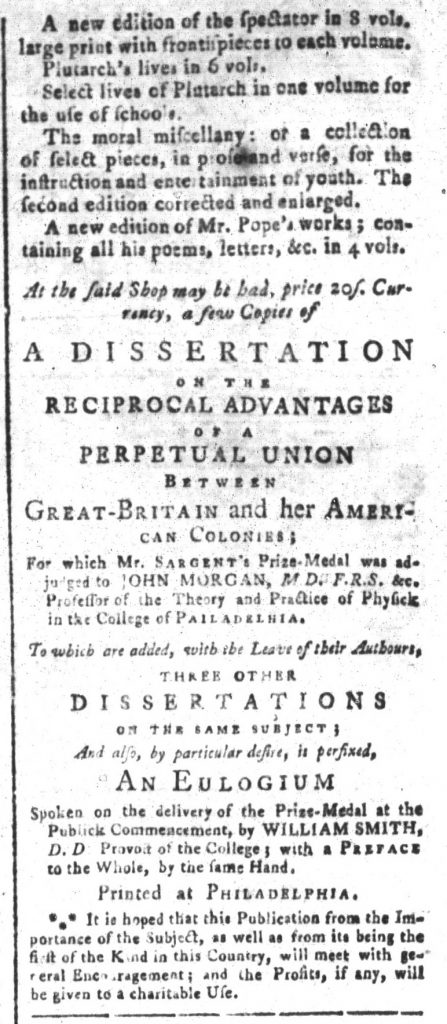
“This masterly Performance merits the closest Attention and Consideration of every true SON OF AMERICA, the Propriety of imposing TAXES on free Subjects.”

Yesterday’s advertisements from the New-Hampshire Gazette testified to the connections between slavery and consumer culture in eighteenth-century America. Slavery was discussed elsewhere on the same page of that issue, though it was slavery of a different sort. The printers inserted several letters forwarded by the “true born Sons of Liberty” concerning the continuing controversy over the Stamp Act. The American protestors were “determined to use there utmost Efforts to prevent even the Appearance of Slavery.” Meanwhile, readers who glanced two columns to the left would have seen the advertisements for “BARBADOS whitest LOAF SUGAR” and “A NEGRO BOY.”

Today’s advertisement appeared on the previous page. It does not include the word “slavery,” but other items published in the same issue demonstrate that many readers consciously linked the Stamp Act and enslavement (even as they may have attempted to eschew associations between sugar and slavery). In American Slavery, American Freedom (1975), Edmund S. Morgan explored the paradox of the founding of the American nation: the rhetoric of freedom and equality during the Revolution and after occurred with the enslavement of black laborers as its backdrop throughout the colonial era and beyond. The liberty of white Americans was contingent in many ways on the enslavement of Africans and African Americans, a distressing contradiction.

Today’s advertisement is certainly evidence that advertising and consumer culture took on a political valence in the years of the imperial crisis, but a story of patriotic advertising would be an incomplete story. Just as yesterday’s advertisements for sugar and an enslaved boy were bound together, the stories of Americans advocating (and eventually fighting) for their liberties and simultaneously continuing to practice slavery cannot be separated from each other.

January 30

What was advertised in a colonial newspaper 250 years ago today?

Jan 30 - 1:30:1766 Massachusetts Gazette
Massachusetts Gazette (January 30, 1766)

“This masterly Performance merits the closest Attention and Consideration of every true SON of AMERICA the Propriety of imposing TAXES on free Subjects without their Consent.”

The Stamp Act crisis and protests spilled over into advertisements for consumer goods in colonial newspapers.  In late 1765 and early 1766 newspapers were filled with editorials opposing the Stamp Act as well as news items about debates and protests reprinted from far and wide.  Nonimportation agreements altered consumer culture, but, as this advertisement and others indicate, the imperial crisis transformed the meaning of consumption in other ways as well.

Printers and booksellers might be considered opportunistic for taking advantage of a political crisis to market and sell newspapers, books, and pamphlets, but believing in a cause and being entrepreneurial were not mutually exclusive.  Publications that considered “the Propriety of imposing Taxes in the British Colonies” based on “Knowledge of the Laws of our Mother-Country” reflected many printers’  views and likely shaped the political attitudes of many colonists, prompting them to further consider resistance efforts and, eventually, revolution.

Even if colonists did not buy and read such any particular publication, encountering  advertisements like this one yielded a certain consistency throughout the various sections of the newspaper.  Commerce and consumption could not be separated from politics in an easily classified manner.

The Story So Far

It may seem strange for the first entry for this blog to be titled “The Story So Far,” but that title recognizes that The Adverts 250 Project began elsewhere. Since October 24, 2015, it has existed exclusively as part of my Twitter feed (@TradeCardCarl for those who would like to visit and follow me there or #Adverts250 for just the featured advertisements). Good advice from friends and colleagues, however, prompted me to seek out a more permanent home for this digital humanities and public history project, one that will make the advertisements and commentary more easily accessible over time.

I plan to continue a daily update, here and on Twitter, featuring both an advertisement published in a colonial American newspaper 250 years ago and brief commentary. This blog will make possible additional content, including periodic reflections on pursuing this project. I am interested in exploring advertising and consumer culture in eighteenth-century America, but I would also like to discuss the process of conducting the research and making it available to other audiences. Innumerable interesting and informative advertisements were published in American newspapers and other media during the eighteenth century, but only a fraction of them are available to be featured as part of this project. My supplementary posts will explore the sources currently available, noting how archiving and digitization processes have sometimes limited access even while opening it to a greater degree than at any time in the past.

In the future I also plan to feature contributions from guests, especially undergraduates enrolled in my Public History, Colonial America, and Revolutionary America courses at Assumption College in Worcester, Massachusetts.

I have a lot I want to accomplish. Eighteenth-century advertisements have so many stories to tell about the people and culture of early America. I have also generated my own stories throughout the research process. The first story I would like to share gives credit to those who have inspired me and reveals the genesis of this project.

This project began as a whim. I had no idea what it might become when I featured the first advertisement.

During the first two months of the Fall 2015 semester I had been following The Stamp Act at 250 (@KillingStamp), a group project for Joseph M. Adelman’s History 304 – American Revolution course at Framingham State University. As Adelman noted in his instructions to his students, “This summer and fall marks the 250th anniversary of the protests against the Stamp Act, one of the first major acts of resistance during the imperial crisis that resulted in the American Revolution. During this project, the entire class will jointly produce a Twitter feed to commemorate the protests.”

Using primary sources previously digitized and made available online, especially America’s Historical Newspapers (offered by Readex), Adelman’s students tweeted the debates and protests against the Stamp Act in real time, but 250 years later. Throughout the fall, followers “witnessed” how events in the colonies unfolded as colonists became increasingly discontent with the imminent implementation of the Stamp Act.

I was relatively new to Twitter at the time, having first established an account a few months earlier when I participated in the American Antiquarian Society’s Digital Antiquarian Conference and Workshop. I figured that if I was going to learn that much about digital humanities and their public history applications that I should at least have a Twitter handle. Still, I found Twitter to be an acquired taste. I did not tweet much until I began the Adverts 250 Project.

Inspired in part by the work being done by Adelman’s students, one Saturday afternoon I decided to tweet an image of an advertisement that had appeared in a colonial newspaper exactly 250 years ago that day. I chose an advertisement from “Wm Murray At the Sign of General WOLFE” for several reasons. Its typography was interesting, with “William” shortened to “Wm” and in a much larger font than anything else in the advertisement, as well as “WOLFE” in all capitals. The shop’s location “At the Sign of General WOLFE” evoked visual images of the streets of eighteenth-century Boston. Murray made some (but not all) of the standard appeals in eighteenth-century advertising when he noted that he stocked “AN Assortment of English Goods … which he will sell cheaper than can be had at any other Shop in Town.” In the midst of the consumer revolution, he offered potential customers a choice of many goods at low prices.

Oct 24 - 10:24:1765 Massachusetts Gazette
Massachusetts Gazette (October 24, 1765)

He also made an appeal to patriotism and a sense of belonging in the nation. Here context was especially important. I have previously published work on advertising’s role in creating an American identity during the era of the American Revolution and into the early nineteenth century. That work, however, has focused almost exclusively on American patriotism as distinctive and intentionally separate from former connections to the British Empire. In 1765, however, that rupture had not yet occurred. For colonists, a sense of patriotism and nationhood was imbedded in their identity as part of the British Empire. Major General James Wolfe, a British army officer, was remembered chiefly for his victory over the French during the Battle of Quebec in 1759. Wounded during the battle, Wolfe died on the Plains of Abraham outside the walled city, making him a hero and martyr for the British Empire in the wake of Britain’s decisive victory in this battle and its repercussions. French forces in North America came under increasing pressure. Eventually the French were ejected from North America at the conclusion of the war.

Death of General Wolfe
The Death of General Wolfe (Benjamin West, 1770)

I understood why Murray chose “the Sign of General WOLFE” at first glance, but the day after I tweeted the advertisement I realized that perhaps it needed a little more explanation for others less familiar with the history of the Atlantic World in the eighteenth century. Twitter does not allow for such extensive commentary, but I was able to provide an overview in 140 characters: “Invoking hero of British Empire to market imported English goods: such shop signs replaced with symbols of American patriotism in 1780s.”

An image of an advertisement accompanied by brief commentary: the Adverts 250 Project was born!