December 16

What was advertised in a revolutionary American newspaper 250 years ago today?

Pennsylvania Evening Post (December 16, 1775).

“A TREATISE … on the treatment of wounds and fractures, with a short APPENDIX on camp and military hospitals.”

Even before the battles at Lexington and Concord, advertisements for military manuals appeared in colonial newspapers.  The number of manuals available to the public and the frequency of the advertisements both increased following the outbreak of hostilities.  Yet not all the manuals on the market addressed military discipline and maneuvers.  In the December 16, 1775, edition of the Pennsylvania Evening Post, George Weed promoted “A TREATISE, entitled plain and concise practical remarks on the treatment of wounds and fractures, with a short APPENDIX on camp and military hospitals, principally designed for the use of young military surgeons, in North-America.  By JOHN JONES, M.D. Professor of Surgery, King’s College, New-York.”  As was often the case when advertising books, Weed did not generate advertising copy but instead used the lengthy title of the book to promote it in the public prints.  He likely sold copies of an edition printed by John Holt in New York.  The treatise apparently met with such success that Robert Bell, a prominent printer and bookseller in Philadelphia, decided to publish another edition in 1776.
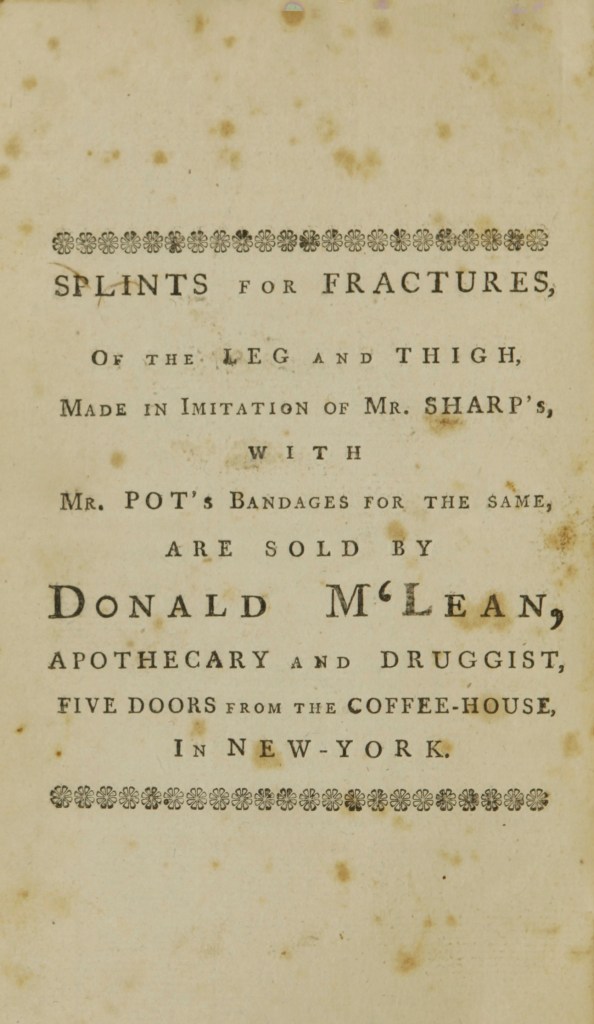
Advertisement in John Jones, Plain and Concise Practical Remarks on the Treatment of Wounds and Fractures (New York: John Holt, 1775), 96.

The book itself became a vehicle for distributing additional advertising.  Printers and booksellers frequently inserted their own advertisements in books, pamphlets, and almanacs, yet that was not the case with this medical treatise.  Instead, it featured an advertisement from a medical practitioner that resonated with the contents of the book.  After the treatise and appendix, a full-page advertisement informed readers that “SPLINTS FOR FRACTURES, OF THE LEG AND THIGH, MADE IN IMMITATION OF MR. SHARP’S, WITH MR. POT’S BANDAGES FOR THE SAME, ARE SOLD BY DONALD M ‘LEAN, APOTHECARY AND DRUGGIST, FIVE DOORS FROM THE COFFEE-HOUSE, IN NEW YORK.”  Two lines of fleurettes, one above and below, adorned the advertisement.  Today, readers expect to encounter promotions for books and related products incorporated into books by publishers, yet that marketing strategy was not invented by the modern publishing industry.  Instead, it dates to the eighteenth century and earlier as printers, booksellers, and other entrepreneurs devised many kinds of advertising media.  The Adverts 250 Project focused primarily on advertisements that appeared in eighteenth-century newspapers for several reasons, including their abundance and frequency, yet early Americans encountered many forms of advertising, including broadsides, billheads, catalogs, trade cards, and advertisements inserted in books.
December 12

What was advertised in a revolutionary American newspaper 250 years ago today?

Pennsylvania Evening Post (December 12, 1775).

“HARE’s and Co. best DRAUGHT and BOTTLED AMERICAN PORTER.”

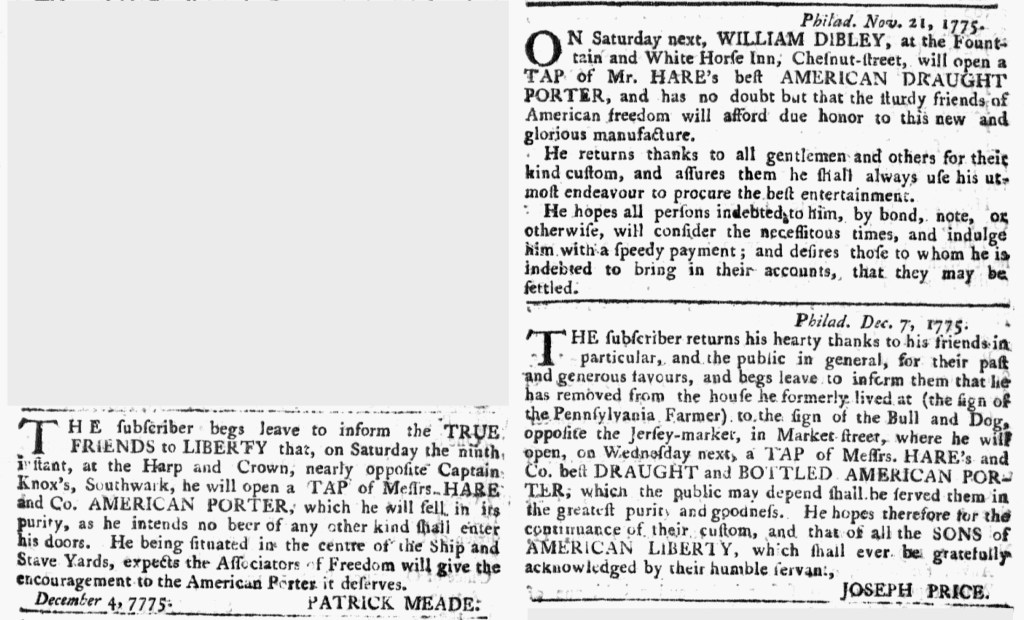
In December 1775, Philadelphia tavernkeeper Joseph Price ran an advertisement to express his gratitude to “his friends in particular, and the public in general,” while simultaneously alerting them that he had moved to a new location.  They could now find him at “the sign of the Bull and Dog” on Market Street rather than at “the sign of the Pennsylvania Farmer.”  To entice readers to visit his new location, he announced that “he will open … a TAP of Messrs. HARE’s and Co. best DRAUGHT and BOTTLED AMERICAN PORTER, which the public may depend shall be served them in the greatest purity and goodness.”

Price was not the only tavernkeeper promoting Hare and Company’s American porter, nor was he the only one associating that beer with support for the American cause.  He proclaimed that he “hopes … all the SONS of AMERICAN LIBERTY” would affirm their commitment by choosing Hare and Company’s American porter.  Price joined two other tavernkeepers who already promoted that brew.  All three of them placed advertisements in the December 12, 1775, edition of the Pennsylvania Evening Post.  William Dibley’s advertisement ran immediately above Price’s notice.  He confidently declared that he “has no doubt but that the sturdy friends of American freedom will afford due honor to this new and glorious manufacture.”  Immediately to the left of Price’s advertisement, Patrick Meade stated that he “expects the Associators of Freedom will give the encouragement to the American Porter it deserves.”  Readers who did not know much about Hare and Company’s American porter encountered endorsement after endorsement, encouraging them to take note of a beer that local tavernkeepers promoted over any others.  Tavernkeepers usually did not mention which brewers supplied their beer, making these advertisements even more noteworthy.  For their part, Hare and Company did not need to do any advertising of their own when they had such eager advocates for their American porter encouraging the public to demonstrate their political principles through the choices they made when they placed their orders at taverns in Philadelphia and nearby Southwark.

December 10

What was advertised in a revolutionary American newspaper 250 years ago this week?

Pennsylvania Evening Post (December 9, 1775).

“JUST published, and may be had of the printer hereof, JOURNAL of the PROCEEDINGS of the CONGRESS.”

Like other printers, Benjamin Towne sold books to supplement the revenue he generated from newspaper subscriptions, advertisements, and job printing.  In a brief advertisement in the December 9, 1775, edition of the Pennsylvania Evening Post he announced, “JUST published, and may be had of the printer hereof, JOURNAL of the PROCEEDINGS of the CONGRESS, held at Philadelphia May 10, 1775.  Also that new and interesting work, of great merit and integrity, BURGH’s POLITICAL DISQUISITIONS.”

Three days earlier, on a Wednesday, William Bradford and Thomas Bradford, the printers of the Pennsylvania Journal, advertised that they would publish and sell the journal of the proceedings of the Second Continental Congress from May through August starting “On FRIDAY Next.”  On Saturday, Towne became the first bookseller other than the Bradfords to announce that he had copies for sale.  In this instance, as in so many other advertisements for books and pamphlets that appeared in early American newspapers, the phrases “JUST published” and “may be had of the printer hereof” did not both apply to the printer who placed the notice.  Instead, “JUST published” merely informed readers that a work was now available.  Such was the case for the journal of the proceedings of the Second Continental Congress as well as for the American edition of James Burgh’s Political Disquisitions, published by Robert Bell.  Towne did not take up Bell’s invitation to “All the Printers on the continent to insert “the whole” of a lengthy advertisement with an address from “The American Editor to his Countrymen” in his newspaper even though Bell promised to pay for such consideration with cash or books.  Towne may have expected that prospective customers were already familiar with Bell’s marketing efforts from other newspapers printed in Philadelphia.  Towne likely sold other books at his printing office, yet he did not choose to include any others in his advertisement.  Instead, the printer opted to promote books that resonated with current events, believing that they would draw customers to his shop.  He could hawk other books once readers arrived to examine the volumes that he advertised.

December 9

What was advertised in a revolutionary American newspaper 250 years ago today?

Pennsylvania Evening Post (December 9, 1775).

“He will open a TAP of Messrs. HARE’s and Co. AMERICAN PORTER.”

Patrick Meade aimed to create some anticipation among prospective patrons who might visit his tavern, the Harp and Crown, in Southwark on the outskirts of Philadelphia.  In an advertisement that first appeared in the Pennsylvania Evening Post on December 5, 1775, he announced that “on Saturday the ninth … he will open a TAP of Messrs. HARE and Co. AMERICAN PORTER.”  Hare and Company had been building a reputation for their brew.  Two weeks earlier, William Dibley, the proprietor of the Fountain and White Horse Inn in Philadelphia, advertised that he “will open a TAP of Mr. HARE’s best AMERICAN DRAUGHT PORTER.”  Meade’s advertisement ran again on December 9, the day he tapped the celebrated porter.

Meade and Dibley deployed similar marketing strategies to entice “gentlemen and others” to visit their establishments and drink Hare and Company’s porter.  Dibley proclaimed that he “has no doubt but that the sturdy friends of American freedom will afford due honor to this new and glorious manufacture.”  Meade addressed “the TRUE FRIENDS to LIBERTY” and emphasized his location, “situated in the center of the Ship and Stave Yards,” and declared that he “expects the Associators of Freedom will give the encouragement to the American Porter it deserves.”  Meade went all in on promoting Hare and Company’s porter, asserting that “he intends no beer of any other kind shall enter his doors,” especially not porters and other beers imported from England.  The tavernkeeper made a porter brewed in America the exclusive choice for his patron, likely expecting that the lack of other options mattered less to prospective patrons when they gather to drink, socialize, and discuss politics and current events than demonstrating their patriotism by consuming a porter brewed in America.  Meade stated that he would sell Hare and Company’s “AMERICAN PORTER … in its purity,” signaling the quality of the beverage.  Meade issued both an invitation and a challenge: who could desire any beer other than one brewed in America in support of the American cause?

November 18

What was advertised in a revolutionary American newspaper 250 years ago today?

Pennsylvania Evening Post (November 18, 1775).

“The Provedore to the Sentimentalists will exhibit food for the mind.”

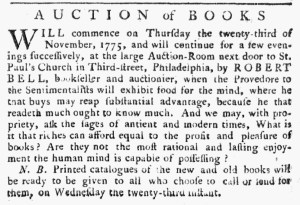
Readers of the November 18, 1775, edition of the Pennsylvania Evening Post encountered two advertisements promoting an “AUCTION of BOOKS,” one placed by Charles Mouse, “auctionier,” and the other by Robert Bell, “bookseller and auctionier.”  Mouse operated a “vendue store,” a combination of an auction house and a flea market, where he had a “large and choice collection of the most useful and entertaining [books].”  He invited those who had books to sell and “will[ing] to take their chance by auction” to deliver them to his vendue store on Second Street in Philadelphia.  The auctions would begin “precisely at six each evening” and “continue till the whole are sold.”  Mouse provided a straightforward account of this endeavor.

Robert Bell, on the other hand, crafted a more elaborate advertisement.  One of the most prominent American booksellers in the second half of the eighteenth century, Bell already established a reputation throughout the colonies by the time he advertised an auction “at the large Auction-Room next door to St. Paul’s Church in Third-street, Philadelphia,” scheduled for November 23.  He colorfully referred to himself in the third person as “the Provedore to the Sentimentalists” who would “exhibit food for the mind” to bidders and curious observers.  Those who made purchases, Bell declared, “may reap substantial advantage, because he that readeth much ought to know much.”  He further mused that “we may, with propriety, ask the sages of antient and modern times, What is it that riches can afford equal to the profit and pleasure of books?  Are they not the most rational and lasting enjoyment the human mind is capable of possessing?”  Mouse’s description of his “large and choice collection of the most useful and entertaining [books]” paled in comparison to the appeals that Bell made to readers.

Bell deployed another strategy to entice prospective bidders.  In a nota bene, he informed them that “[p]rinted catalogues of the new and old books will be ready to be given to all who choose to call or send for them.”  Those catalogues gave a preview of the sale and allowed Bell to disseminate information about the books up for bids more widely.  Those who visited his “Auction-Room” to collect a catalogue likely had an opportunity to browse the books, yet they could take their time going through the entries in the catalogue in the comfort of their own homes or offices or even at a coffeehouse with friends.  Those who sent for catalogues enjoyed the same benefit.  By distributing catalogs, Bell encouraged interest and prompted readers to imagine themselves bidding on the books they selected in advance.  He may have believed that prospective bidders were more likely to bid higher prices if they had spent time with the catalogue in advance and, as a result, became more committed to acquiring the books that interested them.

November 16

What was advertised in a revolutionary American newspaper 250 years ago today?

Pennsylvania Evening Post (November 16, 1775).

“The Managers of the American Manufactory … wish to employ every good spinner that can apply.”

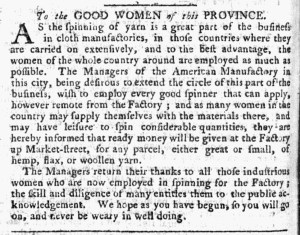
The proprietors of the American Manufactory in Philadelphia periodically took to the public prints to encourage the public to support their enterprise.  In the March 1775, they called a general meeting at Carpenters’ Hall, the site where the First Continental Congress held its meetings the previous fall.  They invited prospective investors to attend as well as sign subscription papers already circulating.  A month later, the proprietors ran a brief advertisement, that one seeking both materials (“A Quantity of WOOL, COTTON, FLAX, and HEMP”) and workers “(a number of spinners and flax dressers”).  That notice happened to appear in the Pennsylvania Journal on April 19, 1775, the day of the battles at Lexington and Concord, though it would take a while for residents of Philadelphia to learn about the outbreak of hostilities near Boston.  The mission of the American Manufactory to produce an alternative to imported textiles became even more urgent.  In August, the proprietors once again sought workers, publishing an address “To the SPINNERS in thisCITY and the SUBURBS.”  They offered women an opportunity to participate in politics and “help to save the state from ruin.”

In November 1775, the proprietors or “Managers of the American Manufactory” made another appeal “To the GOOD WOMEN of this PROVINCE.”  They explained that “the spinning of year is a great part of the business in cloth manufactories” and “in those countries where they are carried on extensively, and to the best advantage, the women of the whole country are employed as much as possible.”  Having already engaged women “in this CITY and the SUBURBS” who responded to their previous advertisement and apparently needing even more yarn to make into textiles, the managers found themselves “desirous to extend the circle … to employ every good spinner than can apply, however remote from the Factory.”  They believed that women in the countryside “may supply themselves with the materials there” and had “leisure to spin considerable quantities.”  They may have been right on the first count, but perhaps overestimated how many other responsibilities wives, mothers, sisters, and daughters had in their households.  For those who made the time, the managers offered “ready money … for any parcel, either great or small, of hemp, flax, or woollen yarn.”

The managers also lauded the contributions of “those industrious women who are now employed in spinning for the Factory,” declaring that “the skill and diligence of many entitles them to the public acknowledgement.”  They served the American cause in their own way according to their own abilities, just as the delegates to the Second Continental Congress did and just as the soldiers and officers participating in the siege of Boston did.  “We hope as you have begun,” the managers encouraged, “so you will go on, and never be weary in well doing.”

November 7

What was advertised in a revolutionary American newspaper 250 years ago today?

Pennsylvania Evening Post (November 7, 1775).

“MAPS … Montreal with all its fortifications.  The city of Quebec.”

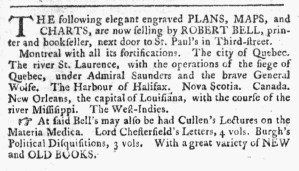
Robert Bell, one of the most prominent American booksellers of the eighteenth century, also sold “PLANS, MAPS, and CHARTS” at his shop in Philadelphia.  In an advertisement in the November 7, 1775, edition of the Pennsylvania Evening Post, he promoted maps depicting “Montreal with all its fortifications.  The city of Quebec.  The river St. Laurence, with the operations of the siege of Quebec, under Admiral Saunders and the brave General Wolfe.  The Harbour of Halifax.  Nova Scotia.  Canada.  New Orleans, the capital of Louisiana, with the course of the river Mississippi.  [And] The West-Indies.”

Bell moved from north to south, generally, in listing the places depicted on the maps and charts that he stocked and sold, though he seemingly made a deliberate decision to list Montreal and Quebec before Halifax.  Current events likely influenced that choice.  For its first major military initiative, the Continental Army launched an invasion of Quebec in hopes of capturing the province and convincing its inhabitants to join the American cause.  That territory had been claimed by the French Empire for centuries, but only recently became part of the British Empire as part of the settlement that brought the Seven Years War to an end in 1763.  The Americans suspected that French speakers in Quebec had little loyalty to the British.

Two expeditions conducted a dual-pronged attack on the province.  In late August, an expedition authorized by the Second Continental Congress and commanded by General Richard Montgomery departed Fort Ticonderoga in New York, headed to Montreal.  Colonel Benedict Arnold, disappointed at being passed over to lead that expedition, convinced General George Washington to send another expedition to Quebec City.  Under Arnold’s command, that expedition departed Newburyport, Massachusetts, and made a harrowing journey up the Kennebec River.

At the time that Bell ran his advertisement, Montgomery’s expedition approached Montreal and Arnold’s expedition approached Quebec, though it would take some time for news to arrive in Philadelphia for readers of the Pennsylvania Evening Post.  Yet those readers did know that those expeditions were underway and that Montgomery began a siege of the town and fort of Saint-Jean in September.  Bell believed that some prospective customers were already interested in maps and plans of Montral and Quebec City and that he could incite demand among others by informing them of the items available at his shop.  The maps he sold supplement the news that colonizers read in the public prints.

November 4

What was advertised in a revolutionary American newspaper 250 years ago today?

Supplement to the Pennsylvania Evening Post (November 4, 1775).

“Those gentlemen who have taken subscriptions … are requested to return the lists speedily.”

A notice in the Supplement to the Pennsylvania Evening Post for November 4, 1775, advised that “THOSE gentlemen who intend to subscribe for HANSON’s EVOLUTIONS, and have not sent in their names, are requested to be speedy in forwarding them.”  Thomas Hanson, “Adjutant to the 2d Battalion” and author of the work, expected that the readers he addressed knew that he referred to The Prussian Evolutions in Actual Engagements; Both in Platoons, Sub, and Grand-Divisions; Explaining, all the Different Evolutions, and Manoeuvres, in Firing, Standing, Advancing, and Retreating, Which Were Exhibitted before His Present Majesty, May 8, 1769; and before John Duke of Argyle , on the Links, near Edenburgh, in 1771; with Some Additions, Since that Time, Explained with Thirty Folio Copper-Plates; To Which Is Added, the Prussian Manual Exercise; Also the Theory and Practices of Gunnery.  To include the entire title of the book would have doubled the length of the advertisement!  An advertisement published in July had included most of the title as a means of inciting interest among prospective subscribers.

Hanson had been marketing the book since early May, apparently embarking on the project almost as soon as residents of Philadelphia learned of the battles at Lexington and Concord that took place on April 19.  When he ran the newspaper advertisement in July, he anticipated that the “said work will be completed in three or four weeks from this date,” but it took longer than expected since more than three months later he ran a new advertisement that indicated the “first edition” had not yet been printed.  Subscribers needed to submit their names quickly, Hanson asserted, or else their names would not appear in the subscription list incorporated into the book with the other content.  That subscription list eventually filled five pages and included prominent military officers, such as “His Excellency George Washington” and “His Excellency Philip Schuyler,” and members of the Second Continental Congress, such as “The Honourable Benjamin Franklin” and “The Hon. John Hancock.”  Peyton Randolph also appeared among the list of subscribers, though he died before Hanson published the book.  In his newest advertisement, he once again instructed prospective subscribers to submit their names because “otherwise a list of them cannot be printed.”

In the earlier advertisement, Hanson listed about a dozen local subscription agents who collected orders, including merchants and printers.  This time, he told prospective subscribers that they could submit their names directly to him or “to the bar of the London Coffee-house,” a popular place for gathering to socialize, conduct business, and discuss politics.  Hanson did acknowledge those “gentlemen who have taken subscriptions” and requested that they “return the lists speedily” so he could compile them for publication.  It seemed to be the last chance to submit orders before the book was published.  The title page did not include a date, but historians believe it was printed in late 1775.

October 24

What was advertised in a revolutionary American newspaper 250 years ago today?

Pennsylvania Evening Post (October 25, 1775).

“THE AMERICAN GLASS STORE is removed from Second-street.”

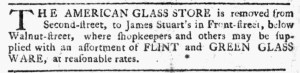
The advertisement consisted of only five lines in the October 24, 1775, edition of the Pennsylvania Evening Post, yet it spoke volumes about the current events.  “THE AMERICAN GLASS STORE,” the notice informed the public, “is removed from Second-street, to James Stuart’s in Front-street, below Walnut-street, where shopkeepers and others may be supplied with an assortment of FLINT and GREEN GLASS WARE, at reasonable rates.”  It was one of many advertisements that presented opportunities for colonizers to “Buy American” during the imperial crisis that eventually became a war for independence.

On several occasions, supporters of the American cause participated in boycotts in hopes of using their participation in the marketplace as leverage to achieve political ends.  They organized nonimportation agreements in response to the Stamp Act in 1765 and in response to the duties levied on certain imported goods, including glass, in the Townshend Acts in the late 1760s.  Simultaneously, they called for “domestic manufactures” or goods produced in the colonies as alternatives to imported wares.  In August 1769, Richard Wistar advertised products from his “GLASS-WORKS,” items “of American manufactory” produced in Pennsylvania, “consequently clear of the duties the Americans so justly complain of.”  The most extensive and coordinated boycott, the Continental Association devised by the First Continental Congress in response to the Coercive Acts, went into effect on December 1, 1774.  Within a week, the “Proprietors of the GLASS HOUSE near this city,” Philadelphia, advertised “White and Green Glass Ware; Such as are usually imported from Great-Britain.”  The proprietors accepted orders from “store-keepers and others, both of town and country.”  As the imperial crisis intensified, savvy entrepreneurs opened an “AMERICAN GLASS STORE” in Philadelphia, an establishment that specialized in glassware produced locally.  The Continental Association specified that colonizers “will, in our several Stations, encourage Frugality, Economy, and Industry; and promote Agriculture, Arts, and the Manufactures of this Country.”  Local producers of glassware delivered, but they needed retailers and consumers to do their part as well.  The brief advertisement in the Pennsylvania Evening Post let shopkeepers and other customers, all of them very much aware of the events of the last decade, know where they could express their political principles by purchasing American glassware.

September 8

What was advertised in a revolutionary American newspaper 250 years ago today?

Pennsylvania Evening Post Extraordinary (September 8, 1775).

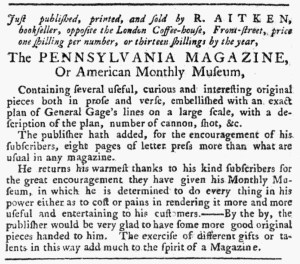
“The publisher would be very glad to have some more good original pieces handed to him.”

When Joseph Greenleaf ceased publication of the Royal American Magazine just after the battles at Lexington and Concord, Robert Aitken’s Pennsylvania Magazine, Or American Monthly Museum became the only magazine published in the American colonies.  Circumstances in Boston prevented Greenleaf from continuing production of his magazine, acquired from its founder, Isaiah Thomas, the previous summer.  Aitken had a more advantageous situation in Philadelphia.

Yet events unfolding in Massachusetts loomed large for Aitken and readers of the Pennsylvania Magazine.  When Samuel Loudon, a bookseller in New York, advertised subscriptions for the magazine in August 1775, he noted that the most recent issue came with a bonus item, a “new and correct Plan of the TOWN of BOSTON, and PROVINCIAL CAMP.”  Aitken highlighted coverage of the siege of Boston and the threat posed by British troops in his own advertisements.  In early September, he informed the public that the contents of the most recent issue included “several useful, curious and interesting original pieces both in prose and verse, embellished with an exact plan of General Gage’s lines on a large scale, with a description of the plan, number of cannon, shot, &c.”  When it came to disseminating news about the Continental Army facing off against British forces during the first months of the Revolutionary War, the Pennsylvania Magazine supplemented coverage in newspapers.

While Aitken certainly welcomed any accounts of current events in Massachusetts, he aimed to compile an array of “useful, curious and interesting” content for his readers.  To that end, he proclaimed that he “would be very glad to have some more good original pieces handed to him.”  During his time as publisher of the Royal American America, Thomas similarly ran advertisements seeking submissions.  He solicited “LUCUBRATIONS,” requesting that “Gentlemen” send them “with all speed to his Printing office.”  Aitken did not make his request solely of men, perhaps recognizing that genteel women participated in belles lettres literary circles as both readers and writers.  Women used pseudonyms, often classical allusions, in those circles.  They could do the same when sending pieces for the magazine.  “The exercise of different gifts or talents,” Aitken declared, “add much to the spirit of a Magazine.”  Like Thomas, he engaged in an eighteenth-century version of crowdsourcing to generate content for his magazine.