April 9

What was advertised in a revolutionary American newspaper 250 years ago today?
Pennsylvania Evening Post (April 9, 1776).

“Making application to BENJAMIN CROFTS, recruiting Serjeant in Capt. LLOYD’s company.”

A recruiting notice ran in the April 9, 1776, edition of the Pennsylvania Evening Post.  It called on “ALL able-bodied freemen, willing to enter into the Provincial service, in the battalion of MUSQUETRY now raising for the immediate defence of this province.”  It was not the only news of that sort that appeared in that issue.  In the column to the left of that advertisement, a news update informed readers that “[a]t a meeting of the battalion of riflemen held yesterday at Carpenters-hall in this city, the following officers were chosen by ballot, viz. Timothy Matlack, Esq; Colonel – Daniel Clymer, Esq; Lieutenant-Colonel – Lawrence Herbert, First Major – George Miller, Second Major.”  Both news articles and advertisements relayed information about the companies forming as the war that started at Lexington and Concord nearly a year earlier continued and moved into a new phase following the British evacuation of Boston in the middle of March.

Those who enlisted in the “battalion of MUSQUETRY” would receive one month’s pay in advance, amounting to “Five Dollars per man.”  They would also “enter into present good quarters, with an allowance of Ten Shillings per week to each for subsistence.”  The notice instructed “able-bodied freemen” interested in enlisting to “mak[e] application to BENJAMIN CROFTS, recruiting Serjeant in Capt. LLOYD’s company, at said Croft’s quarters, the sign of the Britannia, in Front-street.”  That “the sign of the Britannia,” the personification of the British Empire, marked the location for recruits to enlist to defend the colony against British troops was an interesting juxtaposition.  When the war started, the colonies desired a redress of their grievance by Parliament.  In April 1776, they had not yet declared independence, though public opinion seemed to be moving in that direction rather than continuing to seek reforms within the imperial system.  In an extract of “a letter from a gentleman in Virginia to his friend” in Philadelphia immediately to the left of the recruiting notice, the correspondent stated, “I have read COMMON SENSE with much pleasure.  …  He has made many converts here.  Indeed every man of sense and candor, with whom I have had an opportunity of conversing, with whom I have had an opportunity of conversing, acknowledges the necessity of setting up for ourselves, having already tried in vain every reasonable mode of accommodation.”  Symbols of British identity, such as “the sign of the Britannia,” were part of everyday life in the colonies, but they did not hold the same power as they did throughout most of the eighteenth century.  For many colonizers, they lost their meaning.  For “able-bodied freemen, willing to enter into the Provincial service,” Britannia merely marked the location of the recruiting office.  The sign was no longer an expression of pride in being part of the British Empire.

April 2

What was advertised in a revolutionary American newspaper 250 years ago today?

Pennsylvania Evening Post (April 2, 1776).

“HYNS TAYLOR, UPHOLSTERER, … AMELIA TAYLORS, MILANER and MANTUA MAKER.”

When Hyns Taylor, an upholsterer, relocated from London to Philadelphia, he introduced himself to prospective customers via an advertisement in the Pennsylvania Evening Post in the spring of 1776.  Like other artisans who migrated from the largest and most cosmopolitan city in the empire to the colonies, he encouraged consumers to associate sophistication with his prior experience.  Rather than merely stating that he was “from London,” as many did in their advertisements, he instead specified that he was “late from Saint James’s, London,” apparently believing that readers recognized the cachet of that address.  He also emphasized that he upholstered “all kind of furniture in the newest fashion,” including “drapery, Venetian, Gothic, canopy, four-post and couch beds.”  Even though the colonies were at odds with the empire, many colonizers even calling for independence as the anniversary of the battles at Lexington and Concord approached, they still looked to London for that “newest fashion,” yet Taylor also took current events into account by noting that he also worked on “field and camp beds” with “all sorts of mattresses.”

Members of Taylor’s household may have assisted him in the upholstery shop, yet Amelia Taylor, most likely his wife, but perhaps a daughter or other female relation, pursued her own enterprise as a “MILANER and MANTUA MAKER.”  Hyns and Amelia devised a join advertisement.  He received top billing in the first paragraph, while the second paragraph informed prospective customers that she “makes up all sorts of milanery goods,” such as “child-bed linen, childrens robes, jams, frocks, vests and tunics, gentlemens shirts, stocks, and all kinds of needlework.”  She emphasized her skill, stating that she did her work “in the very neatest manner,” though the Taylors likely intended for readers to note her origins “from Saint James’s, London,” when they considered engaging her services.  Although Amelia appeared second in the advertisement, her name and occupation in capital letters received the same treatment as Hyns’s name and occupation.  Only the drop cap, the large letter “H” that began the advertisement, distinguished his name from hers.  That may have been by their own design when they composed the copy or it may have been a decision made by the compositor when setting the type.  Either way, it signaled a partnership in which both Hyns and Amelia contributed to the livelihood of the Taylor household.

March 30

What was advertised in a revolutionary American newspaper 250 years ago today?

Pennsylvania Evening Post (March 30, 1776).

“JOHN ATKINS … was seen wheeling a wheelbarrow … for a woman selling liquor.”

It was a rare instance of an aggrieved wife running a response to an advertisement that her husband placed to describe her supposed bad behavior and cut off her access to credit.  It began with a notice that John Atkins inserted in the February 19, 1776, edition of Dunlap’s Pennsylvania Packet: “WHEREAS ALICE ATIKENS, wife of the subscriber, now in this city,” Philadelphia, “has for some time past absented herself from my bed without any reason: This is therefore to caution all persons not to trust her on my account, as I am determined not to pay any debt she may contract.”  John used standard language that could have appeared in any newspaper published anywhere in the colonies.  Such notices, known to historians as runaway wife advertisements, ran regularly, often more than one in a given issue of a newspaper.  They were a familiar mechanism for husbands to attempt to assert authority over wives they claimed misbehaved.

Yet they told only one side of the story … and since husbands refused to pay expenses incurred by their wives that meant that very few of the women featured in such advertisements published responses in the public prints.  Alice was an exception.  Her own advertisement ran in Pennsylvania Evening Post, declaring that “JOHN ATKINS, by trade a bricklayer, was seen wheeling a wheelbarrow across the Race Ground, for a woman selling liquor and had not been with me for six nights past.”  Alice implied that John had been unfaithful or at least inappropriately directed his affections toward another woman.  He may even have diverted his time away from earning a living by transporting liquor for the other woman when he should have been on a job.  His absence might have been a relief of sorts because, Alice reported, “when he comes home, [John] pulls his wife’s cap and hair up by the root.”  Many runaway wife advertisements likely concealed domestic abuse that caused women to flee from their husbands.

Alice concluded with familiar instructions to the public, though inverted to disadvantage an absent husband rather than a disobedient wife: “This is therefore to forewarn all persons not to trust him on my account, as I will pay none of his debts.”  As a married woman, according to English common law, Alice held the status of a feme covert (or covered woman) whose legal identity had been subsumed by her husband.  She did not have the authority to cut her husband off from credit, though she did find resources to place the advertisement.  That final threat likely was not her purpose in placing the advertisement; instead, she wished to tell her side of the story and reveal the mistreatment she experienced at home.  In so doing, she deployed a format readers easily recognized, making it more powerful by bending it to her own purpose.

March 19

What was advertised in a revolutionary American newspaper 250 years ago today?

Pennsylvania Evening Post (March 19, 1776).

“Hare’s American best bottled PORTER.”

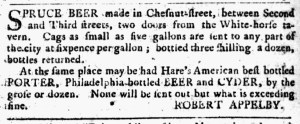
Robert Appleby apparently specialized in beers brewed locally.  Those were the only products that he promoted in an advertisement that ran in the March 19, 1776, edition of the Pennsylvania Evening Post.  He opened with “SPRUCE BEER” that he brewed himself “in Chesnut-street, between Second and Third streets, two doors from the White-horse tavern” in Philadelphia.  Even if prospective customers were not already familiar with his beer, they could certainly find him once they were in the vicinity of the tavern.  Flavored with spruce needles or buds, this popular beverage helped in preventing scurvy.  Appleby sold his spruce beer in bottles, charging three shillings a dozen, or kegs as small as five gallons.  For the convenience of his customers, he offered delivery “to any part of the city.”

He also distributed beer that he did not brew, “Hare’s American best bottled PORTER.”  That beverage already had quite a reputation in Philadelphia.  Over the past several months, several tavernkeepers placed advertisements to alert prospective patrons when they planned to “open a TAP of Mr. HARE’s best AMERICAN DRAUGHT PORTER,” often associating drinking a brew brewed in the colony (and gathering together to do so) with support for the American cause.  Patrick Meade, for instance, declared that he “expects the Associators of Freedom will encouragement to the American Porter it deserves,” and Joseph Price called on “all the SONS of AMERICAN LIBERTY” to drink it at his tavern at “the sign of the Bull and Dog.”

In addition to his spruce beer and the most famous beer brewed in the city at the time, Appleby also sold “Philadelphia bottled BEER and CYDER, by the grose or dozen,” pledging that “None will be sent out but what is exceeding fine.”  Elsewhere in the same issue, Robert Bell placed competing advertisements for his third edition of Thomas Paine’s Common Sense and James Chalmers’s Plain Truth, a response that depicted the “scheme of INDEPENDANCE” as “ruinous, delusive, and impracticable.”  Whether or not they purchased those pamphlets, the readers who consumed Appleby’s spruce beer and Hare’s porter likely had animated conversations as they discussed current events.

February 27

What was advertised in a revolutionary American newspaper 250 years ago today?

Pennsylvania Evening Post (February 27, 1776).

“BOTTLES wanted by ROBERT HARE and Co. at their Porter Brewery.”

During the first year of the Revolutionary War, Robert Hare and Company gained a following for “HARE’s best AMERICAN DRAUGHT PORTER.”  Hare, the son of an English brewer, arrived in Philadelphia in 1773.  He established a brewery, reportedly the first to produce porter in the colonies.  As the imperial crisis intensified and Americans leveraged their participation in the marketplace for political purpose, Hare’s porter became a popular alternative to imported beer.

Tavernkeepers, innkeepers, and others promoted Hare’s porter when they invited patrons to their establishments.  In the November 25, 1775, edition of the Pennsylvania Evening Post, for instance, William Dibley, the proprietor of the Fountain and White Horse Inn, announced that he would soon “open a TAP” of Hare’s porter and declared that he “has no doubt but that the sturdy friends of American freedom will afford due honor to this new and glorious manufacture.”  Not long after that, Patrick Meade invited the “TRUE FRIENDS to LIBERTY” to the Harp and Crown in Southwark, just outside of Philadelphia, to enjoy “HARE’s and Co. AMERICAN PORTER, which he will sell in its purity.”  Rather than offer a selection of beverages, he stated that he “intends no beer of any other kind shall enter his doors.”  As far as Meade was concerned, it was the only beer for the “Associators of Freedom.”  He hoped they would “give the encouragement to the American Porter it deserves.”  Joseph Price also served Hare’s porter “in the greatest purity and goodness” to “all the SONS of AMERICAN LIBERTY” at the “sign of the Bull and Dog” in Philadelphia.  Jeremiah Baker served Hare’s porter at the “sign of Noah’s Ark.”  Lewis Nicola opened an “AMERICAN PORTER HOUSE” where he no doubt served Hare’s porter.

With all that buzz for their beer, Hare and Company did not need to advertise in the public prints, at least not to gain customers.  They did, however, need supplies.  At the end of February 1776, the brewers placed an advertisement soliciting bottles “at their Porter Brewery.”  Readers could show their support for the American cause by drinking Hare’s porter, but that was not the only way.  They could also supply the brewery with bottles to aid in distributing the porter to even more consumers who wanted to drink beer produced in America rather than imported from England.

February 25

What was advertised in a revolutionary American newspaper 250 years ago this week?

Pennsylvania Evening Post (February 22, 1775).

“Self-defence against unjust attacks needs no apology.”

It was the final volley in the battle over competing editions of Thomas Paine’s Common Sense that took place in newspapers advertisements in Philadelphia over a course of a month in late January and most of February 1776.  The author and Robert Bell, the publisher of the first edition, had a parting of the ways over Bell’s bookkeeping for the first edition.  Paine claimed that he wished to donate his share of the proceeds to purchase mittens for American soldiers participating in the invasion of Canada, but Bell somehow had not turned a profit.  That prompted Paine to work with William Bradford and Thomas Bradford, the printers of the Pennsylvania Journal, on an expanded edition.  Bell published an unauthorized second edition.  Paine, who remained anonymous at that point, and Bell attacked each other in newspaper advertisements.  The author walked away, but Bell continued and the Bradfords joined the fray.  When Aitken learned that the Bradfords’ edition would feature new material, he published his own “ADDITIONS to Common Sense.”  The Bradfords warned that Bell’s new pamphlet “consists of Pieces taken out of News Papers, and not written by the Author of COMMON SENSE.”  Several newspapers carried some of these advertisements; the Pennsylvania Evening Post carried all of them.  Printed three times a week instead of just once (in contrast to the other newspapers published in Philadelphia at t the time), the Pennsylvania Evening Post allowed the feuding printers to publish speedy responses to the latest accusations leveled against them.

Bell inserted the last of those responses in the February 22 edition of the Pennsylvania Evening Post and the February 26 edition of Dunlap’s Pennsylvania Packet.  In Thomas Paine: A Bibliographical Check List of Common Sense with an Account of Its Publication, Richard Gimbel notes that Bell “thought so much of this address that he had it separately printed as a two-page leaflet and added it, as an integral part, to his ‘complete’ edition of Common Sense.”[1]  In this advertisement, Bell presented himself as a performing his civic dry as a “Bookseller, to the Public.”  He entitled this new address, “Self-defence against unjust attacks needs no apology.”  He then disparaged Paine, the “envious Mr. ANONYMOUS,” for wanting to have all the attention for writing Common Sense when other authors, “worthy and respectables citizens of Philadelphia,” also penned “excellent pieces.”  Furthermore, “in the opinion of some gentlemen, who are good judges of literary merit,” those essays were “worthy of preservation, in such manner as to bind with other pamphlets in an octavo volume.”  Why should readers limit themselves to Common Sense alone when they considered current events when they could instead consult an entire compendium of essays that supported the American cause?  Paine, his intermediaries who negotiated with Bell, and the printers who worked with him attempted to “insinuate,” according to Bell, that there is no WRITERS in America but the would-be-author of Common Sense.”  Yet Paine had been influenced by others, so any acclaim he received amounted to nothing more than “stolen applause.”  In addition, the publisher framed the production and, especially, the dissemination of Common Sense as his work.  After all, Paine did not attach his name to the pamphlet and most printers initially did not want to be associated with such a revolutionary tract, but Bell “printed his name on the title of the flaming production, to sound the depths of the multitude for a virtuous and glorious independency.”  “Mr. ANONYMOUS” wrote the pamphlet, but it was Bell who deserved credit for presenting it to the world.  He concluded by proclaiming that he “continueth to sell to all who are capable of making proper distinctions, the large edition of Common Sense with ALL the additions and improvements.”  That volume included “the appendix, and address to the Quakers COMPLETE,” pieces written by Bell for the Bradfords’ expanded edition and pirated by Bell.  Gimbel contends that this “acrimonious quarrel” in newspaper advertisements “doubtless helped to make Paine’s Common Sense the most discussed and most widely circulated pamphlet in America.”[2]  Then, as now, everyone loved a controversy.  The dispute gave readers all the more reason to check out the pamphlet.

**********

[1] Richard Gimbel, Thomas Paine: A Bibliographical Check List of Common Sense with an Account of Its Publication (New Haven: Yale University Press, 1956), 47.

[2] Gimbel, Thomas Paine: A Bibliographical Check List of Common Sense, 49.

February 24

What was advertised in a revolutionary American newspaper 250 years ago today?

Pennsylvania Evening Post (February 24, 1776).

“THE MODERN RIDING-MASTER … Adorned with sixteen neat engravings.”

When Robert Aitken “PUBLISHED, PRINTED and SOLD” an American edition of Philip Astley’s “THE MODERN RIDING-MASTER, or a KEY to the KNOWLEDGE of the HORSE and HORSEMANSHIP,” he placed an advertisement in the Pennsylvania Evening Post.  In marketing the manual, he emphasized Astley’s celebrity, identifying him as a “Riding-master, late of his Majesty’s royal light dragoons.”  Aitken also promised that the manual included “several necessary rules for young horsemen.”  To that end, he declared that The Modern Riding-Master “may be considered as an useful Vade-Mecum” or handbook “for gentlemen of every rank and profession, whether civil or military.”  As printers and booksellers often did in their advertisements, Aitken copied the section headings to provide an overview of the contents.  The manual began with “Necessary precautions in purchasing a horse” and attention “Of the bridle and saddle,” continued with “The art of riding, and reducing a horse to proper obedience,” and also covered how “To mount the horse; with a variety of directions for the training and better government of this useful animal” and “Necessary directions on a journey.”

Figure 6 from Philip Astley, The Modern Riding-Master (Philadelphia: Robert Aitken, 1776). Courtesy American Antiquarian Society.

In addition to these directions, the manual featured “sixteen neat engravings descriptive of this manly exercise.”  Aitken exaggerated a bit.  The handbook did indeed have sixteen illustrations, but they were woodcuts integrated into the text rather than copperplate engravings printed separately.  Those images “Adorned” the text, as Aitken stated, but they were not of the same quality as engravings.  Still, they provided useful visual aids for readers.  To draw the attention of prospective customers, Aitken submitted one of those woodcuts, Figure 6, to accompany his advertisement in the Pennsylvania Evening Post.  It depicted a rider placing his “left Foot in the Stirrup” as he prepared to mount a horse held steady by an attendant.  Aitken made savvy use of the woodcut, reusing it in an advertisement once he finished printing the manual.  It was the only visual image in his notice in the Pennsylvania Evening Post, a newspaper that did not even have a device in its masthead.  The woodcut gave a preview of what readers could expect if they purchased Astley’s manual.

Woodcuts in Philip Astley, The Modern Riding-Master (Philadelphia: Robert Aitken, 1776). Courtesy American Antiquarian Society.

February 22

GUEST CURATOR:  Madison Sandusky

What was advertised in a revolutionary American newspaper 250 years ago today?

Pennsylvania Evening Post (February 22, 1776).

“THE MILITARY GUIDE for YOUNG OFFICERS.  By THOMAS SIMES, Esq.”

Several printers in Philadelphia advertised “THE MILITARY GUIDE for YOUNG OFFICERS” by Thomas Simes in February 1776.  The manual was published in 1776 and contained a compilation of “works of several military authors, including Humphrey Bland and the comte de Saxe.”  When the American Revolution began in 1775, military manuals, such as the one Simes wrote, became popular among young men preparing to join the war and those who had already joined. According to the American Revolution Institute of the Society of the Cincinnati, “to meet the demand for military texts, a flood of printings began to appear from the American presses.”  Additionally, the advertisement above, published in the Pennsylvania Evening Post, which was a newspaper located in Philadelphia, displays how that flood of printing was “centered in Philadelphia, where more than thirty works on military subjects were published in the years 1775 and 1776 alone.”  The advertisement briefly summarizes the book, stating that it included “the experience of many brave heroes in critical situations, for the use of young warriors” to entice the target audience of young men who would serve as officers to purchase the book as a helpful guide. The advertisement even noted that the guide came with its own “explanatory DICTIONARY,” a bonus section. One signer of the Declaration of Independence, William Floyd, owned a copy of Simes’s guide, which can be taken as an indicator of both the quality and popularity of its contents.

**********

ADDITIONAL COMMENTARY:  Carl Robert Keyes

Robert Bell, the publisher of the first edition of Thomas Paine’s Common Sense, continued his feud with William Bradford and Thomas Bradford, the printers of the Pennsylvania Journal, with a new advertisement in the February 22, 1776, edition of the Pennsylvania Evening Post.  Dissatisfied with Bell’s bookkeeping, Paine collaborated with the Bradfords on an expanded edition of his popular political pamphlet, yet Bell took an unauthorized second edition to press and simultaneously published diatribes about Paine and the Bradfords.  His latest advertisement would be the last in the series that attacked the author and his fellow printers.  It filled more than a column, starting on the third page of the February 22 issue of the Pennsylvania Evening Post and overflowing onto the fourth page.  The advertisement for Thomas Simes’s Military Guide for Young Officers, jointly published by Bell, Robert Aitken, and James Humphreys, Jr., immediately followed Bell’s advertisement.  In the column to the right, the Bradfords promoted their “NEW EDITION of COMMON SENSE, With ADDITIONS and IMPROVEMENTS,” and warned that the “Pamphlet advertised by Robert Bell intitled ADDITIONS to COMMON SENSE … consists of Pieces taken out of News Papers, and not written by the Author of COMMON SENSE.”

The advertisement for Simes’s Military Guide for Young Officers thus appeared in the middle of the controversy over the publication of new editions of Common Sense.  Unlike Bell’s questionable decision to produce a second edition of the political pamphlet and then attempt to capitalize off it by publishing another pamphlet of “ADDITIONS” drawn from newspapers rather than written by Paine, he collaborated with Aitken and Humphreys in producing the military manual “at the desire of several Members of the Honorable the Continental Congress, and some of the Military Officers of the Association.”  Bell (along with Aitken and Humphreys) had the right endorsements for an American edition of a manual previously published in London and the printers attempted to leverage that in marketing Simes’s Military Guide for Young Officers to prospective customers who, as Madison notes, could choose from among many similar works published in Philadelphia at the time.  In the Pennsylvania Evening Post, the advertisement appeared in the middle of the various notices in the February 22 edition, but two days later it had a privileged place in the Pennsylvania Ledger.  Humphreys, the printer of that newspaper, placed the advertisement on the first page, making it the first item in the first column.  The printers of the Pennsylvania Gazette gave the advertisement the same treatment in the February 28 edition of their newspaper.  The flamboyant Bell took a more measured approach to marketing the military manual compared to some of the other books and pamphlets he printed and, especially, his new editions of Common Sense.  Perhaps his partners in the endeavor took the lead in marketing Simes’s Military Guide for Young Officers.

February 20

What was advertised in a revolutionary American newspaper 250 years ago today?

Pennsylvania Evening Post (February 20, 1776).

“Pieces taken out of News papers, and not written by the Author of COMMON SENSE.”

The final page of the Pennsylvania Evening Post was once again ground zero for the dispute between Robert Bell, the publisher of the first edition of Thomas Paine’s Common Sense and subsequent unauthorized editions, and William Bradford and Thomas Bradford, the printers of the Pennsylvania Journal entrusted by Paine to publish a “NEW EDITION … With ADDITIONS and IMPROVEMENTS in the BODY of the WORK.”  Paine previously participated in the dispute, but he seemingly withdrew in favor of letting the printers duke it out in the public prints.

The Bradfords’ expanded edition had been in the press for a few weeks, but on February 14, 1776, they announced in their own newspaper that “THIS DAY WILL BE PUBLISHED AND SOLD … THE NEW EDITION OF COMMON SENSE.”  The following day, they ran a new advertisement in the Pennsylvania Evening Post and then updated it on February 20.  To make that edition more appealing than any of the editions published by Bell, the Bradfords proclaimed, “The Additions which are here given, amount to upwards of one Third of any former Edition.”  They also acknowledged that Bell had been advertising “ADDITION to COMMON SENSE,” but they alerted readers that Bell was trying to pull a fast one.  The “ADDITIONS” that Bell marketed “consist of Pieces taken out of News Papers, and not written by the Author of COMMON SENSE.”  Paine had worked exclusively with the Bradfords on the “ADDITIONS and IMPROVEMENTS.”  The Bradfords also listed several booksellers who stocked their new edition.  Benjamin Towne, the printer of the Pennsylvania Evening Post, was not among them, but he certainly generated revenue from publishing the advertisements that the Bradfords and Bell submitted to his printing office.

Right next to the Bradfords’ advertisement, as had been the case on other occasions, appeared Bell’s advertisement for “Large ADDITIONS to COMMON SENSE.”  Those “ADDITIONS” included “the following interesting subjects,” “American Independency defended by Candidus,” and “The Propriety of Independancy, by Demophilus,” and “Observations on Lord North’s Conciliatory Plan, by Sincerus.”  This version of the advertisement added “The American Patriot’s Prayer,” left out of Bell’s previous notice, to entice prospective customers.  Bell also pirated “AN APPENDIX TO COMMON SENSE, together with an ADDRESS to the people called QUAKERS, on their Testimony concerning Kings and Government.”  Like the Bradfords, he charged “one shilling ONLY” and made “allowance to those who buy quantities.”  In other words, the printers of Common Sense and related materials offered discounts to retailers who purchased in volume to sell the pamphlet in their own shops and others who bought multiple copies to distribute to friends, relatives, and associates.  The contents of Paine’s political pamphlet made it popular, yet the advertisements in the Pennsylvania Evening Post and other newspapers also helped raise awareness of Common Sense.

February 6

What was advertised in a revolutionary American newspaper 250 years ago today?

Pennsylvania Evening Post (February 6, 1776).

“The sign of Kouli Khan.”

Mary Robinson had a variety of “HOUSEHOLD GOODS and KITCHEN FURNITURE” that she wished to sell, either at an upcoming auction or, if possible, via private sales before the auction.  She listed some of those items in an advertisement in the February 6, 1776, edition of the Pennsylvania Evening Post, including “walnut dining and tea tables, chest of drawers, beds and bedding, walnut chairs, looking glasses, pictures, handirons, tongs, shovels, pots, kettles, dishes, plates, [and] bottles.”  She did not give a reason for the sale, whether it was an estate sale, she intended to move, she needed money to pay bills, or she wished to clean out a cluttered house, but the reason likely did not matter to most prospective buyers who saw an opportunity to acquire all sorts of items at bargain prices.  Purchasing secondhand goods made the consumer revolution accessible to many colonizers.

In an era before standardized street numbers, Robinson gave her address as “the sign of Kouli Khan, on the west side of Fifth-street, the fourth door from the corner of Market-street,” in Philadelphia.  That a sign marked the location suggested that Robinson operated a shop or a tavern at her house.  The sign certainly distinguished Robinson’s house from other places that displayed signs in Philadelphia, including “the Sign of the SCYTHE and SICKLE” displayed by Goucher and Wylie, cutlers on Fourth Street, and “the sign of the Sugar-loaf, Pound of Chocolate, and Tea Canister,” where Robert Levers sold “GROCERY GOODS” on Second Street.  For those entrepreneurs, their signs corresponded with the items they made or sold.  Isaac Bartram, a “Chymist and Druggist,” chose a more fanciful device for his “Medicine Store” at “the Sign of the Unicorn’s Head” on Third Street, while the sign at Robinson’s house depicted a real person, Nader Shah Afshar.  Kouli Khan (as he was known to Europeans in the eighteenth century), the powerful emperor of Persia, invaded India in the late 1730s, seizing the treasury and the Peacock Throne before withdrawing.  Colonizers in Philadelphia likely considered the powerful leader of a place they considered exotic a proper symbol to mark the location of a shop that sold imported goods, especially the textiles imported from India so often advertised in the Pennsylvania Evening Post and other newspapers.  Robinson likely intended for the combination of military might and connections to global commerce to resonate with customers who shopped or drank at “the sign of Kouli Khan.”