January 3

What was advertised in a revolutionary American newspaper 250 years ago today?
Pennsylvania Journal (January 3, 1776).

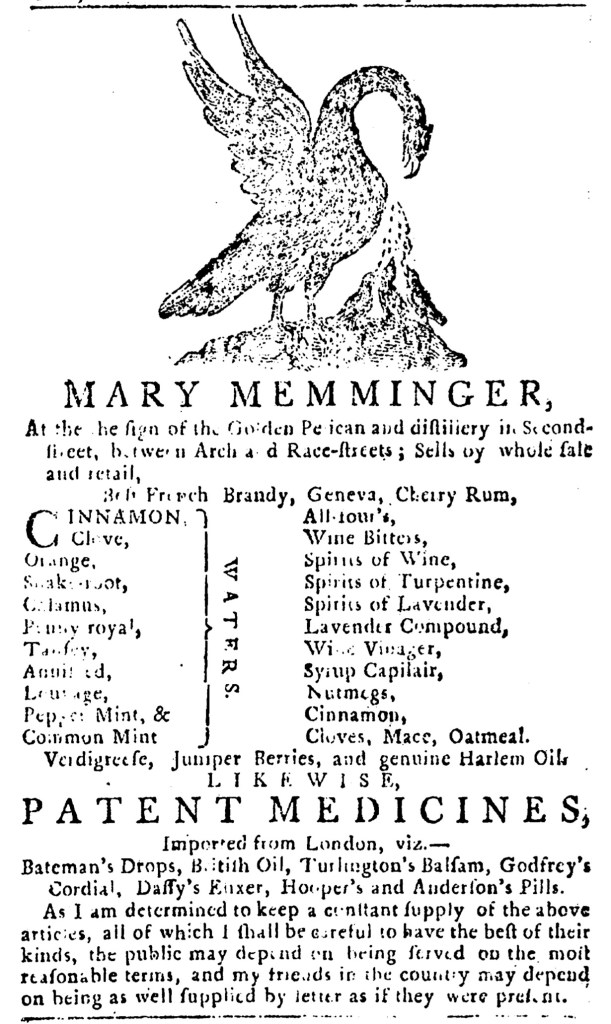
“MARY MEMMINGER, At the sign of the Golden Pelican.”

In the final issue of the Pennsylvania Journal published in 1775 and continuing in January 1776, Mary Memminger advertised the remedies available at her apothecary shop “At the sign of the Golden Pelican” on Second Street in Philadelphia.  Memminger described her shop as a “distillery,” suggesting that she may have produced some of the “WATERS” (including cinnamon, clove, orange, peppermint, and “Common Mint”) and “Spirits of Wine,” “Spirits of Turpentine,” and “Spirits of Lavender.”  She also stocked popular “PATENT MEDICINES, Imported from London,” listing “Bateman’s Drops, British Oil, Turlington’s Balsam, Godfrey’s Cordial, Daffy’s Elixer, [and] Hooper’s and Anderson’s Pills.”  Memminger apparently tended closely to her advertising.  The first time her notice appeared, it featured an error, truncating “Godrey’s Cordial, Daffy’s Elixer” to “Godfrey’s Elixer.”  The compositor fixed the mistake, a rare instance of an updated version of a newspaper advertisement for consumer goods and services after the type had been set.

Memminger did not indicate when she received the patent medicines “Imported from London,” whether they arrived in the colonies before the Continental Association went into effect on December 1, 1774.  Apothecaries and others who sold patent medicines often gave assurances that they were “fresh,” recent arrivals that had not lingered on shelves or in storerooms for months, yet Memminger left it to readers to draw their own conclusions.  She did assert that she was “determined to keep a constant supply of the above articles, all of which I shall be careful to have the best of their kinds,” perhaps indicating a willingness to make exceptions when it came to certain imported items.  Memminger made the health of her clients her priority, promising that “the public may depend on being served on the most reasonable terms, and my friends in the country may depend on being as well supplied by letter as if they were present.”  As a symbol of the care she provided, a woodcut dominated her advertisement (and the entire final page of the January 3, 1776, edition of the Pennsylvania Journal).  As William H. Helfand explains, it depicted “a pelican piercing her breast to nourish her young.”  Perhaps it replicated the “sign of the Golden Pelican” that marked Memminger’s location.  While other apothecaries, like Philip Godfrid Kast and Oliver Smith, deployed images that incorporated mortars and pestles, Memminger declined to include a tool of the trade in favor of emphasizing a symbol of motherly care and sacrifice tending to the welfare of others.

December 6

What was advertised in a revolutionary American newspaper 250 years ago today?

Pennsylvania Journal (December 6, 1775).

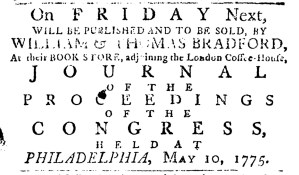
“JOURNAL OF THE PROCEEDINGS OF THE CONGRESS, HELD AT PHILADELPHIA, MAY 10, 1775.”

On Wednesday, December 6, 1775, William Bradford and Thomas Bradford, printers of the Pennsylvania Journal, announced that “On FRIDAY Next, WILL BE PUBLISHED … [the] JOURNAL OF THE PROCEEDINGS OF THE CONGRESS, HELD AT PHILADELPHIA, MAY 10, 1775.”  The contents of that volume covered the period from May 10 through August 1.  Throughout the colonies, readers had been able to follow news from the Second Continental Congress reprinted from newspaper to newspaper.  Local printers made editorial decisions about which items to include.  With this volume, however, readers gained access to the entire proceedings.  It supplemented the news they previously read or heard.  It also provided a convenient means of collecting the information in a single place, though some colonizers did save newspapers and one, Harbottle Dorr, even created an extensive index to aid him as he reviewed news of the imperial crisis that eventually became a revolution.

The Bradfords announced publication of the Journal of the Proceedings of the Congress in advance in hopes that the anticipation would incite demand.  They gave their advertisement a privileged place in their newspaper, placing it immediately after the news.  The “ARTICLES of CAPITULATION made and entered into between Richard Montgomery, Esq; Brigadier General of the Continental army, and the citizens and inhabitants of Montreal” on November 12 appeared in the column to the left of the Bradfords’ advertisement.  They may have hoped that news of an American victory in the two-pronged invasion of Canada that targeted Montreal and Quebec City would help to sell copies of the Journal of the Proceedings of the Congress.  In addition to publishing the journal documenting the first months of the Second Continental Congress, the Bradfords previously printed and advertised a complete journal of the proceedings of the First Continental Congress held in Philadelphia in September and October 1774.  Nearly as soon as that body adjourned, the Bradfords published and advertised a collection of Extracts that included “a List of Grievances” and the Continental Association, a nonimportation and nonconsumption agreement intended to use commercial leverage to achieve political goals.  Within a month of marketing the Extracts, the Bradfords made the complete journal available to the public.  These publications supplemented and expanded newspaper coverage of the debates and decisions made by delegates meeting in Philadelphia.

November 1

What was advertised in a revolutionary American newspaper 250 years ago today?

Pennsylvania Journal (November 1, 1775).

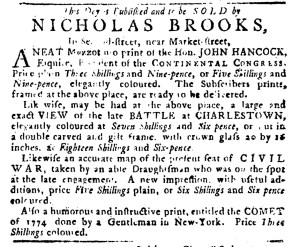
“A NEAT Mezzotinto print of the Hon. JOHN HANCOCK.”

“A large and exact VIEW of the late BATTLE at CHARLESTOWN.”

“An accurate map of the present seat of CIVIL WAR.”

Nicholas Brooks produced and marketed items that commemorated the American Revolution before the colonies declared independence.  In an advertisement in the November 1, 1775, edition of the Pennsylvania Journal, for instance, he packaged together three prints previously advertised separately, each of them related to imperial crisis that had boiled over into a war.  For this notice, Brooks presented them as a collection of prints for consumers who wished to demonstrate their support for the American cause by purchasing and displaying one or more of them.

Brooks announced that a “NEAT Mezzotinto print of the Hon JOHN HANCOCK, Esquire, President of the CONTINENTAL CONGRESS,” that had previously been proposed in other advertisements had been published and was now for sale at his shop on Second Street in Philadelphia.  The subscribers who had reserved copies in advance could pick up their framed copies or arrange for delivery.  Others who had not placed advanced orders could acquire the print for three shillings and nine pence or pay two extra shillings for one “elegantly coloured.”

“Likewise, may be had at the above place,” Brooks reported, “a large and exact VIEW of the late BATTLE at CHARLESTOWN,” depicting what has become known as the Battle of Bunker Hill.  This print competed with an imitation bearing a similar title, “a neat and correct VIEW of the late BATTLE at CHARLESTOWN,” that Robert Aitken inserted in the Pennsylvania Magazine and sold separately.  Brooks, who had long experience selling framed prints, offered choices for his “exact VIEW.”  Customers could opt for an “elegantly coloured” version for seven shillings and six pence” or have it “put in a double carved and gilt frame, with glass 20 by 16 inches,” for eighteen shillings and six pence.  The eleven shillings for the frame, half again the cost of the print, indicated that Brooks anticipated that customers would display the “exact VIEW” proudly in their homes or offices.

He also promoted “an accurate map of the present seat of CIVIL WAR, taken by an able Draughtsman,” Bernard Romans, “who was on the spot of the late engagement.”  Brooks revised copy from earlier advertisements: “The draught was taken by the most skillful draughtsman in all America, and who was on the spot at the engagements of Lexington and Bunker’s Hill.”  The map showed a portion of New England that included Boston, Salem, Providence, and Worcester.   This print, he declared, was a “new impression, with useful additions,” though he did not specify how it differed from the one he previously marketed and sold.  As with the others, customers had a choice of a plain version for five shillings or a “coloured” one for six shillings and six pence.

Brooks added one more item, “a humorous and instructive print, entitled the COMET of 1774, done by a Gentleman in New-York.”  Did this print offer some sort of satirical commentary on current events?  Or was it unrelated to the prints of Hancock, the Battle of Bunker Hill, and the “CIVIL WAR” in New England?  Whatever the additional print depicted, Brooks made the prints that commemorated the American Revolution the focus of his advertisement, gathering together three items previously promoted individually.  In so doing, he not only offered each print to customers as separate purchases but also suggested that they could consider them part of a collection.  Consumers who really wanted to demonstrate their patriotism could easily acquire all three at his shop.

October 18

What was advertised in a revolutionary American newspaper 250 years ago today?

Pennsylvania Journal (October 18, 1775).

“An Elegy to the memory of the American Volunteers who fell … April 19, 1775.”

During the era of the American Revolution, advertisements for almanacs frequently appeared in newspapers from New England to Georgia each fall.  Such was the case in the Pennsylvania Journal in 1775.  James Adams, a printer in Delaware, inserted a notice that announced that he “JUST PUBLISHED … The WILMINGTON and PENNSYLVANIA ALMANACKS, For the year of our LORD, 1776.”

Adams followed a familiar format for advertising almanacs.  He indicated that both editions included “the usual astronomical calculations” that readers would find in any almanac as well as a variety of other enticing contents.  The Pennsylvania edition included “Pithy Sayings” for entertainment and “Tables of Interest at six and seven per cent” for reference as well as the “Continuation of William Penn’s Advice to his Children” and the “Conclusion of Wisdom’s Call to the young of both sexes.”  Adams published a portion of those pieces in the almanac for the previous year, anticipating that readers would purchase the subsequent edition for access to the essays in their entirety.  The almanac for 1776 also suggested “Substitutes for Tea,” certainly timely considering that the Continental Association remained in effect. Colonizers sought alternatives while they boycotted imported tea.

Current events played an even more prominent role in the Wilmington Almanack.  It featured an “Elegy to the memory of the American Volunteers, who fell in the engagement between the Massachusetts-Bay Militia and the British Troops, April 19, 1775.”  Six months after the battles at Lexington and Concord, Adams memorialized the minutemen who had died for the American cause during the first battles of the Revolutionary War.  In addition, the almanac featured “The Irishman’s Epistle to the Officers and troops at Boston,” “Liberty-Tree,” and “A droll Dialogue between a fisherman of Poole, in England, and a countryman, relative to the trade of America, and proposed victory over the Americans.”  Adams did not elaborate on those items, perhaps intentionally.  Presenting the titles of the pieces without further elaboration was standard practice in advertisements for almanacs, but in this case the printer may have intended to stoke curiosity that would lead to more sales.  For both almanacs, a concern for current events and a burst of patriotism influenced the contents and their marketing.

October 4

What was advertised in a revolutionary American newspaper 250 years ago today?

Pennsylvania Journal (October 4, 1775).

“A NEAT MEZZOTINTO PRINT of the HON. JOHN HANCOKC, ESQ; PRESIDENT of the CONTINENTAL CONGRESS.”

On October 4, 1775, Nicholas Brooks took to the pages of the Pennsylvania Journal to announce that he “JUST PUBLISHED … An Exact VIEW of the Late BATTLE at CHARLESTOWN,” now known as the Battle of Bunker Hill.  Brooks had previously distributed subscription proposals for the project that he pursued in collaboration with Bernard Romans.  Brooks and Romans had recently worked together on a map of Boston that depicted the siege of the city following the battles at Lexington and Concord.  Brooks described the new print now ready for purchase as a “Large Elegant PIECE, beautifully Coloured, and much superior to any pirated copy now offered or offering to the public.” Apparently, Brooks had not worked with Robert Aitken in making a version to accompany the Pennsylvania Magazine.  It was not the first time that one colonizer pirated the work of another when producing items that commemorated the imperial crisis that eventually became a war for independence.  Paul Revere had done the same with Henry Pelham’s image of the Boston Massacre, advertising his copy in Boston’s newspapers before Pelham marketed the original.

Despite his frustration with the situation, Brooks must have considered prints commemorating the people and events related to the current crisis viable business ventures.  Immediately below his advertisement for “An Exact View of the Late BATTLE at CHARLESTOWN,” he inserted another advertisement, that one proclaiming, “It is PROPOSED to PRINT, in about ten days, A NEAT MEZZOTINTO PRINT of the HON. JOHN HANCOKC, ESQ; PRESIDENT of the CONTINENTAL CONGRESS.”  Brooks collected subscribers’ names and reserved copies of the print for them at his shop on Second Street in Philadelphia.  Interested parties could also visit the London Coffee House, a popular spot for socializing, conducting business, and talking politics.  Brooks’s advertisement did not give details about what to do at the London Coffee House.  Subscribers may have given their names to an employee who recorded them on a list or they may have signed their own names (and indicated the number of copies they wished to purchase) on a subscription proposal posted alongside other advertisements.  They very well may have perused the names of other patriots who ordered the print as they committed to acquiring their own copy.  Brooks hoped that they would also purchase “Frames and Glasses” to display the prints from his shop, just as he marketed a “Double Carv’d and Gilt Frame … with Crown Glass” for the print depicting the battle.  Brooks certainly wanted commemorative items to become fashionable items that consumers believed that they not only wanted but needed as the imperial crisis intensified.

September 27

What was advertised in a revolutionary American newspaper 250 years ago today?

Pennsylvania Journal (September 27, 1775).

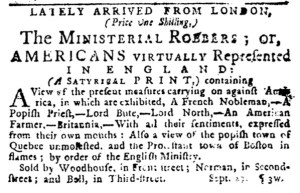
 “AMERICANS VIRTUALLY Represented IN ENGLAND: (A SATYRICAL PRINT.)”

As the imperial crisis intensified and hostilities commenced in Massachusetts in the spring of 1775, American colonizers had supporters in London.  In addition, some artists, engravers, and printers, whatever their own politics may have been, hoped to generate revenue by creating and publishing political cartoons that lambasted the British ministry for the abuses it perpetrated in the colonies.  Some of those prints found their way to eager audiences on the other side of the Atlantic.  In the fall of 1775, William Woodhouse, a bookseller and bookbinder, John Norman, an architect engraver building his reputation, and Robert Bell, the renowned bookseller and publisher, advertised a “SATYRICAL PRINT” that “LATELY ARRIVED FROM LONDON.”

The trio promoted “The MINISTERIAL ROBBERS; or, AMERICANS VIRTUALLY Represented IN ENGLAND,” echoing one of the complaints that colonizers made about being taxed by Parliament without having actual representatives serve in Parliament.  Based on the description of the print in the advertisement, Woodhouse, Norman, and Bell stocked “Virtual Representation, 1775” or a variation of it.  According to the newspaper notice, the image depicted a “View of the present measures carrying on against America, in which are exhibited, A French Nobleman,– A Popish Priest,– Lord Bute,– Lord North,– An American Farmer,– [and] Britannia.”  For each character, “their sentiments, expressed from their own mouths,” appeared as well.

Lord Bute, the former prime minister who inaugurated the plan of regulating American commerce to pay debts incurred during the Seven Years War, appeared at the center of the image, aiming a blunderbuss at two American farmers.  For his “sentiments,” he proclaimed, “Deliver your Property.”  Lord North, the current prime minister, stood next to Bute, pointing at one of the farmers and exclaiming, “I Give you that man’s money for my use.”  In turn, the first farmer stoutly declared, “I will not be Robbed.”  The second expressed solidarity: “I shall be wounded with you.”

The advertisement indicated that the print also showed a “view of the popish town of Quebec unmolested, and the Protestant town of Boston in flames; by order of the English ministry.”  Those parts of the political cartoon unfavorably compared the Quebec Act to the Coercive Acts (including the Boston Port Act and the Massachusetts Government Act), all passed by Parliament in 1774.  The Quebec Act angered colonizers because it extended certain rights to Catholics in territory gained from the French at the end of the Seven Years War.  In the print, the town of Quebec sat high atop its bluff, the flag of Great Britain prominently unfurled, in the upper left with the “French Nobleman” and “Popish Priest” in the foreground.  The legend labeled it as “The French Roman Catholick Town of Quebeck.”  The anti-Catholicism was palpable; the kneeling priest exclaiming “Te Deum” in Latin and holding a cross in one hand and a gallows in the other, playing on Protestant fears of the dangers they faced from their “Popish” enemies.

While Quebec appeared “unmolested” and even favored by Bute, North, and their allies in Parliament, the “English Protestant Town of Boston” appeared in the distance behind the American farmers in the upper right.  The town was indeed on fire, a reference to the battles fought in the vicinity as well as a metaphor for the way Parliament treated the town to punish residents for the Boston Tea Party.  As the advertisement indicated, Britannia, the personification of the empire, made an appearance in the print.  She wore a blindfold and exclaimed, “I am Blinded.”  She looked to be in motion, one foot at the edge of “The Pit Prepared for Others” and her next step surely causing her to fall into it.  There seemed to be no saving Britannia as Bute and North harassed the American farmers and their French and Catholic “Accomplices” watched with satisfaction.

The description of the “SATYRICAL PRINT” in the Pennsylvania Journal merely previewed the levels of meaning contained within the image, yet in likely piqued the curiosity of colonizers who supported the American cause and worried about their own liberties as events continued to unfold in Boston.  Such a powerful piece of propaganda supplemented newspaper reports, maps of the Battle of Bunker Hill, and political treatises circulating in the fall of 1775.

“Virtual Representation, 1775” (London, 1775). Courtesy Boston Public Library.

September 6

What was advertised in a revolutionary American newspaper 250 years ago today?

Pennsylvania Journal (September 6, 1775).

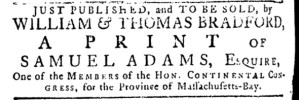
“A PRINT OF SAMUEL ADAMS, ESQUIRE, One of the MEMBERS of the HON. CONTINENTAL CONGRESS.”

The Second Continental Congress convened in Philadelphia after the battles of Lexington and Concord.  It met through most of the summer of 1775, took a recess during August, and started meeting again in September.  The delegates had just resumed their deliberations when William Bradford and Thomas Bradford, the printers of the Pennsylvania Journal, ran an advertisement promoting “A PRINT OF SAMUEL ADAMS, ESQUIRE, One of the MEMBERS of the HON. CONTINENTAL CONGRESS, for the Province of Massachusetts-Bay.”

Even though their advertisement stated, “JUST PUBLISHED, and TO BE SOLD, by WILLIAM & THOMAS BRADFORD,” this seems to have been another instance of printers treating those two phrases separately.  “TO BE SOLD” did indeed refer to the Bradfords stocking and selling the print at their printing office, but “JUST PUBLISHED” did not indicate that they had published the published the print, only that someone had recently published it and made it available for sale.  The Bradfords did not previously attempt to incite demand or gauge interest in a print of Adams among residents of Philadelphia with a subscription notice or other advertisement.

They most likely acquired and sold copies of the print that Charles Reak and Samuel Okey advertised in the Newport Mercury, the Massachusetts Spy, and the Boston-Gazette several months earlier.  In February, Reak and Okey took to the pages of the Newport Mercury to announce their intention to print a “striking likeness of that truly staunch Patriot, the Hon, SAMUEL ADAMS, of Boston.”  Near the end of March, a truncated advertisement in the Massachusetts Spy and the Boston-Gazette advised that “[i]n a few days will be published … A FINE mezzotinto print of that truly worthy Patriot S. A. … executed and published by and for Charles Reak and Samuel Okey, in Newport, Rhode-Island.”  The version in the Massachusetts Spy indicated that more information would appear in the next issue, but the printer, Isaiah Thomas, did not supply additional details in the last few issues printed in Boston before he suspended the newspaper for several weeks and relocated to Worcester just before hostilities commenced at Lexington and Concord.  Those events gave Reak and Okey an expanded market for a print of a Patriot leader already famous in New England.  Their advertisements in Boston’s newspapers listed local agents who would sell their print there.  The Bradfords likely became local agents in Philadelphia rather than publishers of another print of Adams.

August 30

What was advertised in a revolutionary American newspaper 250 years ago today?

Pennsylvania Journal (August 30, 1775).

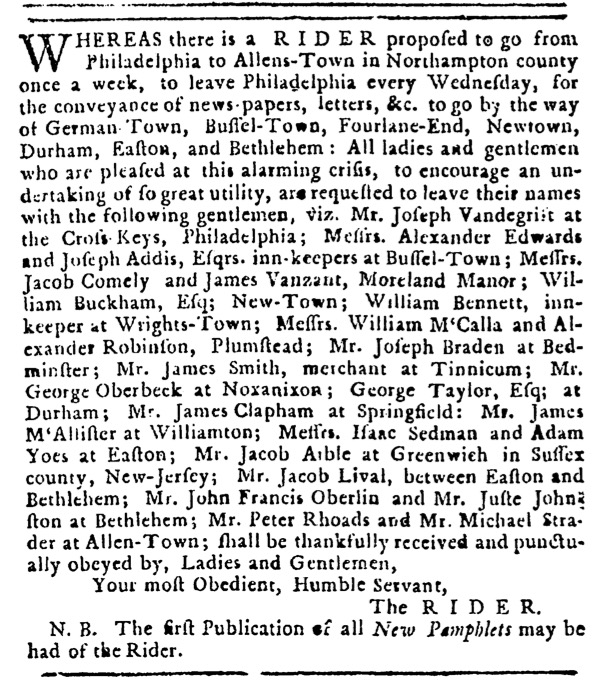
“The first Publication of all New Pamphlets may be had of the Rider.”

An anonymous post rider advertised his services in the August 30, 1775, edition of the Pennsylvania Journal, stating that the “Proposed to go from Philadelphia to Allens-Town in Northampton county once a week.”  He intended to depart from Philadelphia each Wednesday, the same day that a new issue of the Pennsylvania Journal, a weekly publication, hit the streets.  Subscribers to that newspaper along his route would benefit from the quickest possible access to the news in the latest edition.  Although “The RIDER” did not give details about collecting fees, he likely envisioned providing his services via subscription, similar to the plan that Thomas Sculley outlined in an advertisement for his route between Philadelphia and Lewes, Delaware, in the Pennsylvania Ledger a month earlier.  Both post riders contributed to an expanding communication infrastructure.  The same issue of the Pennsylvania Journal that carried the anonymous rider’s advertisement also featured a notice that gave the days the new Constitutional Post departed Philadelphia to carry letters to “New-York, Connecticut, Rhode-Island, Massachusetts-Bay, [and] New-Hampshire.”

The rider framed carrying “news-papers, letters, &c.” as a public service at an important moment, instructing “ladies and gentlemen who are pleased at this alarming crisis, to encourage an undertaking of so great utility … to leave their names with the following gentlemen.”  He then listed twenty-three associates in sixteen towns, demonstrating that he had already devoted significant effort to establishing a network for transmitting information.  The outbreak of hostilities in Massachusetts, the “alarming crisis,” made it more important than ever that colonizers residing in smaller towns gained regular access to newspapers and correspondence.  Some were so eager to read the latest news that they may have been stealing copies of Dunlap’s Maryland Gazette.  The rider aimed to keep colonizers along his route well informed.  “The first Publication of all New Pamphlets,” he stated in a nota bene, “may be had of the Rider.”  The “&c.” (or etc.) in “news-papers, letters, &c.” included the political pamphlets and sermons about current events so often advertised in the Pennsylvania Journal and other newspapers printed in Philadelphia.  Post riders in New England had sometimes acted as local agents for disseminating political pamphlets earlier during the imperial crisis.  The anonymous rider joined their ranks, delivering “news-papers, letters, &c.” with a purpose beyond merely earning his own livelihood.

August 2

What was advertised in a revolutionary American newspaper 250 years ago today?

Pennsylvania Journal (August 2, 1775).

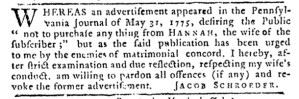
“I hereby … am willing to pardon all offences (if any) and revoke the former advertisement.”

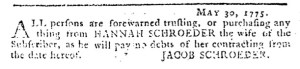
It was a rare retraction.  Jacob Schroeder asked the public to disregard the advertisement he placed regarding his wife, Hannah, a few months earlier.  Some sort of marital discord occurred within the Schroeder household, prompting Jacob to run an advertisement with these instructions: “ALL persons are forewarned trusting, or purchasing any thing from HANNAH SCHROEDER the wife of the Subscriber, as he will pay no debts of her contracting from the date hereof.” Similar advertisements regularly appeared in newspapers throughout the colonies, sometimes more than one in a single issue.  Usually, they indicated that a wife had “eloped” or run away from her husband.  In turn, the husband instructed merchants, shopkeepers, artisans, and others not to allow his wife access to his credit.  Such advertisements often alleged various kinds of bad behavior perpetrated by the wife.  However, husbands set the narrative.  In many instances, the wife likely removed herself from an unhappy or even abusive marriage.  Deprived of credit, most did not have an opportunity to publish their side of the story, though occasionally a wife did find the means to respond in an advertisement.

Retractions made by the husbands were also few and far between in early American newspapers, making Jacob’s advertisement even more noteworthy.  “WHEREAS an advertisement appeared in the Pennsylvania Journal of May 31, 1775, desiring the Public ‘not to purchase any thing from HANNAH, the wife of the subscriber,’” he wrote, “but as the said publication has been urged to me by the enemies of matrimonial concord, I hereby, after strict reflection, respecting my wife’s conduct, an willing to pardon all offences (if any) and revoked the former advertisement.”  He did not offer additional details.  A shorter advertisement cost less, but a desire to avoid as much public scrutiny as possible may have been the deciding factor in not elaborating on the “offences (if any)” or the insinuations made to Jabob by “the enemies of matrimonial concord.”  After all, it would have been embarrassing enough to resort to an advertisement in the first place, an admission that Jacob had been unable to exercise proper authority within his own household.  That the details of Jacob and Hannah’s did not appear in print did not mean that they did not circulate in their neighborhood and beyond.  Those “enemies of matrimonial concord,” whether relatives, friend, or acquaintances, likely gossiped about the couple, as did others.  The appearance of both Jacob’s original advertisement and his retraction may have sparked more conversations and speculation about what occurred in the Schroeder household.  The newspaper notices captured only part of the story.

Pennsylvania Journal (May 31, 1775).

June 28

What was advertised in a revolutionary American newspaper 250 years ago today?

Pennsylvania Gazette (June 28, 1775).

“JUST PUBLISHED … SWAN’s BRITISH ARCHITECT … Illustrated with upwards of ONE HUNDRED DESIGNS AND EXAMPLES.”

At the end of June 1775, Robert Bell, “Printer and Bookseller,” and John Norman, “Architect Engraver,” published an American edition of Abraham Swan’s British Architect: Or, the Builders Treasury of Staircases.  Norman had previously promoted the work with newspaper advertisements and proposals “with a specimen of the plates and letter press” that prospective subscribers could examine.  When the volume was ready for sale and for subscribers to collect the copies they reserved, Bell and Norman ran advertisements in the Pennsylvania Gazette and the Pennsylvania Journal on June 28.  The following day they placed the same advertisement in the Pennsylvania Evening Post.  On July 1, it appeared in the Pennsylvania Ledger and in Story and Humphreys’s Pennsylvania Mercury on July 7.  Of the newspapers printed in English in Philadelphia at the time, only Dunlap’s Pennsylvania Packet did not carry the advertisement.  Bell and Norman made a significant investment in marketing their edition of Swan’s British Architect.

Pennsylvania Journal (June 28, 1775).

To entice prospective customers, they specified that the book was “Illustrated with upwards of one hundred DESIGNS and EXAMPLES, curiously engraved on sixty Folio Copper-Plates” bound into the volume.  They also appended a “Memorandum” requesting that the “Artists and all others who wish to see useful and ornamental ARCHITECTURE flourish … look at the Work.”  If residents of the largest and most cosmopolitan urban port in the colonies wanted their city to maintain and enhance its level of sophistication, Bell and Norman implied, they needed to consider architecture and design important cultural pursuits.  To that end, they also marketed similar publications to those who purchased Swan’s British Architect.  Readers found to subscription proposals bound into the book.  The first one, advertising The Gentleman and Cabinet-Maker’s Assistant with drawings by John Folwell, a local cabinetmaker, and engravings by Norman (dated June 20), faced the title page.  The other, advertising an American edition of Swan’s Collection of Designs in Architecture, Containing New Plans and Elevations of Houses, for General Use (dated June 26), appeared immediately after the letterpress explanations of the engraved illustrations.  The dates on the subscription proposals suggest that they might have circulated separately, yet Bell and Norman made certain to place them before customers who already confirmed an interest in the subject matter.