September 27

What was advertised in a revolutionary American newspaper 250 years ago today?

Pennsylvania Journal (September 27, 1775).

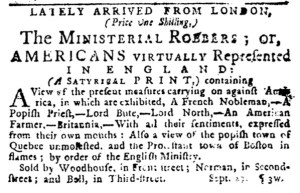
 “AMERICANS VIRTUALLY Represented IN ENGLAND: (A SATYRICAL PRINT.)”

As the imperial crisis intensified and hostilities commenced in Massachusetts in the spring of 1775, American colonizers had supporters in London.  In addition, some artists, engravers, and printers, whatever their own politics may have been, hoped to generate revenue by creating and publishing political cartoons that lambasted the British ministry for the abuses it perpetrated in the colonies.  Some of those prints found their way to eager audiences on the other side of the Atlantic.  In the fall of 1775, William Woodhouse, a bookseller and bookbinder, John Norman, an architect engraver building his reputation, and Robert Bell, the renowned bookseller and publisher, advertised a “SATYRICAL PRINT” that “LATELY ARRIVED FROM LONDON.”

The trio promoted “The MINISTERIAL ROBBERS; or, AMERICANS VIRTUALLY Represented IN ENGLAND,” echoing one of the complaints that colonizers made about being taxed by Parliament without having actual representatives serve in Parliament.  Based on the description of the print in the advertisement, Woodhouse, Norman, and Bell stocked “Virtual Representation, 1775” or a variation of it.  According to the newspaper notice, the image depicted a “View of the present measures carrying on against America, in which are exhibited, A French Nobleman,– A Popish Priest,– Lord Bute,– Lord North,– An American Farmer,– [and] Britannia.”  For each character, “their sentiments, expressed from their own mouths,” appeared as well.

Lord Bute, the former prime minister who inaugurated the plan of regulating American commerce to pay debts incurred during the Seven Years War, appeared at the center of the image, aiming a blunderbuss at two American farmers.  For his “sentiments,” he proclaimed, “Deliver your Property.”  Lord North, the current prime minister, stood next to Bute, pointing at one of the farmers and exclaiming, “I Give you that man’s money for my use.”  In turn, the first farmer stoutly declared, “I will not be Robbed.”  The second expressed solidarity: “I shall be wounded with you.”

The advertisement indicated that the print also showed a “view of the popish town of Quebec unmolested, and the Protestant town of Boston in flames; by order of the English ministry.”  Those parts of the political cartoon unfavorably compared the Quebec Act to the Coercive Acts (including the Boston Port Act and the Massachusetts Government Act), all passed by Parliament in 1774.  The Quebec Act angered colonizers because it extended certain rights to Catholics in territory gained from the French at the end of the Seven Years War.  In the print, the town of Quebec sat high atop its bluff, the flag of Great Britain prominently unfurled, in the upper left with the “French Nobleman” and “Popish Priest” in the foreground.  The legend labeled it as “The French Roman Catholick Town of Quebeck.”  The anti-Catholicism was palpable; the kneeling priest exclaiming “Te Deum” in Latin and holding a cross in one hand and a gallows in the other, playing on Protestant fears of the dangers they faced from their “Popish” enemies.

While Quebec appeared “unmolested” and even favored by Bute, North, and their allies in Parliament, the “English Protestant Town of Boston” appeared in the distance behind the American farmers in the upper right.  The town was indeed on fire, a reference to the battles fought in the vicinity as well as a metaphor for the way Parliament treated the town to punish residents for the Boston Tea Party.  As the advertisement indicated, Britannia, the personification of the empire, made an appearance in the print.  She wore a blindfold and exclaimed, “I am Blinded.”  She looked to be in motion, one foot at the edge of “The Pit Prepared for Others” and her next step surely causing her to fall into it.  There seemed to be no saving Britannia as Bute and North harassed the American farmers and their French and Catholic “Accomplices” watched with satisfaction.

The description of the “SATYRICAL PRINT” in the Pennsylvania Journal merely previewed the levels of meaning contained within the image, yet it likely piqued the curiosity of colonizers who supported the American cause and worried about their own liberties as events continued to unfold in Boston.  Such a powerful piece of propaganda supplemented newspaper reports, maps of the Battle of Bunker Hill, and political treatises circulating in the fall of 1775.

“Virtual Representation, 1775” (London, 1775). Courtesy Boston Public Library.

September 6

What was advertised in a revolutionary American newspaper 250 years ago today?

Pennsylvania Journal (September 6, 1775).

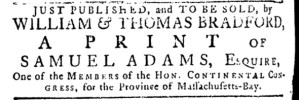
“A PRINT OF SAMUEL ADAMS, ESQUIRE, One of the MEMBERS of the HON. CONTINENTAL CONGRESS.”

The Second Continental Congress convened in Philadelphia after the battles of Lexington and Concord.  It met through most of the summer of 1775, took a recess during August, and started meeting again in September.  The delegates had just resumed their deliberations when William Bradford and Thomas Bradford, the printers of the Pennsylvania Journal, ran an advertisement promoting “A PRINT OF SAMUEL ADAMS, ESQUIRE, One of the MEMBERS of the HON. CONTINENTAL CONGRESS, for the Province of Massachusetts-Bay.”

Even though their advertisement stated, “JUST PUBLISHED, and TO BE SOLD, by WILLIAM & THOMAS BRADFORD,” this seems to have been another instance of printers treating those two phrases separately.  “TO BE SOLD” did indeed refer to the Bradfords stocking and selling the print at their printing office, but “JUST PUBLISHED” did not indicate that they had published the published the print, only that someone had recently published it and made it available for sale.  The Bradfords did not previously attempt to incite demand or gauge interest in a print of Adams among residents of Philadelphia with a subscription notice or other advertisement.

They most likely acquired and sold copies of the print that Charles Reak and Samuel Okey advertised in the Newport Mercury, the Massachusetts Spy, and the Boston-Gazette several months earlier.  In February, Reak and Okey took to the pages of the Newport Mercury to announce their intention to print a “striking likeness of that truly staunch Patriot, the Hon, SAMUEL ADAMS, of Boston.”  Near the end of March, a truncated advertisement in the Massachusetts Spy and the Boston-Gazette advised that “[i]n a few days will be published … A FINE mezzotinto print of that truly worthy Patriot S. A. … executed and published by and for Charles Reak and Samuel Okey, in Newport, Rhode-Island.”  The version in the Massachusetts Spy indicated that more information would appear in the next issue, but the printer, Isaiah Thomas, did not supply additional details in the last few issues printed in Boston before he suspended the newspaper for several weeks and relocated to Worcester just before hostilities commenced at Lexington and Concord.  Those events gave Reak and Okey an expanded market for a print of a Patriot leader already famous in New England.  Their advertisements in Boston’s newspapers listed local agents who would sell their print there.  The Bradfords likely became local agents in Philadelphia rather than publishers of another print of Adams.

August 30

What was advertised in a revolutionary American newspaper 250 years ago today?

Pennsylvania Journal (August 30, 1775).

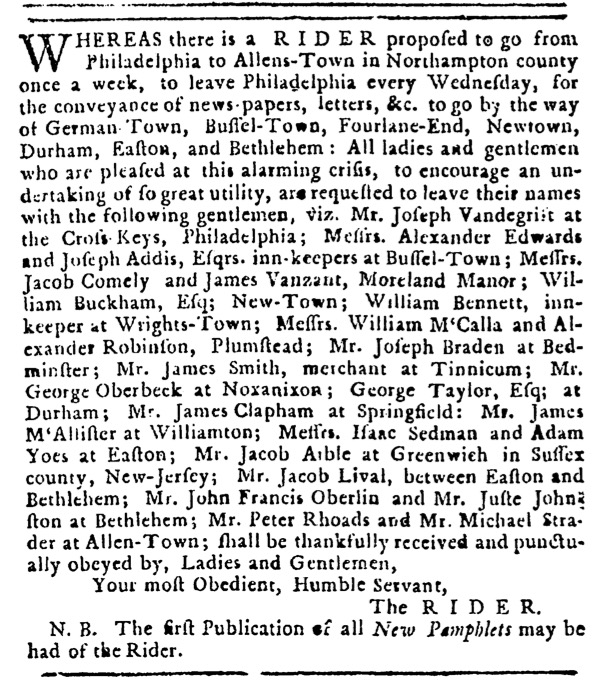
“The first Publication of all New Pamphlets may be had of the Rider.”

An anonymous post rider advertised his services in the August 30, 1775, edition of the Pennsylvania Journal, stating that the “Proposed to go from Philadelphia to Allens-Town in Northampton county once a week.”  He intended to depart from Philadelphia each Wednesday, the same day that a new issue of the Pennsylvania Journal, a weekly publication, hit the streets.  Subscribers to that newspaper along his route would benefit from the quickest possible access to the news in the latest edition.  Although “The RIDER” did not give details about collecting fees, he likely envisioned providing his services via subscription, similar to the plan that Thomas Sculley outlined in an advertisement for his route between Philadelphia and Lewes, Delaware, in the Pennsylvania Ledger a month earlier.  Both post riders contributed to an expanding communication infrastructure.  The same issue of the Pennsylvania Journal that carried the anonymous rider’s advertisement also featured a notice that gave the days the new Constitutional Post departed Philadelphia to carry letters to “New-York, Connecticut, Rhode-Island, Massachusetts-Bay, [and] New-Hampshire.”

The rider framed carrying “news-papers, letters, &c.” as a public service at an important moment, instructing “ladies and gentlemen who are pleased at this alarming crisis, to encourage an undertaking of so great utility … to leave their names with the following gentlemen.”  He then listed twenty-three associates in sixteen towns, demonstrating that he had already devoted significant effort to establishing a network for transmitting information.  The outbreak of hostilities in Massachusetts, the “alarming crisis,” made it more important than ever that colonizers residing in smaller towns gained regular access to newspapers and correspondence.  Some were so eager to read the latest news that they may have been stealing copies of Dunlap’s Maryland Gazette.  The rider aimed to keep colonizers along his route well informed.  “The first Publication of all New Pamphlets,” he stated in a nota bene, “may be had of the Rider.”  The “&c.” (or etc.) in “news-papers, letters, &c.” included the political pamphlets and sermons about current events so often advertised in the Pennsylvania Journal and other newspapers printed in Philadelphia.  Post riders in New England had sometimes acted as local agents for disseminating political pamphlets earlier during the imperial crisis.  The anonymous rider joined their ranks, delivering “news-papers, letters, &c.” with a purpose beyond merely earning his own livelihood.

August 2

What was advertised in a revolutionary American newspaper 250 years ago today?

Pennsylvania Journal (August 2, 1775).

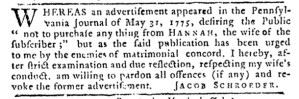
“I hereby … am willing to pardon all offences (if any) and revoke the former advertisement.”

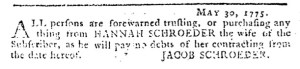
It was a rare retraction.  Jacob Schroeder asked the public to disregard the advertisement he placed regarding his wife, Hannah, a few months earlier.  Some sort of marital discord occurred within the Schroeder household, prompting Jacob to run an advertisement with these instructions: “ALL persons are forewarned trusting, or purchasing any thing from HANNAH SCHROEDER the wife of the Subscriber, as he will pay no debts of her contracting from the date hereof.” Similar advertisements regularly appeared in newspapers throughout the colonies, sometimes more than one in a single issue.  Usually, they indicated that a wife had “eloped” or run away from her husband.  In turn, the husband instructed merchants, shopkeepers, artisans, and others not to allow his wife access to his credit.  Such advertisements often alleged various kinds of bad behavior perpetrated by the wife.  However, husbands set the narrative.  In many instances, the wife likely removed herself from an unhappy or even abusive marriage.  Deprived of credit, most did not have an opportunity to publish their side of the story, though occasionally a wife did find the means to respond in an advertisement.

Retractions made by the husbands were also few and far between in early American newspapers, making Jacob’s advertisement even more noteworthy.  “WHEREAS an advertisement appeared in the Pennsylvania Journal of May 31, 1775, desiring the Public ‘not to purchase any thing from HANNAH, the wife of the subscriber,’” he wrote, “but as the said publication has been urged to me by the enemies of matrimonial concord, I hereby, after strict reflection, respecting my wife’s conduct, an willing to pardon all offences (if any) and revoked the former advertisement.”  He did not offer additional details.  A shorter advertisement cost less, but a desire to avoid as much public scrutiny as possible may have been the deciding factor in not elaborating on the “offences (if any)” or the insinuations made to Jabob by “the enemies of matrimonial concord.”  After all, it would have been embarrassing enough to resort to an advertisement in the first place, an admission that Jacob had been unable to exercise proper authority within his own household.  That the details of Jacob and Hannah’s did not appear in print did not mean that they did not circulate in their neighborhood and beyond.  Those “enemies of matrimonial concord,” whether relatives, friend, or acquaintances, likely gossiped about the couple, as did others.  The appearance of both Jacob’s original advertisement and his retraction may have sparked more conversations and speculation about what occurred in the Schroeder household.  The newspaper notices captured only part of the story.

Pennsylvania Journal (May 31, 1775).

June 28

What was advertised in a revolutionary American newspaper 250 years ago today?

Pennsylvania Gazette (June 28, 1775).

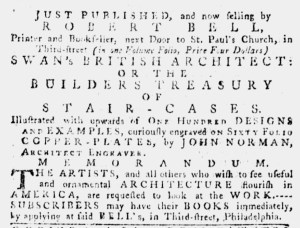
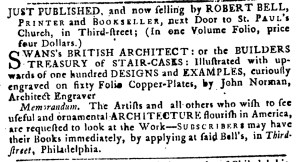
“JUST PUBLISHED … SWAN’s BRITISH ARCHITECT … Illustrated with upwards of ONE HUNDRED DESIGNS AND EXAMPLES.”

At the end of June 1775, Robert Bell, “Printer and Bookseller,” and John Norman, “Architect Engraver,” published an American edition of Abraham Swan’s British Architect: Or, the Builders Treasury of Staircases.  Norman had previously promoted the work with newspaper advertisements and proposals “with a specimen of the plates and letter press” that prospective subscribers could examine.  When the volume was ready for sale and for subscribers to collect the copies they reserved, Bell and Norman ran advertisements in the Pennsylvania Gazette and the Pennsylvania Journal on June 28.  The following day they placed the same advertisement in the Pennsylvania Evening Post.  On July 1, it appeared in the Pennsylvania Ledger and in Story and Humphreys’s Pennsylvania Mercury on July 7.  Of the newspapers printed in English in Philadelphia at the time, only Dunlap’s Pennsylvania Packet did not carry the advertisement.  Bell and Norman made a significant investment in marketing their edition of Swan’s British Architect.

Pennsylvania Journal (June 28, 1775).

To entice prospective customers, they specified that the book was “Illustrated with upwards of one hundred DESIGNS and EXAMPLES, curiously engraved on sixty Folio Copper-Plates” bound into the volume.  They also appended a “Memorandum” requesting that the “Artists and all others who wish to see useful and ornamental ARCHITECTURE flourish … look at the Work.”  If residents of the largest and most cosmopolitan urban port in the colonies wanted their city to maintain and enhance its level of sophistication, Bell and Norman implied, they needed to consider architecture and design important cultural pursuits.  To that end, they also marketed similar publications to those who purchased Swan’s British Architect.  Readers found to subscription proposals bound into the book.  The first one, advertising The Gentleman and Cabinet-Maker’s Assistant with drawings by John Folwell, a local cabinetmaker, and engravings by Norman (dated June 20), faced the title page.  The other, advertising an American edition of Swan’s Collection of Designs in Architecture, Containing New Plans and Elevations of Houses, for General Use (dated June 26), appeared immediately after the letterpress explanations of the engraved illustrations.  The dates on the subscription proposals suggest that they might have circulated separately, yet Bell and Norman made certain to place them before customers who already confirmed an interest in the subject matter.

May 24

What was advertised in a revolutionary American newspaper 250 years ago today?

Pennsylvania Journal (May 24, 1775).

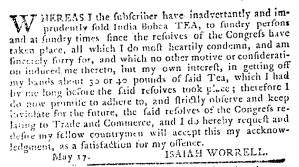
“I … have inadvertently and imprudently sold India Bohea TEA, to sundry persons and at sundry times.”

Isaac Worrell needed to do some damage control when others discovered that he had been selling tea in violation of the third article of the Continental Association in the spring of 1775.  That nonimportation agreement, devised by the First Continental Congress the previous fall, stated “we will not purchase or use any Tea imported on Account of the East India Company, or any on which a Duty hath been or shall be paid; and, from and after the first Dat of March next, we will not purchase or use any East India Tea whatever.”  Yet Worrell had not abided by those terms.

In an advertisement that first appeared in the May 17, 1775, edition of the Pennsylvania Journal and ran again the following week, Worrell confessed that he “imprudently sold India Bohea TEA, to sundry persons and at sundry times since the resolves of the Congress have taken place,” though he claimed that he had done so “inadvertently.”  Readers may have been skeptical that a prohibited act that occurred repeatedly happened “inadvertently.”  All the same, Worrell hoped that they would take note of his explanation for the infractions and accept his apology.  He asserted that he had “no other motive or consideration … but my own interest, in getting off my hands about 30 or 40 pounds of said Tea.”  He also contended that he acquired the tea “long before the said resolves took place,” hoping that would make his offense seem less serious.  At least he had not actively ordered or received new shipments.

Worrell assured his community that he had reformed.  “I do now promise to adhere to, and strictly observe and keep inviolate for the future,” he proclaimed, “the said resolves of the Congress relating to Trade and Commerce.”  He hoped that would be sufficient that “my fellow countrymen will accept this my accknowledgment, as a satisfaction for my offence.”  The Continental Association called for breaking off all ties, commercial and social, with those who violated it, yet Worrell hoped that his apology would outweigh his flimsy excuses to restore him to the good graces of the public. That he managed to sell “30 or 40 pounds of said Tea,” however, suggests that many others did not obey the terms of the Continental Association.  Loyalists accused Patriots of cheating, especially when it came to tea.  Worrell’s notice seems to support such allegations.

May 17

What was advertised in a revolutionary American newspaper 250 years ago today?

Pennsylvania Journal (May 17, 1775).

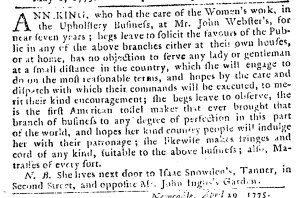
“ANN KING … had the care of the Women’s work, in the Upholstery Business, at Mr. John Webster’s.”

Ann King promoted her experience and expertise when she advertised her services in the May 17, 1775, edition of the Pennsylvania Journal, following an example set by artisans, male and female, who placed notices in newspapers during the era of the American Revolution.  She explained that she “had the care of the Women’s work, in the Upholstery Business, at Mr. John Webster’s, for near seven years.”  Although she had worked with Webster for quite some time, he had not acknowledged her contributions to his enterprise in his own advertisements.  Artisans only occasionally mentioned their assistants in their newspaper notices, yet King’s advertisement testified to the invisible labor performed by employees (as well as family members) in many workshops.  In particular, she reveals that women, whether employees or relative, participated on the production side even though editorials usually depicted them exclusively as consumers.

King took pride in her work.  She proclaimed that she “is the first American tostel [tassel] maker that ever brought that branch of business to perfection in this part of the world.”  If readers had ever admired the tassels that adorned any of the furniture upholstered in Webster’s workshop, then they should hire King when they were in the market for that item.  Even if they were not familiar those tassels, King hoped that her long tenure in a workshop operated by an “Upholsterer from London” who had served “several of the nobility and gentry, both in England and Scotland” would recommend her to prospective clients.  She intended for Webster’s reputation to bolster her own.  In addition to tassels, King “likewise makes fringes and cord of any kind,” part of the “Women’s work” she had overseen for Webster, and even “Mattrasses of every sort.”  She did so with “care and dispatch,” hoping to “merit [the] kind encouragement” of her patrons.

Female shopkeepers and milliners occasionally placed newspaper advertisements, far outnumbering the female artisans who did so.  King took to the public prints to advance her business, demonstrating that women did work alongside men in workshops, though their endeavors were sometimes cast as “Women’s work.”  Webster upholstered furniture “in the best and newest taste” for many years, depending on King and other women for assistance with the final product.  King then leveraged that experience in her effort to earn her livelihood by contracting directly with customers.

May 10

What was advertised in a revolutionary American newspaper 250 years ago today?

Pennsylvania Journal (May 10, 1775).

“The manufacturing of all sorts of Sugar Wares.”

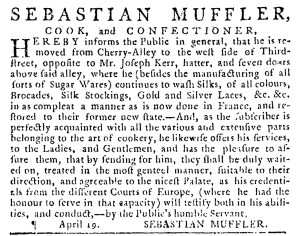
In the spring of 1775, Sebastion Muffler, “COOK, and CONFECTIONER,” ran a newspaper notice to promote his “manufacturing of all sorts of Sugar Wares” at a new location on Third Street in Philadelphia.  Customers would no longer find him in Cherry Alley.  Muffler joined the ranks of confectioners who advertised their services in American port cities, including Peter Lorent in Boston, Frederick Kreitner in Charleston, and P. Lenzi in New York.  Like most of his counterparts, he touted his prior experience on the other side of the Atlantic.  To that end, Muffler proclaimed that he earned “his credentials from the different Courts of Europe, (where he had the honour to serve …)”  That experience, he asserted, “will testify both in his abilities, and conduct.”  The cook and confectioner hoped that would entice “Ladies, and Gentlemen” to hire him.  Upon doing so, they could depend on being “duly waited on, [and] treated in the most genteel manner, suitable to their direction.”  Furthermore, Muffler declared himself “perfectly acquainted with all the various and extensive parts belonging to the art of cookery.”  Accordingly, his clients should anticipate dining “agreeable to the nicest Palate.”

Despite this depiction of his mastery of “the art of cookery” and “manufacturing of all sorts of Sugar Wares,” Muffler apparently depended on a side hustle to earn his livelihood.  He advised readers of the Pennsylvania Journal that he “continues to wash Silks, of all colours,” and other items “in as compleat a manner as is now done in France, and restored to their former new state.”  That was an impressive feat, but not a service directly related to his primary occupation.  In the largest and most cosmopolitan city in the colonies, Muffler needed to supplement the income he earned as a cook and confectioner by providing unrelated services.  Perhaps he hoped that he could eventually establish himself well enough to cultivate a market for his culinary services that made cleaning fabrics unnecessary.  Until then, he included his other occupation in his advertisements.  He hoped that his secondary headline, “COOK and CONFECTIONER,” would attract attention, using it to direct prospective customers to both related and unrelated services.

April 26

What was advertised in a revolutionary American newspaper 250 years ago today?

Pennsylvania Journal (April 26, 1775).

“He still carries on the Cabinet business … no advantages shall be taken of the present times.”

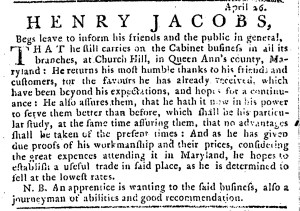
Henry Jacobs had confidence in the circulation of the Pennsylvania Journal when he placed an advertisement in the spring of 1775.  Addressing “his friends and the public in general,” he declared that he “still carries on the Cabinet business in all its branches, at Church Hill, in Queen Ann’s county, Maryland.”  That small town on the colony’s eastern shore was approximately eighty miles from Philadelphia, the bustling port where William Bradford and Thomas Bradford printed the Pennsylvania Journal, yet Jacobs considered advertising in that newspaper a sound investment.  He may not have expected to gain any customers in Philadelphia, but he realized that the Pennsylvania Journal served an extensive readership in Pennsylvania, New Jersey, Delaware, and Maryland.  That meant that “the public in general” in Queen Anne’s County might see his advertisement as copies of the Pennsylvania Journal circulated there.

Yet some of the language in his advertisement suggests that Jacobs did not yet have friends and customers in Maryland.  Near the end of his notice, he stated that he “hopes to establish a useful trade in said place,” indicating that he may have been a newcomer there.  Perhaps Jacobs relocated from Philadelphia.  When he announced that he “still carries on the Cabinet business … at Church Hill,” the “still” may have referred to pursuing his trade but not the location.  Jacobs’s advertisement might have been a moving notice, alerting customers that he left one town and opened a workshop in another.  He hoped to maintain at least some of his former clientele.  If that was the case, it also helps to explain why he chose to advertise in a newspaper published in Philadelphia rather than the Maryland Gazette printed in Annapolis.  Furthermore, he sought an apprentice and a journeyman “of abilities and good recommendation,” possibly seeking staff to assist him at his workshop in a new town.

Like many other colonizers who advertised goods and services, Jacobs expressed gratitude to “his friends and customers, for the favours he has already received.”  Doing so signaled to readers not familiar with him or his furniture that he was an established artisan.  He underscored his skill and experience when he trumpeted that he “has given due proofs of his workmanship.”  Jacobs intended to bolster his reputation, especially when he stated that customers previously placed orders “beyond his expectations.”  Such appeals could have resonated with customers in both Philadelphia and Queen Anne’s County.  The primary purpose of his advertisement, after all, was not to proclaim “his most humble thanks” but instead to drum up new business.  To that end, he asserted that he “hath it now in his power to serve [his customers] better than before,” though he did not explain what he meant when he gave those assurances.  If he had been in Church Hill for some time, perhaps he made improvements to his workshop or acquired new tools.  If he was new to town, he may have referred to his new workshop.  Whatever the case, he promised that “no advantages shall be taken of the present times.”  Jacobs likely had not heard about events at Lexington and Concord on April 19 when he composed his advertisement and submitted it to the printing office.  The “present times” became more complicated as the imperial crisis became a war.

April 19

What was advertised in a revolutionary American newspaper 250 years ago today?

Pennsylvania Journal (April 19, 1775).

“WANTED, at the AMERICAN MANUFACTORY … A Quantity of WOOL, COTTON, FLAX, and HEMP.”

In the middle of March 1775, supporters of a “FUND for establishing and carrying on an AMERICAN MANUFACTORY, of LINEN, WOOLLEN,” and textiles made of other items met at Carpenters’ Hall in Philadelphia to learn more about the undertaking.  They pledged their support by signing their names to “Subscription Papers” or “general Proposals,” either at the meeting or at the London Coffee House in advance.  The organizers and the “Subscribers” sought to encourage “domestic manufactures” (products made in the colonies) as alternatives to imported goods.  Entrepreneurs had been pursuing that goal for more than a decade during the imperial crisis, though many devoted more effort during the times that colonizers adopted nonimportation agreements as political leverage.  In the spring of 1775, those involved with the “AMERICAN MANUFACTORY” did so as part of the Continental Association.  Its eighth article called for “encourage[ing] Frugality, Economy, and Industry; and promot[ing] Agriculture, Arts, and the Manufacturers of this Country.”

A month later, advertisements concerning the venture simultaneously appeared in the Pennsylvania Gazette and the Pennsylvania Journal on April 19.  “WANTED, At the AMERICAN MANUFACTORY,” the notices advised, “A Quantity of WOOL, COTTON, FLAX, and HEMP.”  Readers could demonstrate their commitment to the cause by supplying the resources necessary to produce textiles in the colony.  The advertisement also noted that “a number of spinners and flax dressers may meet with employment” at the manufactory, contributing to the success of the Continental Association while earning their livelihoods.

When the printers of the Pennsylvania Gazette and the Pennsylvania Journal distributed the weekly issue of their newspapers on April 19, they were not yet aware of the momentous events that happened at Lexington and Concord in Massachusetts that morning, though it would not take long for word to spread to Philadelphia and throughout the colonies.  Historians have long debated when the American Revolution began, echoing the question that John Adams posed to Thomas Jefferson in 1815: “What do We mean by the Revolution?  The War?  That was no part of the Revolution.  It was only an Effect and Consequence of it.  The Revolution was in the Minds of the People, and this was effected, from 1760 to 1775, in the course of fifteen Years before a drop of blood was drawn at Lexington.”  Establishing the “AMERICAN MANUFACTORY” in Philadelphia before the war, according to Adams, was part of the revolution.  Today, however, the 250th anniversary of the battles at Lexington and Concord offers a convenient moment for commemorating the American Revolution by aligning it with the Revolutionary War that secured independence for a new nation composed of thirteen former colonies.  For readers of the Pennsylvania Journal in 1775, the political cartoon depicting a severed snake with the motto “UNITE OR DIE” had already been spreading its message for many months.  The masthead, the articles and letters, and many of the advertisements had been part of a revolution that was already occurring “in the Minds of the People.”

Pennsylvania Journal (April 19, 1775).