April 27

What was advertised in a revolutionary American newspaper 250 years ago today?
Norwich Packet (April 27, 1775).

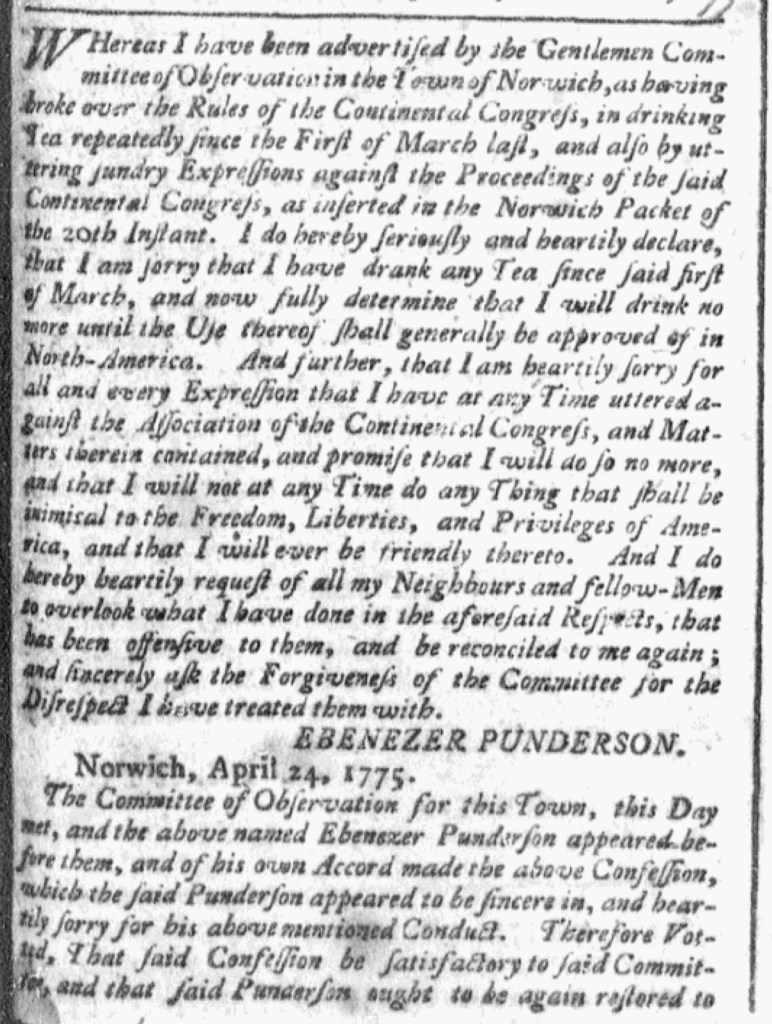
I am sorry that I have drank any Tea.”

Ebenezer Punderson had the misfortune of appearing in an advertisement placed in the Norwich Packet by the local Committee of Inspection in the issue that carried the first newspaper coverage of the battles of Lexington and Concord.  The committee accused him of drinking tea in violation of the Continental Association, disparaging the First Continental Congress, and refusing to meet with the committee to discuss his conduct.  In turn, the committee advised the public not to carry on any “Trade, Commerce, Dealings or Intercourse” with Punderson.

Perhaps Punderson would have weathered that sort of public shaming under other circumstances, but news of events at Lexington and Concord made his politics even more unpalatable and his situation more dire.  From what ran in the newspaper, it did not take him long to change his tune, meet with the committee, and publish an apology for his behavior.  In a missive dated four days after the committee’s advertisement, Punderson reiterated the charges against him and “seriously and heartily” declared the he was “sorry I have drank any Tea since the first of March” and “will drink no more until the Use thereof shall generally be approved in North-America.”  In addition, he apologized for “all and every Expression that I have at any Time uttered against the Association of the Continental Congress.”  Furthermore, Punderson pledged that he “will not at any Time do any Thing that shall be inimical to the Freedom, Liberties, and Privileges of America, and that I will ever be friendly thereto.”  He requested that his “Neighbours and fellow-Men to overlook” his transgression and “sincerely ask[ed] the Forgiveness of the Committee for the Disrespect I have treated them with.”
Norwich Packet (April 27, 1775).

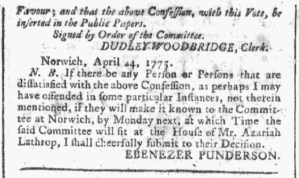
Punderson apparently convinced the committee to give him another chance.  Dudley Woodbridge, the clerk, reported that Punderson “appeared before them, and of his own Accord made the above Confession” and seemed “heartily sorry for his … conduct.”  In turn, the committee voted to find Punderson’s confession “satisfactory” and recommended that he “be again restored to Favour” in the community.  The committee also determined that “the above Confession, with this Vote, be inserted in the Public Papers,” perhaps less concerned with restoring Punderson’s good name than the example his recantation set for other Tories.  When the notice appeared in the Norwich Packet, Punderson inserted an additional note that extended an offer to meet with anyone “dissatisfied with the above Confession” and asserted that he would “cheerfully submit” to any further decisions the Committee of Inspection made in response.

Yet what appeared in the Norwich Packet did not tell the whole story.  According to Steve Fithian, Punderson “attempted to flee to New York but was captured and returned to Norwich where he spent eight days in jail and only released after signing a confession admitting to his loyalist sympathies.”  He did not stay in Norwich long after that.  “Several weeks later he fled to Newport, Rhode Island and boarded a ship which took him to England where he remained for the entire Revolutionary War.”  Apparently, he convincly feigned the sincerity he expressed, well enough that the committee accepted it.  While imprisoned, Punderson wrote a letter to his wife about his ordeal.  After arriving in England, he published an account with a subtitle that summarized what he had endured: The Narrative of Mr. Ebenezer Punderson, Merchant; Who Was Drove Away by the Rebels in America from His Family and a Very Considerable Fortune in Norwich, in Connecticut.  Just as the Committee of Inspection used print to advance a version of events that privileged the patriot cause, Punderson disseminated his own rendering once he arrived in a place where he could safely do so.

**********

The Committee of Inspection’s notice appeared with the advertisements in the April 20, 1775, edition of the Norwich Packet.  Punderson’s confession, however, ran interspersed with news items in the April 27 edition.  It may or may not have been a paid notice, but it was certainly an “advertisement” in the eighteenth-century meaning of the word.  At the time, according to the Oxford English Dictionary, an advertisement was a “(written) statement calling attention to anything” and “an act of informing or notifying.”  Advertisements often delivered local news in early American newspapers.  Punderson definitely made news as the imperial crisis became a war.

January 23

What was advertised in a colonial American newspaper 250 years ago today?

Massachusetts Gazette and Boston Post-Boy (January 23, 1775).

“This Paper, has been printed with ink manufactured by said Geyer, for several Months past.”

When the Continental Association went into effect, colonizers looked to “domestic manufactures” or goods produced in the colonies as alternatives to imports.  The eighth article of that nonimportation, nonconsumption, and nonexportation agreement even stated that “we will, on our several Stations, encourage Frugality, Economy, and Industry; and promote Agriculture, Arts and the Manufactures of this Country.”  Henry Christian Geyer did just that in an advertisement that appeared in the January 23, 1775, edition of the Massachusetts Gazette and Boston Post-Boy.  He announced that he “manufactured” printing ink “in large or small Quantities, at his Shop near Liberty-Tree South-End of Boston.”  Devoting such “Industry” to the “Manufactures of this Country” testified to Geyer’s support of the American cause; noting the proximity of his shop and such an important symbol underscored his patriotism.

Yet Geyer had more to say about the matter.  He proclaimed to “the Public” that “the Royal American Magazine, was not printed with his Ink.”  His advertisement gave no indication why he singled out the Royal American Magazine and not any of the newspapers published in Boston or any of the city’s printing offices.  After all, if he had captured the entire market (except for the Royal American Magazine) then he had less need to place an advertisement.  He chose to shame Joseph Greenleaf, the publisher of the Royal American Magazine, for not purchasing his product, perhaps intending to bully him into buying Geyer’s printing ink or perhaps settling some score by embarrassing him in a public forum.

Geyer’s advertisement concluded with a nota bene that clarified that “This Paper, has been printed with Ink manufactured by said Geyer, for several Months past.”  Geyer may have written the nota bene himself, presenting a testimonial of the quality of the ink that readers could assess for themselves as they held the Massachusetts Gazette and Boston Post-Boy in their hands.  Alternately, Nathaniel Mills and John Hicks, the printers of the newspaper, could have added the nota beneon their own as a means of demonstrating that they supported domestic manufactures even before the Continental Association went into effect.

September 22

What was advertised in a colonial American newspaper 250 years ago today?

Maryland Gazette (September 22, 1774).

“YES, YOU SHALL BE PAID; BUT NOT BEFORE YOU HAVE LEARNED TO BE LESS INSOLENT.”

The saga continued.  Elie Vallette, the clerk of the Prerogative Court in Annapolis and author of the Deputy Commissary’s Guide, did not bow to the public shaming that Charles Willson Peale, the painter, undertook in the pages of the Maryland Gazette in September 1774.  Earlier in the year, Peale had painted a family portrait for Vallette and then attempted through private correspondence to get the clerk to pay what he owed.  When Vallette did not settle accounts, Peale turned to the public prints.  He started with a warning shot in the September 8 edition of the Maryland Gazette: “IF a certain E.V. does not immediately pay for his family picture, his name shall be published at full length in the next paper.”  Peale meant it.  He did not allow for any delay in Vallette taking note of the advertisement and acting on it.  A week later, he followed through on his threat, resorting to all capitals to underscore his point, draw more attention to his advertisement, and embarrass the recalcitrant clerk.  “MR. ELIE VALLETTE,” Peale proclaimed in his advertisement, “PAY ME FOR PAINTING YOUR FAMILY PICTURE.”

That still did not do the trick.  Instead, it made Vallette double down on delaying payment.  He responded to Peale’s advertisement, attempting to put the young painter in his place.  In a notice also in all capitals, he lectured, “MR. CHARLES WILSON PEALE; ALIAS CHARLES PEALE – YES, YOU SHALL BE PAID; BUT NOT BEFORE YOU HAVE LEARNED TO BE LESS INSOLENT.”  Vallette sought to shift attention away from his own debt by critiquing the decorum of an artist he considered of inferior status.  That strategy may have worked, though only for a moment.  Peale’s advertisement did not run in the next issue of the Maryland Gazette.  That could have been because Peale instructed the printer, Anne Catharine Green, to remove his notice and returned to working with Vallette privately.  Even if that was the case, it was only temporary.  “MR. ELIE VALLETTE, PAY ME FOR PAINTING YOUR FAMILY PICTURE” appeared once again in the October 6 edition.  Peale was not finished with his insolence.  He placed the advertisement again on October 13 and 20.  Vallette did not run his notice a second time, perhaps considering it beneath him to continue to engage Peale in the public prints.  He had, after all, made his point, plus advertisements cost money.  That being the case, the painter eventually discontinued his notice.  Martha J. King notes that Vallette “eventually settled his account about a year later.”[1]  For a time, advertisements in the only newspaper printed in Annapolis became the forum for a very public airing of Peale’s private grievances and Vallette’s haughty response.

**********

[1] Martha J. King, “The Printer and the Painter: Portraying Print Culture in an Age of Revolution,” Transactions of the American Philosophical Society 109, no. 5 (2021): 79.

September 15

Who was the subject of an advertisement in a colonial American newspaper 250 years ago today?

Maryland Gazette (September 15, 1774).

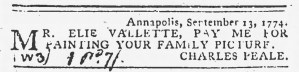
“MR. ELIE VALLETTE, PAY ME FOR PAINTING YOUR FAMILY PICTURE.”

Charles Willson Peale followed through on his threat.  He had placed an advertisement in the September 8, 1774, edition of the Maryland Gazette warning that “IF a certain E.V. does not immediately pay for his family picture, his name shall be published at full length in the next paper.”  The subject of the painter’s notice had not heeded it, perhaps mistakenly believing that Peale would not have the audacity to actually do what he suggested.  If that was the case, he miscalculated because a week later the very first advertisement in the next issue of the Maryland Gazette proclaimed, “MR. ELIE VALLETTE, PAY ME FOR PAINTING YOUR FAMILY PICTURE.”  Using all capital letters signaled the artist’s frustration; it also called greater attention to the advertisement.

Another advertisement involving Vallette appeared on the next page of the newspaper.  That one, which had first appeared four months earlier, promoted the Deputy Commissary’s Guide, a book that Vallette had authored and invested many months in acquiring subscribers before taking it to press.  He had advertised extensively in the Maryland Gazette.  His name did not happen to appear in the most recent advertisement; instead, it gave the title of the book and featured an endorsement by William Fitzhugh, the colony’s commissary general.  Martha J. King suggests that Vallette did not place the advertisement for the Deputy Commissary’s Guide, asserting that Anne Catherine Greene, the printer of both the Maryland Gazette and Vallette’s book, ran that notice.[1]  To whatever extent Vallette was or was not involved in continuing to advertise the Deputy Commissary’s Guide following publication, he was proud enough of his achievement as an author that the book with its engraved title page appeared in the foreground of the family portrait Peale painted.  Peale’s notices may not have been the kind of acclaim that Vallette desired, but the painter had given him public notice after seeking payment in private letters for several months.

Readers of the Maryland Gazette witnessed one side of the feud as it escalated from one week to the next in September 1774.  Some may have found the spectacle entertaining, a good bit of gossip.  Now that he had been named in the public prints, how would Vallette react?  Would the disagreement escalate even more?  Readers had a new reason to peruse the advertisements in the next edition of the Maryland Gazette.

**********

[1] Martha J. King, “The Printer and the Painter: Portraying Print Culture in an Age of Revolution,” Transactions of the American Philosophical Society 109, no. 5 (2021): 79.

September 8

What was advertised in a colonial American newspaper 250 years ago today?

Maryland Gazette (September 8, 1774).

“IF a certain E.V. does not immediately pay for his family picture, his name shall be published at full length in the next paper.”

A private scuffle over paying for a portrait became a public spectacle when Charles Willson Peale resorted to shaming Elie Vallette, author of the Deputy Commissary’s Guide, in a newspaper advertisement.  A notice in the September 8, 1774, edition of the Maryland Gazette advised that “IF a certain E.V. does not immediately pay for his family picture, his name shall be published at full length in the next paper.”  The painter, who signed his name as “CHARLES PEALE,” was near the beginning of his career, though he had already studied with Benjamin West in London for two years and then provided his services in Annapolis for a dozen more.  Still, at the time he sought the overdue payment, he was not yet the prominent figure, one of the most influential America painters and naturalists of his era, that he would become in the decades after the American Revolution.  He gained access to the power of celebrity later in his career, but at the moment he vied with Vallette he sought to leverage public shaming as the most effective tool available.

As Martha J. King notes, Peale “obtained a commission to paint a group portrait of the Vallette family and portrayed the author seated at a table with the engraved title page of the Deputy Commissary’s Guide clearly visible in the foreground.  [His] wife and two children clustered in the picture’s right.”[1]  Vallette had extensively advertised the Deputy Commissary’s Guide in the Maryland Gazette, gaining prominence for himself and his manual for settling estates and writing wills.  Commissioning a family portrait served to further enhance his status, yet the dispute that followed did not necessarily reflect well on Vallette.  On May 28, 1774, Peale sent a letter to Vallette to request payment, explaining that he needed to cover immediate expenses that included rent on the house where his family resided.[2]  The author did not heed that request.  Three months later, Peale decided to escalate his methods for collecting on the debt, placing the advertisement that gave Vallette’s initials and enough information that the author would recognize himself and perhaps enough that some readers could work out his identity, but not so much that readers in Annapolis and throughout the colony knew without a doubt that Peale addressed Vallette.  Was this strategy effective?  Next week the Adverts 250 Project will examine the subsequent issue of the Maryland Gazette to determine whether Peale had to further escalate his demand for payment.

**********

[1] Martha J. King, “The Printer and the Painter: Portraying Print Culture in an Age of Revolution,” Transactions of the American Philosophical Society 109, no. 5 (2021): 78.

[2] King, “Printer and the Painter,” 78.

June 29

What was advertised in a colonial American newspaper 250 years ago today?

Essex Gazette (June 29, 1773).

“Our Customers are very willing their Papers should be read … by any Person who will be so kind as to forward them.”

Newspapers stolen before subscribers read them: the problem dates back to the eighteenth century … and probably even earlier.  It became such an issue in Massachusetts in the summer of 1773 that Samuel Hall and Ebenezer Hall, the printers of the Essex Gazette, inserted a notice addressing the situation.  The printers recognized that many subscribers who lived outside Salem “depend upon receiving their Papers by transient Conveyance” or by indirect means as postriders and others delivered bundles of letters and newspapers to designated locations, such as taverns or shops, with the expectation that members of those communities would then distribute the items to the intended recipients.

The Halls expressed their appreciation to “any Persons for their Favours in forwarding any Bundles to the respective Persons and Places that they are directed to.”  They also acknowledged that their “our Customers are very willing their Papers should be read, after the Bundles are opened, by any Person who will be so kind as to forward them to their Owners in due Season.”  However, all too often that did not happen.  Those who should have felt obliged to see that the newspapers reached the subscribers, especially after they read someone else’s newspaper for free, waited too long to do so or set them aside and forgot about them completely.  That being the case, the printers “earnestly” requested that “those who have heretofore taken up Paper only for their own Perusal, and afterwards thrown them by, or not taken any Care to send them to those who pay for them, would be so kind as not to take up any more.”  Instead, they should “leave them to the Care of those who are more kindly disposed” to see them delivered to the subscribers.

To make the point to those most in the need of reading it, the Halls declared that they “had the Names of some (living in Andover) … who, after having taken up and perused the Papers, and kept them several Days, were at last ashamed to deliver them to the Owners.”  The printers, as well the subscribers, considered this practice “very ungenerous.”  The Halls made a point of advising the culprits that they were aware of who read the newspapers without forwarding them to the subscribers.  They hoped that an intervention that did not involve naming names or directly contacting the perpetrators would be sufficient in altering such behavior.  They did not scold the offenders for reading the newspapers without subscribing.  Indeed, they framed that practice as something printers expected, but they did remind those readers that such generosity did not deserve the “very ungenerous” habit of hoarding and disposing of newspapers instead of forwarding them to the subscribers in a timely manner.  This was one of many challenges that colonial printers encountered in maintaining an infrastructure for disseminating information.

June 5

What was advertised in a colonial American newspaper 250 years ago today?

Jun 5 - 6:5:1770 South-Carolina Gazette and Country Journal
South-Carolina Gazette and Country Journal (June 5, 1770).

“ANN & BENJAMIN MATHEWES … VIOLATORS OF THE RESOLUTIONS.”

The “GENERAL COMMITTEE” responsible for overseeing adherence to the nonimportation agreement adopted in Charleston in July 1769 ran an advertisement in the June 5, 1770, edition of the South-Carolina Gazette and Country Journal to inform the community of two violations.  The story of the first had unfolded over several months.  Benjamin Mathewes, a merchant and “Subscriber to the Resolutions,” had imported “sundry Goods from London” in January, but upon being detected had “voluntarily agreed to store” them until nonimportation came to an end and “a general Importation should take Place.”  The committee published the new agreement that Mathewes signed to that effect.

For many colonists caught in such circumstances that was the end of the story.  Newspaper notices published in several colonies documented violators attempting to rehabilitate their reputations and relationships with the community by making special effort to abide by the terms of the nonimportation agreed after they had been discovered deviating from it.  Such was the case for William Glen and Son, “having also been guilty of a Breach of the Resolutions.”  Glen and Son acknowledged that they had imported some textiles “contrary to the Resolutions” and then agreed to store them for the duration of the boycott.  However, “through Mistake” they “disposed of a few Pieces.”  For that error, they “declare our Sorrow” and promised to “adhere strictly to the Resolutions” in the future.  Glen and Son also agreed to deposit the remainder of the textiles and other goods “in the public Stores” where they would not have access to them, thus offering reassurance that the mistake would not happen again.  The committee stated that Glen and Son depicted the incident as “an Act of Inadvertence, rather than Design” and recommended that their pledge to turn over the remaining textiles “will be received as a sufficient Atonement for their Fault, and restore them to the Public’s Favour and Confidence.”

Mathewes, on the other hand, did not make the same effort to demonstrate his recalcitrance, prompting the committee to take a different approach to his case.  Although he affixed his signature to an apology and claimed that he would turn over the goods, the Committee of Inspection discovered that “many of the said Goods … had been opened” and sold.  Mathewes claimed that his mother, Ann, also a subscriber to the nonimportation agreement, had been responsible for their sale while he was away from town.  Neither mother nor son “ma[d]e proper Satisfaction to the Public for such shameful Breach of their sacred Contracts.”  Indeed, the elder Mathewes continued to sell the goods “in manifest Violation of the said Resolutions.”

This resulted in consequences.  Although the General Committee had shown “all possible Lenity and Forbearance” in attempting to resolve the situation, they came to the point that they deemed it necessary to advertise “ANN & BENJAMIN MATHEWES, as VIOLATORS OF THE RESOLUTIONS.”  The committee asserted that these violators were guilty of “counteracting the united Sentiments of the whole Body of the People, not only in this, but all the Northern Provinces; and prefering their own little private Advantage to the general Good of AMERICA.”  The Mathewes had betrayed both consumers and their country.  The Committee even more stridently made that point, proclaiming that “every such Violator should be treated with the utmost Contempt.”  Furthermore, the committee instructed those who supported the nonimportation agreement “against having any commercial Dealings whatever with the said ANN & BENJAMIN MATHEWES.”  Until they took the necessary actions to redeem themselves, “their Actions must declare them to be obstinate and inveterate Enemies to their Country, and unworthy of the least Confidence or Esteem.”

The General Committee told two stories of violations of the nonimportation agreement, one about the contrite Glen and Son and the other about two generations of the Mathewes family who refused to abide by the resolutions they had signed.  In each instance, the committee made recommendations for how members of the community should interpret these actions and react to the perpetrators.  By publishing this advertisement, the committee used the power of the press in their efforts to achieve compliance with the agreement and shape the narrative of resistance to the duties on certain imported goods that Parliament imposed in the Townshend Acts.

March 30

What was advertised in a colonial American newspaper 250 years ago today?

Mar 30 - 3:30:1770 New-Hampshire Gazette
New-Hampshire Gazette (March 30, 1770).

“The trifling expence of a News Paper.”

Colonists did not have to subscribe to newspapers to gain access to their contents.  Some subscribers passed along newspapers to friends and neighbors.  A single newspaper could change hands several times.  Proprietors of coffeehouses often subscribed to a variety of newspapers that they made available to their patrons, just one of the many amenities intended to make their establishments more cosmopolitan and attractive to customers.  Colonists sometimes read aloud from newspapers in taverns, sharing news and editorials with larger audiences than read the articles themselves.  Colonists did not need to subscribe in order to read or hear about the news.  They could gain access to newspapers in public venues … or they could steal them.

The theft of newspapers was a sufficiently chronic problem that Daniel Fowle and Robert Fowle, printers of the New-Hampshire Gazette, inserted a notice in the March 30, 1770, edition of the New-Hampshire Gazette.  The Fowles excoriated the “mean, lowliv’d Fellows, who have not Souls large enough to be at the trifling expence of a News Paper, yet are continually stealing their Neighbours, and others.”  The Fowles did not deliver the New-Hampshire Gazettedirectly to subscribers.  Instead, they dispatched copies from their printing office in Portsmouth to taverns “in the several Country Towns” with the intention that subscribers would pick them up or arrange for delivery by a local carrier.  Too many “lowliv’d Fellows,” however, interfered with the system by picking up newspapers that belonged to others and “never deliver[ing them] to the proper Owners.”

The Fowles were concerned about subscribers not receiving their newspapers, but they were just as worried about the impact this “vile and scandalous Practice” would have on their business.  Customers who regularly did not receive their newspapers were likely to discontinue their subscriptions.  Theft endangered another important revenue stream.  The Fowles lamented that the missing newspapers were “often a Damage on Account of Advertisements,” a twofold problem.  First, advertising represented significant revenue that made it possible to disseminate the news.  If prospective advertisers suspected that their advertisements did not reach the intended audiences then they might refrain from placing them.  Second, many advertisements, especially notices about public meetings, estate notices, and legal notices, delivered news that supplemented the articles, editorials, and letters that appeared elsewhere in the newspaper.  Advertisements underwrote the newspaper business while also informing readers of matters of public interest.

The situation reached a point that the Fowles called on their “good Customers” to inform them “of those Fellows Names” who had “abused both the Customers & Printers in this Way for Years past.”  The Fowles planned to publish a list of the offenders, a public shaming that included descriptions of “their proper Character,” as well as prosecute them “as the Law directs for stopping Letters, News Papers.”  Newspaper advertisements frequently reported the theft of consumer goods in eighteenth-century America, but this notice indicates that “lowliv’d Fellows” also stole newspapers and, by extension, access to information.