May 1

What was advertised in a colonial American newspaper 250 years ago this week?
May 1 - 4:28:1768 Massachusetts Gazette
Massachusetts Gazette (April 28, 1768).

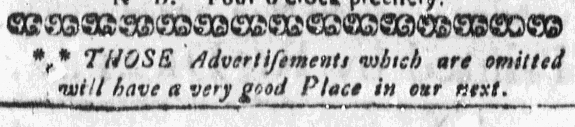
THOSE Advertisements which are omitted will have a very good Place in our next.”

Richard Draper inserted a short notice at the bottom of the middle column on the third page of the April 28, 1768, edition of the Massachusetts Gazette. In it, the printer informed the public that “THOSE Advertisements which are omitted will have a very good Place in our next.” Like the abbreviated colophon (“Printed by R. DRAPER”) that appeared at the same place on the final page, it looked like the printer barely had enough space to squeeze this announcement into an issue that quite literally overflowed with news, editorials, and, especially, advertising. Unlike other printers in Boston and elsewhere in the colonies, Draper did not issue a supplement. Perhaps he did not have sufficient time or resources to do so. Perhaps he did not have sufficient content to fill an additional two pages, even though he had not been able to run all of the advertisements he had received.

Proportionally, Draper did publish a significant quantity of advertisements compared to other content in the April 28 edition. More than thirty advertisements of various lengths accounted for nearly two-thirds of the space, filling seven of the twelve columns and extending well into an eighth. Although the Massachusetts Gazette was alternately known as the Boston News-Letter, it also functioned as a delivery mechanism for advertising of all sorts in addition to news. In this particular issue, for instance, merchants and shopkeepers promoted vast assortments of consumer goods and services. Vendue masters highlighted which goods would be presented for bids at upcoming auctions. Local officials inserted legal notices. Executors called on debtors and creditors to settle accounts. Two schoolmistresses declared their intentions to open a boarding school for young ladies. Timothy Force warned others not to allow his wife to contract any debts in his name because she “has eloped and keeps away, and refuses to live with me.” All the way from Antigua, Edward Gamble announced an estate sale that included a plantation and 151 enslaved men, women, and children.

Although more than half of the paid notices in that issue featured consumer goods and services, “subscribers” placed advertisements with various purposes and goals in mind. Each expected some sort of results or return on their investment. In his own notice concerning “Advertisements which are omitted,” Draper primarily addressed advertisers rather than readers, though his announcement may have also incited anticipation about what else might appear in the pages of the next issue among some readers. The printer offered a consolation to advertisers, promising “a very good Place in our next.” That promise suggested that the printer put more consideration into the order of advertisements than their haphazard arrangement on the page otherwise indicated. That he could not include all of them in the issue also testified to the popularity of his publication, implying that prospective advertisers should follow the lead established by their peers and place their notices in the Massachusetts Gazette. After all, demand for space in that newspaper was so high, presumably because advertisers believed the publication placed their advertisements before as many eyes as possible, that Draper could not include all of them. Though he did not state it so bluntly, the printer transformed his inability to disseminate all the advertisements submitted for the April 28 edition into a rationale for others to advertise in his newspaper when choosing among the several published in Boston at the time.

October 8

What was advertised in a colonial American newspaper 250 years ago today?

Oct 8 - 10:8:1767 Massachusetts Gazette
Massachusetts Gazette (October 8, 1767).

The Advertisements taking up so much Room, the several Articles intended for this Page are thrown into a SUPPLEMENT.”

This notice appeared at the bottom of the first column on the second page of the October 8, 1767, edition of the Massachusetts Gazette. Richard Draper followed a standard procedure among eighteenth-century printers: when faced with too much content to fit into the allotted space he opted to distribute a two-page supplement along with the regular issue. This happened fairly frequently, especially in major port cities. Higher concentrations of residents meant greater numbers of advertisements to squeeze into each week’s four-page issue, sometimes yielding supplements devoted almost exclusively to advertising. The October 8 supplement, however, consisted primarily of news items as a result of “The Advertisements taking up so much Room” in the regular issue.

Draper and the Massachusetts Gazette did not have a higher number of advertisers than usual. Instead, advertisements placed by two local shopkeepers occupied significant amounts of space. Shopkeeper Jolley Allen continued publication of his lengthy list-style advertisement that filled two entire columns on the final page. Not to be outdone, bookseller John Mein commenced a new full-page advertisement for his “grand Assortment of the most MODERN BOOKS In every Branch of Polite Literature Arts and Sciences,” the one that he intended to launch in the Boston-Gazette three days earlier. That advertisement combined a previous advertisement for “A NEW EDITION of Dilworth’s Spelling Book” (set apart almost as a distinct advertisement in the lower right corner) and descriptions of two other books followed by a list of other books and stationery supplies in stock. The compositor created four narrow columns instead of the usual three slightly wider ones, resulting in a new look for that particular page compared to the rest of the newspaper.

Overall, just two advertisements accounted for nearly half of the October 8 issue of the Massachusetts Gazette, making the supplement practically a necessity. This happened as a result of both the printer and the advertisers experimenting with the format for newspaper notices. Although colonial newspapers published full-page advertisements sporadically in the 1760s, having an issue dominated by only two advertisements would have been an extraordinary event for readers, one that would have garnered even more notice among potential customers for John Mein and Jolley Allen.

May 29

What was advertised in a colonial newspaper 250 years ago today?

May 29 - 5:29:1766 Massachusetts Gazette Extraordinary
Massachusetts Gazette Extraordinary (May 29, 1766).

Print played a significant role in the coming of the American Revolution. Some scholars argue for the primacy of newspapers in facilitating debate, giving a voice to protest, and shaping public opinion. Other printed items, however, also played a role, including pamphlets, sermons, almanacs, and engraved images (the eighteenth-century counterpart to modern political cartoons). Many of the advertisements selected for inclusion here directly addressed the discontent over the Stamp Act, some of them by marketing tracts that defended the colonies against the abuses of Parliament.

Printers and booksellers simultaneously expressed political views and sought to earn a living by advertising and selling items related to the crisis while the Stamp Act was still in effect. That did not change when the Stamp Act was repealed, though the rhetoric may have shifted slightly. Rather than promote a work condemning an overzealous and overreaching Parliament, today’s advertisement announced the publication of a “Thanksgiving-Discourse, on the REPEAL of the Stamp-Act.” That hated piece of legislation was gone, but printers continued to express their political beliefs – and they seized new opportunities to turn a profit as well.

In this case, politics might have slightly edged out profit. Three printing firms that otherwise would have been competitors joined together to advertise and sell the “Thanksgiving-Discourse”: Richard Draper and Samuel Draper (printers of the Massachusetts Gazette), Benjamin Edes and John Gill (printers of the Boston-Gazette) and Thomas Fleet and John Fleet (printers of the Boston Evening-Post).

**********

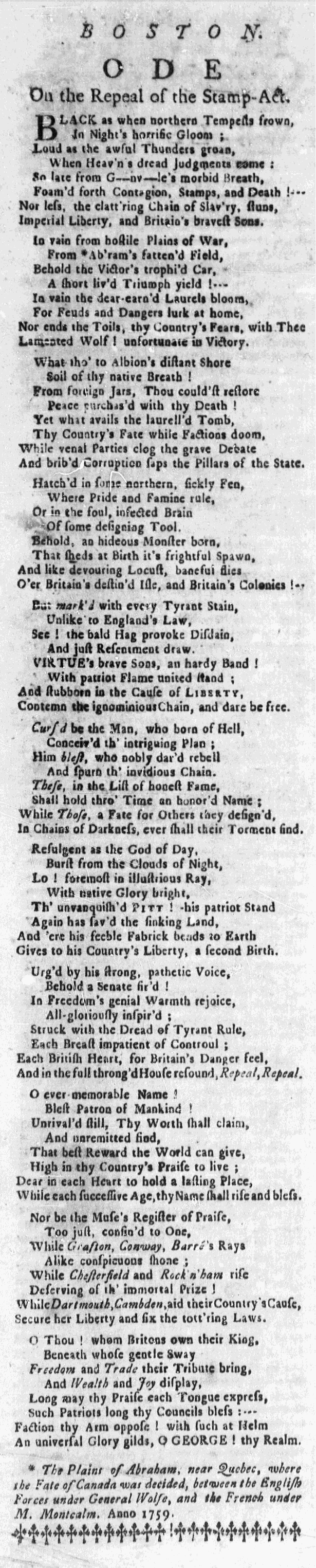
Bonus: Newspapers carried more than editorials and advertisements that commented on politics. This “ODE On the Repeal of the Stamp-Act” appeared in the Massachusetts Gazette in the same week as the advertisement for the “Thanksgiving-Discourse, on the REPEAL of the Stamp-Act.”

May 29 - 5:29:1766 Massachusetts Gazette
Massachusetts Gazette (May 29, 1766).