
What was advertised in a revolutionary American newspaper 250 years ago this week?
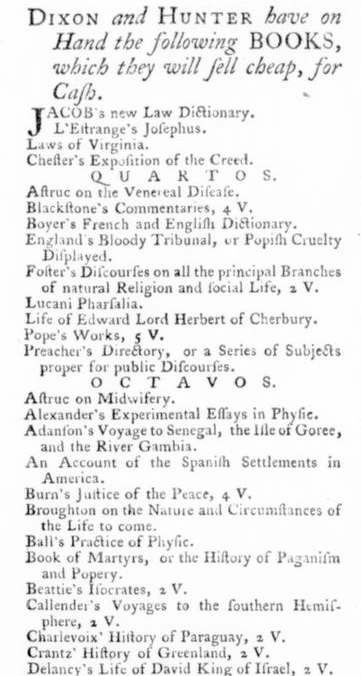
“DIXON and HUNTER have on Hand the following BOOKS, which they will sell cheap, for Cash.”
John Dixon and William Hunter doubled the size of the Virginia Gazette that they published on August 24, 1776. Like other newspapers, it usually consisted of four pages created by printing two pages on each side of a broadsheet and then folding it in half. This time, however, they used two broadsheets, bringing the total number of pages to eight. That meant printing the first, second, seventh, and eighth pages on one broadsheet and the third, fourth, fifth, and sixth pages on another, tucking the second folded broadsheet inside the first one.
The printers devoted the entire fifth page and half of the sixth page to a book catalog, something they did occasionally in other issues as well. A brief introduction informed readers that “DIXON and HUNTER have on Hand the followingBOOKS, which they will sell cheap, for Cash.” A lengthy list of books followed. The printers arranged them in order of size – folios, quartos, octavos, and duodecimos – from largest to smallest. The catalog included only four folios and nine quartos but dozens of octavos and duodecimos, some of them in multiple volumes. Within each category, Dixon and Hunter arranged the titles in rough alphabetical order by author, such as “Burn’s Justice of the Peace” or “Pope’s Works,” but sometimes by title, such as “An Account of the Spanish Settlements in America.” That made the list easier for readers to navigate, especially if they were looking for a particular volume.
The format of the catalog distinguished it from news, editorials, and other advertisements in that issue of the Virginia Gazette. Most content appeared in two wide columns, but the catalog had three columns. If an entry was too long or just one line in the narrower columns, the printers indented the second and subsequent lines, differentiating each entry from the ones above and below it. On the sixth page of the newspaper, the second page of the catalog, that meant that three columns appeared on the top half of the page but only two columns on the bottom half. Once again, the format distinguished Dixon and Hunter’s advertisement from other content. The catalog concluded with a list of “SCHOOL BOOKS” and “STATIONARY” in dense paragraphs of text. Readers had to invest more effort in finding “Ruddiman’s Grammatical Exercises” and “Entick’s Latin and English Dictionary” or “Pewter Ink Chests of various Kinds” and “Magazine Paper for Ladies to work upon.”
Dixon and Hunter printed twice as much content for subscribers and other readers of the August 24, 1776, edition of the Virginia Gazette, yet their own advertisement, their book catalog, accounted for a significant portion of the additional content. They exercised their privilege as printers of the newspaper to promote another endeavor that generated revenue in their printing office.