June 24

What was advertised in a revolutionary American newspaper 250 years ago today?

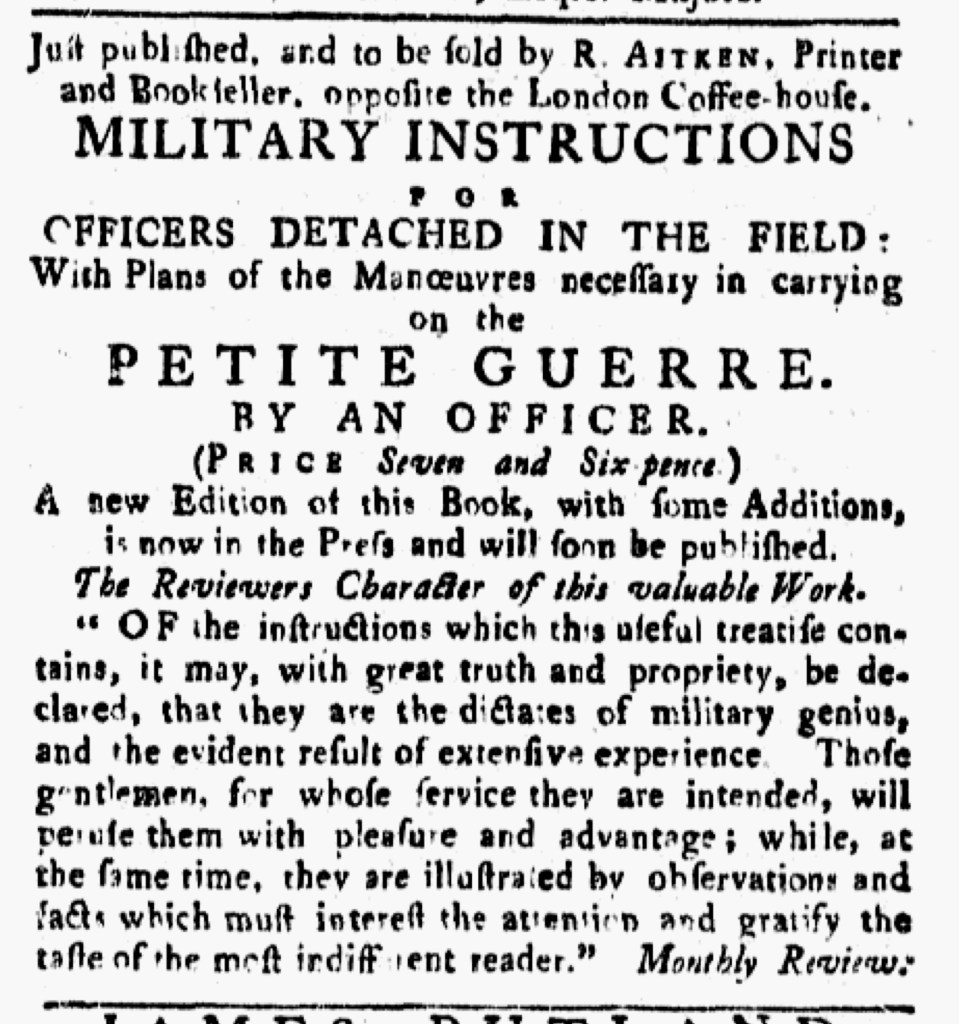
Pennsylvania Ledger (June 24, 1775).

“MILITARY INSTRUCTIONS FOR OFFICERS DETACHED IN THE FIELD.”

It was a timely volume for the summer of 1775.  The June 24 edition of the Pennsylvania Ledger carried an advertisement for Military Instructions for Officers Detached in the Field: With Plans of the Manoeuvres Necessary in Carrying on the Petite Guerre.  Robert Aitken, a printer and bookseller in Philadelphia, published and sold an American edition of a book that had been successful enough in England to go to a second edition the previous year.

Aitken marketed it at a time that readers of the Pennsylvania Ledger already knew about the battles at Concord and Lexington and the siege of Boston.  They were just learning about the Battle of Bunker Hill a week earlier.  In the column to the left of the advertisement for Military Instructions, the Pennsylvania Ledger reprinted a portion of a letter that reported “our people attempting to take possession of Bunker’s Hill and Dorchester Point … were attacked by the regulars.”  The correspondent did not have all the details, but did know that “three Colonels in our service were wounded, Col. Gardner, mortally; how many are slain on either side, is uncertain.”  The letter did not mention the death of Joseph Warren, a noted Patriot and the president of the Massachusetts Provincial Congress, nor did it reveal the outcome of the battle.  “When the post came away,” the letter stated, “our people kept their ground and made a stand; how they have fared at Dorchester, we do not hear.”  Incomplete, it was the most recent update available in Philadelphia at the time the June 24 edition of the Pennsylvania Ledger went to press.

Still, it likely primed some readers to take greater interest in Military Instructions written “BY AN OFFICER.”  To help in stimulating demand, Aitken inserted an excerpt of a review that appeared in the Monthly Review, a magazine published in London.  “OF the instructions which this useful treatise contains,” the reviewer asserted, “it may, with great truth and propriety, be declared, that they are the dictates of military genius, and the evident result of extensive experience.”  That made the book required reading for colonizers serving as officers.  “Those gentlemen, for whose service they are intended,” the reviewer pronounced, “will peruse them with pleasure and advantage.”  Yet that was not the only prospective audience for Military Instructions.  The reviewer insisted that “they are illustrated by observations and facts which must interest the attention and gratify the taste of the most indifferent reader.”  With battles being fought in New England and George Washington “appointed commander in chief of all the North-American forces by the Honourable Continental CONGRESS” (according to an update that appeared just below the initial report from Bunker Hill), could any prospective reader have been “indifferent” when they saw Aitken’s advertisement?

June 18

What was advertised in a colonial American newspaper 250 years ago this week?

Jun 18 - 6:15:1769 Pennsylvania Journal
Pennsylvania Journal (June 15, 1769).

“ROBERT AITKEN, Bookseller, From Glasgow.”

Robert Aitken, a bookseller, kept shop in Philadelphia only briefly in 1769. In an advertisement in the Pennsylvania Journal, he announced that he had “just now arrived” from Glasgow and “opened his store” on Front Street. His inventory consisted of “a valuable variety of books,” including literature, history, law, medicine, and divinity as well as novels, plays, songs, and ballads. Aitken offered something agreeable to the tastes of practically any reader.

To stimulate sales, the bookseller advised “Such who intend to furnish themselves with any of the above articles” to make their purchases as soon as possible or else miss their chance because he did not intend to remain in Pennsylvania long. Indeed, he did make “but a short stay” in Philadelphia, returning to Scotland before the year ended. Yet he must have been encouraged by the prospects available in Philadelphia. He returned two years later and remained in the city until his death in 1802.

In his History of Printing in America, Isaiah Thomas offers an overview of Aitken’s career. Born in Dalkeith, Scotland, Aitken apprenticed to a bookbinder in Edinburgh. After his initial sojourn as a bookseller in Philadelphia in 1769, he returned in 1771 and “followed the business of bookselling and binding, both before and after the revolution.”[1] In 1774, he became a printer. In January 1775 he founded the Pennsylvania Magazine, one of only seventeen magazines published in the colonies before the American Revolution.[2] It survived for a little over a year, ending its run in July 1776. He earned some renown for publishing an American bible in 1802, though Thomas contests the claim that it was the first printed in America.

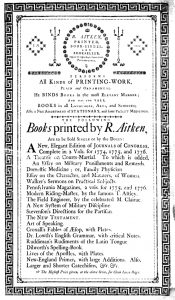
Aitken Broadside
Robert Aitken, Advertising Broadside (Philadelphia: 1779). Courtesy Library Company of Philadelphia.

Like other eighteenth-century printers, Aitken contributed to the culture of advertising in early America. His ledger, now in the collections of the Historical Society of Pennsylvania, lists several broadsides, billheads, and other printed materials distributed for the purposes of advertising that are otherwise unknown since, unfortunately, copies have not survived. He delivered the Pennsylvania Magazine enclosed in advertising wrappers; these are also rare, though some can be found among the collections of the Library Company of Philadelphia. He also printed broadsides listing books he printed in Philadelphia. One also advised prospective clients that Aitken bound books and “PERFORMS All KINDS of PRINTING-WORK, PLAIN and ORNAMENTAL.” The ornamental printing on that broadside was a model of the advertising that Aitken could produce for his customers.  Aitken’s first newspaper advertisements in 1769 barely hinted on the influence he would exert over early American advertising, both as an advertiser of his own goods and services and as a producer of advertising for others who enlisted him in printing broadsides, handbills, magazine wrappers, trade cards, and other media intended to stimulate consumer interest.

**********

[1] Isaiah Thomas, History of Printing in America with a Biography of Printers and an Account of Newspapers (1810; 1874; New York: Weathervane Books, 1970), 401.

[2] See “Chronological List of Magazines” in Frank Luther Mott, A History of Americasn Magazines, 1741-1850 (Cambridge, Massachusetts: Harvard University Press, 1939), 787-788.