September 4

Who was the subject of an advertisement in a colonial American newspaper 250 years ago this week?

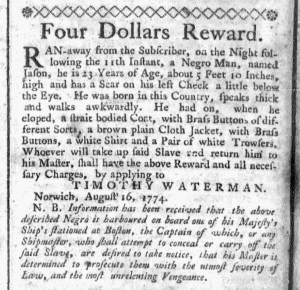
Norwich Packet (September 1, 1774).

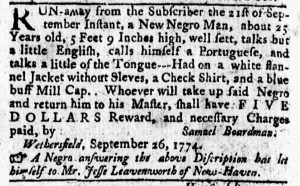
“RAN-away … a Negro Man named Jason.”

Like every other newspaper published in the colonies, from New England to Georgia, during the era of the American Revolution, the Norwich Packet carried advertisements that described enslaved men and women who liberated themselves by running away from their enslavers.  Such advertisements encouraged all colonizers to engage in surveillance of Black bodies to determine whether the people they encountered matched descriptions in the newspapers, offering rewards to those who provided information or captured and returned fugitives seeking freedom.

One such advertisement appeared as summer turned to fall in 1774.  Jason, an enslaved man “born in this Country,” departed sometime during the night of August 11.  Timothy Waterman of Norwich spent a few days trying to find Jason on his before resorting to a newspaper advertisement dated August 16.  It first ran in the August 18 edition of the Norwich Packet and appeared again on August 25.  For its third iteration in the weekly newspaper, Waterman’s notice included a nota bene with an update: “Information has been received that the above described Negro is harboured on board one of his Majesty’s Ship’s stationed at Boston.”  Waterman did not reveal the source of this information.  Perhaps his advertisement and its dissemination far beyond Norwich yielded this lead.  Waterman warned the captain of that vessel “or any Shipmaster” that should they “attempt to conceal or carry off said slave … that his Master is determined to prosecute them with the utmost severity of Law, and the most unrelenting Vengeance.”  He sought to combine the power of the press and the power of the state in his effort to retrieve Jason and return him to enslavement.

Waterman also expected that the Norwich Packet and the Connecticut, Massachusetts, New-Hampshire, and Rhode-Island Weekly Advertiser circulated widely enough that ship captains in Boston would either see his advertisement or otherwise become aware of it.  The information infrastructure worked in favor of enslavers and against enslaved men and women who made their own declarations of independence during the era of the American Revolution.  That so many of these advertisements appeared in colonial newspapers, year after year, decade after decade, suggests that they must have been effective, at least to some degree, or else enslavers would not have continued investing in them.

July 4

Who was the subject of an advertisement in a colonial American newspaper 250 years ago today?

New-York Gazette and Weekly Mercury (July 4, 1774).

“RAN AWAY … a Negro Man named GEORGE.”

On June 4, 1774, a “Negro Man named GEORGE” liberated himself from his enslaver, Abraham Lawrence of “Flushing on Long-Island,” by running away.  In hopes of recovering George and returning him to slavery, Lawrence ran an advertisement in the New-York Gazette and Weekly Mercury.  It first appeared in the June 13 edition and continued for several issues, including the one published on July 4.  The enslaver hoped to enlist the aid of the public, offering “FIVE DOLLARS Reward” and providing a description of George so readers could identify him as they engaged in surveillance of Black men they encounter.  Lawrence also issued a standard warning: “All Masters of Vessels and others, are forbid carrying off, or harbouring said Run-away, as they will be dealt with according to Law.”  Already utilizing the power of the press, Lawrence was prepared to deploy the power of the state to return George to slavery and punish anyone who assisted this fugitive from slavery.

Lawrence’s description of George differed significantly from how George would have described himself, focusing on physical characteristics.  According to the enslaver, George “is of a yellowish Complexion, has black bushy Hair, which he commonly wears tied behind; 5 feet 8 Inches high.”  Lawrence did not indicate George’s approximate age, which language(s) he spoke, any skills he possessed or trades he followed, or whether he had been born in the colonies or Africa, nor did he mention any relations with other enslaved people.  Other advertisements often included such details.  Lawrence devoted the most attention to George’s clothing: “a whitish Linen Coat, a grey homespun Coat, blue Jacket, Buff coloured half-worn Velvet Breeches, with some Patches, black Stockings, and old Shoes.”  The enslaver reporter that George “most commonly wears his Hat cocked” and suspected that he “may change his Coat to a brown.”  In so doing, Lawrence acknowledged that George was clever, but condemned him for applying his intelligence to what the enslaver considered nefarious purposes.

Quite possibly, this may be the only trace of George that survives in the historical record, an account of his escape from slavery written not by himself but by an enslaver seeking his capture and return.  It tells an exceptionally truncated account of George’s life.  Despite the intentions of its author, this advertisement tells a story of courage, resilience, and resistance during the era of the American Revolution.  News coverage and editorials elsewhere in the July 4, 1774, edition of the New-York Gazette and Weekly Mercury focused on the imperial crisis, especially the aftermath of the Boston Port Act devised as punishment for the Boston Tea Party.  George may or may not have heard rumblings about that.  Either way, he made his own declaration of independence on June 4, 1774, much to the dismay of his enslaver.

For other stories of enslaved people liberating themselves originally published on July 4 during the era of the American Revolution, see:

May 31

Who was the subject of an advertisement in a colonial American newspaper 250 years ago today?

Essex Gazette (May 31, 1774).

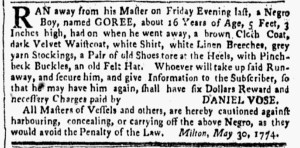
“RAN away … a Negro Boy, named GOREE.”

As the summer of 1774 approached, an enslaved youth named Goree saw his opportunity to liberate himself by running away from Daniel Vose of Milton, Massachusetts.  Vose, for his part, joined the ranks of enslavers who placed newspaper advertisement that offered rewards for the capture and return of enslaved men and women who made similar declarations of independence during the era of the American Revolution.  He provided a description of the Goree, encouraging readers to engage in surveillance of all Black people, especially young Black men, with the intention that such scrutiny would aid in identifying him.  Vose also warned “All Masters of Vessels and others … against harbouring, concealing, or carrying off” Goree or else face “the Penalty of the Law” for aiding him.

Massachusetts Gazette and Boston Post-Boy (May 30, 1774).

Vose made quite an investment in locating and securing Goree.  In addition to offering “six Dollars Reward and necessary Charges” for securing him in jail and sending word to Milford, he also ran advertisements in several newspapers.  On May 30, his notice appeared in the Boston Evening-Post, the Boston-Gazette, and the Massachusetts Gazette and Boston Post-Boy, all three newspapers published in Boston on Mondays.  His advertisement in the Massachusetts Gazette and Boston Post-Boy even included a crude woodcut depicting an enslaved man on the run as a means of drawing attention to it.  Apart from the masthead, that was the only image in that issue of the newspaper.  The following day, Vose ran the same advertisement in the Essex Gazette, published in Salem.  He did not place his advertisement in the Massachusetts Gazette and Boston Weekly News-Letter or the Massachusetts Spy, both published in Boston on Thursdays, perhaps believing that four newspapers printed in two towns provided sufficient dissemination of Goree’s description and the reward for capturing him.

South-Carolina Gazette and Country Journal (May 31, 1774).

Vose was not alone in placing such advertisements in multiple newspapers.  At the same time that he sought to enlist the aid of other colonizers in securing an enslaved youth who liberated himself, Charles Ogilvie ran advertisement about “a Negro Man named MINOS” in the South-Carolina and American General Gazette on May 27, the South-Carolina Gazette on May 30, and the South-Carolina Gazette and Country Journal on May 31.  That accounted for every newspaper published in Charleston and the rest of the colony at the time.  Ogilvie had recently purchased Minos “at Mr. Benjamin Wigfall’s Sale,” but Minos had other ideas.  The enslaver suspected that Minos had assistance from “his Wife at Mr. Elias Wigfall’s” or his “many Relations” in the “Parishes of St. James, Santee, and Christ Church,” believing that they “harboured” or hid him.  Although not his purpose in placing the advertisement, Ogilvie revealed one of Minos’s likely motivations for liberating himself.

In both New England and South Carolina, enslavers like Vose and Ogilvie went to great expense in running advertisements about enslaved people who liberated themselves.  Such notices were not a feature solely of the newspapers published in southern colonies during the era of the American Revolution.  Instead, they appeared in newspapers throughout the colonies, part of the everyday culture of slavery from New England to Georgia.

May 24

Who was the subject of an advertisement in a colonial American newspaper 250 years ago today?

Connecticut Courant (May 24, 1774).

“RUN away … a negro man about 27 years of age.”

An advertisement in the May 24, 1774, edition of the Connecticut Courant offered a reward for the capture and return of an unnamed “negro man about 27 years of age” who liberated himself by running away from Thomas Moses, his enslaver.  Moses provided a description, declaring that the “negro man … lisps in his speech” and wore “a brown coat and red waistcoat, a white holland shirt, a new castor hat, a new pair of leather breeches, [and] a pair of blue stockings.”  He also took other clothing with him, items that he could use to vary his appearance or sell in his efforts to make good on his escape.  Moses stated that he would present ten dollars to “Whoever shall take up said negro and return him to me” or five dollars to whoever would “secure him in any of his majesty’s goals [jails] and send me word so that I may have him again.”  In a nota bene, he warned, “All persons are hereby forbid to harbour said negro on penalty of law.”

The first half of that advertisement appeared at the bottom of a column that featured an editorial with a headline that proclaimed, “JOIN OR DIE!!!”  A more extensive version first ran in the May 16 edition of the Newport Mercury as a combination of news and opinion.  An abbreviated version, the first paragraph, then circulated in other newspapers as printers followed the common practice of reprinting items from one publication to another.  The shorter version featured an additional exclamation mark for emphasis.  The editorial commented on the Boston Port Act and Parliament’s intention “to reduce its spirited inhabitants to the most servile and mean compliance ever attempted to be imposed on a free people.”  This new legislation was “infinitely more alarming and dangerous to our common liberties, than even that hydra the Stamp Act.”  While directed at Boston in retaliation for the destruction of tea the previous December, the Boston Port Act, according to the anonymous author, was also “a direct hostile invasion of every province on the continent.”  The people of Boston “nobly stood as a barrier against slavery.”  Now residents of other towns needed to do the same “to stand … for the relief, support, and animation of our brethren in the insulted, besieged capital of Massachusetts-Bay” because “nothing but unity, resolution, and perseverance, can save ourselves and posterity from what is worse than death — SLAVERY.”

Connecticut Courant (May 24, 1774).

Twice in a single paragraph, the author of the editorial invoked slavery as the consequence of Parliament’s treatment of the colonies.  Ebenezer Watson, the printer of the Connecticut Courant, selected that piece to feature in his newspaper and placed it in proximity to an advertisement that offered a reward for capturing an enslaved man who liberated himself.  A single advertisement, a probate notice, separated the editorial from the “RUN away” advertisement.  Perhaps even as he generated revenue from publishing the latter, Watson recognized the juxtaposition of very different concepts of slavery and could not position one item right after the other.  Just as likely, however, that juxtaposition did not register.  After all, Moses’s advertisement was one of at least eighty-five advertisements about enslaved people that ran in nineteen newspapers, including nine published in New England, that week.  Even as many printers advocated for liberty for colonizers who faced the prospect of figurative enslavement by Parliament, the early American press participated in perpetuating the literal enslavement of Africans, African Americans, and Indigenous Americans with advertisements for buying and selling enslaved people and notices calling on colonizers to capture enslaved people who liberated themselves by running away from their enslavers.  The proximity of such advertisements to content similar to the “JOIN OR DIE!!!” editorial was a common feature of newspapers published during the era of the American Revolution.

December 2

Who was the subject of an advertisement in a colonial American newspaper 250 years ago today?

Norwich Packet (December 2, 1773).

“RUN away … a Negro Boy, named PIGGEN.”

It was the ninth issue of the Norwich Packet, a newspaper established by Alexander Robertson, James Robertson, and John Trumbull in October 1773.  The ninth issue included an advertisement that described “a Negro Boy, named PIGGEN,” who liberated himself by running away from his enslaver, James Rogers.  The advertisement documented the clothing worn by the young man, “about 19 years of age,” when he departed from New London, Connecticut.  Rogers also reported that Piggen “speaks good English,” encouraging readers to listen to Black men they did not recognize as well as take note of their apparel.  Anyone who identified Piggen, captured him, and returned him to Rogers “shall have three dollars reward.”  This advertisement resembled so many others that appeared in newspapers from New England to Georgia.

It may not have been the first paid notice about an enslaved person that appeared in the Norwich Packet.  The first several issues have not survived.  Coverage in America’s Historical Newspapers, the most extensive database of digitized images of eighteenth-century newspapers, begins with the sixth issue.  Previous issues might have included advertisements offering enslaved men, women, and children for sale or advertisements about other enslaved people who liberated themselves.  Every newspaper published in New England at the time ran such advertisements.  Whether or not Rogers’s advertisement about Piggen was the first to appear in the Norwich Packet, it took the Robertsons and Trumbull no more than two months to incorporate this particular kind of content into their new publication.  In both northern colonies and southern colonies, printers quickly became complicit in perpetuating slavery by publishing such advertisements.  In Baltimore, for instance, the first issue of the Maryland Journal, published August 20, 1773, included an advertisement by a broker seeking to purchase and enslaved girl and a notice promising a reward for Prince, an enslaved man who emancipated himself.  In the third issue of Rivington’s New-York Gazetteer, published May 6, 1773, James Rivington published an advertisement offering a “Very fine Negro Boy” for sale.  Nathaniel Mills and John Hicks became the new proprietors of the Massachusetts Gazette and Boston Post-Boy in the spring of 1773.  They continued publishing advertisements about enslaved people, a policy already in place at that newspaper.  When printers ran such advertisements, they generated revenues that underwrote the dissemination of other news during the era of the American Revolution.

October 8

Who was the subject of an advertisement in a colonial American newspaper 250 years ago today?

Connecticut Journal (September 10, 1773).

“RUNAWAY … a Molatto Fellow named PERO.”

“Said Pero, was born FREE of an Indian Woman, called Hannah Moree.”

Late in the summer of 1773, Samuel Turner of Hartford inserted an advertisement about “a Molatto Fellow named PERO” in the Connecticut Journal and New-Haven Post-Boy.  Turner alerted the public that Pero an enslaved man who ran away and offered a reward for his capture and return.  In enlisting the aid of readers in the surveillance of young men with darker skin, the enslaver provided a description of Pero that included his approximate age, height, and clothing.  He also threatened that “All Masters of Vessels and Others are forbid harbouring, concealing, or carrying off said Fellow at their Peril,” suggesting that he would initiate legal action against anyone who assisted his human property in liberating himself.

Connecticut Journal (October 8, 1773).

Several weeks later, Oliver Collins and Benjamin Douglass challenged Turner’s version of events with advertisements of their own.  Collins cited the issue in which he saw “an Advertisement sign’d Samuel Turner, offering Five Dollars Reward for taking up a Molatto Fellow, named Pero, whom the said Turner claims to be a Slave for Life.”  Turner misled the public, according to Collins.  He asserted that the young man, also known as Aaron, “was born FREE of an Indian Woman, called Hannah Moree.”  As a young child, Pero had been “bound to me by Advice of Authority … per Indenture, bearing the Date the 16th of Nov. 1750.”  Furthermore, the indenture ended five years earlier in 1768 when Aaron turned twenty-one.  Collins pleaded with “all who have the common Feelings of Humanity, to yield their Influence and Assistance to protect the said Indian against all Attempts upon his just Liberty.”  Turner attempted to leverage the power of the press to enslave Aaron, just as so many other colonizers did in their newspaper advertisements about enslaved people who liberated themselves, while Collins demonstrated that the press could be an instrument for extending and protecting freedom when colonizers chose to use it for those ends.

Advertisements alone, however, would not secure Aaron’s liberty.  Benjamin Douglas turned to the courts in his efforts to aid the young man.  Citing the same advertisement that Turner inserted “in this Paper, No. 308,” on September 10, Douglas declared his “full Conviction that Aaron Moree, a Molatto Fellow,” also known as Pero, “was free born.”  Sympathetic to the young man pursued by Douglas and perhaps hounded by colonizers who recognized him from the advertisement, Douglas “commenced a Suit for the Trial of his Liberty, and taken him into my Service and Protection, until it shall be issued.”  Ignoring Turner’s threats against anyone “harbouring, concealing, or carrying off” Aaron, Douglas issued his own warning to “any, who under the Influence of that Advertisement, may molest the said Aaron, that it shall be at their own Peril.”

Whatever Collins and Douglas’s views about enslaving Africans, African Americans, and Indigenous Americans more generally, they recognized the injustices in the case of Aaron Moree.  Most advertisements concerning enslaved people published in the early 1770s sought to perpetuate their enslavement.  In contrast, colonizers occasionally published newspaper notices that challenged slavery.  In this instance, that challenge focused on an individual, yet it demonstrated that the press did not have to be the tool of enslavers exclusively.

August 20

Who were the subjects of advertisements in a colonial American newspaper 250 years ago today?

Maryland Journal (August 20, 1773).

“A NEGRO GIRL, about 12 years old.”

“RAN away … Negro PRINCE.”

After many months of disseminating subscription proposals and promoting the Maryland Journal, the first newspaper published in Baltimore, William Goddard printed and distributed the first issue on August 20, 1773.  In addition to subscribers, he sought advertisers to generate revenues that would make the enterprise viable.  In an update that appeared in the May 20 edition of the Maryland Gazette, for instance, Goddard pledged that “seasonable notice will be given in this gazette, to give gentlemen an opportunity to advertise in the first number.”  Just as John Dunlap managed to do when he launched the Pennsylvania Packet, Goddard attracted a significant number of advertisers for the first issue of the Maryland Journal.  Advertising accounted for a little more than four of the twelve columns in the inaugural issue.

Those advertisements included some that previously appeared in other newspapers, including Daniel Grant’s notice that he opened an inn and tavern “at the Sign of the Fountain” in Baltimore and a lengthy notice concerning land in the Ohio River valley placed by Virginia planter and land speculator George Washington.  Other advertisers included Christopher Hughes and Company, “GOLDSMITHS and JEWELLERS,” David Evans, “CLOCK and WATCH-MAKER,” Francis Sanderson, “COPPERSMITH,” Grant and Garrison, “TAYLORS,” and Mr. Rathell, “Teacher of the ENGLISH Language, Writing-master and Accomptant.”

Maryland Journal (August 20, 1773).

In addition, Thomas Brereton, “COMMISSION and INSURANCE BROKER,” placed a short notice in which he “GRATEFULLY acknowledges the favours of his friends, and hopes for a continuance of their correspondence.”  He also reported that he “has now for sale, a Pocket of good HOPS, a 10-inch new CABLE – and wants to buy a NEGRO GIRL about 12 years old.”  In another advertisement, Richard Bennet Hall described a Black man, Prince, who had liberated himself the previously December.  Prince was captured once “at Susquehanna Lower Ferry, but made his escape, and is often seen in the neighbourhood.”  The formerly enslaved man managed to elude capture, but Hall hoped his advertisement would help put an end to that. He offered five dollars who anyone who detained Prince in a local jail “so that that the owner may get him again” or ten pounds and “reasonable charges” to anyone who delivered Prince to Hall in Prince George’s County.  In its very first issue, the Maryland Journal became an instrument for perpetuating slavery with both a brokerage notice related to the slave trade and an advertisement encouraging readers to engage in surveillance of Black men in order to identify an enslaved man who liberated himself and assist in returning him to captivity.  Goddard had prior experience publishing such advertisements in the Providence Gazette and the Pennsylvania Chronicle.  From New England to Georgia, no newspaper printer in the colonies rejected advertisements about enslaved people.  Instead, they solicited and accepted them as an integral part of generating revenues that underwrote publishing news and editorials.

July 9

Who was the subject of an advertisement in a colonial American newspaper 250 years ago today?

New-London Gazette (July 9, 1773).

“Ran away … a NEGRO Man Slave named PRINCE.”

When “a NEGRO Man Slave named PRINCE” liberated himself by running away from his enslave, John Mulford “of East-Hampton, on Long Island,” in June 1773, the story became frontpage news in the New-London Gazette.  Timothy Green, the printer, did not actually treat the story as news, but he did run Mulford’s advertisement describing Prince and offering a reward for his capture and return on the front page of the July 9 edition of his newspaper.  Prince may have been familiar to some readers since he previously “lived about Six Years with Mr. Daniel Denison, at Stonington, in New-London County,” a roundabout way of saying that Denison enslaved Prince before Mulford did.  Like many other advertisements – from legal notices and estate notices to advertisements about burglaries and thefts to notices about wives who “eloped” from their husbands to advertisements about apprentices, enslaved people, and indentured servants who “ran away” to notices about lotteries that funded public works projects – this one delivered news to readers.  In many instances, advertisements provided more local news than printers inserted elsewhere in their newspapers.

Mulford’s advertisement about Prince was not the only paid notice on the first page of the July 9 edition of the New-London Gazette.  Green (or a compositor who worked in the printing office) positioned a real estate notice, an advertisement for a “variety of Goods suitable for the SEASON” available at a shop in Norwich, and the notice describing Prince as the first items in the first column.  An editorial “Continued from our last” issue filled the rest of the column and the remainder of the page.  Additional advertisements, including one about “two melatto men slaves,” Edward Peters and Rufus Cooper, who liberated themselves from Ezekiel Root of Pittsfield, Massachusetts, appeared on the third and fourth pages.  How did any advertisements land on the front page?  A standard edition of the New-London Gazette and other colonial newspapers consisted of four pages created by printing two on each side of a broadsheet and folding it in half.  Printers usually printed the first and fourth pages on one side, let the ink dry, and then printed the second and third pages on the other side.  Since many advertisements ran for several weeks, printers used type already set when they printed the first and fourth pages, reserving the second and third pages for the latest news that arrived in the printing office.  In this instance, Green selected advertisements and the continuation of an editorial to take to press while he figured out the content for the remaining two pages.  As a result, Prince’s escape and liberation from his enslaver became frontpage news.

July 4

Who were the subjects of advertisements in colonial American newspapers 250 years ago this week?

Pennsylvania Journal (June 30, 1773).

“RUN AWAY … a Negro Man named Peter.”

For the past six years, the Adverts 250 Project has marked Independence Day by featuring the (incomplete) stories of enslaved men and women who made their declarations of independence when they liberated themselves by escaping from their enslavers during the era of the American Revolution.  These stories are incomplete because they are drawn from newspaper advertisements placed by enslavers who enlisted the aid of readers in scrutinizing Black people in hopes of capturing and returning to enslavement fugitives seeking freedom.  Still, despite their intentions in placing the advertisements, those enslavers who sought to maintain slavery and racial hierarchies provided truncated accounts of courage, resilience, and devotion to liberty that resonate today.

July 4 fell on a Sunday in 1773.  Sunday was the one day of the week that no printer published and distributed a new edition of their weekly newspaper anywhere in the colonies.  Rather than select a single advertisement from 250 years ago this week to feature on Independence Day, the Adverts 250 Project presents this census of all of the advertisements about enslaved men and women who liberated themselves that appeared in newspapers from New England to South Carolina during the week before July 4, 1773.  As these advertisements demonstrate, enslaved people knew the value of freedom throughout the era of the American Revolution and certainly before July 4, 1776.

On Monday, June 28, 1773, the New-York Gazette and Weekly Mercury carried an advertisement about “a certain Mulatto fellow named Harry” who liberated himself from his enslaver in Newark, New Jersey.  Harry “speaks good English” and “understands the Pot-Ash Business.”

On the same day, the Supplement to the Pennsylvania Packet ran a notice offering a reward for “a negro man named STANHOPE.”  He had been enslaved in Philadelphia, but made his escape from his most recent enslaver at Trenton Ferry on the Pennsylvania side of the Delaware River.

Also on June 28, 1773, the South-Carolina Gazette featured an advertisement offering a reward for “A New Negro Fellow, named Johnny, Of the Gambia Country” who liberated himself from a plantation in Prince William’s Parish.  Johnny endured the Middle Passage, resolving to claim his freedom after arriving in the colonies.

In the same issue, another notice described “A sensible Country born FELLOW, Named BILLY” who fled from his enslaver in St. Thomas’s Parish.  Andrew Deveaux described Billy as “about five Feet five Inches high, Twenty-one Years of Age, and has a Scar over one of his Eyes.”  Billy did not have the opportunity to tell his own story in the public prints.

On Tuesday, June 29, 1773, the Connecticut Courant carried an advertisement about “a negro man named TONEY” who liberated himself from his enslaver at Hebron.  Samuel Gilbert, Jr., suspected that Toney and Samuel Gilbert, a white “hired man,” found common cause and cooperated in escaping from him.

On Wednesday, July 30, 1773, the Pennsylvania Gazette featured a notice about “a Negroe man slave, named RAGON” who fled from his enslaver in New Castle, Delaware.  Richard McWilliam suspected that Ragon “keeps near Ogletown” where he had previously been enslaved.  If Ragon had written his own story, he may have mentioned family and friends in the area.

Another advertisement in that newspaper offered a reward for “a young Negroe man, named ANDREW” who liberated himself from Christiana Hundred in New Castle County, Delaware.  To make good on his escape, “it is probably he will change his clothes” to avoid detection by readers of newspapers who participated in the surveillance of Black men and women.

Also on June 30, 1773, the Pennsylvania Journal ran an advertisement about “a Negro Man named Peter” who escaped from John McCalla in Philadelphia.  His enslaver believed that Peter “will endeavour to pass for a free man” and would likely visit his mother, “a free woman named Violet,” in Trenton.

One Thursday, July 1, 1773, the Maryland Gazette featured an advertisement about “a negro man named Till” who liberated himself from his enslaver in Anne Arundel County.  Till apparently made a previous attempt.  Benjamin Lane reported that Till “was heard to say if he ever went away again he should endeavour to get on the Eastern shore” where he formerly lived.  Like others who seized their liberty, Till may have been headed to family and friends.

In the same issue, another advertisement described “a certain negro man named BOB” who escaped from his enslaver at Mount Pleasant in Spotsylvania County, Virginia.  Bob planned carefully.  He stole some clothing to disguise himself, “procured a forged pass,” and presented himself as a free man named Robert Alexander.

That edition of the Maryland Gazette also carried an advertisement about “a mulatto slave named JACK” who “plays on the violin.”  Jack liberated himself from his enslaver in Garrison Forest, about ten miles from Baltimore.  He likely stole a horse from a nearby tavern to aid in making his escape.

Another advertisement in that newspaper described “a negro man, named Frank,” who seized his liberty from his enslaver at Piscataway in Prince George’s County.  Thomas Clagett expressed dismay that Frank “has lately taken upon himself the practice of physick, in which employment he has against my consent been countenanced by a few people.”  Claggett considered such “encouragement” the cause of Frank’s “elopement.”

Also on July 1, 1773, the New-York Journal carried the advertisement about “a Mulatto Fellow, called HARRY” that appeared in the New-York Gazette and Weekly Mercury three days earlier.  In both advertisements, Thomas Brown reported that Harry might head toward Albany.

On the same day, the Virginia Gazette featured an advertisement about “a Negro Man named JAMES” who liberated himself from his enslaver in Mecklenburg.  John Armistad described James as “an artful Fellow” who “may endeavour to pass for a Freeman.”

In another notice in the Virginia Gazette, an enslaver described “a likely Virginia born NEGRO FELLOW,” but did not give the name of the Black man who escaped to freedom.  John Puryear expected that the unnamed “NEGRO FELLOW” would “change his Dress, endeavour to pass for a Freeman, and make for York Town, where he was raised, and brought up as a Waiting Man.”

That issue also carried an advertisement about “a likely Virginia born Negro Man named SAM” who liberated himself from his enslaver in Prince George County more than six months earlier.  Michael Nicholson thought that Sam “will probably endeavour to get on Board a Vessel, in Order to make his Escape” and “forewarned” captains “from carrying him out of the Colony, at their Peril” of being punished as accomplices.

Just below that advertisement, another notice described another unnamed “NEGRO MAN” who seized his liberty when he escaped from his enslaver in Hertford County, North Carolina.  The unnamed “NEGRO MAN” could “read and write tolerably,” skills that he might use “to pass for a Freeman.”

The July 1, 1773, edition of the Virginia Gazette also featured an advertisement about “a very light Mulatto Fellow named JESSE, about eighteen Years of Age,” who fled for freedom from his enslaver in Charles City.  Given Jesse’s light skin, Charles Christian thought it possible that the young man “will endeavour to pass for a Freeman.”

One more notice from that newspaper described “a Negro Man named JACK, alias Phil,” who made his escape “from on Board the Matty, lying in Pagan Creek.”  James Prudden offered a physical description of Jack, alias Phil.  Like so many other enslaved men and women who liberated themselves, Jack, alias Phil, did not have an opportunity to record his own story in his own words.

All of these advertisements can be found here:

For other stories of enslaved people liberating themselves originally published on July 4 during the era of the American Revolution, see:

May 3

Who was the subject of an advertisement in a colonial American newspaper 250 years ago today?

Massachusetts Gazette and Boston Post-Boy (May 3, 1773).

“RAN away from Admiral Montagu … a Negro Man, named JOHN POLITE.”

Two issues.  That was how long after they became printers of the Massachusetts Gazette and Boston Post-Boy it took for Nathaniel Mills and John Hicks to aid in perpetuating slavery in colonial New England by publishing advertisements offering rewards for the capture of enslaved people who liberated themselves.  The April 26, 1773, edition commenced with a notice that John Green and Joseph Russell transferred the “Printing and Publishing of this PAPER” to Mills and Hicks.  That issue featured a new colophon that promoted the various goods and services available in Mills and Hicks’s printing office, where “Advertisements … for this Paper are taken in.”  In the next issue, the new proprietors of Massachusetts Gazette and Boston Post-Boy ran an advertisement that described “a Negro Man, named JOHN POTITE,” and offered a reward to “Whoever will apprehend the above Negro, and bring him to Admiral Montagu.”[1]

Mills and Hicks were not alone in publishing that advertisement.  On the same day, May 3, Thomas Fleet and John Fleet included it (along with two other advertisements concerning enslaved people) in the Boston Evening-Post and Benjamin Edes and John Gill included it (along with an advertisement about another enslaved man who liberated himself) in the Boston-Gazette.  The other two newspapers published in Boston at the time did not happen to carry that particular advertisement, but Richard Draper did publish two advertisements about enslaved people for sale in the May 6 edition of the Massachusetts Gazette and Boston Weekly News-Letter.  Isaiah Thomas had not printed any advertisements concerning enslaved people in the Massachusetts Spy since late February when a notice in that newspaper instructed readers interested in purchasing a “NEGRO WOMAN … as good a house-negro as any in America” to “Enquire of [t]he Printer” for more information, effectively making him a broker in the sale.

Mills and Hicks participated in a practice established throughout the colonies.  No printers refused to publish such advertisements out of principle.  Instead, they inserted notices about enslaved men, women, and children in their newspapers, disseminated them far and wide, and collected the advertising fees for providing those services.  In many cases, they acted as brokers after publishing and disseminating the advertisements, as Thomas did for the sale of enslaved woman advertised in his newspaper in February 1773.  Although the practice had been well established by the time Mills and Hicks became proprietors of the Massachusetts Gazette and Boston Post-Boy, they chose to accept new advertisements concerning enslaved people when enslavers submitted them to their printing office.  They could have enacted a different editorial policy, just as other printers in Boston and beyond could have done so at any time.  Apparently, colonial printers considered publishing such advertisements too lucrative to discontinue them during the era of the American Revolution.

**********

[1] That advertisement misspelled the enslaved man’s name: John Polite.  The compositor fixed the error in the May 10 edition.