GUEST CURATOR: Massimo Sgambati
What was advertised in a revolutionary American newspaper 250 years ago today?

“I WILL give good wages for a journeyman SHOEMAKER.”
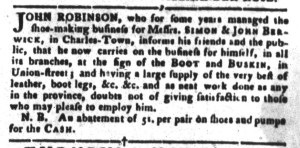
In this advertisement in the Virginia Gazette, Francis Moreland searched for a “journeyman SHOEMAKER.” The specificity of a journeyman implies that Moreland wanted to hire a shoemaker who was quite skilled rather than a young apprentice who still had much to learn. In eighteenth-century America, according to Patrick Grubbs, there was a difference in the levels of craftsmanship. The master oversaw production, owned the shops, and trained journeymen and apprentices. The journeyman was a skilled worker who had finished an apprenticeship, but did not have master status. An apprentice was a beginner learning the trade under a master.

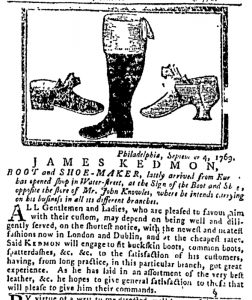
To help us better understand a shoemaker’s shop, Thomas Ford provides an image in The Leatherworker in Eighteenth-Century Williamsburg. In this image we see the inner workings of the customer-shoemaker relationship. Shoemaking as a craft grew across the colonies during the eighteenth century, not just in Virginia. In Philadelphia, Grubbs explains, the occupation grew from a handful in 1680 to over three hundred in 1774, due to a rise in demand and the colonists deciding it would be better to shop domestically for shoes. Craftsmanship was important in the eighteenth century, including in the market for shoes. Although some shoemakers made large quantities of shoes, colonists did not have access to mass produced shoes in the same way that modern consumers purchase Nike and Adidas, so they often relied on their local shoemakers to meet their needs.
**********
ADDITIONAL COMMENTARY: Carl Robert Keyes
When I asked students in my senior capstone research seminar about advertising and consumer culture in early America to choose advertisements about consumer goods and services for the portfolios they created throughout the semester, I did not necessarily have employments advertisements in mind, but I allow for flexibility and creativity in selecting and interpreting newspaper notices for their portfolios and for publication via the Adverts 250 Project. As I have written on other occasions, one of my favorite parts of enlisting my students as junior colleagues in the production of this digital humanities work is the opportunity to see sources that are so familiar to me through new eyes. I likely would have passed over Moreland’s advertisement, but Massimo demonstrated its relevance to our readings and discussions about colonizers participating in consumer culture. Consumption, after all, occurs in a reciprocal relationship with production and distribution of goods, as T.H. Breen highlights in The Marketplace of Revolution: How Consumer Politics Shaped American Independence, a book we read and discussed in our seminar.
Massimo chose one of three employment advertisements in the March 8, 1776, edition of Alexander Purdie’s Virginia Gazette. In another notice, Thomas Warren sought a “BRICKLAYER, who is a good workman,” for the next season. He limited his search to those “coming well recommended.” Robert Anderson also wanted “well recommended” applicants to respond to his advertisement for a “GOOD HOSTLER” to care for horses. The “journeyman SHOEMAKER” would have been the only one of the three who served an apprenticeship and may have worked more closely with customers than the bricklayer and the hostler. On the other hand, Moreland may have had other plans for a new employee. In another advertisement in that issue, William Aylett informed the public that he “WANTED, for the army, a large number of SHOES.” Moreland may have had his journeyman shoemaker craft shoes for individual clients or he may have tasked him with producing a quantity of shoes to supply the army, a precursor to modern mass production.