May 6

What was advertised in a colonial newspaper 250 years ago this week?

May 6 - 5:5:1766 Newport Mercury
Newport Mercury (May 5, 1766).

“He has as usual, an Assortment of ENGLISH GOODS.”

Thomas Green’s notice that he intended to open a school does not look much different from other advertisements offering similar services in the decade prior to the Revolution, at least not until the final sentence. After rehearsing the subjects to be taught and assuring parents that their “Scholars” and “small Readers” that he would instruct his charges “with the greatest Alacrity,” he also announced that “He has, as usual, an Assortment of ENGLISH GOODS, &c. at a reasonable Rate.”

How did Green earn his living? Was he primarily a shopkeeper who sought to supplement his income by trying his hand at teaching? Or was he a teacher or tutor who sold some imported goods on the side to help make ends meet when he his school was not fully enrolled? This advertisement does not offer any definitive answers, but Newport was a small enough town in 1766 (even though it ranked as one of the most significant ports in British mainland North America) that most readers would have been familiar with his occupation(s). In his reference to retailing imported goods, he noted he did so “as usual,” suggesting that readers were already aware of his business activities.

As many American towns and cities continued to grow throughout the eighteenth century and into the nineteenth, the residents increasingly lived among strangers. “THOMAS GREEN, In Banister’s Row” did not seem to think of himself as a stranger to others in Newport. Just the opposite, his advertisement suggests that he believed the majority of residents were at least acquainted with him in some fashion.

April 27

What was advertised in a colonial newspaper 250 years ago this week?

Apr 27 - 4:25:1766 New-Hampshire Gazette
New-Hampshire Gazette (April 25, 1766).

Some of Portsmouth’s retailers regularly advertised in the New-Hampshire Gazette throughout the winter of 1765 and 1766 while the Stamp Act was still in effect, but it tended to be the same advertisers week after week. In April, the residents of Portsmouth received word of the repeal of the Stamp Act. The news was first published in the April 18 issue of the New-Hampshire Gazette. The newspaper published the following week included several new advertisements from retailers who had not marketed their wares during the winter, including Nathaniel Barrell.

This could simply have been a matter of not needing to advertise. Perhaps Barrell and his counterparts had a surplus of goods in stock before the winter or before the Stamp Act went into effect, making it less necessary to advertise. Indeed, throughout the series of non-importation and non-consumption agreements in the decade prior to the Revolution merchants and retailers seized opportunities to clear out surplus wares.

Perhaps Barrell and his counterparts advertised wares recently imported from England after a lull in transatlantic voyages during the winter months. The same vessels that brought news that the Stamp Act had been repealed also brought consumer goods in their cargo holds. This may have simply been a matter of timing.

On the other hand, it is also possible that news about the Stamp Act played a role in Barrell’s decision to advertise in the April 25 issue. With tensions between England the colonies reduced, he may have had more room to maneuver in the public prints and the marketplace, announcing boldly in the first line of his advertisement that he carried goods “Imported from LONDON.” Given his own politics or the views of neighbors and acquaintances who were also his customers, he might have identified the shift in attitudes toward England in the wake of recent news as a signal that he could promote goods imported from London.

It very well could be that all three of these factors, to greater or lesser degrees, played a role in Barrell’s decision to advertise in the April 25 issues of the New-Hampshire Gazette.

February 22

GUEST CURATOR:  Mary Aldrich

What was advertised in a colonial newspaper 250 years ago this week?

Feb 22 - 2:17:1766 Connecticut Courant
Connecticut Courant (February 17, 1766).

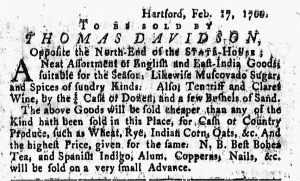
“The above Goods will be sold … for Cash or Country Produce.”

It is interesting that Davidson starts his advertisement assuring his potential customers that the “neat assortment of English and East-India Goods [were] suitable for the season.” He is letting them know that the products he was currently carrying could be used immediately and did not need to be stored until their use was required.

Davidson also mentioned that if people did not have cash on hand he would be more than happy to barter. He even went beyond mentioning his openness to bartering; he listed specific items that he would accept in lieu of cash. He would have accepted country produce and a list of other products that costumers from the town would likely have gotten from another source or grown themselves.

By accepting items other than cash in exchange for goods, he interested a larger audience because hard currency was not as common at this time. Davidson appealed to a larger constituency than if he had advertised cash only.

**********

ADDITIONAL COMMENTARY:  Carl Robert Keyes

Mary notes that Davidson described his stock of “A Neat Assortment of English and East-India Goods” as “suitable for the Season.” This was one of many appeals the shopkeeper incorporated into his advertisement, along with mentioning price, quality, and the possibility of bartering. This advertisement also includes several stock phrases, including “Neat Assortment” and “suitable for the Season,” among its attempts to woo potential customers.

Davidson inserted one element that did not always appear in eighteenth-century advertisements: the date. While it was not exceptional for an advertiser to include a date, it was not the standard practice either. In this case, the date of the advertisement matched the date of the issue in which it appeared. (The type would have been set and the newspaper printed before February 17, so most likely Davidson intentionally specified that the date of his commercial notice would bear the same date as the issue in which it appeared.) Davidson, like other newspaper readers of the period, would have realized that sometimes an advertisement might be repeated for weeks or even months. Including the date in his advertisement buttressed his claim that his “Assortment of English and East-India Goods” was indeed “suitable for the Season,” or at least allowed readers and potential customers to better assess that claim.

January 2

What was advertised in a colonial newspaper 250 years ago today?

Jan 2 - 1:2:1766 Massachusetts-Gazette Supplement
Supplement to the Massachusetts-Gazette (January 2, 1766)

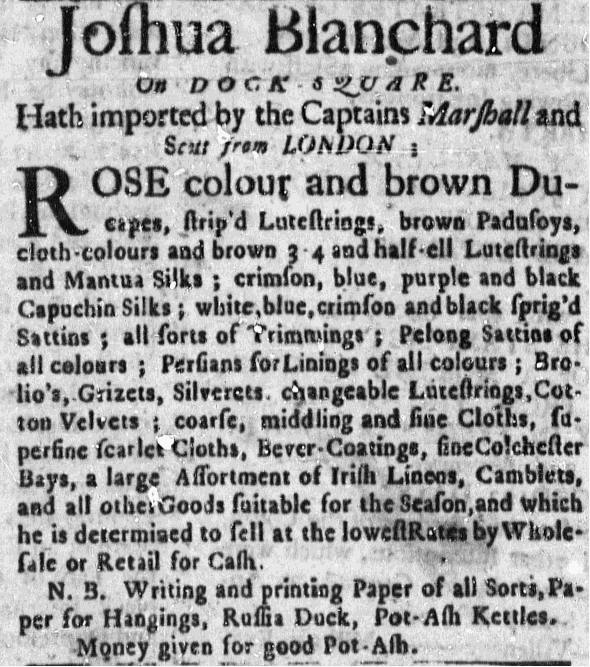
“Ducapes, Lutestrings, Padufoys, Capuchin Silks, Pelong Sattins, Persians, Colchester Bays, Camblets, Russia Duck …”

Such an assortment of goods available to purchase in Joshua Blanchard’s shop on Dock Square in Boston!  Throughout the British Atlantic World a consumer revolution was taking place during the eighteenth century.  Potential customers experienced increasing choices as they considered what and whether to buy all kinds of goods.

As this advertisement indicates, early Americans spoke a specialized language of consumption.  Blanchard did not merely indicate that he stocked a variety of textiles and patterns.  He listed them in detail, employing a lexicon lost to most modern readers (so alien that spellcheck indicates the names of many of these fabrics have been misspelled).  Yet savvy consumers would have recognized each of these during the eighteenth century.  Even without glossy images used to market clothing in modern time, this advertisement would have conjured up visions of a variety of textiles for potential customers capable of making distinctions among them.