January 11

What was advertised in a colonial American newspaper 250 years ago this week?

jan-11-1111767-providence-gazette
Providence Gazette (January 10, 1767).

He intends to sell on as reasonable terms as any Person in this town.”

Eighteenth-century shopkeepers and artisans frequently made appeals to price in their advertisements, but they usually did not elaborate much beyond a few words or phrases assuring prospective customers that they charged “low rates” for their merchandise. On occasion, some advertisers, like Jabez Peirce, elaborated on this theme. He confidently proclaimed that he sold his “fresh assortment of European goods … on as reasonable terms as any Person in this town, or any of the neighbouring governments.” While he did not explicitly state that he offered low prices, he informed potential customers that they would not find better deals anywhere else around town.

In this regard, he adopted language similar to what appeared in other advertisements published in the Providence Gazette in recent weeks. In the previous issue, Elihu Robinson, a hatter, announced that he sold his wares “as Cheap for Cash, as … any Person in this Town.” Similarly, James Green pledged that he priced his merchandise “at as low a rate as can be bought in this town.” Both Robinson and Green also favorably compared their prices to those in other places (indicating that consumers might travel to do some of their shopping or order goods from shopkeepers via the post, a service mentioned fairly regularly in advertisements). Robinson mentioned Boston and New York by name, but Green used the same phrase as Peirce: “neighbouring governments.”

Many advertisers used formulaic language in their commercial notices in the eighteenth century, which caused many advertisements to take on a standardized appearance (at least at first glance; close and careful reading yields variations, innovations, and attempts to distinguish some advertisements from the bulk of others that appeared on the page). That many printers preferred specific formats for fonts, sizes, and spacing when laying out advertisements for their own publications further contributed to creating a static visual culture of advertising within the pages of many newspapers. At a glance, graphic design and formulaic language made many advertisements appear indistinguishable.

Peirce’s advertisement is interesting and significant because it demonstrates how advertisers made the same appeals as their competitors, often even resorting to the same language, while simultaneously illustrating that unique appeals sometimes emerged in specific places and were quickly adopted by multiple advertisers. Although several advertisements in the Providence Gazette in early 1767 stressed the lowest prices in town, advertisers in other cities throughout the colonies universally relied on more general assertions about low prices, if they made appeals to price at all. Similarly, only advertisers in Providence showed any concern about local residents obtaining goods from competitors in “neighbouring governments.”

How long did that trend last? Did it eventually appear in advertisements published in other cities? Jabez Peirce’s advertisement raises interesting questions even as it further establishes a pattern in the Providence Gazette.
January 5

What was advertised in a colonial American newspaper 250 years ago today?

jan-5-151767-boston-evening-post
Boston Evening-Post (January 5, 1767).

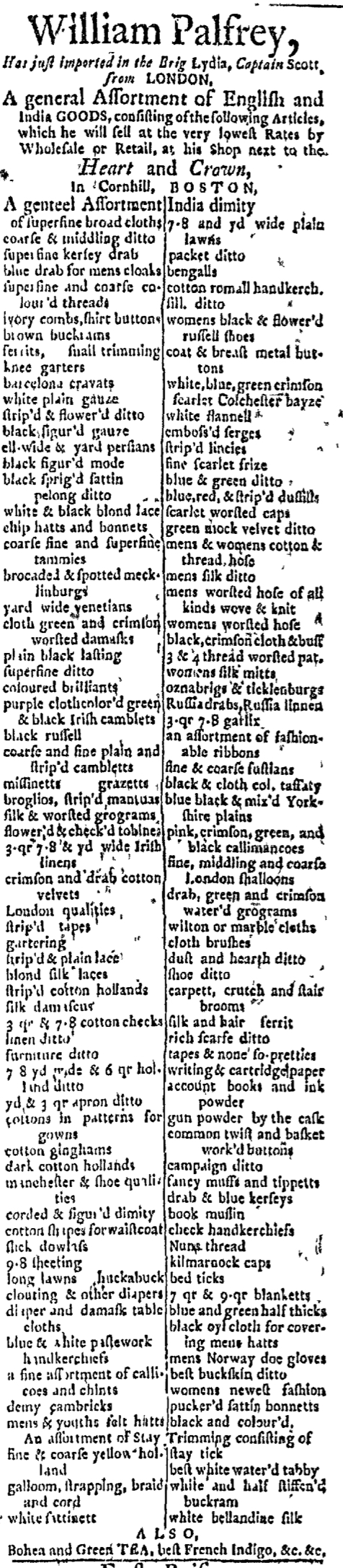
“A general Assortment of English and India GOODS, consisting of the following Articles.”

William Palfrey’s lengthy list advertisement, which comprised almost the entire third column of the January 5, 1767, issue of the Boston Evening-Post, fulfilled a promise made in a much shorter advertisement inserted in the previous issue. Confined to a single “square” of advertising space, the earlier advertisement announced that Palfrey had just imported “A general Assortment of English and India GOODS, consisting of many Articles.” The final line of the notice indicated that “[The particular Articles will be in our next].” A week later the same short announcement appeared, though this time as a header for a list of dozens of items divided into two columns. The phrase “consisting of many Articles” had been updated to “consisting of the following Articles,” a more appropriate introduction for the list that followed, but otherwise the content and format for the header remained the same.

It would be reasonable to conclude that the printers of the Boston Evening-Post made a decision to truncate Palfrey’s lengthy advertisement in the interest of space. After all, colonial newspapers often included some sort of notice that due to space restrictions some advertisements that had been omitted would appear in the next issue. That could have been the case in this instance, but another explanation places the decision in the hands of the advertiser rather than the printers.

Perhaps Palfrey decided to insert the first advertisement with its promise of a lengthier catalog of merchandise to appear later as a means of inciting interest and anticipation among prospective customers. The advertisement invited readers to consult the pages of the Boston Evening-Post once again, prompting them to look for Palfrey’s advertisement specifically amid all of those from his competitors. Palfrey may have calculated this as a strategy to overshadow other advertisements, especially if he did not have sufficient time to draw up a list of merchandise that had been “just imported in the Brig Lydia, Captain Scott, from LONDON.” The shipping news supplied by the Customs House in the December 29 issue indicated that the Lydia had arrived only two days earlier. Palfrey likely did not have time to compile a complete inventory of his newly arrived merchandise, but did not want to wait a week to inform potential customers about his “general Assortment of English and India GOODS.” The shorter advertisement simultaneously allowed him to spread the word to eager customers and to encourage anticipation among curious readers who might choose to visit his shop only after previewing the merchandise listed in a subsequent advertisement.

January 3

What was advertised in a colonial American newspaper 250 years ago today?

jan-3-131767-providence-gazette
Providence Gazette (January 3, 1767).

“TO BE SOLD BY JAMES GREEN, At his Shop at the Sign of the Elephant.”

In the first issue of the Providence Gazette published in 1767, James Green became the third retailer over the course of two months, joining Joseph and William Russell and Thompson and Arnold. Such advertisements required collaboration between printers and advertisers. They also likely derived from competition and imitation among shopkeepers. In recent weeks I have questioned who was responsible for these advertisements and what motivated them to experiment with such an innovative (and presumably expensive) format. After all, at least one other advertiser complained about the high cost of the lengthy list advertisements that were standard parts of eighteenth-century newspaper advertising.

The January 3, 1767, issue of the Providence Gazette provides another clue about what might have contributed to the appearance of some, but perhaps not all, of the recently published full-page advertisements. The fourth page of the issue was given over to Green’s (nearly) full-page advertisement and the colophon immediately beneath it. The third page concluded with this announcement:

“Our Readers are desired to excuse the late Publication of our Paper, for this Fortnight past, which has been entirely owing to the Western Post not being arrived; for whom we have waited, expecting that we should be able to oblige them with something more Material, than we are at Present able to furnish them with.”

The past fortnight encompassed the issues that included full-page advertisements by Thompson and Arnold and, now, James Green. If necessity was the mother of invention, then perhaps Sarah Goddard and Company, the printers of the Providence Gazette, played the lead role in devising full-page advertisements for Thompson and Arnold and James Green as a means of producing sufficient content to fill recent issues. Both advertisements adapted previous advertisements. The printers already had relationships with these retailers. Eager to fill the pages of their publication, they may even have offered reduced rates for these advertisements. Goddard and Company may have regretted the dearth of new news items to insert in recent issues, but they offset that shortcoming with the visual sensation of full-page advertising that likely attracted readers and additional advertisers.

Even if this accounts for the full-page advertisements published by Thompson and Arnold and James Green, it does not explain the initial and three subsequent appearances of full-page advertisements by Joseph and William Russell. The string of full-page advertisements that appeared in the Providence Gazette in the 1760s did not arise from a single cause.

December 22

What was advertised in a colonial American newspaper 250 years ago today?

dec-22-12221766-boston-post-boy
Boston Post-Boy (December 22, 1766).

“A General Assortment of English Goods.”

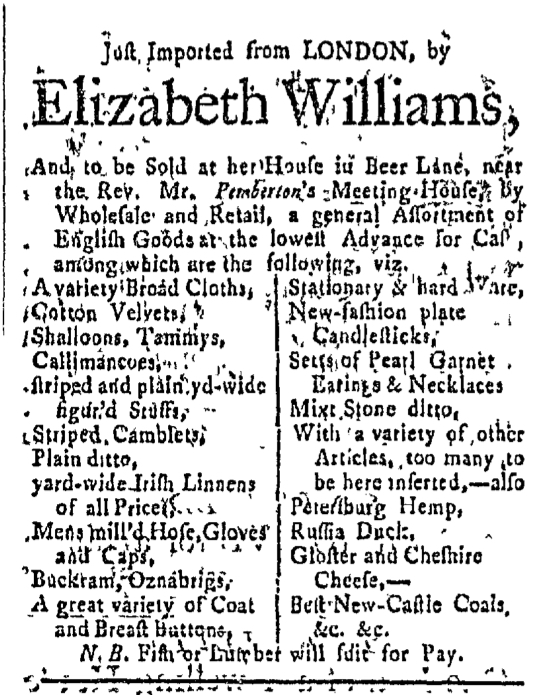
Elizabeth Williams operated a shop out of her “House in Beer Lane, near the Rev. Mr. Pemberton’s Meeting-House” in Boston. She imported “a general Assortment of English Goods” from London, including “Cotton Velvets,” Mens mill’d Hose, Gloves and Caps,” and “Stationary & hard Ware.” Although she listed approximately two dozen types of merchandise, she also carried “a variety of other Articles, to many to be here inserted.”

In promoting a variety of consumer goods recently imported from English ports, Williams advanced one of the most common marketing appeals of the eighteenth century. She offered choices to potential customers, drawing them in by naming popular items and by promising even more for shoppers to discover and examine once they were in her shop. Indeed, “variety” was important in Williams’ marketing efforts. In addition to general descriptions of her merchandise, she inserted the word into her list twice: “A variety of Broad Cloths” and “A great Variety of Coat and Breast Buttons.” Her customers would not be stuck with whatever she happened to have on hand; instead, they could choose according to their own tastes.

Williams also made appeals to price, noting that she sold her English goods “at the lowest Advance.” For one product, “yard-wide Irish Linnens,” she had several different sorts “of all Prices,” again offering choices to her potential customers. In addition, she made implicit appeals to fashion when she listed several textiles, as well as an explicit appeal when she described her candlesticks as “New-fashion.”

In making appeals to choice, price, and fashion, Williams adopted several of the most popular marketing strategies deployed by her male competitors. In that regard, little distinguished her advertisement from others except that a woman’s name appeared at the beginning. Other historians have demonstrated that in the busiest urban ports, like Boston, as many as one-third of shopkeepers were women by the middle of the eighteenth century, although they do not comprise such a high proportion of advertising for consumer goods and services. Women faced challenges when they operated retail establishments, but they were not excluded from participating on the supply – rather than the consumption – side of the marketplace. Elizabeth Williams’ advertisement demonstrates one method used by some female shopkeepers to integrate into a male-dominated occupation.

December 15

What was advertised in a colonial American newspaper 250 years ago today?

dec-15-12151766-new-york-mercury
New-York Mercury (December 15, 1766).

She has employ’d a young woman lately arrived from London.”

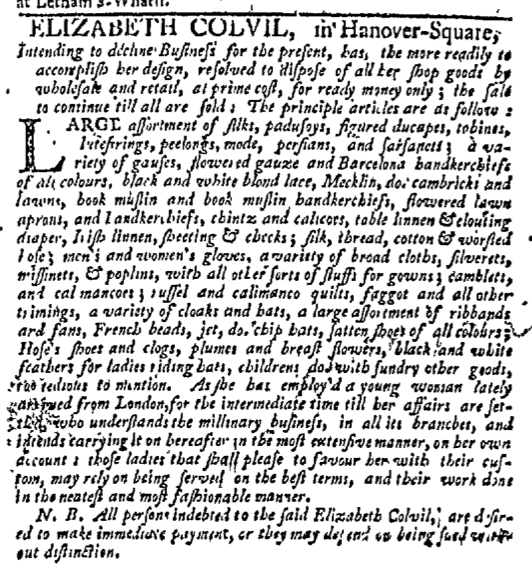
When she decided to “decline Business for the present,” shopkeeper and milliner Elizabeth Colvil announced the eighteenth-century equivalent of a going-out-of-business sale. She “resolved to dispose of all her shop goods by wholesale and retail, at prime cost, for ready money only; the sale to continue till all are sold.” Colvil was liquidating her merchandise, enticing prospective customers with low prices in order to move the process along as quickly as possible.

In and of itself, that sort of promotion distinguished Colvil’s advertisement from many others of the period, but it was not the only aspect of her announcement that set it apart. After listing much of her remaining merchandise and promising “sundry other goods too tedious to mention,” Colvil indicated that she had hired an assistant, a young woman who had recently arrived from London. Her assistant, “who understands the millinary business, in all its branches,” would stay on until Colvil closed shop. At that time, she would pursue the business on her own “in the most extensive manner.” Although Colvil was not selling her shop to her assistant, she was setting her up as her successor.

To that end, Colvil made an appeal to current and prospective customers: “those ladies that shall please to favour her [the young woman recently arrived from London] with their custom, may rely on being served on the best terms, and their work done in the neatest and most fashionable manner.” Colvil voiced a strong endorsement of her assistant, directing the women of New York to patronize her assistant’s shop once Colvil had departed the marketplace.

This differs significantly from most eighteenth-century advertisements in which male merchants, shopkeepers, and artisans indicated the amiable end of a partnership or the transfer of a business from one man to another. In such cases they used advertisements to announce a change in status but did not incorporate an extensive endorsement of the new business or its proprietor.

Elizabeth Colvil probably knew a thing or two about the particular difficulties of being a woman and operating a business in eighteenth-century America. As a result, she attempted to assist her assistant in launching her own shop, recognizing that a young woman, especially one new to the city and unknown to most of its residents, would benefit from establishing a good reputation as quickly as possible. Colvil’s endorsement in her advertisement was the first step. The assistant working with customers was the second. She could build up a clientele, drawing on Colvil’s network of patrons, while the senior shopkeeper and milliner was still active in the business. In this advertisements, Elizabeth Colvil advocated on behalf of a fellow female entrepreneur.

November 22

GUEST CURATOR: Patrick Keane

What was advertised in a colonial American newspaper 250 years ago today?

nov-22-11221766-providence-gazette
Providence Gazette (November 22, 1766).

“SUPERFINE broad cloths.”

Gideon Young sold imported materials at his shop that people could use to make clothing. He sold some materials that were intended for the rich (“fashionable silks”) as well as some that were not intended for the rich (“midling and coarse broad cloths”). I found it interesting that he sold at low prices so that he could bring in rich or poor people. He wanted to bring as much attention to his shop as possible; the best way was having “cheap” prices for those who lived in Providence.

On the Colonial Williamsburg website, Edward R. Crews talks about the “18th Century love of fashion and the art of making clothes.” People who bought these materials from Young could then bring them to a milliner to make the clothing for them. Some of the colonists who bought from Young might use the materials to make fancy clothing. Young wanted to appeal to the lower class by having lower prices so that they too could make their own clothes that could also look fancy.

**********

ADDITIONAL COMMENTARY: Carl Robert Keyes

Who were Gideon Young’s customers? As Patrick notes, they could have included colonists from a variety of backgrounds. Young stocked some textiles that would have appealed to genteel gentlemen and ladies as well as others more likely to be purchased by the middling and lower sorts. By offering low prices, he invited all sorts of potential customers to visit his shop.

That Young attempted to cater to different kinds of clients demonstrates a tension that emerged as the consumer revolution of the eighteenth century expanded to include greater numbers of colonists. Products and fashions that had once been reserved for the elite increasingly became more widely accessible as the number of imported goods rose and prices fell. Affluent colonists engaged in conspicuous consumption as a means of continuing to distinguish themselves from their social subordinates. However, even as the elite bought more and more things, other colonists purchased what they could afford and engaged in their own acts of displaying their possessions – and their good taste – to others.

Young certainly wanted to make his customers feel special when he offered “fashionable silks” and “best black sattins, pelong, and alamode.” Yet he balanced a sense of exclusivity against “cheap” prices that suggested that not everyone who visited his shop on Union Street came from the upper echelons of Providence residents.

If all sorts of colonists could buy “fashionable” and “best” goods with all the “trimmings to suit” for low prices from shopkeepers like Young, how could the elite assert their status? A rise in concern for manners as well as attention to personal comportment accompanied the consumer revolution of the eighteenth century. Colonists concentrated on demonstrating their gentility through their actions and interactions with others rather than relying solely on their possessions to testify to their status. In such cases, the clothes did not, by themselves, make the man (or woman). Appearances and possessions were not enough to claim social status. Colonists who wanted to claim a place among the genteel also needed to exhibit politeness and demonstrate that they understood refined rules for social interactions.

September 25

GUEST CURATOR: Nicholas Commesso

What was advertised in a colonial American newspaper 250 years ago today?

sep-25-9251766-massachusetts-gazette
Massachusetts Gazette (September 25, 1766).

“Woolens and other Articles suitable for the approaching Season.”

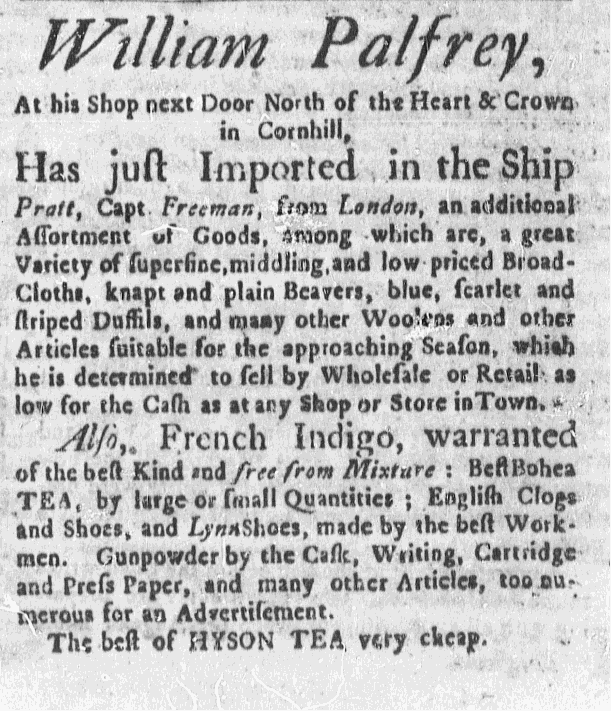
By beginning with the location of his shop, William Palfrey’s advertisement for his “Assortment of Goods” was able to attract fresh clientele that were unfamiliar with his establishment. He made a point to put the location directly following his name, and, interestingly enough, what his shop was next to: “next Door North of the Heart & Crown a well known emblem for the print shop where the Boston Evening-Post was printed.

Also, consider the significance of including where the goods had originated — in this case, London — alluding to the fact that many of these goods were not manufactured in the colonies at this time. According to T.H. Breen, “British goods flooded English colonies,” starting in the 1740s.[1] Palfrey adds that the varieties of “Broad-Cloths,” “Duffils,” and “other Woolens” would be very suitable for the upcoming changing of the seasons. Nearly every New England advertisement I examined mentioned the changing seasons, suggesting that the colonists adjusted their purchases to the varying conditions of the local climate. The changing weather conditions may not have been as extreme in the southern colonies, where the seasonal adjustments were not as significant. The advertisement prompted consumers to prepare for the upcoming change to a chillier fall and a cold winter.

**********

ADDITIONAL COMMENTARY: Carl Robert Keyes

Nick identifies an important aspect of William Palfrey’s advertisement in his examination of the section that promoted “many other Woolens and other Articles suitable for the approaching Season.” The autumnal equinox occurred just a few days before this advertisement was published. Fall had arrived. Colonists in Boston certainly would have been aware that seasons were changing, but Palfrey used his advertisement to draw potential customers into his shop by reminding them that they would soon need different sorts of clothing and other goods. Some readers would have stored fall and winter apparel during the spring and summer seasons, but Palfrey realized there was a good chance that even those who were most prepared likely needed replacements and supplements.

Nick raises a question about regional differences in advertising, noting that many advertisements that appeared in New England newspapers deployed appeals that stressed the goods for sale were appropriate for the season. This was also true of advertisements published in Philadelphia, a city that also experienced significant changes in weather throughout the year. Advertisements published there often used the phrase “suitable for the season” to describe the merchandise. Was that an appeal commonly used in other regions, especially the Chesapeake and the Lower South? I’m not certain. This project originated as a case study of advertising in Philadelphia, the largest city in the American colonies at the time of the Revolution and one of the centers of printing. I have not yet examined newspaper advertisements from southern colonies in the same depth. In his analysis of today’s advertisement, Nick has presented a question that merits further research as this project continues.

**********

[1] T.H. Breen, “An Empire of Goods: The Anglicization of Colonial America, 1690-1776,” Journal of British Studies 25, no. 4 (October 1986): 486.

July 7

What was advertised in a colonial newspaper 250 years ago today?

Jul 7 - 7:7:1766 Boston Post-Boy
Boston Post-Boy (July 7, 1766).

JUST Imported from London, by Jolley Allen.”

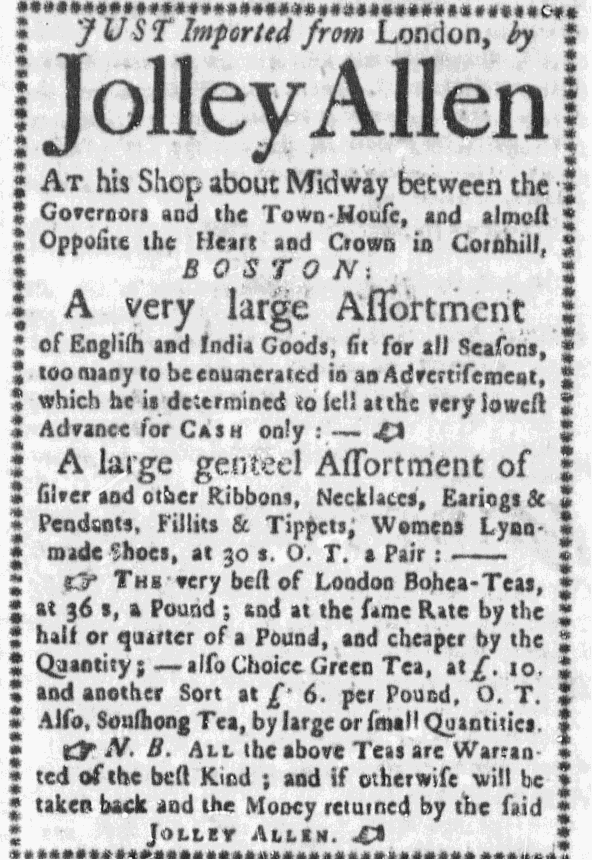
Shopkeeper Jolley Allen almost certainly played a role in designing this advertisement. As I have noted previously, the available evidence suggests that advertisers tended to write their own copy and printers tended to make decisions about layout and fonts when they set the type. Printers often adopted formats that were consistent from advertisement to advertisement, giving all commercial notices that appeared in a given newspaper similar visual qualities and making them easy to recognize at a glance.

Allen’s advertisement had a distinctive border that set it apart from other advertisements in the Boston Post-Boy. It seemed unlikely that the printer went through the additional effort of setting ornamental type of his own volition. What was more probable, I hypothesized, was that Allen made special arrangements with the printer (and perhaps paid more) to arrange for this special feature.

Jul 7 - 7:7:1766 Boston Evening-Post
Boston Evening-Post (July 7, 1766).

Allen’s advertisement in other newspapers published in Boston on the same day suggested that was indeed the case. His advertisement in the Boston Evening-Post also had a decorative border, though it was composed of different ornaments. Otherwise, the advertisement had the same copy and nearly identical layout. Another version of the advertisement appeared in the Boston-Gazette. While the copy was the same, the border consisted of yet another style of printing ornaments and the format had two columns within the advertisement. Finally, Allen’s advertisement had previously appeared in Boston’s other newspaper (the only one not distributed on Mondays), the Massachusetts Gazette. Except for yet another method of creating the decorative border, it was nearly identical to the advertisements in the Boston Post-Boy and the Boston Evening-Post. The copy was the same and the format nearly identical.

Jolley Allen placed his advertisement in four newspapers. In each instance, it had a decorative border that would have drawn attention to it, especially since such borders were not a standard part of other advertisements in any of those publications. Allen almost certainly designed that portion of his advertisement, even if he left it to the individual printers to make decisions about setting the rest of the type. Realizing that advertisements often tended to look the same, Allen devised a graphic design innovation intended to set his own apart from the crowd.

Jul 7 - 7:7:1766 Boston-Gazette
Boston-Gazette (July 7, 1766).
Jul 7 - 7:3:1766 Massachusetts Gazette
Massachusetts Gazette (July 3, 1766).

May 15

What was advertised in a colonial newspaper 250 years ago today?

May 15 - 5:15:1766 Pennsylvania Gazette
Pennsylvania Gazette (May 15, 1766).

“To be sold by MARY HARVEY, … a well chosen and neat Assortment of Dry and wet Goods.”

Female shopkeepers were disproportionately underrepresented among the advertisements placed in colonial newspapers. Consciously seeking to avoid erasing women from the commercial landscape as producers, suppliers, and retailers – not solely as consumers on the other side of exchanges – I take notice every time I spot an advertisement placed by a woman when I am making selections about which to feature here.

It would be unfair, however, to assume that I chose Mary Harvey’s advertisement solely based on her sex. It reveals so much more about early American marketing and consumer culture than “just” demonstrating that women played varied roles (though I contend that is significant in its own right). When I first began studying eighteenth-century advertising I expected to identify distinct methods or appeals made by men and women, but Mary Harvey’s advertisement, like so many others placed by women, demonstrates that male and female advertisers relied on similar appeals. In this advertisement, Harvey promised low prices. By providing an extensive list of her wares she also engaged potential customers to think of the range of choices that will allow them to make selections according to their own tastes.

Harvey also concludes with a political appeal that mirrored those frequently made by male advertisers: “as she has made it her Study to promote Home-made Manufactures, she hopes for the Countenance of her old Friends, and all those who are Lovers of their Country.” Although not allowed to participate in the formal mechanisms of politics due to her sex, Harvey joined many others in imbuing consumer choices with political ramifications. Through her advertising, Mary Harvey gained a voice in public discourse about the Stamp Act, the Declaratory Act, and the relationship between Parliament and the colonies.

May 12

What was advertised in a colonial newspaper 250 years ago today?

May 12 - 5:12:1766 Boston Post-Boy
Boston Post-Boy (May 12, 1766).

“William Fisher, In CORNHILL, HAS imported a general Assortment of English Goods which he sells at the cheapest Rates.”

Today’s featured advertisement appears fairly short and relatively basic when compared to many of the more extensive advertisements that crowded the pages of eighteenth-century newspapers. William Fisher’s advertisement, however, was not unique. Many advertisers opted for this sort of short commercial notice. Some may not have been able to afford more space in the newspaper. Others may not have been as innovative in their thinking, compared to their competitors, about how to incite demand among potential customers. Some may have depended on networks of friends, neighbors, and acquaintances to sustain their shops, believing that an abbreviated advertisement served as sufficient reminder of the wares they offered for sale.

I’ve chosen this advertisement to feature today as a means of correcting an oversight. In the process of selecting advertisements to examine I have privileged some and disproportionately excluded others, especially the plethora of short commercial notices that were familiar to colonial readers.

I’ve also selected this advertisement because even though it is short enough to fit entirely in a modern tweet it still incorporated three common marketing appeals that tell us about eighteenth-century consumer culture. Fisher made an appeal to price when he noted that “he sells at the cheapest Rates.” He expected that low prices would help to attract customers. He also stressed that he offered choices to his customers, “a general Assortment.” Upon visiting his shop customers could expect to make purchases based on their own tastes rather than accept whatever happened to be in stock. Fisher may not have found it necessary to pay to print an exhaustive list of his merchandise. Other shopkeepers already did so, which meant that Fisher could depend on readers already being familiar with what was available in Boston. Finally, he stated that he had “imported … English Goods.” Consuming wares imported from England helped colonists feel connected to fellow Britons on the other side of the Atlantic. Though they resided thousands of miles away, they shared a British identity.

William Fisher’s advertisement seems deceptively short considering how much it tells us about early American consumer culture.