December 22

What was advertised in a revolutionary American newspaper 250 years ago today?
South-Carolina and American General Gazette (December 22, 1775).

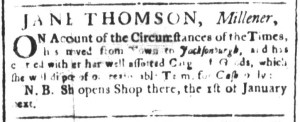
“JANE THOMSON, Millener, ON Account of the Circumstances of the Times, has moved from Town to Jacksonburgh.”

In December 1775, Jane Thomson, a milliner, had been running a shop in Charleston and occasionally placing newspaper advertisements for several years.  She likely followed news from Massachusetts about the hostilities that commenced at Lexington and Concord the previous April as well as updates from the meetings of the Second Continental Congress in Philadelphia.  She probably knew that residents of urban ports beyond New England felt anxious that the British would target their homes next, prompting some to move to the countryside for better security.  She apparently experienced the same anxiety and charted a new course accordingly.  In the December 22 edition of the South-Carolina and American General Gazette, the only newspaper still being published in the colony at the time, she announced that “ON Account of the Circumstances of the Times” she “has moved from Town [or Charleston] to Jacksonburgh,” nearly fifty miles to the west.  Thomson informed readers that she “has carried with her her well assorted [illegible] of Goods, which she will dispose of on reasonable Terms for Cash only.”  She planned to open her shop in her new location on January 1, 1776.

Thomson’s notice will be one of the last advertisements from the South-Carolina and American General Gazette featured on the Adverts 250 Project.  The newspaper continued publication until the end of February 1781, with some suspensions due to the Revolutionary War, and a complete run through December 1779 has been preserved buy the Charleston Library Society.  However, issues for 1776, 1777, 1778, and 1779 have not been digitized for greater accessibility.  In producing the Adverts 250 Project and the Slavery Adverts 250 Project, I have relied on the South Carolina Newspapers collection from Accessible Archives (now part of History Commons), yet that coverage ends with the issue for December 22, 1775.  Readex’s America’s Historical Newspapers has five more issues (September 4, 1776; April 10, 1777; February 19, June 4, and October 1, 1778) that I will incorporate into the project at the appropriate times, but the Adverts 250 Project and the Slavery Adverts 250 Project will not offer the same sustained look at advertising and the intersections of commerce, politics, and everyday life in Charleston during the Revolutionary War as I have attempted to provide for the period of the imperial crisis that ultimately led to that war.  The stories of that important urban port have always been truncated according to which advertisements I selected to feature.  Now they will be absent altogether.
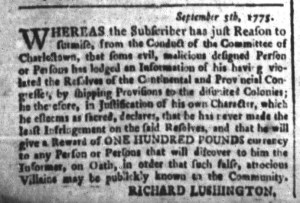
September 15

What was advertised in a revolutionary American newspaper 250 years ago today?

South-Carolina and American General Gazette (September 15, 1775).

“He … declares, that he has never made the least Infringement on the said Resolves.”

Richard Lushington was serious about defending his reputation.  When the merchant suspected that rumors circulated about alleged misconduct, he placed an advertisement in the South-Carolina and American General Gazette to offer a substantial reward to anyone who revealed the source.  In a notice dated September 5, 1775, Lushington declared that he “has just Reason to surmise, from the Conduct of the Committee of Charlestown” that was responsible for enforcing nonimportation and nonexportation agreements “that some evil, malicious Person or Persons has lodged an Information of his having violated the Resolves of the Continental and Provincial Congresses, by shipping Provisions to the disunited Colonies.”  The Continental Association did not prohibit exporting commodities to Britain, Ireland, and colonies in the West Indies until September 10, but perhaps the reports contended that Lushington had been overzealous in how much and how quickly he exported provisions to colonies in the Caribbean that had not signaled support for the American cause.  Had the merchant attempted to sidestep the Continental Association, abiding by the letter but not the spirit?

Lushington denied that he acted inappropriately.  “[I]n justification of his own Character, which he esteems as sacred,” he proclaimed that “he has never made the least Infringement on the said Resolves.”  The merchant was so anxious to address the allegations that offered “a Reward of ONE HUNDRED POUNDS currency to any Person or Persons that will discover to him the Informer, on Oath, in order that such false, atrocious Villains may be publickly known in the Community.”  He may have been especially keen to address the charges manufactured against him because, as Amy Pastan explains, he was a Quaker and thus an outsider among the predominantly Anglican population in Charleston.  “While Quakers were tolerated in the southern port city,” Pastan notes, “their anti-slavery views set them apart from the Charleston elite.”  Whatever challenges he faced as fall arrived in 1775, Lushington later demonstrated his allegiance to the American cause by serving as captain of a Patriot militia company known as the Free Citizens of Charleston as well as the Jews Company because several Jewish men, also outsiders in Charleston, served in it.

For more on Lushington and the Free Citizens of Charleston, visit “Rediscovering Charleston’s Revolutionary Outsiders.”

August 20

What was advertised in a revolutionary American newspaper 250 years ago this week?

South-Carolina and American General Gazette (August 18, 1775).

“In Order to enable her to support her Family in these hard Time, she intends retailing … Gin, Brandy, Coffee.”

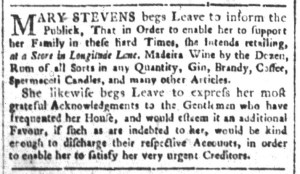
Women regularly advertised goods and services in early American newspapers.  Mrs. Miller, a milliner, for instance, ran an advertisement in the August 18, 1775, edition of the South-Carolina and American General Gazette.  Like many advertisements placed by female entrepreneurs, it did not differ from others placed by their male counterparts.  Mary Stevens also placed an advertisement in the same issue of that newspaper, though she deployed a marketing strategy more often used by women than by men.  She announced that she planned to open a store to retail wine, rum, gin, brandy, coffee, candles, and “many other Article.”  She did so, she declared, “in Order to enable her to support her Family in these hard Times.”  Rather than promote the quality or variety of her wares or promise exemplary customer service, some of the most common marketing strategies of the era, Stevens made her ability to support her family the primary reason that prospective customers should visit her store.  Many readers would have known more details than Stevens revealed in her advertisement, details that would have made her even more sympathetic.

Whatever her circumstances, Stevens had apparently conducted another sort of business for some time.  She devoted the second half of her advertisement to expressing “her most grateful Acknowledgments to the Gentlemen who have frequented her House.”  Again, many readers would have known whether Stevens took in boarders or prepared meals or served coffee in the parlor while her patrons discussed business and current events.  She served those “Gentlemen” on credit, but “these hard Times” made it necessary to ask them to “discharge their respective Accounts, in order to enable her to satisfy her very urgent Creditors.”  Men very often placed newspaper notices that called on associates to settle accounts, but rarely did they invoke the urgency that Stevens conveyed in her advertisement.  Even more rarely did they refer to supporting their families.  As a woman in business, Stevens may have been able to exercise a small amount of privilege in framing her advertisement in this manner, though the necessity that led her to do so did not suggest that she benefited from many advantages when it came to participating in the marketplace.

August 18

What was advertised in a revolutionary American newspaper 250 years ago today?

South-Carolina and American General Gazette (August 18, 1775).

They cannot … insert any Advertisements, without receiving previous Payment.”

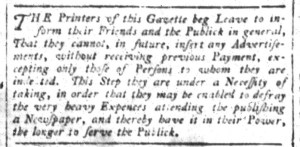
The August 18, 1775, edition of the South-Carolina and American General Gazette included an update about how Robert Wells and Son would conduct business.  “THE Printers of this Gazette,” they stated, “beg Leave to inform their Friends and the Publick in general, That they cannot, in future, insert any Advertisements, without receiving Payments” in advance.  Wells and Son did make an exception for “persons to whom they are indebted.”  Why did they change their policy?  “This Stop they are under a Necessity of taking,” the printers explained, “in order that they may be enabled to defray the very heavy Expences attending the publishing a Newspaper, and therevy have it in their Power, the longer to serve the Publick.”  That warning carried even more weight when readers and “the Publick in general” considered that the South-Carolina Gazette and Country Journal, one of three newspapers published in Charleston during the last decade, “discontinued” publication just a few weeks earlier.

This notice indicates that a common assumption about how printers managed their newspapers may be more complex than historians of the early American press previously realized.  The usual narrative asserts that printers extended generous credit to subscribers, allowing them to go years without paying for their newspapers because the printers wanted to bolster their circulation numbers.  In turn, that meant that they could attract more advertisers … and advertisements provided the most important revenue stream, especially since printers supposedly required advertisers to pay for their newspaper notices in advance.  For several years, the Adverts 250 Project has tracked notices that seem to contradict that narrative, though references to “advertisements” in some of those notices may have referred to handbills, broadsides, and other media distributed separately rather than newspaper notices.  In this notice, however, Wells and Son clearly referred to inserting advertisement in their newspaper.  While they adopted a new policy of requiring payment for advertisements in advance, they previously extended credit to advertisers.  More printers mya have done so than historians have realized.

July 23

What was advertised in a revolutionary American newspaper 250 years ago this week?

South-Carolina and American General Gazette (July 21, 1775).

“A SERMON on the present Situation of American Affairs.”

Robert Wells, the printer of the South-Carolina and American General Gazette, often inserted advertisements that promoted the merchandise available at his “GREAT STATIONARY & BOOK STORE” in Charleston.  On July 21, 1775, he devoted a notice to “A SERMON on the present Situation of American Affairs.  Preached in Christ Church, Philadelphia, June 23, 1775, at the Request of the Officers of the Third Battalion of the City of Philadelphia and District of Southwark.  By WILLIAM SMITH, D.D. Provost of the College in that City.”  Like many other advertisements for books, the copy replicated the title page.  Wells added the verse from the Book of Joshua that Smith cited as inspiration for the sermon.

The headline for the advertisement declared, “Just published, and to be sold BY ROBERT WELLS.”  Did “Just published” and “to be sold” both describe Wells’s role in disseminating Smith’s sermon?  When printers and booksellers linked those phrases together, they often meant that a work had been “Just published” by someone else and made available “to be sold” by other printers and booksellers.  Wells may have acquired copies of the sermon printed by James Humphreys, Jr., in Philadelphia and retailed them at his own shop.  Another advertisement in the same issue used the headline, “This Day are Published, BY ROBERT WELLS,” to introduce two books, “OBSERVATIONS on the RAISING and TRAINING of RECRUITS. By CAMPBELL DALRYMPLE, Esq; Lieutenant Colonel to the King’s Own Regiment of Dragoons,” and “THE MANUAL EXERCISE, with EXPLANATIONS, as now practised by The CHARLESTOWN ARTILLERY COMPANY.”  In contrast to “This Day are Published,” other items certainly not printed by Wells appeared beneath a header that stated, “At the same STORE may be had.”  On the other hand, Wells could have published a local edition of Smith’s sermon.  James Adams printed and sold a local edition in Wilmington, Delaware.

Christopher Gould includes Smith’s Sermon on the Present Situation of American Affairs (entry 103) in his roster of imprints from Wells’s printing office, along with The Manual Exercise (entry 92) and Observations on the Raising and Training of Recruits (entry 93).  For each of them, he indicates that he did not examine an extant copy but instead drew the information from newspaper advertisements.  Gould explains that “many of the entries for 1774 and 1775 must be regarded as suspect.  Wells advertises them as his publications, but in the absence of extant copies bearing his imprint, the likelihood is strong that they are in fact London editions of popular works bound in Charleston by Wells.”[1]  As I have noted, Wells used a headline to introduce Smith’s Sermon that both contemporary printers and readers understood did not necessarily attribute publication to the advertiser.  Even if he sold copies of the sermon printed elsewhere, they did not come from London.  Smith delivered the sermon on June 23 and Wells advertised it just four weeks later, not nearly enough time for London printers to be involved.  Wells advertised an American edition, even if he did not publish it.

Whatever the case, the sermon supplemented the news.  Readers of the South-Carolina and American General Gazettefollowed all sorts of “AMERICAN INTELLIGENCE” from New England to Georgia, but the pages of any newspaper could present only so much content.  Wells presented readers an opportunity to learn more about the discussions about current events taking place in Philadelphia by experiencing Smith’s sermon themselves.  As consumers, they could become better informed and join with others who heard or read the sermon.

**********

[1] Chrisopher Gould, “Robert Wells, Colonial Charleston Printer,” South Carolina Historical Magazine 79, no. 1 (January 1978): 42.

March 31

What was advertised in a colonial American newspaper 250 years ago today?

South-Carolina and American General Gazette (March 31, 1775).

“She intends again OPENING her BOARDING and DAY-BOARDING SCHOOL.”

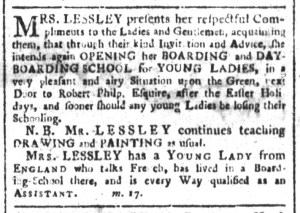
Mrs. Lessley ran a “BOARDING and DAY-BOARDING SCHOOL for YOUNG LADIES” in Charleston in the 1770s. She closed the school for a while, as schoolmasters and schoolmistresses often did for various reasons, but, as spring arrived in 1775, she took to the pages of the South-Carolina and American General Gazette to announce that she planned on “again OPENING” her school “after the Easter Holiday.”  She decided to do so, she stated, at the “kind Invitation and Advice” of “Ladies and Gentlemen” familiar with her school, offering an implicit endorsement she hoped would convince prospective pupils and their families.

Lessley also gave information about others who worked at her school.  “MR. LESSLEY continues teaching DRAWING and PAINTING as usual,” enriching the curriculum offered by his wife.  Readers, especially former students, may have assumed that was the case, but they did not necessarily know about a new employee.  The schoolmistress reported that she “has a YOUNG LADY from ENGLAND who talks French, has lived in a Boarding-School there, and is every Way qualified as an ASSISTANT.”  Those cosmopolitan skills and experiences enhanced the education that Lessley provided for her charges.  Her assistant aided in teaching a language considered a marker of gentility among the gentry and those who aspired to join their ranks.  Perhaps she even served as the primary instructor for that subject.  She may have consulted with Lessley on replicating an English boarding school without students having to cross the Atlantic while also serving as a role model for how “YOUNG LADIES” should comport themselves at such a school.

The schoolmistress gave less attention to the amenities at her school, though she did mention that it was located “in a very pleasant and airy Situation upon the Green.”  With classes slated to begin sometime after April 16, she assured prospective students and their families that they would live and learn in a comfortable environment.  She also indicated that she would commence lessons “sooner should any young Ladies be losing their Schooling.”  In other words, if other schoolmasters and schoolmistresses closed or suspended their schools, Lessley would gladly accept their students.  She hoped that these additional appeals in combination with her description of those who taught at her school would help in encouraging prospective pupils and their families to enroll.

March 3

What was advertised in a colonial American newspaper 250 years ago today?

South-Carolina and American General Gazette (March 3, 1775).

“PENNSYLVANIA LEDGER … His First Number may be seen at all the Printing Offices in Charlestown.”

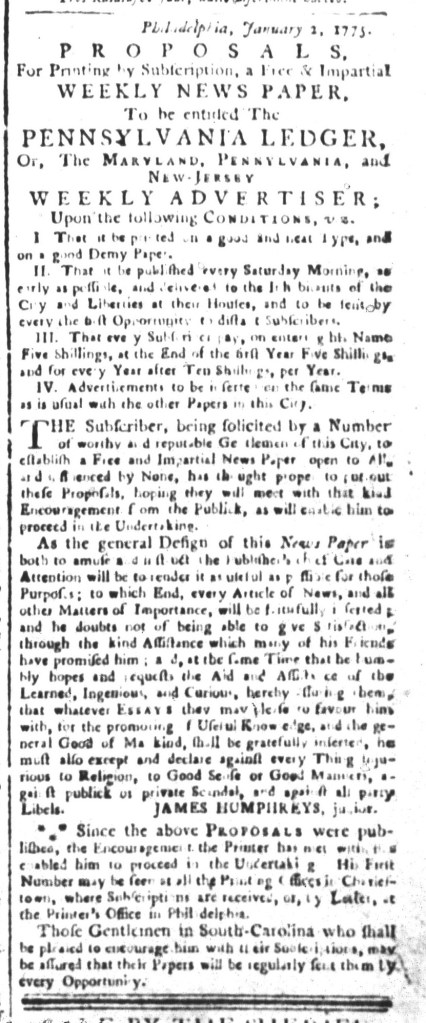
When James Humphreys, Jr., launched the Pennsylvania Ledger in 1775, he sought local subscribers by placing the proposals for his “Free & Impartial WEEKLY NEWSPAPER” in other newspapers published in Philadelphia.  Given the extended title – Pennsylvania Ledger, Or, the Maryland, Pennsylvania, and New-Jersey Weekly Advertiser (in the proposals) or Pennsylvania Ledger: Or the Virginia, Maryland, Pennsylvania, and New-Jersey Weekly Advertiser (on the masthead) – it made sense to promote the newspaper to prospective subscribers and advertisers in towns in Pennsylvania and neighboring colonies.  After all, colonial newspapers served vast regions.

Yet they circulated even more widely than the expansive title of the Pennsylvania Ledger suggested.  Realizing that was the case, Humphreys sent the proposals for the Pennsylvania Ledger to R. Wells and Son, the printers of the South-Carolina and American General Gazette, in Charleston.  Dated “Philadelphia, January 2, 1775,” the proposals ran in the February 24 and March 3 editions.  By that time, Humphreys had already commenced publication of his newspaper.  A note at the end of the advertisement acknowledged that was the case: “Since the above PROPOSALS were published, the Encouragement the Printer has met with has enabled him to proceed in the Undertaking.  His First Number,” published on January 28, “may be seen at all the Printing Offices in Charlestown, where Subscriptions are received.”  Wells and Son acted as local agents for Humphreys, a common practice among eighteenth-century printers who also participated in exchange networks for sharing newspapers and reprinting content.

Another note directed to readers of the South-Carolina and American General Gazette advised, “Those Gentlemen in South-Carolina who shall be pleased to encourage [Humphreys] with their Subscriptions, may be assured that their Papers will be regularly sent them by every Opportunity.”  That the January 28 edition was available for inspection at a local printing office by February 24 testified to Humphreys’s commitment to delivering newspapers to distant subscribers in a timely manner.  While he certainly welcomed individual subscribers, the printer likely hoped that his newspaper would attract the attention of the proprietors of establishments where merchants and others gathered to do business.  Coffeehouses, for instance, often supplied newspapers from near and far for patrons to peruse news about current events and consult the shipping news for updates about commerce in the British Atlantic world.  Humphreys had a reasonable expectation that publishing proposals for the Pennsylvania Ledger would yield subscribers in South Carolina.

January 27

What was advertised in a colonial American newspaper 250 years ago today?

South-Carolina and American General Gazette (January 27, 1775).

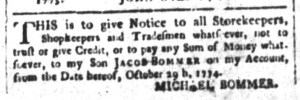
“Not to trust or give Credit … to my Son JACOB BOMMER on my Account.”

As the imperial crisis intensified and the colonies and Parliament were increasingly at odds in 1774, a rupture occurred in the relationship that Michael Bommer had with his son, Jacob.  It may or may not have been the result of politics and disagreements over the Coercive Acts and how the colonies should respond.  Just as likely, it had nothing to with politics.  After all, colonizers continued to lead their daily lives even as momentous events unfolded around them.  Fathers and sons quarreled about a variety of personal and financial issues that had little or nothing to do with politics.

Whatever the cause of their discord, it was significant enough to cause the father to take to the pages of the South-Carolina and American General Gazette with a notice “to all Storekeepers, Shopkeepers, and Tradesmen whatsoever, not to trust or give Credit, or to pay any Sum of Money whatsoever, to my Son JACOB BOMMER, on my Account, from the Date hereof, October 29th, 1774.”  Three months later, the Bommers had not reconciled.  Instead, the elder Bommer felt compelled to insert his advertisement in the January 27, 1775, edition of the South-Carolina and American General Gazette.

When he did so, he followed a format familiar to readers because it was so very regularly deployed by husbands against their wives in newspapers throughout the colonies.  On the same day that Bommer’s notice appeared, for instance, Richard Mills informed readers of the New-Hampshire Gazette that he “hereby forbids any person crediting his Wife ANNA, on his Account, as he will not pay any Debts by her contracted.”  Such notices offered a means for husbands to attempt to assert their authority in public after their wives had disdained that authority in private.  On rare occasions, men adapted those sorts of newspaper notices when their relationships with other family members deteriorated.  When Bommer did so, he protected his credit and finances, but at the expense of hinting at private affairs in the public prints.  Such a spectacle had the potential to fuel gossip and draw more attention to the strife he and his son experienced.

January 6

What was advertised in a colonial American newspaper 250 years ago today?

South-Carolina and American General Gazette (January 6, 1775).

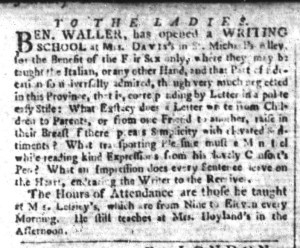
“That Part of Education so universally admired … corresponding by Letter in a polite easy Stile.”

Benjamin Waller taught penmanship and so much more to female pupils in Charleston on the eve of the American Revolution.  In an advertisement addressed “TO THE LADIES” in the January 6, 1775, edition of the South-Carolina and American General Gazette, the tutor announced that he “opened a WRITING SCHOOL … for the Benefit of the Fair Sex only.”  His students learned “the Italian, or any other Hand,” yet Waller’s lessons extended beyond writing to encompass style.  He devoted much of his advertisement to describing the merits of “that Part of Education so universally admired, though very much neglected in this Province, that is, corresponding by Letter in a polite easy Stile.”

Waller likely intended for such an allegation to incite anxiety among many of his prospective pupils.  After all, Charleston was one of the largest and most cosmopolitan urban ports in the colonies.  The local gentry prided themselves on being as fashionable and genteel as their counterparts in New York and Philadelphia.  In addition, they guarded against being considered a backwater outpost when compared to London and other European cities.  Some would have been uncomfortable with Waller’s assertion that writing letters “in a Polite easy Stile” was not widely practiced in South Carolina, questioning whether they fell short of the ideal and put their deficiencies on display each time they wrote to family and friends.

Those were not the only stakes.  Waller deployed a series of questions to illustrate what prospective pupils would gain from his instruction: “What Exstacy does a Letter wrote from Children to parents, or from one Friend to another, raise in their Breast if there appears Simplicity with elevated Sentiments?  What transporting Pleasure must as Man feel while reading kind Expressions from his lovely Consort’s Pen?  What an Impression does every Sentence leave on the Heart, endearing the Writer to the Receiver.”  Writing letters, Waller argued, was not merely a skill but an art, just as much as the drawing and painting lessons advertised by other tutors.  Women who were truly genteel could not take knowing how to write for granted; they also needed guidance, Waller suggested, in forming their thoughts and expressing them gracefully.

November 25

What was advertised in a colonial American newspaper 250 years ago today?

South-Carolina and American General Gazette (November 25, 1774).

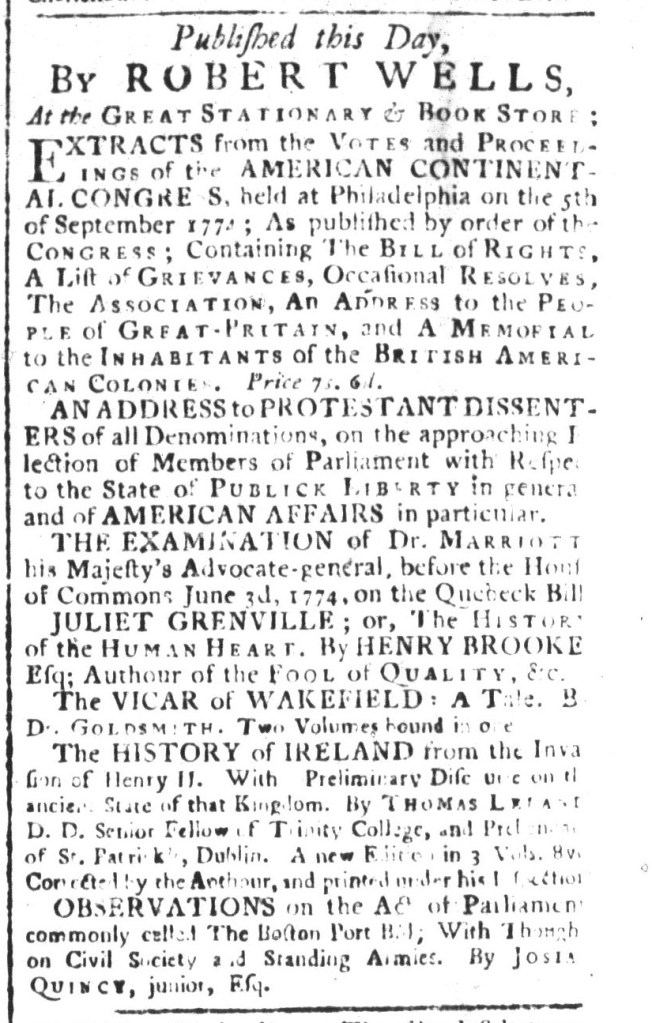
“EXTRACTS from the VOTES and PROCEEDINGS of the AMERICAN CONTINENTAL CONGRESS.”

As soon as the First Continental Congress adjourned near the end of October 1774, printers set about publishing, advertising, and selling “EXTRACTS from the VOTES and PROCEEDINGS of the AMERICAN CONTINENTAL CONGRESS, held at Philadelphia.”  William Bradford and Thomas Bradford, printers of the Pennsylvania Journal, were the first to advertise this political pamphlet, but other printers soon advertised that they produced local editions in their own towns, helping to disseminate the news far and wide.  Conveniently packaging “The BILL of RIGHTS, A List of GRIEVANCES, Occasional RESOLVES, The ASSOCIATION, An ADDRESS to the PEOPLE of GREAT-BRITAIN, and A MEMORIAL to the INHABITANTS of the BRITISH AMERICAN COLONIES” in one volume, this pamphlet supplemented coverage in newspapers.  Its format allowed for easier reference than saving and scouring issue after issue of newspapers that relayed some but not all the contents of the Extracts.  The pamphlet met with such demand that some printers quickly printed second editions.  In the November 24 edition of the Norwich Packet, for instance, Alexander Robertson, James Robertson, and John Trumbull advertised the “second Norwich EDITION” of the Extracts.

The Adverts 250 Project has examined the publication and dissemination of the Extracts in Pennsylvania, the neighboring colonies of Maryland and New York, and multiple towns in New England.  It took a little longer for printers in southern colonies to publish the pamphlet, but within a month of the First Continental Congress finishing its business Robert Wells, the printer of the South-Carolina and American General Gazette, advised readers that they could purchase the Extracts at his “GREAT STATIONARY & BOOK STORE.”  Unlike other printers who ran separate advertisements for the pamphlet, Wells included it among a list of half a dozen titles he sold.  He gave it a privileged place, first on the list, acknowledging its importance and likely interest among readers.  The other items included a couple of novels and a history of Ireland, but Wells concluded the list with “OBSERVATIONS on the Act of Parliament commonly called The Boston Port Bill, With Thoughts on Civil Society and Standing Armies.  By JOSIAH QUINCY, junior, Esq.”  Among the many volumes available at his bookstore, Wells chose to emphasize two concerning current events as the imperial crisis intensified.  Like so many other printers, he marketed items that supplemented the news he published in his newspaper.