August 1

What was advertised in a revolutionary American newspaper 250 years ago today?
South-Carolina Gazette and Country Journal (August 1, 1775).

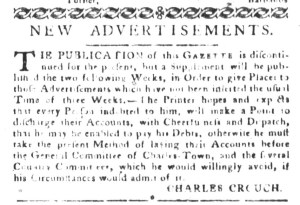
“THE PUBLICATION of this GAZETTE is discontinued for the present.”

It was the last issue of the South-Carolina Gazette and Country Journal, though Charles Crouch, the printer, may not have known it at the time.  The “NEW ADVERTISEMENTS” in the August 1, 1775, edition began with an announcement that the “PUBLICATION of this GAZETTE is discontinued for the present,” suggesting that the printer might revive it at a later time.  For now, he promised that “a Supplement will be published the two following Weeks, in Order to give Places to those Advertisements which have not been inserted the usual Time of three Weeks.”  Perhaps Crouch did distribute those supplements, but extant copies have yet to be located.  However, a nearly complete run of issues from the newspaper’s founding on December 17, 1765, through its last regular issue nearly a decade later does survive.  In 1908, A.S. Salley, Jr., noted, “The Charleston Library Society possesses an almost complete file of Crouch’s paper, only twenty-five numbers being missing from the ten years of the file.”[1]  Four decades later, Clarence Brigham did not record any missing issues in the Charleston Library Society’s collections in his History and Bibliography of American Newspapers, 1690-1820.[2]  Perhaps in the intervening years the Charleston Library Society acquired copies of those missing issues.

Isaiah Thomas, the printer of the Massachusetts Spy who later penned The History of Printing in America in 1810, wrote a short history of the South-Carolina Gazette and Country Journal.  The newspaper, he explained, “was established in opposition to the British American stamp act … and was published without stamps.”  That garnered acclaim from the public, earning Crouch a reputation as a “sound whig” or patriot.  “The general opposition of the colonies to the stamp act induced the public to patronize this Gazette.  It immediately gained a large list of respectable subscribers, and a full proportion of advertising customers.”  Crouch did not leave that to chance.  He included “Gazette” in the title, like the printers of the South-Carolina Gazette and the South-Carolina and American General Gazette, “in order to secure certain advertisements, directed by law to be ‘inserted in the South Carolina Gazette.’”  In addition to those notices, Crouch’s newspaper also carried a variety of advertisements for consumer goods and services as well as notice presenting enslaved people for sale or offering rewards for the capture and return of enslaved people who liberated themselves by running away from their enslaver.  Each sort of advertisement represented a lucrative revenue stream for the printer.  Among its competitors in Charleston, Thomas asserted, Crouch’s newspaper was the only one that “appeared regularly.”[3]  Others sometimes had gaps in publication.

Even though Crouch hoped to resume publishing the South-Carolina Gazette and Country Journal, he did not have the opportunity.  In late August 1775, he boarded a vessel headed to Philadelphia.  He sought supplies for his printing office, especially paper that had grown scarce.  The ship was lost at sea.  Thomas stated that Crouch’s widow published the newspaper for a short time, but Salley clarifies that Ann Crouch “revived her husband’s paper under the name of The Charlestown Gazette” in 1778 and “conducted it until the capture of Charles Town by the British in 1780.”[4]  A few issues have survived and been digitized for greater access by scholars and the public.  The Adverts 250 Project will examine those at the appropriate time.  For now, the demise of the South-Carolina Gazette and Country Journalcertainly had ramifications in Charleston and beyond.  In August 1775, readers in South Carolina had one less source of news and one less publication for disseminating advertisements.

**********

[1] A.S. Salley, Jr., “The First Presses of South Carolina,” Proceedings and Papers (Bibliographical Society of America) 2 (1907-1908): 66.

[2] Clarence Brigham, History and Bibliography of American Newspapers, 1690-1820 (Worcester, Massachusetts: American Antiquarian Society, 1947), 1039.

[3] Isaiah Thomas, The History of Printing in America: With a Biography of Printers and an Account of Newspapers (1810; New York: Weathervane Books, 1970), 571, 582.

[4] Salley, “First Presses of South Carolina,” 65-66.

July 9

What was advertised in a revolutionary American newspaper 250 years ago today?

South-Carolina Gazette and Country Journal Extraordinary (July 9, 1775).

“SOAP and CANDLES as usual.”

It was an exceptionally rare Sunday edition that carried John Benfield’s advertisement for “RUM of all Sorts” and “SOAP and CANDLES as usual,” Ann Durffey’s advertisement offering an enslaved man for sale, and a handful of other advertisements.  Charles Crouch usually published the South-Carolina Gazette and Country Journal on Tuesdays, but news of recent events merited a broadside extraordinary edition on Sunday, July 9.

Throughout the colonies, printers produced issues of their weekly newspapers on every day from Monday through Saturday, many of them choosing which day according to when postriders arrived with weekly newspapers from other towns.  They allowed just enough time to select and reprint news updates, editorials, and letters about current events.  None, however, published their weekly newspaper on Sundays.  Some occasionally distributed supplements or postscripts at some point during the week, but not on Sundays.  That made Crouch’s South-Carolina Gazette Extraordinary for “SUNDAY EVENING, June 9, 1775” truly extraordinary.  The Adverts 250 Project has so far examined advertising from January 1, 1766, through July 9, 1775.  I believe this is the first advertisement from a newspaper published on a Sunday included in the project in nearly a decade.

What prompted Crouch to rush to press with a broadside edition printed on only one side of the sheet?  The Extraordinary included news of the Battle of Bunker Hill, including articles and letters that originated in Cambridge, Massachusetts; Newport, Rhode Island; and Philadelphia.   The news filled two entire columns and spilled over into a second.  A short update with borders composed of ornamental type to draw attention, ran just above the advertisements that accounted for half of the final column.  Although the dateline, “CHARLES-TOWN, JULY 9,” suggested local news, it carried a grave update about recent events in Massachusetts.  “LETTERS from Rhode-Island mention,” Crouch reported, “That there were only 1200 Provincials in the Engagement mentioned under the Cambridge Head, and near 5000 of the King’s Troops; and that the celebrated Dr. Jospeh Warren, was among the Slain of our Brethren” at the Battle of Bunker Hill.  When Crouch decided to deliver that news as soon as he could after receiving it, he also disseminated advertisements that would not otherwise have circulated on a Sunday.  Benfield advertised “SOAP and CANDLES as usual,” yet there was nothing usual about the Extraordinary that carried his advertisement.

South-Carolina Gazette and Country Journal Extraordinary (July 9, 1775).

June 13

What was advertised in a revolutionary American newspaper 250 years ago today?

South-Carolina Gazette and Country Journal (June 13, 1775).

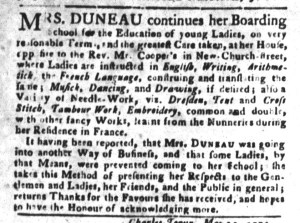
“MRS. DUNEAU continues her Boarding School for the Education of young Ladies.”

In an advertisement in the June 13, 1775, edition of the South-Carolina Gazette and Country Journal, Mrs. Duneau assured the public that she “continues her Boarding School for the Education of young Ladies … at her House, opposite to the Rev. Mr. Cooper’s in New-Church-street” in Charleston.  She may have intended to suggest that her proximity to the minister contributed to the “greatest Care” that she took of her pupils.  The schoolmistress also provided an overview of the curriculum at her school: “English, Writing, Arithmetic, the French Language, construing and translating the same; Musick, Dancing, and Drawing.”  The education they received from Duneau helped in forming her students into genteel young ladies.  In addition, they learned a “Variety of Needle-Work,” likely intended to demonstrate their devotion to leisurely pursuits rather prepare them occupations to support themselves.  Those included “Dresden, Tent and Cross Stitch, Tambour Work, [and] Embroidery, common and double,” along with “other fancy Works” that Duneau “learnt from the Nunneries during her Residence in France.”

Although advertisements for boarding schools regularly appeared in newspapers published in Charleston on the eve of the American Revolution, Duneau may have considered it especially necessary to insert this notice to attract students.  “It having been reported,” she stated, “that Mrs. DUNEAU was going into another Way of Business, … some Ladies, by that Means, were prevented coming to her School.”  What kinds of reports had circulated?  Who was responsible for suggesting that she planned to pursue another occupation, perhaps putting her skill with a needle to use in the marketplace?  Had a rival schoolmistress spread rumors as a means of undercutting Duneau and enrolling students who otherwise would have attended her school?  Duneau did not provide further details in her advertisement.  Instead, she focused on “presenting her Respects to the Gentlemen and Ladies, her Friends, and the Public in general,” expressing her gratitude for “the Favours she has received” when entrusted with students in the past and requesting “the Honour of acknowledging more.”  Whatever readers may have heard about whether Duneau continued to operate her school, she wanted the parents of prospective students to know that she was prepared to teach their daughters.

May 30

What was advertised in a revolutionary American newspaper 250 years ago today?

South-Carolina Gazette and Country Journal (May 30, 1775).

“Dr. KEYSER’s GENUINE PILLS, With FULL DIRECTIONS for their Use in all CASES.”

Like many eighteenth-century printers, Charles Crouch, the printer of the South-Carolina Gazette and Country Journal, sold patent medicines as a side hustle to supplement revenues from newspaper subscriptions, advertisements, job printing, and selling books and writing supplies.  In the May 30, 1775, edition of his newspaper, for instance, he ran an advertisement for a “FRESH PARCEL of Dr. KEYSER’s GENUINE PILLS.”  He did not need to explain that the pills treated venereal diseases because they were so familiar to consumers, but that did make it necessary to assure the public that he carried the “GENUINE” item rather than imitations or counterfeits.  Crouch also stocked “Dr. BOERHAAVE’s GRAND BALSAM of HEALTH.”  Realizing that many prospective customers would have been less familiar with this “admirable Remedy,” the printer explained that they could take it for “the dry Belly-Ach, Cholic, Griping in the Bowels, [and] Pain in the Stomach.”  In addition, the balsam “cleanses the Stomach.”  Today, many consumers have favorite over-the-counter medicines for similar symptoms.

Crouch realized that treating venereal disease was a sensitive subject and that customers purchasing Keyser’s Pills wanted to use them correctly and effectively.  He promised in his advertisement that he provided “FULL DIRECTIONS for their Use in all CASES.”  Doing so also minimized the amount of contact between the purchaser and the seller.  Customers did not need to visit an apothecary and go over how to use the medication.  Instead, they could visit the printer, ask for the pills and the directions, and avoid additional interaction.  Some may have even requested Keyser’s Pills along with other items, perhaps ink powder or a recent political pamphlet, to draw attention away from a purchase that caused embarrassment or discomfort.  Crouch also assured prospective customers that the pills were effective, inviting them to examine a “NARRATIVE of the Effects of Dr. KEYSER’s MEDICINE, with an Account of his ANALYSIS, by the Members of the Royal Academy of Sciences.”  Perusing those accounts did require more interaction between buyer and seller, but Crouch may have believed that some readers would have considered it sufficient to know that they were available.  That the printer could provide documentation upon request increased trust in the remedy.

The advertisement for Keyser’s Pills and Boerhaave’s Grand Balsam appeared immediately above a notice listing more than a dozen kinds of printed blanks commonly used for commercial and legal transactions.  Beyond publishing the South-Carolina and Country Journal, Crouch generated revenue through a variety of other means, some of them more closely related to printing than others.  He could earn money with both printed blanks and patent medicines, especially when he deployed savvy marketing.

May 19

Who was the subject of an advertisement in a revolutionary American newspaper 250 years ago today?

South-Carolina Gazette and Country Journal Extraordinary (May 19, 1775).

“NEGROES of different Qualifications.”

Charles Crouch usually published the South-Carolina Gazette and Country Journal on Tuesdays in 1775, distributing new issues on a different day than his competitors in Charleston.  Peter Timothy delivered the South-Carolina Gazette on Mondays and Robert Wells and Son presented the South-Carolina and American General Gazette on Fridays.  Yet as information about the battles at Lexington and Concord arrived in Charleston, Crouch published a two-page extraordinary issue on Friday, May 19.  He had first broken the news in the May 9 edition, printing “alarming Intelligence” received via “the Brigantine, Industry, Captain Allen, who sailed the 25th [of April] from Salem.”  Subsequent issues of both the South-Carolina Gazette and Country Journal and the South-Carolina and American Gazette carried news about Lexington and Concord.  (A gap in extant issues between April 10 and May 29 prevents determining when the South-Carolina Gazette reported on those events.)

Many, perhaps most, readers likely heard that British regulars had engaged colonial militia outside of Boston before they read anything in newspapers.  News and rumors spread via word of mouth more quickly than printers could set type, yet readers still clamored for coverage.  After all, the public prints carried more details about what happened, though not all of them were always correct.  Wells and Son printed the South-Carolina and American General Gazette as usual on Friday, May 19, carrying additional news about Lexington and Concord and the aftermath.  Refusing to be scooped, Crouch published his extraordinary issue on the same day.  He specified that the “particulars respecting the Engagement at Lexington, are copied from the Newport Mercury.”

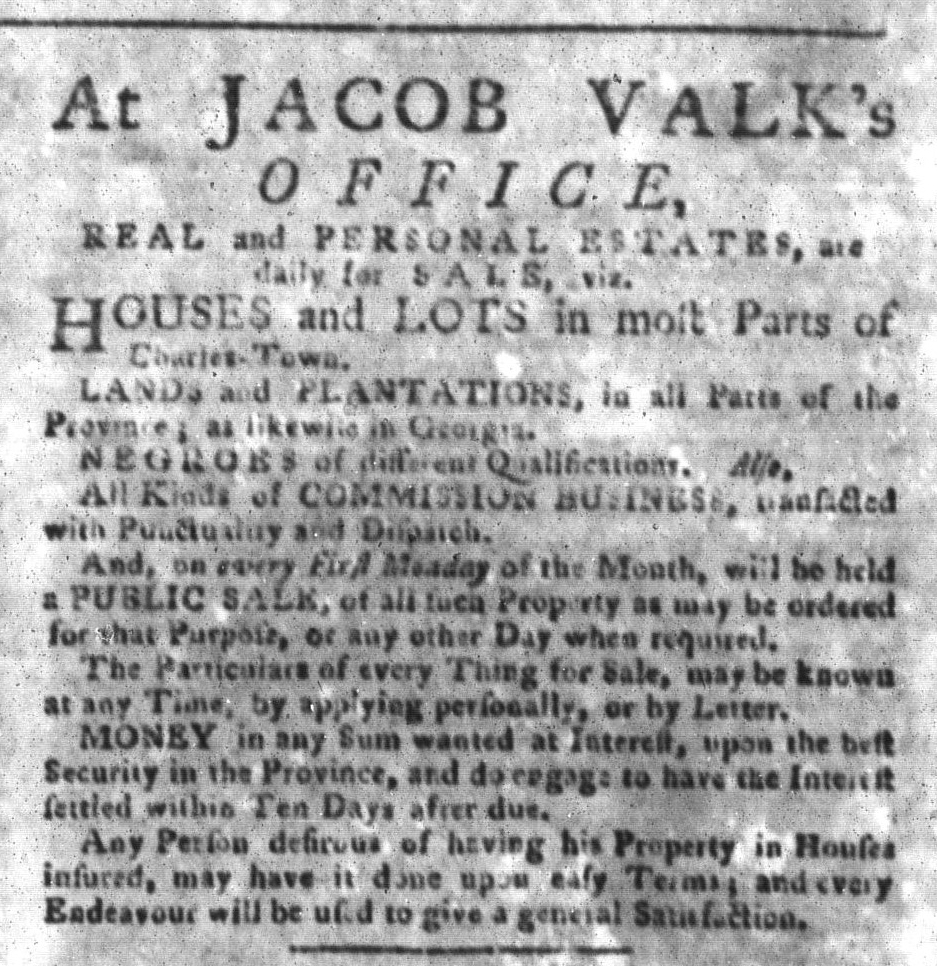
Even as Crouch provided more news for subscribers and the public, he disseminated even more advertisements.  News accounted for only one-quarter of the contents of the May 19 extraordinary issue, with advertisements filling three-quarters of the space.  Those notices included three from Jacob Valk, a broker, looking to facilitate the sales of “ONE of the compleatest WAITING-MEN in the Province,” “Some valuable PLANTATION NEGROES,” and “NEGROES of different Qualifications” at his office.  In another advertisement, William Stitt described Lydia and Phebe, enslaved women who liberated themselves by running away, and offered rewards for their capture and return to bondage.  In yet another, the warden of Charleston’s workhouse described nearly a dozen Black men and women, all of them fugitives seeking freedom, imprisoned there, alerting their enslavers to claim them, pay their expenses, and take them away.  As readers learned more about acts of tyranny and resistance underway in Massachusetts, they also encountered various sorts of advertisements designed to perpetuate the enslavement of Black men and women.  The early American press simultaneously served multiple purposes, regularly featuring a juxtaposition of liberty and slavery that readers conveniently compartmentalized.

May 9

What was advertised in a revolutionary American newspaper 250 years ago today?

South-Carolina Gazette and Country Journal (May 9, 1775).

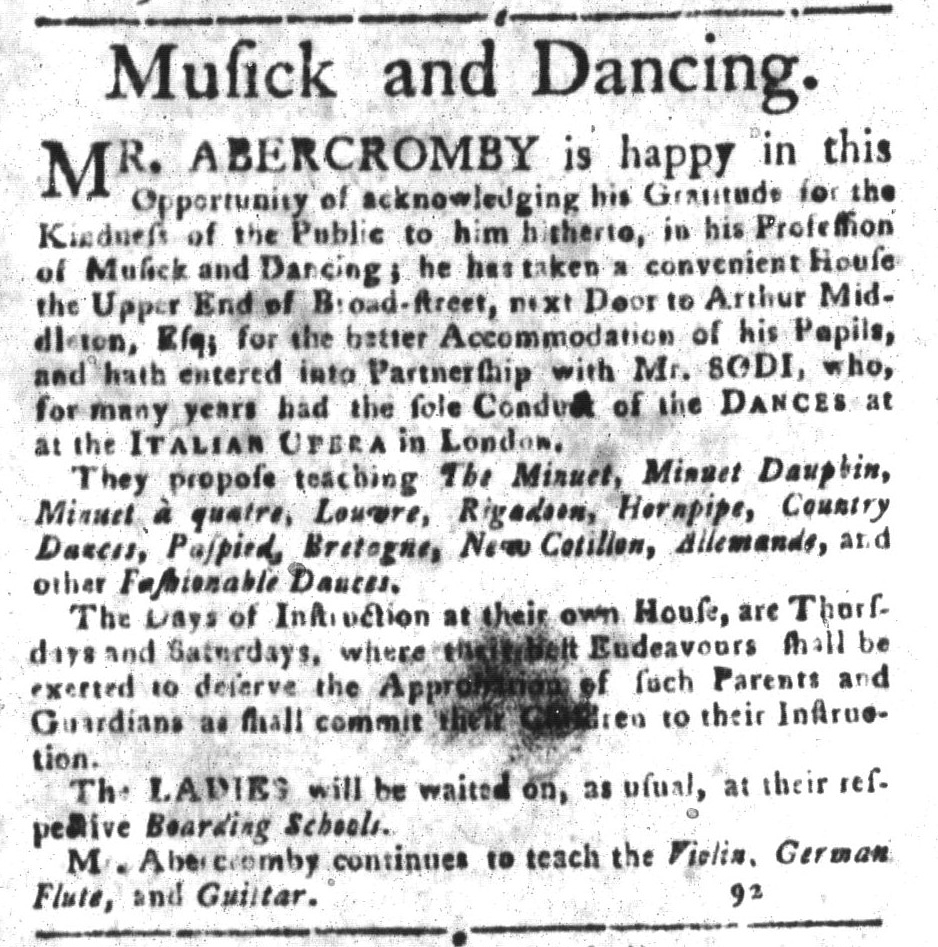
“Musick and Dancing.”

Among the advertisements for textiles, patent medicines, vessels preparing to depart for distant ports, and enslaved people for sale in the May 9, 1775, edition of the South-Carolina Gazette and Country Journal, Mr. Abercromby promoted lessons in “Musick and Dancing.”  He started by expressing his appreciation for the support he already received, stating that he was “happy in this Opportunity of acknowledging his Gratitude for the Kindness of the Public to him hitherto, in his Profession.”  Doing so bolstered his reputation; readers not previously familiar with Abercromby, especially genteel readers who knew that their social standing depended in part on their ability to demonstrate that they had mastered the steps of various dances or could play a musical instrument, may have asked themselves why they did not know Abercromby and whether they should make his acquaintance.

Abercromby next made two important announcements.  First, he moved to a new location, a “convenient House [in] the Upper End of Broad-street” in Charleston, that offered “better Accommodation of his Pupils.”  In addition, he “entered into Partnership with Mr. SODI, who, for many years had the sole Conduct of the DANCES at the ITALIAN OPERA in London.”  Signior Sodi, as he styled himself, previously advertised his services in the Pennsylvania Journal in the summer and fall of 1774, but by the spring of 1775 he had migrated from Philadelphia to Charleston.  Just as Sodi had done in his own advertisements, Abercromby emphasized the cachet of learning to dance from an instructor with connections to such an illustrious institution.

Abercromby listed nearly a dozen dances that he and Sodi taught, including “The Minuet, Minuet Dauphin, Minuet à quatre, Louvre, [and] Rigadoon,” as well as “other Fashionable Dances.”  Their pupils could learn new dances or refine their steps for those they already knew.  In addition to the lessons they gave at their “convenient House,” Abercromby and Sodi visited boarding schools in Charleston.  Parents and guardians could arrange to enhance the curriculum that their young “LADIES” studied, trusting that the schoolmistresses provided appropriate supervision of the dancing masters and their pupils.  Such services may have been especially attractive to the gentry in one of the largest and most cosmopolitan urban ports in the colonies.  Abercromby and Sodi did not merely teach dancing, after all, but instead sold status to those who succeeded at their lessons.

April 11

What was advertised in a colonial American newspaper 250 years ago today?

South-Carolina Gazette and Country Journal (April 11, 1775).

“The Sign of the NEGRO BOY.”

The April 11, 1775, edition of the South-Carolina Gazette and Country Journal carried seventeen advertisements about enslaved people.  Several offered enslaved people for sale.  Jacob Valk, a broker who regularly advertised, noted that “NEGROES of different Qualifications” were “daily for SALE” at his office.  Valentine Lynn sought to sell “Seven healthy, stout NEGROES,” including “a good boatman,” a “handy” domestic servant, and five “field slaves.”  Robert Goudey announced that he “will dispose of, by private contract,” nearly three dozen enslaved people, “among whom are carpenters, coopers, wagon drivers, plough men, and house” maids.  Prospective purchasers could presumably examine those enslaved people, just as they could examine any of the eleven Black men and women “Brought to the Workhouse” and imprisoned there until their enslavers claimed them.

Other advertisements certainly enlisted readers in examining Black bodies closely to determine if they matched the descriptions of enslaved people who liberated themselves by running away from their enslavers.  William Stitt, for instance, asked readers to take note of any Black women they encountered who might be Lydia, “about 40 years of age, of a yellowish complexion.”  William Roberts described Tena, who “had on when she went away, a blue negro cloth gown, and osnaburgs apron.”

Yet these were not the only instances of Black bodies on display in Charleston.  In a notice asking others to settle accounts before he left the city for a while, John Welch, a tobacconist, advised his “Friends and Customers” that associates would conduct business “as usual” at his “SHOP in Union-street, the Sign of the NEGRO BOY.”  He may have chosen that emblem to represent the laborers who cultivated the tobacco he sold.  By the time Welch ran his advertisement in the spring of 1775 the sign that marked his shop was a familiar sight to those who traversed the streets of Charleston.  He referenced it in an advertisement the previous summer, so it had been in place for the better part of a year and probably longer, especially considering that he also referred to that location as his “old SHOP.”  Welch’s commercial enterprise appropriated the labor the enslaved men and women who raised the tobacco he sold, but that was not the extent of his use of Black bodies in earning his livelihood.  He also deployed an image of a Black boy as the emblem of his business and the device that confirmed customers arrived at the right location to purchase tobacco and snuff.

March 7

What was advertised in a colonial American newspaper 250 years ago today?

South-Carolina Gazette and Country Journal (March 7, 1775).

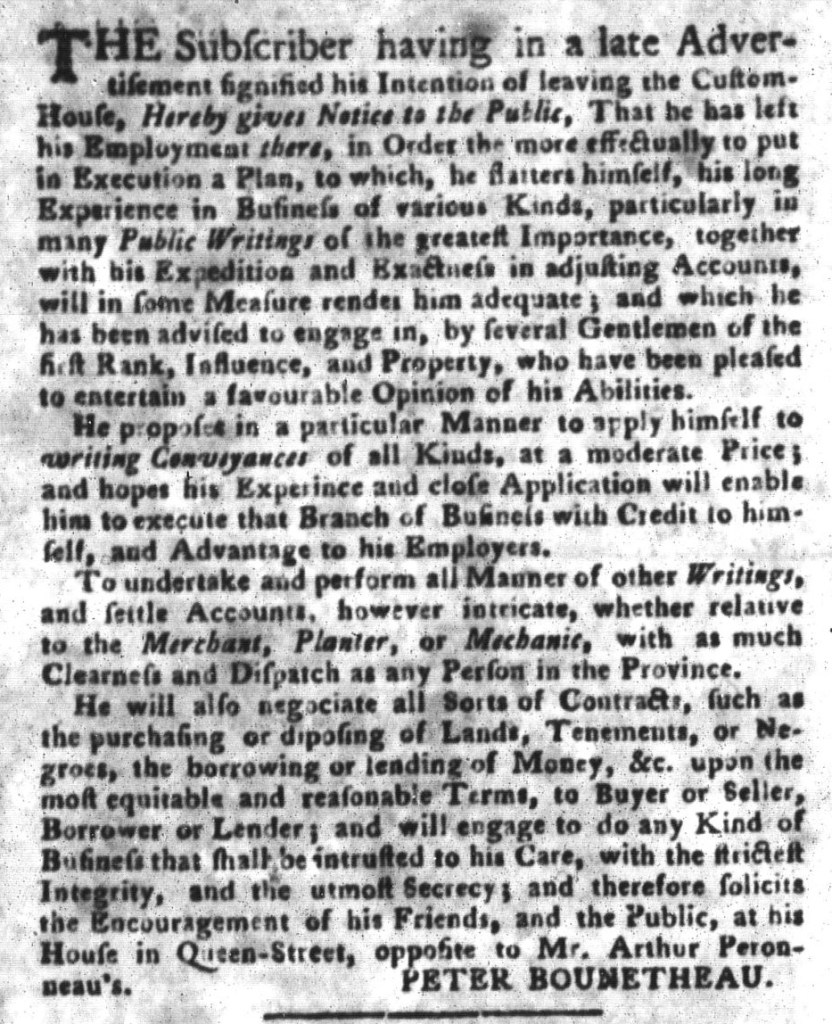
“He proposes … to apply himself to writing Conveyances of all Kinds.”

On the eve of the American Revolution, Peter Bounetheau left his job at the custom house in Charleston and established his own business for “writing Conveyances of all Kinds” and negotiating “all Sort of Contracts, such as the purchasing or disposing of Lands, Tenements, or Negroes [and] the borrowing or lending of Money.”  He claimed that he had done so on the advice of “several Gentlemen of the first Rank, Influence, and Property, who have been pleased to entertain a favourable Opinion of his Abilities.”  In addition to that endorsement, he emphasized “his long Experience in Business of various Kinds, particularly in many Public Writings of the greatest Importance, together with his Expedition and Exactness in adjusting Accounts.”

By the time his advertisement ran in the March 7, 1775, edition of the South-Carolina Gazette and Country Journal, Bounetheau had been in business for several months.  He had established himself well enough to attract clients that accounted for twelve other advertisements of various lengths on the same page.  A couple concerned real estate and a couple hawked commodities like mustard and olives, yet most of them offered enslaved people for sale.  Six of those advertisements enumerated three enslaved men, ten enslaved women, and six enslaved women that Bounetheau sought to sell on behalf of others.  A seventh advertisement listed “Several NEGROES,” but did not specify how many beyond “a complete boatman and jobbing carpenter” and “a complete washer and ironer.”  The others were “field slaves.”

Bounetheau’s enterprise meant good business for Charles Crouch, the printer of the South-Carolina Gazette and Country Journal.  Week after week, the broker placed multiple advertisements, representing significant revenues for the printing office.  In the March 7 edition, his notices filled an entire column and nearly half of another out of twelve total columns in a standard issue of four pages consisting of three columns each.  That meant that Bounetheau generating ten percent of the content.  Another broker, Philip Henry, inserted fifteen advertisements that occupied the same amount of space, though he focused more on real estate than enslaved people.  Still, he offered “TWENTY-TWO young and healthy NEGROES, that have been used to a Plantation” in one notice and “ELEVEN NEGROES, chiefly Country born” in another.  These brokerage firms likely increased the number of advertisements that ran in the South-Carolina Gazette and Country Journal and other newspapers published in Charleston in the 1770s.  Such endeavors included greater dissemination of advertisements that contributed to perpetuating the slave trade.

January 31

What was advertised in a colonial American newspaper 250 years ago today?

South-Carolina Gazette and Country Journal (January 31, 1775).

“She intends to carry on the UPHOLSTERY BUSINESS in all its branches, except paper hanging.”

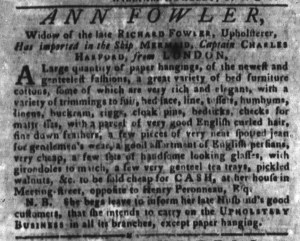
Ann Fowler, “Widow of the late RICHARD FOWLER, Upholsterer,” took to the pages of the South-Carolina Gazette and Country Journal to advertise a variety of merchandise that she sold out of her house on Meeting Street in Charleston.  She indicated that she imported her wares “in the Ship MERMAID, Captain CHARLES HARFORD, from LONDON,” a vessel that arrived in port on December 29, 1774, according to the list of “ENTRIES INWARDS” at the custom house published in the January 3, 1775, edition of the South-Carolina Gazette and Country Journal.  Those goods should have fallen under the jurisdiction of the Continental Association.  Nevertheless, Fowler hawked a “Large quantity of paper hangings, of the newest and genteelest fashions, a great variety of bed furniture cottons, some of which are very rich and elegant, with a variety of trimmings to suit, [and] a few sets of handsome looking glasses, with girandoles to match.”  The widow was not the only advertiser who placed notices about imported goods that looked the same as those published before the Continental Association went into effect.

Fowler appended a nota bene to “inform her late Husband’s good customers, that she intends to carry on the UPHOLSTERY BUSINESS in all its branches, except paper hanging.”  Widows often took over the family business in colonial America, sometimes doing the same tasks their husbands had done and sometimes supervising employees.  Even though Ann had not been the public face of the enterprise while Richard still lived, she likely had experience assisting him in his shop and interacting with any assistants that he hired.  She hoped that she and her husband had cultivated relationships that would allow her to maintain their clientele, though they would have to look elsewhere when it came to “paper hanging” or installing wallpaper.  Fowler sold papers hangings “of the newest and genteelest fashions,” but her customers needed to contract with someone else to paste them up.  That may have been because she lacked experience with that aspect of the family business, her role having been primarily in the shop.  On the other hand, perhaps she felt comfortable doing all sorts of upholstery work in the shop, a semi-public space that now belonged to her, but she did not consider it appropriate to enter the private spaces of her customers, especially male clients who lived alone.  As a female entrepreneur, Fowler may have attempted to observe a sense of propriety that the public would find acceptable.  Whether or not Fowler had prior experience installing paper hangings, she constrained herself in discontinuing that service following the death of her husband.

January 10

What was advertised in a colonial American newspaper 250 years ago today?

South-Carolina Gazette and Country Journal (January 10, 1775).

“The Negro Caesar’s Cure for Poison.”

On January 10, 1775, Charles Crouch, the printer of the South-Carolina Gazette and Country Journal, advertised “THE SOUTH-CAROLINA ALMANACK, or Lady’s and Gentleman’s DIARY for the Year of our Lord Christ 1775.”  Like many other printers who promoted almanacs, he attempted to incite interest by listing the contents, including the usual astronomical calculations, “High Water at Charles-Town,” “Days for holding Courts in South-Carolina and Georgia,” “Lists of Public Officers,” and a “Description of the Roads throughout the Continent.”  This almanac contained all sorts of useful information for readers to reference throughout the year.

In addition to the contents, Crouch printed a poem that resonated with current events.  That poem (or perhaps a longer version) presumably appeared in the almanac, a piece of inspiration to inculcate support for the American cause.  As the imperial crisis intensified in the wake of the Coercive Acts and the meeting of the First Continental Congress, the poem called on “AMERICANS! for Freedom firmly join, / Unite your Councils, and your Force combine, / Disarm Oppression — prune Ambition’s Wings, / And stifle Tories, e’er they dart their Stings.”  While the poem in Crouch’s advertisement lamented the loss of “Rights and Liberties” for colonizers, the printer simultaneously disseminated two dozen advertisements about enslaved people in that edition of the South-Carolina Gazette and Country Journal and the supplement that accompanied it.  Yet readers did not need to look beyond the advertisement for the almanac to find references to enslaved people.  The contents included “The Negro Caesar’s Cure for Poison, and the Bite of a Rattle-Snake,” appropriating African knowledge just as so many of the advertisements appropriated African labor.  The exploitation of enslaved people that contributed to the welfare and prosperity of colonizers occurred along multiple trajectories.  Although agricultural labor on plantations has been the most visible of those, newspaper advertisements and other primary sources demonstrate that enslaved Africans and African Americans provided all sorts of knowledge and skilled labor, ranging from remedies like Caesar’s cures for poison and rattlesnake bites to the work undertaken by enslaved coopers, carpenters, cooks, and seamstresses.