January 5

Who was the subject of an advertisement in a colonial American newspaper 250 years ago today?

Supplement to the South-Carolina Gazette and Country Journal (January 5, 1775).

“Several valuable NEGROES.”

The first week of 1775 was a busy one in Charles Crouch’s printing office “on the Bay, the Corner of Elliott-street” in Charleston.  Crouch published the South-Carolina Gazette and Country Journal on Tuesday, January 3, distributing it to subscribers on the usual day.  The standard four-page issue, however, could not contain all the content that Crouch received for that edition.  Accordingly, he released a two-page supplement, composed entirely of advertisements, on the same day.  Yet Crouch’s press was not finished with the “freshest Advices, both Foreign and Domestic,” for the week.  Two days later, a two-page Supplement to the South-Carolina Gazette and Country Journal carried both news and advertising.  It featured updates from Boston, New York, and Philadelphia, as well as local news.  Advertising appeared on both sides of the broadsheet, accounting for just under half of the content.  Many of those advertisements ran in the standard edition or its supplement just two days earlier.  Thanks to the news that Crouch determined to publish immediately rather than wait nearly a week for the next issue, all the advertisements in the January 5 supplement circulated sooner than anticipated.

Initially, I did not notice that Crouch published the second supplement on January 5 rather than January 3.  Both supplements have been cataloged with the standard edition for that week in the database of digitized eighteenth-century newspapers I consult for this project.  It seemed strange to have two two-page supplements rather than one four-page supplement on a single day.  Although uncommon, that arrangement was not unknown, especially when a printer received breaking news after the supplement went to press.  When I downloaded the standard issue and the supplements, I was in enough of a hurry to move on to other tasks that I did not look closely enough at the mastheads to spot “THURSDAY, JANUARY 5” instead of “TUESDAY, JANUARY 3” on the second supplement.  I noticed only later when I worked more intensively with the advertisements, questioning why John Grafton’s advertisement ran twice on the same day.  On closer inspection, I discovered that it made its second appearance in the January 5 supplement.  I could have been frustrated that the database did not include a separate entry for the January 5 supplement, but I recognized that I had overlooked the date in the masthead more than once when working with the file I downloaded.  My own lack of attention to detail had almost led me into attributing incorrect dates to notices compiled for the Slavery Adverts 250 Project (including the advertisement featured above).  This incident served as a good reminder to work carefully with primary sources, including digitized primary sources, because minor errors do happen no matter how carefully and conscientiously catalogers, archivists, librarians, historians, and others go about the work of making documents more widely accessible.

January 3

What was advertised in a colonial American newspaper 250 years ago today?

South-Carolina Gazette and Country Journal (January 3, 1775).

Late Pupil to Sir JOSHUA REYNOLD’s, of Leicester Fields, LONDON.”

When John Grafton migrated to Charleston, he introduced himself to his new community with an advertisement in the South-Carolina Gazette and Country Journal.  Like many other artists and artisans, he emphasized his training and credentials since prospective clients were not familiar with him by reputation.  In addition to being a “PORTRAIT PAINTER,” Grafton was “Late Pupil to Sir JOSHUA REYNOLD’s, of Leicester Fields, LONDON.”  Grafton expected that at least some readers would recognize the name of one of the most influential English portrait painters of the eighteenth century.  Reynolds was one of the founders of the Royal Academy of Arts in 1768 and served as its first president.  The following year, George III knighted him.  Grafton sought to benefit from the acclaim achieved by his mentor, asserting that since “he has been under one of the first Masters of that Art in England, and having made [painting portraits] his principal Study for a Number of Years, he shall be able to give general Satisfaction.”  For those who needed more convincing, he had “several Specimens of his Performance on display” for their inspection.

After conferring with other artists in South Carolina, Grafton realized that he likely would not have “constant employ” solely from commissions for portraits.  “[B]eing unwilling to let any Tim slip unimproved” and needing to support himself, he intended to offer lessons in drawing.  Grafton announced that he reserved two days each week for giving “Instructions at his Academy.”  Many tutors, especially those who taught dancing and French, advertised private lessons. Grafton did the same for those who wished to learn to draw, indicating that they could be “initiated at their Houses.”  He also presented his services to schoolmasters and -mistresses interested in adding drawing to their curricula.  What could pupils expect from their lessons with Grafton?  He confidently asserted that he “will engage to make any one that has some Instructions in Drawing, or has the least Genius for Painting, capable of taking their own, or any Person’s Likeness with Crayons, in less than three Months.”  Students could assess their own progress relative to this claim, entering their lessons with the understanding that their skills should improve within months rather than over years thanks to “the most easy and agreeable Manner” of Grafton’s instruction.  They could learn “one of the politest Arts” from a student of an acknowledged master, an endeavor that had its own cachet for the “Ladies and Gentlemen” of South Carolina.

December 6

What was advertised in a colonial American newspaper 250 years ago today?

South-Carolina Gazette and Country Journal (December 6, 1774).

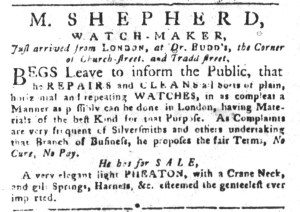
“WATCH-MAKER … proposes the fair Terms, No Cure, No Pay.”

When he moved to Charleston, one of the largest port cities in the colonies, M. Shepherd, a watchmaker, took to the pages of the South-Carolina Gazette and Country Journal to introduce himself to his prospective customers.  Like many artisans who crossed the Atlantic, he emphasized his connections to London, suggesting the level of skill he obtained while employed there.  In addition to stating that he “Just arrived from LONDON,” Shepherd also asserted that he “REPAIRS and CLEANS all Sorts of plain, horizontal and repeating WATCHES, in as compleat a Manner as possibly can be done in London.”  That was possible, in part, because he had “Materials of the best Kind for that Purpose.”  Shepherd’s competitors could make claims about doing work that rivaled that of their counterparts in London, but he was in a much better position to deliver on those promises.

The watchmaker also seized an opportunity to critique what he believed was a shortcoming in the services offered in the local market.  He suggested that “Silversmiths and other undertaking that Branch of Business,” rather than trained and experienced watchmakers, attempted to repair and clean watches, resulting in “very frequent” complaints about shoddy work.  In that regard, he echoed the critiques so often launched by John Simnet, another watchmaker from London who had migrated to the colonies.  Simnet regularly asserted that his competitors who attempted to fix watches did more damage, making it necessary for him to undertake even greater repairs.  Shepherd was so confident of his abilities that he offered a guarantee that he framed as “fair Terms.”  Invoking language more often deployed by physicians and apothecaries, the watchmaker promised, “No Cure, No Pay.”  In other words, if he could not fix a watch then he did not charge the customer for the time or materials that he invested in the effort.  As a newcomer in Charleston, he aimed to make his services attractive to prospective clients, highlighting both his skill and his no-risk guarantee.

November 29

What was advertised in a colonial American newspaper 250 years ago today?

Supplement to the South-Carolina Gazette and Country Journal (November 29, 1774).

“Employ him in any Kind of Commission Business.”

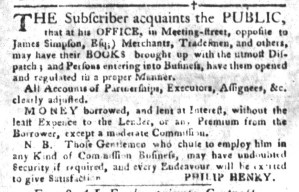
Philip Henry worked as a bookkeeper and a broker in Charleston on the eve of the American Revolution.  In an advertisement in the South-Carolina Gazette and Country Journal, he advised the public that “Merchants, Tradesmen, and others, may have their BOOKS brought up with the utmost Dispatch.”  Those considering embarking on a new endeavor could engage his services to have their accounts and ledgers “opened and regulated in a proper Manner” from the start.  In addition, he assisted with “any Kind of Commission Business,” whether commodities, real estate, or enslaved laborers.

As part of that aspect of his business, Henry placed many more advertisements on behalf of his clients.  In the supplement that accompanied the November 29, 1774, edition of the South-Carolina Gazette and Country Journal, for instance, his advertisement describing the variety of services he offered at his office on Meeting Street served as an introduction for a series of advertisements that ran immediately below it.  He inserted eight additional advertisements, six of them for real estate and two offering enslaved people for sale.  His brokerage business was good business for Charles Crouch, the printer of that newspaper.

Henry was not alone as a broker or as an advertiser.  Peter Bounetheau ran a similar notice, one that also served as an introduction to a series of other advertisements.  He placed eleven on another page of the supplement that included Henry’s notices, requiring enough space to fill an entire column and spill over into another.  Those included six about enslaved people, two about real estate, one on behalf of the executor of an estate, and one about several lots in the city, a plantation in the country, and “Several NEGROES.”  Similarly, Jacob Valk, another broker, inserted advertisements that accounted for a significant amount of space in November 29 edition.  He collated most of the real estate handled by his office into a single advertisement that filled a column, yet placed five separate advertisements about enslaved people as well as an estate notice and an advertisement about horses.

Henry, Bounetheau, and Valk industriously placed their notices in the South-Carolina and American General Gazette and the South-Carolina Gazette in addition to the South-Carolina Gazette and Country Journal.  Even though brokers ran offices in other urban ports, they did not adopt a similar advertising strategy as part of their business model.  That made the rhythm of advertising in South Carolina’s newspapers distinctive compared to those published in Boston, New York, and Philadelphia.

November 22

What was advertised in a colonial American newspaper 250 years ago today?

South-Carolina Gazette and Country Journal (November 22, 1774).

“They will sell off very low … their valuable STOCK of GOODS.”

It was a going out of business sale.  That was not the language that Hawkins, Petrie, and Company used in their advertisement in the November 22, 1774, edition of the South-Carolina Gazette and Country Journal, yet that was what they described to readers.  They first noted that their “co-partnership” would “expire” at the end of the year and, “by mutual consent,” they did not plan to renew it.  Indeed, neither of them intended to continue in business, so they called on customers and associates to settle accounts.

They also sought to liquidate their inventory, announcing that they “will sell off very low … their valuable STOCK of GOODS, which consists of a large assortment.”  Prospective customers could anticipate good deals because Hawkins, Petrie, and Company acquired their wares “on the very best terms.”  They expected cash payments (or “ready money”), but also made allowances to “sell for credit to good customers” who had made timely payments in the past.  To further entice sales, the partners offered discounts to customers “purchasing to a considerable amount,” whether merchants and shopkeepers seeking to expand their own inventories or consumers stocking up on items they frequently used.  “[T]he larger the purchase,” they proclaimed, “the lower the goods will be sold.”  In other words, Hawkins, Petrie, and Company were so eager to move their merchandise that they determined discounts on a sliding scale.  The more that a customer purchased the larger they discount they would receive.

Hawkins, Petrie, and Company did not undertake the sort of flashy going out of business sale familiar in modern marketing, but they did underscore the opportunities and advantages they made available to both consumers and other businesses in the final weeks that their business remained open.  Moving their merchandise was their priority, so they started with low prices and promised to slash them even more for customers who bought in volume.

November 15

What was advertised in a colonial American newspaper 250 years ago today?

South-Carolina Gazette and Country Journal (November 15, 1774).

“PUBLIC NOTICE in the three Gazettes of this Province.”

The section for “NEW ADVERTISEMENTS” in the November 15, 1774, edition of the South-Carolina Gazette and Country Journal included a notice from David Deas and John Deas.  “OUR Co-partnership being now expired,” they declared, “we are desirous of brining all our Concerns in Trade to a speedy and final Settlement.”  Like many other merchants, shopkeepers, and other entrepreneurs, the Deases used a newspaper advertisement to call on associates to settle accounts.  Their notice replicated so many others that ran in newspapers throughout the colonies, including a threat of legal action against those who did not respond.  Any “Bonds, Notes, and Book Debts, due to us, which shall not be discharged or settled to our Satisfaction, on or before the 10th Day of March next,” they warned, “will then be put in Suit without Distinction.”  The Deases did not plan to make any exceptions for any reasons, so those with outstanding accounts needed to tend to them by the specified date.

Today, the Deases are best known among historians for their broadside advertising the sale of “A CARGO OF NINETY-FOUR PRIME, HEALTHY NEGROES, CONSISTING OF Thirty-nine MEN, Fifteen BOYS, Twenty-four WOMEN, and Sixteen GIRLS …from SIERRA-LEON” held in Charleston on July 24, 1769.  Yet that was not the only time that they leveraged the power of the press in advancing their business interests.  In this instance, they published their “PUBLIC NOTICE in the three Gazettes of this Province,” submitting it to the South-Carolina and American General Gazette and the South Carolina Gazette as well as the South-Carolina Gazette and Country Journal.  While inserting it in just one of those newspapers would have been sufficient to argue that they gave fair notice, running it in all three increased the likelihood that associates who owed them debts would see their announcement and take heed.  At the same time, placing the advertisement in all three newspapers increased their investment in the endeavor, apparently money the Deases considered well spent if it either had the desired results or gave them a stronger case when they had to resort to going to court.

November 8

What was advertised in a colonial American newspaper 250 years ago today?

South-Carolina Gazette and Country Journal (November 8, 1774).

“He can afford selling them cheaper than any ever imported in this province.”

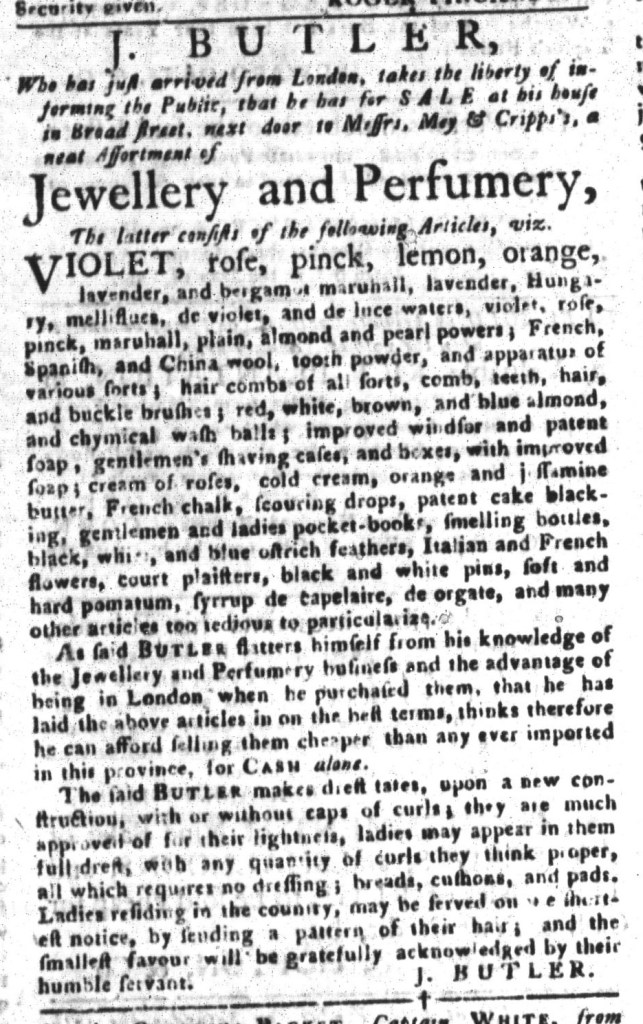
J. Butler’s advertisement in the November 8, 1774, edition of the South-Carolina Gazette and Country Journal proclaimed that he sold “Jewellery and Perfumery” at a shop he operated at his house on Broad Street in Charleston. Among the perfumery, he provided “VIOLET, rose, pinck, lemon, orange, lavender, and bergamot.” In addition, he listed a variety of personal hygiene products and cosmetics that he stocked, including “tooth powder, … hair combs of all sorts, … gentlemen’s shaving cases and boxes, with improved soap, … cold cream, [and] soft and hard pomatum.”  If that was not enough to attract consumers looking to pamper themselves, Butler also proclaimed that he carried “many other articles too tedious to particularize.”  Readers could cure their curiosity with a visit to Butler’s shop.

As further encouragement, he emphasized that he had “just arrived from London.”  Rather than accept merchandise shipped to him without first examining it himself, Butler had carefully examined and thoughtfully selected the wares he now advertised.  He considered that an “advantage,” especially in combination with “his knowledge of the Jewellery and Perfumery business,” that allowed him to acquire his inventory “on the best terms.”  In turn, he passed along the savings to his customers, asserting that “therefore he can afford selling [the above articles] cheaper than any ever imported in this province.”  According to Butler, he not only offered the best prices at that moment, but the best bargains for “Jewellery and Perfumery” ever seen in South Carolina thanks to savvy negotiations with suppliers when he was in London.

Butler was not alone in suggesting that his personal oversight in obtaining his wares accrued benefits to his customers.  Elsewhere in the same issue, Henry Calwell ran a short advertisement that announced he “just arrived from the Northward” and sold a “Large Quantity of Cheese, Chocolate, Potatoes, Onions,” and other groceries.  He added a note that “the Chocolate he warrants to be good, as he saw it made himself.”  Both Butler and Calwell sought to convince consumers that their personal connections to their merchandise should make those items more appealing.

September 27

What was advertised in a colonial American newspaper 250 years ago today?

Supplement to the South-Carolina Gazette and Country Journal (September 27, 1774).

“HOME-SPUN, A Quantity wanted.”

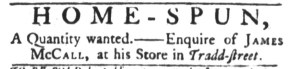
In so many ways, James McCall’s advertisement appeared as a stark contrast compared to others in the September 27, 1774, edition of the South-Carolina Gazette and Country Journal.  In just three lines, it proclaimed, “HOME-SPUN, A Quantity wanted. – Enquire of JAMES McCALL, at his Store in Tradd-street.”  The word “HOME-SPUN” in all capitals in a significantly larger font occupied a line on its own, calling attention to the commodity that McCall sought.  He referred to linen and wool textiles produced in the colonies as an alternative to imported fabrics.  Spinning, a domestic chore undertaken by women, took on political significance when colonizers enacted nonimportation agreements in response to the duties imposed in the Townshend Acts in the late 1760s.  The homespun cloth that resulted from their efforts became a visible symbol of support for the Patriot cause.  McCall did not need to elaborate on the political principles associated with homespun when he placed his advertisement seeking a quantity of it.  In other advertisements, he had previously demonstrated that how well he understood consumer politics.

Elsewhere in the same issue of the South-Carolina Gazette and Country Journal, merchants who imported “fashionable” textiles from London and other English ports ran lengthy advertisements that listed and described their merchandise.  Edwards, Fisher, and Company, for instance, ran their notice about receiving “PART of their FALL GOODS.”  Mansell and Corbett inserted an even more lengthy advertisement that featured imported fabrics, emphasizing “the most fashionable colours” and “an entire new pattern,” as well as housewares.  Other advertisers were a bit more restrained in terms of length, but not their exuberance for imported textiles.  In addition to leading his list of merchandise with a “LARGE Assortment of printed Muslins, Linens, and Calicoes,” Z. Kingsley concluded with a nota bene that explained, “The printed Muslins and Linens, are all the newest Patterns.”  These merchants considered it necessary to offer assurances to prospective customers that their wares did indeed follow the latest styles, simultaneously emphasizing all the choices available to them.  Homespun cloth, on the other hand, turned fashion on its head.  What was the newest and the most sophisticated did not matter as much as the simple political message that producing, purchasing, and wearing homespun communicated during the imperial crisis.

September 20

Who was the subject of an advertisement in a colonial American newspaper 250 years ago today?

South-Carolina Gazette and Country Journal (September 20, 1774).

“TO BE SOLD … Two able Men Field Slaves … Apply to the Printer.”

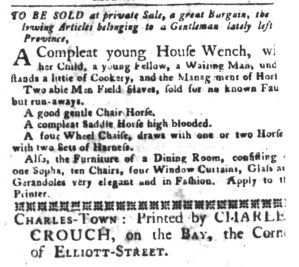
On behalf of a customer, “a Gentleman lately left the Province,” Charles Crouch, the printer of the South-Carolina Gazette and Country Journal, advertised a variety of “Articles” available “at private Sale, a great Bargain.”  Those articles included horses, a carriage with two sets of harnesses and “the Furniture of a Dining Room, consisting of one Sopha, ten Chairs, four Window Curtains, Glass and Gerandoles.”  Crouch informed interested parties that they should “Apply to the Printer,” taking on the role of broker and intermediary.

In addition to the horses and housewares, the “Articles” for sale also include people treated as commodities.  The list commenced with a “compleat young House [Woman], with her Child, a young Fellow, a Waiting Man, understands a little of Cookery, and the Management of Horses” and “Two able Men Field Slaves, sold for no known Fault but run-aways.” Crouch, the printer, facilitated the sale of those enslaved people, perhaps even earning a commission.  He certainly generated revenue from running the advertisement in his newspaper, along with more than a dozen advertisements concerning enslaved people in the September 20, 1774, edition of the South-Carolina Gazette and Country Journal.  Peter Bounetheau and Jacob Valk, brokers of “LANDS, HOUSES, NEGROES, and other Property,” placed many of the others, making them good customers for the newspaper.  In this instance, however, Crouch acted as a slave broker, assuming responsibilities beyond printing and disseminating the advertisement.  The placement of the colophon underscored that was the case.  It appeared immediately below the advertisement: “CHARLES-TOWN: Printed by CHARLES CROUCH, on the BAY, the Corner of ELLIOTT-STREET.”

Two days ago, the Slavery Adverts 250 Project, a companion to the Adverts 250 Project, marked eight years of identifying, remediating, and republishing advertisements about enslaved people originally published in American newspapers 250 years ago that day.  To date, the project includes more than 27,000 advertisements place for various purposes, such as enslaved people for sale, enslaved people wanted to purchase or hire, and descriptions of enslaved people who liberated themselves by running away from their enslavers (as two of the enslaved men in today’s advertisement had done at some point, perhaps captured and returned to slavery as a result of the surveillance encouraged by a newspaper advertisement).  In many instances, advertisements offering enslaved people for sale incorporated some variation of “enquire of the printer.”  From New England to Georgia, printers like Crouch provided an information infrastructure for perpetuating slavery and the slave trade and even served as agents who brokered sales of enslaved men, women, and children.

August 30

What was advertised in a colonial American newspaper 250 years ago today?

South-Carolina Gazette and Country Journal (August 30, 1774).

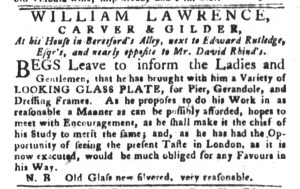
“He has had the Opportunity of seeing the present Taste in London, as it is now executed.”

William Lawrence, a “CARVER & GILDER,” offered his services to “the Ladies and Gentlemen” of Charleston in an advertisement in the August 30, 1774, edition of the South-Carolina Gazette and Country Journal.  He had a “Variety of LOOKING GLASS PLATE” that he could fit to “Pier, Gerandole, and Dressing Frames.”  Though those items may sound unfamiliar today, eighteenth-century consumers recognized each of those kinds of mirrors and understood their purposes.  As the Oxford English Dictionary explains, a pier glass was a “large mirror, originally one fitted in the space between two windows, or over a chimney piece.”  The frame often matched the design of the windows.  These large mirrors reflected light to better illuminate rooms.  That was also the purpose of girandoles fitted with mirrors.  Those branched supports held candles, the mirrors multiplying the light.  Finally, dressing glasses sat on dressing tables or were hung above them, allowing users to view themselves as they prepared their hair and jewelry.

Although practical, each of these items had the potential to be elegant, testifying to the good taste of the men and women who displayed them in their homes.  Lawrence emphasized that aspect of the looking glasses he framed.  He alluded to a recent trip to London, the cosmopolitan center of the British Empire, asserting that he “has had the Opportunity of seeing the present Taste in London, as it is now executed.”  Consumers in Charleston, New York, Philadelphia, and other major urban ports closely followed London fashions, adopting them quickly to demonstrate their own gentility rather than risk appearing unsophisticated in comparison to the gentry on the other side of the Atlantic.  During his journey, Lawrence apparently selected plates that he “brought with him” when he returned to Charleston, believing that this personal connection, rather than ordering them from afar, would enhance their value and his ability to market them.  He intended that his firsthand observation of current London fashions and subsequent selection of materials gave him an advantage over other carvers and gilders in Charleston.