August 15

What was advertised in a colonial American newspaper 250 years ago today?

Aug 15 - 8:15:1766 New-London Gazette
New-London Gazette (August 15, 1766).

“STOLEN out of the Subscriber’s House in the Night … Two silver Watches.”

As a general rule, most advertisements featured on the Adverts 250 Project promoted consumer goods and services. As its primary purpose, the project explores how eighteenth-century advertising incited consumer demand and convinced colonists to purchase an expanding array of goods and services.

Today’s advertisement, however, demonstrates that buying new goods from shopkeepers and merchants was not the only way that colonists could participate in the consumer economy. Some purchased used goods (which were sometimes advertised, but also changed hands in an informal economy that did not rely on public commercial notices), but others resorted to theft to obtain the items they desired or intended to sell for their own gain.

In Simon Rhodes’ case, a thief made off with “Two Silver Watches” and “a pair of Silver wrought Buckles with Steel Chapes and Tongues.”

Rhodes wanted his watches and buckles back, so much so that he paid to insert this advertisement in the New-London Gazette at least three times. (It appeared on August 15, 22, and 29. It may have appeared in earlier issues, but they are no longer extant.) He also offered a reward of five dollars to anybody who captured “the Thief or Thieves, so that the above things may be had, and he or they brought to Justice.” At the very least, Rhodes wanted to make it difficult for the thief or thieves to benefit from the crime. He requested that if any readers noticed his stolen property “offered for Sale” that “they may be stopped.” In addition, his descriptions of the stolen goods, including their flaws and repairs, were designed to make it more difficult to sell them.

April 28

What was advertised in a colonial newspaper 250 years ago today?

Apr 28 - 4:28:1766 Boston Post-Boy
Boston Post-Boy (April 28, 1766).

“TAKEN out of the Shop … two Beaver Hatts supposed to be Stolen.”

Advertisements did not always serve a single purpose in the eighteenth century, as we saw last week in a notice that seemed to squeeze two separate advertisements – one for a sloop and the other for an enslaved woman – together into a single square. Neither seemed to be the primary purpose for the advertisement; instead, an auctioneer placed relatively equal emphasis on both sales.

Lazarus LeBaron, however, did have a purpose when he placed his notice. He proclaimed that a thief had stolen “two Beaver Hatts” from his shop and warned readers against “any suspicious Person” selling similar hats. LeBaron was agitated and he wanted justice, offering a reward to “any Person that can give Information so that the Person who took them may be convicted.” His indignation was apparent.

His demeanor in the notice made the nota bene that much more jarring: “Hatts of all Sorts made and Sold at the above Shop.” As long as he was paying for an advertisement in hopes of recovering his stolen goods, LeBaron likely figured that he might as well attempt to attract some business in the bargain. Even if the pilfered hats never turned up, perhaps the nota bene might have yielded new business to offset the loss and the price of the notice. Still, promoting his shop seemed to be an afterthought relative to his crusade to track down “any suspicious Person” who had absconded with his “Beaver Hatts.”

February 14

GUEST CURATOR:  Elizabeth Curley

What was advertised in a colonial newspaper 250 years ago today?

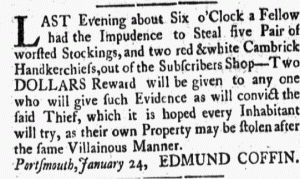
Feb 14 - 2:14:1766 New-Hampshire gazette
New- Hampshire Gazette (February 14, 1766).

“A Fellow had the Impudence to Steal five Pair of worsted Stockings.”

I could not imagine having my stockings and handkerchiefs stolen from within my own home or shop. Clearly this person from New Hampshire could not either until it happened to him, and he was upset enough to place a whole two dollar reward for information on thief. That would have been a lot of money for five pairs of stockings and two red and white handkerchiefs. This makes me wonder if it was more about revenge on the thief.

This advertisement was placed in Portsmouth, which was one of the biggest cities in New Hampshire, and had different types of people living in the area: robbers and other questionable characters, shopkeepers, merchants, and the genteel class. Edmund Coffin went on to say that “every inhabitant” should watch out and report such behavior or it could happen to them.

This advertisement really grabbed my attention. It was a little different from some of the other advertisements that I had seen, because it was not a service or goods begin sold or bought. Especially in today’s society socks and handkerchiefs are so easily attainable that I would never even think twice if two of my socks disappeared.

**********

ADDITIONAL COMMENTARY:  Carl Robert Keyes

The Adverts 250 Project focuses primarily on marketing consumer goods and services in eighteenth-century America, but then (as now) not all advertisements were placed for that purpose. The guest curators from my Public History class and I have reached an agreement: each may select one advertisement not intended to sell goods or services during his or her week.

Elizabeth is beginning her week as guest curator with her “exception(al)” advertisement, but it is an extremely good choice because it tells us a lot about consumption in eighteenth-century America. Purchasing goods was not the only way to participate in the consumer revolution taking place in the colonies and Britain. Sometimes people came into possession of goods in more nefarious ways via an underground economy that included stolen items. Serena Zabin devotes an entire chapter to this “Informal Economy” in Dangerous Economies: Status and Commerce in Imperial New York. In addition to stolen items, secondhand goods were often exchanged via the informal economy. As Elizabeth notes, people of various backgrounds – from the lower sorts to the elite – resided in colonial cities and towns. Not all of them purchased new goods, but a great many found alternate ways to participate in the marketplace. This advertisement demonstrates one way they did so, much to the chagrin of poor Edmund Coffin who was the victim of an eighteenth-century shoplifter.