October 25

What was advertised in a colonial American newspaper 250 years this week?

Supplement to the Massachusetts Gazette and Boston Weekly News-Letter (October 22, 1772).

“PROPOSALS For Re-Printing by Subscription … Baron de MONTESQUIEU’s celebrated Spirit of Laws”

On October 22, 1772, Richard Draper distributed a two-page supplement to accompany the standard issue of the Massachusetts Gazette and Boston Weekly News-Letter.  That supplement consisted almost entirely of advertising, though it did include brief news items from London and Quebec.  A subscription proposal for an “American Edition of … Baron de MONTESQUIEU’s celebrated Spirit of Laws” filled most of the second page of the supplement.  That subscription proposal would have looked familiar to colonizers who also read the Massachusetts Gazette and Boston Post-Boy since it appeared in that newspaper three days earlier.  It may have also looked familiar to those who had not perused the other publication.  As I argued when examining the first appearance of the subscription proposal in Boston’s newspapers, it likely circulated separately as a handbill or broadside.

Draper adopted the same method of making the subscription proposal fit on the page that John Green and Joseph Russell used in their newspaper.  Since it was wider than two standard columns, he created a narrower third column by rotating the type to run perpendicular to the rest of the page.  Draper also added a colophon, centered at the bottom of the subscription proposal.  This method of making the broadside fit on a newspaper page was not the only similarity between its appearance in two newspapers.  It looks as though the printing offices shared the type.  If that was the case, who produced the broadside?  Draper or Green and Russell?  Even if the subscription proposal did not circulate separately as a broadside or handbill, the printers almost certainly shared type between their offices.  That was not the first time in 1772 that Draper collaborated with other printers in that manner.  In May, Jolley Allen’s advertisements in the Boston-Gazette and the Massachusetts Gazette and Boston Weekly News-Letter had identical copy and format.  At the same time, Andrew Dexter’s advertisements in the Boston Evening-Post and the Massachusetts Gazette and Boston Weekly News-Letter also featured identical copy and format.  At various times, Draper apparently shared type already set with three other printing offices.  Yet he was not always involved in instances of sharing type.  Advertisements for a “Variety of Goods” that ran in the Boston Evening-Post and the Boston-Gazette on October 12, for instance, appear identical, with the exception of the last two lines either added to the notice in the Boston-Gazette or removed from the one in the Boston Evening-Post to make it fit the page.  Examining advertisements reveals several other examples of printers in Boston seemingly sharing type in the early 1770s.

As I have noted on other occasions that I have identified what appears to be type transferred from one printing office to another, these observations are drawn from digitized copies of eighteenth-century newspapers.  Examining the original editions, including taking measurements, may yield additional details that either demonstrate that Boston’s printers did not share type for newspaper advertisements or that further suggest that they did indeed do so.  This question merits further investigation to learn more about business practices in printing offices that competed for both newspaper subscribers and advertisers.

Supplement to the Massachusetts Gazette and Boston Weekly News-Letter (October 22, 1772).

October 19

What was advertised in a colonial American newspaper 250 years ago today?

Massachusetts Gazette and Boston Post-Boy (October 19, 1772).

“PROPOSALS For Re-Printing by Subscription … Baron de MONTESQUIEU’s celebrated Spirit of Laws.”

It would have been hard for readers to miss the subscription proposal that dominated the final page of the October 19, 1772, edition of the Massachusetts Gazette and Boston Post-Boy.  John Boyles announced his intention to publish an “American Edition” of the “Baron de MONTESQUIEU’s celebrated Sprit of the Laws,” a work of political philosophy “Which ought to be in EVERY MAN’s Hands.”  Boyles explained that the book had been “Translated from the French Original” as well as “translated and published in most of the civilized Nations of EUROPE.”  Colonizers who wished to participate in the transatlantic republic of letters needed to acquire copies of their own.  To make this particular edition even more attractive than imported alternatives, the publisher stated that it would include “a larger Account of the Life and Writings of the AUTHOR, than is in the European Editions.”

The format of the subscription proposal suggests that it may have been printed separately as a broadside or handbill, on paper of a different size, for distribution beyond subscribers to the Massachusetts Gazette and Boston Post-Boy.  If that was indeed the case, the compositor did not wish to set the type once again in order to insert the subscription proposal in the newspaper.  Its width exceeded two newspaper columns, causing the compositor to create a narrow third column by rotating the type for additional advertisements to run perpendicular to the page.  In the years immediately preceding the American Revolution, advertisers sometimes arranged to have book catalogues, broadsides, or handbills incorporated into newspapers, expanding the reach of their marketing efforts.  That being the case, I suspect that more advertising ephemera circulated in early America than has been identified and preserved in research libraries, historical societies, and private collections.  This subscription proposal in the Massachusetts Gazette and Boston Post-Boy hints at a hidden history of early American advertising impossible to recover in its entirety.  Although newspaper notices constituted, by the far, the most voluminous form of advertising in early America, other printed media likely circulated more frequently than previously realized.

Massachusetts Gazette and Boston Post-Boy (October 19, 1772).

September 3

What was advertised in a colonial American newspaper 250 years ago today?

Massachusetts Gazette and Boston Weekly News-Letter (September 3, 1772).

“Funeral SERMON … preached by the Rev. Mr. ELI FORBES, of Brookfield.”

A few months after the death of Joshua Eaton in April 1772, a subscription notice for “SOME short Account of the LIFE and CHARACTER of the late Rev’d Mr. JOSHUA EATON, of Spencer” appeared in the September 3 edition of the Massachusetts Gazette and Boston Weekly News-Letter.  The proposed volume also included “Seven of his serious and useful SERMONS – together with his Funeral SERMON, preached the Sabbath after his Interment by the Rev. Mr. ELI FORBES, of Brookfield.”

Subscription proposals for books that publishers anticipated would have widespread interest often listed local agents in cities and towns in several colonies.  Sometimes the networks for collecting subscriptions were regional, such as those that extended throughout New England, while others incorporated all of the colonies, including the efforts of Robert Bell to establish an American literary marketplace.  In this instance, however, the publishers suspected that Eaton’s biography and sermons would generate primarily local interest in central Massachusetts.  The list of local agents who collected subscriptions included “Deacons Watson and Murry of Spencer” as well as men in the nearby towns of Brookfield, Worcester, Shrewsbury, and Westborough.  Richard Draper and John Boyles, printers in Boston, were the only local agents outside of central Massachusetts.  The proposals did not include other agents along the Massachusetts coastline or in neighboring colonies.  Even in such a compact market, the subscription notice helped to generate sufficient interest to take the book to press, perhaps aided by the commitment of Eaton’s friends to honor the deceased minister.  Draper and Boyles printed the book sometime the following year, with a preface that Forbes, the editor, dated October 20, 1772.

That the subscription notice that ran in a newspaper printed in Boston listed local agents in several towns in central Massachusetts demonstrates the reach of colonial newspapers as they circulated far beyond the towns where they were published.  Newspaper advertisements likely would not have been the only means of spreading word about the proposed volume in Spencer and nearby towns, but if the advertisement in the Massachusetts Gazette and Boston Weekly News-Letter had been intended solely for prospective subscribers in and near Boston then it would not have been necessary to list more than half a dozen local agents in central Massachusetts.  In the absence of newspapers printed in that part of the colony prior to 1775, newspapers from Boston served as local publications.

August 26

What was advertised in a colonial American newspaper 250 years ago today?

Pennsylvania Gazette (August 26, 1772).

“Beautifully printed on a fine American Paper, and with elegant Types.”

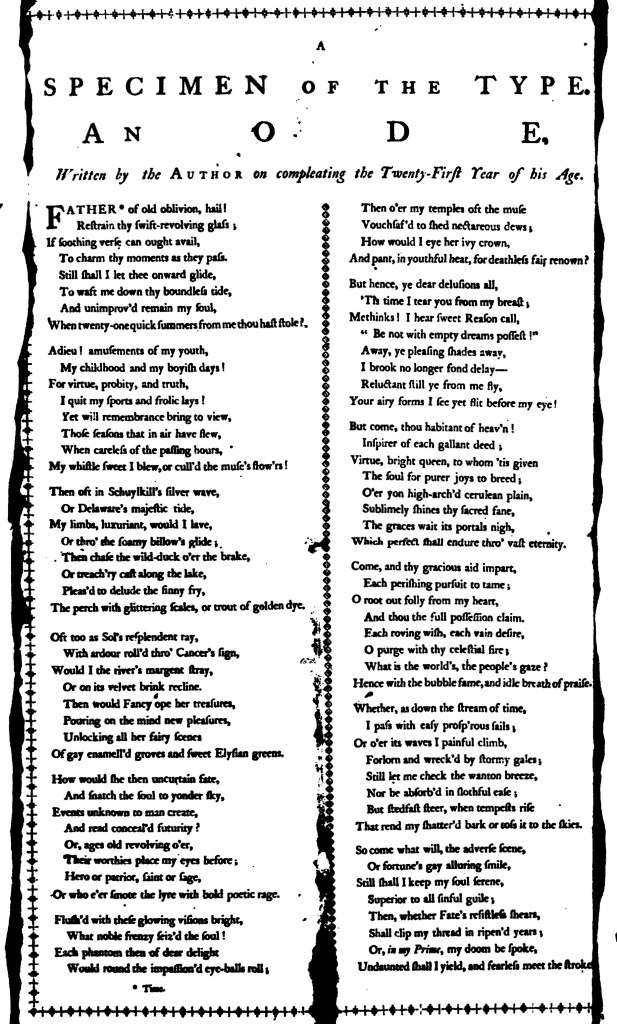
In the summer of 1772, John Dunlap informed the public that he “JUST PUBLISHED … POEMS on SEVERAL OCCASIONS, with some other COMPOSITIONS; by NATHANIEL EVANS.”  He called on subscribers who previously reserved copies to collect them from his printing office on Market Street in Philadelphia while also encouraging others “who design to become Purchasers … as there are but few Copies thrown off above those subscribed for.”  In addition to promoting the author as a former “Missionary (appointed by the Society for propogating the Gospel) for Gloucester County, in New-Jersey; and Chaplain to the Lord Viscount Kilmorey, of the Kingdom ofIreland,” Dunlap asserted that the book was “Beautifully printed on a fine American Paper, and with elegant Types.”

That short advertisement in the Pennsylvania Gazette reiterated several of the appeals that Dunlap previously deployed in marketing the book.  He distributed a broadsheet subscription notice that gave prospective buyers a chance to examine both the paper and the type.  At the beginning of a lengthy description of the project on one side, Dunlap declared that the book would be “printed on the same Pennsylvania manufactured Paper as this Advertisement, and the same Type as the Poem annexed.”  During the imperial crisis, many colonizers express their appreciation for domestic manufactures, items produced in the colonies, making “Pennsylvania manufactured Paper” an attractive alternative to imported paper.  The printer devoted the other side of the broadsheet to “AN ODE, Written by the AUTHOR on compleating the Twenty-First Year of his Age” that doubled as a “A SPECIMEN OF THE TYPE.”  That preview of the content simultaneously allowed buyers to see what they could expect in terms of the material qualities of the book.

An excerpt from the “PREFACE,” including a history of collecting and preparing the poems for publication following the death of the author, appeared on the other side of the broadsheet.  Dunlap appended a note that “the List of Subscribers will be committed to the press,” instructing “all who are desirous of encouraging this Publication, and who may not yet have subscribed [to] send their names.”  He also advised “those who have taken subscriptions of others” to send their lists as quickly as possible so he could include all subscribers in the list and print enough copies to match the advance orders.  In the newspaper advertisement, Dunlap promised that non-subscribers who bought any of the surplus copies would have their name “printed in the List of Subscribers to the 2d Edition.”  They would eventually be recognized among the ranks of those who supported the project.

Dunlap did not rely solely on newspaper advertisements in marketing his edition of Evans’s Poems.  Instead, he printed and distributed a broadsheet subscription notice that incorporated excerpts to entice prospective subscribers.  He also promised public recognition in the form of a printed subscription list.  Unlike newspaper advertisements, the broadsheet utilized the paper and the type for the project, allowing prospective customers to assess the material conditions of the proposed book when they decided if they wished to subscribe.  Although newspaper notices accounted for most advertising in eighteenth century America, entrepreneurs circulated many other kinds of marketing media, including trade cards, catalogs, and subscription notices with excerpts and type specimens.

John Dunlap, Type Specimen from Subscription Notice (Philadelphia, 1772). Courtesy Historical Society of Pennsylvania.

August 21

What was advertised in a colonial American newspaper 250 years ago today?

New-Hampshire Gazette (August 21, 1772).

“PROPOSED to Print by SUBSCRIPTION.”

In the summer of 1772, Daniel Fowle and Robert Fowle, printers of the New-Hampshire Gazette, distributed a proposal for printing “A rational Interpretation of the prophetic Visions of St. John … By SAMUEL LANGDON, D.D. Pastor of the first Church in Portsmouth.”  Before taking the work to press, they first sought subscribers who pledged in advance that they would purchase it.  Printing by subscription was a common business model in eighteenth-century America. Subscription proposals allowed printers to encourage interest in their projects and assess demand before investing time, materials, and other resources in ventures unlikely to succeed.  The Fowles claimed that they considered publishing Langdon’s “Series of expository Discourses … at the earnest Request of many Gentlemen acquainted with it,” suggesting that some demand already existed.  Savvy consumers, however, may have suspected that claim was merely a ploy to get them to jump on the bandwagon.  Regardless of how many “Gentlemen” already subscribed, the Fowles declared that they would not move forward with the project unless “proper Encouragement is given by a full Subscription.”  Furthermore, “No more will be printed than what are engaged by Subscribers.”  The printers attempted to create a sense of urgency around subscribing to what they portrayed as a popular project as soon as possible or miss out on having their names printed among the list of subscribers.

Production of the book, on the other hand, would take quite a bit of time.  Rather than take the entire volume to press, the Fowles proposed a serial publication that would “come out in month Numbers, containing about 32 Octavo Pages, on good Paper and a new Type.”  Subscribers paid only when they received new installments of the series.  The Fowles estimated that it would take about two years to publish the entire work, “each Year making a Volume of about 380 Pages.”  They promised that the “Numbers will be duely sent, free of Charge, to all the principal Towns where Subscriptions are taken in.”  They listed nearly a dozen local agents in towns in New Hampshire, Massachusetts, Rhode Island, Connecticut, New York, and Philadelphia, stating that they sent subscription papers to them.  In addition, the Fowles explained that each number would be “advertised in the publick Prints as soon as publish’d.”  Those who resided “at too great a distance to receive the Numbers seasonably” could instead choose “to subscribe for the whole in Volumes, stitched or bound,” as long as they “specify their Desire, in the Subscription.”  The Fowles asserted that they would send each annual volume “as soon as published.”  They did not, however, indicate how often such subscribers were expected to submit payment.  Overall, they outlined a complicated system of distributing and collecting subscription proposals as well as distributing serialized “numbers” and collecting payments each month.  The logistics may have been too complicated.  It does not appear that they printed and distributed the first “number” in November 1772 as intended.  They did publish a pamphlet by Langdon, “A Rational Explication of St. John’s Vision of the Two Beasts,” thirty-two pages on octavo paper, in 1774.  They may have published other essays by Langdon separately as well, but not the entire project as originally envisioned and presented to prospective subscribers.  If few subscribers responded to their proposals, that likely played a significant role in their decision not to pursue the project.

July 1

What was advertised in a colonial American newspaper 250 years ago this week?

Boston-Gazette (June 29, 1772).

“The Gentlemen who subscribed … for the American Edition of BLACKSTONE’S Commentaries … are desired to apply for the second Volume.”

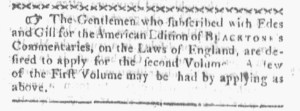
Benjamin Edes and John Gill, printers of the Boston-Gazette, inserted a brief notice at the bottom of the final column of the June 29, 1772, edition.  “The Gentlemen who subscribed with Edes and Gill for the American Edition of BLACKSTONE’S Commentaries on the Laws of England,” they announced, are desired to apply for the second Volume.”  In addition, “A few of the First Volume may be had by applying as above.”  Edes and Gill did not publish this “American Edition.”  Instead, they served as local agents for Robert Bell, a printer and bookseller based in Philadelphia.

Over the course of many months, Bell inserted subscription notices for an American edition of William Blackstone’s Commentaries on the Laws of England in newspapers from New England to South Carolina.  He also distributed handbills to promote the project.  Bell sought to cultivate an American literary market that supplied American readers with American editions instead of books imported from London.  In addition to Blackstone’s Commentaries, he advertised an American edition of David Hume’s History of England, from the Invasion of Julius Caesar to the Revolution in 1688.  Bell suggested that consumers had a civic obligation to purchase these volumes, addressing his subscription notices to “all those who are animated by the Wish of seeing Native Fabrications in AMERICA.”

Bell also stated that those who assisted him in this venture engaged in “peaceable, yet active Patriotism.”  In case that was not enough to recruit local agents like Edes and Gill in Boston, he also pledged that “All Persons who collect the Names and Residence, and deliver the Books to twelve Subscribers, have a Claim of Right, and are allowed fourteen to the Dozen for their Assiduity.”  In other words, local agents received two copies gratis for each dozen they sold to subscribers.  The copies of the first volume of Blackstone’s Commentaries that Edes and Gill offered for sale when they announced that subscribers could pick up the second volume may have been copies they received for gathering subscriptions in Boston.  Bell devised marketing strategies to entice both reader-consumers and local agents.

May 24

What was advertised in a colonial American newspaper 250 years ago this week?

Supplement to the South-Carolina Gazette (May 21, 1772).

“Send their names to the Printers of this Paper.”

The supplement that accompanied the May 21, 1772, edition of the South-Carolina Gazette included “PROPOSALS FOR PUBLISHING BY SUBSCRIPTION, A MAP of the INTERIOR PARTS OF NORTH-AMERICA.  By THOMAS HUTCHINS, Lieutenant in His Majesty’s Royal American Regiment, and Engineer.”  Hutchins explained that the map depicted a region “which must soon become a most important and very interesting part of the British empire in America.”  It included “the great rivers of Missisippi and Ohio, with the newest smaller streams which empty into them” as well as “Lakes Erie, Huron, and Michigan.”  Hutchins asserted that the map “accurately delineated” the region, “a great part of the country and most of the rivers and lakes … laid down from surveys, corrected by the observation of latitudes, carefully executed by himself” during the Seven Years War and “since the final treaty with the western and northern Indians in 1764.”  The map also incorporated “every considerable town of the various Indian Nations, who inhabit these regions.”  The “extent of their respective claims,” Hutchins noted, “are also particularly pointed out.”  Land speculators and settler colonizers certainly had their eyes on those “respective claims,” despite the Proclamation Line of 1763 that reserved that territory for indigenous peoples.

Hutchins declared that he would publish and deliver the map “as soon as the Subscribers amount to a number adequate to defray the unavoidable expence of the publication.”  Like so many others who wished to publish books and maps, he did not intend to assume the financial risk without assurances that the project would meet with success.  To that end, he invited “those in SOUTH-CAROLINA who may think proper to encourage” publishing the map to “as soon as possible, send their names to the Printers of this Paper.”  Powell, Hughes and Company acted as local agents for subscribers.  Hutching did not, however, restrict his marketing efforts to newspaper notices.  He also distributed broadside subscription proposals that featured almost identical text.  Measuring approximately thirteen inches by eight inches, a copy at the Historical Society of Pennsylvania includes blank space to insert the name of a local agent who could have posted the subscription notice in a retail shop or printing office.  That accounts for the first variation in the text compared to the advertisement in the South-Carolina Gazette, an invitation for subscribers to “send their names to [blank]” rather than “send their names to the Printers of this Paper.”  A short paragraph unique to the broadside notice followed that blank: “WE the Subscribers do agree to pay Lieutenant THOMAS HUTCHINS, or Order, for the above-mentioned Map and Analysis, ONE PISTOLE, on the receipt thereof, according to the Number affixed to our respective Names.”  Additional blank space provided room for subscribers to add their names and indicate how many copies they wished to order.  The Historical Society of Pennsylvania’s copy does not have any manuscript additions; no subscribers signed it to reserve their maps.

Newspaper advertisements provided the best opportunity to circulate subscription notices to the greatest number of prospective customers, but they were not the only means of inciting interest in books and maps.  Hutchins and other entrepreneurs also distributed broadsides to local agents to facilitate recording the names of subscribers.  I suspect that a greater number of those broadsides circulated in early America than survive today, increasing the frequency that colonizers encountered advertising media.

Broadside Subscription Proposal with Space for Subscribers to Add Names. Courtesy Historical Society of Pennsylvania.

March 10

What was advertised in a colonial American newspaper 250 years ago today?

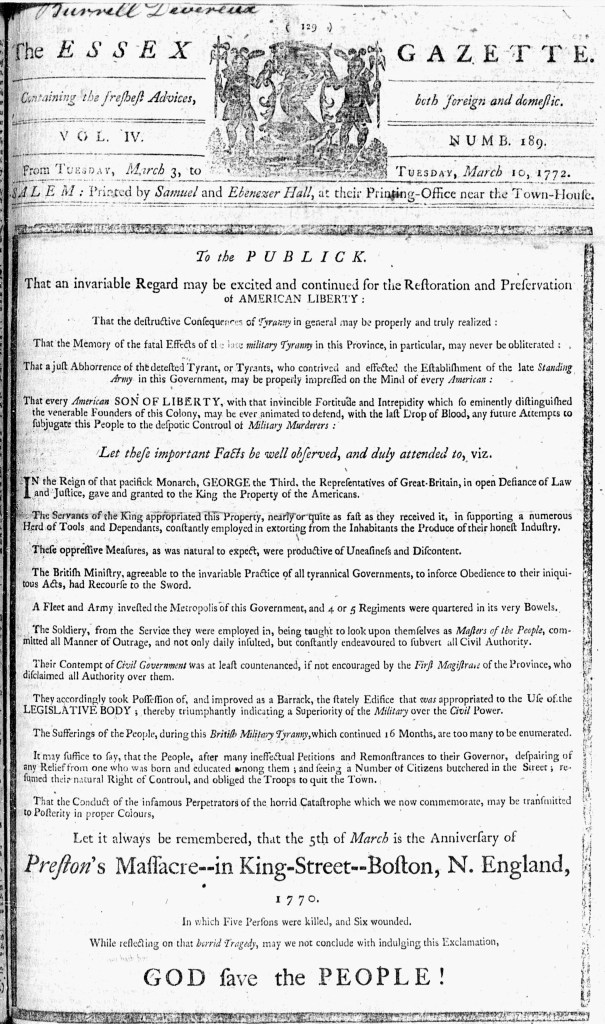
Essex Gazette (March 10, 1772).

“The Preservation of these Papers for the Benefit of Posterity.”

A subscription notice for a “second Volume of Collection of Papers relative to the History of Massachusetts-Bay” ran in several newspapers in New England in 1772.  The version that appeared in the March 10 edition of the Essex Gazette carried a familiar appeal, asserting that “most of these Papers will, probably, be irrevocably lost in a few Years, unless preserved by Printing” so many copies that “the Public” would always have access to important documents about the history of the colony.  Prospective subscribers, the advertisement argued, had a duty to assist in “the Preservation of these Papers for the Benefit of Posterity.”

Readers of the Essex Gazette encountered this subscription notice in the context of commemorating recent history, “Preston’s Massacre–in King-Street–Boston” on March 5, 1770.  Samuel Hall and Ebenezer Hall, printers of the Essex Gazette, devoted the entire first page of the March 10 edition to commemorations marking the second anniversary of the Boston Massacre.  They enclosed a lengthy memorial within thick mourning borders, a convention usually reserved for death notices but frequently deployed for political purposes during the imperial crisis that culminated in the American Revolution.

In the memorial, the Halls called on the public to seek “the Restoration and Preservation of AMERICAN LIBERTY,” advocating that “the destructive Consequences of Tyranny in general may be properly and truly realized” and that “the Memory of the fatal Effects of the late military Tyranny in this Province, in Particular, may never be obliterated.”  They invoked “that invincible Fortitude and Intrepidity which so eminently distinguished the venerable Founders of this Colony” as they encouraged “every American SON OF LIBERTY … to defend, with the last Drop of Blood, any future Attempts to subjugate this people to the despotic Controul of Military Murderers.”  As they commemorated the second anniversary of the Boston Massacre, the Halls encouraged colonizers to consider 150 years of history and their role in shaping events.  They rehearsed recent events in a list of grievances against “Servants of the King,” the “British Ministry,” and the “Soldiery … taught to look upon themselves as Masters of the People.”  Those grievances had greater impact when considered in relation to the founding of the colony and subsequent events chronicled in the proposed volume of “Papers relative to the History of Massachusetts-Bay” advertised on another page.  The advertisement listed the Halls as local agents who accepted subscriptions for the project.  Between the memorial on the first page and the subscription notice on the final page, they tended to the recent and distant past by presenting readers with opportunities to prevent “the Memory” of significant events from being “obliterated” but instead “transmitted to Posterity.”

Essex Gazette (March 10, 1772).

February 16

What was advertised in a colonial American newspaper 250 years ago this week?

New-York Journal (February 13, 1772).

“Subscribers in the distant Provinces will be supplied as soon as possible.”

Robert Bell invested a lot of effort in promoting an “American Edition of BLACKSTONE’s COMMENTARIES ON THE LAWS OF ENGLAND” in the early 1770s.  He inserted subscription notices in newspapers from New England to South Carolina, encouraging colonizers to support the development of a distinctly American market for literature.  He inserted an update in the February 13, 1772, edition of the New-York Journal, alerting the public that the second volume “will be ready for Delivery to the Subscribers of Philadelphia and New-York, on the 28th of February.”  In addition, “Subscribers in the distant Provinces shall be supplied as soon as possible.”

Bell’s notice in the February 13 edition of the New-York Journal ran on a Thursday, the only day that John Holt, the printer, distributed that newspaper.  Most American newspapers published prior to the American Revolution were weeklies, though a few printers did experiment with producing and disseminating two or three issues per week.  Daily newspapers did not emerge until after the Revolution.  That meant that printers strategically chose which days to publish their newspapers.  Most selected Mondays and Thursdays.  Holt’s competitor, Hugh Gaine, published the New-York Gazette and Weekly Mercury on Mondays, thus allowing readers in New York two opportunities to peruse “the freshest ADVICES, both FOREIGN and DOMESTIC” throughout the week.  Some newspapers published in smaller towns in New England appeared on Tuesdays or Fridays or Wednesdays or Saturdays, one or two days after newspapers in Boston and New York.  That allowed printers to acquire the newest editions and reprint items of interest.

Sundays were the only day that printers did not distribute their latest issues anywhere in the colonies.  In the twentieth century, the Sunday newspaper became the most coveted edition, the one that contained the most sections of specialized content as well as advertising supplements.  Today, the Sunday edition remains a distinct entity, the only issue that many readers acquire and read.  That represents an evolution in publication and reading habits.  Once a week, the Adverts 250 Project examines a newspaper advertisement published 250 years ago that week instead of 250 years ago that day because printers did not produce Sunday editions in the eighteenth century.  That remained the case even for the dailies published in the largest cities after the Revolution.

February 14

What was advertised in a colonial American newspaper 250 years ago today?

New-London Gazette (February 14, 1772).

“SUBSCRIPTIONS … will be received by T. & J. Fleet, in Boston, T. Green in New-London, and by the other Printers in Connecticut.”

When a “Gentleman in England, of Distinguished character for many munificent deeds to the Publick,” supposedly wished to sponsor publication of “a second Volume of Collection of Papers relative to the History of Massachusetts Bay” in 1772, Thomas Fleet and John Fleet, printers of the first volume, set about promoting the project.  Advertisements initially appeared in newspapers published in Boston, but eventually ran in other newspapers as well.

An advertisement nearly identical to one in the January 23, 1772, edition of the Massachusetts Gazette and Boston Weekly News-Letter appeared in the New-London Gazette on February 14.  It featured the same introduction that gave the story of the “Gentleman in England” and cautioned that “None will be printed for Sale” except those reserved by subscribers in advance.  It also included the primary justification intended to persuade colonizers to support the project: “As most of these Papers will, probably, be irrecoverably lost in a few Years, unless preserved by Printing, it is hoped that a sufficient Number of Subscribers will soon appear, from a regard to the Public.”  Readers had a duty “for the Benefit of Posterity,” the advertisement underscored, to participate in the preservation of important documents through printing them so widely that they would always remain accessible.

The version of the advertisement that ran in the New-London Gazette did have some variations.  Timothy Green, the printer of that newspaper, reserved space for other content by significantly reducing the list of local agents who worked with the Fleets.  “SUBSCRIPTIONS to encourage the Printing of this Collection,” the advertisement instructed, “will be received by T. & J. Fleet, in Boston, T. Green in New-London, and by the other Printers in Connecticut.”  The original version listed local agents in nearly a dozen cities and towns in New England, New York, and Pennsylvania.  It also concluded with a note that “A few of the first Volumes of Collection of Papers, may be had at the Heart and Crown.”  Compared to readers of the Massachusetts Gazette and Boston Weekly News-Letter, readers of the New-London Gazettewere less likely to know that a sign depicting a heart and crown marked the location of the Fleets’ printing office.  Green edited that final note to advise readers of his newspaper that “A few of the first Volume of Collection of Papers may be had of T. & J. Fleet, in Boston.”

Green participated in an extensive network of local agents, comprised primarily of printers, who accepted subscriptions for the proposed “second Volume of Collection of Papers relative to the History of Massachusetts Bay.”  His responsibilities included marketing as well as collecting names of colonizers who wished to reserve copies.  He published advertisements consistent with those distributed by the printers in charge of the project, but edited them to suit his own purposes and to provide clarifications for readers of his newspaper.  That resulted in an advertising largely consistent from newspapers in one town to another, but with minor variations.