What was advertised in a colonial American newspaper 250 years ago today?
Massachusetts Spy (March 2, 1775).
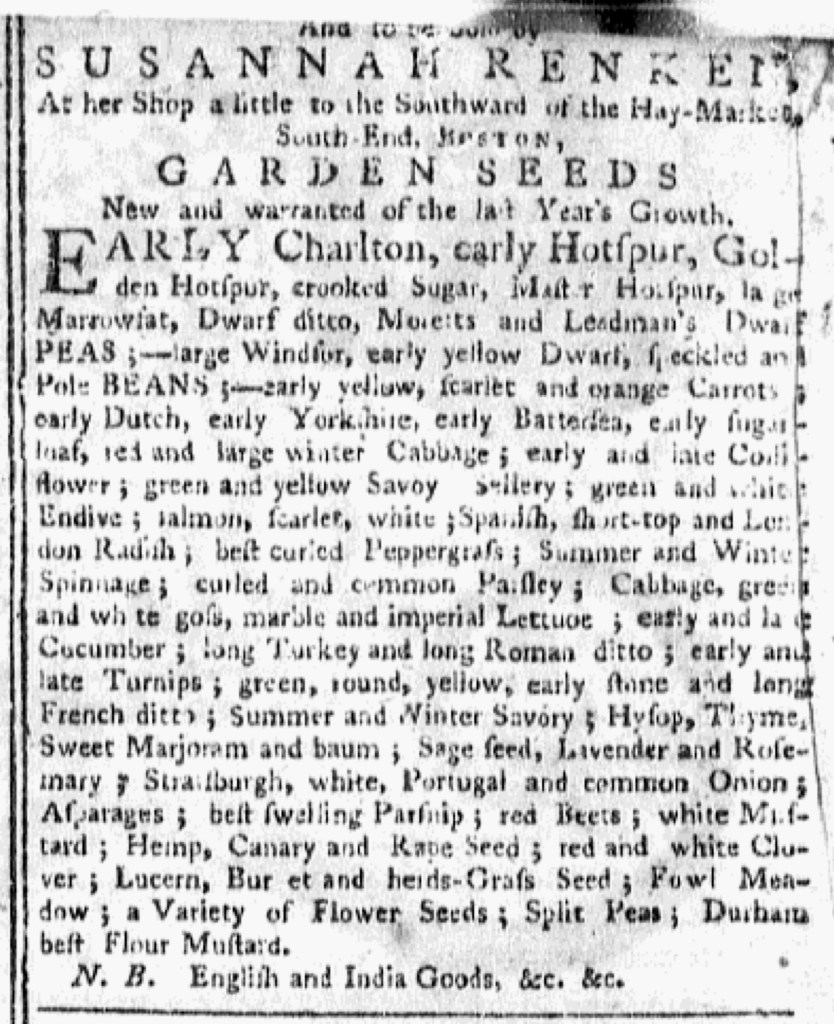
“GARDEN SEEDS New and warranted of the last Year’s Growth.”
Although her advertisement appeared later than in some years, Susannah Renken was the first to advertise “GARDEN SEEDS” in Boston in 1775. She had also been first in 1768, 1770, and 1773, commencing an annual ritual of seed sellers, most of them women, taking to the pages of Boston’s newspapers to hawk extensive selections of garden seeds. In 1775, Renken’s first advertisements was brief, just two lines in the February 23 edition of the Massachusetts Spy: “SUSANNAH RENKEN, has received a fresh supply of Garden Seeds. Particulars in our next.” She may have been in such a rush to run any advertisement at all that she did not have time to prepare her usual list of seeds before Isaiah Thomas, the printer, took that issue to press, though Thomas may have opted to publish an abbreviated notice. A note at the bottom of the column advised, “Advertisements omitted will be in our next.” Renken may have been fortunate that even a short notice appeared. The following week, her full advertisement, featuring dozens of varieties of seeds, ran in the Massachusetts Spy.
The copy of the March 2 edition digitized to grant greater access has been damaged, eliminating the first lines of Renken’s advertisement, but it ran again the following week. That issue reveals that the notice began with a familiar introduction: “Imported in Capt, Shayler from LONDON, And to be Sold by SUSANNAH RENKEN.” Merchants, shopkeepers, and other purveyors of goods often stated which vessels carried their merchandise, revealing to prospective customers when their wares had been shipped and delivered. In this case, it meant that Renken’s seeds arrived in the colonies, but not in Boston, several months before she placed her advertisement; she may have acquired her seeds only recently. With the city’s harbor closed to commerce because of the Boston Port Act, Shayler’s vessel arrived in Salem with “Fresh Advices from London” in late November 1774, according to the December 5 edition of the Boston-Gazette. Shayler delivered goods as well as news, but Renken had to arrange to have her seeds transported from Salem to Boston. Perhaps she had only just confirmed delivery when her brief notice appeared in the Massachusetts Spy. When W.P. Bartlett advertised garden seeds in the February 21, 1775, edition of the Essex Gazette, published in Salem, he proclaimed that his wares were “JUST IMPORTED, in the Venus, from LONDON.” In previous years, Renken and her sister seed sellers in Boston usually did not describe their seeds as “just imported.” In 1775, the imperial crisis prevented them from even considering doing so.
What was advertised in a colonial American newspaper 250 years ago today?
Massachusetts Spy (July 15, 1774).
“She has removed from Fore-street, to a little above the Hay-Market.”
Susanna Renken achieved her greatest visibility in the public prints with the advertisements for garden seeds she inserted in several newspapers printed in Boston in the winter and spring. In several years, she was the first entrepreneur to advertise garden seeds, quickly joined by a sorority of seed sellers who sought their share of the market. Most of those female entrepreneurs did not place advertisements throughout the rest of the year, even those, like Renken, who mentioned that they also stocked “English and India Goods all which may be had cheap for Cash.”
In the summer of 1774, however, circumstances prompted Renken to advertise that “she has removed from Fore-street,” where she had been for many years, “to a little above the Hay-Market.” She reminded both current customers and the public that she “has for Sale, a variety of English and India GOODS, Groceries of all sorts, West-India and New-England Rum.” Renken did not go into as much detail about her wares as many other merchants and shopkeepers, confining her notice to announcing her new location so she could maintain (and perhaps expand) her clientele.
She also did not advertise as widely as she usually did when she promoted garden seeds. She usually placed notices in several newspapers printed in Boston and sometimes even in the Essex Gazette published in Salem. Of the five newspapers that served Boston in 1774, Renken opted to advertise in only two, the Boston-Gazette, printed by Benjamin Edes and John Gill, and the Massachusetts Spy, printed by Isaiah Thomas. Those printers and their publications were well known for their support of the Sons of Liberty and their critiques of a British government that encroached on the liberties of colonizers. Thomas had recently updated the masthead of the Massachusetts Spy to include an image of a snake, representing the colonies, defending itself against a dragon, representing Britain, with the declaration “JOIN OR DIE.” With the harbor closed to trade due to the Boston Port Act, perhaps Renken expressed her own political views in choosing which newspapers to carry her advertisement.
What was advertised in a colonial American newspaper 250 years ago today?
Massachusetts Spy (April 22, 1774).
“GARDEN SEEDS.”
“GARDEN SEEDS.”
“GARDEN SEEDS.”
“GARDEN SEEDS.”
“GARDEN SEEDS.”
Susanna Renken advertised “GARDEN SEEDS” in several newspapers published in Boston throughout the spring of 1774, just as she had been doing for many years. Many of her competitors, including Lydia Dyar, Elizabeth Greenleaf, and Anna Johnson, did the same. Each of them deployed the same headline, “GARDEN SEEDS,” and listed the many options they stocked in their shops. Dyar’s advertisement in the Massachusetts Spy included a final notation, “4 m,” intended for those who worked in the printing office, not for readers. It indicated that her advertisement should run for four months before the compositor removed it. All the advertisements placed by Boston’s female seed sellers became familiar sights in the public prints, an annual ritual that marked the changing of the seasons.
Their notices often appeared together. In the April 22 edition of the Massachusetts Spy, for instance, four of their advertisements filled most of a column, running one after another with Greenleaf’s first, followed by Dyar’s and Renken’s, and finally Johnson’s. That merits notice because printers did not tend to arrange advertisements by purpose or genre in eighteenth-century newspapers. Paid notices were not classified advertisements because they were not clustered together according to classification or category. Instead, they appeared in whatever order the compositor made them fit on the page. The eight advertisements immediately to the right of those placed by the female seed sellers included one for a pamphlet for sale, two for imported textiles and “all sorts of Groceries … except TEA,” one for imported silks and “Hard-Ware and Cutlery GOODS,” one for a lottery to benefit Harvard College, one for “CHOICE MADDER,” a plant used in dyeing, one for “ENGLISH, India, and Scotch Goods, suitable for the season, one for a school for girls, and one for millinery goods “of the newest fashion,” in that order. No guiding principle seemed to dictate which one followed which. Yet the compositor made a choice to place the advertisements for “GARDEN SEEDS” together, even opting to put Sarah Dawson’s notice first. The “Widow of the late Joseph Dawson, Gardner,” marketed a “collection of grafted and inoculated English FRUIT TREES,” but also happened to mention an “assortment of GARDEN SEEDS.” That apparently convinced the compositor to position her advertisement with those from Dyar, Greenleaf, Johnson, and Renken.
This practice made the notices placed by female seed sellers in Boston during the era of the American Revolution precursors to classified advertisements that would eventually run in American newspapers in later periods. For the most part, however, advertising in early American newspapers did not have that level of organization when it came to the order in which they appeared.
What was advertised in a colonial American newspaper 250 years ago this week?
Massachusetts Spy (February 27, 1774).
“GARDEN SEEDS … SOLD by SUSANNA RENKEN.”
Susanna Renken was not the first entrepreneur to advertise seeds in Boston’s newspapers as the spring of 1774 approached, though she had been on several occasions in the past decade. That distinction went to John White, “Gardner, and Seeds-Man, in SEVEN-STAR LANE,” with his advertisement in the February 17 edition of the Massachusetts Spy, yet within a week Renken she activated her advertising campaign. Fittingly, Renken placed an advertisement for “GARDEN SEEDS” in the next issue, serving as a counterpoint to White’s repeated notice.
Unlike the approach White had taken so far, Renken did not confine her marketing efforts to a single newspaper. When she ran her first advertisement on February 24, she placed it in both the Massachusetts Gazette and Boston Weekly News-Letter and the Massachusetts Spy. That made her among the first of the sorority of female seed sellers to advertise in 1774. Her competitors Elizabeth Clark and Elizabeth Nowell also ran a notice in the Massachusetts Gazette and Boston Weekly News-Letter. It appeared immediately to the left of Renken’s advertisement.
So began the annual contest to woo customers to purchase seeds. As had been her practice in the past, Renken continued expanding her advertising campaign, seeking to reach more prospective customers by inserting her notice in multiple newspapers. On February 28, she ran it in the Boston Evening-Post, immediately above Elizabeth Greenleaf’s advertisement for “GARDEN-SEEDS.” The appropriately named Greenleaf was part of the sisterhood of seed sellers who advertised extensively each spring. On the same day, her advertisement appeared immediately above Renken’s advertisement in the Boston-Gazette. Perhaps having noticed that Renken and Clark and Nowell commenced their advertising Greenleaf determined that it was time to invest in her own marketing efforts for 1774.
For whatever reason, none of them or their competitors placed advertisements in the Massachusetts Gazette and Boston Post-Boy on February 28, but the March 3 edition of the Massachusetts Gazette and Boston Weekly News-Letter once again featured advertisements from Renken and Clark and Nowell, joined by Greenleaf. As had been common in previous years, the compositor arranged them one after the other in a single column. Printers did not usually arrange advertisements by purpose or category, but they often made an exception for women who sold seeds in Boston. Renken and White once again placed their notices in the Massachusetts Spy on March 3.
For newspaper readers in and near Boston, this flurry of advertising was an annual ritual. It signaled that spring was on its way. Perhaps for modern readers who regularly visit the Adverts 250 Project, these advertisements serve a similar purpose, a sign of the changing seasons as days become longer even if not necessarily warmer.
What was advertised in a colonial American newspaper 250 years ago this week?
Massachusetts Gazette and Boston Weekly News-Letter (April 22, 1773).
“Garden Seeds, &c. Are to be Sold by the following Persons, who have advertised the Particular Sorts in this Paper.”
Richard Draper, the printer of the Massachusetts Gazette and Boston Weekly News-Letter, did not have room for all of the news, letters, and advertisements submitted to his printing office for the April 22, 1773, edition. To remedy the matter, he collected together and abbreviated notices about “Peas, Beans, [and] Garden Seeds” peddled by John Adams, Ebenezer Oliver, Elizabeth Greenleaf, Susanna Renken, Elizabeth Clark and Nowell, and Lydia Dyar. Draper informed readers that the “following Persons, who have advertised the Particular Sorts in this Paper” continued to sell seeds, but “we have not Room this Week.” Along with each name, the printer provided the location, but did not elaborate on their merchandise except for a note at the end intended to apply to each advertiser, a single line advising prospective customers that “All the Seeds [were] of the last Year’s Growth.”
Indeed, each of those purveyors of seeds had indeed “advertised the Particular Sorts in this Paper” … and in the four other newspapers published in Boston in the spring of 1773. For two months readers had encountered advertisements placed by Adams, Oliver, Greenleaf, Renken, Clark and Nowell, and Dyar, an annual herald of the arrival of spring in Boston. Eighteenth-century printers did not usually classify and categorize advertisements according to purpose and then organize them accordingly in the pages of their newspapers. Advertisements for seeds, however, proved the exception to the rule. In each of the newspapers printed in the city, the compositors often clustered advertisements for seeds together. When they did so, those advertisements filled entire columns and, sometimes, more than one column. In the supplement that accompanied the previous edition of the Massachusetts Gazette and Boston Weekly Mercury, the advertisements by Adams, Oliver, Greenleaf, Renken, Clark and Nowell, and Dyar accounted for half the content on the final page, running one after another in the last two columns.
That practice in place, it made sense for Draper to truncate those advertisements when he did not have sufficient space for all of them in the April 22 edition. He likely assumed that subscribers and others who regularly read his newspapers had already seen those notices on several occasions. They could even consult previous editions if they needed more information. Besides, the season for advertising seeds was coming to an end. The Massachusetts Gazette and Boston Weekly Mercury did not run any more advertisements for seeds in the following weeks, nor did some of the other newspapers. Some of the seed sellers discontinued their advertising efforts. The others began tapering off their notices, placing them in fewer newspapers for the overall effect of seeds having less prominence in the public prints in Boston as April came to a close and May arrived. The annual ritual completed for 1773, it would begin again the following February.
What was advertised in a colonial American newspaper 250 years ago this week?
Boston Evening-Post (February 15, 1773).
“Early Charlton, early Hotspur, early Golden Hotspur.”
For colonizers in Boston and nearby towns, it was a sign that spring was coming! The first advertisement for garden seeds appeared in local newspapers on February 15, 1773. In the late 1760s and the early 1770s, seed sellers, most of them women, took to the pages of the public prints to advertise their wares when they believed that winter passed its halfway point. Susanna Renken was the first in 1773, just as she had been in 1768 and 1770. Soon, several other women who advertised seeds each year would join her, as would a smaller number of men. Indeed, shopkeeper John Adams placed the second advertisement for seeds in newspapers printed in Boston in 1773, but it did not take long for women to outnumber him with their advertisements.
Renken, already familiar to many readers in part due to her annual advertising campaign, had the market to her herself for a few days. On February 15, she ran notices with identical copy in two of the three newspapers published in Boston that day, the Boston Evening-Post and the Boston-Gazette. She focused primarily on a long list of seeds, but concluded by mentioning some grocery items, a “Variety of China Bowls and Dishes,” and an “Assortment of India and English Goods.” Most of her female competitors usually did not promote other items, but Renken recognized an opportunity to encourage other sales, especially if customers were not quite ready to purchase garden seeds in the middle of February. After all, many of the headlines in other advertisements still hawked “WINTER GOODS.
Massachusetts Gazette and Boston Weekly News-Letter (February 18, 1773).
She had the public prints to herself for only three days. Adams inserted his advertisement in the Massachusetts Gazette and Boston Weekly News-Letter on February 18. Renken did not expand her advertising to that newspaper or the Massachusetts Spy. Her next notices ran once again in the Boston Evening-Post and the Boston-Gazette and, for the first time that year, the Massachusetts Gazette and Boston Post-Boy on February 22. Other women who participated in the annual ritual joined her on that day, Elizabeth Clark and Nowell, Elizabeth Dyar, and Elizabeth Greenleaf in the Supplement to the Boston-Gazette and Elizabeth Greenleaf in the Massachusetts Gazette and Boston Post-Boy. Ebenezer Oliver, who inherited the business from his mother, Bethiah Oliver, and invoked her name in his notice, also advertised in the Supplement to the Boston-Gazette, as did John Adams. A few days later, John Adams, Elizabeth Greenleaf, and Ebenezer Oliver advertised in the Massachusetts Gazette and Boston Weekly News-Letter and Lydia Dyar, Elizabeth Greenleaf, and Anna Johnson advertised in the Massachusetts Spy on February 25. By then, Renken decided that she would increase the number of newspapers carrying her advertisements, perhaps after noticing that her competitors launched their campaigns. She also placed a notice in the February 25 edition of the Massachusetts Spy. For a few days Renken was the sole seed seller promoting her merchandise in Boston’s newspapers, but it soon became a very crowded field.
What was advertised in a colonial American newspaper 250 years ago today?
Massachusetts Gazette and Boston Weekly News-Letter (April 6, 1770).
“Seeds.”
It was a sign of spring. Just as advertisements for almanacs told readers of colonial newspapers that fall had arrived and the new year was coming, advertisements for seeds signified that winter was coming to an end and spring would soon be upon them. In the newspapers published in Boston in the late 1760s and early 1770s, this meant a dramatic increase in female entrepreneurs among those who placed advertisements. Women who sold goods or provided services appeared only sporadically among newspaper notices throughout the rest of the year, but turned out in much greater numbers to peddle seeds in the spring.
Although printers and compositors did not usually organize or classify advertisements according to their purpose in eighteenth-century newspapers, they did tend to group together notices placed by women selling seeds. Consider the last column of the final page of the April 6, 1770, edition of the Massachusetts Gazette and Boston Weekly News-Letter. Although it concluded with a legal notice, advertisements for seeds sold by women comprised the rest of the column. Bethiah Oliver hawked seeds available at her shop “opposite the Rev. Dr. Sewall’s Meeting House.” The appropriately named Elizabeth Greenleaf advised prospective customers to visit her shop “at the End of Union-Street, over-against the BLUE-BALL.”: Elizabeth Clark and Elizabeth Nowell sold seeds at their shop “six Doors to the Southward of the Mill-Bridge.” Susanna Renken also carried seeds at her shop “In Fore Street, near the Draw-Bridge.” She was the only member of this sorority who advertised other wares, declaring that she stocked “all sorts of English Goods, imported before the Non-importation Agreement took Place.” She was also the only one who sometimes advertised at other times during the year. Did the others sell only seeds and operate seasonal businesses? Or did they also carry other wares but refrain from advertising?
Spring planting was a ritual for colonists, including women who kept gardens to help feed their families. Placing advertisements about seeds for growing peas, beans, onions, turnips, lettuce, and other produce was a ritual for the female seed sellers of Boston. Encountering those advertisements in the city’s newspapers became one or many markers of the passage of time and the progression of the seasons for readers of those newspapers. The news changed from year to year, but advertisements for seeds in the spring was a constant feature of the Massachusetts Gazette and Boston Weekly News-Letter and other newspaper.
What was advertised in a colonial American newspaper 250 years ago today?
Massachusetts Gazette and Boston Weekly News-Letter (March 15, 1770).
“All sorts of English Goods, imported before the Non-importation Agreement took place.”
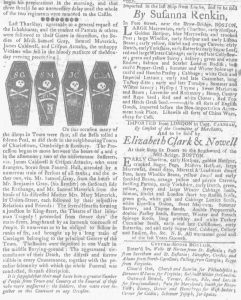
Richard Draper, printer of the Massachusetts Gazette and Boston Weekly News-Letter, included coverage of the “bloody massacre” and the funerals of the victims in the March 15, 1770, edition of his newspaper. In so doing, he adopted a method commonly used by printers throughout the colonies: he reprinted news that already appeared in another newspaper. In this case, he reprinted an article about the funeral procession that Benjamin Edes and John Gill originally printed in the March 12, 1770, edition of the Boston-Gazette, though Draper included a brief addendum at the conclusion. “It is supposed,” he added, “that their must have been a greater Number of People from Town and Country at the Funeral of those who were massacred by the Soldiers, than were ever together on this Continent on any Occasion.” Draper even included an image depicting the coffins of Samuel Gray, Samuel Maverick, James Caldwell, and Crispus Attucks. Edes and Gill presumably loaned him the woodcut.
The article, along with the dramatic image that drew attention to it, aimed to disseminate information about the Boston Massacre to readers in the city and far beyond. The advertisements that appeared in close proximity may have received more notice – and more scrutiny – than under other circumstances. The two notices that ran immediately next to the article about the “bloody massacre,” both placed by female seed seller commencing their annual marketing campaigns as spring approached, addressed the politics of the period, though they did not comment explicitly on recent events in King Street or the funeral procession that followed. Susanna Renken listed the seeds she offered for sale, but also declared that she stocked “all sorts of English Goods.” She carefully noted that she imported those wares “before the Non-importation Agreement took Place.” Similarly, Elizabeth Clark and Elizabeth Nowell asserted that they imported their seeds from London and sold them “By Consent of the Committee of Merchants” who oversaw adherence to the nonimportation agreement and reported violators.
These advertisements demonstrate that readers did not experience a respite from politics and current events when they perused advertisements for consumer goods and services during the era of the American Revolution. Instead, advertisers increasingly inflected politics into their notices as they enticed prospective customers not only to make purchases but also to make principled decisions about which merchandise they did buy. Those advertisers assured the community that they had already made such principled decisions themselves.
What was advertised in a colonial American newspaper 250 years ago today?
Boston-Gazette (March 5, 1770).
“Large Marrowfats, early Charlston.”
Susanna Renken and Abigail Davidson were the first in 1770. Spring was on the way. Newspaper advertisements for garden seeds were among the many signs of the changing seasons that greeted colonists in Massachusetts on the eve of the American Revolution. Every year a cohort of women took to the pages of the several newspapers published in Boston to promote the seeds they offered for sale. Renken and Davidson both placed advertisements in the March 5, 1770, edition of the Boston-Gazette, conveniently placed one after the other. Readers could expect that soon advertisements placed by other female entrepreneurs would join them. Although printers and compositors usually did not impose any sort of classification system on newspaper notices, they did tend to cluster advertisements by women selling seeds together, a nod toward the possibility of organizing the information in advertisements for the convenience of subscribers and other readers. Renken, usually one of the most prolific and aggressive of the female seed sellers when it came to advertising, also placed a notice (with identical copy) in the March 5 edition of the Massachusetts Gazette and Boston Post-Boy.
Renken concluded her advertisement with a brief note about other merchandise available at her shop, “all sorts of English Goods, imported before the Non-importation Agreement took Place.” That brief reference to a commercial strategy for protesting the duties imposed on certain imported goods by the Townshend Acts belied how the imperial crisis would intensify by the end of the day. That evening a crowd outside the Boston Custom House on King Street (now State Street), harassing British soldiers. The encounter culminated in the Boston Massacre or what Paul Revere termed the “BLOODY MASSACRE” in an engraving intended to stoke patriotic sentiment among the colonists. Three men died instantly; two others who were wounded died soon after. Collectively, they have been considered the first casualties of the American Revolution, along with Christopher Seider who had died less than two weeks earlier. A week after Renken and Davidson placed their first advertisements of the season, other women joined them in advertising seeds in the Boston-Gazette. Their advertisements, however, were enclosed in thick borders that denoted mourning. Many of them appeared on the same page as coverage of the Boston Massacre.
What was advertised in a colonial American newspaper 250 years ago today?
Essex Gazette (March 28, 1769).
“A fresh Assortment of Garden Seeds.”
In this advertisement for seeds Benjamin Coats mentioned beans, peas, carrots, and many other vegetables. Gardening was a common practice in the colonies, and it was often women who kept the gardens for their families. In As Various as Their Land: The Everyday Lives of Eighteenth-Century Americans, Stephanie Grauman Wolf also uses advertisements about seeds to examine life in eighteenth-century America, including an advertisement from a Boston newspapers in 1748. She states, “The purchase of seeds involved women in a wider world of commerce than we might have supposed, and this involvement included selling extra produce.”[1] Gardening was one of the outlets that women used to interact with the wider world of trade in the eighteenth century. Wolf also notes that certain plants were more popular regionally: “Pease for ‘English pease porridge’ were supplanted by beans for “baked beans” in New England.”[2] She also notes that potatoes and tomatoes were popular in the northern colonies, while sweet potatoes were popular in the southern colonies.
**********
ADDITIONAL COMMENTARY: Carl Robert Keyes
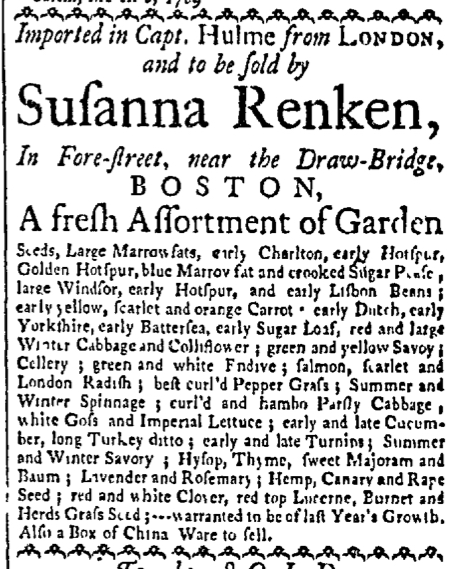
When readers of the Essex Gazette finished perusing Benjamin Coats’s advertisement for a “fresh Assortment of Garden Seeds” they almost immediately encountered the same inventory listed in Susanna Renken’s advertisement, published in the same column just two advertisements below. Coats and Renken did not merely offer similar wares. The copy of their advertisements was identical, with the exception of their names, the locations of their shops, and a short addendum to Renken’s advertisement that announced she “Also [had] a Box of China Ware to sell.” Coats sold his seeds locally, “Near the School-House in SALEM,” but Renken attempted to enlarge her share of the market for seeds she sold “In Fore-street, near the Draw-Bridge, BOSTON.” The lists of seeds Coats and Renken offered for sale were identical, both in content and order. Purveyors of goods often began their advertisements by acknowledging the origins, often deploying formulaic language that included the names of the vessel and captain that had transported the goods to the local port. In this case, Coats and Renken used exactly the same language: “Imported in Capt. Hulme from LONDON, and to be sold by …”
Essex Gazette (March 28, 1769).
How did two advertisers end up publishing virtually identical copy? Examining the publication history of the advertisements provides some clues. Both advertisements first appeared in the Essex Gazette on March 14, 1769, and ran again on March 21 and 28. Prior to that, Renken’s advertisement ran in three Boston newspapers. It first appeared in the Boston Evening-Post and the Boston-Gazette on February 27, without the note about “China Ware,” and then continued weekly in each of those newspapers (March 6, 13, 20, and 27). It did not run in the Boston Post-Boy (published concurrently with Green and Russell’s Massachusetts Gazette) until March 6, a week after it first appeared in the other newspapers, but after that it also ran every week for the rest of the month. That one included the note about “China Ware,” suggesting that Renken may have clipped it from that newspaper and submitted it to the Essex Gazette with instructions to publish it without alteration.
Renken’s advertisement ran in newspapers printed in Boston and distributed far beyond that city eight times before she and Coats published nearly identical advertisements in the Essex Gazette. Coats certainly had plenty of opportunities to see the advertisement and either clip it or copy it to transform into an advertisement intended for his local newspaper. This would have been a particularly efficient means of generating copy if Renken had been his supplier, especially if he did not realize that she planned to expand her marketing campaign beyond Boston’s newspapers. Alternately, if both Coats and Renken dealt with the same commercial seed suppliers from England, they could have both copied from letters or printed lists provided by correspondents on the other side of the Atlantic. That does not explain, however, the time that elapsed between Renken’s first advertisement in Boston and Coats’s advertisement in the Essex Gazette two weeks later.
For the past several years Renken had aggressively advertised garden seeds in Boston’s newspapers in the spring. The Essex Gazette commenced publication in August 1768, making the spring of 1769 the first time that Renken could also advertise in that newspaper. Perhaps she initially overlooked it as a new option. If she did sell seeds wholesale to Coats for resale in Salem, that might have prompted her to think about better addressing the market for her merchandise in the nearby town. In that case, Coats probably would not have been pleased to see her advertisement appear simultaneously with his in his local newspaper, but he did have the advantage of proximity to prospective customers in Salem. Neither of them apparently felt so concerned about the similarities between their advertisements that they found it necessary to submit revisions for further insertions. Cooperation and competition between Coats and Renken seemed to exist side by side as their advertisements appeared one above the other.
**********
[1] Stephanie Grauman Wolf, As Various as Their Land: The Everyday Lives of Eighteenth-Century Americans (New York: harper Perennial, 1994), 90.