What was advertised in a colonial American newspaper 250 years ago today?
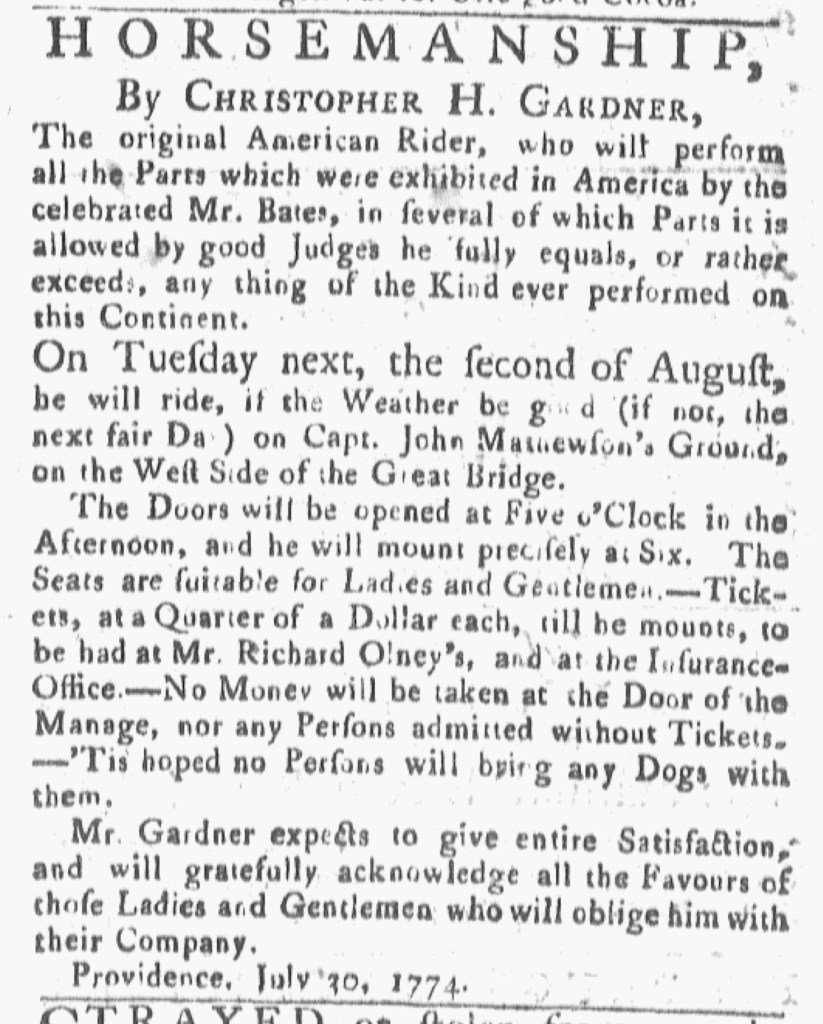
“HORSEMANSHIP … The original American Rider.”
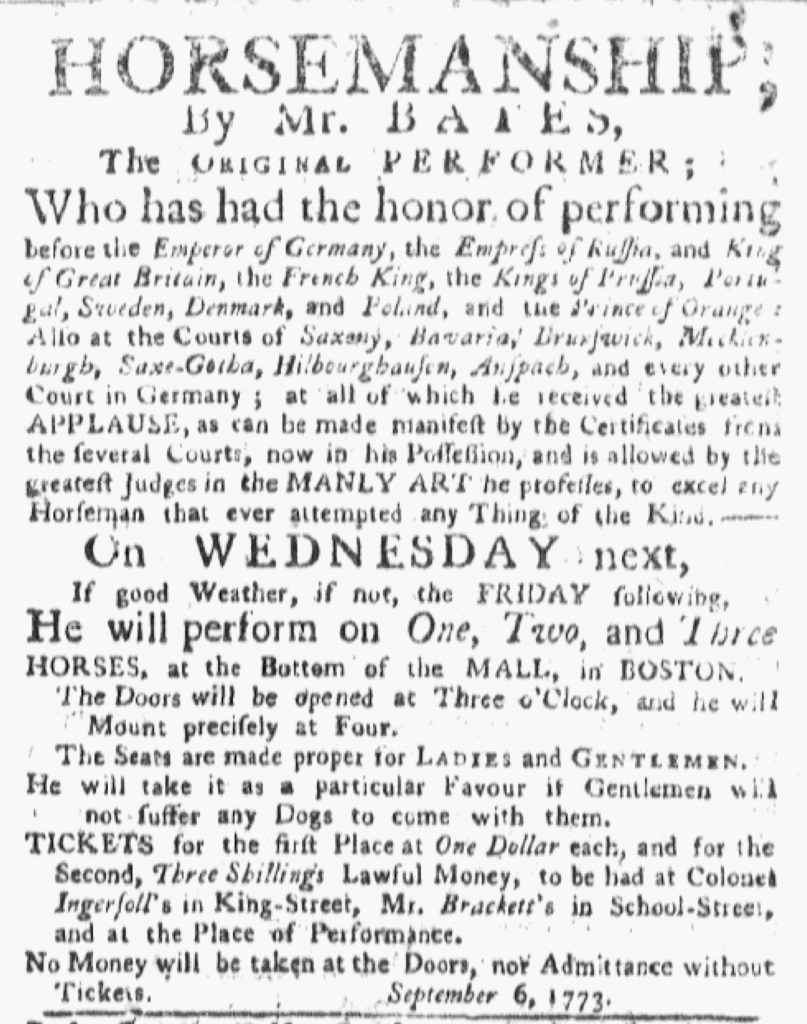
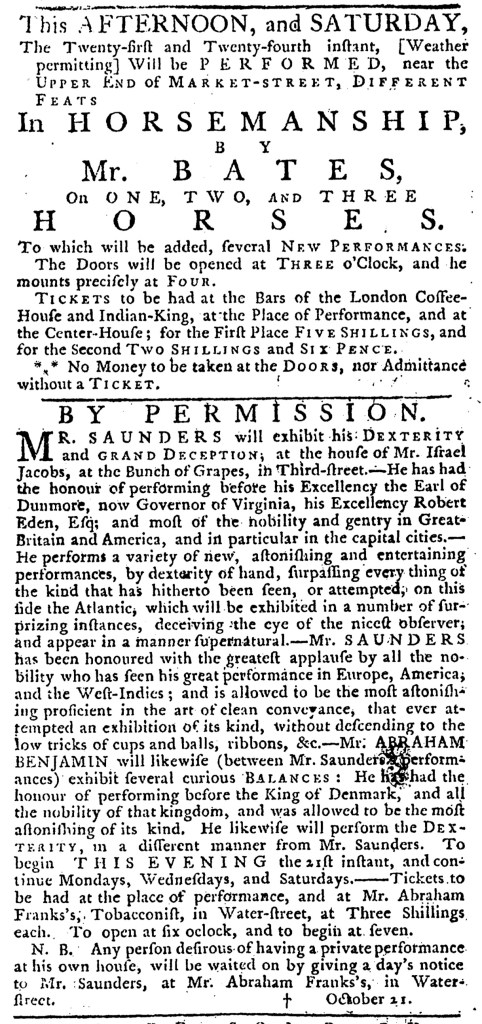
A couple of days before his performance, Christopher H. Gardner, who billed himself as the “original American Rider,” placed an advertisement in the Providence Gazette to encourage the public to attend and witness his feats of “HORSEMANSHIP.” He declared that he “will perform all the Parts which were exhibited in America by the celebrated Mr. Bates,” invoking the equestrian who had achieved considerable celebrity in the colonies over the past couple of years following a career performing in Europe. Bates had demonstrated feats that included tricks involving “One, Two, and Three HORSES” in Philadelphia, New York, Boston, and Newport, advertising in newspapers in each city as he moved from one to the next. Gardner asserted that he possessed the same skill as Bates, so spectators would be amazed and delighted by what they witnessed. According to “good Judges,” Gardner’s performance “fully equals, or rather exceeds, any thing of the Kind evert performed on this Continent.” Readers did not want to miss it!
To make sure that they did not, they needed to purchase tickets in advance. Gardner made clear that “No Money will be taken at the Door …, nor any Persons admitted without Tickets.” The audience could purchase tickets in advance at two locations in town, remaining on sale until the moment that show began. Spectators could arrive early to claim their seats, with the doors opening an hour before Gardner mounted. The equestrian encouraged readers of both sexes to attend, promising that the “Seats are suitable for Ladies and Gentlemen.” Dogs, on the other hand, were prohibited, presumably to prevent spooking the horses. Bates had previously banned dogs from his performances as well.
Gardner did not have the extensive experience performing for monarchs and nobles in European courts that Bates so often touted in his advertisements, yet he “expect[ed] to give entire Satisfaction” to “those Ladies and Gentlemen who will oblige him with their Company.” He aimed to create some buzz in advance of his performance, giving the public an opportunity to see feats that rivaled those done by Bates, but they had to act quickly to acquire their tickets before the show began. Garnder intended for a combination of curiosity and anticipation to drive audiences to his show.