March 11

What was advertised in a colonial American newspaper 250 years ago today?
Virginia Gazette [Hunter and Dixon] (March 11, 1775).

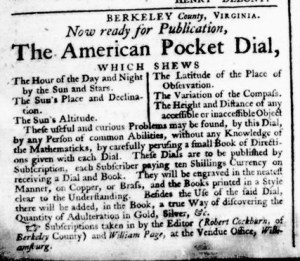
“The American Pocket Dial.”

It was an unusual publication promoted in the March 11, 1775, edition of John Dixon and William Hunter’s Virginia Gazette.  Was it really a publication at all?  A subscription notice proclaimed that “The American Pocket Dial” was “Now ready for Publication.”  This handy device, according to “the Editor,” Robert Cockburn of Berkeley County, showed the “Hour of the Day and Night by the Sun and Stars” as well as the “Sun’s Place and Declination,” the “Sun’s Altitude,” the “Latitude of the Place of Observation,” and the “Height and Distance of any accessible or inaccessible Object.”  That it also showed the “Variation of the Compass” suggests that the pocket sundial had a magnetic compass embedded in it.  Each dial came with a “small Book of Directions” easily understood by “any Person of common Abilities, without any Knowledge of the Mathematicks.”  In “European Pocket Sundials for Colonial Use in American Territories,” Sara H. Schechner notes that “tables of latitude, known as gazetteers” were sometimes “printed in a broadsheet, which was a sundial accessory.”[1]

Cockburn declared that the American Pocket Dials “are to be published by Subscription.”  With the Continental Association in effect, colonizers were not supposed to import or purchase finished goods from Great Britain.  Instead, that pact called on them to “encourage … Industry” and “promote … the Manufactures of this Country.”  Schechner notes that when Anthony Lamb advertised “large Pocket Compasses, with or without Dials” in the April 7, 1760, edition of the New-York Mercury that he likely sold imported items.[2]  Fifteen years later, the political turmoil of the imperial crisis presented an opportunity to market an American alternative, though Cockburn did not take the risk of producing or “publishing” the American Pocket Dial without first lining up buyers or “subscribers.”  He asserted that the sundials “will be engraved in the neatest Manner, on Copper, or Brass.”  Did he find “subscribers” for this project?  During the American Revolution, Schechner states, “American patriots favored compass sundials” while their French allies preferred inclining dials but does not indicate that American makers like Cockburn “published” and sold such products to officers and soldiers.[3]  Addressing that question falls beyond the scope of Schechner’s chapter on “European Pocket Sundials for Colonial Use in American Territories.”  Having encountered Cockburn’s “subscription proposal,” I am curious to see if he published additional advertisements, especially any calling on “subscribers” to collect their pocket sundials once he “published” them.  I will also be looking for other work on early American scientific instruments to learn whether Cockburn and others established an industry during the American Revolution.

**********

[1] Sara J. Schechner, “European Pocket Sundials for Colonial Use in American Territories” in How Scientific Instruments Have Changed Hands, ed. A.D. Morrison-Low, Sara J. Schechner, and Paolo Brenni (Leiden: Brill, 2017), 125.

[2] Schechner, “European Pocket Sundials,” 148.

[3] Schechner, “European Pocket Sundials,” 147.
January 14

What was advertised in a colonial American newspaper 250 years ago today?

Virginia Gazette [Dixon and Hunter] (January 14, 1775).

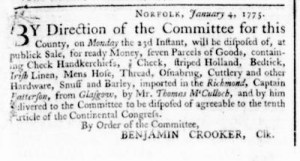
“Seven Parcels of Goods … delivered to the Committee to be disposed of agreeable to the tenth Article of the Continental Congress.”

As an advertisement in the January 14, 1775, edition of Dixon and Hunter’s Virginia Gazette made clear, Thomas McCulloch of Norfolk abided by the Continental Association.  The First Continental Congress adopted that nonimportation, nonconsumption, and nonexportation agreement when it met in Philadelphia in September and October 1774, intending to use economic leverage to convince Parliament to repeal the Coercive Acts passed in retaliation for the destruction of tea during the Boston Tea Party.

“BY Direction of the Committee for this County,” the advertisement informed readers, “on Monday the 23d Instant, will be disposed of, at publick Sale, for ready Money, seven Parcels of Goods … imported in the Richmond, Captain Patterson, from Glasgow, by Mr. Thomas McCulloch.”  The “Committee for this County” referred to the local Committee of Inspection, empowered to oversee the sale of imported goods that arrived between December 1, 1774, and February 1, 1775.  According to the tenth article of the Continental Association, importers had several options for dealing with such items.  They could return the goods, surrender them to the committee to store until the nonimportation agreement concluded, or entrust them to the committee to sell.  McCulloch “delivered [his goods” to the Committee to be disposed of agreeable to the tenth Article of the Continental Congress.”  In that case, the committee would reimburse him what he paid but apply any profit to the relief of Boston where the harbor had been closed since the Boston Port Act went into effect on June 1, 1774.

Another advertisement in the same issue of Dixon and Hunter’s Virginia Gazette advised the public of the sale of “SUNDRY Parcels of Goods lately imported from Great Britain” for sale “Under the Direction of the Committee for the County of CHARLES CITY.”  In this instance, the committee divided the merchandise into “Lots not over ten Pounds Value” to encourage sales.  These local Committees of Inspection joined their counterparts in Massachusetts, New York, and other colonies in advertising imported goods sold according to the tenth article of the Continental Association and, in the process, demonstrating compliance with that measure.

January 7

What was advertised in a colonial American newspaper 250 years ago today?

Virginia Gazette [Dixon and Hunter] (January 7, 1775).

“We now present the Publick with our Paper, as a Sample of what they are to expect from us in Future.”

When John Dixon and William Hunter commenced their partnership as publishers of the Virginia Gazette, they inserted a notice “To the PUBLICK” as the first item in the first column of the first page of the January 7, 1775, edition.  A month earlier, Alexander Purdie and John Dixon announced the end of their partnership, alerting readers that Dixon and Hunter would continue publishing the Virginia Gazette and that Purdie would endeavor to launch his own Virginia Gazette once he attracted enough subscribers.  The numbering for Dixon and Hunter’s newspaper continued uninterrupted, though there were some changes.  They distributed it on Saturdays instead of Thursdays.  For several years, Purdie and Dixon had published their Virginia Gazette on the same day that William Rind, Clementina Rind, and John Pinkney, in succession, took a competing Virginia Gazette to press.  Readers in Williamsburg now had access to newspapers on both Thursdays and Saturdays.  The new partners published their Virginia Gazette “early every Saturday Morning” so it could be “despatched by the several Posts on the same day” for “speedy Conveyance to the Subscribers.”

Dixon and Hunter also updated the combination masthead and colophon beyond merely changing the names of the printers.  The woodcut depicting the arms of the colony that previously adorned the Virginia Gazette now appeared within an ornate baroque border.  The new partners also incorporated a note about the services they provided: “ALL Persons may be supplied with this Paper at 12s6 a Year, and have Advertisements (of a moderate Length) inserted for 3s. the first Week, and 2s. each Week after. – Printing Work done at this Office in the neatest Manner, with Care and Expedition.”  Those lines transformed the masthead and colophon into an advertisement.  In their notice, Dixon and Hunter reported that only a few readers “have withdrawn their Subscriptions,” leaving them feeling confident about the prospects for their newspaper because they received “many Orders … from the Subscribers to this Gazette for continuing them on our List.”  At twelve shillings and six pence for an annual subscription, the price remained the same.  The price for advertising did as well.  Dixon and Hunter charged a shilling for setting type and two shillings for the space the first time an advertisement appeared and then two shillings for each subsequent insertion.

The new partners also signaled their editorial stance in their message “To the PUBLICK.”  They declared that they would published “Whatever may be sent us in Favour of LIBERTY, or for the PUBLICK GOOD … with Cheerfulness.”  In the event of “Scarcity of News,” they planned to fill the pages with “such moral Pieces, from the best Writers, as may contribute to the Improvement of Mankind in general” and, occasionally, “Pieces of Wit and Humour, that tend both to amuse and instruct.”  It went without saying that advertisements would also fill the pages of the Virginia Gazette.  Indeed, paid notices accounted for nearly half the content in Number 1222, the first issue published by Dixon and Hunter.