January 7

What was advertised in a colonial American newspaper 250 years ago today?

Virginia Gazette [Dixon and Hunter] (January 7, 1775).

“We now present the Publick with our Paper, as a Sample of what they are to expect from us in Future.”

When John Dixon and William Hunter commenced their partnership as publishers of the Virginia Gazette, they inserted a notice “To the PUBLICK” as the first item in the first column of the first page of the January 7, 1775, edition.  A month earlier, Alexander Purdie and John Dixon announced the end of their partnership, alerting readers that Dixon and Hunter would continue publishing the Virginia Gazette and that Purdie would endeavor to launch his own Virginia Gazette once he attracted enough subscribers.  The numbering for Dixon and Hunter’s newspaper continued uninterrupted, though there were some changes.  They distributed it on Saturdays instead of Thursdays.  For several years, Purdie and Dixon had published their Virginia Gazette on the same day that William Rind, Clementina Rind, and John Pinkney, in succession, took a competing Virginia Gazette to press.  Readers in Williamsburg now had access to newspapers on both Thursdays and Saturdays.  The new partners published their Virginia Gazette “early every Saturday Morning” so it could be “despatched by the several Posts on the same day” for “speedy Conveyance to the Subscribers.”

Dixon and Hunter also updated the combination masthead and colophon beyond merely changing the names of the printers.  The woodcut depicting the arms of the colony that previously adorned the Virginia Gazette now appeared within an ornate baroque border.  The new partners also incorporated a note about the services they provided: “ALL Persons may be supplied with this Paper at 12s6 a Year, and have Advertisements (of a moderate Length) inserted for 3s. the first Week, and 2s. each Week after. – Printing Work done at this Office in the neatest Manner, with Care and Expedition.”  Those lines transformed the masthead and colophon into an advertisement.  In their notice, Dixon and Hunter reported that only a few readers “have withdrawn their Subscriptions,” leaving them feeling confident about the prospects for their newspaper because they received “many Orders … from the Subscribers to this Gazette for continuing them on our List.”  At twelve shillings and six pence for an annual subscription, the price remained the same.  The price for advertising did as well.  Dixon and Hunter charged a shilling for setting type and two shillings for the space the first time an advertisement appeared and then two shillings for each subsequent insertion.

The new partners also signaled their editorial stance in their message “To the PUBLICK.”  They declared that they would published “Whatever may be sent us in Favour of LIBERTY, or for the PUBLICK GOOD … with Cheerfulness.”  In the event of “Scarcity of News,” they planned to fill the pages with “such moral Pieces, from the best Writers, as may contribute to the Improvement of Mankind in general” and, occasionally, “Pieces of Wit and Humour, that tend both to amuse and instruct.”  It went without saying that advertisements would also fill the pages of the Virginia Gazette.  Indeed, paid notices accounted for nearly half the content in Number 1222, the first issue published by Dixon and Hunter.
December 4

What was advertised in a colonial American newspaper 250 years ago this week?

Virginia Gazette [Purdie and Dixon] (December 1, 1774).

“Our Press shall be as free as any in America.”

The first page of the December 1, 1774, edition of the Virginia Gazette featured two notices about the future endeavors of the partners who printed that newspaper.  In the first, Alexander Purdie announced his withdrawal from that partnership and outlined his plans to publish another newspaper on his own as soon as he garnered enough subscribers to make it a viable venture.  In the other, John Dixon expressed his appreciation for customers who had supported the partnership and revealed that he would continue to publish the Virginia Gazette with a new partner, William Hunter.

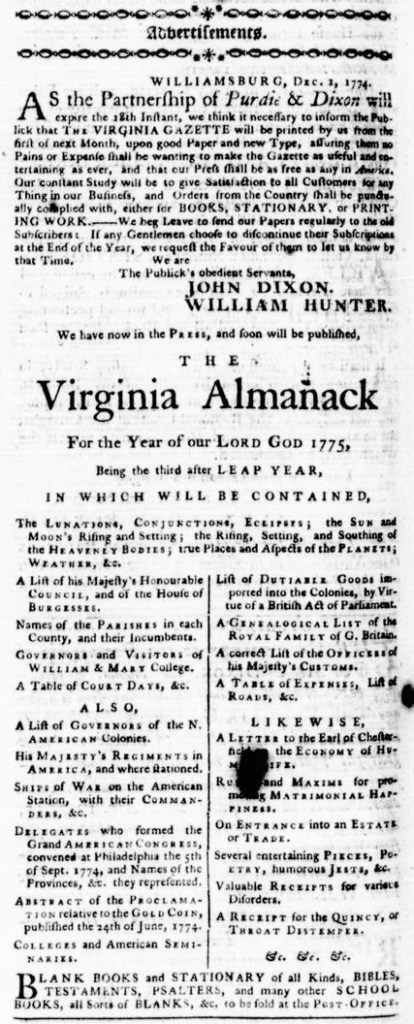
Although those were the only advertisements on the first page, they were not the only advertisements in that issue, nor the end of the notices inserted by the printers.  The remainder of the advertisements appeared after news and essays, commencing in the final column of the second page.  A notice placed by Dixon and Hunter led those advertisements, making clear that the new partnership would actively serve current and prospective customers.  They asserted that their newspaper “will be printed … upon good Paper and new Type.”  Beyond that investment that would benefit readers, Dixon and Hunter pledged that “no Pains or Expense shall be wanting to make this Gazette as useful and entertaining as ever.”  In other words, the newspaper would maintain the same quality that readers expected when the new management went into place.  Furthermore, they proclaimed that “our Press shall be as free as any in America.”  They hoped that would convince customers to continue their patronage, yet did not make assumptions.  “We beg Leave,” they declared, “to send put Papers regularly to the old Subscribers,” but recognized that some might not wish to renew.”  “If any Gentlemen choose to discontinue their Subscriptions at the end of the Year,” they instructed, “we request the Favour of them to let us know by that Time.”  The new partners also promoted other branches of their business, offering “BOOKS, STATIONARY, or PRINTING WORK” to residents of Williamsburg who visited their shop and customers in the country who sent orders.

That, however, did not conclude their advertisement.  Instead, Dixon and Hunter alerted readers that they would soon publish “THE Virginia Almanack For the Year of our LORD GOD 1775.”  The list of contents, intended to entice prospective customers, occupied more space than their announcement about upcoming changes in the partnership.  It contained the usual astronomical data and a selection of informative and “entertaining PIECES” along with several items related to current events.  Those included a list of “DELEGATES who formed the Grand AMERICAN CONGRESS convened at Philadelphia the 5th of Sept, 1774, and Names of the Provinces, &c. they represented,” a “List of DUTIABLE GOODS imported into the Colonies, by Virtue of a British Act of Parliament,” “His MAJESTY’S REGIMENT in AMERICA, and where stationed,” and “SHIPS of WAR on the American Station, with their COMMANDERS.”  The imperial crisis loomed large among the materials selected for inclusion in Dixon and Hunter’s almanac.  Before they began publishing the Virginia Gazette together, they disseminated information about the troubled relationship between the colonies and Britain in an almanac that customers would consult throughout the entire year of 1775.

December 1

What was advertised in a colonial American newspaper 250 years ago today?

Virginia Gazette [Purdie and Dixon] (December 1, 1774).

“I have sent Subscription Papers into all publick Places of the Country.”

Two advertisements that led the front page of the December 1, 1774, edition of Alexander Purdie and John Dixon’s Virginia Gazette provided important updates from the printers.  In the first, Purdie reported that he planned to “resign the Conduct of this Gazette” and wished to express his “sincere and most grateful Acknowledgments to all our Customers, and to the Publick in general,” for years of support.  In addition, he announced that he “shall begin doing Business for myself, and intend to print a GAZETTE as soon as I am furnished with a moderate Number of Customers.”  To entice them, he unveiled the proposed newspaper’s motto: “ALWAYS FOR LIBERTY AND THE PUBLICK GOOD.”  To acquire content, Purdie asked “the Favour of my BROTHER PRINTERS to the Northward to furnish me with their Newspapers, and they shall be sure to have mine, as soon as I begin to print.”  No doubt he and Dixon already participated in such exchanges.

Purdie planned to launch that enterprise “Immediately after Christmas,” but there was no guarantee that he would attract enough subscribers and advertisers to make a go of it.  After all, his newspaper would compete with the Virginia Gazettethat Dixon continued to publish and another Virginia Gazette printed by John Pinkney.  Was Williamsburg and the rest of the colony ready to support three newspapers?  To get a better sense of the market, Purdie “sent Subscription Papers into all publick Places of the Country” and instructed prospective customers that they could also contact him by letter or visit his printing office.  He eventually gained the “moderate Number of Customers” that he needed, though it took a couple of months before he distributed the first issue of his Virginia Gazette on February 3, 1775.  In that time, he also operated a shop where he sold books, sheet music, and stationery, pledging to circulate “a Catalogue of all my Books, &c. as soon as I possibly can.”  Purdie resorted to a variety of marketing media: newspaper advertisements, subscription papers, book catalogs.

In the second advertisement, Dixon revealed William Hunter, “Son of the late Mr. WM. HUNTER of this City, Printer,” would become his new partner in printing the Virginia Gazette and running a book and stationery shop.  He suggested that customers would experience a seamless transition, expressing his “most grateful Thanks for their many Favours” in the past, reminding them that “my Conduct, while in Company with Mr. PURDIE, met with general Approbation,” and pledging that “my future Endeavours to serve the Publick … will render me an Object worthy of their Encouragement.”  Aas Purdie sought subscribers and advertisers for his proposed newspaper, Dixon hoped to maintain the clientele they had cultivated over nearly a decade of working together.

Before perusing news articles or essays in the December 1 edition of Purdie and Dixon’s Virginia Gazette, readers first encountered two advertisements that delivered important news about the future of that newspaper and the possibility that another newspaper might soon be published in Williamsburg.  As was so often the case, printers used advertising space in their own publication to promote their enterprises, framing their work as service to the public.