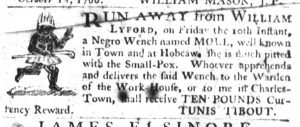
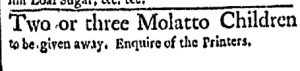
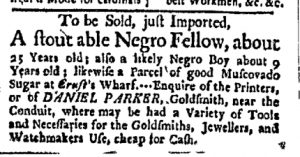
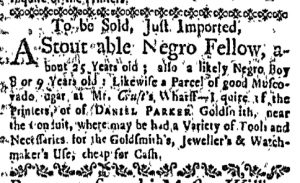
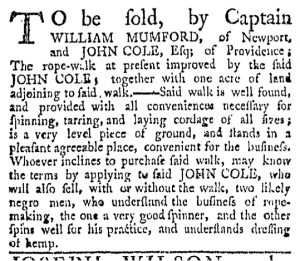
The Slavery Adverts 250 Project chronicles the role of newspaper advertising in perpetuating slavery in the era of the American Revolution. The project seeks to reveal the ubiquity of slavery in eighteenth-century life from New England to Georgia by republishing advertisements about enslaved people – for sale as individuals or in groups, wanted to purchase or for hire for short periods, runaways who liberated themselves, and those who were subsequently captured and confined in jails and workhouses – in daily digests on this site as well as in real time via the @SlaveAdverts250 Twitter feed, utilizing twenty-first-century media to stand in for the print media of the eighteenth century.
The project aims to provide modern audiences with a sense of just how often colonizers encountered these advertisements in their daily lives. Enslaved men, women, and children appeared in print somewhere in the colonies almost every single day. Those advertisements served as a constant backdrop for social, cultural, economic, and political life in colonial and revolutionary America. Colonizers who did not purport to own enslaved people were still confronted with slavery as well as invited to maintain the system by purchasing enslaved men, women, and children or assisting in the capture of so-called “runaways” who sought to free themselves from bondage. The frequency of these newspaper advertisements suggests just how embedded slavery was in colonial and revolutionary American culture in everyday interactions beyond the printed page.
These advertisements also testify to the experiences of enslaved men, women, and children, though readers must consider that those experiences have been remediated through descriptions offered by enslavers rather than enslaved people themselves. Often unnamed in the advertisements, enslaved men, women, and children were not invisible or unimportant in early America.
These advertisements appeared in colonial American newspapers 250 years ago today.
What was advertised in a colonial American newspaper 250 years ago today?
South-Carolina Gazette and Country Journal (November 11, 1766).
“WEST-INDIA Rum in Hogsheads, Muscovado Sugar in Hogsheads and Barrels.”
In this advertisement, two colonial merchants, Edward Blake and John Savage, promoted the arrival and sale of various products including rum, sugar, salt and flour. I was fascinated by this advertisement because I did not have any idea what the terms “Hogsheads” or “Barrels” meant.
According to Russ Rowlett, “Larger volumes of liquids were carried in barrels, hogshead, or other containers whose size in gallons tended to vary with the commodity, with wine unites being different from beer and ale units or other units of liquids.” In general, a hogshead was a relatively large and wide cylinder cask that contained sixty-four gallons.. Barrels were relatively shorter and wider, containing thirty-two gallons, half the volume of a hogshead.. Casks like hogshead and barrels were easier to stack and maneuver than boxes and crates as they were shipped from one place to another. Additionally, they were designed to keep various liquids from becoming spoiled. According to Natasha Hoover, a cask made to transport liquids “must be made from a hard wood, such as oak, wrapped tightly with metal bands and is usually waterproofed in some way, either with brewers’ pitch or wax.” By doing this, bacteria and pests were not likely to get on the inside and spoil the liquid that was in the container.
**********
ADDITIONAL COMMENTARY: Carl Robert Keyes
Carolyn and her peers enrolled in my Colonial America class recently worked through a primary source exercise involving customs and shipping records from the 1740s. To make sense of the documents, they familiarized themselves with some of the common weights and measures used in the eighteenth century, a system that seemed strange and confusing to modern eyes. (This exercise also involved more math than some expected to encounter in history class, a good reminder that several subdisciplines, including economic history, require quantitative skills as well as the ability to engage in qualitative interpretation of texts.) I appreciate the way that Carolyn applied her curiosity from that classroom exercise to learning more about the weights and measures included in the advertisement she selected for today.
In her research, Carolyn turned up a very useful reference page, “What is a Hogshead? Barrels and Measurement in Colonial America.” On that page, Natasha Hoover explains that “a tun was standardized at 256 gallons” in the English colonies in the seventeenth century. Furthermore, the modern ton “is actually how much a tun of water weighs, so the two are related.”
We tend to think of all casks as being some sort of barrel today, but, as Carolyn points out, a barrel was a specific designation in the colonial period. Units like firkin, kilderkin, hogshead, and pipe are no longer regularly used in everyday life, but colonists recognized each and would have noted the relative volume contained in each without much thought. Once familiar with the system, that would have been easy because each successive unit doubled the volume of its predecessor.
Firkin = 8 gallons
Kilderkin = 16 gallons
Barrel = 32 gallons
Hogshead = 64 gallons
Pipe = 128 gallons
Tun = 256 gallons
This system was not as complicated as the unfamiliar names might suggest, but just to keep things interesting the puncheon was also a popular measurement. A puncheon contained one-third of a tun – eighty-five gallons – which meant it contained more than a hogshead but less than a pipe.
I have invited my students to serve as guest curators with the intention that they learn something about colonial commerce and life from each advertisement they select. I am often surprised and pleased by what attracts their attention. My first instinct would have been to examine the commodities contained in the hogsheads and barrels listed in this advertisement. Although Carolyn went in a much different direction, she investigated an important aspect of the world in which colonists lived.
The Slavery Adverts 250 Project chronicles the role of newspaper advertising in perpetuating slavery in the era of the American Revolution. The project seeks to reveal the ubiquity of slavery in eighteenth-century life from New England to Georgia by republishing advertisements about enslaved people – for sale as individuals or in groups, wanted to purchase or for hire for short periods, runaways who liberated themselves, and those who were subsequently captured and confined in jails and workhouses – in daily digests on this site as well as in real time via the @SlaveAdverts250 Twitter feed, utilizing twenty-first-century media to stand in for the print media of the eighteenth century.
The project aims to provide modern audiences with a sense of just how often colonizers encountered these advertisements in their daily lives. Enslaved men, women, and children appeared in print somewhere in the colonies almost every single day. Those advertisements served as a constant backdrop for social, cultural, economic, and political life in colonial and revolutionary America. Colonizers who did not purport to own enslaved people were still confronted with slavery as well as invited to maintain the system by purchasing enslaved men, women, and children or assisting in the capture of so-called “runaways” who sought to free themselves from bondage. The frequency of these newspaper advertisements suggests just how embedded slavery was in colonial and revolutionary American culture in everyday interactions beyond the printed page.
These advertisements also testify to the experiences of enslaved men, women, and children, though readers must consider that those experiences have been remediated through descriptions offered by enslavers rather than enslaved people themselves. Often unnamed in the advertisements, enslaved men, women, and children were not invisible or unimportant in early America.
These advertisements appeared in colonial American newspapers 250 years ago today.
South-Carolina Gazette and Country Journal (November 11, 1766).
**********
South-Carolina Gazette and Country Journal (November 11, 1766).
**********
South-Carolina Gazette and Country Journal (November 11, 1766).
**********
South-Carolina Gazette and Country Journal (November 11, 1766).
**********
South-Carolina Gazette and Country Journal (November 11, 1766).
**********
South-Carolina Gazette and Country Journal (November 11, 1766).
**********
South-Carolina Gazette and Country Journal (November 11, 1766).
**********
South-Carolina Gazette and Country Journal (November 11, 1766).
**********
South-Carolina Gazette and Country Journal (November 11, 1766).
**********
South-Carolina Gazette and Country Journal (November 11, 1766).
**********
South-Carolina Gazette and Country Journal (November 11, 1766).
**********
South-Carolina Gazette and Country Journal (November 11, 1766).
**********
South-Carolina Gazette and Country Journal (November 11, 1766).
**********
South-Carolina Gazette and Country Journal (November 11, 1766).
**********
South-Carolina Gazette and Country Journal (November 11, 1766).
**********
South-Carolina Gazette and Country Journal (November 11, 1766).
What was advertised in a colonial American newspaper 250 years ago today?
Supplement to the Boston Evening-Post (November 10, 1766).
“A fine assortment of neat pinchbeck shoe-buckles.”
As I read this advertisement, I was overwhelmed by the variety of goods imported in the Thames by Captain Watt and offered for sale by “Baker & Bridgham In Union Street.” The assortment of goods ranged from fabrics such as satins and flannels to accessories such as buckles and buttons.
I was intrigued by the description of the shoe buckles made of pinchbeck. Pinchbeck, a form of brass, was commonly used to design accessories during the colonial era. An alloy of copper and zinc, pinchbeck resembled gold in its appearance. At first, many colonists might have thought that pinchbeck was real gold because of its bright and polished image. However, pinchbeck was a “counterfeit” of gold regularly used to craft various jewelry and other adornments, including rings, necklaces, earrings, brooches and shoe buckles.
Colonial smiths and jewelers designed items made of pinchbeck for customers, who asked for their jewelry and accessories to be specific shapes, include precious stones, or have their name engraved. However, there were other colonists who preferred to take advantage of the already stocked and readymade items that were available from shopkeepers like Baker and Bridgham.
**********
ADDITIONAL COMMENTARY: Carl Robert Keyes
The November 10, 1766, issue of the Boston Evening-Post was accompanied by an advertising supplement. Approximately half of the regular issue already consisted of advertising, but T. and J. Fleet sold more advertisements than the issue could contain. As was often the case with colonial newspapers, this issue and its supplement functioned as a delivery mechanism for advertising more than as a means of delivering news items. Rather than a mixture of legal notices and other sorts of advertising that transmitted news and announcements, almost every advertisement that appeared in the supplement promoted consumer goods and services. A couple of dozen merchants and shopkeepers enticed readers in Boston to desire and purchase the merchandise they stocked.
This supplement demonstrates one of the disadvantages of working with digitized sources. The size of the page on which it was printed appears to be different than the broadsheet for the regular issue, but the database does not provide sufficient metadata (or any sort of measurements at all) to make that determination. Each page of the regular issue included three columns, but both pages of the supplement had four. When downloading the entire issue as a PDF, the supplement appears wider, but there’s no way to know if the relative proportions accurately represent the original sources without consulting those sources themselves. This hinders our ability to understand some of the ways that colonists might have interacted with the advertising supplement as a material text.
The content of the advertisements does not tell the entire story. Was the supplement indeed printed on a larger sheet? If so, why? Would it have been simply to squeeze in all the remaining advertisements? Or was that a strategy the Fleets employed to call special attention to the advertisements they published, perhaps making their newspaper more attractive to other advertisers (and, in turn, generating more revenues)? Is there evidence that the supplement was folded in order to fit inside the original issue and delivered at the same time? The digitized images of the November 10 issue and its supplement do not indicate the answers to these questions. Digital surrogates simultaneously allow for greater access to historical sources and conceal some of the important attributes of the originals.
The Slavery Adverts 250 Project chronicles the role of newspaper advertising in perpetuating slavery in the era of the American Revolution. The project seeks to reveal the ubiquity of slavery in eighteenth-century life from New England to Georgia by republishing advertisements about enslaved people – for sale as individuals or in groups, wanted to purchase or for hire for short periods, runaways who liberated themselves, and those who were subsequently captured and confined in jails and workhouses – in daily digests on this site as well as in real time via the @SlaveAdverts250 Twitter feed, utilizing twenty-first-century media to stand in for the print media of the eighteenth century.
The project aims to provide modern audiences with a sense of just how often colonizers encountered these advertisements in their daily lives. Enslaved men, women, and children appeared in print somewhere in the colonies almost every single day. Those advertisements served as a constant backdrop for social, cultural, economic, and political life in colonial and revolutionary America. Colonizers who did not purport to own enslaved people were still confronted with slavery as well as invited to maintain the system by purchasing enslaved men, women, and children or assisting in the capture of so-called “runaways” who sought to free themselves from bondage. The frequency of these newspaper advertisements suggests just how embedded slavery was in colonial and revolutionary American culture in everyday interactions beyond the printed page.
These advertisements also testify to the experiences of enslaved men, women, and children, though readers must consider that those experiences have been remediated through descriptions offered by enslavers rather than enslaved people themselves. Often unnamed in the advertisements, enslaved men, women, and children were not invisible or unimportant in early America.
These advertisements appeared in colonial American newspapers 250 years ago today.
Boston Evening-Post (November 10, 1766).
**********
Boston Evening-Post (November 10, 1766).
**********
Supplement to the Boston Evening-Post (November 10, 1766).
**********
Boston-Gazette (November 10, 1766).
**********
Supplement to the Boston-Gazette (November 10, 1766).
**********
Supplement to the Boston-Gazette (November 10, 1766).
What was advertised in a colonial American newspaper 250 years ago this week?
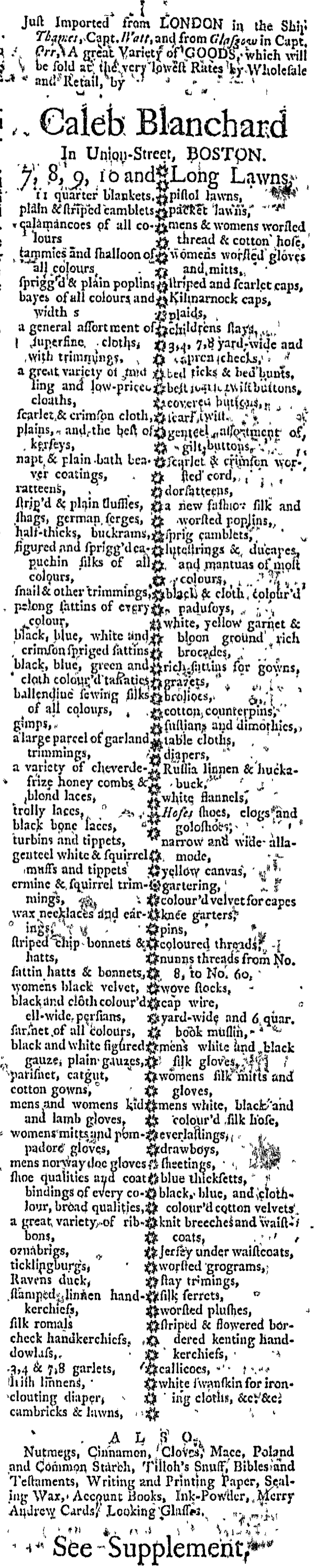
Massachusetts Gazette (November 6, 1766).
“A great Variety of GOODS … cotton gowns … womens mitts and pompadore gloves.”
When I first glanced at this advertisement, I was overwhelmed by the number of products and clothing accessories that Caleb Blanchard listed and sold to the public in Boston. After I examined this advertisement, I concluded that there was some differentiation between the social classes, especially for the women.
For instance, affluent women could afford to purchase the necessary materials for seamstresses to make clothes. In particular, gowns, designed in cotton or rich satin and silk, were a favorite for elite women. A gown “consisted of the bodice and skirt joined together, with the skirt opened in the front to reveal the separate petticoat, which was an essential part of the dress and not an undergarment.” Elite women presented themselves in clothes that were displayed in various colors and fabrics. Additionally, affluent women presented themselves in the latest fashionable necklaces, earrings, gloves, and satin bonnets and hats.
On the other hand, some colonial women purchased materials that they needed from shopkeepers like Caleb Blanchard in order to make their own clothing themselves. Many of them had to consciously ration out their money. Since the goods were sold “at the very lowest Rates,” colonial women strategically made purchases.
Throughout the colonial era, fashion was represented status. With that being said, individuals were given the opportunity to purchase any products of their choosing. However, finances played an essential role. Some could afford to purchase anything they wanted, while others had to be more selective.
**********
ADDITIONAL COMMENTARY: Carl Robert Keyes
This advertisement attracted Carolyn’s attention thanks to the number of imported goods it listed, divided into two columns within the advertisement. It would have been hard to miss because it comprised the entire third and final column of the second page of the Massachusetts Gazette. Its impressive length, however, lent itself to the graphic design element that drew my eye: the printing ornaments deployed to divide the advertisement into two columns of goods. They were all the more visible because they extended down the entire page.
Dividing a lost of goods within in advertisement into two columns was fairly common in the 1760s. Two other advertisements that appeared in the same issue used this method, one full-column advertisement by Frederick William Geyer on the third page and one shorter advertisement by John Head on the fourth page. Both of the other two advertisements, however, featured a narrow line dividing the two columns of merchandise. Caleb Blanchard’s advertisement was unique in its use of printing ornaments to separate the columns.
I have argued on other occasions that advertisers assumed responsibility for writing copy while printers oversaw layout and other design elements of most newspaper advertisements. On occasion, it appears that advertisers made requests or gave specific directives concerning the appearance of their advertisements. This seems to have been just such a case. While it’s possible that Richard Draper may have played with the design elements within the Massachusetts Gazette, it seems highly unlikely that Edes and Gill would have independently made the same decision when they printed Blanchard’s advertisement in the November 10, 1766, issue of the Boston-Gazette – or that T. and J. Fleet would also use the same printing ornaments to create columns in Blanchard’s advertisement in the November 10, 1766, Supplement to the Boston Evening-Post. (The November 6, 1766, issue of the Massachusetts Gazette also included Jolley Allen’s advertisement with its distinctive border created with printing ornaments.)
Blanchard was a savvy marketer who aimed for maximum exposure by advertising in multiple newspapers, but that was not where his entrepreneurial spirit ended. He adroitly used distinctive graphic design to make sure that readers of those newspapers noticed his advertisements, increasing the chances the chances that they would become customers.
What was advertised in a colonial American newspaper 250 years ago this week?
Massachusetts Gazette (November 6, 1766).
“Robert Jenkins … has just imported … Fur Trimmings.”
Robert Jenkins carried a variety of materials for making clothing, like various textiles (including satins and silks), leather, and fur. These extravagant products came in various colors, including black, white, and crimson.
Marge Bruchac explains that during the colonial era “fur and leather garments in New England exemplified the intersection of Native American Indian and Euro-American material culture and fashion, in ways that crossed and blurred categories of class, wealth and ethnicity.” Before that, Bruchac continues, fur garments, such as coats and gloves, were primarily worn by affluent individuals in Europe. Fur indicated wealth or an association with nobility. In contrast, Native Americans of North America did not associate their furs with status. Instead, fur was often passed down through the generations and contributed to survival.
By the late eighteenth century, Europeans were actively involved in the fur trade with Native Americans. In the process, Europeans acquired and “adopted Native items like fur hats, leggings, mittens and moccasins, for warmth and comfort.” They were interested in practical attire. Many clothing items were designed from the soft fur of many animals, including muskrat, rabbit, fox, bear, otter and seal. In particular, fur hats became widely popular. They were even worn by runaway servants, such as John Cannon (according to an advertisement in the Pennsylvania Gazette in 1763), and colonial troops.
**********
ADDITIONAL COMMENTARY: Carl Robert Keyes
Despite his pledge to sell imported fabrics “at the very lowest Rates,” Robert Jenkins appeared to cater to customers of some means. The “large and fresh Assortment of Goods, suitable for the Season” that he had just imported from London may have included general merchandise of interest to colonists from diverse backgrounds, but among those goods he mentioned by name in his advertisement he opted to list several items that would have denoted the refinement and wealth of genteel customers.
Depending on how they were incorporated into garments, the “Fur Trimmings” may have been intended for customers of a certain social standing. On the other hand, Carolyn’s examination of how Anglo-Americans used fur in making clothing during the colonial era demonstrates that fur was not exclusively reserved for the better sorts. She points to an interesting case of historical contingency in determining the social value and meanings of certain garments.
Consider how fur garments have been interpreted during various periods of European and American history. In modern times fur garments have often been associated with wealth, power, and, especially, refinement. In modern America, many people reserve their fur coats and other garments for special occasions. Similarly, as Carolyn notes, wearing fur garments was associated with the nobility in medieval Europe. It might be tempting, therefore, to assume that fur clothing has always been an indicator of status. However, that was not the case in colonial America. Instead, many settlers adopted fur garments because they were practical, not to signal their status.
The Slavery Adverts 250 Project chronicles the role of newspaper advertising in perpetuating slavery in the era of the American Revolution. The project seeks to reveal the ubiquity of slavery in eighteenth-century life from New England to Georgia by republishing advertisements about enslaved people – for sale as individuals or in groups, wanted to purchase or for hire for short periods, runaways who liberated themselves, and those who were subsequently captured and confined in jails and workhouses – in daily digests on this site as well as in real time via the @SlaveAdverts250 Twitter feed, utilizing twenty-first-century media to stand in for the print media of the eighteenth century.
The project aims to provide modern audiences with a sense of just how often colonizers encountered these advertisements in their daily lives. Enslaved men, women, and children appeared in print somewhere in the colonies almost every single day. Those advertisements served as a constant backdrop for social, cultural, economic, and political life in colonial and revolutionary America. Colonizers who did not purport to own enslaved people were still confronted with slavery as well as invited to maintain the system by purchasing enslaved men, women, and children or assisting in the capture of so-called “runaways” who sought to free themselves from bondage. The frequency of these newspaper advertisements suggests just how embedded slavery was in colonial and revolutionary American culture in everyday interactions beyond the printed page.
These advertisements also testify to the experiences of enslaved men, women, and children, though readers must consider that those experiences have been remediated through descriptions offered by enslavers rather than enslaved people themselves. Often unnamed in the advertisements, enslaved men, women, and children were not invisible or unimportant in early America.
These advertisements appeared in colonial American newspapers 250 years ago today.
What was advertised in a colonial American newspaper 250 years ago today?
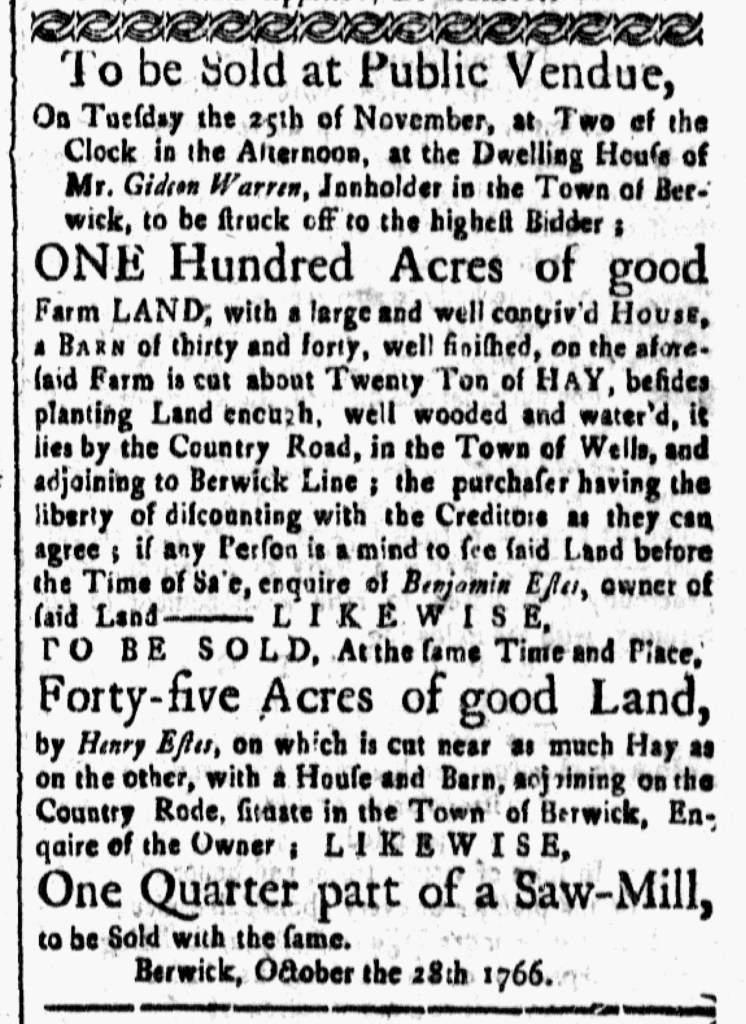
New-Hampshire Gazette (November 7, 1766).
“To Be Sold at Public Vendue … One Quarter part of a Saw-Mill.”
In this advertisement, Benjamin Estes and Henry Estes, two landowners, promoted the sale of “ONE Hundred Acres of good farm LAND” and “Forty-five Acres of good Land” at a “Public Vendue,” otherwise known as an auction. Both of the landowners stated that their land would be sold to the highest bidder at the inn owned by Gideon Warren, in the town of Berwick. Benjamin Estes was the owner of the hundred acres, which included a house, a barn and “Twenty Ton of HAY.” On the other hand, Henry Estes was selling forty-five acres that included a house, a barn, large bundles of hay, and perhaps, most importantly, a sawmill, an important piece of technology.
Over time, technology has dramatically changed. According to the historians at the Ledyard Up-Down Sawmill, “the first water-powered sawmills in New England were built near Berwick, Maine, in the 1630s.” For the next two centuries or so these sawmills used “a wooden waterwheel with a crank connected by the ‘pitman’ arm to a wooden sash (frame) in which was mounted a straight saw blade.” According to Barnes Riznik, “This so-called pitman arm was propelled by an iron crank fixed into the end of the waterwheel shaft.”
During the colonial period, water was used as a source transportation and power. These sawmills “needed to have a dam and millpond to impound water for dry periods and to regulate flow; a millrace to carry water to the wheel itself; a sluice with a gate called a penstock to put the water onto the wheel; and a tailrace to carry off the spent water.” It wasn’t until the 1830s that the sawmills transitioned to circular saws which improved the size and sharpness of the blades. By doing so, the blades were able to produce a larger amount of equal pieces at a rapid rate. Overall, the sawmill technology was beneficial because it allowed for expansion and production to continue and grow.
**********
ADDITIONAL COMMENTARY: Carl Robert Keyes
Although the Adverts 250 Project focuses primarily on advertisements for consumer goods and services, each guest curator may select one advertisement that explores some other aspect of life in colonial America. Real estate advertisements seem to be among the most popular. Carolyn has chosen one today, just a few days after Ceara Morse examined a real estate advertisement from the Georgia Gazette. The tracts of land offered for sale in the two advertisements were located about as distant from each other as was possible within the thirteen colonies that became the United States. Despite their differences, advertisers from Berwick, Maine, and Sunbury, Georgia, crafted advertisements that underscored the profits that buyers could earn from the land offered for sale. The dwellings seemed secondary to the resources and ability to earn a livelihood associated with each piece of land.
Benjamin Estes offered “good Farm LAND” that produced significant amounts of hay that could generate revenue for the new owner. Likewise, Henry Estes indicated that his “good Land” yielded nearly as much hay, even though his tract was slightly less than half the size. The hay, however, was not the only resource Henry Estes planned to auction. He also advertised “One Quarter part of a Saw-Mill.” In other words, Estes sold a share of a sawmill; the purchaser would become the new partner alongside one or more other owners. This presented a different sort of opportunity than farming, but one that Henry Estes considered attractive.
The graphic design elements of the advertisement suggest that the seller believed the sawmill merited as much attention as the farmland. Four lines of the advertisement were set in larger type, one announcing the “Public Vendue,” two listing the acreage of the land, and one devoted to the sawmill. Each of these underscored resources associated with the property for sale and the ability to convert those resources into financial security.
The Slavery Adverts 250 Project chronicles the role of newspaper advertising in perpetuating slavery in the era of the American Revolution. The project seeks to reveal the ubiquity of slavery in eighteenth-century life from New England to Georgia by republishing advertisements about enslaved people – for sale as individuals or in groups, wanted to purchase or for hire for short periods, runaways who liberated themselves, and those who were subsequently captured and confined in jails and workhouses – in daily digests on this site as well as in real time via the @SlaveAdverts250 Twitter feed, utilizing twenty-first-century media to stand in for the print media of the eighteenth century.
The project aims to provide modern audiences with a sense of just how often colonizers encountered these advertisements in their daily lives. Enslaved men, women, and children appeared in print somewhere in the colonies almost every single day. Those advertisements served as a constant backdrop for social, cultural, economic, and political life in colonial and revolutionary America. Colonizers who did not purport to own enslaved people were still confronted with slavery as well as invited to maintain the system by purchasing enslaved men, women, and children or assisting in the capture of so-called “runaways” who sought to free themselves from bondage. The frequency of these newspaper advertisements suggests just how embedded slavery was in colonial and revolutionary American culture in everyday interactions beyond the printed page.
These advertisements also testify to the experiences of enslaved men, women, and children, though readers must consider that those experiences have been remediated through descriptions offered by enslavers rather than enslaved people themselves. Often unnamed in the advertisements, enslaved men, women, and children were not invisible or unimportant in early America.
These advertisements appeared in colonial American newspapers 250 years ago today.