November 16

GUEST CURATOR: Mary Williams

What was advertised in a colonial American newspaper 250 years ago this week?

nov-16-11161766-providence-gazette
Providence Gazette (November 16, 1766).

Opened my House … for the Reception of such Gentlemen and Ladies who may travel this Way.”

In this advertisement from the Providence Gazette, Abijah Hunt wrote that he had just opened up his house to the public. He promised “every Thing suitable for their Accommodation” to any gentlemen and ladies who might stop by.

When I first read through this advertisement I was confused about what exactly Hunt was advertising to readers: an inn or a tavern. He promised to accommodate travelers, but he also mentioned entertainment. On the Colonial Williamsburg webpage, Ed Crews writes that taverns were also called “inns, ordinaries, and public houses” in colonial America. Traveling performers often provided the entertainment in these inns. A wide variety of performers put on acts at these inns, such as magicians, actors, and musicians. Some acts included the use of animals, such as trained pigs. The most common instruments musicians used in their performances were violins, flutes, and trumpets. On nights when there was no provided entertainment, customers often sang together in groups.

Hunt wrote that some of the public taverns in Providence were “not so agreeable as those (to be found in most other large Towns).” Taverns and inns could vary greatly in their atmospheres. Crews describes many inns as “male-domains” where men drank too much and used foul language. Furthermore, “Felons planned crimes, fenced goods, and passed counterfeit money in inns. Fights and murders were common.” Refined women avoided taverns, but prostitutes visited often. In this advertisement, Hunt offered an alternative place of shelter and entertainment for those colonists who wanted a more safe and refined experience.

**********

ADDITIONAL COMMENTARY: Carl Robert Keyes

Mary paints a vivid picture of some of the activities that took place in taverns in the eighteenth century. In addition to being places of entertainment where colonists socialized, Mary also indicates that taverns provided a venue for participating in consumer culture in various ways, including fencing stolen goods and passing counterfeit money.

Such activities were part of what Serena R. Zabin has described as the “informal economy” in colonial America. Not all colonists had the means to purchase new goods directly from merchants and shopkeepers, but that did not prevent them seeking out other ways to obtain the “English, India, and West-India GOODS” that Samuel Nightingale, Jr., marketed on the page after Abijah Hunt’s advertisement appeared. Zabin and others have demonstrated that a vibrant secondhand economy operated in eighteenth-century America; colonists bought and sold used clothing and other goods. Yet others turned to more nefarious means to get their hands on the goods they desired, either stealing or purchasing stolen items. In today’s advertisement Abijah Hunt announced that he opened a house of entertainment to be a place of refuge for visitors “to this Town, both on Business and Recreation,” patrons that he believed wished to avoid some of the more unsavory activities (including the exchange of stolen goods) that took place in some taverns.

While newspaper advertisements reveal a lot about the availability of goods during the consumer revolution, they do not tell the entire story. Occasionally shopkeepers and others placed advertisements lamenting thefts and announcing rewards upon the capture and conviction of the perpetrators, but those who stole the goods almost certainly did not turn to newspapers to offer them for sale. Piecing together the informal economy that included fencing stolen goods, as Zabin has done, requires consulting court records. Those documents provide insight into how some colonists – consumers themselves – used and thought about goods, while newspaper advertisements, for the most part, suggest how retailers, producers, and suppliers attempted to shape colonists’ attitudes and behaviors related to consumption.
November 15

GUEST CURATOR: Mary Williams

What was advertised in a colonial American newspaper 250 years ago today?

nov-15-11151766-providence-gazette
Providence Gazette (November 15, 1766).

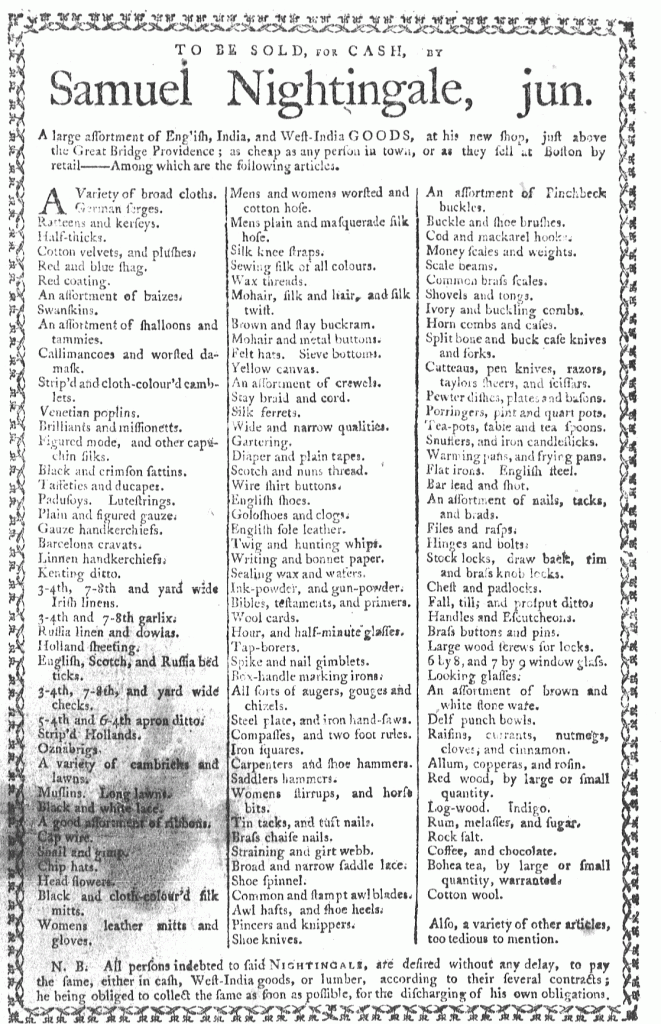
“TO BE SOLD, FOR CASH, BY Samuel Nightingale … Sealing wax and wafers.”

In this advertisement published in the Providence Gazette, Samuel Nightingale offered a wide assortment of goods in his “new shop.” Out of the many goods to choose to research, I decided to take a look at sealing wax and wafers.

Letters in colonial America were not placed into separate envelopes before being sent. Instead, the letters themselves were folded into hand-made envelopes and sealed closed with either sealing wax or wafers.[1] Using sealing wax involved melting a stick of wax over the folded letter with a candle. Before the wax dried, the writer pressed a stamp into the wax to form a seal. The process was messy and time consuming compared to the alternative method to seal letters: wafers. Wafers were pre-made seals that would stick to paper when they were wet.

Reading about the ways letters were sealed reveals a few issues of security and privacy involving mail in the colonies. In “The Meaning and Value of Privacy,” Daniel J. Solove writes, “In colonial America, mail was often insecure. Letters sealed only with wax, left many people concerned that they were far from secure.”[2] Solove goes on to say that Benjamin Franklin, who was a colonial postmaster general, required his post workers to take an oath that they would not open up other people’s mail. [3] We can infer from sealing wax and wafers that there was a certain lack of privacy that existed in the postal system in colonial America.

**********

ADDITIONAL COMMENTARY: Carl Robert Keyes

More than any other newspaper printers in the 1760s, Sarah Goddard and Company, the printers of the Providence Gazette, seem to have allowed advertisers to experiment with innovative graphic design. Goddard may have even suggested and encouraged innovative approaches to layout that distinguished individual advertisements from each other and her newspaper from others circulating in New England and beyond.

The Providence Gazette, established by William Goddard in 1762, ceased publication in May 1765. When it was resurrected by his mother in August 1766, issues almost immediately included oversized advertisements that spanned two columns and featured decorative borders. The Adverts 250 Project has already examined several of those advertisements, including notices by Thompson and Arnold and Benjamin and Edward Thurber and Samuel Nightingale, Jr. Although copies of Goddard’s Providence Gazette most certainly made their way to Boston and New York and beyond, neither advertisers nor printers in other cities were quick to adopt the unique layout that resembled a trade card superimposed on a page of the newspaper. Given that printers ultimately controlled the content and layout of their newspapers, it is possible that shopkeepers requested similar treatment for their advertisements only to meet resistance from printers who did not wish to disrupt the format of their publications.

Considering that the Providence Gazette was only recently revived and may not yet have had an extensive cohort of advertisers providing financial support for the endeavor, Goddard may have been more eager and willing to experiment with the graphic design elements of advertising as a means of filling space and possibly raising more interest among potential new advertisers. Whatever the reasons, advertisements of the type that Mary has selected for today appeared exclusively in the Providence Gazette during the summer and fall of 1766. Keep an eye open for next week’s entry featuring an advertisement from the Providence Gazette to see how Mary Goddard and Company and their advertisers continued to create attention-grabbing advertisements using innovative graphic design.

**********

[1] E. Jennifer Monaghan, Learning to Read and Write in Colonial America, (Amherst: University of Massachusetts Press, 2005), 284.

[2] Daniel H. Solove, “The Meaning and Value of Privacy,” in Social Dimensions of Privacy: Interdisciplinary Perspectives, ed. Beate Roessler and Dorota Mokrosinka (New York: Cambridge University Press, 2015), 75.

[3] Solove, “Meaning and Value of Privacy,” 76.

November 14

GUEST CURATOR: Mary Williams

What was advertised in a colonial American newspaper 250 years ago today?

nov-14-11141766-new-hampshire-gazette
New-Hampshire Gazette (November 14, 1766).

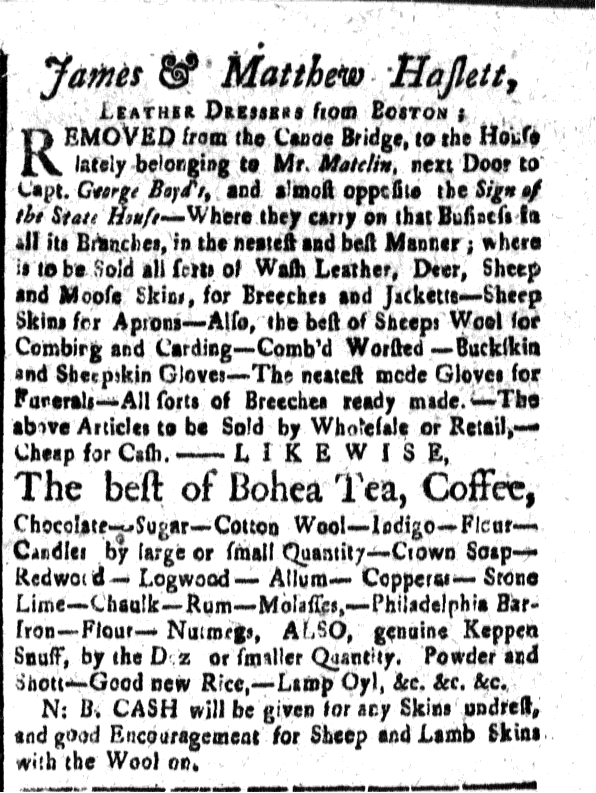
“Buckskin and Sheepskin Gloves – The neatest made Gloves for Funerals.”

In this advertisement from the New-Hampshire Gazette, James and Matthew Haslett offered several leather goods. The first thing I noticed was the description of gloves that were specifically made for funerals.

For my research, I found “The Handsome Tokens of a Funeral: Glove-Giving and the Large Funeral in Eighteenth-Century New England” by Steven Bullock and Sheila McIntyre. Bullock and McIntyre explain that the family of the deceased distributed leather gloves to funeral attendees. They write that this tradition was short-lived, but when it was popular it was a very important funeral custom in British North America. “Well-to-do families distributed them to everyone, often using far more than twelve dozen pairs. A particularly substantial ceremony might require a thousand – or more.”[1] This tells us that a wide variety of people might have responded to this advertisement for funeral gloves: both common people and the elite. The difference between the groups would most likely be that the elite would purchase a large amount of gloves that would be more widely distributed, while common people would purchase a smaller number of gloves that would be reserved for specific funeral attendees.

**********

ADDITIONAL COMMENTARY: Carl Robert Keyes

James and Matthew Haslett advertised regularly in the New-Hampshire Gazette. The Adverts 250 Project featured one of their advertisements just two months ago, selecting that advertisement because of the woodcut depicting the “Sign of the Buck and Glove” that accompanied it. Over a period of several weeks the Hasletts published three advertisements that included two different woodcuts depicting the sign that marked their place of business. Considering that very few newspaper advertisements included visual images (and that those that did usually relied on stock images of houses or ships that belonged to the printer), it was quite exceptional that the Hasletts commissioned not only one but two woodcuts.

Just two months later, however, neither woodcut was anywhere in evidence in their advertisement in the New-Hampshire Gazette. The image was missing and so was any mention of the sign. The Hasletts previously announced that “they have set up their Factory at the Sign of the Buck and Glove, adjoining Canoe Bridge.” Now they reported that they had REMOVED from the Canoe Bridge, to the House lately belonging to Mr. Matelin, next Door to Capt. George Boyd’s, and almost opposite the Sign of the State House.” These new directions were extensive, which would have allowed new and returning customers to find the Hasletts.

What happened to the “Sign of the Buck and Glove” that marked their previous location? Presumably it moved with them. After all, other colonial artisans and shopkeepers were known to have operated under the same shop sign for years or decades. For some, it became a brand of sorts, especially when they commissioned woodcuts that consistently appeared in their newspapers advertisements and on their trade cards and billheads. The Hasletts were in a position to create their own brand with their shop sign. Considering the verbiage involved in the directions they provided in today’s advertisement, it would not have been any more complex to include the name of their shop sign as a means of encouraging readers to always associate their products with the Sign of the Buck and Glove. This appears to have been a missed opportunity.

It may have also been a pragmatic decision. Although this advertisement did not include a woodcut, very little else changed from the previous iteration. The headline was identical. The text was identical from the fifth line of the body of the advertisement until the conclusion of the nota bene, although an additional call for ashes was eliminated. If the Hasletts paid for a certain amount of space or to have type reset, then it made sense to leave out a reference to their shop sign in favor of inserting sufficient information to direct customers to their new location.

**********

[1] Steven Bullock and Sheila McIntyre, “The Handsome Tokens of a Funeral: Glove-Giving and the Large Funeral in Eighteenth-Century New England,” William and Mary Quarterly, 3rd ser., 68, no. 2 (April 2012): 336.

Slavery Advertisements Published November 14, 1766

GUEST CURATOR:  Jordan Russo

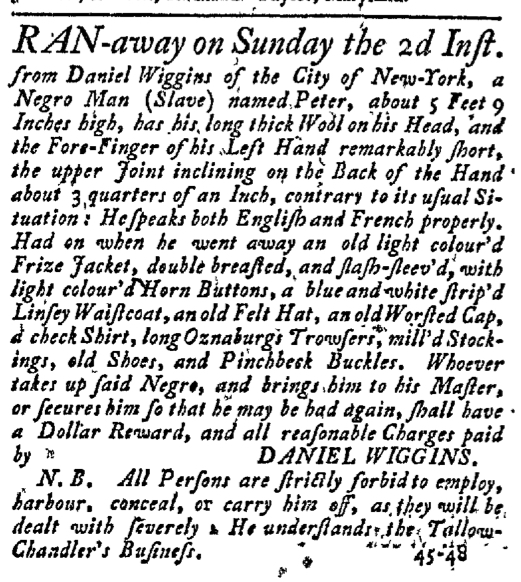
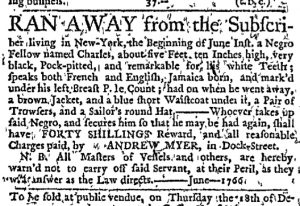
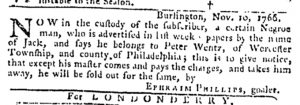
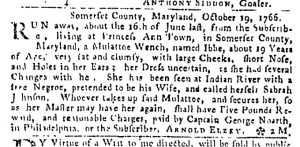
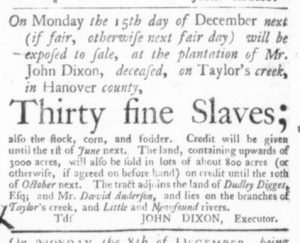
The Slavery Adverts 250 Project chronicles the role of newspaper advertising in perpetuating slavery in the era of the American Revolution. The project seeks to reveal the ubiquity of slavery in eighteenth-century life from New England to Georgia by republishing advertisements about enslaved people – for sale as individuals or in groups, wanted to purchase or for hire for short periods, runaways who liberated themselves, and those who were subsequently captured and confined in jails and workhouses – in daily digests on this site as well as in real time via the @SlaveAdverts250 Twitter feed, utilizing twenty-first-century media to stand in for the print media of the eighteenth century.

The project aims to provide modern audiences with a sense of just how often colonizers encountered these advertisements in their daily lives. Enslaved men, women, and children appeared in print somewhere in the colonies almost every single day. Those advertisements served as a constant backdrop for social, cultural, economic, and political life in colonial and revolutionary America. Colonizers who did not purport to own enslaved people were still confronted with slavery as well as invited to maintain the system by purchasing enslaved men, women, and children or assisting in the capture of so-called “runaways” who sought to free themselves from bondage. The frequency of these newspaper advertisements suggests just how embedded slavery was in colonial and revolutionary American culture in everyday interactions beyond the printed page.

These advertisements also testify to the experiences of enslaved men, women, and children, though readers must consider that those experiences have been remediated through descriptions offered by enslavers rather than enslaved people themselves. Often unnamed in the advertisements, enslaved men, women, and children were not invisible or unimportant in early America.

These advertisements appeared in colonial American newspapers 250 years ago today.

nov-14-new-london-gazette-slavery-1
New-London Gazette (November 14, 1766).

November 13

GUEST CURATOR: Mary Williams

What was advertised in a colonial newspaper 250 years ago today?

nov-13-11131766-new-york-journal
Supplement to the New-York Journal (November 13, 1766).

“TO BE SOLD, By THOMAS DOUGHTY, IN DOCK-STREET: CHOICE old Madeira Wine.”

In this advertisement published in the New-York Journal, Thomas Doughty offered a lot of different beverages, both alcoholic and non-alcoholic, for sale in his shop on Dock Street. What caught my eye was that Madeira wine was the only drink listed with a description: “old.”

After researching the history of Madeira wine, I discovered that it was created specifically to withstand long travels overseas when it would be shipped to other countries. Steven Grasse, author of Colonial Spirits: A Toast to Our Drunken History, writes, “The idea – and what made Madeira so durable and, in turn, beloved by early Americans – is that the wine is essentially spoiled, professionally and on purpose.”[1] Madeira wine was advertised as being old, because that’s what it was known for: never going bad despite the passing of time.

Madeira wine was a favorite drink amongst colonists. Grasse writes that although Madeira was a more expensive item, it was still very popular in British North America. “Madeira wasn’t cheap. Common people wouldn’t have drunk it – or, at least, not often – but that didn’t stop it from becoming part and parcel of the story of the American Revolution.”[2] Grasse goes on to say that Madeira became a leading import during the Revolution.[3] Madeira was a favorite choice of colonists because it kept constant quality over long periods of time.

**********

ADDITIONAL COMMENTARY: Carl Robert Keyes

In addition to “Madeira Wine,” Thomas Doughty sold “sundry other Articles of Grocery” imported from faraway places. To help potential customers navigate his advertisement he grouped similar items together: first alcoholic beverages, hot drinks (tea, coffee, and chocolate) next, then sugars followed by fruits and spices, and finally tobacco. That he listed alcohol first indicates which products he believed would attract readers’ attention and prompt them to peruse the rest of the goods he offered for sale.

Mary has examined the origins of Madeira, a wine that may be less familiar to modern readers than the rum, port, and wines Doughty hawked in his advertisement. He also sold another spirit that remains very popular today, Holland Geneva, though it is now commonly known as gin (which is a corruption of the word “Geneva”). Originally produced in Holland, gin almost immediately became one of the most popular drinks when it was introduced in England, especially after William and Mary assumed the throne. It had a reputation for being both inexpensive and strong.

Each of the alcoholic beverages in Doughty’s advertisement was either named after its place of origin (Madeira and Holland Geneva) or included a place in their description (“Lisbon Red Port,” “Tenriffe Wines,” “Jamaica Spirits,” and “West-India Rum”). Modern consumers certainly still identify their potent potables by their place of origin, but for colonists that was not merely a means of making distinctions of quality or reputation or other attributes. In addition, they also thought about the networks of trade and commerce that brought alcoholic beverages to British mainland North America from Portugal and its island outposts in the eastern Atlantic, the Netherlands, and the Caribbean. The range of alcohols and groceries items in Doughty’s advertisement demonstrates that colonists participated in transatlantic and global networks of trade during the eighteenth century.

**********

[1] Steven A. Grasse, Colonial Spirits: A Toast to our Drunken History (New York: Abrams, 2016), 74.

[2] Grasse, Colonial Spirits, 75.

[3] Grasse, Colonial Spirits, 75.

Welcome, Guest Curator Mary Williams

Mary Williams is a senior majoring in Secondary Education and History at Assumption College in Worcester, Massachusetts. She was inducted into Phi Alpha Theta, the History National Honor Society, in her junior year. She has previous experience with public history and digital humanities, having contributed to the Isaiah Thomas Broadside Ballads Project at the American Antiquarian Society. As part of her Revolutionary America class she used T-PEN to transcribe and tag a ballad to make it more accessible to scholars and general audiences. Beyond her studies she enjoys baking and giving piano lessons. She will be guest curator of the Adverts 250 Project during the week of November 13 to 19, 2016. She previously curated the Slavery Adverts 250 Project during the week of October 2 to 8, 2016.

Welcome, Mary Williams!

Slavery Advertisements Published November 13, 1766

GUEST CURATOR:  Jordan Russo

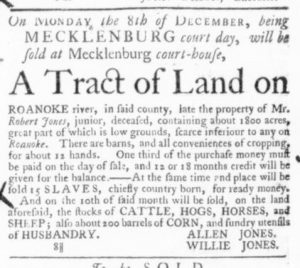
The Slavery Adverts 250 Project chronicles the role of newspaper advertising in perpetuating slavery in the era of the American Revolution. The project seeks to reveal the ubiquity of slavery in eighteenth-century life from New England to Georgia by republishing advertisements about enslaved people – for sale as individuals or in groups, wanted to purchase or for hire for short periods, runaways who liberated themselves, and those who were subsequently captured and confined in jails and workhouses – in daily digests on this site as well as in real time via the @SlaveAdverts250 Twitter feed, utilizing twenty-first-century media to stand in for the print media of the eighteenth century.

The project aims to provide modern audiences with a sense of just how often colonizers encountered these advertisements in their daily lives. Enslaved men, women, and children appeared in print somewhere in the colonies almost every single day. Those advertisements served as a constant backdrop for social, cultural, economic, and political life in colonial and revolutionary America. Colonizers who did not purport to own enslaved people were still confronted with slavery as well as invited to maintain the system by purchasing enslaved men, women, and children or assisting in the capture of so-called “runaways” who sought to free themselves from bondage. The frequency of these newspaper advertisements suggests just how embedded slavery was in colonial and revolutionary American culture in everyday interactions beyond the printed page.

These advertisements also testify to the experiences of enslaved men, women, and children, though readers must consider that those experiences have been remediated through descriptions offered by enslavers rather than enslaved people themselves. Often unnamed in the advertisements, enslaved men, women, and children were not invisible or unimportant in early America.

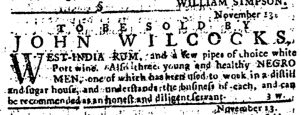
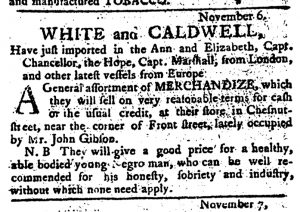
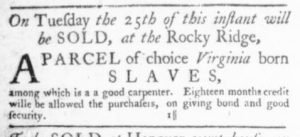
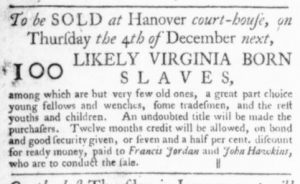
These advertisements appeared in colonial American newspapers 250 years ago today.

nov-13-new-york-journal-slavery-1
New-York Journal (November 13, 1766).

**********

nov-13-new-york-journal-supplement-slavery-1
Supplement to the New-York Journal (November 13, 1766).

**********

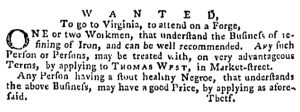
nov-13-pennsylvania-gazette-slavery-1
Pennsylvania Gazette (November 13, 1766).

**********

nov-13-pennsylvania-gazette-slavery-2
Pennsylvania Gazette (November 13, 1766).

**********

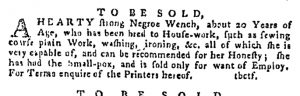
nov-13-pennsylvania-gazette-supplement-slavery-1
Supplement to the Pennsylvania Gazette (November 13, 1766).

**********

nov-13-pennsylvania-gazette-supplement-slavery-2
Supplement to the Pennsylvania Gazette (November 13, 1766).

**********

nov-13-pennsylvania-gazette-supplement-slavery-3
Supplement to the Pennsylvania Gazette (November 13, 1766).

**********

nov-13-pennsylvania-gazette-supplement-slavery-4
Supplement to the Pennsylvania Gazette (November 13, 1766).

**********

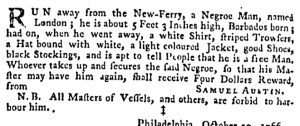
nov-13-pennsylvania-journal-slavery-1
Pennsylvania Journal (November 13, 1766).

**********

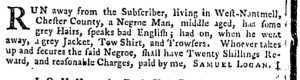
nov-13-pennsylvania-journal-slavery-2
Pennsylvania Journal (November 13, 1766).

**********

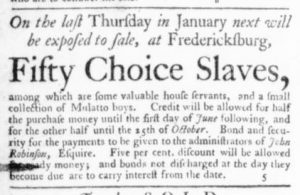
nov-13-virginia-gazette-slavery-1
Virginia Gazette (November 13, 1766).

**********

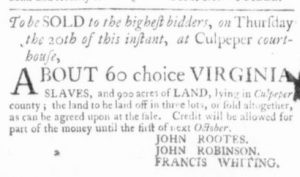
nov-13-virginia-gazette-slavery-2
Virginia Gazette (November 13, 1766).

**********

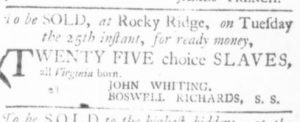
nov-13-virginia-gazette-slavery-3
Virginia Gazette (November 13, 1766).

**********

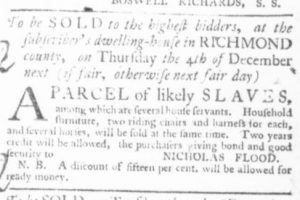
nov-13-virginia-gazette-slavery-5
Virginia Gazette (November 13, 1766).

**********

nov-13-virginia-gazette-slavery-6
Virginia Gazette (November 13, 1766).

**********

nov-13-virginia-gazette-slavery-7
Virginia Gazette (November 13, 1766).

**********

nov-13-virginia-gazette-slavery-8
Virginia Gazette (November 13, 1766).

**********

nov-13-virginia-gazette-slavery-9
Virginia Gazette (November 13, 1766).

**********

nov-13-virginia-gazette-slavery-10
Virginia Gazette (November 13, 1766).

**********

nov-13-virginia-gazette-slavery-11
Virginia Gazette (November 13, 1766).

**********

nov-13-virginia-gazette-slavery-12
Virginia Gazette (November 13, 1766).

**********

nov-13-virginia-gazette-slavery-13
Virginia Gazette (November 13, 1766).

**********

nov-13-virginia-gazette-slavery-14
Virginia Gazette (November 13, 1766).

Reflections from Guest Curator Carolyn Crawford

I thought that the Adverts 250 Project was a challenging task to complete. However, when I officially completed the project, I felt accomplished and proud for all of the hard work that I had done. I am pleased to call myself a guest curator for the Adverts 250 Project. I was glad to have participated in the project and share my work with others.

Throughout my entire education, I have always expressed an interest in history. During middle school and high school, I was never given a project so extensive and detailed as the Adverts 250 Project. Usually my classmates and I were asked to analyze documents and then participate in a discussion. Following this, we would usually be asked to write an essay on the documents discussed or a reflection on what we thought of them. I did not always benefit from this repeated routine because we either needed to stay within a set of boundaries or we did not discuss the documents as explicitly as we should have.

After choosing my own week for the Adverts 250 Project, I was asked to gather advertisements from 250 years ago that week. My goal was to find advertisements for colonial goods being produced, sold, or purchased. I was free to select any advertisements for goods of my choice from a vast number of newspapers.

I browsed through the newspapers for quite some time because I wanted to find advertisements that I knew either little or no information about. Some reflected upon something that I knew about, while others gave me a whole new learning experience. In regards to the newspapers, some were longer and more detailed than others. Thankfully, I managed to find an unfamiliar advertisement for each day as guest curator.

Once I chose my advertisements, I found it challenging to decode the text of each advertisement and choose a particular part or word to respond to. With that being said, it was difficult to visibly see and comprehend some of the terminology and phrases that were written. I wonder if it was because part of the text was naturally smudged when printed during the colonial era. In addition, I found it challenging to find online articles or databases that connected to either a word or phrase that I decided to focus on for my responses. I knew that I could not use one particular source multiple times for my responses. Despite these challenges, I knew that it was essential to continue searching for clues and connections that referred back to my advertisements. By doing so, I was able to expand my knowledge of colonial life and even imagine myself living during the era.

Prior to completing the Adverts 250 Project, I did not have a well developed understanding of the difference between various kinds of sources, such as primary and secondary sources. Additionally, I had a difficult time determining whether or not an article or website was accurate enough to use. Before I was a student at Assumption, I was briefly taught about source documents and the accuracy of websites and articles in high school. With that being said, I never fully developed a concrete understanding of either of these two concepts. Ultimately, it affected me and the way I analyze and write essays when I came to college. Thankfully, the Adverts 250 Project and my Colonial America class, in general, cleared up my past misconceptions and confusion of these two concepts. After completing this project, I feel like I’d be able to accomplish any other school project that involves primary and secondary sources or determining the accuracy of articles or websites.

I’ll admit that before I started this project, I never had my own Twitter account. At first, I was a bit apprehensive about completing this project because I did not understand how the social media site worked. Once a friend helped me create an account and taught me the basics of how the social media site worked, I felt more confident and prepared for what I was supposed to do. The Adverts 250 Project not only got me on Twitter but it allowed me to share my accomplishments and communicate with other history students and historians across the United States.

Upon my completion of the project, I learned how to accurately analyze a primary source and determine if an article or website is accurate or not. Additionally, I was able to expand my knowledge of colonial America by examining various goods that were bought and sold. Although this project had a lot of work and components involved, I encouraged others to experience it, whether that is by looking on the blog, the Twitter feed, or becoming an active guest curator.

November 12

GUEST CURATOR: Carolyn Crawford

What was advertised in a colonial American newspaper 250 years ago today?

nov-12-11121766-georgia-gazette
Georgia Gazette (November 12, 1766).

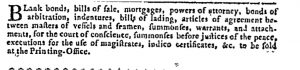
“BLank bonds, bills of sale, mortgages, powers of attorney.”

Unlike other advertisements I examined this week, I found this particular advertisement fascinating because it focused on various products that were sold at the “Printing-Office” and nowhere else: all sorts of printed blanks (which Prof. Keyes explained was the eighteenth-century way of saying “blank forms”). As I analyzed this advertisement, I discovered that printing offices served as a central distribution centers for colonists to gather and acquire information as well as the forms they needed to pass along information.

According to William S. Reese, “Blank forms for business and law were a mainstay of job printing.” With this in mind, colonists were able to obtain forms, such as “Bills of sale, mortgages, [and] powers of attorney,” and then complete them by filling in the necessary information. These forms were used to facilitate legal and business transactions. Ultimately, this “job printing” of blank forms meant income for printers.

Another advantage of the “Printing-Office” was that printers were often postmasters too, which meant colonists gathered there to send and retrieve mail. Additionally, they could regularly receive local newspapers and newspapers sent from other cities. These newspapers, filled with current news and advertisements, encouraged colonists to explore and purchase what was available.

**********

ADDITIONAL COMMENTARY: Carl Robert Keyes

James Johnston, the printer of the Georgia Gazette, inserted advertisements for the printed blanks he produced and sold on a fairly regularly basis. Like many other colonial printers, he sought to generate additional revenues through such job printing, supplementing the fees he received for newspaper subscriptions and advertisements.

In the November 12, 1766, issue of the Georgia Gazette Johnston used a separate advertisement, the one Carolyn selected for today, to list the various sorts of business and legal documents he sold. That advertisement appeared in addition to a regular feature of the newspaper: the colophon that listed the publication information across the bottom of the final page. The colophon did more than announce that the Georgia Gazette came from “SAVANNAH: Printed by JAMES JOHNSTON, at the Printing-Office in Broughton-Street.” It also announced that readers could go to the printing shop, “where Advertisements, Letters of Intelligence and Subscriptions for this Paper, are taken in.—Hand-Bills, Advertisements, &c. printed at the shortest Notice.”

Here we see many sorts of work printers did to earn a living. Newspapers allowed for two streams of income: subscriptions and advertisements. To draw readers and attract subscribers for those newspapers, printers needed content. As Carolyn has indicated, some of it came through the post, either in letters or newspapers from other cities and towns. Some of it also came from local correspondents in the “Letters of Intelligence” solicited in the colophon. Johnston printed some or all of such letters when he received them, keeping his readers better informed.

In addition to printing newspapers, Johnston also did a variety of job printing, including the “Hand-Bills, Advertisements, &c.” that appeared every issue in the colophon and the assortment of printed blanks (at least fourteen different sorts of forms!) listed in the advertisement Carolyn selected. In this way, Johnston used the advertising space in his own newspaper to drum up additional business for his own shop. He did not merely provide advertising space for others who purchased it. He used his own newspaper to advertise other printed goods he sold to the public.

Summary of Slavery Advertisements Published November 6-12, 1766

These tables indicate how many advertisements for slaves appeared in colonial American newspapers during the week of November 6-12, 1766.  Data for both tables was compiled by Nicholas Sears.

Note:  These tables are as comprehensive as currently digitized sources permit, but they may not be an exhaustive account.  They includes all newspapers that have been digitized and made available via Accessible Archives, Colonial Williamsburg’s Digital Library, and Readex’s America’s Historical Newspapers.  There are several reasons some newspapers may not have been consulted:

  • Issues that are no longer extant;
  • Issues that are extant but have not yet been digitized; and
  • Newspapers published in a language other than English (including the Wochentliche Philadelphische Staatsbote).

**********

Slavery Advertisements Published November 6-12, 1766:  By Date

slavery-adverts-tables-nov-6-by-date

**********

Slavery Advertisements Published November 6-12, 1766:  By Region

slavery-adverts-tables-nov-6-by-region