January 17

What was advertised in a colonial American newspaper 250 years ago today?

jan-17-1171767-providence-gazette
Providence Gazette (January 17, 1767).

“A Very large and new Assortment consisting of almost every Kind suitable for Town and Country.”

Regular readers of the Providence Gazette may have raised their eyebrows when they encountered Joseph and William Russell’s claim that “Their Assortment [of consumer goods] is too large for an Advertisement of Particulars in this Paper.” Such an assertion belied the numerous lengthy list advertisements that appeared in American newspapers throughout the eighteenth century. More significantly, it contradicted the Russells’ recent marketing strategies in the Providence Gazette itself. Less than two months earlier, the Russells had inaugurated the first full-page advertisement in that publication, a commercial notice divided into three columns that listed hundreds of items from their “large Assortment of English Goods and Braziery Ware.” The Russells placed that advertisement multiple times over the next several weeks before yielding the space to other advertisers, shopkeepers who also experimented with full-page advertising once they observed competitors initiate the practice. Almost every issue of the Providence Gazette published since late November included a full-page advertisement on the final page.

That may explain the remarkable statement that “an Advertisement of Particulars” from among the Russells’ “Very large and new Assortment” of goods was “too large” to be included “in this Paper.” That portion of the advertisement may not have been written by either of the Russells but may have instead been an editorial comment inserted by the printers. Perhaps “this Paper” referred specifically to that particular issue, already filled with other content, including a full-page list advertisement for Thompson and Arnold’s “Shop near the Great Bridge.” If the suspect claim was indeed an editorial explanation, it might also have been a promise that a more complete accounting of the Russells’ “Fresh GOODS, JUST IMPORTED FROM LONDON” would appear in a subsequent issue.

At any rate, the comment rang particularly false because the Russells’ advertisement appeared in the first column on the first page of that issue (perhaps given such a prominent place – the only advertisement that appeared on the front page of a newspaper that usually reserved paid notices for the final two pages – as a consolation for the printer not being able to accommodate a larger or lengthier advertisement). As a result, the Russells’ advertisement was printed directly to the right of Thompson and Arnold’s full-page advertisement before the broadsheet was folded in half to create a four-page issue. Although separated as the first and last pages most of the time, those two advertisements appeared next to each other any time a reader opened the newspaper. In the absence of listing their merchandise, the Russells resorted to promising that “Customers may have a fine Choice,” enough variety to compete with the hundreds of items Thompson and Arnold listed in their advertisement elsewhere in the same issue.
January 16

What was advertised in a colonial American newspaper 250 years ago today?

jan-16-1161767-south-carolina-and-american-general-gazette
South-Carolina and American General Gazette (January 16, 1767).

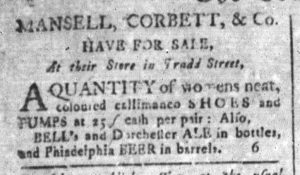
“MANSELL, CORBETT, & Co. HAVE FOR SALE, At their Store in Tradd Street.”

Not much distinguished Mansell, Corbett, and Company’s advertisement from other commercial notices inserted in the same issue of the South-Carolina and American General Gazette. The partners announced that they stocked an interesting combination of women’s shoes, ale (in bottles) from Dorchester, and beer (in barrels) from Philadelphia at their store in Tradd Street. As far as the copy was concerned, Mansell, Corbett, and Company incorporated one aspect that set their advertisement apart from others: they listed a specific price for the shoes, twenty-five shillings per pair.

The shopkeepers may have been fairly conservative in their marketing when it came to making appeals to potential customers, but they did experiment with other methods of attracting notice in the advertising pages of one of their local newspapers. Their advertisement for women’s shoes and Philadelphia beer was not their only contribution to the advertising pages of that issue of the South-Carolina and American General Gazette. They also inserted a separate advertisement that appeared two pages earlier, that one promoting an “ASSORTMENT OF GOODS” that they pledged to “sell very cheap at their new Store in Tradd-street.”

Many eighteenth-century advertisers, especially those who marketed consumer goods and services, ran their advertisements for multiple weeks in order to achieve greater exposure for their businesses. In cities with more than one newspaper, some hedged their bets by placing the same advertisement in multiple publications simultaneously. On the other hand, relatively few colonists who advertised in the 1760s experimented with increasing their exposure by inserting multiple advertisements in a single issue of a newspaper, an iterative method that forced readers to give a business a second consideration even if they skimmed over the first advertisement they encountered.

Given that Mansell, Corbett, and Company described their shop as a “new Store” in the more extensive of their two advertisements, they may have considered this method an effective way of gaining visibility for their endeavor. Whether they were new on the scene in Charleston or had simply moved locations, placing multiple advertisements aided in increasing local awareness of that the partnership sold assorted consumer goods at their shop on Tradd Street.

Slavery Advertisements Published January 16, 1767

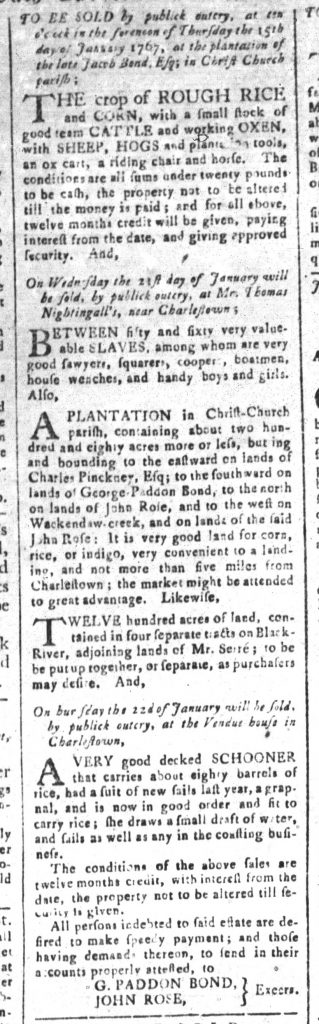
The Slavery Adverts 250 Project chronicles the role of newspaper advertising in perpetuating slavery in the era of the American Revolution. The project seeks to reveal the ubiquity of slavery in eighteenth-century life from New England to Georgia by republishing advertisements about enslaved people – for sale as individuals or in groups, wanted to purchase or for hire for short periods, runaways who liberated themselves, and those who were subsequently captured and confined in jails and workhouses – in daily digests on this site as well as in real time via the @SlaveAdverts250 Twitter feed, utilizing twenty-first-century media to stand in for the print media of the eighteenth century.

The project aims to provide modern audiences with a sense of just how often colonizers encountered these advertisements in their daily lives. Enslaved men, women, and children appeared in print somewhere in the colonies almost every single day. Those advertisements served as a constant backdrop for social, cultural, economic, and political life in colonial and revolutionary America. Colonizers who did not purport to own enslaved people were still confronted with slavery as well as invited to maintain the system by purchasing enslaved men, women, and children or assisting in the capture of so-called “runaways” who sought to free themselves from bondage. The frequency of these newspaper advertisements suggests just how embedded slavery was in colonial and revolutionary American culture in everyday interactions beyond the printed page.

These advertisements also testify to the experiences of enslaved men, women, and children, though readers must consider that those experiences have been remediated through descriptions offered by enslavers rather than enslaved people themselves. Often unnamed in the advertisements, enslaved men, women, and children were not invisible or unimportant in early America.

These advertisements appeared in colonial American newspapers 250 years ago today.

jan-16-south-carolina-and-american-general-gazette-slavery-1
South-Carolina and American General Gazette (January 16, 1767).

**********

jan-16-south-carolina-and-american-general-gazette-slavery-2
South- Carolina and American General Gazette (January 16, 1767).

January 15

What was advertised in a colonial American newspaper 250 years ago today?

jan-15-1151767-pennsylvania-journal
Pennsylvania Journal (January 15, 1767).

“To the PRINTER, WHEREAS a very extraordinary newspaper hath lately appeared in your paper …”

Advertisements for “runaway wives,” women who defied the practices of patriarchy and the laws of coverture by disobeying or abandoning their husbands, frequently appeared in colonial newspapers. On January 15, 1767, alone a total of six such advertisements appeared in Pennsylvania Gazette and the Pennsylvania Journal, alerting residents of Philadelphia and its hinterland not to trust half a dozen women, nor to extend credit to them.

Most advertisements for runaway wives were fairly brief, such as this one that appeared on the first page of the Pennsylvania Journal: “January 15. WHEREAS Catherine the wife of Stephen Wright, of Bristol Township, Bucks county, has absconded and refused to live with him, this is to forewarn all persons from trusting her on my account, as I will pay no debts by her contracted after the date hereof, STEPHEN WRIGHT.” The indigent husband resorted to stock language and formulaic constructions in making this announcement, inserting the appropriate names, dates, and locations.

Charles Tennent, in an advertisement dated January 1, opted for more original language in a much lengthier advertisements that spelled out a variety of charges against his wife, Jane. He reported that she “hath departed from me without my consent, after having extravagantly laid out large sums of money without my knowledge; has threatened to run me much more in debt than she has already done, and not withstanding my frequent earnest, and tender requests to her, she has refused to return to my house and live with me, according to our solemn obligations.” Charles then devoted the second half of his notice to disavowing any debts contracted by Jane.

Its length alone made that advertisement extraordinary, but even more significantly it garnered a response from the runaway wife, a woman who felt she had been defamed by her unjust and unreasonable husband. In an advertisement twice the length of that placed by the disgruntled Charles, Jane defended her reputation and told her side of the dispute “In order to do myself justice, and let the matter in a clearer light to the public than what it has yet been represented.” She made accusations that Charles had “used me extremely ill, and not treated me like a wife.” She also complained that her husband had deprived of her female slave as well as her horse and carriage. To make matters even worse, he had refused to allow her to take a horse when she needed to have a tooth extracted. In turn, she set out on foot and upon returning home discovered that in the interim Charles had placed advertisements about her conduct. Furthermore, she disputed his claims that she spent money extravagantly, arguing that any purchases she made came out of the estate she brought to the marriage. From her perspective, she had been generous in providing clothes for Charles and his children (who may have been from a previous marriage, making them stepchildren to Jane). To make matters worse, Jane stated that she had attempted to return to their household but Charles refused to admit her and was not even willing to meet with her “before any gentlemen in town to talk the matter face to face.” She put up a spirited defense that may have been considered unseemly for a woman yet simultaneously shamed her husband for his poor conduct.

Advertisements for runaway wives demonstrate the agency of colonial women who sought to escape the confines and, in some cases, abuses of patriarchal marriage. In most cases they must be read against the grain because they are accounts written and shaped by men about women. Jane Tennent, however, did not leave it to her friends and neighbors – or historians – to consider her take on the events her husband described. She offered a response that recast her husband as the villain rather than herself as improperly deviating from the ideals of virtuous femininity.

**********

As an aside about another aspect of the history of advertising, note that Jane Tennent reported that her husband “pasted up advertisements round the neighbourhood to the same effect he has done here” in the Pennsylvania Journal. Charles went beyond simply placing an advertisement in the local newspaper. Instead, he contracted a bit of job printing, a separate broadside of unspecified size, that he distributed on his own and strategically placed in places around his own neighborhood. This suggests that pasting up advertisements in colonial cities and towns was fairly common, that residents experienced a visual and textual landscape of advertising in their everyday lives.

Slavery Advertisements Published January 15, 1767

The Slavery Adverts 250 Project chronicles the role of newspaper advertising in perpetuating slavery in the era of the American Revolution. The project seeks to reveal the ubiquity of slavery in eighteenth-century life from New England to Georgia by republishing advertisements about enslaved people – for sale as individuals or in groups, wanted to purchase or for hire for short periods, runaways who liberated themselves, and those who were subsequently captured and confined in jails and workhouses – in daily digests on this site as well as in real time via the @SlaveAdverts250 Twitter feed, utilizing twenty-first-century media to stand in for the print media of the eighteenth century.

The project aims to provide modern audiences with a sense of just how often colonizers encountered these advertisements in their daily lives. Enslaved men, women, and children appeared in print somewhere in the colonies almost every single day. Those advertisements served as a constant backdrop for social, cultural, economic, and political life in colonial and revolutionary America. Colonizers who did not purport to own enslaved people were still confronted with slavery as well as invited to maintain the system by purchasing enslaved men, women, and children or assisting in the capture of so-called “runaways” who sought to free themselves from bondage. The frequency of these newspaper advertisements suggests just how embedded slavery was in colonial and revolutionary American culture in everyday interactions beyond the printed page.

These advertisements also testify to the experiences of enslaved men, women, and children, though readers must consider that those experiences have been remediated through descriptions offered by enslavers rather than enslaved people themselves. Often unnamed in the advertisements, enslaved men, women, and children were not invisible or unimportant in early America.

These advertisements appeared in colonial American newspapers 250 years ago today.

jan-15-new-york-gazette-weekly-post-boy-slavery-1
New-York Gazette: Or, the Weekly Post-Boy (January 15, 1767).

**********

jan-15-new-york-gazette-weekly-post-boy-slavery-2
New-York Gazette: Or, the Weekly Post-Boy (January 15, 1767).

**********

jan-15-new-york-journal-slavery-1
New-York Journal (January 15, 1767).

**********

jan-15-new-york-journal-slavery-2
New-York Journal (January 15, 1767).

**********

jan-15-new-york-journal-slavery-3
New-York Journal (January 15, 1767).

**********

jan-15-pennsylvania-gazette-supplement-slavery-1
Supplement to the Pennsylvania Gazette (January 15, 1767).

**********

jan-15-pennsylvania-gazette-supplement-slavery-2
Supplement to the Pennsylvania Gazette (January 15, 1767).

**********

jan-15-pennsylvania-journal-slavery-1
Pennsylvania Journal (January 15, 1767).

**********

jan-15-pennsylvania-journal-slavery-2
Pennsylvania Journal (January 15, 1767).

**********

jan-15-virginia-gazette-slavery-1
Virginia Gazette (January 15, 1767).

**********

jan-15-virginia-gazette-slavery-2
Virginia Gazette (January 15, 1767).

**********

jan-15-virginia-gazette-slavery-3
Virginia Gazette (January 15, 1767).

**********

jan-15-virginia-gazette-slavery-4
Virginia Gazette (January 15, 1767).

**********

jan-15-virginia-gazette-slavery-5
Virginia Gazette (January 15, 1767).

**********

jan-15-virginia-gazette-slavery-6
Virginia Gazette (January 15, 1767).

**********

jan-15-virginia-gazette-slavery-7
Virginia Gazette (January 15, 1767).

January 14

What was advertised in a colonial American newspaper 250 years ago today?

jan-14-1141767-georgia-gazette
Georgia Gazette (January 14, 1767).

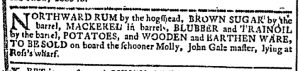
“TO BE SOLD on board the schooner Molly, John Gale master, lying at Ross’s Wharf.”

Not all commercial transactions took place in shops or warehouses in eighteenth-century America. In addition to acquiring consumer goods at auction houses and estate sales, some colonists also made purchases aboard ships when they arrived in port. Such was the case with a small selection of commodities advertised by “John Gale, master” who advertised that he sold his wares “on board the schooner Molly … lying at Ross’s wharf.”

Gale’s advertisement first appeared in the January 14, 1767, issue of the Georgia Gazette. The shipping news in that issue indicated that the Molly, sailing from Salem and Marblehead, had “ENTERED INWARDS at the CUSTOM-HOUSE in SAVANNAH” on January 8. Gale placed his advertisement in the first issue of the local newspaper published after his arrival. While shopkeepers and merchants could depend on residents of Savannah having at least some familiarity with the shops and storehouses they operated and possibly did not find it necessary to advertise, Gale did not have that advantage. Advertising was imperative for the master of the newly arrived vessel to attract customers, especially since he planned to be in port for a limited time. Two weeks later, the shipping news reported that the Molly had “ENTERED OUTWARDS” to return to Salem and Marblehead.

Given that he transacted business aboard a ship in port for just a few weeks, Gale operated exclusively as a wholesaler, selling all of his goods in bulk: rum by the hogshead and brown sugar and mackerel by the barrel. He also sold blubber and “trainoil,” an eighteenth-century designation for whale oil, by the barrel. Although whaling flourished as an American maritime commercial endeavor in the nineteenth century, it had already emerged as an important economic activity by the final third of the eighteenth century because consumers desired whale oil to burn in lamps and to make soap.

Although Gale served as captain of the Molly, he likely worked for one or more merchant owners of the vessel, men who determined where the ship would sail and what cargo it would carry. Gale and the Molly may have pursued the coastal trade and traced a regular route between New England and the southern colonies. Not all traders in the Atlantic world needed to cross the ocean to generate profits.

Summary of Slavery Advertisements Published January 8-14, 1767

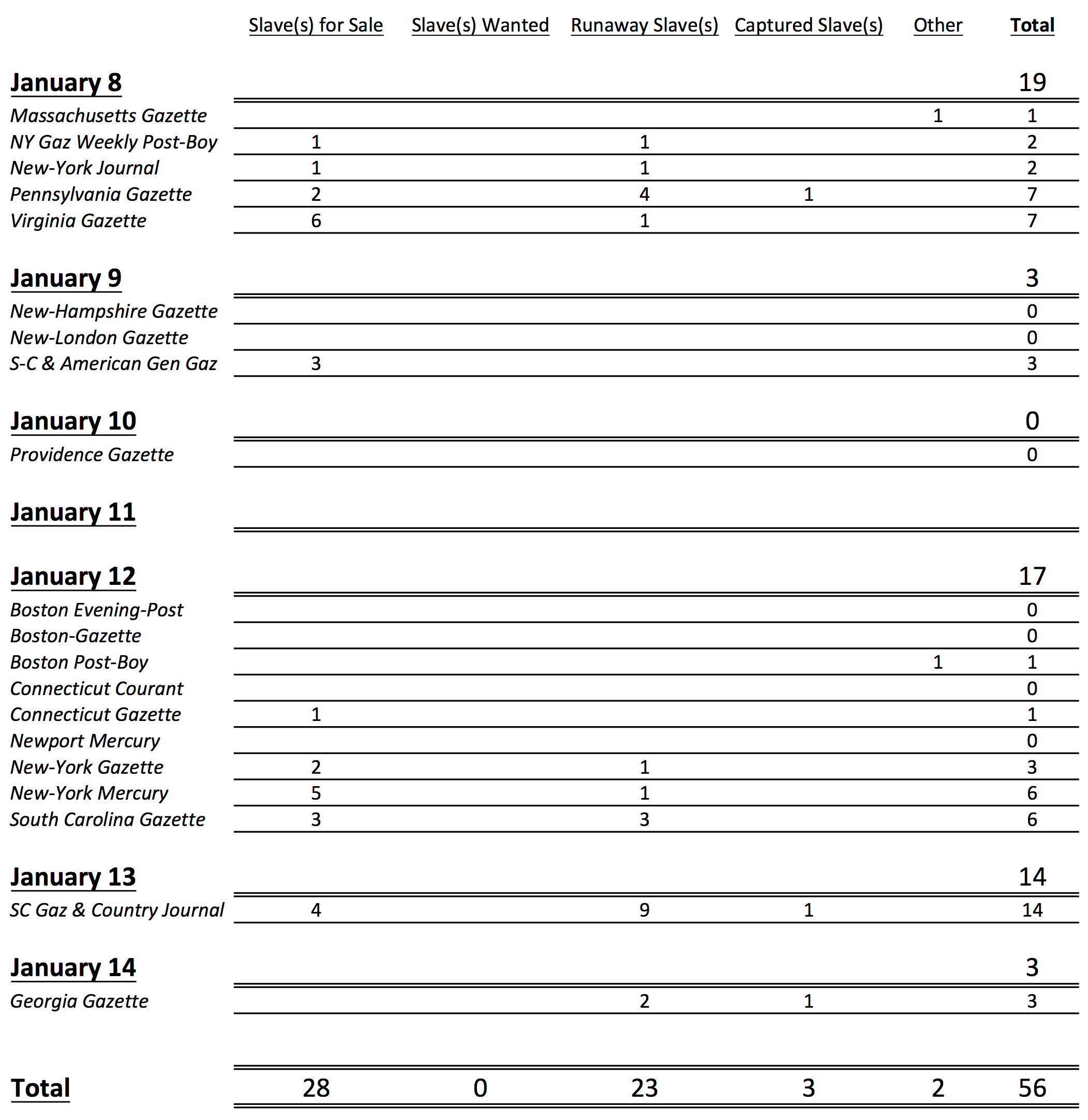
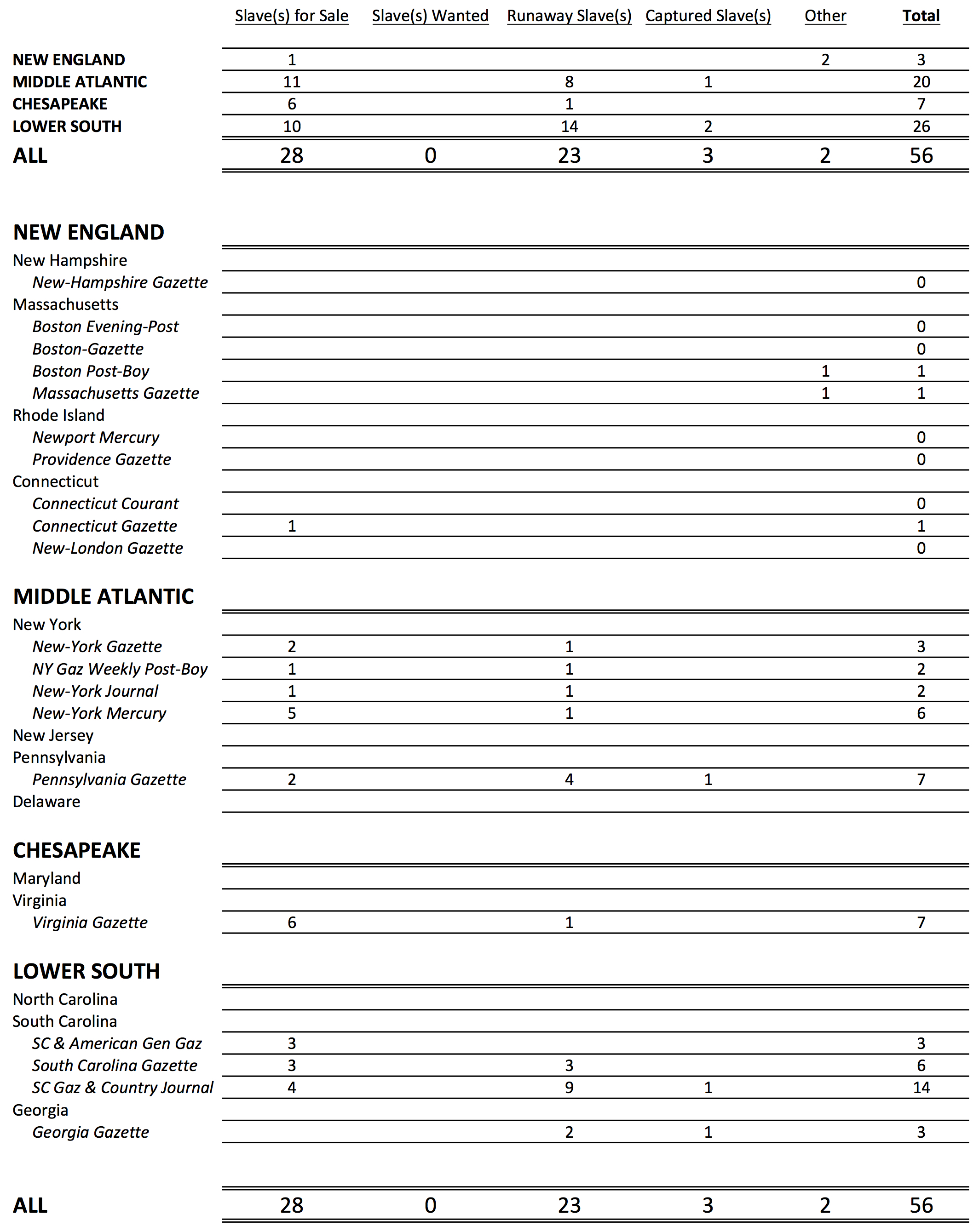
These tables indicate how many advertisements for slaves appeared in colonial American newspapers during the week of January 8-14, 1767.

Note:  These tables are as comprehensive as currently digitized sources permit, but they may not be an exhaustive account.  They includes all newspapers that have been digitized and made available via Accessible Archives, Colonial Williamsburg’s Digital Library, and Readex’s America’s Historical Newspapers.  There are several reasons some newspapers may not have been consulted:

  • Issues that are no longer extant;
  • Issues that are extant but have not yet been digitized; and
  • Newspapers published in a language other than English (including the Wochentliche Philadelphische Staatsbote).

**********

Slavery Advertisements Published January 8-14, 1767:  By Date

slavery-adverts-tables-1767-by-date-jan-8

**********

Slavery Advertisements Published January 8-14, 1767:  By Region

slavery-adverts-tables-1767-by-region-jan-8


Slavery Advertisements Published January 14, 1767

The Slavery Adverts 250 Project chronicles the role of newspaper advertising in perpetuating slavery in the era of the American Revolution. The project seeks to reveal the ubiquity of slavery in eighteenth-century life from New England to Georgia by republishing advertisements about enslaved people – for sale as individuals or in groups, wanted to purchase or for hire for short periods, runaways who liberated themselves, and those who were subsequently captured and confined in jails and workhouses – in daily digests on this site as well as in real time via the @SlaveAdverts250 Twitter feed, utilizing twenty-first-century media to stand in for the print media of the eighteenth century.

The project aims to provide modern audiences with a sense of just how often colonizers encountered these advertisements in their daily lives. Enslaved men, women, and children appeared in print somewhere in the colonies almost every single day. Those advertisements served as a constant backdrop for social, cultural, economic, and political life in colonial and revolutionary America. Colonizers who did not purport to own enslaved people were still confronted with slavery as well as invited to maintain the system by purchasing enslaved men, women, and children or assisting in the capture of so-called “runaways” who sought to free themselves from bondage. The frequency of these newspaper advertisements suggests just how embedded slavery was in colonial and revolutionary American culture in everyday interactions beyond the printed page.

These advertisements also testify to the experiences of enslaved men, women, and children, though readers must consider that those experiences have been remediated through descriptions offered by enslavers rather than enslaved people themselves. Often unnamed in the advertisements, enslaved men, women, and children were not invisible or unimportant in early America.

These advertisements appeared in colonial American newspapers 250 years ago today.

jan-14-georgia-gazette-slavery-1
Georgia Gazette (January 14, 1767).

**********

jan-14-georgia-gazette-slavery-2
Georgia Gazette (January 14, 1767).

**********

jan-14-georgia-gazette-slavery-3
Georgia Gazette (January 14, 1767).

January 13

What was advertised in a colonial American newspaper 250 years ago today?

jan-13-1131767-south-carolina-gazette-and-country-journal-page-2
South-Carolina Gazette and Country Journal (January 13, 1767).

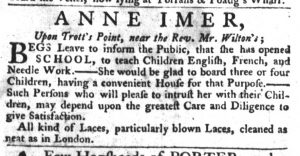
“ANNE IMER … has opened SCHOOL.”

Less than two weeks into the new year, Charleston’s schoolmasters encouraged parents to enroll their children in classes. The January 13, 1767, issue of the South-Carolina Gazette and Country Journal and its supplement included five notices promoting educational opportunities. Advertisements placed by schoolmasters and tutors of various sorts frequently appeared in the city’s newspapers in the 1760s, but not usually so many in a single issue. The start of the year, however, was an opportune time to seek new students as colonists thought about how to make the new year more prosperous than the last. As the advertisements indicate, parents who could afford to educate their children had many choices. Schoolmasters faced stiff competition from their peers, a factor that caused each to market more than just their curriculum.

William Hutchins, who operated a day school where students learned reading, writing, and arithmetic, asserted that he took “the greatest Care” in shaping the “Morals and Behaviour” of his students. For the convenience of scholars who could not attend during the day, he also kept an evening school.

Schoolmistress Anne Imer was the only educator who taught a subject specifically aimed at female students. She listed three subjects in her curriculum: “English, French, and Needle Work.” Most likely her charges learned needlework as a genteel pursuit for refined young ladies, a complement to their instruction in the French language, rather than solely as a practical skill. Imer also offered “to board three or four Children, having a convenient House for that Purpose.”

D’Ellient and Alexander welcomed both “Day boarders” and fulltime boarding students to their school, “where the English, French, Latin and Greek Languages, Writing and Arithmetick are taught as usual.” They offered a more refined education than Hutchins, as well as several amenities suited to the status of their students. The schoolmasters indicated that they had hired “a prudent Housekeeper” in order to provide satisfactory “boarding, lodging and washing of young Gentlemen from the Country.” They also provided lunch for “Day boarders,” students who lived in Charleston but far enough from the school that it was “inconvenient for them to return Home to dine.”

Walter Coningham supplemented the standard curriculum (reading, writing, and arithmetic) at his “Grammar-School” with lessons in Greek and Latin. Unlike others who taught foreign languages, he described his methods for parents of prospective students to review in advance. Like Imer, he accepted a limited number of boarders, though most of his pupils seemed to have been day students.

The enigmatic Pike (who never revealed his first name in any of his advertisements in Charleston or, later, Philadelphia) offered a very different curriculum, dancing and fencing. These genteel pursuits supplemented the knowledge students gained at other schools and academies. He invited male and female students to learn “proper address, the Minuet, Country Dances” or “any Branch of dancing they chuse.” Instruction in “the Use of the SMALL-SWORD,” however, was reserved for men.

The schoolmasters who placed these advertisements offered services and amenities in addition to instruction in the subjects they taught. In describing the ancillary aspects of they education they provided, these advertisers allowed prospective students and their parents to select the school that best fit their budget, status, and aspirations.

Slavery Advertisements Published January 13, 1767

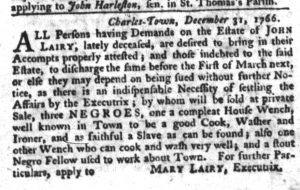
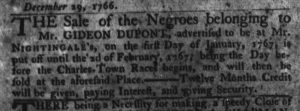
The Slavery Adverts 250 Project chronicles the role of newspaper advertising in perpetuating slavery in the era of the American Revolution. The project seeks to reveal the ubiquity of slavery in eighteenth-century life from New England to Georgia by republishing advertisements about enslaved people – for sale as individuals or in groups, wanted to purchase or for hire for short periods, runaways who liberated themselves, and those who were subsequently captured and confined in jails and workhouses – in daily digests on this site as well as in real time via the @SlaveAdverts250 Twitter feed, utilizing twenty-first-century media to stand in for the print media of the eighteenth century.

The project aims to provide modern audiences with a sense of just how often colonizers encountered these advertisements in their daily lives. Enslaved men, women, and children appeared in print somewhere in the colonies almost every single day. Those advertisements served as a constant backdrop for social, cultural, economic, and political life in colonial and revolutionary America. Colonizers who did not purport to own enslaved people were still confronted with slavery as well as invited to maintain the system by purchasing enslaved men, women, and children or assisting in the capture of so-called “runaways” who sought to free themselves from bondage. The frequency of these newspaper advertisements suggests just how embedded slavery was in colonial and revolutionary American culture in everyday interactions beyond the printed page.

These advertisements also testify to the experiences of enslaved men, women, and children, though readers must consider that those experiences have been remediated through descriptions offered by enslavers rather than enslaved people themselves. Often unnamed in the advertisements, enslaved men, women, and children were not invisible or unimportant in early America.

These advertisements appeared in colonial American newspapers 250 years ago today.

jan-13-south-carolina-gazette-and-country-journal-slavery-1
South-Carolina Gazette and Country Journal (January 13, 1767).

**********

jan-13-south-carolina-gazette-and-country-journal-slavery-2
South-Carolina Gazette and Country Journal (January 13, 1767).

**********

jan-13-south-carolina-gazette-and-country-journal-slavery-3
South-Carolina Gazette and Country Journal (January 13, 1767).

**********

jan-13-south-carolina-gazette-and-country-journal-slavery-4
South-Carolina Gazette and Country Journal (January 13, 1767).

**********

jan-13-south-carolina-gazette-and-country-journal-slavery-5
South-Carolina Gazette and Country Journal (January 13, 1767).

**********

jan-13-south-carolina-gazette-and-country-journal-slavery-6
South-Carolina Gazette and Country Journal (January 13, 1767).

**********

jan-13-south-carolina-gazette-and-country-journal-slavery-7
South-Carolina Gazette and Country Journal (January 13, 1767).

**********

jan-13-south-carolina-gazette-and-country-journal-slavery-8
South-Carolina Gazette and Country Journal (January 13, 1767).

**********

jan-13-south-carolina-gazette-and-country-journal-slavery-9
South-Carolina Gazette and Country Journal (January 13, 1767).

**********

jan-13-south-carolina-gazette-and-country-journal-slavery-10
South-Carolina Gazette and Country Journal (January 13, 1767).

**********

jan-13-south-carolina-gazette-and-country-journal-supplement-slavery-1
Supplement to the South-Carolina Gazette and Country Journal (January 13, 1767).

**********

jan-13-south-carolina-gazette-and-country-journal-supplement-slavery-2
Supplement to the South-Carolina Gazette and Country Journal (January 13, 1767).

**********

jan-13-south-carolina-gazette-and-country-journal-supplement-slavery-3
Supplement to the South-Carolina Gazette and Country Journal (January 13, 1767).

**********

jan-13-south-carolina-gazette-and-country-journal-supplement-slavery-4
Supplement to the South-Carolina Gazette and Country Journal (January 13, 1767).