What was advertised in a colonial American newspaper 250 years ago today?
Boston Evening-Post (January 12, 1767).
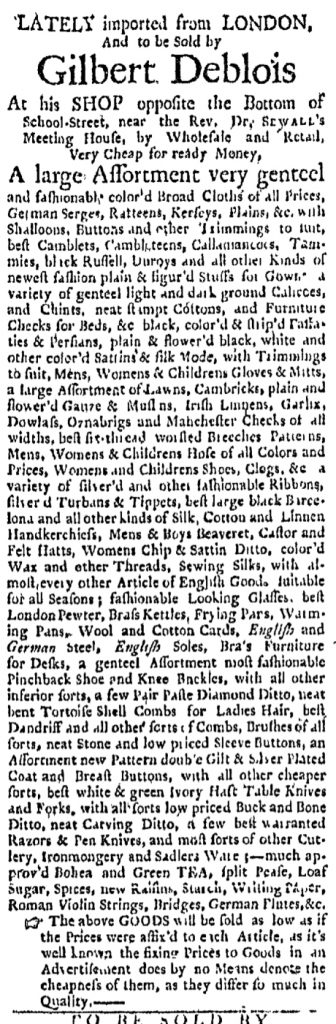
“The above GOODS will be sold as low as if the Prices were affix’d to each Article.”
Eighteenth-century advertisers rarely indicated specific prices for their merchandise, though they frequently proclaimed that they charged “reasonable rates” or offered discounts for purchasing by volume. Shopkeeper Gilbert Deblois stated that he sold the “large Assortment” of goods he stocked “Very Cheap for ready Money.” He made this promise in what might be considered the header of his advertisement that appeared before an extensive list detailing his inventory. Advertisements placed by retailers commonly featured some sort of header that included the advertiser’s name and location, announced that their wares had been recently imported, and made general appeals to price, quality, and fashion.
Deblois augmented his standard assurance that customers could expect “Very Cheap” prices with a note that explained why he did not specify any particular prices. “The above goods,” he asserted, “will be sold as low as if the Prices were affix’d to each Article.” He further explained, just in case potential customers were not already aware or needed to be reminded, that “it’s well known the fixing Prices to Goods in an Advertisement does by no Means denote the cheapness of them, as they differ so much in Quality.” Consumers would not find it useful, the shopkeeper argued, to review the prices in an advertisement before visiting his shop. They needed to examine the merchandise to assess its quality for themselves in order to determine that any price was indeed “Very Cheap.”
This clarification may help to explain why so few advertisers announced specific low prices as a means of attracting potential customers, a significant difference between eighteenth-century methods and modern marketing practices that often rely on advertising particular prices. In an era before major manufacturers mass produced products that carried brand names associated with well known reputations, both retailers and, especially, consumers may have considered listing specific prices in advertisements meaningless, ineffective, and potentially misleading.
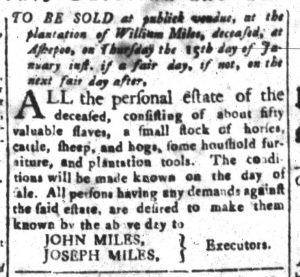
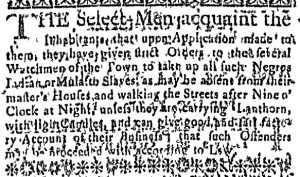
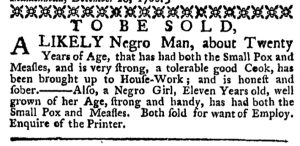
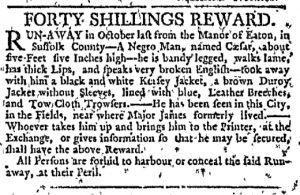
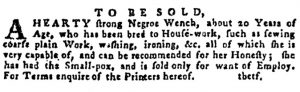
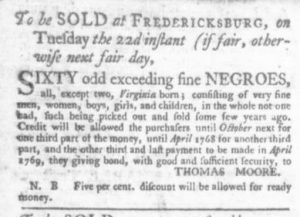
The Slavery Adverts 250 Project chronicles the role of newspaper advertising in perpetuating slavery in the era of the American Revolution. The project seeks to reveal the ubiquity of slavery in eighteenth-century life from New England to Georgia by republishing advertisements about enslaved people – for sale as individuals or in groups, wanted to purchase or for hire for short periods, runaways who liberated themselves, and those who were subsequently captured and confined in jails and workhouses – in daily digests on this site as well as in real time via the @SlaveAdverts250 Twitter feed, utilizing twenty-first-century media to stand in for the print media of the eighteenth century.
The project aims to provide modern audiences with a sense of just how often colonizers encountered these advertisements in their daily lives. Enslaved men, women, and children appeared in print somewhere in the colonies almost every single day. Those advertisements served as a constant backdrop for social, cultural, economic, and political life in colonial and revolutionary America. Colonizers who did not purport to own enslaved people were still confronted with slavery as well as invited to maintain the system by purchasing enslaved men, women, and children or assisting in the capture of so-called “runaways” who sought to free themselves from bondage. The frequency of these newspaper advertisements suggests just how embedded slavery was in colonial and revolutionary American culture in everyday interactions beyond the printed page.
These advertisements also testify to the experiences of enslaved men, women, and children, though readers must consider that those experiences have been remediated through descriptions offered by enslavers rather than enslaved people themselves. Often unnamed in the advertisements, enslaved men, women, and children were not invisible or unimportant in early America.
These advertisements appeared in colonial American newspapers 250 years ago today.
What was advertised in a colonial American newspaper 250 years ago this week?
Providence Gazette (January 10, 1767).
“He intends to sell on as reasonable terms as any Person in this town.”
Eighteenth-century shopkeepers and artisans frequently made appeals to price in their advertisements, but they usually did not elaborate much beyond a few words or phrases assuring prospective customers that they charged “low rates” for their merchandise. On occasion, some advertisers, like Jabez Peirce, elaborated on this theme. He confidently proclaimed that he sold his “fresh assortment of European goods … on as reasonable terms as any Person in this town, or any of the neighbouring governments.” While he did not explicitly state that he offered low prices, he informed potential customers that they would not find better deals anywhere else around town.
In this regard, he adopted language similar to what appeared in other advertisements published in the Providence Gazette in recent weeks. In the previous issue, Elihu Robinson, a hatter, announced that he sold his wares “as Cheap for Cash, as … any Person in this Town.” Similarly, James Green pledged that he priced his merchandise “at as low a rate as can be bought in this town.” Both Robinson and Green also favorably compared their prices to those in other places (indicating that consumers might travel to do some of their shopping or order goods from shopkeepers via the post, a service mentioned fairly regularly in advertisements). Robinson mentioned Boston and New York by name, but Green used the same phrase as Peirce: “neighbouring governments.”
Many advertisers used formulaic language in their commercial notices in the eighteenth century, which caused many advertisements to take on a standardized appearance (at least at first glance; close and careful reading yields variations, innovations, and attempts to distinguish some advertisements from the bulk of others that appeared on the page). That many printers preferred specific formats for fonts, sizes, and spacing when laying out advertisements for their own publications further contributed to creating a static visual culture of advertising within the pages of many newspapers. At a glance, graphic design and formulaic language made many advertisements appear indistinguishable.
Peirce’s advertisement is interesting and significant because it demonstrates how advertisers made the same appeals as their competitors, often even resorting to the same language, while simultaneously illustrating that unique appeals sometimes emerged in specific places and were quickly adopted by multiple advertisers. Although several advertisements in the Providence Gazette in early 1767 stressed the lowest prices in town, advertisers in other cities throughout the colonies universally relied on more general assertions about low prices, if they made appeals to price at all. Similarly, only advertisers in Providence showed any concern about local residents obtaining goods from competitors in “neighbouring governments.”
How long did that trend last? Did it eventually appear in advertisements published in other cities? Jabez Peirce’s advertisement raises interesting questions even as it further establishes a pattern in the Providence Gazette.
What was advertised in a colonial American newspaper 250 years ago today?
Providence Gazette (January 10, 1767).
“A FINE large CAMERA OBSCURA, which shuts up in the form of a book: Also the Compleat Florist.”
Although there is no way to know for certain, this advertisement seems to offer secondhand goods. The seller did not include his or her name, but instead instructed anyone interested in purchasing a camera obscura and a copy of The Compleat Florist to “Inquire at the Printing-Office, in Providence.”
This advertisement presents a bit of a puzzle since the description of the book deviates from the features most commonly associated with its contents, assuming that this was the combined volume printed in London for J. Duke in 1747. Most descriptions of The Compleat Florist focus primarily on the images contained in it. Consider, for instance, this short description from the Luxuriant Nature Smiling Round… exhibition that first appeared in the Rare Book Room of Canady Library at Bryn Mawr College:
“This gardening guide by an anonymous author consists of 100 engraved and hand-colored plates. Produced for popular consumption, this collection of plants reflects the tastes current in Great Britain in the mid-eighteenth century. The book consists entirely of pictures of flowering plants, accompanied by brief notes with advice on cultivation. Although the book was mass-produced, few copies survived rough handling by avid gardeners.”
Today’s advertisement, however, mentions the “extensive and curious collection of the most beautiful flowers” briefly, but elaborates in greater detail on the book’s “short introduction to drawing, and directions for mixing and using of colours, with several proper and easy examples.” Was this the same Compleat Florist? Librarians and rare book dealers do not mention the “introduction to drawing” but instead exclusively discuss the engraved images. They also tend to specify that gardeners considered The Compleat Florist a valuable resource and consulted it regularly.
Perhaps the advertiser did some gardening, but the notice in the Providence Gazette seemed to be aimed at hobbyists who enjoyed drawing and painting, especially considering the inclusion of the camera obscura. Such “pinhole cameras” had been used to aid drawing and painting for nearly a century by the time today’s advertisement was published. Joshua Reynolds, the prominent British portrait painter and first president of the Royal Academy, famously owned his own camera obscura that collapsed to look like a book when not in use.
There may be an important lesson here concerning the uses of consumer goods. The author and printer may have originally intended that readers purchase The Compleat Florist to admire its images of flowers and to consult when gardening. Some consumers, however, may have adopted their own uses for the book, including at least one colonist interested in painting flora in Providence in the 1760s.
What was advertised in a colonial American newspaper 250 years ago today?
South-Carolina and American General Gazette (January 9, 1767).
“He … proposes opening his school after the holidays.”
Osborne Straton planned to start a new session at his school “after the holidays,” to commence three days after this advertisement appeared in the South-Carolina and American General Gazette. In his attempt to attract students, he noted that he already had four years of teaching experience under his belt. For the past two years, he “had the honour of being intrusted with the tuition of the youth” from many households within the colony. He suggested that parents of prospective new students should “refer to the opinion of those that have employed him.” Straton was confident that he had earned a positive reputation as a teacher during his relatively short time in South Carolina.
In addition to relying on the endorsements from others, the schoolmaster presented further qualifications that were rather unique. Straton explained that he had been “regularly bred a merchant at London” and possessed “forty years experience as head book-keeper in some of the first counting-houses in Europe.” Straton taught what he knew from experience, arguing that he had many “opportunities of ratifying theory by practice.” Teaching was not an abstract occupation for him. He did not rely solely on so-called book learning passed down from the tutors who had educated him. Instead, he incorporated his own experiences from an earlier (yet extensive) career into his classroom and his curriculum in his efforts “to qualify youth for business.”
Straton identified two outcomes parents could expect after enrolling their children in his school. One was a lofty goal – “to open and enlarge the human understanding” – but the other had a purpose many parents might have found might more practical – “to qualify youth for business.” In his advertisement 250 years ago, Osborne Straton did the same dance that many liberal arts colleges, programs, and departments are doing in their marketing efforts today, striking a balance between exhorting the personal benefits of a liberal arts education and demonstrating the preparation for a profession derived from the training undertaken in the process of earning an undergraduate degree.
The Slavery Adverts 250 Project chronicles the role of newspaper advertising in perpetuating slavery in the era of the American Revolution. The project seeks to reveal the ubiquity of slavery in eighteenth-century life from New England to Georgia by republishing advertisements about enslaved people – for sale as individuals or in groups, wanted to purchase or for hire for short periods, runaways who liberated themselves, and those who were subsequently captured and confined in jails and workhouses – in daily digests on this site as well as in real time via the @SlaveAdverts250 Twitter feed, utilizing twenty-first-century media to stand in for the print media of the eighteenth century.
The project aims to provide modern audiences with a sense of just how often colonizers encountered these advertisements in their daily lives. Enslaved men, women, and children appeared in print somewhere in the colonies almost every single day. Those advertisements served as a constant backdrop for social, cultural, economic, and political life in colonial and revolutionary America. Colonizers who did not purport to own enslaved people were still confronted with slavery as well as invited to maintain the system by purchasing enslaved men, women, and children or assisting in the capture of so-called “runaways” who sought to free themselves from bondage. The frequency of these newspaper advertisements suggests just how embedded slavery was in colonial and revolutionary American culture in everyday interactions beyond the printed page.
These advertisements also testify to the experiences of enslaved men, women, and children, though readers must consider that those experiences have been remediated through descriptions offered by enslavers rather than enslaved people themselves. Often unnamed in the advertisements, enslaved men, women, and children were not invisible or unimportant in early America.
These advertisements appeared in colonial American newspapers 250 years ago today.
South-Carolina and American General Gazette (January 9, 1767).
**********
South-Carolina and American General Gazette (January 9, 1767).
**********
South-Carolina and American General Gazette (January 9, 1767).
What was advertised in a colonial American newspaper 250 years ago today?
Massachusetts Gazette (January 8, 1767).
“Books for Children, very proper for Christmas and New Year’s Gifts.”
John Mein made a fairly unique appeal to potential customers when he advertised “A Large Assortment of entertaining and instructive Books for Children, very proper for Christmas and New Year’s Gifts.” The bookseller tied consumerism to the holidays in a way that few other advertisers did in late 1766 and early 1767, which differs significantly from marketing practices in the twentieth and twenty-first centuries. Very few advertisers acknowledged Christmas as a holiday, much less used it to promote purchases from their shops. Recognition of the new year manifested itself in advertising mostly through calls for those who previously bought on credit to settle accounts. Indeed, only a handful of advertisers linked the holidays to making purchases and giving gifts.
As with many other aspects of marketing, members of the book trade seemed to be at the forefront of this innovation. Throughout all of the advertisements placed in newspapers during December 1766 and early January 1767, booksellers alone encouraged customers to think of their wares as gifts for others. In an advertisement in the January 8, 1767, issue of the New-York Journal bookseller Garrat Noel listed “A very large Parcel of Mr. Newberry’s beautiful gilt Picture Books, for the Entertainment of his old Friends the pretty Masters and Misses of New-York, at Christmas and New-York.” The appropriately named Noel was a veteran of promoting holiday gifts, having noted in his advertisements a year earlier that it was “his annual Custom … to offer to the Public, the following List of Books, as proper for Christmas Presents and New-Year’s Gifts.”
John Mein further advanced this innovation, anticipating marketing strategies of the late nineteenth century and beyond. He announced that potential customers could pick up free “Printed Catalogues” listing the books he considered especially suited to be given as gifts. Retailers of all sorts eventually resorted to catalogs, especially Christmas catalogs, to drive sales during a season increasingly associated with consumerism.
In the 1760s, however, the media – both printers and advertisers – took little notice of the Christmas season. On the same day that Mein’s advertisement appeared in Boston and Noel’s in New York, the first page of the Virginia Gazette featured “An ODE upon CHRISTMAS” on the front page. It was dated December 4, 1766, but the printers did not consider it pressing enough to make room for it in their newspaper until five weeks later. The Christmas holiday did not dominate December in the 1760s to the extent it does in modern America.
The Slavery Adverts 250 Project chronicles the role of newspaper advertising in perpetuating slavery in the era of the American Revolution. The project seeks to reveal the ubiquity of slavery in eighteenth-century life from New England to Georgia by republishing advertisements about enslaved people – for sale as individuals or in groups, wanted to purchase or for hire for short periods, runaways who liberated themselves, and those who were subsequently captured and confined in jails and workhouses – in daily digests on this site as well as in real time via the @SlaveAdverts250 Twitter feed, utilizing twenty-first-century media to stand in for the print media of the eighteenth century.
The project aims to provide modern audiences with a sense of just how often colonizers encountered these advertisements in their daily lives. Enslaved men, women, and children appeared in print somewhere in the colonies almost every single day. Those advertisements served as a constant backdrop for social, cultural, economic, and political life in colonial and revolutionary America. Colonizers who did not purport to own enslaved people were still confronted with slavery as well as invited to maintain the system by purchasing enslaved men, women, and children or assisting in the capture of so-called “runaways” who sought to free themselves from bondage. The frequency of these newspaper advertisements suggests just how embedded slavery was in colonial and revolutionary American culture in everyday interactions beyond the printed page.
These advertisements also testify to the experiences of enslaved men, women, and children, though readers must consider that those experiences have been remediated through descriptions offered by enslavers rather than enslaved people themselves. Often unnamed in the advertisements, enslaved men, women, and children were not invisible or unimportant in early America.
These advertisements appeared in colonial American newspapers 250 years ago today.
Massachusetts Gazette (January 8, 1767).
**********
New-York Gazette: Or, the Weekly Post-Boy (January 8, 1767).
**********
New-York Gazette: Or, the Weekly Post-Boy (January 8, 1767).
**********
New-York Journal (January 8, 1767).
**********
New-York Journal (January 8, 1767).
**********
Pennsylvania Gazette (January 8, 1767).
**********
Pennsylvania Gazette (January 8, 1767).
**********
Pennsylvania Gazette (January 8, 1767).
**********
Pennsylvania Gazette (January 8, 1767).
**********
Pennsylvania Gazette (January 8, 1767).
**********
Pennsylvania Gazette (January 8, 1767).
**********
Supplement to the Pennsylvania Gazette (January 8, 1767).
What was advertised in a colonial American newspaper 250 years ago today?
Georgia Gazette (January 7, 1767).
“BLank bonds, bills of sale, mortgages, powers of attorney, bonds of arbitration, indentures.”
Variations of this advertisement for printed blanks that appeared in the Georgia Gazette have been featured on the Adverts 250 Project on a couple of occasions. Rather than focus on the advertisement itself, this presents an opportunity to discuss methodology and process instead. This notice was the only advertisement for any sort of new consumer goods in the January 7, 1767, issue of the Georgia Gazette, though several advertisements did announce secondhand goods to be sold at estate auctions.
Selecting advertisements to include in this project can sometimes be a case of feast or famine. On some days I encounter multiple advertisements that I would like to share with readers and explore in greater detail. On those occasions I look ahead to see if an advertisement of interest ran for multiple weeks and could be incorporated into the project at another time. On other days, like today, selecting an advertisement becomes much more challenging due to the scarcity of commercial notices that appeared in some newspapers. Throughout the colonial period advertising for consumer goods and services (as well as other sorts of advertising) was not evenly distributed across newspapers or days of the week.
Consider the newspapers published during the first week of January 1767. (This is not an exhaustive list but instead includes only those newspapers for which a digital surrogate is available via Accessible Archives, Colonial Williamsburg’s Digital Library, or Readex’s Early American Newspapers.)
Thursday, January 1, 1767
Massachusetts Gazette
New-York Gazette, or Weekly Post-Boy
New-York Journal
Pennsylvania Gazette
Virginia Gazette (Purdie & Dixon)
Friday, January 2, 1767
New-Hampshire Gazette
New-London Gazette
South-Carolina and American General Gazette
Saturday, January 3, 1767
Providence Gazette
Sunday, January 4, 1767
Monday, January 5, 1767
Boston Evening-Post
Boston Gazette
Boston Post-Boy
Connecticut Courant
New-York Gazette
New-York Mercury
South Carolina Gazette
Wochentliche Philadelphische Staatsbote
Tuesday, January 6, 1767
South-Carolina Gazette and Country Journal
Wednesday, January 7, 1767
Georgia Gazette
Newspaper publication clustered on particular days, especially Mondays and Thursdays. That means that there are some days that I may select advertisements from far more newspapers. As much as possible, I cycle through each publication. In addition, many of those newspapers were published in larger cities and included much more advertising than their counterparts in smaller towns. Some even expanded from four to six pages in order to insert greater numbers of advertisements.
On other days, however, I have no choice about which newspaper to consult. In general, I know that once a week I will examine advertisements from the South-Carolina Gazette and Country Journal, Georgia Gazette, and Providence Gazette because those were the only newspapers published on Tuesdays, Wednesdays, and Saturdays, respectively. For most weeks, I also expect to select a second advertisement from the Providence Gazette since no newspapers were published on Sundays and the project’s methodology requires consulting the most recently published newspaper in colonial America 250 years ago that day. On occasion all of the advertisements for consumer goods and services from the Providence Gazette have previously been featured in the project, which means that I have to go back a day earlier to select an advertisement.
Fortunately, the printers of the Providence Gazette and their advertisers created some interesting and significant advertisements in the 1760s, but there have been occasions that only one advertisement in a particular issue qualified for inclusion in the project. That made the choice easy while sometimes providing a challenge as far as research and writing was concerned. The same situation periodically presents itself on days that I consult the Georgia Gazette. According to the project’s methodology, technically I should not have once again selected the advertisement for printed blanks from the Georgia Gazette. However, it has been a while since I discussed methodology. I decided that this provided a helpful opportunity to share with readers a more complete accounting of newspapers published during this week in 1767 in order to provide more context for understanding advertisements otherwise removed from the publications in which they originally appeared.
These tables indicate how many advertisements for slaves appeared in colonial American newspapers during the week of January 1-7, 1767.
Note: These tables are as comprehensive as currently digitized sources permit, but they may not be an exhaustive account. They includes all newspapers that have been digitized and made available via Accessible Archives, Colonial Williamsburg’s Digital Library, and Readex’s America’s Historical Newspapers. There are several reasons some newspapers may not have been consulted:
Issues that are no longer extant;
Issues that are extant but have not yet been digitized; and
Newspapers published in a language other than English (including the Wochentliche Philadelphische Staatsbote).
**********
Slavery Advertisements Published January 1-7, 1767: By Date
**********
Slavery Advertisements Published January 1-7, 1767: By Region