The Slavery Adverts 250 Project chronicles the role of newspaper advertising in perpetuating slavery in the era of the American Revolution. The project seeks to reveal the ubiquity of slavery in eighteenth-century life from New England to Georgia by republishing advertisements about enslaved people – for sale as individuals or in groups, wanted to purchase or for hire for short periods, runaways who liberated themselves, and those who were subsequently captured and confined in jails and workhouses – in daily digests on this site as well as in real time via the @SlaveAdverts250 Twitter feed, utilizing twenty-first-century media to stand in for the print media of the eighteenth century.
The project aims to provide modern audiences with a sense of just how often colonizers encountered these advertisements in their daily lives. Enslaved men, women, and children appeared in print somewhere in the colonies almost every single day. Those advertisements served as a constant backdrop for social, cultural, economic, and political life in colonial and revolutionary America. Colonizers who did not purport to own enslaved people were still confronted with slavery as well as invited to maintain the system by purchasing enslaved men, women, and children or assisting in the capture of so-called “runaways” who sought to free themselves from bondage. The frequency of these newspaper advertisements suggests just how embedded slavery was in colonial and revolutionary American culture in everyday interactions beyond the printed page.
These advertisements also testify to the experiences of enslaved men, women, and children, though readers must consider that those experiences have been remediated through descriptions offered by enslavers rather than enslaved people themselves. Often unnamed in the advertisements, enslaved men, women, and children were not invisible or unimportant in early America.
These advertisements appeared in colonial American newspapers 250 years ago today.
What was advertised in a colonial American newspaper 250 years ago today?
South-Carolina and American General Gazette (April 24, 1767).
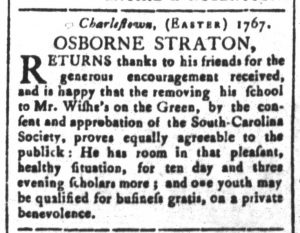
“He has room … for ten day and three evening scholars more.”
In recent weeks the guest curators of the Adverts 250 Project have examined advertisements placed by some of Savannah’s schoolmasters in the Georgia Gazette. Both schoolmasters promoted the subjects they taught, which were limited mostly to the basics of reading, writing, and arithmetic (though one also provided instruction in Latin). Meanwhile, Osborne Straton, a schoolmaster in Charleston, took a different approach in advertising his school. He did not discuss his curriculum at all, but instead noted the location – “on the Green” – and described the surroundings as a “pleasant, healthy situation.”
Most schoolmasters and schoolmistresses placed advertisements to attract pupils they expected to pay tuition. Such was the case with Straton, who indicated that he had slots to accommodate ten more “scholars” in the classes he offered during the day and three more for evening classes. One fortunate student, however, might have qualified to attend Straton’s classes on a scholarship: “one youth may be qualified for business gratis, on a private benevolence.”
Straton did not reveal the identity of the benefactor, but it might have been a civic organization mentioned earlier in his advertisement. He implied that moving his school to a new location “on the Green” had been done “by the consent and approbation of the South-Carolina Society.” Perhaps the members sponsored his school, formally or informally. The society or one of its members may have provided for the “private benevolence” as a means of bolstering the futures of the student, the city, and the colony. Alternately, someone else may have provided the funds to offer an education to a youth who otherwise might not have afforded it. The schoolmaster himself may have opted not to charge tuition of one of his charges, leveraging the decision into a public relations opportunity.
Regardless of the source of the “private benevolence,” Straton possessed a means to distinguish his school from others when he advertised for students. His association with a philanthropic venture positioned him as an instructor capable of overseeing the moral development of his students as well as their academic work.
The Slavery Adverts 250 Project chronicles the role of newspaper advertising in perpetuating slavery in the era of the American Revolution. The project seeks to reveal the ubiquity of slavery in eighteenth-century life from New England to Georgia by republishing advertisements about enslaved people – for sale as individuals or in groups, wanted to purchase or for hire for short periods, runaways who liberated themselves, and those who were subsequently captured and confined in jails and workhouses – in daily digests on this site as well as in real time via the @SlaveAdverts250 Twitter feed, utilizing twenty-first-century media to stand in for the print media of the eighteenth century.
The project aims to provide modern audiences with a sense of just how often colonizers encountered these advertisements in their daily lives. Enslaved men, women, and children appeared in print somewhere in the colonies almost every single day. Those advertisements served as a constant backdrop for social, cultural, economic, and political life in colonial and revolutionary America. Colonizers who did not purport to own enslaved people were still confronted with slavery as well as invited to maintain the system by purchasing enslaved men, women, and children or assisting in the capture of so-called “runaways” who sought to free themselves from bondage. The frequency of these newspaper advertisements suggests just how embedded slavery was in colonial and revolutionary American culture in everyday interactions beyond the printed page.
These advertisements also testify to the experiences of enslaved men, women, and children, though readers must consider that those experiences have been remediated through descriptions offered by enslavers rather than enslaved people themselves. Often unnamed in the advertisements, enslaved men, women, and children were not invisible or unimportant in early America.
These advertisements appeared in colonial American newspapers 250 years ago today.
New-Hampshire Gazette (April 24, 1767).
**********
South-Carolina and American General Gazette (April 24, 1767).
**********
South-Carolina and American General Gazette (April 24, 1767).
**********
South-Carolina and American General Gazette (April 24, 1767).
**********
South-Carolina and American General Gazette (April 24, 1767).
**********
South-Carolina and American General Gazette (April 24, 1767).
**********
South-Carolina and American General Gazette (April 24, 1767).
**********
South-Carolina and American General Gazette (April 24, 1767).
**********
South-Carolina and American General Gazette (April 24, 1767).
**********
South-Carolina and American General Gazette (April 24, 1767).
**********
South-Carolina and American General Gazette (April 24, 1767).
What was advertised in a colonial American newspaper 250 years ago today?
Massachusetts Gazette (April 23, 1767).
“At his Shop opposite LIBERTY-TREE, Boston.”
Other than his name, “LIBERTY-TREE, Boston” appeared in the largest font in the advertisement John Gore, Jr. placed in the April 23, 1767, issue of the Massachusetts Gazette. For months, in advertisements brief and lengthy, Gore consistently included that landmark in his commercial notices, directing potential customers to “his Shop opposite LIBERTY-TREE, Boston.” That became a distinctive part of his advertisements, making them easy to recognize at a glance. In addition to serving as rudimentary branding, this consistency also informed consumers of his politics. The Stamp Act had been repealed more than a year earlier, but the Quartering Act of 1765 was still in effect. (A letter from London elsewhere in the same issue stated, “EVERY one of the American Provinces have complied, without demur, with the orders of the government, for quartering troops, and all other requisitions, except Boston and New York.”) The Townshend Acts were on the horizon, but neither Gore nor his fellow colonists knew quite yet that they would be enacted.
Still, Gore remained suspicious, rightfully it turned out, about what Parliament might do next. After all, the repeal of the Stamp Act had been accompanied by the passage of the Declaratory Act, asserting that Parliament possessed broad authority to oversee colonies that owed their allegiance to king and Parliament: “the king’s Majesty, by and with the advice and consent of the Lords Spiritual and Temporal, and Commons, of Great Britain, in Parliament assembled, had, hath, and of right out to have, full power and authority to make laws and statutes of sufficient force and validity to bind the colonies and people of America, subjects of the crown of Great Britain, in all cases whatsoever.” Given that he adopted the Liberty Tree as the sigil for his shop, Gore rejected this argument and remained vigilant about protecting the rights of the colonies. Even as he marketed “A large and general Assortment of English and India GOODS” recently “Imported from LONDON,” Gore reminded readers and potential customers that their participation in the extensive consumer culture of the era could be threatened at any time if Parliament again invoked an authority that many colonists did not believe that distant legislative body possessed.
The Slavery Adverts 250 Project chronicles the role of newspaper advertising in perpetuating slavery in the era of the American Revolution. The project seeks to reveal the ubiquity of slavery in eighteenth-century life from New England to Georgia by republishing advertisements about enslaved people – for sale as individuals or in groups, wanted to purchase or for hire for short periods, runaways who liberated themselves, and those who were subsequently captured and confined in jails and workhouses – in daily digests on this site as well as in real time via the @SlaveAdverts250 Twitter feed, utilizing twenty-first-century media to stand in for the print media of the eighteenth century.
The project aims to provide modern audiences with a sense of just how often colonizers encountered these advertisements in their daily lives. Enslaved men, women, and children appeared in print somewhere in the colonies almost every single day. Those advertisements served as a constant backdrop for social, cultural, economic, and political life in colonial and revolutionary America. Colonizers who did not purport to own enslaved people were still confronted with slavery as well as invited to maintain the system by purchasing enslaved men, women, and children or assisting in the capture of so-called “runaways” who sought to free themselves from bondage. The frequency of these newspaper advertisements suggests just how embedded slavery was in colonial and revolutionary American culture in everyday interactions beyond the printed page.
These advertisements also testify to the experiences of enslaved men, women, and children, though readers must consider that those experiences have been remediated through descriptions offered by enslavers rather than enslaved people themselves. Often unnamed in the advertisements, enslaved men, women, and children were not invisible or unimportant in early America.
These advertisements appeared in colonial American newspapers 250 years ago today.
Massachusetts Gazette (April 23, 1767).
**********
New-York Gazette: Or, the Weekly Post-Boy (April 23, 1767).
During my time working on the Adverts 250 Project I spent quite a lot of time trying to decipher the meaning of sometimes very vague advertisements for things as basic as lodging and as complex as slavery. I feel this taught me more about history than pretty much anything I have ever done. The reason this was so powerful and effective for me was because it was real and in most cases I could see the actual thing I was learning about and working with. These were not just some boring anecdotes in a text book or a slow documentary. They were actual advertisements in newspapers created 250 years ago. Working with this type of primary sources is something that I have never had a chance to do, which was scary at first, but once I started doing my research it became a lot easier to decipher meaning in these sources.
I cannot stress enough the meaning this project has to me. There are several different reasons why I was hesitant to even work on the project but having worked through it I feel changed in many ways. I know this sounds cliché but for me this project changed quite a bit in my life and gave me new meaning for the future.
At the beginning of the Adverts 250 Project I thought the most difficult part would be gathering the information and then composing my summary and analysis. This was not the case. This project created a revival in what was a dwindling passion for history. The hardest part of the project was coming to terms with the idea that I wanted to change my prospective future career. I had originally planned on being a high school history teacher but the Adverts 250 Project made me realize that I would not enjoy that but rather I would enjoy teaching upper-level students who can appreciate it more.
This would become the meaning that I found during the course of my week guest curating for the Adverts 250 Project. I would also say that this was also one the most rewarding parts of the project. The other was the amount of information that I learned through my time curating the project. This is not just how to look at a primary source and deduce what it is about, but actually what can be learned from every single advertisement. For instance, my advertisement from April 19, 1767, by James King was an open advertisement to try to get men who were “Genteel” to lodge at his abode. Through my years of history class, we had never even used the word genteel. Of course I had known what it meant today but this new curiosity led me to so much new knowledge about the topic and ideas about gentility in colonial and Revolutionary America that I had never had before.
As I already stated, this project really meant a lot to me. It was challenging at times, rewarding at others, but for the most part it was a fun project. I have now realized the importance of doing work like this in college. It has opened my eyes to the possibilities of the future but more importantly it has shown to me that I truly am interested in history and I want to devote my life to this sort of studying and teaching.
What was advertised in a colonial American newspaper 250 years ago today?
Georgia Gazette (April 22, 1767).
“HAVING OPENED A SCHOOL … TEACHING READING, WRITING, and ARITHMETICK.”
I chose this advertisement because I plan on being an educator – a teacher, professor, or a public historian – so this advertisement is quite close to heart. It is important to note that this advertisement comes from a newspaper printed in the southern colonies, the Georgia Gazette. This education offered in this advertisement differs from the schooling some children in the region received. “The sons of a planter typically would be taught the basics at home,” state the curators at Stratford Hall. Discussions in “Schools in American Society,” an Education course taught by Professor Casey Handfield at Assumption College, confirmed that this was typical in southern colonies. On the other hand, in Learning to Read and Write in Colonial America, E. Jennifer Monaghan argues the northern colonies had significantly more extensive schooling, including pubic schooling in New England, due to the religious focus on education dating back to the seventeenth century.
Also it should not be overlooked that the advertisement included the subjects to be taught. Due to the nature of these subjects it appears as though the school was for younger children who needed the basics but not a “genteel” education. When it came to children of the elite, according to historians at Stratford Hall, “The boys studied higher math, Greek, Latin, science, celestial navigation (navigatin[g] ships by the stars), geography, history, fencing, social etiquette, and plantation management.” In addition, “The school days for girls were somewhat different. Girls learned enough reading, writing, and arithmetic to read their Bibles and be able to record household expenses.” This distinction is important because it separates the typical roles that men and women would play in life from an early start. This is important because it gives modern historians a view of gender roles in colonial society.
**********
ADDITIONAL COMMENTARY: Carl Robert Keyes
As Jonathan notes, John Francklin taught the basics: reading, writing, and arithmetic. James Whitefield, a competitor who also advertised in the Georgia Gazette, offered only a slightly more extensive curriculum. He listed Latin among the subjects taught at his school. Neither schoolmaster advertised additional subjects often promoted as “genteel education” in newspapers printed in other cities, the sorts of subjects Jonathan already listed.
In addition to the north-south divide that distinguished educational opportunities in the different colonial regions, urban culture also played a role in determining which subjects were offered (or, at least, advertised) to potential students. Schoolmasters and schoolmistresses in both Philadelphia and Charleston, both large and bustling port cities, advertised day and boarding schools where students learned a variety of advanced academic subjects as well as ancillary skills (like dancing and personal comportment) in addition to reading, writing, and arithmetic.
In colonial America’s larger cities, some instructors advertised independently of any affiliation with schoolmasters and schoolmistresses whose curriculum focused on general education. For instance, French language tutors frequently advertised their services, often offering one-on-one instruction with their pupils. Dancing masters also advertised regularly in newspapers printed in larger cities. In addition to one-on-one instruction, many also ran their own academies where they tended to teach female students during one portion of the day and male students at alternate times. Some dancing masters doubled as fencing instructors, further enhancing the genteel arts their charges developed. Although some French tutors and dancing and fencing masters were itinerants, many tended to remain in the larger colonial cities for several years, presumably because they cultivated a clientele that kept them employed.
Surveying advertisements for education in newspapers printed throughout the colonies in the decade before the Revolution reveals certain disparities. From New Hampshire to Georgia, colonists used consumer culture to assert their status and identity, anxious lest their counterparts in England think they lived in provincial backwaters. While advertisements for goods demonstrate standardization of products available to purchase during this period, advertisements for services – especially education – suggest uneven opportunities. Schoolmasters and schoolmistresses everywhere taught the basics, but, not surprisingly, instructors with specialized skills most often promoted their services to potential pupils in larger cities. They relied not only on larger populations but also elites conscious of demonstrating their status and middling sorts with aspirations for social mobility. Readers of the Pennsylvania Gazette and the South-Carolina Gazette regularly encountered advertisements for education that looked much different than today’s advertisement from the Georgia Gazette.
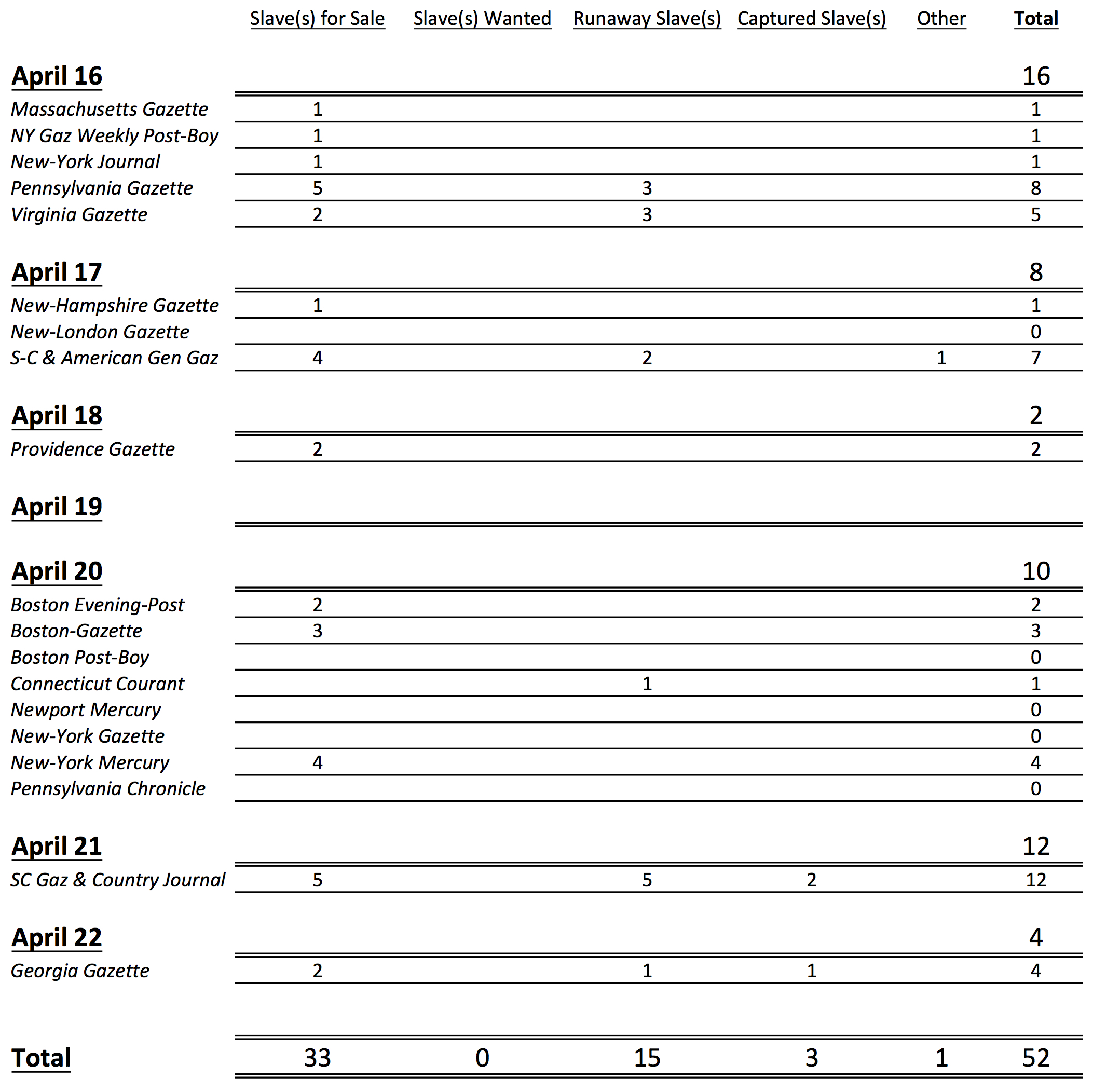
These tables indicate how many advertisements for slaves appeared in colonial American newspapers during the week of April 16-22, 1767. The data has been compiled based on research conducted by Evan Sutherland.
Note: These tables are as comprehensive as currently digitized sources permit, but they may not be an exhaustive account. They includes all newspapers that have been digitized and made available via Accessible Archives, Colonial Williamsburg’s Digital Library, and Readex’s America’s Historical Newspapers. There are several reasons some newspapers may not have been consulted:
Issues that are no longer extant;
Issues that are extant but have not yet been digitized (including the Pennsylvania Journal); and
Newspapers published in a language other than English (including the Wochentliche Philadelphische Staatsbote).
**********
Slavery Advertisements Published April 16-22, 1767: By Date
**********
Slavery Advertisements Published April 16-22, 1767: By Region
The Slavery Adverts 250 Project chronicles the role of newspaper advertising in perpetuating slavery in the era of the American Revolution. The project seeks to reveal the ubiquity of slavery in eighteenth-century life from New England to Georgia by republishing advertisements about enslaved people – for sale as individuals or in groups, wanted to purchase or for hire for short periods, runaways who liberated themselves, and those who were subsequently captured and confined in jails and workhouses – in daily digests on this site as well as in real time via the @SlaveAdverts250 Twitter feed, utilizing twenty-first-century media to stand in for the print media of the eighteenth century.
The project aims to provide modern audiences with a sense of just how often colonizers encountered these advertisements in their daily lives. Enslaved men, women, and children appeared in print somewhere in the colonies almost every single day. Those advertisements served as a constant backdrop for social, cultural, economic, and political life in colonial and revolutionary America. Colonizers who did not purport to own enslaved people were still confronted with slavery as well as invited to maintain the system by purchasing enslaved men, women, and children or assisting in the capture of so-called “runaways” who sought to free themselves from bondage. The frequency of these newspaper advertisements suggests just how embedded slavery was in colonial and revolutionary American culture in everyday interactions beyond the printed page.
These advertisements also testify to the experiences of enslaved men, women, and children, though readers must consider that those experiences have been remediated through descriptions offered by enslavers rather than enslaved people themselves. Often unnamed in the advertisements, enslaved men, women, and children were not invisible or unimportant in early America.
These advertisements appeared in colonial American newspapers 250 years ago today.
Who was the subject of an advertisement in a colonial American newspaper 250 years ago today?
South-Carolina Gazette and Country Journal (April 21, 1767).
“ABOUT FORTY valuable country-born NEGROES, among whom are Boatmen, Carpenters, Sawyers.”
American slavery consisted of masters and overseers who controlled, in some cases, the manual labor of hundreds of slaves. That is the story taught in many schools. It was the story I thought I knew when I began college. However, this advertisement points to other roles among slaves, not strictly manual labor but also skilled workmanship. It states that the slaves being sold had various specialized skills that made them even more useful to prospective owners. According to Daniel C. Littlefield, “planters expected enslaved people to perform a wide range of jobs that included carpenter, cooper, boatman, cook, seamstress, and blacksmith, to mention only a few of the skilled functions required around plantations.” This shows a different way of looking at the uses of slavery in America during the eighteenth century. It shows that many slaves were more skilled than what is often taught in high school history classes.
These specialized skills led some slaves to be “hired out” to other masters. Douglas Egerton tells the story of Gabriel, an enslaved blacksmith, who gained a sense of freedom when he was away from his master’s plantation. This led Gabriel to want more freedom. He planned a slave rebellion in 1800 called, now known as Gabriel’s Rebellion. A highly-skilled enslaved blacksmith plotted to overthrow the government of Virginia, but the plan was discovered. In the end, the rebellion was unsuccessful. Gabriel was executed.
This advertisement reflects a part of history largely unknown to most people, a history where slaves did more than just tend fields.
**********
ADDITIONAL COMMENTARY: Carl Robert Keyes
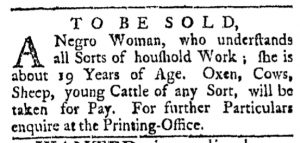
During his week as guest curator, Jonathan has selected two advertisements that treated black men and women as commodities. In the process of examining these advertisements, he has addressed two common misconceptions about slavery in early America. Earlier in the week he demonstrated that slavery was practiced in New England and other northern colonies in the era of the American Revolution. In addition to his selected advertisement about “A Negro Woman, who understands all sorts of houshold Work,” he identified a Rhode Island census, conducted in 1774, that documented the numbers of “WHITES,” “INDIANS,” and “BLACKS” that resided in the colony. He also argued that even though relatively few slaves lived and worked in Rhode Island, the colony’s commerce was enmeshed in the transatlantic slave trade.
Today, Jonathan addresses the kinds of work done by slaves, a variety of jobs that many students find quite surprising when first introduced to this information for the first time. In the process, he has achieved a much better understanding of the diversity of experiences among enslaved men, women, and children in eighteenth-century America. Some worked as artisans on plantations, as was certainly the case with some of the carpenters and sawyers in today’s advertisement, but others worked in urban ports, sometimes as artisans and sometimes as domestic servants. Slaves in urban environments had experiences that did not necessarily replicate those of their counterparts who worked in the fields on farms and plantations. For instance, Sarah, a runaway also advertised in the South-Carolina Gazette and Country Journal on April 21, 1767, was a laundress “well known among the vessels” docked in Charleston because she so frequently “washed for the mariners.” Not all slaves were agricultural laborers in rural settings, nor were slaves exploited only for their labor. Masters also benefited from slaves’ expertise and skills, deriving significant additional value from them. As Jonathan indicates, this aspect of early American history often remains overlooked in the most rudimentary narratives of slavery in colonial and Revolutionary America.