July 11

What was advertised in a colonial American newspaper 250 years ago today?

Jul 11 - 7:11:1767 Providence Gazette
Providence Gazette (July 11, 1767).

“They have been unjustly detained out of a Sum of Money, greatly to their Disadvantage.”

No publicity is bad publicity. That may have been the sentiment that motivated Black and Stewart when they placed this advertisement in the Providence Gazette. As part of their attempt to market tea, rum, molasses, and sugar, the partners aired their dirty laundry in the public prints.

Black and Stewart did not go into the particulars of what had transpired, but they did inform readers “that through the Knavery of some, and Collusion of others, they have been unjustly detained out of a Sum of Money, greatly to their Disadvantage.” Perhaps in a town the size of Providence it was not necessary to go into more detail. Black and Stewart may have been referencing a tale that local readers already knew, gossip that had already spread. They may have felt that acknowledging their difficulties presented the better path than trying to pretend that the unfortunate situation did not exist.

At the same time, the partners also attempted to generate sympathy for their plight. Even if readers did not know the specifics, they could still be moved that Black and Stewart “stand in Need of Cash.” The shopkeepers first emphasized their own needs and how they would benefit from commercial transactions, but then they pivoted to stress the benefits accrued to potential customers who chose to patronize their business. They noted that competitors “sell some Goods below Prime Cost” (perhaps as what would be called loss leaders today), prompting Black and Stewart to offer discounted prices on several popular items. To aid potential customers in comparison shopping, they listed prices for tea, rum, molasses, and sugar. They also issued a guarantee on the tea, which was “warranted good” but would be “taken back and the Money returned” if customers were not satisfied. If they could get customers though the door to purchase these items, some might also make selections from among the “Variety of English and West-India Goods” they also stocked.

Some readers may have found the story of Black and Stewart’s difficulties untoward, but the shopkeepers gambled that they could mobilize their tale of woe to attract customers. They portrayed their disappointments in business as opportunities for customers to benefit from lower prices. The marketplace could be cruel, but this afforded consumers victories on occasion. Black and Stewart invited potential customers to take advantage of their misfortunes, giving unspoken assurances that they could trust the deals were real since the shopkeepers were in such dire straits.

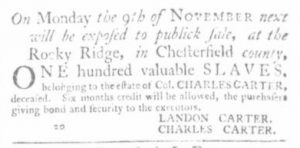
Slavery Advertisements Published July 11, 1767

The Slavery Adverts 250 Project chronicles the role of newspaper advertising in perpetuating slavery in the era of the American Revolution. The project seeks to reveal the ubiquity of slavery in eighteenth-century life from New England to Georgia by republishing advertisements about enslaved people – for sale as individuals or in groups, wanted to purchase or for hire for short periods, runaways who liberated themselves, and those who were subsequently captured and confined in jails and workhouses – in daily digests on this site as well as in real time via the @SlaveAdverts250 Twitter feed, utilizing twenty-first-century media to stand in for the print media of the eighteenth century.

The project aims to provide modern audiences with a sense of just how often colonizers encountered these advertisements in their daily lives. Enslaved men, women, and children appeared in print somewhere in the colonies almost every single day. Those advertisements served as a constant backdrop for social, cultural, economic, and political life in colonial and revolutionary America. Colonizers who did not purport to own enslaved people were still confronted with slavery as well as invited to maintain the system by purchasing enslaved men, women, and children or assisting in the capture of so-called “runaways” who sought to free themselves from bondage. The frequency of these newspaper advertisements suggests just how embedded slavery was in colonial and revolutionary American culture in everyday interactions beyond the printed page.

These advertisements also testify to the experiences of enslaved men, women, and children, though readers must consider that those experiences have been remediated through descriptions offered by enslavers rather than enslaved people themselves. Often unnamed in the advertisements, enslaved men, women, and children were not invisible or unimportant in early America.

These advertisements appeared in colonial American newspapers 250 years ago today.

Jul 11 - Providence Gazette Slavery 1
Providence Gazette (July 11, 1767).

July 10

What was advertised in a colonial American newspaper 250 years ago today?

Jul 10 - 7:10:1767 New-Hampshire Gazette
New-Hampshire Gazette (July 10, 1767).

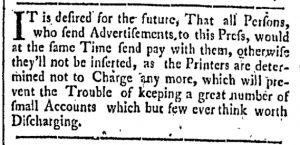
“All Persons, who send Advertisements to this Press, would at the same Time send pay with them.”

Daniel Fowle and Robert Fowle inserted this notice in the final column of the July 10, 1767, issue of the New-Hampshire Gazette. In it, they instructed that “all Persons, who send Advertisements to this Press” should “at the same Time send pay with them.” In making this request, the Fowles addressed two common questions about eighteenth-century newspaper advertising. Who wrote the advertisements? Did printers make money from advertising?

By comparing text and typography in advertisements published in multiple newspapers, it appears that advertisers wrote the copy and printers took primary responsibility for format and layout (though some exceptional advertisers also participated in designing the visual aspects of their own notices). The Fowles seem to confirm that advertisers composed the text, though they do not address the question of layout. Advertisers possibly sent along instructions, though the printers would have preferred payment instead.

This notice does not definitively answer whether advertising turned profits for printers, but it does cast light on some of their standard practices and challenges. The Fowles threatened not to insert any advertisements delivered without payment. They were “determined not to Charge any more” because extending credit was more hassle than it was worth. They had learned through unfortunate experience “the Trouble of keeping a great number of small Accounts which but few ever think worth Discharging.”

Historians of eighteenth-century printers have long argued that newspapers did not make money from subscriptions, that profits derived from advertising. This notice, however, suggests that in some cases – or “a great number” of cases, to borrow the Fowles’ phrase – advertising was no more likely to turn a profit than selling subscriptions. Colonists purchased advertising on credit, just as they participated in the consumer revolution by buying on credit. Sometimes they paid in a timely manner, but, if the Fowles were to be believed, quite often they were delinquent in settling their accounts. Historians of print culture cannot assume that advertisements published in eighteenth-century newspapers always generated revenues for the printers.

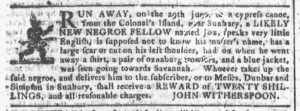
Slavery Advertisements Published July 10, 1767

The Slavery Adverts 250 Project chronicles the role of newspaper advertising in perpetuating slavery in the era of the American Revolution. The project seeks to reveal the ubiquity of slavery in eighteenth-century life from New England to Georgia by republishing advertisements about enslaved people – for sale as individuals or in groups, wanted to purchase or for hire for short periods, runaways who liberated themselves, and those who were subsequently captured and confined in jails and workhouses – in daily digests on this site as well as in real time via the @SlaveAdverts250 Twitter feed, utilizing twenty-first-century media to stand in for the print media of the eighteenth century.

The project aims to provide modern audiences with a sense of just how often colonizers encountered these advertisements in their daily lives. Enslaved men, women, and children appeared in print somewhere in the colonies almost every single day. Those advertisements served as a constant backdrop for social, cultural, economic, and political life in colonial and revolutionary America. Colonizers who did not purport to own enslaved people were still confronted with slavery as well as invited to maintain the system by purchasing enslaved men, women, and children or assisting in the capture of so-called “runaways” who sought to free themselves from bondage. The frequency of these newspaper advertisements suggests just how embedded slavery was in colonial and revolutionary American culture in everyday interactions beyond the printed page.

These advertisements also testify to the experiences of enslaved men, women, and children, though readers must consider that those experiences have been remediated through descriptions offered by enslavers rather than enslaved people themselves. Often unnamed in the advertisements, enslaved men, women, and children were not invisible or unimportant in early America.

These advertisements appeared in colonial American newspapers 250 years ago today.

Jul 10 - New-London Gazette Slavery 1
New-London Gazette (July 10, 1767).

**********

Jul 10 - South-Carolina and American General Gazette Slavery 1
South-Carolina and American General Gazette (July 10, 1767).

**********

Jul 10 - South-Carolina and American General Gazette Slavery 2
South-Carolina and American General Gazette (July 10, 1767).

**********

Jul 10 - South-Carolina and American General Gazette Slavery 3
South-Carolina and American General Gazette (July 10, 1767).

**********

Jul 10 - South-Carolina and American General Gazette Slavery 4
South-Carolina and American General Gazette (July 10, 1767).

**********

Jul 10 - South-Carolina and American General Gazette Slavery 5
South-Carolina and American General Gazette (July 10, 1767).

July 9

What was advertised in a colonial American newspaper 250 years ago today?

Jul 9 - 7:9:1767 Pennsylvania Gazette
Pennsylvania Gazette (July 9, 1767).

“He finds it necessary to reduce the several Prices of his Work one third Part lower than formerly.”

Upholsterer John Mason placed an advertisement in the Pennsylvania Gazette when he significantly reduced the prices he charged for various services. His method for delivering this information, however, could have used a little refinement. Rather than focus on the deals that benefited prospective customers, Mason offered two other explanations for lowering his fees: “the Stagnation of Business and Scarcity of Cash.” While both of these factors prompted Mason to adjust his prices, neither of them placed customers at the center of Mason’s business model. Overcoming the “Stagnation of Business” was self-serving, hardly a fault for a tradesman trying to make a living but perhaps not the most artful way to frame his motivation fueling the business relationships he hoped to cultivate. He seemed to be saying that current conditions forced him to lower his fees rather than more graciously formulating this as a benefit intended specifically to advantage customers. Acknowledging the “Scarcity of Cash” made a nod toward the concerns of prospective clients. Many may have found themselves in a situation of not being able to afford to hire Mason at the former rates because they did not have access to sufficient cash. The reduced fees made the upholsterer’s services more obtainable.

Still, Mason underplayed the most important appeal in his advertisement. He noted that he had “reduce[d] the several Prices of his Work one third Part lower than formerly.” In other words, he knocked a tremendous 33% off his prices! Mason set about demonstrating this with a list of the fees he now charged for various services. He even encouraged prospective clients to compare “the above Prices with the Upholsterers Bills” (perhaps handbills distributed or posted by competitors), but this called for readers to expend additional effort to confirm a claim that he made only once rather than asserting it repeatedly and with greater force. Mason made his case, presenting a list of fees as evidence to support it, but the overarching message seems to have been overshadowed by the details. Mason may not have presented too much information, but that does not mean that he optimized the marketing potential associated with significant price reductions.

This critique may not be completely fair to an advertiser who operated within the conventions of eighteenth-century marketing practices. After all, his notice displayed a fair amount of innovation that distinguished it from others. However, it lacked other elements designed to attract attention and generate excitement. Mason opted for practical numbers instead of insistent proclamations about price reductions. He opted for substance over style, which may have better served potential customers in the end. Yet that decision demonstrates the chasm between advertising innovations in the eighteenth century and innovations that became standard practices in later centuries.

Slavery Advertisements Published July 9, 1767

The Slavery Adverts 250 Project chronicles the role of newspaper advertising in perpetuating slavery in the era of the American Revolution. The project seeks to reveal the ubiquity of slavery in eighteenth-century life from New England to Georgia by republishing advertisements about enslaved people – for sale as individuals or in groups, wanted to purchase or for hire for short periods, runaways who liberated themselves, and those who were subsequently captured and confined in jails and workhouses – in daily digests on this site as well as in real time via the @SlaveAdverts250 Twitter feed, utilizing twenty-first-century media to stand in for the print media of the eighteenth century.

The project aims to provide modern audiences with a sense of just how often colonizers encountered these advertisements in their daily lives. Enslaved men, women, and children appeared in print somewhere in the colonies almost every single day. Those advertisements served as a constant backdrop for social, cultural, economic, and political life in colonial and revolutionary America. Colonizers who did not purport to own enslaved people were still confronted with slavery as well as invited to maintain the system by purchasing enslaved men, women, and children or assisting in the capture of so-called “runaways” who sought to free themselves from bondage. The frequency of these newspaper advertisements suggests just how embedded slavery was in colonial and revolutionary American culture in everyday interactions beyond the printed page.

These advertisements also testify to the experiences of enslaved men, women, and children, though readers must consider that those experiences have been remediated through descriptions offered by enslavers rather than enslaved people themselves. Often unnamed in the advertisements, enslaved men, women, and children were not invisible or unimportant in early America.

These advertisements appeared in colonial American newspapers 250 years ago today.

Jul 9 - Massachusetts Gazette Slavery 1
Massachusetts Gazette (July 9, 1767).

**********

Jul 9 - New-York Gazette Weekly Post Boy Slavery 1
New-York Gazette: Or, the Weekly Post-Boy (July 9, 1767).

**********

Jul 9 - New-York Gazette Weekly Post Boy Slavery 2
New-York Gazette: Or, the Weekly Post-Boy (July 9, 1767).

**********

Jul 9 - New-York Journal Supplement Slavery 1
Supplement to the New-York Journal (July 9, 1767).

**********

Jul 9 - Pennsylvania Gazette Slavery 1
Pennsylvania Gazette (July 9, 1767).

**********

Jul 9 - Pennsylvania Gazette Slavery 2
Pennsylvania Gazette (July 9, 1767).

**********

Jul 9 - Pennsylvania Gazette Slavery 3
Pennsylvania Gazette (July 9, 1767).

**********

Jul 9 - Pennsylvania Gazette Supplement Slavery 1
Supplement to the Pennsylvania Gazette (July 9, 1767).

**********

Jul 9 - Pennsylvania Gazette Supplement Slavery 2
Supplement to the Pennsylvania Gazette (July 9, 1767).

**********

Jul 9 - Pennsylvania Gazette Supplement Slavery 3
Supplement to the Pennsylvania Gazette (July 9, 1767).

**********

Jul 9 - Pennsylvania Gazette Supplement Slavery 4
Supplement to the Pennsylvania Gazette (July 9, 1767).

**********

Jul 9 - Virginia Gazette Slavery 1
Virginia Gazette (July 9, 1767).

**********

Jul 9 - Virginia Gazette Slavery 2
Virginia Gazette (July 9, 1767).

**********

Jul 9 - Virginia Gazette Slavery 3
Virginia Gazette (July 9, 1767).

**********

Jul 9 - Virginia Gazette Slavery 4
Virginia Gazette (July 9, 1767).

**********

Jul 9 - Virginia Gazette Slavery 5
Virginia Gazette (July 9, 1767).

**********

Jul 9 - Virginia Gazette Slavery 6
Virginia Gazette (July 9, 1767).

**********

Jul 9 - Virginia Gazette Slavery 7
Virginia Gazette (July 9, 1767).

July 8

What was advertised in a colonial American newspaper 250 years ago today?

Jul 8 - 7:8:1767 Georgia Gazette
Georgia Gazette (July 8, 1767).

“INGLIS and HALL have just imported, In the ship Friendship, Capt. Fitzherbert, from Bristol.”

Inglis and Hall advertised a “NEAT ASSORTMENT” of merchandise “just imported, In the ship Friendship, Capt. Fitzherbert, from Bristol, and the last vessels from London.” Throughout the colonies, merchants, shopkeepers, and others who sold imported goods frequently indicated which ship transported their wares across the Atlantic. This was not superfluous information for eighteenth-century consumers. Instead, it allowed readers who might be potential customers to determine how recently sellers obtained their inventory. They could test the accuracy of what “just imported,” a formulaic phrase regularly inserted in advertisements, actually meant.

Inglis and Hall had the good fortune that their advertisement appeared immediately below the shipping news in the July 8, 1767, edition of the Georgia Gazette. Upon reading that their merchandise arrived “In the ship Friendship, Capt. Fitzherbert, from Bristol,” readers could glance up the column to see of they spotted the vessel and its captain in the list of those that had “ENTERED INWARDS at the CUSTOM-HOUSE” since the last issue. The Friendship was listed first, having arrived from South Carolina five days earlier. Apparently Fitzherbert did not sail directly from Bristol to Savannah but instead made port in the much larger Charleston before continuing to Georgia. Still, by consulting the shipping new readers could determine that at least some of the merchandise Inglis and Hall promoted as “just imported” had indeed been just imported.

Not every advertisement that indicated which ship and captain transported goods now available for sale happened to be positioned so conveniently on the page in relation to the shipping news. (Most likely, the proximity in this case was a happy coincidence for Inglis and Hall, rather than a deliberate effort.) Yet colonial newspapers were relatively short by today’s standards, only four pages or perhaps six or eight if they happened to include a supplement that week. In addition, most printers inserted the shipping news immediately before the advertisements, making that information fairly easy to locate. If readers were not already aware of which ships had recently been in port, they could efficiently consult the shipping news when they encountered the names of vessels in commercial notices. Eighteenth-century advertisers expected potential customers participated in this sort of active engagement with news items printed elsewhere in newspapers as they contemplated future purchases.

Summary of Slavery Advertisements Published July 2-8, 1767

These tables indicate how many advertisements for slaves appeared in colonial American newspapers during the week of July 2-8, 1767.

Note:  These tables are as comprehensive as currently digitized sources permit, but they may not be an exhaustive account.  They includes all newspapers that have been digitized and made available via Accessible Archives, Colonial Williamsburg’s Digital Library, and Readex’s America’s Historical Newspapers.  There are several reasons some newspapers may not have been consulted:

  • Issues that are no longer extant;
  • Issues that are extant but have not yet been digitized (including the Pennsylvania Journal); and
  • Newspapers published in a language other than English (including the Wochentliche Philadelphische Staatsbote).

**********

Slavery Advertisements Published July 2-8, 1767:  By Date

Slavery Adverts Tables 1767 By Date Jul 2

**********

Slavery Advertisements Published July 2-8, 1767:  By Region

Slavery Adverts Tables 1767 By Region Jul 2

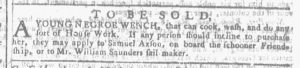
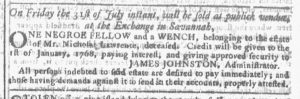
Slavery Advertisements Published July 8, 1767

The Slavery Adverts 250 Project chronicles the role of newspaper advertising in perpetuating slavery in the era of the American Revolution. The project seeks to reveal the ubiquity of slavery in eighteenth-century life from New England to Georgia by republishing advertisements about enslaved people – for sale as individuals or in groups, wanted to purchase or for hire for short periods, runaways who liberated themselves, and those who were subsequently captured and confined in jails and workhouses – in daily digests on this site as well as in real time via the @SlaveAdverts250 Twitter feed, utilizing twenty-first-century media to stand in for the print media of the eighteenth century.

The project aims to provide modern audiences with a sense of just how often colonizers encountered these advertisements in their daily lives. Enslaved men, women, and children appeared in print somewhere in the colonies almost every single day. Those advertisements served as a constant backdrop for social, cultural, economic, and political life in colonial and revolutionary America. Colonizers who did not purport to own enslaved people were still confronted with slavery as well as invited to maintain the system by purchasing enslaved men, women, and children or assisting in the capture of so-called “runaways” who sought to free themselves from bondage. The frequency of these newspaper advertisements suggests just how embedded slavery was in colonial and revolutionary American culture in everyday interactions beyond the printed page.

These advertisements also testify to the experiences of enslaved men, women, and children, though readers must consider that those experiences have been remediated through descriptions offered by enslavers rather than enslaved people themselves. Often unnamed in the advertisements, enslaved men, women, and children were not invisible or unimportant in early America.

These advertisements appeared in colonial American newspapers 250 years ago today.

Jul 8 - Georgia Gazette Slavery 1
Georgia Gazette (July 8, 1767).

**********

Jul 8 - Georgia Gazette Slavery 2
Georgia Gazette (July 8, 1767).

**********

Jul 8 - Georgia Gazette Slavery 3
Georgia Gazette (July 8, 1767).

**********

Jul 8 - Georgia Gazette Slavery 4
Georgia Gazette (July 8, 1767).

July 7

What was advertised in a colonial American newspaper 250 years ago today?

Jul 7 - 7:7:1767 South-Carolina Gazette and Country Journal
South-Carolina Gazette and Country Journal (July 7, 1767).

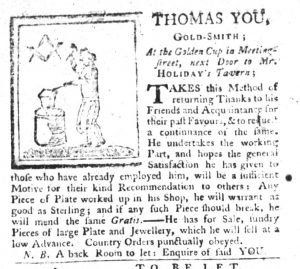
“If any such Piece should break, he will mend the same Gratis.”

For many eighteenth-century artisans, making a living depended in part on establishing a creditable reputation, both for fair dealing and for skilled craftsmanship. Thomas You, a goldsmith in Charleston, devoted most of his advertisement in the South-Carolina Gazette and Country Journal to cultivating and maintaining his reputation, hoping to gain new clients as well as repeat business from previous patrons.

He reminded those who had employed him in the past of their “general Satisfaction” with his work, but he also suggested that this merited passing along “their kind Recommendation to others.” You did not believe that he could rely on word of mouth alone to promote his services to new clients; he apparently supposed that newspaper advertising could provoke word-of-mouth endorsements that would supplement notices in the public prints.

You also pursued another means of cultivating his reputation: he was so confident in the quality of his work that he offered a guarantee. “Any Piece of Plate worked up in his Shop,” the goldsmith pledged, “he will warrant as good as Sterling; and if any such Piece should break, he will mend the same Gratis.” In making this promise to fix defective work for free, You offered a blanket guarantee that covered not only the work done by his own hand but also any tasks undertaken by others who labored in his shop, whether journeymen, apprentices, or enslaved artisans.

You incorporated other appeals into his advertisement, including low prices and punctual service on orders sent by mail, but he saved those for after his endeavors to secure his reputation. He revealed what he thought was most important to his customers. Low prices or quick responses hardly mattered if they accompanied inferior work. The goldsmith first needed to establish the quality of his work, reflected in both his existing reputation and a guarantee on future jobs, in order to convince potential customers of the value of the other appeals he advanced.