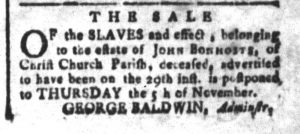
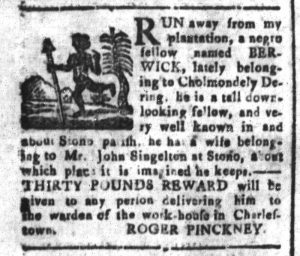
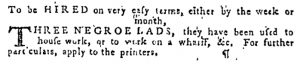
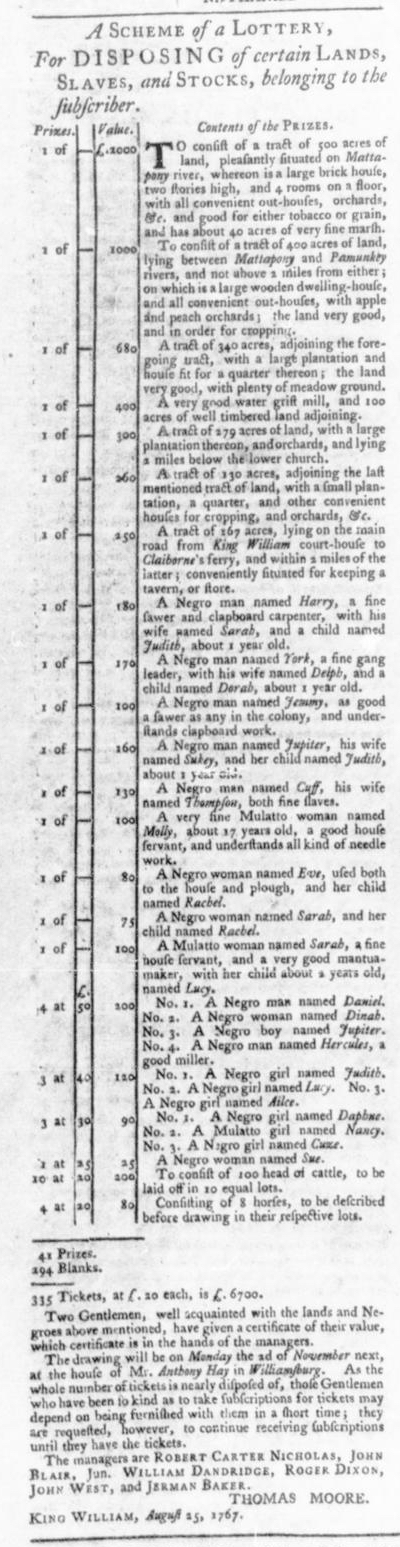
Slavery Advertisements Published October 27, 1767

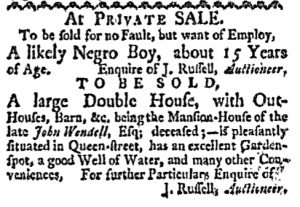
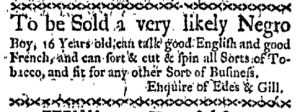
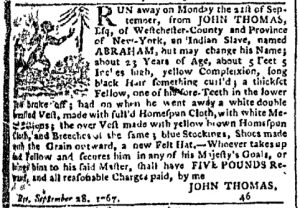
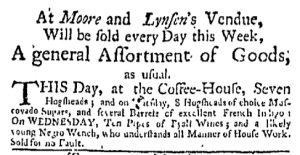
The Slavery Adverts 250 Project chronicles the role of newspaper advertising in perpetuating slavery in the era of the American Revolution. The project seeks to reveal the ubiquity of slavery in eighteenth-century life from New England to Georgia by republishing advertisements about enslaved people – for sale as individuals or in groups, wanted to purchase or for hire for short periods, runaways who liberated themselves, and those who were subsequently captured and confined in jails and workhouses – in daily digests on this site as well as in real time via the @SlaveAdverts250 Twitter feed, utilizing twenty-first-century media to stand in for the print media of the eighteenth century.

The project aims to provide modern audiences with a sense of just how often colonizers encountered these advertisements in their daily lives. Enslaved men, women, and children appeared in print somewhere in the colonies almost every single day. Those advertisements served as a constant backdrop for social, cultural, economic, and political life in colonial and revolutionary America. Colonizers who did not purport to own enslaved people were still confronted with slavery as well as invited to maintain the system by purchasing enslaved men, women, and children or assisting in the capture of so-called “runaways” who sought to free themselves from bondage. The frequency of these newspaper advertisements suggests just how embedded slavery was in colonial and revolutionary American culture in everyday interactions beyond the printed page.

These advertisements also testify to the experiences of enslaved men, women, and children, though readers must consider that those experiences have been remediated through descriptions offered by enslavers rather than enslaved people themselves. Often unnamed in the advertisements, enslaved men, women, and children were not invisible or unimportant in early America.

These advertisements appeared in colonial American newspapers 250 years ago today.
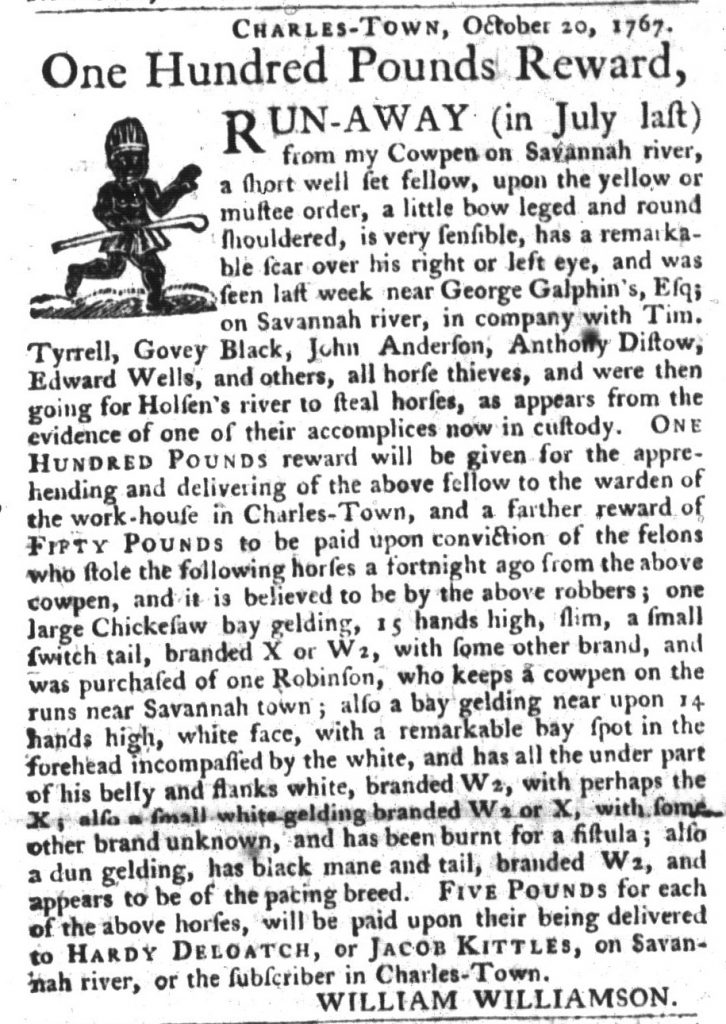
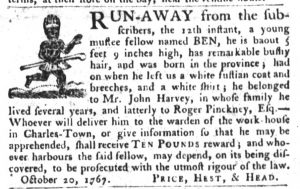
Oct 27 - South-Carolina Gazette and Country Journal Slavery 1
South-Carolina Gazette and Country Journal (October 27, 1767).

**********
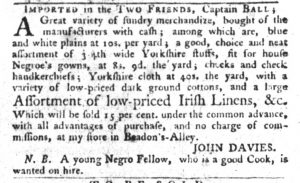
Oct 27 - South-Carolina Gazette and Country Journal Slavery 2
South-Carolina Gazette and Country Journal (October 27, 1767).

**********

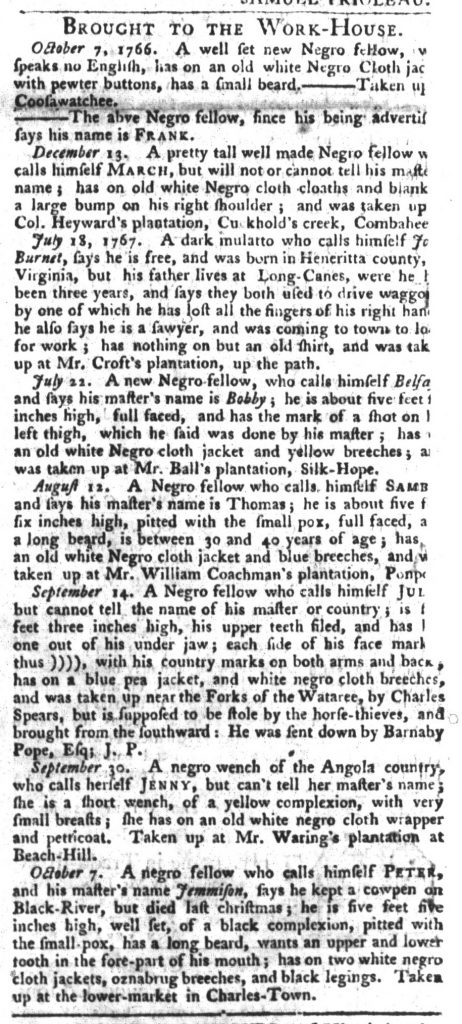
Oct 27 - South-Carolina Gazette and Country Journal Slavery 3
South-Carolina Gazette and Country Journal (October 27, 1767).

**********

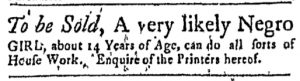
Oct 27 - South-Carolina Gazette and Country Journal Slavery 4
South-Carolina Gazette and Country Journal (October 27, 1767).

**********
Oct 27 - South-Carolina Gazette and Country Journal Slavery 5
South-Carolina Gazette and Country Journal (October 27, 1767).

**********
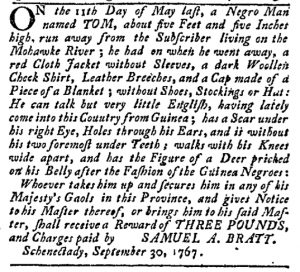
Oct 27 - South-Carolina Gazette and Country Journal Slavery 6
South-Carolina Gazette and Country Journal (October 27, 1767).

**********

Oct 27 - South-Carolina Gazette and Country Journal Slavery 7
South-Carolina Gazette and Country Journal (October 27, 1767).

**********
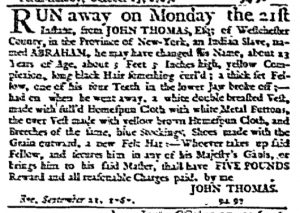
Oct 27 - South-Carolina Gazette and Country Journal Slavery 8
South-Carolina Gazette and Country Journal (October 27, 1767).

**********

Oct 27 - South-Carolina Gazette and Country Journal Slavery 9
South-Carolina Gazette and Country Journal (October 27, 1767).

**********
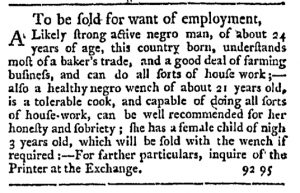
Oct 27 - South-Carolina Gazette and Country Journal Slavery 10
South-Carolina Gazette and Country Journal (October 27, 1767).

**********

Oct 27 - South-Carolina Gazette and Country Journal Slavery 11
South-Carolina Gazette and Country Journal (October 27, 1767).

October 26

What was advertised in a colonial American newspaper 250 years ago today?

Oct 26 - 10:26:1767 Champlin Newport Mercury
Newport Mercury (October 26, 1767).

“To be SOLD, by CHRISTOPHER CHAMPLIN.”

Regular readers of the Newport Gazette would not have been surprised to see an advertisement from Christopher Champlin on the first page of the October 26, 1767, edition. Champlin regularly turned to his local newspaper to promote the “neat Assortment of European and India GOODS” he imported and sold. Readers may have been surprised, however, to encounter a second advertisement from Champlin on the third page. That deviated from standard marketing practices prior to the American Revolution. Given that newspapers usually consisted of only four pages, advertisers rarely inserted more than one commercial notice in an issue. Was Champlin attempting to gain even more attention for his shop “At the Sign of the Golden Ball” by saturating the Newport Gazette with his advertisements? Did he even intend to publish more than one advertisement that day?

While it is possible that Champlin experimented with running multiple advertisements simultaneously, this situation may have instead resulted from decisions made by the printer in the production of that week’s issue. Note the date on the advertisement on the third page: October 26, 1767. It corresponded exactly to the date of that issue. Compare it to the date on the advertisement on the first page: September 14, 1767. Champlin previously placed this notice, intending that it run for several weeks.

Oct 26 - 10:26:1767 Newport Mercury
Newport Mercury (October 26, 1767).

Now consider the production process for a weekly newspaper. Printers created the standard four-page newspapers of the colonial period by printing two pages on each side of a broadsheet and then folding it in half, transforming a single sheet into four pages. This required printing the first and fourth pages on one side at one time and the second and third pages on the other side at another time. This meant that the material on one side of the sheet could have been older, the type could have been set earlier, than the content on the other side.

The first and fourth pages included two standard parts of any issue, the masthead on the first page and the colophon on the last. Except for updating the date and issue number in the masthead, these items did not change from week to week. In the October 26 issue, advertisements that previously appeared in earlier issues filled the fourth page. The type had been set well in advance and simply reused. The first page had other advertisements that continued from previous issues, including Champlin’s advertisement dated September 14. The first page also had two excerpts reprinted from other colonial newspapers, one from the Pennsylvania Chronicle and the other from the New-Hampshire Gazette, dated October 16. All the material on the first and fourth pages could have been prepared and printed early in the week.

The printer likely selected the contents of the second and third pages later in the week, setting the type and printing those pages after the first and fourth pages had been determined. The second page featured news “By several Vessels from London, arrived at Philadelphia and Boston” and then disseminated to other colonies. Given the amount of time it took for ships to cross the Atlantic, the printer likely waited as long as possible to choose the contents of the second page in order to publish the most recent news. The third page had news items from other colonies in the Middle Atlantic and New England, many of them dated after the previous issue of the Newport Gazette. This news had only arrived in the past week. Several advertisements also appeared on the third page, including Champlin’s advertisement dated October 26 and two others dated October 24.

Careful consideration of the contents of the October 26 edition of the Newport Mercury suggests that Champlin may not have intended to run multiple advertisements in that issue. By the time he submitted his new advertisement the printer might have already printed the first and fourth pages, including Champlin’s advertisement dated September 14. Champlin may not even have paid for that advertisement; the printer may have included it as filler in order to complete the page. The shopkeeper certainly wanted to promote his new merchandise he had “Just imported.” Right before the newspaper went to press, he submitted a new advertisement to appear alongside the most recent news.

Christopher Champlin may have attempted an innovative advertising campaign by placing more than one advertisement in a single issue of the Newport Mercury. Taking into consideration the production process for colonial newspapers, however, suggests that this was an accidental rather than intentional aspect of Champlin’s marketing efforts. His advertisements must be considered in the larger context of where they appeared on the page and within the newspaper.

Slavery Advertisements Published October 26, 1767

The Slavery Adverts 250 Project chronicles the role of newspaper advertising in perpetuating slavery in the era of the American Revolution. The project seeks to reveal the ubiquity of slavery in eighteenth-century life from New England to Georgia by republishing advertisements about enslaved people – for sale as individuals or in groups, wanted to purchase or for hire for short periods, runaways who liberated themselves, and those who were subsequently captured and confined in jails and workhouses – in daily digests on this site as well as in real time via the @SlaveAdverts250 Twitter feed, utilizing twenty-first-century media to stand in for the print media of the eighteenth century.

The project aims to provide modern audiences with a sense of just how often colonizers encountered these advertisements in their daily lives. Enslaved men, women, and children appeared in print somewhere in the colonies almost every single day. Those advertisements served as a constant backdrop for social, cultural, economic, and political life in colonial and revolutionary America. Colonizers who did not purport to own enslaved people were still confronted with slavery as well as invited to maintain the system by purchasing enslaved men, women, and children or assisting in the capture of so-called “runaways” who sought to free themselves from bondage. The frequency of these newspaper advertisements suggests just how embedded slavery was in colonial and revolutionary American culture in everyday interactions beyond the printed page.

These advertisements also testify to the experiences of enslaved men, women, and children, though readers must consider that those experiences have been remediated through descriptions offered by enslavers rather than enslaved people themselves. Often unnamed in the advertisements, enslaved men, women, and children were not invisible or unimportant in early America.

These advertisements appeared in colonial American newspapers 250 years ago today.

Oct 26 - Boston Post-Boy Slavery 1
Boston Post-Boy (October 26, 1767).

**********

Oct 26 - Boston-Gazette Slavery 1
Boston-Gazette (October 26, 1767).

**********
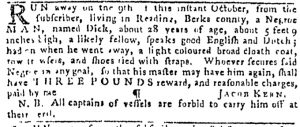
Oct 26 - Boston-Gazette Supplement Slavery 1
Supplement to the Boston-Gazette (October 26, 1767).

**********

Oct 26 - Boston-Gazette Supplement Slavery 2
Supplement to the Boston-Gazette (October 26, 1767).

**********

Oct 26 - New-York Gazette Slavery 1
New-York Gazette (October 26, 1767).

**********

Oct 26 - New-York Mercury Slavery 1
New-York Mercury (October 26, 1767).

**********

Oct 26 - New-York Mercury Slavery 2
New-York Mercury (October 26, 1767).

**********

Oct 26 - New-York Mercury Slavery 3
New-York Mercury (October 26, 1767).

**********

Oct 26 - New-York Mercury Slavery 4
New-York Mercury (October 26, 1767).

October 25

What was advertised in a colonial American newspaper 250 years ago this week?

Oct 25 - 10:22:1767 Pennsylvania Gazette
Pennsylvania Gazette (October 22, 1767).

“A NEAT assortment of coarse, fine and superfine broadcloths.”

Readers of the Pennsylvania Gazette would have recognized Magdalen Devine’s advertisement at a glance even if it had not featured her name in capital letters. Why? Devine used a woodcut that depicted some of her merchandise. In so doing, she successfully branded her business, repeatedly inserting it along with extensive lists of the merchandise she stocked.

The Adverts 250 Project previously examined another advertisement Devine placed in the Pennsylvania Gazette in May 1767. The content changed significantly. Then, Devine announced that she had imported a variety of goods in the Carolina from London and the Peggy from Glasgow. In her new advertisements, she hawked goods that had recently arrived via the Mary and Elizabeth from London as well as “the last vessels from Liverpool and Glasgow.” Both advertisements listed hundreds of items potential customers would find among her inventory; although the types of goods were similar, she enumerated different items in each.

Some aspects of Devine’s advertisements remained consistent. In May and October she gave her address, “In Second-street, between Market and Chestnut-streets, the fourth door from the Quaker meeting-house,” and concluded by assuring readers that “she will sell at the lowest terms, for cash or short credit.” Yet the most significant feature of her advertisements had to have been the woodcut that appeared at the top, a woodcut that occupied as much space as some of the shorter advertisements in the Pennsylvania Gazette.

Devine deployed the woodcut as a brand to identify her business and distinguish it from others, but it also illustrated some of her merchandise. The shopkeeper sold all kinds of imported textiles; her advertisements filled half a column because she listed so many different styles, colors, and qualities of fabrics. Her woodcut provided visual affirmation of her inventory. It showed two rolls of patterned cloth (suggesting quantity) flanked by swatches that revealed distinctive patterns (suggesting fashion).

Commissioning a woodcut would have been an additional expense for Devine, but the length and frequency of her advertisements indicate that she was willing to invest in advertising. She likely considered the woodcut a good investment since it immediately identified her advertisements whenever they appeared in the pages of the Pennsylvania Gazette, the newspaper that usually included more advertising (including a two-page supplement) than any other newspaper printed in the American colonies in the 1760s. Devine relied on standard marketing appeals throughout her advertisements, but her woodcut attracted attention and distinguished her marketing efforts.

October 24

What was advertised in a colonial American newspaper 250 years ago today?

Oct 24 - 10:24:1767 Providence Gazette
Providence Gazette (October 24, 1767).

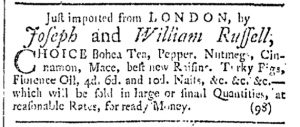
“Just imported from LONDON, by Joseph and William Russell …”

Joseph and William Russell placed this rather modest advertisement in the October 24, 1767, edition of the Providence Gazette. In length and format, it resembled other advertisements for consumer goods and services in the same issue, but regular readers might have wondered at the Russells’ restraint when it came to marketing the goods they imported from London. After all, nearly a year earlier the Russells placed a full-page advertisement in the Providence Gazette, an advertisement that ran several times over the course of the next few months.

When they discontinued that advertisement, their consumer notices still tended to include some sort of innovative strategy that distinguished them from other advertisements. In January, for instance, they explained that their “Assortment [of goods] is too large for an Advertisement of Particulars in this Paper.” Even a full-page advertisement did not provide enough space to do any sort of justice to their inventory, they chided, so they left it to curious readers to conjure images of the “Assortment” of textiles, housewares, groceries, and hardware they would encounter when they visited the Russells’ shop “at the Sign of the Golden Eagle.” Deploying a “less is more” approach, they prompted consumers to do the imaginative work formerly accomplished by their elaborate list of goods that filled an entire page in the newspaper (and saved money on advertising in the process). Yet that strategy depended on their clever remark about the newspaper not having enough space to list their merchandise.

The Russells did not attempt any of that playfulness in their newest advertisement. They did resort to the standard “&c. &c. &c.” to suggest they carried more goods than the few items enumerated in their advertisement. They also made standard appeals to price and quality, but they did not insert anything that distinguished their advertisement from others published in newspapers throughout the colonies. Why not?

This merits further attention as the Adverts 250 Project continues to examine advertisements placed by Joseph and William Russell. If they never again published innovative advertisements after experimenting with a full-page advertisement and other clever appeals that could suggest that they determined that the effort and expense did not yield the desired results. Perhaps they determined that such marketing ploys were not any more effective than following the standard format. On the other hand, if they returned to publishing more elaborate advertisement that could indicate that they decided that such notices generated enough business to justify running them (and incurring the expense) once again. Either way, subsequent advertisements placed by the Russells may provide indirect evidence for assessing readers’ reception of their marketing efforts.

Slavery Advertisements Published October 24, 1767

The Slavery Adverts 250 Project chronicles the role of newspaper advertising in perpetuating slavery in the era of the American Revolution. The project seeks to reveal the ubiquity of slavery in eighteenth-century life from New England to Georgia by republishing advertisements about enslaved people – for sale as individuals or in groups, wanted to purchase or for hire for short periods, runaways who liberated themselves, and those who were subsequently captured and confined in jails and workhouses – in daily digests on this site as well as in real time via the @SlaveAdverts250 Twitter feed, utilizing twenty-first-century media to stand in for the print media of the eighteenth century.

The project aims to provide modern audiences with a sense of just how often colonizers encountered these advertisements in their daily lives. Enslaved men, women, and children appeared in print somewhere in the colonies almost every single day. Those advertisements served as a constant backdrop for social, cultural, economic, and political life in colonial and revolutionary America. Colonizers who did not purport to own enslaved people were still confronted with slavery as well as invited to maintain the system by purchasing enslaved men, women, and children or assisting in the capture of so-called “runaways” who sought to free themselves from bondage. The frequency of these newspaper advertisements suggests just how embedded slavery was in colonial and revolutionary American culture in everyday interactions beyond the printed page.

These advertisements also testify to the experiences of enslaved men, women, and children, though readers must consider that those experiences have been remediated through descriptions offered by enslavers rather than enslaved people themselves. Often unnamed in the advertisements, enslaved men, women, and children were not invisible or unimportant in early America.

These advertisements appeared in colonial American newspapers 250 years ago today.

Oct 24 - Providence Gazette Slavery 1
Providence Gazette (October 24, 1767).

October 23

What was advertised in a colonial American newspaper 250 years ago today?

Oct 23 - 10:23:1767 New-Hampshire Gazette
New-Hampshire Gazette (October 23, 1767).

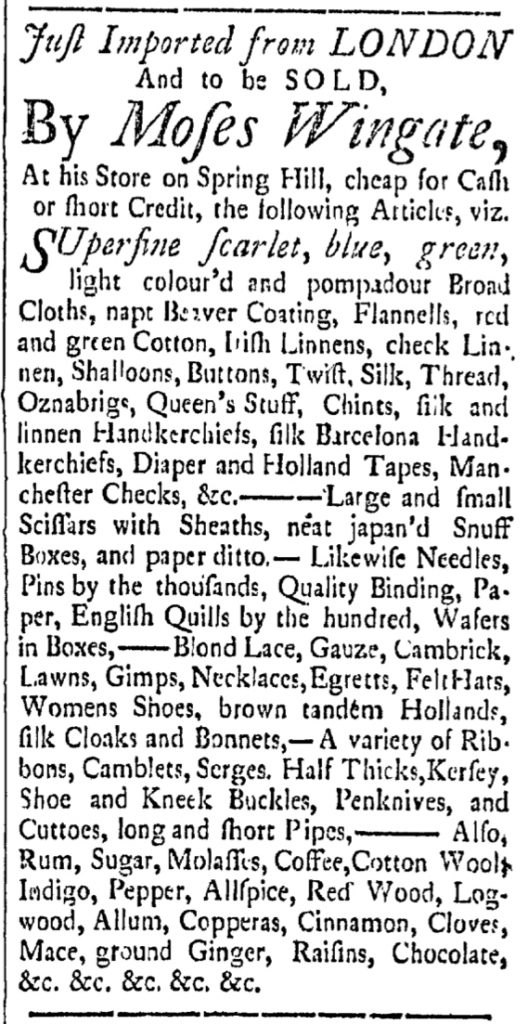
Superfine, scarlet, blue, green, light colour’d and pompadour Broad Cloths …”

In the fall of 1767, Moses Wingate imported and sold a vast assortment of goods “At his Store on Spring Hill” in Portsmouth, New Hampshire. In a newspaper advertisement intended to entice potential customers, he adopted one of the most common marketing strategies of the eighteenth century: listing his merchandise. Very few entrepreneurs, mostly booksellers, distributed catalogs in eighteenth-century America; however, many treated newspaper advertisements as surrogates for publishing separate catalogs. Wingate’s advertisement filled half a column, with most of the space devoted to enumerating his inventory. Other merchants and shopkeepers sometimes published advertisements that occupied an entire column and, on occasion, spilled over into the next. List style advertisements for consumer goods filled the pages of American newspapers in the eighteenth century. These lists implicitly communicated an appeal to consumer choice. Wingate and others informed readers that they did not have to accept whatever happened to be on their shelves. Instead, merchants and shopkeepers stocked such varieties of goods that customers could exercise their own taste and judgment – assert their own independence – by choosing the goods that most appealed to them.

To that end, Wingate named more than seventy-five distinct items readers could expect to find among his inventory. In some cases, these were categories of goods, such as buttons or penknives, suggesting even variety. In one instance, he specified further choices: “A variety of Ribbons.” Like many of his competitors and counterparts, he also deployed “&c.” (the eighteenth-century abbreviation for et cetera), inserting it once in the middle of the advertisement to indicate he sold an even broader array of imported textiles than listed there. He also concluded his advertisement with “&c. &c. &c. &c.” to underscore to potential customers that they would find much, much more when they visited his store. Wingate provided an extensive list of imported goods to encourage potential customers to imagine his inventory, to imagine touching, sorting through, comparing, and selecting from among his wares. He indicated readers could find even more imported goods at his store as a means of further inflaming their curiosity. Wingate could have placed a much shorter advertisement that simply announced that he sold a variety of goods imported from London, but he made an investment in a lengthier list style advertisement because he believed that perusing its contents would incite consumer demand.

Slavery Advertisements Published October 23, 1767

The Slavery Adverts 250 Project chronicles the role of newspaper advertising in perpetuating slavery in the era of the American Revolution. The project seeks to reveal the ubiquity of slavery in eighteenth-century life from New England to Georgia by republishing advertisements about enslaved people – for sale as individuals or in groups, wanted to purchase or for hire for short periods, runaways who liberated themselves, and those who were subsequently captured and confined in jails and workhouses – in daily digests on this site as well as in real time via the @SlaveAdverts250 Twitter feed, utilizing twenty-first-century media to stand in for the print media of the eighteenth century.

The project aims to provide modern audiences with a sense of just how often colonizers encountered these advertisements in their daily lives. Enslaved men, women, and children appeared in print somewhere in the colonies almost every single day. Those advertisements served as a constant backdrop for social, cultural, economic, and political life in colonial and revolutionary America. Colonizers who did not purport to own enslaved people were still confronted with slavery as well as invited to maintain the system by purchasing enslaved men, women, and children or assisting in the capture of so-called “runaways” who sought to free themselves from bondage. The frequency of these newspaper advertisements suggests just how embedded slavery was in colonial and revolutionary American culture in everyday interactions beyond the printed page.

These advertisements also testify to the experiences of enslaved men, women, and children, though readers must consider that those experiences have been remediated through descriptions offered by enslavers rather than enslaved people themselves. Often unnamed in the advertisements, enslaved men, women, and children were not invisible or unimportant in early America.

These advertisements appeared in colonial American newspapers 250 years ago today.

Oct 23 - South-Carolina and American General Gazette Slavery 1
South-Carolina and American General Gazette (October 23, 1767).

**********

Oct 23 - South-Carolina and American General Gazette Slavery 2
South-Carolina and American General Gazette (October 23, 1767).

**********

Oct 23 - South-Carolina and American General Gazette Slavery 3
South-Carolina and American General Gazette (October 23, 1767).

**********

Oct 23 - South-Carolina and American General Gazette Slavery 4
South-Carolina and American General Gazette (October 23, 1767).

**********

Oct 23 - South-Carolina and American General Gazette Slavery 5
South-Carolina and American General Gazette (October 23, 1767).

**********

Oct 23 - South-Carolina and American General Gazette Slavery 6
South-Carolina and American General Gazette (October 23, 1767).

**********

Oct 23 - South-Carolina and American General Gazette Slavery 7
South-Carolina and American General Gazette (October 23, 1767).

**********

Oct 23 - South-Carolina and American General Gazette Slavery 8
South-Carolina and American General Gazette (October 23, 1767).

**********

Oct 23 - South-Carolina and American General Gazette Slavery 9
South-Carolina and American General Gazette (October 23, 1767).

**********

Oct 23 - South-Carolina and American General Gazette Slavery 10
South-Carolina and American General Gazette (October 23, 1767).

**********

Oct 23 - South-Carolina and American General Gazette Slavery 11
South-Carolina and American General Gazette (October 23, 1767).

October 22

What was advertised in a colonial American newspaper 250 years ago today?

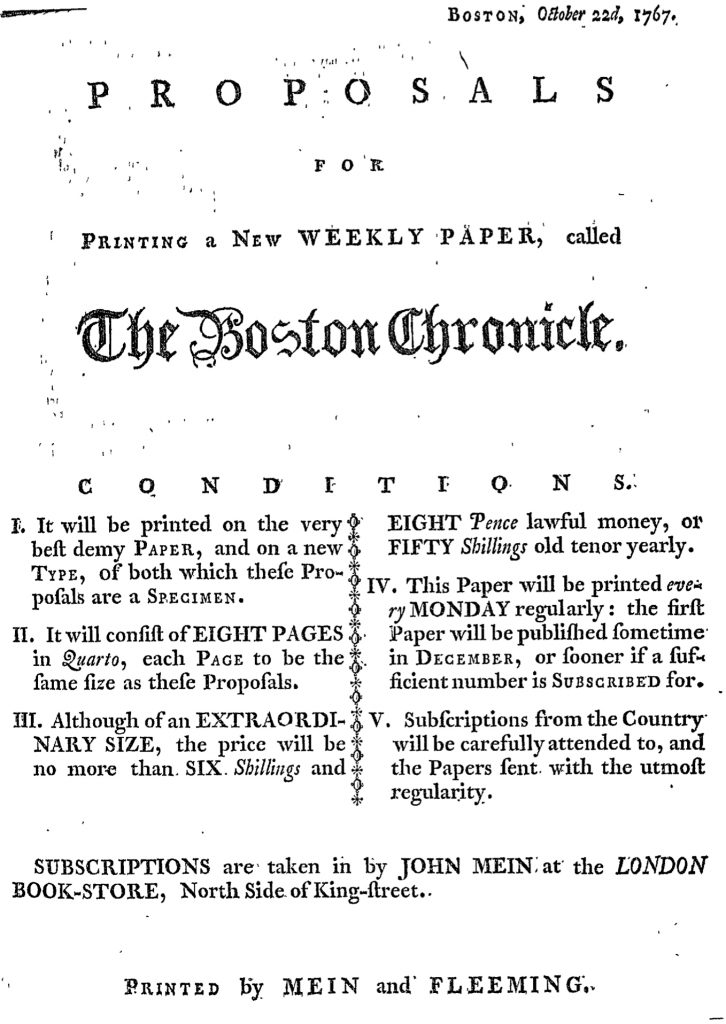
Oct 22 - 10:22:1767 Page 1 Boston Chronicle
Subscription Notice for the Boston Chronicle (October 22, 1767).

“PROPOSALS FOR PRINTING a NEW WEEKLY PAPER.”

Two months before it commenced publication, John Mein and John Fleeming distributed a subscription notice for “PRINTING a NEW WEEKLY PAPER, called The Boston Chronicle.” Their proposals advertised the newspaper in advance in an effort to gain as many subscribers as possible before the first issue even went to press. Although they did not say so explicitly in their subscription notice, they stood to sell more advertising if they could demonstrate that they attracted sufficient subscribers.

Mein and Fleeming’s broadsheet subscription notice had three parts. One side outlined the “CONDITIONS” of publication, a standard aspect of any eighteenth-century subscription notice, whether it appeared as a newspaper advertisement, on a magazine wrapper, or as a separate broadside. The other side enumerated the types of news items to be included in the new publication and described the networks the printers had established for acquiring that content.

The “CONDITIONS” provided a general overview of the newspaper. Mein and Fleeming promoted the material aspects, including the paper and type, and asserted that the subscription notice itself was a “SPECIMEN” of the newspapers prospective subscribers could expect to receive. Rather than the standard four pages, the Boston Chronicle would be eight pages, yet Mein and Fleeming specified a low price. Although it was an “EXTRAORDINARY SIZE,” it was still affordable. The weekly paper would be distributed on Mondays, like most of its competitors in Boston, and the publishers welcomed “Subscriptions from the Country,” promising to deliver the newspaper to subscribers outside the city “with the utmost regularity.”

Oct 22 - 10:22:1767 Page 2 Boston Chronicle
Subscription Notice for the Boston Chronicle (October 22, 1767).

In terms of content, they promised “All the current news, foreign and domestic, ecclesiastical or military.” Of particular interest, they would publish “debates in the great assemblies,” “Remakrkable and interesting cases, civil or criminal,” and “Whatever may contribute to promote agriculture, population, trade and manufactures in America.” Not surprisingly, given that Mein and Fleeming were both booksellers, the Boston Chronicle would include “An account of the new books” to guide readers in making their own purchases.

To obtain the necessary content, the publishers reported that “A correspondence has been established, in several parts of Great-Britain, but particularly in LONDON, by which we will receive, by every vessel, all the news-papers of any note, and every Magazine, Review, and political pamphlet without exception.” In addition, their “friends have also promised to send private anecdotes” that might not appear in newspapers printed in England. To collect as much news as possible, Mein and Fleeming had also cultivated correspondents “along the whole continent and West Indies.” They were indeed committed to receiving “All the current news, foreign and domestic” so they could pass it along to their subscribers.

Mein and Fleeming distributed the first issue of the Boston Chronicle on December 21, 1767. They continued publication for two and half years, releasing the final issue in June 1770. Their subscription notice almost certainly helped them initially as they sought sufficient subscribers, but the Boston Chronicle, like many other eighteenth-century newspapers, had a short run in the face of competition and political turmoil.

Slavery Advertisements Published October 22, 1767

The Slavery Adverts 250 Project chronicles the role of newspaper advertising in perpetuating slavery in the era of the American Revolution. The project seeks to reveal the ubiquity of slavery in eighteenth-century life from New England to Georgia by republishing advertisements about enslaved people – for sale as individuals or in groups, wanted to purchase or for hire for short periods, runaways who liberated themselves, and those who were subsequently captured and confined in jails and workhouses – in daily digests on this site as well as in real time via the @SlaveAdverts250 Twitter feed, utilizing twenty-first-century media to stand in for the print media of the eighteenth century.

The project aims to provide modern audiences with a sense of just how often colonizers encountered these advertisements in their daily lives. Enslaved men, women, and children appeared in print somewhere in the colonies almost every single day. Those advertisements served as a constant backdrop for social, cultural, economic, and political life in colonial and revolutionary America. Colonizers who did not purport to own enslaved people were still confronted with slavery as well as invited to maintain the system by purchasing enslaved men, women, and children or assisting in the capture of so-called “runaways” who sought to free themselves from bondage. The frequency of these newspaper advertisements suggests just how embedded slavery was in colonial and revolutionary American culture in everyday interactions beyond the printed page.

These advertisements also testify to the experiences of enslaved men, women, and children, though readers must consider that those experiences have been remediated through descriptions offered by enslavers rather than enslaved people themselves. Often unnamed in the advertisements, enslaved men, women, and children were not invisible or unimportant in early America.

These advertisements appeared in colonial American newspapers 250 years ago today.

Oct 22 - Massachusetts Gazette Slavery 1
Massachusetts Gazette (October 22, 1767).

**********

Oct 22 - Massachusetts Gazette Slavery 2
Massachusetts Gazette (October 22, 1767).

**********

Oct 22 - New-York Journal Slavery 1
New-York Journal (October 22, 1767).

**********

Oct 22 - New-York Journal Slavery 2
New-York Journal (October 22, 1767).

**********

Oct 22 - New-York Journal Slavery 3
New-York Journal (October 22, 1767).

**********

Oct 22 - New-York Journal Slavery 4
New-York Journal (October 22, 1767).

**********

Oct 22 - New-York Journal Slavery 5
New-York Journal (October 22, 1767).

**********

Oct 22 - New-York Journal Supplement Slavery 1
Supplement to the New-York Journal (October 22, 1767).

**********

Oct 22 - New-York Journal Supplement Slavery 2
Supplement to the New-York Journal (October 22, 1767).

**********

Oct 22 - Pennsylvania Gazette Slavery 1
Pennsylvania Gazette (October 22, 1767).

**********

Oct 22 - Pennsylvania Gazette Supplement Slavery 1
Supplement to the Pennsylvania Gazette (October 22, 1767).

**********

Oct 22 - Pennsylvania Gazette Supplement Slavery 2
Supplement to the Pennsylvania Gazette (October 22, 1767).

**********

Oct 22 - Virginia Gazette Slavery 1
Virginia Gazette (October 22, 1767).

**********

Oct 22 - Virginia Gazette Slavery 2
Virginia Gazette (October 22, 1767).

**********

Oct 22 - Virginia Gazette Slavery 3
Virginia Gazette (October 22, 1767).

**********

Oct 22 - Virginia Gazette Slavery 4
Virginia Gazette (October 22, 1767).

**********

Oct 22 - Virginia Gazette Slavery 5
Virginia Gazette (October 22, 1767).

**********

Oct 22 - Virginia Gazette Slavery 6
Virginia Gazette (October 22, 1767).

**********

Oct 22 - Virginia Gazette Slavery 8
Virginia Gazette (October 22, 1767).