October 21

Who was the subject of an advertisement in a colonial American newspaper 250 years ago today?
Oct 21 - Georgia Gazette Slavery 11
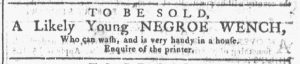
Georgia Gazette (October 21, 1767).

“TO BE SOLD, A Likely Young NEGROE WNECH, Who can wash, and is very handy in a house.”

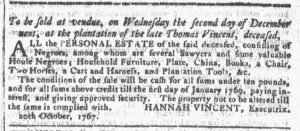
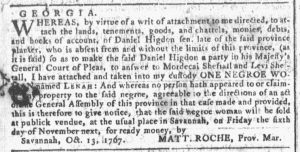
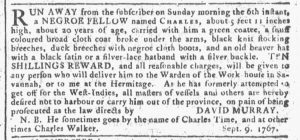
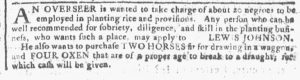
The October 21, 1767, edition of the Georgia Gazette included thirteen advertisements that involved enslaved men, women, and children in some way. Seven advertisers sought to sell slaves. Two offered rewards for the capture and return of runaway slaves. Another two described suspected runaways that had been captured and requested that their masters claim them. One employment notice outlined the responsibilities of an overseer who would “take charge of about 20 negroes to be employed in planting rice and provisions.” The final advertisement proposed hiring out (or renting out) a “LIKELY NEGROE GIRL,” a good seamstress, by the month or year.

Among these thirteen advertisements, five featured enslaved women and girls. Women may have been largely (but not completely) absent from the advertising pages when it came to operating businesses and promoting their entrepreneurial activities to consumers, but enslaved women and girls appeared in the pages of colonial newspapers regularly. Practically every day in the 1760s at least one newspaper published somewhere in the colonies included at least one advertisement that featured enslaved women or girls, making slavery advertisements perhaps the most voluminous source for examining women’s history printed in colonial newspapers. Although not written from the perspective of enslaved women and girls, they still reveal much about their experiences.

Some reveal more than others. One simply stated: “TO BE SOLD, A VERY FINE, STOUT, YOUNG, and HEALTHY WENCH. For particulars apply to THOMAS HAMILTON.” In addition to the enslaved seamstress who could be hired out, another short advertisement offered a “NEGROE WENCH, Who can wash, and is very handy in a house.” A real estate advertisement for a farm concluded by noting the seller also had “TWO YOUNG NEGROE WENCHES … who are very handy at any kind of house work, and are good sempstresses.” These mentions were brief, but they still aid in understanding and reconstructing the experiences of enslaved women and girls. For instance, these advertisements indicate that enslaved women and girls often engaged in domestic labor rather than working in the fields. Not all of them were drudges within the home but instead developed valuable skills.

Other advertisements told much more elaborate stories about enslaved women and girls, especially advertisements for runaways that often included physical descriptions, described clothing, commented on personality traits, and acknowledged relationships with other slaves. Sometimes they tracked known or suspected movements, speculating on which friends or relatives runaways might approach for aid. No advertisements of that sort appeared in the October 21, 1767, edition of the Georgia Gazette, but they had in the past and they would again. That publication, like most of its counterparts throughout the colonies, frequently ran advertisements about enslaved women and girls, advertisements of various lengths and with assorted purposes. As a result, enslaved women and girls likely appeared in colonial newspapers more often than other women. The attempts to keep them in bondage also yielded a more prominent and extensive record of their experiences in the public prints. Enslaved women could never be out of sight to anyone who read the newspaper, either in the eighteenth century or today.

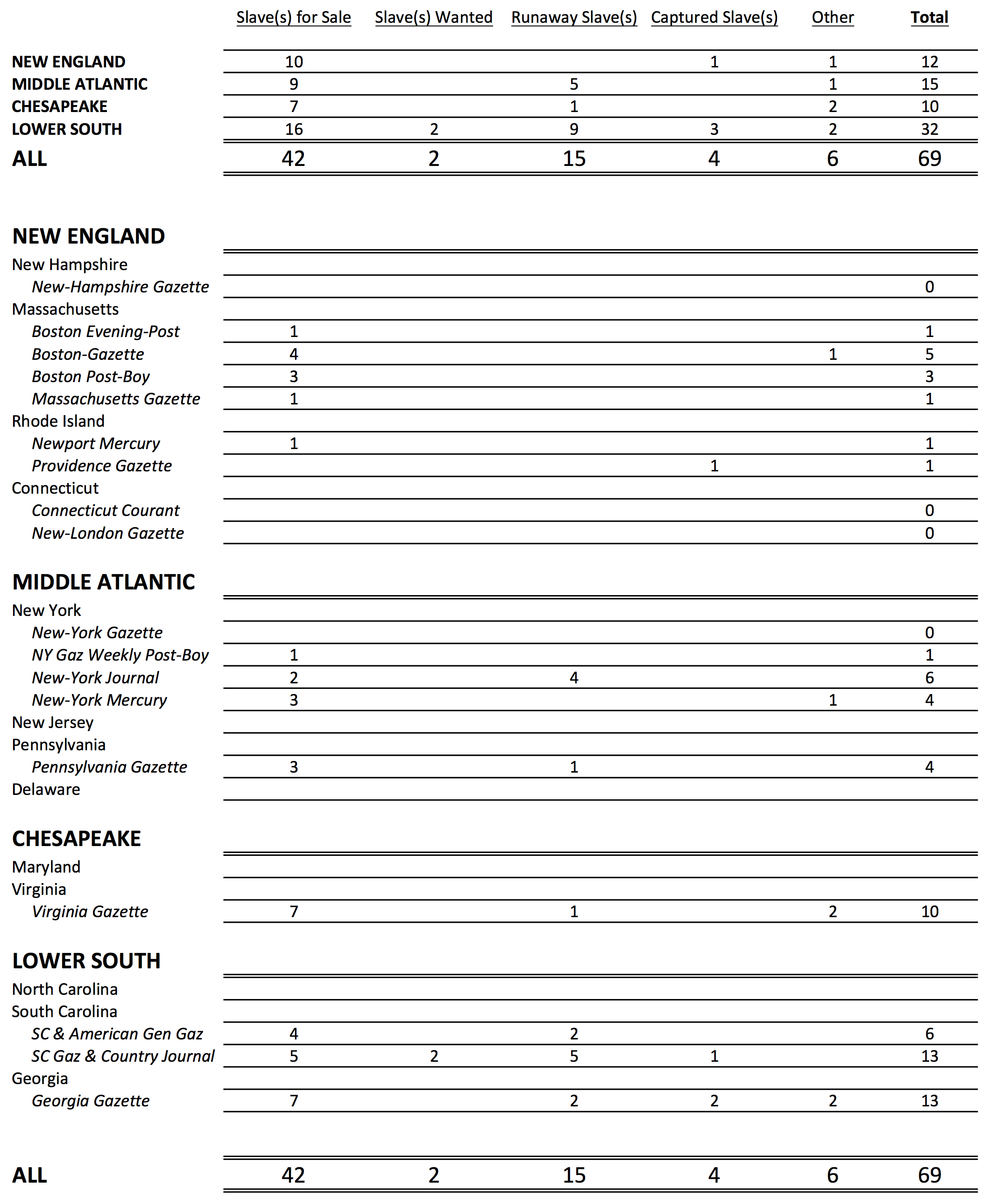
Summary of Slavery Advertisements Published October 15-21, 1767

These tables indicate how many advertisements for slaves appeared in colonial American newspapers during the week of October 15-21, 1767.

Note:  These tables are as comprehensive as currently digitized sources permit, but they may not be an exhaustive account.  They includes all newspapers that have been digitized and made available via Accessible Archives, Colonial Williamsburg’s Digital Library, and Readex’s America’s Historical Newspapers.  There are several reasons some newspapers may not have been consulted:

  • Issues that are no longer extant;
  • Issues that are extant but have not yet been digitized (including the Pennsylvania Journal); and
  • Newspapers published in a language other than English (including the Wochentliche Philadelphische Staatsbote).

**********

Slavery Advertisements Published October 15-21, 1767:  By Date

Slavery Adverts Tables 1767 By Date Oct 15

**********

Slavery Advertisements Published October 15-21, 1767:  By Region

Slavery Adverts Tables 1767 Oct 15 By Region

Slavery Advertisements Published October 21, 1767

The Slavery Adverts 250 Project chronicles the role of newspaper advertising in perpetuating slavery in the era of the American Revolution. The project seeks to reveal the ubiquity of slavery in eighteenth-century life from New England to Georgia by republishing advertisements about enslaved people – for sale as individuals or in groups, wanted to purchase or for hire for short periods, runaways who liberated themselves, and those who were subsequently captured and confined in jails and workhouses – in daily digests on this site as well as in real time via the @SlaveAdverts250 Twitter feed, utilizing twenty-first-century media to stand in for the print media of the eighteenth century.

The project aims to provide modern audiences with a sense of just how often colonizers encountered these advertisements in their daily lives. Enslaved men, women, and children appeared in print somewhere in the colonies almost every single day. Those advertisements served as a constant backdrop for social, cultural, economic, and political life in colonial and revolutionary America. Colonizers who did not purport to own enslaved people were still confronted with slavery as well as invited to maintain the system by purchasing enslaved men, women, and children or assisting in the capture of so-called “runaways” who sought to free themselves from bondage. The frequency of these newspaper advertisements suggests just how embedded slavery was in colonial and revolutionary American culture in everyday interactions beyond the printed page.

These advertisements also testify to the experiences of enslaved men, women, and children, though readers must consider that those experiences have been remediated through descriptions offered by enslavers rather than enslaved people themselves. Often unnamed in the advertisements, enslaved men, women, and children were not invisible or unimportant in early America.

These advertisements appeared in colonial American newspapers 250 years ago today.

Oct 21 - Georgia Gazette Slavery 1
Georgia Gazette (October 21, 1767).

**********

Oct 21 - Georgia Gazette Slavery 2
Georgia Gazette (October 21, 1767).

**********

Oct 21 - Georgia Gazette Slavery 3
Georgia Gazette (October 21, 1767).

**********

Oct 21 - Georgia Gazette Slavery 4
Georgia Gazette (October 21, 1767).

**********

Oct 21 - Georgia Gazette Slavery 5
Georgia Gazette (October 21, 1767).

**********

Oct 21 - Georgia Gazette Slavery 7
Georgia Gazette (October 21, 1767).

**********

Oct 21 - Georgia Gazette Slavery 8
Georgia Gazette (October 21, 1767).

**********

Oct 21 - Georgia Gazette Slavery 9
Georgia Gazette (October 21, 1767).

**********

Oct 21 - Georgia Gazette Slavery 10
Georgia Gazette (October 21, 1767).

**********

Oct 21 - Georgia Gazette Slavery 11
Georgia Gazette (October 21, 1767).

**********

Oct 21 - Georgia Gazette Slavery 13
Georgia Gazette (October 21, 1767).

**********

Oct 21 - Georgia Gazette Slavery Slavery 6
Georgia Gazette (October 21, 1767).

**********

Oct 21 - Georgia Gazette Slavery Slavery 12
Georgia Gazette (October 21, 1767).

October 20

What was advertised in a colonial American newspaper 250 years ago today?

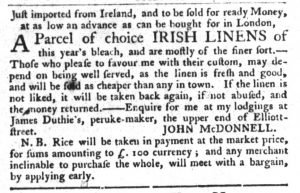
Oct 20 - 10:20:1767 South-Carolina Gazette and Country Journal
South-Carolina Gazette and Country Journal (October 20, 1767).

“If the linen is not liked, it will be taken back again, if not abused, and the money returned.”

In the fall of 1767 John McDonnell advertised “A Parcel of choice IRISH LINENS” in the South-Carolina Gazette and Country Journal. To entice potential buyers he resorted to several marketing appeals. Like many other merchants and shopkeepers, he underscored price. Indeed, he mentioned low prices even before naming the merchandise, first stating that customers could acquire his wares “at as low an advance as can be bought for in London” and only then revealing that he sold linens. Even though they had been transported across the Atlantic that did not raise the cost he charged for Irish linens in Charleston; local buyers enjoyed the same prices as their counterparts in faraway London. In addition, McDonnell pledged that he would not be undercut by any of his competitors, vowing to sell his linens “as cheaper than any in town.”

McDonnell also offered another opportunity for a potential customer to enjoy a discount, provided they had a willingness to purchase in bulk. “[A]ny merchant inclinable to purchase the whole,” he proclaimed, “will meet with a bargain.” McDonnell understood that he stood to generate greater revenues by selling his entire inventory at a reduced price than gradually selling smaller lots and perhaps ending up with surplus linens that never sold. (He was also willing to barter with customers who bought in bulk, accepting rice rather than cash.)

Yet emphasizing the low price was not the only marketing strategy McDonnell advanced in his advertisement. He also offered a money-back guarantee: “If the linen is not liked, it will be taken back again, if not abused, and the money returned.” He did stipulate one condition, that he would only accept returns and pay refunds if unsatisfied customers returned the merchandise in the same condition they purchased it. He needed to protect his own interests even as he proposed an arrangement that worked in potential customers’ favor.

Relying exclusively on text without images, McDonnell constructed a vibrant advertisement to convince readers to purchase his imported Irish linens. He made nods toward quality and customer service, but repeatedly emphasized low prices and bargains for consumers. If that was not enough to attract buyers, he also provided additional assurances about quality via an innovative money-back guarantee. Readers had nothing to lose if they gave McDonnell and his linens a chance.

Slavery Advertisements Published October 20, 1767

The Slavery Adverts 250 Project chronicles the role of newspaper advertising in perpetuating slavery in the era of the American Revolution. The project seeks to reveal the ubiquity of slavery in eighteenth-century life from New England to Georgia by republishing advertisements about enslaved people – for sale as individuals or in groups, wanted to purchase or for hire for short periods, runaways who liberated themselves, and those who were subsequently captured and confined in jails and workhouses – in daily digests on this site as well as in real time via the @SlaveAdverts250 Twitter feed, utilizing twenty-first-century media to stand in for the print media of the eighteenth century.

The project aims to provide modern audiences with a sense of just how often colonizers encountered these advertisements in their daily lives. Enslaved men, women, and children appeared in print somewhere in the colonies almost every single day. Those advertisements served as a constant backdrop for social, cultural, economic, and political life in colonial and revolutionary America. Colonizers who did not purport to own enslaved people were still confronted with slavery as well as invited to maintain the system by purchasing enslaved men, women, and children or assisting in the capture of so-called “runaways” who sought to free themselves from bondage. The frequency of these newspaper advertisements suggests just how embedded slavery was in colonial and revolutionary American culture in everyday interactions beyond the printed page.

These advertisements also testify to the experiences of enslaved men, women, and children, though readers must consider that those experiences have been remediated through descriptions offered by enslavers rather than enslaved people themselves. Often unnamed in the advertisements, enslaved men, women, and children were not invisible or unimportant in early America.

These advertisements appeared in colonial American newspapers 250 years ago today.

Oct 20 - South-Carolina Gazette and Country Journal Slavery 1
South-Carolina Gazette and Country Journal (October 20, 1767).

**********

Oct 20 - South-Carolina Gazette and Country Journal Slavery 2
South-Carolina Gazette and Country Journal (October 20, 1767).

**********

Oct 20 - South-Carolina Gazette and Country Journal Slavery 3
South-Carolina Gazette and Country Journal (October 20, 1767).

**********

Oct 20 - South-Carolina Gazette and Country Journal Slavery 4
South-Carolina Gazette and Country Journal (October 20, 1767).

**********

Oct 20 - South-Carolina Gazette and Country Journal Slavery 5
South-Carolina Gazette and Country Journal (October 20, 1767).

**********

Oct 20 - South-Carolina Gazette and Country Journal Slavery 6
South-Carolina Gazette and Country Journal (October 20, 1767).

**********

Oct 20 - South-Carolina Gazette and Country Journal Slavery 7
South-Carolina Gazette and Country Journal (October 20, 1767).

**********

Oct 20 - South-Carolina Gazette and Country Journal Slavery 8
South-Carolina Gazette and Country Journal (October 20, 1767).

**********

Oct 20 - South-Carolina Gazette and Country Journal Slavery 9
South-Carolina Gazette and Country Journal (October 20, 1767).

**********

Oct 20 - South-Carolina Gazette and Country Journal Slavery 10
South-Carolina Gazette and Country Journal (October 20, 1767).

**********

Oct 20 - South-Carolina Gazette and Country Journal Slavery 11
South-Carolina Gazette and Country Journal (October 20, 1767).

**********

Oct 20 - South-Carolina Gazette and Country Journal Slavery 12
South-Carolina Gazette and Country Journal (October 20, 1767).

**********

Oct 20 - South-Carolina Gazette and Country Journal Slavery 13
South-Carolina Gazette and Country Journal (October 20, 1767).

October 19

What was advertised in a colonial American newspaper 250 years ago today?

Oct 19 - 10:19:1767 Boston-Gazette
Boston-Gazette (October 19, 1767).

“We are oblig’d to give a SUPPLEMENT.”

Edes and Gill placed their own announcement immediately before the “New Advertisements” in the October 19, 1767, edition of the Boston-Gazette. In it, they explained that within the last three days three ships had arrived in port from London. The captains brought with them the “Prints to the 19th of August,” which they passed along to the printers. In other words, Edes and Gill had just obtained recent (or as recent as could be expected given the time required to cross the Atlantic) newspapers. As was common practice in the eighteenth century, their method of reporting involved reprinting items directly from other publications.

Edes and Gill did not have much time to scan the London newspapers, choose which items to reprint, set the type, and operate the presses before distributing the Boston-Gazette on Monday, its usual publication day. They might have been able to include news that had arrived the previous Friday, if they were industrious, but it would have been impossible to insert anything delivered by the captain who arrived on Sunday night. Setting type and operating the press by hand required more time, even if they quickly identified which items to reprint in their own newspaper.

Still, they wanted to get recently arrived news in print and distributed to their subscribers as quickly as possible. To that end, they determined “to give a SUPPLEMENT at Three o’Clock this Afternoon” and instructed their customers “to call or send for them” at that time if they wished to know the “Articles of Intelligence” delivered on the recently arrived vessels. The Boston Evening-Post and the Boston Post-Boy both also published supplements that day. None of the local newspapers usually published on Mondays allowed the others to scoop them.

Edes and Gill offered an additional explanation for their decision to limit the amount of news from London in the standard issue in favor of filling the supplement with those “Articles of Intelligence.” They reasoned that they needed “to give our Advertizing Customers a good Place.” They considered this a favor and a service to their advertisers, but it also suggested that they realized that even though readers might often be eager to peruse the advertisements that at the moment they prioritized the news, especially since the Townshend Acts were scheduled to go into effect in just a month. Subscribers might (or might not) call or send for a supplement filled with advertisements later in the day, but they would certainly retrieve a supplement that included the most recent political news from London. Edes and Gill implicitly acknowledged that they had a responsibility to place their advertisers’ notices in front of as many eyes as possible rather than consigning them to a separate supplement, distributed at a later time, that might not be read. This was good business that promoted loyalty among their advertisers and encouraged others to consider placing their advertisements in the Boston-Gazette.

Slavery Advertisements Published October 19, 1767

The Slavery Adverts 250 Project chronicles the role of newspaper advertising in perpetuating slavery in the era of the American Revolution. The project seeks to reveal the ubiquity of slavery in eighteenth-century life from New England to Georgia by republishing advertisements about enslaved people – for sale as individuals or in groups, wanted to purchase or for hire for short periods, runaways who liberated themselves, and those who were subsequently captured and confined in jails and workhouses – in daily digests on this site as well as in real time via the @SlaveAdverts250 Twitter feed, utilizing twenty-first-century media to stand in for the print media of the eighteenth century.

The project aims to provide modern audiences with a sense of just how often colonizers encountered these advertisements in their daily lives. Enslaved men, women, and children appeared in print somewhere in the colonies almost every single day. Those advertisements served as a constant backdrop for social, cultural, economic, and political life in colonial and revolutionary America. Colonizers who did not purport to own enslaved people were still confronted with slavery as well as invited to maintain the system by purchasing enslaved men, women, and children or assisting in the capture of so-called “runaways” who sought to free themselves from bondage. The frequency of these newspaper advertisements suggests just how embedded slavery was in colonial and revolutionary American culture in everyday interactions beyond the printed page.

These advertisements also testify to the experiences of enslaved men, women, and children, though readers must consider that those experiences have been remediated through descriptions offered by enslavers rather than enslaved people themselves. Often unnamed in the advertisements, enslaved men, women, and children were not invisible or unimportant in early America.

These advertisements appeared in colonial American newspapers 250 years ago today.

Oct 19 - Boston Evening-Post Slavery 1
Boston Evening-Post (October 19, 1767).

**********

Oct 19 - Boston Post-Boy Slavery 1
Boston Post-Boy (October 19, 1767).

**********

Oct 19 - Boston Post-Boy Slavery 2
Boston Post-Boy (October 19, 1767).

**********

Oct 19 - Boston Post-Boy Slavery 3
Supplement to the Boston Post-Boy (October 19, 1767).

**********

Oct 19 - Boston-Gazette Slavery 1
Boston-Gazette (October 19, 1767).

**********

Oct 19 - Boston-Gazette Slavery 2
Boston-Gazette (October 19, 1767).

**********

Oct 19 - Boston-Gazette Slavery 3
Boston-Gazette (October 19, 1767).

**********

Oct 19 - Boston-Gazette Slavery 4
Boston-Gazette (October 19, 1767).

**********

Oct 19 - Boston-Gazette Slavery 5
Boston-Gazette (October 19, 1767).

**********

Oct 19 - New-York Mercury Slavery 1
Supplement to the New-York Mercury (October 19, 1767).

**********

Oct 19 - New-York Mercury Slavery 2
Supplement to the New-York Mercury (October 19, 1767).

**********

Oct 19 - New-York Mercury Slavery 3
Supplement to the New-York Mercury (October 19, 1767).

**********

Oct 19 - New-York Mercury Slavery 4
Supplement to the New-York Mercury (October 19, 1767).

**********

Oct 19 - Newport Mercury Slavery 1
Newport Mercury (October 19, 1767).

October 18

What was advertised in a colonial American newspaper 250 years ago this week?

Oct 18 - 10:15:1767 Massachusetts Gazette
Massachusetts Gazette (October 15, 1767).

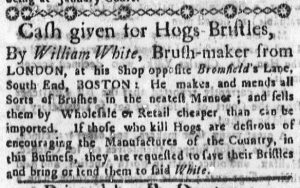
“Desirous of encouraging the Manufactures of the Country.”

During the imperial crisis that led to the American Revolution colonists resisted Parliamentary overreach with several non-importation and non-consumption agreements, each coinciding with particular legislative acts. The first round occurred in response to the Stamp Act, ceasing with the repeal of that hated measure. Colonists once again resorted to non-importation and non-consumption of British goods in response to the Townshend Acts, scheduled to take effect on November 20, 1767.

Throughout the last third of the eighteenth century, as colonists moved from resistance to revolution to independence, American advertisers developed marketing appeals that encouraged consumers to “Buy American.” Over time advertisers became much more explicit in their efforts linking consumption to political participation. A notice that appeared in the Massachusetts Gazette five weeks before the Townshend Acts took effect shows an early attempt. William White, a “Brush-maker from LONDON,” did not mention Parliament or the impending legislation, but readers would have made the connection on their own thanks to news items and opinion pieces elsewhere in Boston’s newspapers as well as conversations taking place throughout the city and beyond.

White encouraged potential customers to support domestic production rather than purchase imported wares. He noted that he made and sold brushes “Wholesale or Retail cheaper than can be imported,” prompting consumers to think about the origins of all the goods they acquired, not just the brushes they purchased from him. He also implicitly issued a challenge to retailers to acquire and distribute locally produced goods: presumably those who purchased brushes “Wholesale” did so with the intention of selling them in their own shops.

White framed his comments about the cost of his brushes with a statement even more overtly political. He made an appeal to colonists who were “desirous of encouraging the Manufactures of the Country” rather than continued importation of goods from England. Here he addressed colonists who could supply him with the bristles he needed to make “all Sorts of Brushes.” Not just consumers but producers as well had a duty to support local production over importation. In addition, even though White described his potential suppliers as “desirous of encouraging the Manufacturers of the Country” he implied that consumers should adopt the same attitude and opt to purchase their brushes from him.

William White did not invoke Parliament or the Townshend Acts by name in his advertisement, but contemporary politics still influenced how he structured his appeal to potential customers and how colonists interpreted his advertisement. He did not need to make his case any more explicitly because his advertisement was part of an ongoing conversation – in print and in person – among residents of Boston and throughout the colonies.

October 17

What was advertised in a colonial American newspaper 250 years ago today?

Oct 17 - 10:17:1767 Providence Gazette
Providence Gazette (October 17, 1767).

“NOW IN THE PRESS, … THE NEW-ENGLAND ALMANACK.”

As surely as leaves turned colors and then fell from trees in the fall, colonists had another reminder of the changing seasons and the approach of a new year: advertisements for almanacs published in newspapers throughout the colonies. Some printers and booksellers placed notices as early as September, prompting potential customers to anticipate the impending publication of the most accurate and most fashionable almanacs. Others began promoting their almanacs in October, but the advertisements became more frequent and more extensive in November and December. Although printers and booksellers attempted to gauge demand, some always ended up with surplus almanacs that they then advertised well into the new year.

Sarah Goddard and John Carter, printers of the Providence Gazette, made an early start on printing and advertising the New-England Almanack, or, Lady’s and Gentleman’s Diary, for the Year of Our Lord 1768. Potential customers still had nearly eleven weeks to acquire their almanacs, but Goddard and Carter knew that their printing office would face competition from the many printers and booksellers in Boston who marketed competing volumes. Advertising early raised the visibility of their almanac, perhaps giving it a privileged place in the minds of potential customers who would eventually encounter other options. Using advertisements to make their almanac familiar to readers could have instilled a sense of loyalty even before they were available for purchase.

Goddard and Carter’s advertisement for the New-England Almanack, relatively sparse in terms of words and space, served as an initial announcement. Upon publication, the printers introduced more extensive advertisements that included the table of contents and listed the price (both by the dozen and singles). In that manner, some advertisements for almanacs offered yet another visual marker of the passing seasons. As the new year drew closer, advertisements for almanacs became lengthier. Just as modern Americans have grown accustomed to certain advertising practices timed to the holiday season, early American readers experienced annual rhythms of marketing for almanacs as the newspaper advertisements became more frequent and more prominent before fading after the new year.

Slavery Advertisements Published October 17, 1767

The Slavery Adverts 250 Project chronicles the role of newspaper advertising in perpetuating slavery in the era of the American Revolution. The project seeks to reveal the ubiquity of slavery in eighteenth-century life from New England to Georgia by republishing advertisements about enslaved people – for sale as individuals or in groups, wanted to purchase or for hire for short periods, runaways who liberated themselves, and those who were subsequently captured and confined in jails and workhouses – in daily digests on this site as well as in real time via the @SlaveAdverts250 Twitter feed, utilizing twenty-first-century media to stand in for the print media of the eighteenth century.

The project aims to provide modern audiences with a sense of just how often colonizers encountered these advertisements in their daily lives. Enslaved men, women, and children appeared in print somewhere in the colonies almost every single day. Those advertisements served as a constant backdrop for social, cultural, economic, and political life in colonial and revolutionary America. Colonizers who did not purport to own enslaved people were still confronted with slavery as well as invited to maintain the system by purchasing enslaved men, women, and children or assisting in the capture of so-called “runaways” who sought to free themselves from bondage. The frequency of these newspaper advertisements suggests just how embedded slavery was in colonial and revolutionary American culture in everyday interactions beyond the printed page.

These advertisements also testify to the experiences of enslaved men, women, and children, though readers must consider that those experiences have been remediated through descriptions offered by enslavers rather than enslaved people themselves. Often unnamed in the advertisements, enslaved men, women, and children were not invisible or unimportant in early America.

These advertisements appeared in colonial American newspapers 250 years ago today.

Oct 17 - Providence Gazette Slavery 1
Providence Gazette (October 17, 1767).