February 13

Who was the subject of an advertisement in a colonial American newspaper 250 years ago today?

Feb 13 - 2:13:1768 Providence Gazette
Providence Gazette (February 13, 1768).

“TO BE SOLD … A healthy likely Negroe Wench.”

The pages of colonial newspapers regularly featured black women, including the unnamed “healthy likely Negroe Wench” that John Lyon advertised for sale in the February 13, 1768, edition of the Providence Gazette. These women appeared either as commodities to be bought and sold or as fugitives who seized their own freedom in an era that white colonists debated the meaning of liberty within the British Empire.

As a result of their bondage and the complicit role the eighteenth-century press played in maintaining systems of unfree labor, black women were more likely to appear in the public prints among “the freshest Advices, both Foreign and Domestic” than white women. News items sometimes mentioned notable women. Female shopkeepers occasionally placed advertisements, but not in proportion to their numbers in the marketplace. Widows affixed their names as executrixes and administrators to legal notices when they settled the estates of their deceased husbands. English, Irish, and other women of European origins were often the subject of advertisements for runaway indentured servants, especially in newspapers published in New York and Pennsylvania, but throughout the colonies black women – both Africans and African Americans – achieved an unsettling prominence among the paid notices inserted in newspapers. Barely a day passed in the 1760s that at least one newspaper did not feature at least one advertisement about one or more enslaved women and girls.

Those advertisements help to reconstruct the history of black women in early America, even though the advertisements provide only truncated stories. Consider the “Negroe Wench” from today’s advertisement. Even though she could “do all Kinds of House-Work” well enough that her master found “no Fault” with her efforts, Lyon decided to sell her “on Account of her breeding fast.” In other words, the unnamed woman had too many children too quickly. Yet the advertisement does not reveal anything about the woman’s relationships with others in the household or the community. Who was the father of her children? A fellow slave or a free black man? A member of the Lyon household? John Lyon himself? This advertisement quite likely chronicled a sexual relationship that was not consensual, even though the wording places the blame on the unnamed woman for “breeding fast.” What of the “two male Children” also offered for sale? Were these children the unwanted result of the woman “breeding fast”? If so, did Lyon sell them with their mother or separate the family? The advertisement hints at the experiences of an unnamed enslaved woman yet reveals precious few details. In broad strokes, it paints a picture of the experiences of countless enslaved women in early America.

Slavery Advertisements Published February 13, 1768

The Slavery Adverts 250 Project chronicles the role of newspaper advertising in perpetuating slavery in the era of the American Revolution. The project seeks to reveal the ubiquity of slavery in eighteenth-century life from New England to Georgia by republishing advertisements about enslaved people – for sale as individuals or in groups, wanted to purchase or for hire for short periods, runaways who liberated themselves, and those who were subsequently captured and confined in jails and workhouses – in daily digests on this site as well as in real time via the @SlaveAdverts250 Twitter feed, utilizing twenty-first-century media to stand in for the print media of the eighteenth century.

The project aims to provide modern audiences with a sense of just how often colonizers encountered these advertisements in their daily lives. Enslaved men, women, and children appeared in print somewhere in the colonies almost every single day. Those advertisements served as a constant backdrop for social, cultural, economic, and political life in colonial and revolutionary America. Colonizers who did not purport to own enslaved people were still confronted with slavery as well as invited to maintain the system by purchasing enslaved men, women, and children or assisting in the capture of so-called “runaways” who sought to free themselves from bondage. The frequency of these newspaper advertisements suggests just how embedded slavery was in colonial and revolutionary American culture in everyday interactions beyond the printed page.

These advertisements also testify to the experiences of enslaved men, women, and children, though readers must consider that those experiences have been remediated through descriptions offered by enslavers rather than enslaved people themselves. Often unnamed in the advertisements, enslaved men, women, and children were not invisible or unimportant in early America.

These advertisements appeared in colonial American newspapers 250 years ago today.

Feb 13 - Providence Gazette Slavery 1
Providence Gazette (February 13, 1768).

**********

Feb 13 - Providence Gazette Slavery 2
Providence Gazette (February 13, 1768).

February 12

What was advertised in a colonial American newspaper 250 years ago today?

Feb 12 - 2:12:1768 New-London Gazette
New-London Gazette (February 12, 1768).

“Lemuel Pattingell … Fabricates and Sells, THE best jerk’d BUTTONS.”

In February 1768, Lemuel Pattingell inserted an advertisement in the New-London Gazette to inform readers that he “Fabricates and Sells, THE best jerk’d BUTTONS.” In addition to their high quality, Pattingell’s buttons were also durable. He proclaimed that they “wear at least twice so long as those Imported.” Potential customers who might have been skeptical of these claimes could examine the buttons for themselves before contacting Pattingell. He announced that “Samples … may be seen at the Printing Office in N. London.” Although brief, this advertisement tapped into concerns about production, consumption, and politics in the colonies and the empire that had gained prominence in the fall of 1767 and continued for months in the public prints.

Colonists found themselves at a disadvantage when it came to a trade deficit with Britain. Many merchants and shopkeepers expressed a preference for dealing in cash rather than credit in their advertisements, hoping to staunch the flow of specie out of the colonies and across the Atlantic. Parliament exacerbated discontent over this situation when it decided to impose new duties on certain imported goods in the Townshend Act. Several weeks before it went into effect in late November 1767, the Boston town meeting voted to initiate a nonimportation agreement to commence at the beginning of the new year. Simultaneously, they also voted to encourage domestic production in whatever way possible, including consuming goods produced in the colonies. As word about these developments spread, both in print and via conversation, other towns adopted similar measures. Consumers’ decisions about which goods to purchase became increasingly politicized as fall became winter.

Pattingell’s advertisement appeared among news and advertisements that advanced those discussions. Elsewhere on the same page of the February 12, 1768, issue of the New-London Gazette, John Armbruester advertised the “Choice GENEVA” he distilled in Norwich. The twelfth and final letter in John Dickinson’s “Letters from a Farmer in Pennsylvania to the Inhabitants of the British Colonies” dominated the first and second pages. Advertisers often liked to suggest that imported goods, including adornments like buttons, possessed cosmopolitan cachet, but that appeal fell out of favor when the imperial crisis intensified and colonists turned to homespun cloth and other goods produced locally. Pattingell’s emphasis on quality and durability addressed the primary concerns of potential customers at the time he placed his advertisement. In turn, that advertisement further shaped public discourse about the politics of consumption, demonstrating to consumers that they could purchase goods made in the colonies rather than relying on imports.

Slavery Advertisements Published February 12, 1768

The Slavery Adverts 250 Project chronicles the role of newspaper advertising in perpetuating slavery in the era of the American Revolution. The project seeks to reveal the ubiquity of slavery in eighteenth-century life from New England to Georgia by republishing advertisements about enslaved people – for sale as individuals or in groups, wanted to purchase or for hire for short periods, runaways who liberated themselves, and those who were subsequently captured and confined in jails and workhouses – in daily digests on this site as well as in real time via the @SlaveAdverts250 Twitter feed, utilizing twenty-first-century media to stand in for the print media of the eighteenth century.

The project aims to provide modern audiences with a sense of just how often colonizers encountered these advertisements in their daily lives. Enslaved men, women, and children appeared in print somewhere in the colonies almost every single day. Those advertisements served as a constant backdrop for social, cultural, economic, and political life in colonial and revolutionary America. Colonizers who did not purport to own enslaved people were still confronted with slavery as well as invited to maintain the system by purchasing enslaved men, women, and children or assisting in the capture of so-called “runaways” who sought to free themselves from bondage. The frequency of these newspaper advertisements suggests just how embedded slavery was in colonial and revolutionary American culture in everyday interactions beyond the printed page.

These advertisements also testify to the experiences of enslaved men, women, and children, though readers must consider that those experiences have been remediated through descriptions offered by enslavers rather than enslaved people themselves. Often unnamed in the advertisements, enslaved men, women, and children were not invisible or unimportant in early America.

These advertisements appeared in colonial American newspapers 250 years ago today.

Feb 12 - South-Carolina and American General Gazette Slavery 1
South-Carolina and American General Gazette (February 12, 1768).

**********

Feb 12 - South-Carolina and American General Gazette Slavery 2
South-Carolina and American General Gazette (February 12, 1768).

**********

Feb 12 - South-Carolina and American General Gazette Slavery 3
South-Carolina and American General Gazette (February 12, 1768).

**********

Feb 12 - South-Carolina and American General Gazette Slavery 4
South-Carolina and American General Gazette (February 12, 1768).

**********

Feb 12 - South-Carolina and American General Gazette Slavery 5
South-Carolina and American General Gazette (February 12, 1768).

**********

Feb 12 - South-Carolina and American General Gazette Slavery 6
South-Carolina and American General Gazette (February 12, 1768).

**********

Feb 12 - South-Carolina and American General Gazette Slavery 7
South-Carolina and American General Gazette (February 12, 1768).

**********

Feb 12 - South-Carolina and American General Gazette Slavery 8
South-Carolina and American General Gazette (February 12, 1768).

**********

Feb 12 - South-Carolina and American General Gazette Slavery 9
South-Carolina and American General Gazette (February 12, 1768).

**********

Feb 12 - South-Carolina and American General Gazette Slavery 10
South-Carolina and American General Gazette (February 12, 1768).

**********

Feb 12 - South-Carolina and American General Gazette Slavery 11
South-Carolina and American General Gazette (February 12, 1768).

**********

Feb 12 - South-Carolina and American General Gazette Slavery 12
South-Carolina and American General Gazette (February 12, 1768).

**********

Feb 12 - South-Carolina and American General Gazette Slavery 13
South-Carolina and American General Gazette (February 12, 1768).

**********

Feb 12 - South-Carolina and American General Gazette Slavery 14
South-Carolina and American General Gazette (February 12, 1768).

**********

Feb 12 - South-Carolina and American General Gazette Slavery 15
South-Carolina and American General Gazette (February 12, 1768).

**********

Feb 12 - South-Carolina and American General Gazette Slavery 16
South-Carolina and American General Gazette (February 12, 1768).

February 11

What was advertised in a colonial American newspaper 250 years ago today?

Feb 11 - 2:11:1768 Massacusetts Gazette
Massachusetts Gazette (February 11, 1768).

“*** Country Customers may be supplied as well by Letter as if present.”

When his partner passed away, Nicholas Bowes placed an advertisement in the Massachusetts Gazette. In it, he issued an invitation for “all Persons that have Accounts open with said Company to come and settle them.” Yet he also wanted current, former, and prospective customers to know that he continued to sell books and stationery “at the same Shop.” Bowes devoted about half of the space in his advertisement to a nota bene that announced the continuation of the business that he had previously operated with Wharton.

To that end, Bowes advanced several marketing appeals. Like many merchants and shopkeepers, he promised consumers that he offered a variety of choices among his “large and compleat Assortment” of books and stationery. Customers could select items that matched their own needs and tastes. Bowes also sold his wares “at the lowest Rates,” attempting to draw visitors to his shop with competitive prices. In making those appeals, Bowes resorted to two of the most common marketing strategies in eighteenth-century newspaper advertisements. He saved his most innovative appeal for last: “*** Country Customers may be supplied as well by Letter as if present.” He even used distinctive typography – the asterisks and italics – as a visual means of attracting notice to that particular effort to market his merchandise. For the convenience of those who lived outside the busy port and faraway from his shop he made available all of the same benefits enjoyed by his local patrons. In proclaiming that distant customers “may be supplied as well by Letter as if present,” he pledged not to show any preferences or to take advantage of those who submitted their orders through the mail.

Retailers did not invent mail order shopping in the late nineteenth century, despite the proliferation and popularity of catalog shopping during the period. Nor did Bowes pioneer the strategy in the mid eighteenth century … but Bowes did offer a service that was not yet a standard practice promoted to potential customers via advertising. Merchants and shopkeepers sporadically made note that they served customers via the post in their newspaper notices, suggesting that the practice was fairly common even if it had not yet been codified as one of the standard marketing strategies that appeared in print. By inserting it into his advertisement, Bowes confirmed that he did provide this service, expanding his potential market to the hinterlands beyond Boston.

Slavery Advertisements Published February 11, 1768

The Slavery Adverts 250 Project chronicles the role of newspaper advertising in perpetuating slavery in the era of the American Revolution. The project seeks to reveal the ubiquity of slavery in eighteenth-century life from New England to Georgia by republishing advertisements about enslaved people – for sale as individuals or in groups, wanted to purchase or for hire for short periods, runaways who liberated themselves, and those who were subsequently captured and confined in jails and workhouses – in daily digests on this site as well as in real time via the @SlaveAdverts250 Twitter feed, utilizing twenty-first-century media to stand in for the print media of the eighteenth century.

The project aims to provide modern audiences with a sense of just how often colonizers encountered these advertisements in their daily lives. Enslaved men, women, and children appeared in print somewhere in the colonies almost every single day. Those advertisements served as a constant backdrop for social, cultural, economic, and political life in colonial and revolutionary America. Colonizers who did not purport to own enslaved people were still confronted with slavery as well as invited to maintain the system by purchasing enslaved men, women, and children or assisting in the capture of so-called “runaways” who sought to free themselves from bondage. The frequency of these newspaper advertisements suggests just how embedded slavery was in colonial and revolutionary American culture in everyday interactions beyond the printed page.

These advertisements also testify to the experiences of enslaved men, women, and children, though readers must consider that those experiences have been remediated through descriptions offered by enslavers rather than enslaved people themselves. Often unnamed in the advertisements, enslaved men, women, and children were not invisible or unimportant in early America.

These advertisements appeared in colonial American newspapers 250 years ago today.

Feb 11 - Massachusetts Gazette Extraordinary Slavery 1
Massachusetts-Gazette Extraordinary (February 11, 1768).

**********

Feb 11 - Massachusetts Gazette Slavery 1
Massachusetts Gazette (February 11, 1768).

**********

Feb 11 - New-York Gazette Weekly Mercury Extraordinary Slavery 1
New-York Gazette and the Weekly Mercury Extraordinary (February 11, 1768).

**********

Feb 11 - New-York Gazette Weekly Mercury Extraordinary Slavery 2
New-York Gazette and the Weekly Mercury Extraordinary (February 11, 1768).

**********

Feb 11 - New-York Journal Slavery 1
New-York Journal (February 11, 1768).

**********

Feb 11 - Pennsylvania Gazette Slavery 1
Pennsylvania Gazette (February 11, 1768).

**********

Feb 11 - Virginia Gazette Purdie and Dixon Slavery 1
Virginia Gazette [Purdie & Dixon] (February 11, 1768).

**********

Feb 11 - Virginia Gazette Purdie and Dixon Slavery 2
Virginia Gazette [Purdie & Dixon] (February 11, 1768).

**********

Feb 11 - Virginia Gazette Purdie and Dixon Slavery 3
Virginia Gazette [Purdie & Dixon] (February 11, 1768).

**********

Feb 11 - Virginia Gazette Purdie and Dixon Slavery 4
Virginia Gazette [Purdie & Dixon] (February 11, 1768).

**********

Feb 11 - Virginia Gazette Purdie and Dixon Slavery 5
Virginia Gazette [Purdie & Dixon] (February 11, 1768).

**********

Feb 11 - Virginia Gazette Purdie and Dixon Slavery 6
Virginia Gazette [Purdie & Dixon] (February 11, 1768).

**********

Feb 11 - Virginia Gazette Purdie and Dixon Slavery 7
Virginia Gazette [Purdie & Dixon] (February 11, 1768).

**********

Feb 11 - Virginia Gazette Purdie and Dixon Slavery 8
Virginia Gazette [Purdie & Dixon] (February 11, 1768).

**********

Feb 11 - Virginia Gazette Rind Slavery 1
Virginia Gazette [Rind] (February 11, 1768).

**********

Feb 11 - Virginia Gazette Rind Slavery 2
Virginia Gazette [Rind] (February 11, 1768).

**********

Feb 11 - Virginia Gazette Rind Slavery 3
Virginia Gazette [Rind] (February 11, 1768).

**********

Feb 11 - Virginia Gazette Rind Slavery 4
Virginia Gazette [Rind] (February 11, 1768).

February 10

Who were the subjects of an advertisement in a colonial American newspaper 250 years ago today?

Feb 10 - 2:10:1768 Georgia Gazette
Georgia Gazette (February 10, 1768).

“RUN AWAY WITH … A SQUARE STERN PILOT-BOAT.”

When Captain Samuel Covell departed Savannah for Barbados in early February 1768 the Elizabeth and Mary sailed without three members of its crew. James Colmy, John Roche, and Alexander Sim had deserted while the ship was in port. That these sailors chose not to continue on the Elizabeth and Mary was not itself out of the ordinary, but their choice to steal a boat from William Lyford attracted more attention than they might otherwise have received.

Lyford placed an advertisement in the February 10 edition of the Georgia Gazette, the first issue published after Colmy, Roche, and Sim stole his “SQUARE STERN PILOT-BOAT” sometime in the night of February 5. To aid in apprehending the fugitive seamen, Lyford provided descriptions of the thieves and his boat. In addition, he indicated that one of his slaves had been kidnapped in the process of stealing his boat. He reported that “there was on board a DARK INDIAN FELLOW, who speaks good English, also the property of the said William Lyford, who it is supposed was asleep in the hold when the above men stole the vessel.”

Lyford may have been correct that the unnamed “INDIAN FELLOW” had been asleep and even unnoticed by the thieves when they made off with his pilot boat, but that was not the only possibility. Sensing an opportunity to gain his freedom, the enslaved Indian may have collaborated with the fugitive sailors in stealing the vessel, choosing not to resist or raise an alarm even if he had been surprised when they first boarded. If he was familiar with local waterways, the unnamed Indian could have been a valuable ally in making the escape and avoiding detection. Colmy, Roche, and Sim may have welcomed him as a partner in their adventure. After all, eighteenth-century mariners practiced an egalitarianism that often overlooked race in favor of emphasizing skill, status, and similar experiences. The “INDIAN FELLOW” and the sailors may have both embraced circumstances that allowed them to cooperate for mutual benefit as they ran away from the masters – whether slaveholders or captains – who exercised power over them.

Summary of Slavery Advertisements Published February 4-10, 1768

These tables indicate how many advertisements for slaves appeared in colonial American newspapers during the week of February 4-10, 1768.

Note:  These tables are as comprehensive as currently digitized sources permit, but they may not be an exhaustive account.  They includes all newspapers that have been digitized and made available via Accessible Archives, Colonial Williamsburg’s Digital Library, and Readex’s America’s Historical Newspapers.  There are several reasons some newspapers may not have been consulted:

  • Issues that are no longer extant;
  • Issues that are extant but have not yet been digitized (including the Pennsylvania Journal); and
  • Newspapers published in a language other than English (including the Wochentliche Philadelphische Staatsbote).

**********

Slavery Advertisements Published February 4-10, 1768:  By Date

Slavery Adverts Tables 1768 By Date Feb 4

**********

Slavery Advertisements Published February 4-10, 1768, 1768:  By Region

Slavery Adverts Tables 1768 By Region Feb 4

Slavery Advertisements Published February 10, 1768

The Slavery Adverts 250 Project chronicles the role of newspaper advertising in perpetuating slavery in the era of the American Revolution. The project seeks to reveal the ubiquity of slavery in eighteenth-century life from New England to Georgia by republishing advertisements about enslaved people – for sale as individuals or in groups, wanted to purchase or for hire for short periods, runaways who liberated themselves, and those who were subsequently captured and confined in jails and workhouses – in daily digests on this site as well as in real time via the @SlaveAdverts250 Twitter feed, utilizing twenty-first-century media to stand in for the print media of the eighteenth century.

The project aims to provide modern audiences with a sense of just how often colonizers encountered these advertisements in their daily lives. Enslaved men, women, and children appeared in print somewhere in the colonies almost every single day. Those advertisements served as a constant backdrop for social, cultural, economic, and political life in colonial and revolutionary America. Colonizers who did not purport to own enslaved people were still confronted with slavery as well as invited to maintain the system by purchasing enslaved men, women, and children or assisting in the capture of so-called “runaways” who sought to free themselves from bondage. The frequency of these newspaper advertisements suggests just how embedded slavery was in colonial and revolutionary American culture in everyday interactions beyond the printed page.

These advertisements also testify to the experiences of enslaved men, women, and children, though readers must consider that those experiences have been remediated through descriptions offered by enslavers rather than enslaved people themselves. Often unnamed in the advertisements, enslaved men, women, and children were not invisible or unimportant in early America.

These advertisements appeared in colonial American newspapers 250 years ago today.

Feb 10 - Georgia Gazette Slavery 1
Georgia Gazette (February 10, 1768).

**********

Feb 10 - Georgia Gazette Slavery 2
Georgia Gazette (February 10, 1768).

**********

Feb 10 - Georgia Gazette Slavery 3
Georgia Gazette (February 10, 1768).

**********

Feb 10 - Georgia Gazette Slavery 4
Georgia Gazette (February 10, 1768).

**********

Feb 10 - Georgia Gazette Slavery 5
Georgia Gazette (February 10, 1768).

**********

Feb 10 - Georgia Gazette Slavery 6
Georgia Gazette (February 10, 1768).

**********

Feb 10 - Georgia Gazette Slavery 7
Georgia Gazette (February 10, 1768).

**********

Feb 10 - Georgia Gazette Slavery 8
Georgia Gazette (February 10, 1768).

February 9

What was advertised in a colonial American newspaper 250 years ago today?

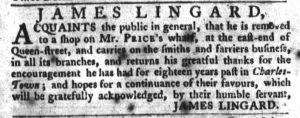
Feb 9 - 2:9:1768 South-Carolina Gazette and Country Journal
South-Carolina Gazette and Country Journal (February 9, 1768).

“Greatful thanks for the encouragement he has had for eighteen years past in Charles-Town.”

Experience matters. That was the central theme James Lingard presented in his advertisement in the February 9, 1768, edition of the South-Carolina Gazette and Country Journal. In the process of announcing that he had moved to a new location at the east end of Queen Street, Lingard expressed his appreciation to his former customers, noting that he had served the residents of Charleston for the past eighteen years. While merchants and shopkeepers occasionally referred to their years of experience in their attempts to entice customers, artisans most commonly made such appeals. Lingard, a blacksmith and farrier, continued a common practice among eighteenth-century artisans who placed newspaper advertisements.

Lingard enhanced his professional reputation by promoting his experience and expressing “his greatful thanks for the encouragement” he had received from those who had previously engaged his services. It would not have been possible for him to operate a shop in the busy port for nearly two decades had it not been for his skills in “the smiths and farriers business, in all its branches.” Still, it did not hurt to inform potential customers that he had honed those skills over the years and now possessed significant experience. For those who had resided in Charleston for quite some time, Lingard’s advertisement served as a reminder that he had been operating his shop for years. For newcomers to the city, however, Lingard seized an opportunity to inform them of his long history working with local customers.

Lingard likely attracted some of his business via word-of-mouth referrals built on his reputation. Turning to print could have been a strategy to prompt more referrals, presenting himself for consideration among members of “the public in general” who had not previously hired him but who might ask others if they had any experiences dealing with Lingard. In such situations, his appeals to skill and experience in his advertisement set the tone for conversations among customers.