May 16

What was advertised in a colonial American newspaper 250 years ago today?

May 16 - 5:16:1768 Pennsylvania Chronicle
Pennsylvania Chronicle (May 16, 1768).

“BURROWS DOWDNEY … MAKES and repairs all Kinds od Clocks and Watches.”

When it came to advertising, watch- and clockmaker Burrows Dowdney was industrious, advertising in more than one newspaper published in Philadelphia in the late 1760s. Although he deployed fairly standard language to describe his services, pledging “the utmost care and dispatch” in doing his work “after the neatest and best manner,” he adopted other means of distinguishing his advertisements from those placed by other artisans. In particular, Dowdney embellished his notices with visual images related to his occupation and his wares.

Yesterday the Adverts 250 Project examined one of those advertisements published in the Pennsylvania Gazette. It included a woodcut of an engraved clock dial with hours in Roman numerals and minutes in Arabic numerals as well as other decorative elements. Dowdney placed another advertisement in the Pennsylvania Chronicle the same week that he advertised in the Gazette, repeating the copy almost exactly but with a different and even more impressive woodcut. It depicted an elegant dial with an arched top that denoted the phases of the moon. Readers could also view the day of the month on the dial. These additional elements further testified to the complexity of the clocks Dowdney constructed, proclaiming to prospective customers that they were not intended merely for keeping time. Instead, they were meant for display, to create genteel living spaces, to impress friends and visitors. Although not depicted in the woodcut, readers could expect the ornamentation of the cases to rival the engraved dials.

Commissioning not one but two woodcuts represented a significant investment for Dowdney, but he may have considered it a necessary expense as he commenced his own business “in the Shop lately occupied by Mr. Emanuel Rouse” on Front Street. As a newcomer, he needed to attract a clientele for his shop quickly to avoid failing before even having a chance to get started. Commissioning woodcuts that featured much more detail than most of the images that appeared in colonial newspapers demonstrated his commitment and attention to detail, reassuring prospective customers that he did not merely reiterate the usual marketing pitches but did indeed construct clocks “after the neatest and best manner.” The woodcuts certified the quality and elegance associated with clocks made by Burrows Dowdney.

Slavery Advertisements Published May 16, 1768

The Slavery Adverts 250 Project chronicles the role of newspaper advertising in perpetuating slavery in the era of the American Revolution. The project seeks to reveal the ubiquity of slavery in eighteenth-century life from New England to Georgia by republishing advertisements for slaves – for sale, wanted to purchase, runaways, captured fugitives – in daily digests on this site as well as in real time via the @SlaveAdverts250 Twitter feed, utilizing twenty-first-century media to stand in for the print media of the eighteenth century.

The project aims to provide modern audiences with a sense of just how often colonists encountered these advertisements in their daily lives. Enslaved men, women, and children appeared in print somewhere in the colonies almost every single day. Those advertisements served as a constant backdrop for social, cultural, economic, and political life in colonial and revolutionary America. Colonists who did not own slaves were still confronted with slavery as well as invited to maintain the system by purchasing slaves or assisting in the capture of runaways. The frequency of these newspaper advertisements suggests just how embedded slavery was in colonial and revolutionary American culture in everyday interactions beyond the printed page.

These advertisements also testify to the experiences of enslaved men, women, and children, though readers must consider that those experiences have been remediated through descriptions offered by slaveholders rather than the slaves themselves. Often unnamed in the advertisements, enslaved men, women, and children were not invisible or unimportant in early America.

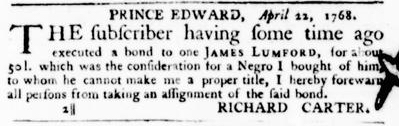
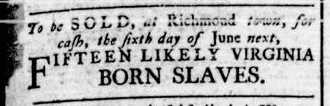
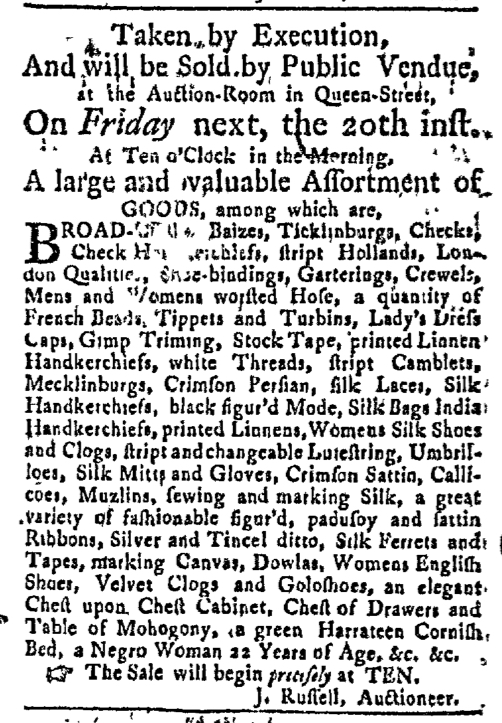
These advertisements appeared in colonial American newspapers 250 years ago today.

May 16 - Boston Evening-Post Slavery 1
Boston Evening-Post (May 16, 1768).

**********

May 16 - Boston Post-Boy Slavery 1
Boston Post-Boy (May 16, 1768).

**********

May 16 - Boston Post-Boy Slavery 2
Boston Post-Boy (May 16, 1768).

**********

May 16 - Boston-Gazette Slavery 1
Boston-Gazette (May 16, 1768).

**********

May 16 - New-York Gazette Weekly Mercury Slavery 1
New-York Gazette and Weekly Mercury (May 16, 1768).

**********

May 16 - New-York Gazette Weekly Mercury Slavery 2
New-York Gazette and Weekly Mercury (May 16, 1768).

**********

May 16 - New-York Gazette Weekly Mercury Slavery 3
New-York Gazette and Weekly Mercury (May 16, 1768).

**********

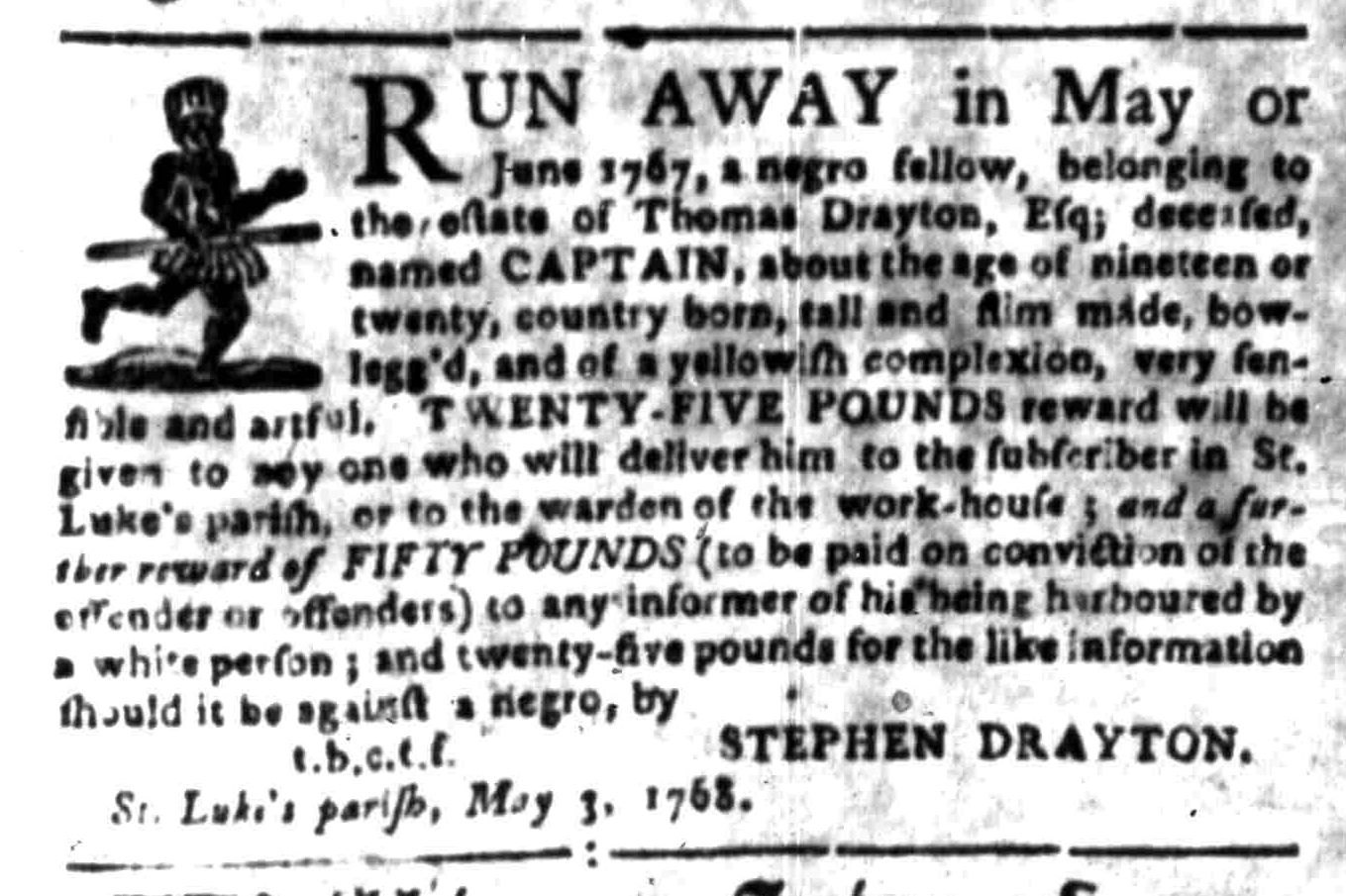
May 16 - South Carolina Gazette Slavery 1
South-Carolina Gazette (May 16, 1768).

**********

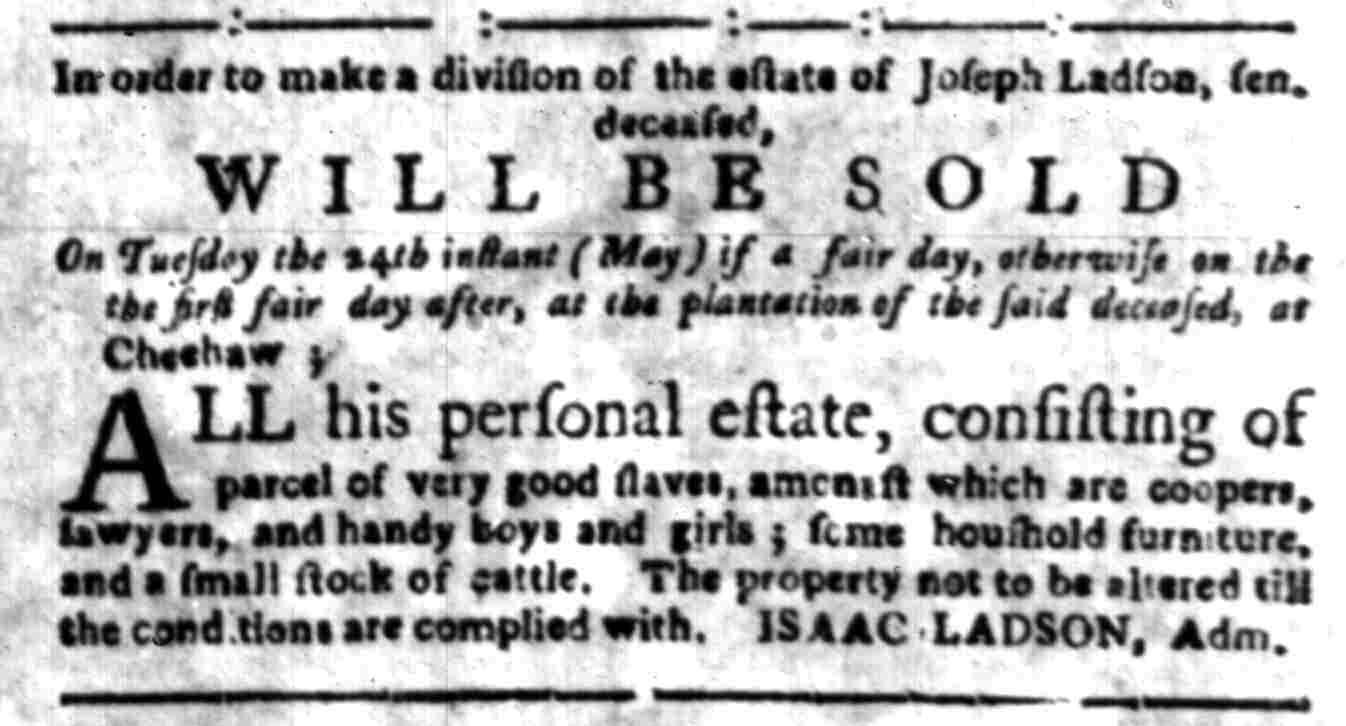
May 16 - South Carolina Gazette Slavery 2
South-Carolina Gazette (May 16, 1768).

**********

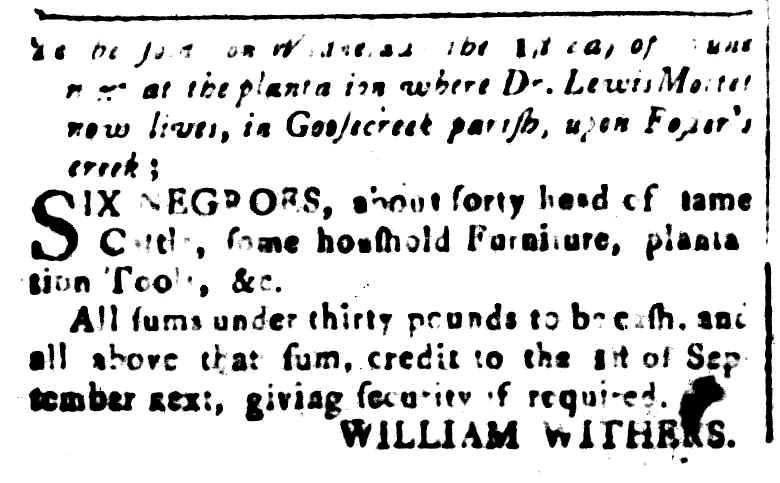
May 16 - South Carolina Gazette Slavery 3
South-Carolina Gazette (May 16, 1768).

**********

May 16 - South Carolina Gazette Slavery 4
South-Carolina Gazette (May 16, 1768).

**********

May 16 - South Carolina Gazette Supplement Slavery 1
Supplement to the South-Carolina Gazette (May 16, 1768).

**********

May 16 - South Carolina Gazette Supplement Slavery 2
Supplement to the South-Carolina Gazette (May 16, 1768).

**********

May 16 - South Carolina Gazette Supplement Slavery 3
Supplement to the South-Carolina Gazette (May 16, 1768).

**********

May 16 - South Carolina Gazette Supplement Slavery 4
Supplement to the South-Carolina Gazette (May 16, 1768).

**********

May 16 - South Carolina Gazette Supplement Slavery 5
Supplement to the South-Carolina Gazette (May 16, 1768).

**********

May 16 - South Carolina Gazette Supplement Slavery 6
Supplement to the South-Carolina Gazette (May 16, 1768).

May 15

What was advertised in an American newspaper 250 years ago this week?

May 15 - 5:12:1768 Pennsylvania Gazette Supplement
Supplement to the Pennsylvania Gazette (May 12, 1768).

“BURROWS DOWDNEY, Clock and Watch Maker, in Front-street.”

Relatively few advertisements in eighteenth-century newspapers included visual images. Those that did tended to feature stock images that belonged to the printer and could be inserted interchangeably in advertisements from the appropriate genre, such as woodcuts of horses, houses, slaves, and ships. Woodcuts of houses could be used in any real estate notice. Woodcuts depicting runaway slaves could be used in any notice alerting colonists about fugitives that might be in their midst.

Some advertisers, however, did invest in woodcuts to enliven their advertisements, distinguishing them from others that consisted solely of text or that were decorated with generic images readers were accustomed to seeing in the pages of the public prints. Unlike the stock images, these woodcuts belonged to advertisers rather than printers. Even if the image happened to match the contents of other advertisements, such woodcuts appeared only in connection to those who had commissioned them. For instance, clock- and watchmakers regularly advertised in the pages of the Pennsylvania Gazette, yet the woodcut depicting the face of a clock appeared solely in notices placed by Burrows Dowdney. That unique image made his advertisements distinctive and memorable for potential customers, especially since it was sometimes the only image on a page otherwise composed of text (as was the case on the final page of the supplement that accompanied the May 12, 1768, edition of the Pennsylvania Gazette).
Many of the woodcuts commissioned by advertisers dominated the notices in which they appeared, but that was especially true for Dowdney’s advertisement. The image of the clock dial accounted for approximately half of the space his notice occupied on the page. Readers would have been able to identify his occupation and wares at a glance, even if “CLOCKS” and “WATCHES” had not been listed in all capitals in the copy that appeared to the right of the image. Printing technologies of the period did not particularly facilitate including images in advertisements, yet some advertisers still invested both money and energy in experimenting with woodcuts that would set their advertisements apart from others that flooded the pages of eighteenth-century newspapers.

May 14

Who were the subjects of the newspaper advertisement in a colonial American newspaper 250 years ago today?

May 14 - 5:14:1768 Providence Gazette
Providence Gazette (May 14, 1768).

“RUN away … a Negroe Man Slave, named Sterling.”

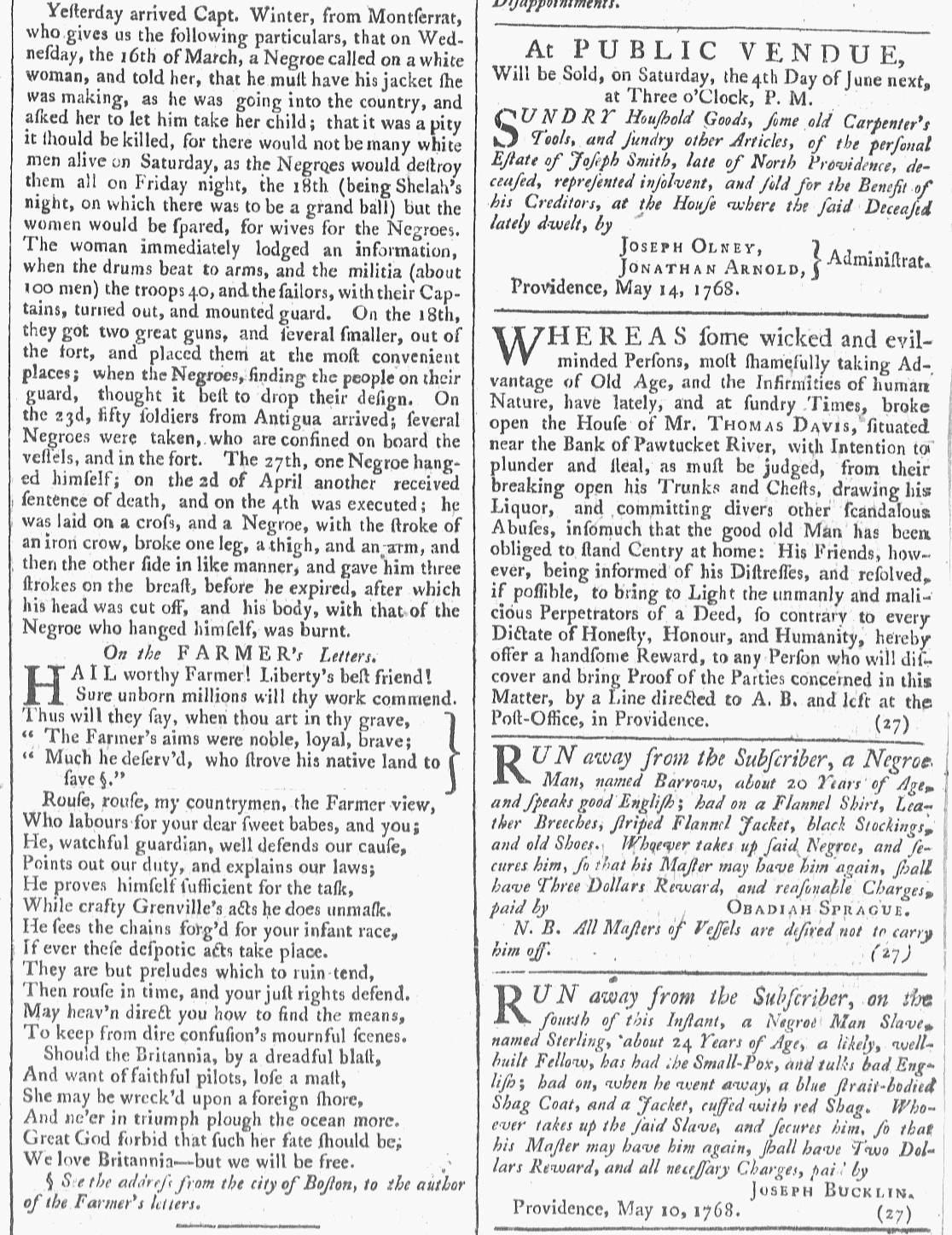
Most of the advertisements in the May 14, 1768, edition of the Providence Gazette had appeared in at least one previous issue, but Obadiah Sprague and Joseph Bucklin inserted two new notices. Both notified readers about runaway slaves, providing descriptions and offering rewards for capturing and returning them. A “Negro Man Slave, named Sterling” who “talks bad English” ran away from Bucklin. A “Negroe Man, named Barrow” who “speaks good English” ran away from Sprague.

Considered on their own, each of these advertisements testifies to the choices made by many enslaved men and women, even though their stories have been filtered through narrators who held them in bondage. Sterling and Barrow did not accept their lot; instead, they took action to gain their freedom rather than remain enslaved. Sprague suspected that Barrow might even attempt to board a ship and make good on his escape by putting as much distance between himself and his former master as possible.

Considered in relation to other items on the same page, these advertisements reveal juxtapositions in colonists’ understandings of liberty at the time of the imperial crisis that preceded the American Revolution. These notices concerning runaway slaves appeared immediately to the right of a poem, “On the FARMER’s Letters.” The ode honored John Dickinson, the pseudonymous “Farmer,” who had written a series of letters defending the colonies against abuse by Parliament in the wake of the Townshend Act. The letters had been reprinted in newspapers throughout the colonies. The poem described the “Farmer” as “Liberty’s best Friend!” It concluded by proclaiming, “We love Britannia – but we will be free.” To modern eyes, such declarations seem starkly contradictory when positioned next to advertisements inserted expressly for the purpose of returning runaway slaves to bondage. Yet they reveal that most colonists did not think of their freedom in the same terms that they considered the condition of enslaved men, women, and children.

This contrast seems even more stark when taking into account the news item printed immediately above the poem. In a paragraph comprised of approximately the same number of lines of text, the printers reported on news that had just come to hand via “Capt. Winter, from Montserrat.” It told of an attempted slave revolt, one that required fifty soldiers from Antigua to put down. The narrative of events concluded with a gruesome description of the torture and execution of one of the insurrection’s leaders. With no transition at all, this tale gave way to the poem extolling the Farmer’s efforts to protect colonists’ liberty.

Most colonists held contradictory views when it came to their own liberty compared to the liberty of slaves. Barrow, Sterling, and other runaways, on the other hand, were not conflicted in their views on the matter. They did not need a series of letters from the “Farmer” to explain enslavement to them, yet some likely felt bolstered in their decisions to determine their own fates as they listened to debates about liberty that intensified during the imperial crisis. They likely also heard about the brutal measures taken to quell slave revolts, making their choice to escape from their masters all the more courageous for knowing the consequences that others faced when they engaged in acts of resistance.
May 14 - Slave Revolt 5:14:1768 Providence Gazette
Providence Gazette (May 14, 1768).

Slavery Advertisements Published May 14, 1768

The Slavery Adverts 250 Project chronicles the role of newspaper advertising in perpetuating slavery in the era of the American Revolution. The project seeks to reveal the ubiquity of slavery in eighteenth-century life from New England to Georgia by republishing advertisements for slaves – for sale, wanted to purchase, runaways, captured fugitives – in daily digests on this site as well as in real time via the @SlaveAdverts250 Twitter feed, utilizing twenty-first-century media to stand in for the print media of the eighteenth century.

The project aims to provide modern audiences with a sense of just how often colonists encountered these advertisements in their daily lives. Enslaved men, women, and children appeared in print somewhere in the colonies almost every single day. Those advertisements served as a constant backdrop for social, cultural, economic, and political life in colonial and revolutionary America. Colonists who did not own slaves were still confronted with slavery as well as invited to maintain the system by purchasing slaves or assisting in the capture of runaways. The frequency of these newspaper advertisements suggests just how embedded slavery was in colonial and revolutionary American culture in everyday interactions beyond the printed page.

These advertisements also testify to the experiences of enslaved men, women, and children, though readers must consider that those experiences have been remediated through descriptions offered by slaveholders rather than the slaves themselves. Often unnamed in the advertisements, enslaved men, women, and children were not invisible or unimportant in early America.

These advertisements appeared in colonial American newspapers 250 years ago today.

May 14 - Providence Gazette Slavery 1
Providence Gazette (May 14, 1768).

**********

May 14 - Providence Gazette Slavery 2
Providence Gazette (May 14, 1768).

May 13

What was advertised in a colonial American newspaper 250 years ago today?

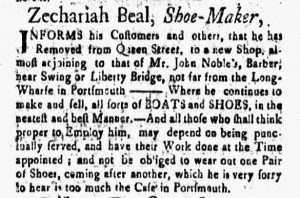
May 13 - 5:13:1768 New-Hampshire Gazette
New-Hampshire Gazette (May 13, 1768).

“Not be obliged to wear out one Pair of Shoes, coming after another.”

Zechariah Beal, a cobbler, placed an advertisement in the May 13, 1768, edition of the New-Hampshire Gazette to announce that he had moved to a new location in Portsmouth. In addition to giving directions to his new shop, Beal also offered commentary on what he considered a sorry state for footwear in the port city. He pledged that his customers would “not be obliged to wear out one Pair of Shoes, coming after another,” a situation “which he is very sorry to hear is too much the Case in Portsmouth.”

In making this assertion, Beal buttressed his appeal to quality. He included one of the standard phrases to describe his workmanship, asserting that he made shoes “in the neatest and best Manner,” but he elaborated on that commonly deployed phrase by favorably contrasting his shoes others sold in the city, whether imported or made locally. Too many colonists purchased shoes that wore out too quickly, forcing them to continuously replace them. Beal set about remedying that situation.

The industrious shoemaker balanced that marketing strategy with an appeal to customer service. Like many others in the garment trades, he declared that his clientele “may depend on being punctually served,” but once again he elaborated on the standard language inserted in many eighteenth-century advertisements. Beal guaranteed that his customers would “have their Work done at the Time appointed.” He would not inconvenience or disappoint them by not meeting the deadlines determined at the time customers contracted his services.

Beal took an innovative approach to writing the copy for his notice in the New-Hampshire Gazette. He started with some of the most common appeals to quality and customer service, but then elaborated on those appeals as a means of distinguishing both his advertisement and his business. Eighteenth-century newspapers advertisements for consumer goods and services often appear static at first glance, but Beal and others incorporated all sorts of variations to make their notices distinctive as they sought to incite demand among prospective customers.

Slavery Advertisements Published May 13, 1768

The Slavery Adverts 250 Project chronicles the role of newspaper advertising in perpetuating slavery in the era of the American Revolution. The project seeks to reveal the ubiquity of slavery in eighteenth-century life from New England to Georgia by republishing advertisements for slaves – for sale, wanted to purchase, runaways, captured fugitives – in daily digests on this site as well as in real time via the @SlaveAdverts250 Twitter feed, utilizing twenty-first-century media to stand in for the print media of the eighteenth century.

The project aims to provide modern audiences with a sense of just how often colonists encountered these advertisements in their daily lives. Enslaved men, women, and children appeared in print somewhere in the colonies almost every single day. Those advertisements served as a constant backdrop for social, cultural, economic, and political life in colonial and revolutionary America. Colonists who did not own slaves were still confronted with slavery as well as invited to maintain the system by purchasing slaves or assisting in the capture of runaways. The frequency of these newspaper advertisements suggests just how embedded slavery was in colonial and revolutionary American culture in everyday interactions beyond the printed page.

These advertisements also testify to the experiences of enslaved men, women, and children, though readers must consider that those experiences have been remediated through descriptions offered by slaveholders rather than the slaves themselves. Often unnamed in the advertisements, enslaved men, women, and children were not invisible or unimportant in early America.

These advertisements appeared in colonial American newspapers 250 years ago today.

May 13 - Connecticut Journal Slavery 1
Connecticut Courant (May 13, 1768).

**********

May 13 - New-London Gazette Slavery 1
New-London Gazette (May 13, 1768).

**********

May 13 - South-Carolina and American General Gazette Slavery 1
South-Carolina and American General Gazette (May 13, 1768).

**********

May 13 - South-Carolina and American General Gazette Slavery 2
South-Carolina and American General Gazette (May 13, 1768).

**********

May 13 - South-Carolina and American General Gazette Slavery 3
South-Carolina and American General Gazette (May 13, 1768).

**********

May 13 - South-Carolina and American General Gazette Slavery 4
South-Carolina and American General Gazette (May 13, 1768).

**********

May 13 - South-Carolina and American General Gazette Slavery 5
South-Carolina and American General Gazette (May 13, 1768).

**********

May 13 - South-Carolina and American General Gazette Slavery 6
South-Carolina and American General Gazette (May 13, 1768).

**********

May 13 - South-Carolina and American General Gazette Slavery 7
South-Carolina and American General Gazette (May 13, 1768).

**********

May 13 - South-Carolina and American General Gazette Slavery 8
South-Carolina and American General Gazette (May 13, 1768).

**********

May 13 - South-Carolina and American General Gazette Slavery 9
South-Carolina and American General Gazette (May 13, 1768).

May 12

What was advertised in a colonial American newspaper 250 years ago today?

May 12 - 5:12:1768 New-York Journal
New-York Journal (May 12, 1768).

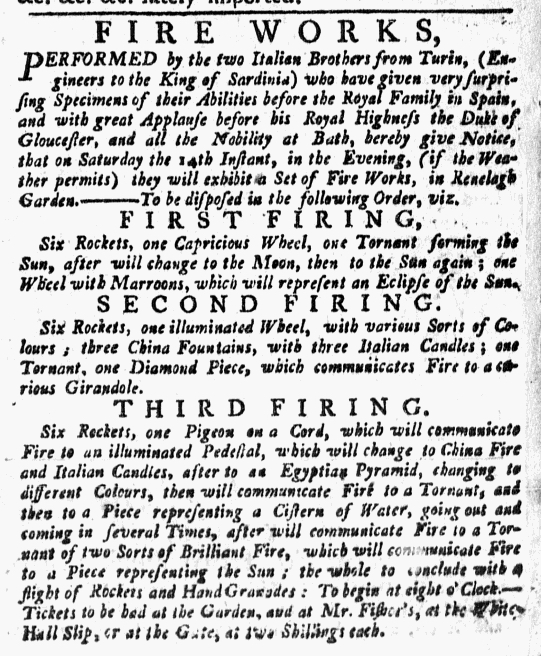
“FIRE WORKS, PERFORMED by two Italian Brothers from Turin.”

In addition to purchasing an array of goods and services, colonial consumers also spent their money on assorted entertainments. Newspaper advertisements testify to both the popular culture and leisure activities of the period. The May 12, 1768, edition of the New-York Journal, for instance, included several advertisements that encouraged readers to gather to socialize at a range of venues that provided entertainment. Some of these, such as an advertisement for a tavern, offered activities available to readers at practically any time, but others, especially an advertisement for a fireworks display, featured one-time-only spectacles.

John Taylor inserted an advertisement announcing that he had just opened “a Tavern and House of public Entertainment” known as “The GLASS-HOUSE” on the outskirts of the city. He invited both “Gentlemen and Ladies” to patronize his new enterprise, pledging to “regale them in the genteelest Manner, with the best Accommodations of every Kind.” In particular, he proclaimed, “Dinners will be provided at the shortest Notice.” Taylor attempted to distinguish his tavern from the many others operating in New York at the time by depicting it as an upscale alternative to the bawdy and boisterous atmosphere in other establishments.

Colonists could also enjoy theatrical productions in some, but not all, of the largest cities. Traveling troupes also entertained residents in towns and villages. In New York, the American Company regularly advertised plays staged “At the Theatre in John-Street.” The company placed two advertisements in the May 12 edition of the New-York Journal, one announcing the program for Friday, May 13 and the other Monday, May 16. On Friday evening viewers would be treated to “A TRAGEDY, call’d VENICE PRESERV’D, OR A PLOT DISCOVER’D” and “A FARCE (never perform’d in America) call’d LOVE A-LA-MODE.” To convince readers to purchase tickets, the company claimed that that the farce would only be performed only once during the season. To raise the stakes, the advertisement included a brief history its popularity: “The above Farce has been acted with more Success than any dramatic Piece in the Memory of Man, for since it was first presented to the Town, it has been presented to crowded Audiences One Hundred and Fifty Seven Nights, and is still constantly play’d at least once a Week, at the Theatre Royal in Covent Garden.” The company implied that they anticipated crowds, but cautioned that “No Person on any Pretence whatsoever, can be admitted behind the Scenes.” Each element of the advertisement was designed to persuade potential patrons to attend the show or risk feeling left out of a major event. The American Company sold an experience that yielded a sense of community; not participating, however, resulted in a sense of exclusion and regret.

Two “Italian Brothers from Turin” offered other entertainments for the evening of Saturday, May 14: a fireworks show in three parts at Renelagh Gardens. The brothers described each portion of the show in detail, but their words merely suggested the spectacle that readers would experience if they attended the exhibition. To provide further encouragement, they listed their credentials, claiming that they were “(Engineers to the King of Sardinia) who have given very surprising Specimens of their Abilities before the Royal Family in Spain, and with great Applause before his Royal Highness the Duke of Gloucester, and all the Nobility at Bath.” Even though New York was an imperial outpost on the far side of the Atlantic, the advertisement suggested that its residents could enjoy some of the best entertainments that had amused royals and nobles in England and other places in Europe, but only if they seized the opportunity and made their way to Renelagh Gardens for the exhibition on the only night it would be performed.

Each of these advertisements peddled popular culture to consumers, encouraging them to purchase experiences in addition to goods. The various entertainments cultivated a sense of community among those who witnessed them. Just as merchants and shopkeepers cautioned colonists not to be left behind when it came to the goods they sold, performers and others whose services emphasized leisure activities portrayed participating in the events they sponsored as a means of establishing bonds with other colonists through shared experiences.

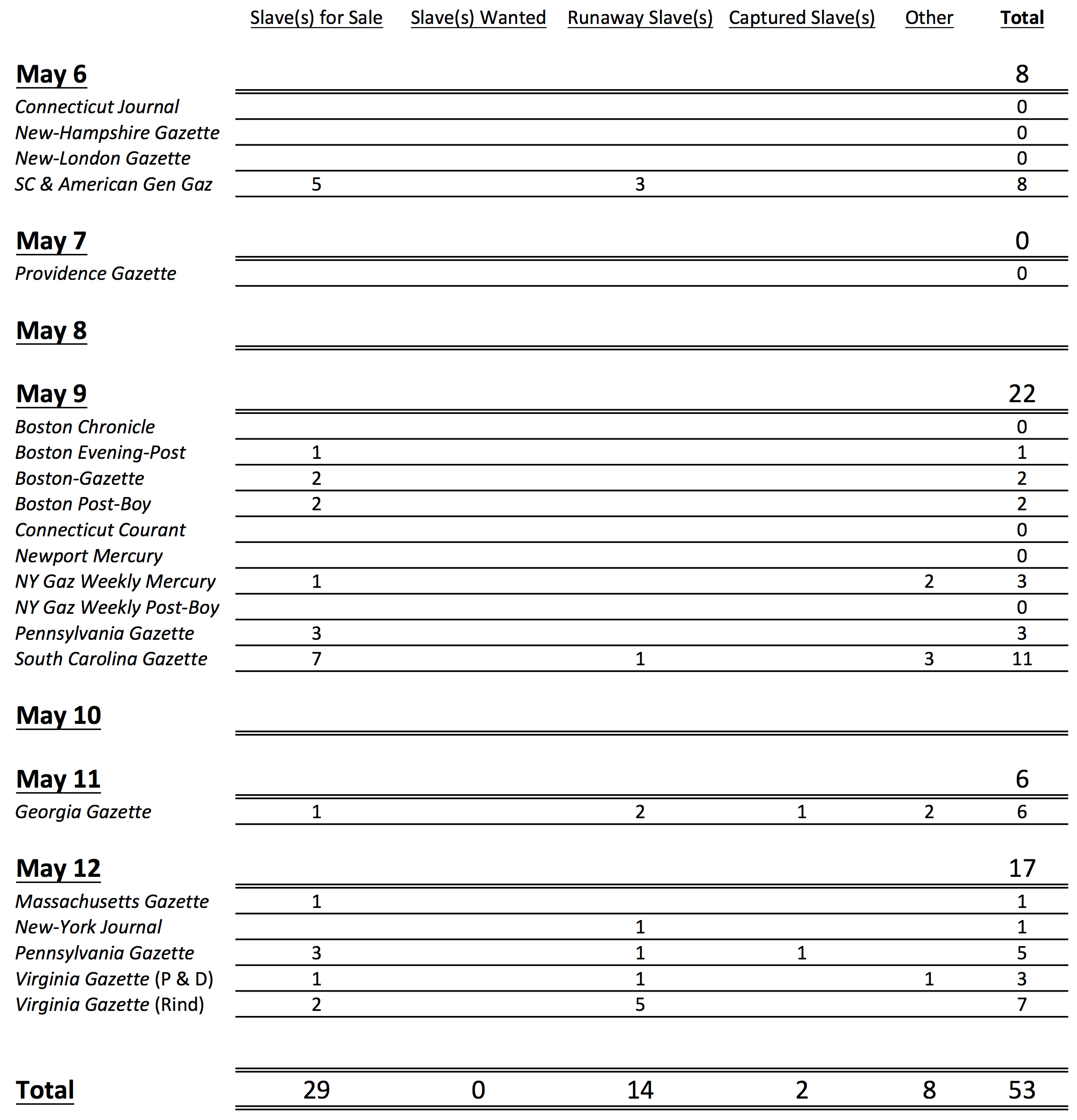
Summary of Slavery Advertisements Published May 6-12, 1768

These tables indicate how many advertisements for slaves appeared in colonial American newspapers during the week of May 6-12, 1768.

Note:  These tables are as comprehensive as currently digitized sources permit, but they may not be an exhaustive account.  They includes all newspapers that have been digitized and made available via Accessible Archives, Colonial Williamsburg’s Digital Library, and Readex’s America’s Historical Newspapers.  There are several reasons some newspapers may not have been consulted:

  • Issues that are no longer extant;
  • Issues that are extant but have not yet been digitized (including the Pennsylvania Journal); and
  • Newspapers published in a language other than English (including the Wochentliche Philadelphische Staatsbote).

**********

Slavery Advertisements Published May 6-12, 1768:  By Date

Slavery Adverts Tables 1768 By Date May 6

**********

Slavery Advertisements Published May 6-12, 1768:  By Region

Slavery Adverts Tables 1768 By Region May 6

Slavery Advertisements Published May 12, 1768

The Slavery Adverts 250 Project chronicles the role of newspaper advertising in perpetuating slavery in the era of the American Revolution. The project seeks to reveal the ubiquity of slavery in eighteenth-century life from New England to Georgia by republishing advertisements for slaves – for sale, wanted to purchase, runaways, captured fugitives – in daily digests on this site as well as in real time via the @SlaveAdverts250 Twitter feed, utilizing twenty-first-century media to stand in for the print media of the eighteenth century.

The project aims to provide modern audiences with a sense of just how often colonists encountered these advertisements in their daily lives. Enslaved men, women, and children appeared in print somewhere in the colonies almost every single day. Those advertisements served as a constant backdrop for social, cultural, economic, and political life in colonial and revolutionary America. Colonists who did not own slaves were still confronted with slavery as well as invited to maintain the system by purchasing slaves or assisting in the capture of runaways. The frequency of these newspaper advertisements suggests just how embedded slavery was in colonial and revolutionary American culture in everyday interactions beyond the printed page.

These advertisements also testify to the experiences of enslaved men, women, and children, though readers must consider that those experiences have been remediated through descriptions offered by slaveholders rather than the slaves themselves. Often unnamed in the advertisements, enslaved men, women, and children were not invisible or unimportant in early America.

These advertisements appeared in colonial American newspapers 250 years ago today.

May 12 - Massachusetts Gazette Slavery 1
Massachusetts Gazette (May 12, 1768).

**********

May 12 - New-York Journal Slavery 1
New-York Journal (May 12, 1768).

**********

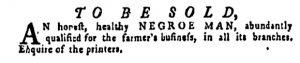
May 12 - Pennsylvania Gazette Slavery 1
Pennsylvania Gazette (May 12, 1768).

**********

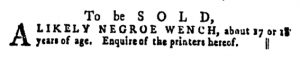
May 12 - Pennsylvania Gazette Supplement Slavery 1
Supplement to the Pennsylvania Gazette (May 12, 1768).

**********

May 12 - Pennsylvania Gazette Supplement Slavery 2
Supplement to the Pennsylvania Gazette (May 12, 1768).

**********

May 12 - Pennsylvania Gazette Supplement Slavery 3
Supplement to the Pennsylvania Gazette (May 12, 1768).

**********

May 12 - Pennsylvania Gazette Supplement Slavery 4
Supplement to the Pennsylvania Gazette (May 12, 1768).

**********

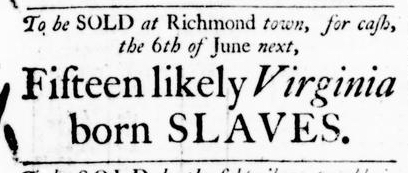
May 12 - Virginia Gazette Purdie and Dixon Slavery 1
Virginia Gazette [Purdie & Dixon] (May 12, 1768).

**********

May 12 - Virginia Gazette Purdie and Dixon Slavery 2
Virginia Gazette [Purdie & Dixon] (May 12, 1768).

**********

May 12 - Virginia Gazette Purdie and Dixon Slavery 3
Virginia Gazette [Purdie & Dixon] (May 12, 1768).

**********

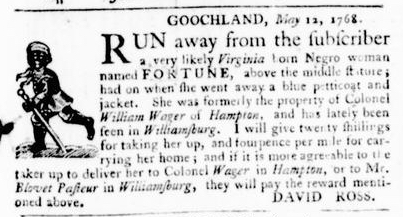
May 12 - Virginia Gazette Rind Slavery 1
Virginia Gazette [Rind] (May 12, 1768).

**********

May 12 - Virginia Gazette Rind Slavery 2
Virginia Gazette [Rind] (May 12, 1768).

**********

May 12 - Virginia Gazette Rind Slavery 3
Virginia Gazette [Rind] (May 12, 1768).

**********

May 12 - Virginia Gazette Rind Slavery 4
Virginia Gazette [Rind] (May 12, 1768).

**********

May 12 - Virginia Gazette Rind Slavery 5
Virginia Gazette [Rind] (May 12, 1768).

**********

May 12 - Virginia Gazette Rind Slavery 6
Virginia Gazette [Rind] (May 12, 1768).

**********

May 12 - Virginia Gazette Rind Slavery 7
Virginia Gazette [Rind] (May 12, 1768).