May 11

What was advertised in a colonial American newspaper 250 years ago today?
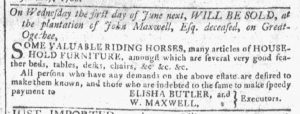
May 11 - 5:11:1768 Georgia Gazette
Georgia Gazette (May 11, 1768).

“WILL BE SOLD … many articles of HOUSEHOLD FURNITURE.”

Advertisements for goods and services, especially newspaper notices, helped to stimulate the consumer revolution in eighteenth-century America. Colonial newspapers featured countless advertisements placed by merchants, shopkeepers, and artisans hawking countless new goods. Yet purchasing those items was not the only manner in which colonists acquired goods. Other advertisements testify to alternate means for participating in the consumer revolution. Many notices promoted vendues or auctions where savvy bidders stood to benefit from even greater bargains than they might experience in shops and warehouses. Customers purchased both new and used goods at auction. Other advertisements announced secondhand goods for sale, often as the result of sellers planning to leave the colony. Some advertisements also alerted colonists about thefts from homes and shops, warning them to be careful when purchasing secondhand goods because they might have been stolen.

When it came to opportunities to obtain secondhand goods, colonists most frequently encountered advertisements for estate sales, such as this advertisement from the May 11, 1768, edition of the Georgia Gazette in which the executors for “John Maxwell, Esq. deceased, on Great-Ogechee” sought to sell “many articles of HOUSEHOLD FURNITURE, amongst which are several very good feather beds, tables, desks, chairs.” Other advertisements in the same issue also promoted secondhand consumer goods that entered the marketplace via estate sales. The executors of “the ESTATE of FREDERICK HOLZENDORFF,” for instance, simultaneously called for his associates to settle accounts and announced the sale of “Household Goods and sundry other Articles.” Compared to newspapers published in Boston, Charleston, New York, Philadelphia, and other larger ports, the Georgia Gazette featured relatively few advertisements placed by merchants, shopkeepers, and artisans looking to sell inventories of new merchandise. In most issues, readers were as likely to find advertisements for estate sales as any other sort of notices presenting opportunities to acquire consumer goods. In eighteenth-century America, buying and selling the baubles of Britain and other items radiated far beyond shops and warehouses.

Slavery Advertisements Published May 11, 1768

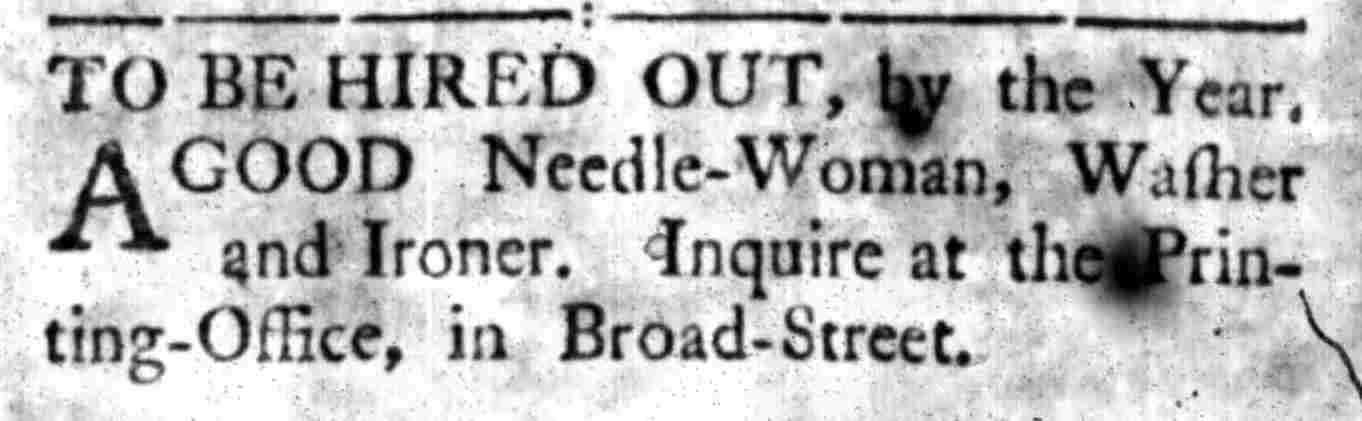
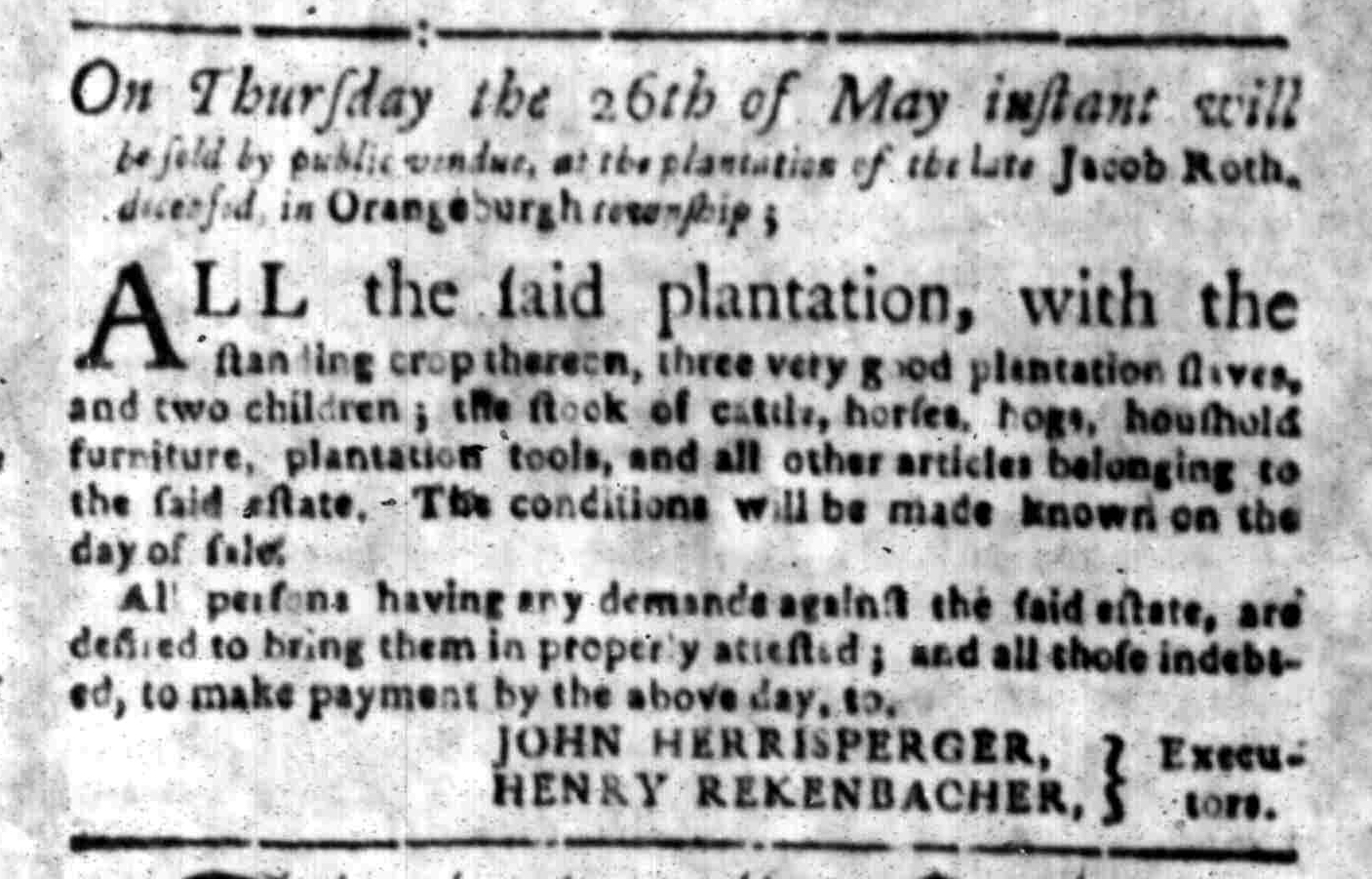
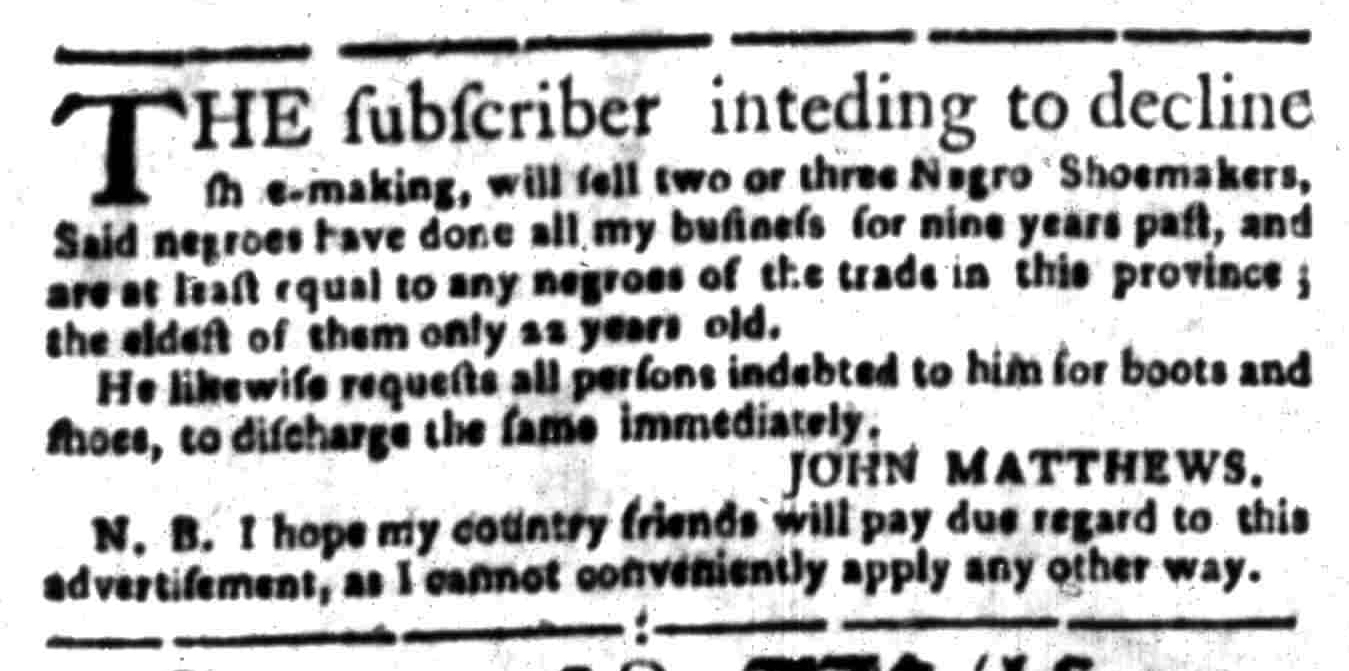
The Slavery Adverts 250 Project chronicles the role of newspaper advertising in perpetuating slavery in the era of the American Revolution. The project seeks to reveal the ubiquity of slavery in eighteenth-century life from New England to Georgia by republishing advertisements for slaves – for sale, wanted to purchase, runaways, captured fugitives – in daily digests on this site as well as in real time via the @SlaveAdverts250 Twitter feed, utilizing twenty-first-century media to stand in for the print media of the eighteenth century.

The project aims to provide modern audiences with a sense of just how often colonists encountered these advertisements in their daily lives. Enslaved men, women, and children appeared in print somewhere in the colonies almost every single day. Those advertisements served as a constant backdrop for social, cultural, economic, and political life in colonial and revolutionary America. Colonists who did not own slaves were still confronted with slavery as well as invited to maintain the system by purchasing slaves or assisting in the capture of runaways. The frequency of these newspaper advertisements suggests just how embedded slavery was in colonial and revolutionary American culture in everyday interactions beyond the printed page.
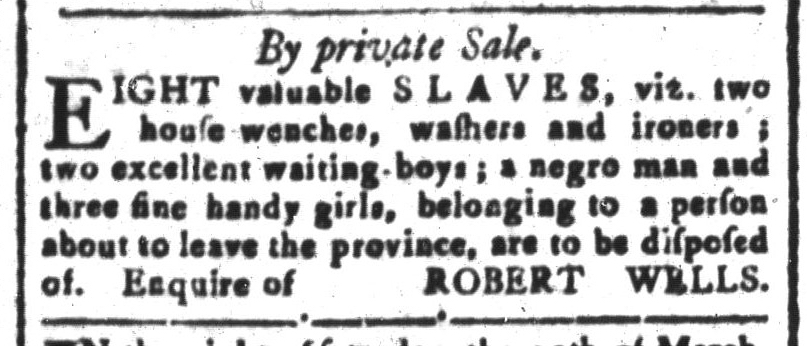
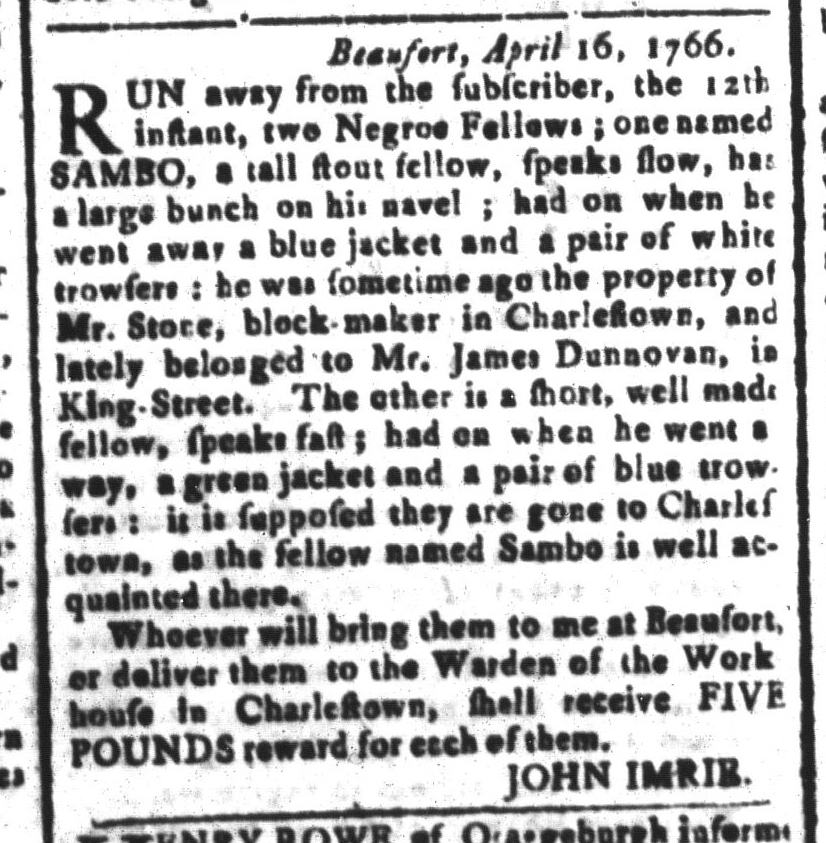
These advertisements also testify to the experiences of enslaved men, women, and children, though readers must consider that those experiences have been remediated through descriptions offered by slaveholders rather than the slaves themselves. Often unnamed in the advertisements, enslaved men, women, and children were not invisible or unimportant in early America.

These advertisements appeared in colonial American newspapers 250 years ago today.

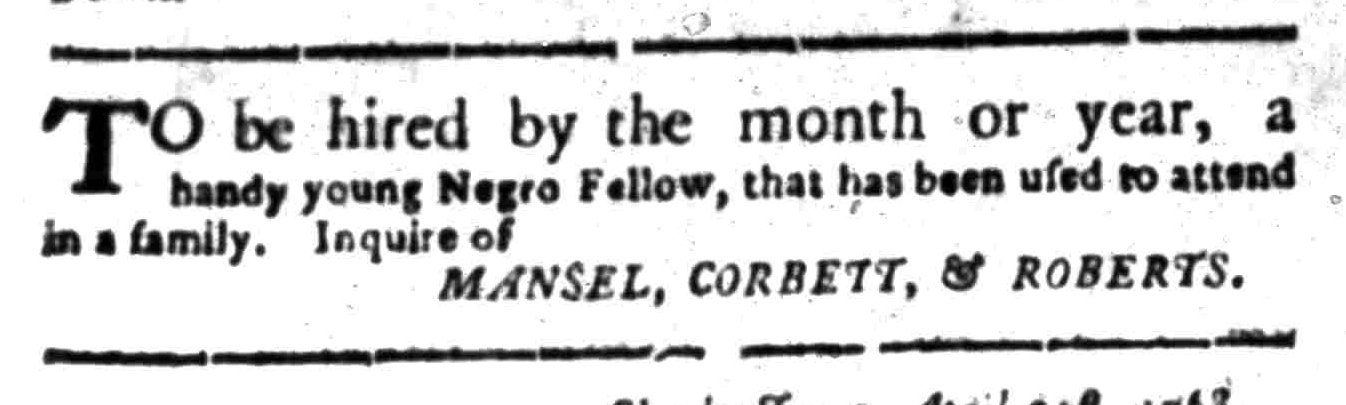
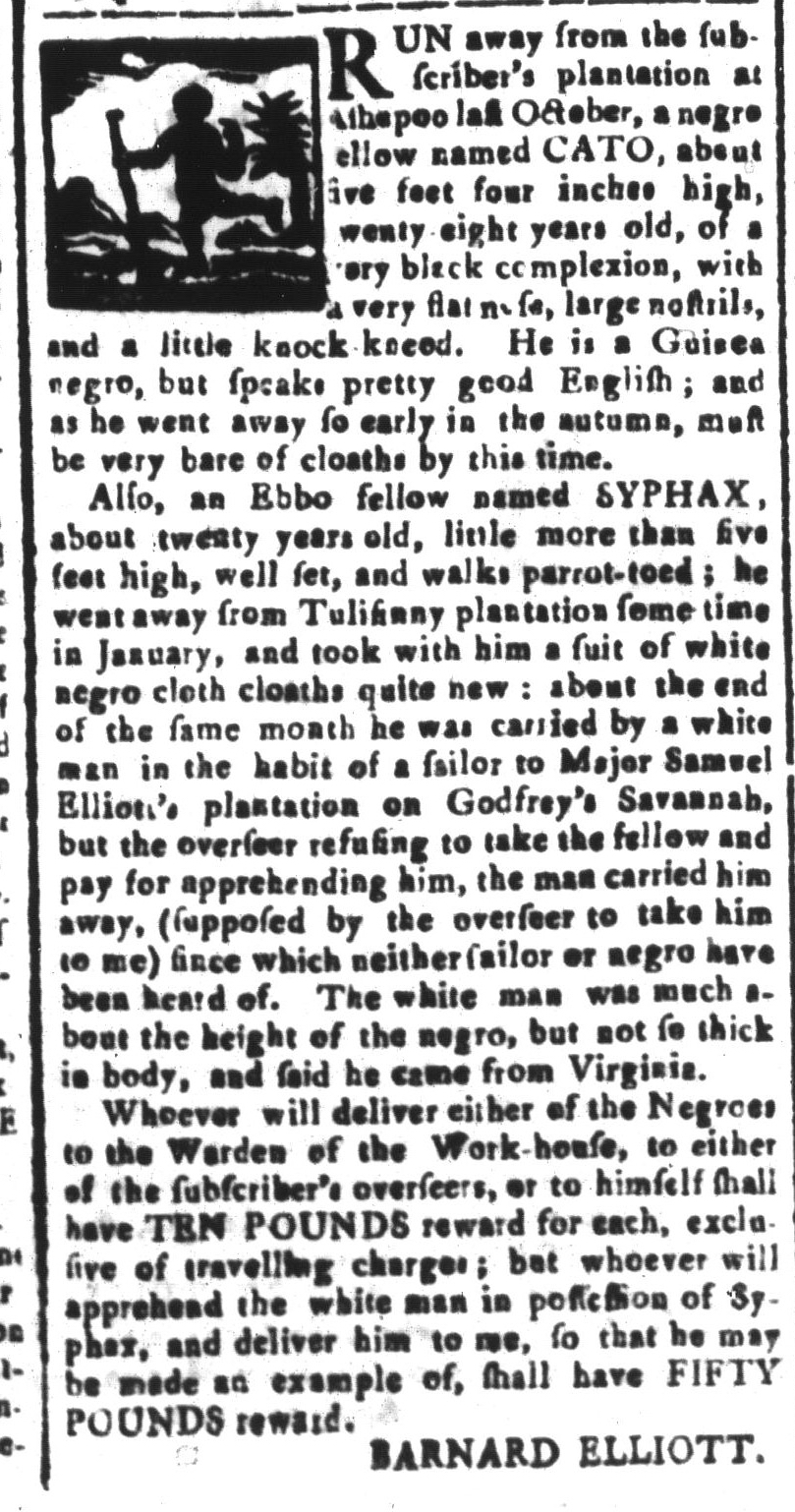
May 11 - Georgia Gazette Slavery 1
Georgia Gazette (May 11, 1768).

**********

May 11 - Georgia Gazette Slavery 2
Georgia Gazette (May 11, 1768).

**********

May 11 - Georgia Gazette Slavery 3
Georgia Gazette (May 11, 1768).

**********

May 11 - Georgia Gazette Slavery 6
Georgia Gazette (May 11, 1768).

**********

May 11 - Georgia Gazette Slavery 4
Georgia Gazette (May 11, 1768).

**********

May 11 - Georgia Gazette Slavery 5
Georgia Gazette (May 11, 1768).

May 10

What was advertised in a colonial American newspaper 250 years ago this week?

May 10 - 5:9:1768 South Carolina Gazette
South-Carolina Gazette (May 9, 1768).

“PROPOSALS For Publishing by SUBSCRIPTION, ALL THE ACTS and ORDINANCES.”

John Rutledge placed a particular sort of advertisement in the May 9, 1768, edition of the South-Carolina Gazette: a subscription notice for a proposed book that had not yet been printed. This was a common practice among printers and publishers in eighteenth-century America. It allowed them to promote a book in advance, yet also gauge interest to determine if publication would yield profits. Buyers made commitments in advance to purchase proposed books, becoming “subscribers” to the enterprise. Not all subscription notices yielded publications.

Rutledge proposed publishing the acts and ordinances passed by the “GENERAL ASSEMBLY of this Province.” In a separate subscription notice in the same issue, he also proposed publishing a related work consisting of statutes passed in Great Britain “Which are expressly made of Force in this Province, by ACTS of the GENERAL ASSEMBLY.” Publication of one, however, was not contingent on publication of the other.

To encourage as many subscribers as possible, Rutledge described several attractive aspects of the proposed book. In addition to the acts and ordinances, it would also include an index, marginal notes, and references to aid readers in navigating and understanding the contents. Rutledge also commented on the material aspects of the text, noting that it would be “printed on good Paper, with a fair new Type.”

The publisher also warned that interested readers needed to reserve their copy in advance rather than assume that they could purchase a surplus copy after the book went to press. “No more Copies will be printed,” he declared, “than shall be subscribed for by the first Day of November next, when the Subscriptions will be closed.” Furthermore, “if a sufficient Number be not then obtained, the Work will not be put to the Press.” Rutledge allowed six months for subscribers to commit to paying “Thirty Pounds Currency” for the proposed work, but it was an all-or-nothing proposition. He would not move forward unless he had enough subscribers and he would not print additional copies. Rutledge cultivated a sense of urgency by suggesting that prospective customers would miss out if they lacked the necessary resolution to subscribe promptly.

Rutledge advertised a product that did not yet exist. Doing so allowed him to assess the market as well as incite demand. The minimal cost for inserting subscription notices in the South-Carolina Gazette presented an alternative to publishing a book that ended up being a poor investment.

May 9

What was advertised in a colonial American newspaper 250 years ago today?

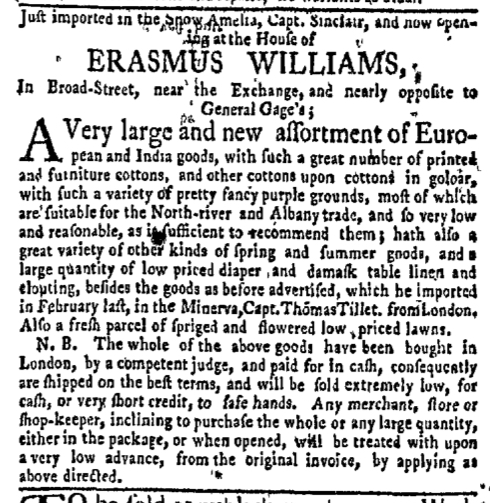
May 9 - 5:9:1768 New-York Gazette Weekly Mercury
New-York Gazette and Weekly Mercury (May 9, 1768).

“Most of which are suitable for the North-river and Albany trade.”

Although Erasmus William’s advertisement in the May 9, 1768, edition of the New-York Gazette and Weekly Mercury did not discourage or exclude retail sales, it did focus primarily on further distributing imported goods by offering to sell to merchants and shopkeepers wholesale. Williams reported that he had just received “A very large and new assortment of European and India goods” via “the Snow Amelia, Capt. Sinclair.” The merchant proposed specific customers for many of the textiles, especially the “great number of printed and furniture cottons.” He stressed that they were “suitable for the North-river and Albany trade.” Since the newspapers published in New York served the entire colony, he had a reasonable expectation that potential buyers from far beyond the city would see his advertisement and possibly contact him to refresh their inventories.

Williams also directly addressed prospective customers who might wish to buy in bulk, pledging that “Any merchant, store or shop-keeper, inclining to purchase the whole or any large quantity” would get a real bargain. He explained that an associate in London, a “competent judge” of the merchandise, had negotiated a deal and paid for the goods in cash. In turn, this allowed Williams to pass along the savings to his own customers, especially those interested in relieving him of significant quantities all at once.

Most merchants who placed advertisements for consumer goods in eighteenth-century newspapers did not explicitly specify that they intended to sell their wares wholesale. Some likely assumed that readers already knew which advertisers were wholesalers and which were retailers. Williams, on the other hand, made it clear that he intended to sell “the whole” or a large quantity in a single transaction. He also imagined the further distribution of the assortment of goods he had just imported, envisioning that they would be transported beyond New York, a busy port city. The consumer revolution of the eighteenth century was not confined to the urban centers on the Atlantic coast. Instead, merchants like Williams and the shopkeepers and other traders that did business with him in other parts of the colony helped facilitated the expansion of consumer culture to towns and villages and beyond.

Slavery Advertisements Published May 9, 1768

The Slavery Adverts 250 Project chronicles the role of newspaper advertising in perpetuating slavery in the era of the American Revolution. The project seeks to reveal the ubiquity of slavery in eighteenth-century life from New England to Georgia by republishing advertisements for slaves – for sale, wanted to purchase, runaways, captured fugitives – in daily digests on this site as well as in real time via the @SlaveAdverts250 Twitter feed, utilizing twenty-first-century media to stand in for the print media of the eighteenth century.

The project aims to provide modern audiences with a sense of just how often colonists encountered these advertisements in their daily lives. Enslaved men, women, and children appeared in print somewhere in the colonies almost every single day. Those advertisements served as a constant backdrop for social, cultural, economic, and political life in colonial and revolutionary America. Colonists who did not own slaves were still confronted with slavery as well as invited to maintain the system by purchasing slaves or assisting in the capture of runaways. The frequency of these newspaper advertisements suggests just how embedded slavery was in colonial and revolutionary American culture in everyday interactions beyond the printed page.

These advertisements also testify to the experiences of enslaved men, women, and children, though readers must consider that those experiences have been remediated through descriptions offered by slaveholders rather than the slaves themselves. Often unnamed in the advertisements, enslaved men, women, and children were not invisible or unimportant in early America.

These advertisements appeared in colonial American newspapers 250 years ago today.

May 9 - Boston Evening-Post Slavery 1
Boston Evening-Post (May 9, 1768).

**********

May 9 - Boston Post-Boy Slavery 1
Boston Post-Boy (May 9, 1768).

**********

May 9 - Boston Post-Boy Slavery 2
Boston Post-Boy (May 9, 1768).

**********

May 9 - Boston-Gazette Slavery 1
Boston-Gazette (May 9, 1768).

**********

May 9 - Boston-Gazette Supplement Slavery 1
Supplement to the Boston-Gazette (May 9, 1768).

**********

May 9 - New-York Gazette Weekly Mercury Supplement Slavery 1
Supplement to the New-York Gazette and Weekly Mercury (May 9, 1768).

**********

May 9 - New-York Gazette Weekly Mercury Supplement Slavery 2
Supplement to the New-York Gazette and Weekly Mercury (May 9, 1768).

**********

May 9 - New-York Gazette Weekly Mercury Supplement Slavery 3
Supplement to the New-York Gazette and Weekly Mercury (May 9, 1768).

**********

May 9 - Pennsylvania Chronicle Slavery 1
Pennsylvania Chronicle (May 9, 1768).

**********

May 9 - Pennsylvania Chronicle Slavery 2
Pennsylvania Chronicle (May 9, 1768).

**********

May 9 - Pennsylvania Chronicle Slavery 3
Pennsylvania Chronicle (May 9, 1768).

**********

May 9 - South-Carolina Gazette Slavery 1
South-Carolina Gazette (May 9, 1768).

**********

May 9 - South-Carolina Gazette Slavery 2
South-Carolina Gazette (May 9, 1768).

**********

May 9 - South-Carolina Gazette Slavery 3
South-Carolina Gazette (May 9, 1768).

**********

May 9 - South-Carolina Gazette Slavery 4
South-Carolina Gazette (May 9, 1768).

**********

May 9 - South-Carolina Gazette Slavery 5
South-Carolina Gazette (May 9, 1768).

**********

May 9 - South-Carolina Gazette Supplement Slavery 1
Supplement to the South-Carolina Gazette (May 9, 1768).

**********

May 9 - South-Carolina Gazette Supplement Slavery 2
Supplement to the South-Carolina Gazette (May 9, 1768).

**********

May 9 - South-Carolina Gazette Supplement Slavery 3
Supplement to the South-Carolina Gazette (May 9, 1768).

**********

May 9 - South-Carolina Gazette Supplement Slavery 4
Supplement to the South-Carolina Gazette (May 9, 1768).

**********

May 9 - South-Carolina Gazette Supplement Slavery 5
Supplement to the South-Carolina Gazette (May 9, 1768).

**********

May 9 - South-Carolina Gazette Supplement Slavery 6
Supplement to the South-Carolina Gazette (May 9, 1768).

May 8

What was advertised in a colonial American newspaper 250 years ago this week?

May 8 - 5:5:1768 New-York Journal Supplement
Supplement to the New-York Journal (May 5, 1768).

“He likewise cleans gentlemen and ladies clothes … in as neat a manner as those done in London.”

Like many other artisans, Henry Brabazon, a “Silk-dier and Dry-scourer,” emphasized his skill in his newspaper advertisements.  Deploying formulaic language, he announced that “his customers may depend upon having their work done with dispatch and fidelity” in a notice he inserted in the supplement that accompanied the May 5, 1768, edition of the New-York Journal.  Yet Brabazon did not resort merely to standardized language that appeared in countless other advertisements placed by artisans of all sorts.  He promoted his skill by favorably comparing the results of his efforts to the work undertaken by his counterparts in England.

For instance, Brabazon proclaimed that he “cleans gentlemen and ladies clothes … in as neat a manner as those done in London.”  In addition to asserting his credentials as a dry scourer, he provided further commentary about his skills as a silk dyer, declaring that he “dies cotton velvet as fine a black, and to as good perfection, as those in Manchester.”  He expected that prospective customers in the colonies were capable of making distinctions when it came to associating specific products with particular places in England.  Note that he introduced himself as “from Europe,” but did not make general comparisons to silk dyers and dry scourers on the other side of the Atlantic.  Instead, he made targeted comparisons that associated dying with Manchester and scouring with London.

Brabazon attempted to cultivate a clientele among colonists who were savvy consumers.  Even though they resided far from the places of production in England, his prospective customers knew the market and distinguished among goods and services based on their place of origin.  Brabazon also knew that colonial consumers did not want to feel as though they had to settle for inferior goods and services merely because they resided far from the center of the empire.  They imported textiles, housewares, and other goods to keep up with fashions in England, but they also wanted services that rivaled the quality available there.  As a dyer and scourer, Brabazon skillfully assisted his customers in maintaining their textiles and garments so they would not appear second best compared to their counterparts in England.

May 7

What was advertised in a colonial American newspaper 250 years ago today?

May 7 - 5:7:1768 Providence Gazette
Providence Gazette (May 7, 1768).

“To be SOLD by JOSEPH AND Wm. RUSSELL.”

How much influence did eighteenth-century advertisers exert when it came to designing their advertisements? This notice placed by prolific advertisers Joseph Russell and William Russell complicates the usual answer to that question.

In most instances advertisers submitted copy and left it to compositors to determine format. The publication of the same advertisement in multiple newspapers with consistent copy but significant deviations in layout, font size, and other visual aspects testifies to the division between advertisers as copywriters and compositors as designers. Yet on relatively rare occasions some advertisements retained specific visual elements, such as a decorative border, across multiple publications, indicating that an advertiser did indeed have a hand in determining the format. In general, most colonial newspapers exhibited an internal logic when it came to the appearance of advertisements. Compositors tended to standardize the appearance of paid notices within their publication depending on genre (consumer goods and services, legal notices, runaway slaves, for example), even as the copy differed from advertisement to advertisement. Advertisers often resorted to formulaic language and accepted patterns for including information, contributing to that standardization of visual elements.

The advertisements in the Providence Gazette, however, displayed far less consistency when it came to graphic design. Compared to counterparts at other newspapers, the compositor seems to have been much more interested in experimenting with how to use type to create distinctive advertisements even when those advertisements were comprised entirely of text. Does the compositor deserve exclusive credit for such innovations? Or did the variations emerge as the result of consultations with advertisers?

Although the advertisement the Russells placed in the May 7, 1768, edition of the Providence Gazette does not provide any definitive answers, its various elements suggest some level of collaboration. It featured a headline that listed a product rather than the names of the advertisers. Their names appeared at the end of the notice, quite unusual for advertisements that promoted consumer goods and services. The dual columns listing their wares differed from the structure of most, but not all, other advertisements recently published in that newspaper. The Russells may have worked closely with the compositor. Alternately, they may have noticed how the compositor experimented with type in previous issues of the Providence Gazette and decided to alter the copy they submitted in order to facilitate further innovations. Even if they did not directly consult the compositor, they may have been inspired to pursue their own experiment in composing copy to see how those advertisements would then appear in print. Whether initiated by compositors or advertisers, one innovation in the appearance of paid notices in the Providence Gazette may have sparked a series of other innovations that resulted in advertisements for consumer goods and services in that newspaper exhibiting greater distinctiveness among themselves compared to the static appearance of most advertisements published in other newspapers.

May 6

What was advertised in a colonial American newspaper 250 years ago today?

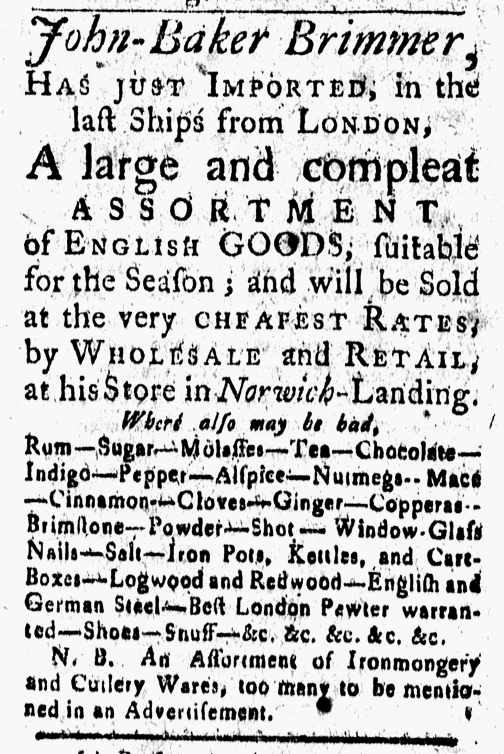
May 6 - 5:6:1768 New-London Gazette
New-London Gazette (May 6, 1768).

“An Assortment of Ironmongery and Cutlery Wares, too many to be mentioned in an Advertisement.”

The New-London Gazette was a much smaller operation than the newspapers published in colonial America’s largest port cities in the late 1760s. It rarely published supplements, in part because the volume of advertising did not warrant doing so. In particular, its advertisements for consumer goods and services tended to be shorter and less elaborate than those inserted in many other cities. New London just was not as busy a port as others in the region, including Boston, Newport, New York, and Providence. The pages of the New-London Gazette reflected that; visually, most pages of that newspaper did not have the same bustling appearance as the crowded pages of publications from the larger ports.

Yet John-Baker Brimmer’s advertisement in the May 6, 1768, edition of the New-London Gazette looked as though it could have been drawn from a newspaper published in another city. In it, Brimmer made some of the standard appeals advanced in eighteenth-century advertisements, including an appeal to price (“the very CHEAPEST RATES”) and an appeal to consumer choice (“A large and compleat ASSORTMENT of ENGLISH GOODS”). He underscored the wide selection prospective customers would encounter at his shop by listing more than two dozen items from among his merchandise, everything from rum and spices to shoes and snuff. He even concluded his list with “&c. &c. &c. &c. &c.” In repeating the eighteenth-century abbreviation for et cetera so many times, he proclaimed that he had a much more extensive inventory than space permitted him to include in his notice. He made the same point in a nota bene that concluded the advertisement: “An Assortment of Ironmongery and Cutlery Wares, too many to be mentioned in an Advertisement.” Merchants and shopkeepers who advertised in newspapers published in other cities sometimes resorted to this strategy, leaving it to readers’ imaginations to envision all sorts of wares available for purchase in their shops.

When it came to marketing consumer goods and services, advertising culture was not as developed in the New-London Gazette as in other newspapers, yet some advertisers, like Brimmer, adopted many of the same methods as their counterparts in larger cities. Brimmer amalgamated basic appeals to price and choice with several means of suggesting that he did indeed stock an array of goods, including a list, claims that his inventory was too extensive to describe in greater detail, and repeated use of “&c.” Such advertisements in smaller newspapers helped to fuel the consumer revolution far beyond colonial America’s major urban ports.

Slavery Advertisements Published May 6, 1768

The Slavery Adverts 250 Project chronicles the role of newspaper advertising in perpetuating slavery in the era of the American Revolution. The project seeks to reveal the ubiquity of slavery in eighteenth-century life from New England to Georgia by republishing advertisements for slaves – for sale, wanted to purchase, runaways, captured fugitives – in daily digests on this site as well as in real time via the @SlaveAdverts250 Twitter feed, utilizing twenty-first-century media to stand in for the print media of the eighteenth century.

The project aims to provide modern audiences with a sense of just how often colonists encountered these advertisements in their daily lives. Enslaved men, women, and children appeared in print somewhere in the colonies almost every single day. Those advertisements served as a constant backdrop for social, cultural, economic, and political life in colonial and revolutionary America. Colonists who did not own slaves were still confronted with slavery as well as invited to maintain the system by purchasing slaves or assisting in the capture of runaways. The frequency of these newspaper advertisements suggests just how embedded slavery was in colonial and revolutionary American culture in everyday interactions beyond the printed page.

These advertisements also testify to the experiences of enslaved men, women, and children, though readers must consider that those experiences have been remediated through descriptions offered by slaveholders rather than the slaves themselves. Often unnamed in the advertisements, enslaved men, women, and children were not invisible or unimportant in early America.

These advertisements appeared in colonial American newspapers 250 years ago today.

May 6 - South-Carolina and American General Gazette Slavery 1
South- Carolina and American General Gazette (May 6, 1768).

**********

May 6 - South-Carolina and American General Gazette Slavery 2
South- Carolina and American General Gazette (May 6, 1768).

**********

May 6 - South-Carolina and American General Gazette Slavery 3
South- Carolina and American General Gazette (May 6, 1768).

**********

May 6 - South-Carolina and American General Gazette Slavery 4
South- Carolina and American General Gazette (May 6, 1768).

**********

May 6 - South-Carolina and American General Gazette Slavery 5
South- Carolina and American General Gazette (May 6, 1768).

**********

May 6 - South-Carolina and American General Gazette Slavery 6
South- Carolina and American General Gazette (May 6, 1768).

**********

May 6 - South-Carolina and American General Gazette Slavery 7
South- Carolina and American General Gazette (May 6, 1768).

**********

May 6 - South-Carolina and American General Gazette Slavery 8
South- Carolina and American General Gazette (May 6, 1768).

May 5

What was advertised in a colonial American newspaper 250 years ago today?

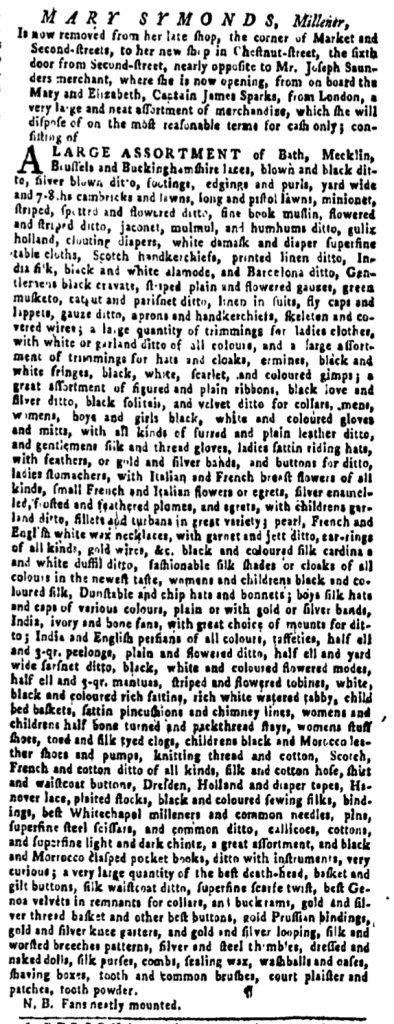
May 5 - 5:5:1768 Pennsylvania Gazette
Pennsylvania Gazette (May 5, 1768).

“A LARGE ASSORTMENT of Bath, Mecklin, Brussels and Buckinghamshire laces.”

Mary Symonds, a milliner, placed a short advertisement in the April 28, 1768, edition of the Pennsylvania Gazette to announce that she now stocked “A VERY large and neat Assortment of MERCHANDIZE” imported from London via the Mary and Elizabeth. The ship had just arrived in port, so Symonds had not yet had time to compose a complete list of her new inventory, but she promised more information about the “Particulars” in the next issue of the Gazette.

The following week Symonds’s lengthy advertisement did indeed appear, occupying a prominent place on the front page, making it difficult for readers to miss. Yet the Pennsylvania Gazette and other newspapers were not the only places where Symonds published this impressive assortment of millinery wares and other goods. Symonds was one of very few women who distributed trade cards in eighteenth-century America. With an elegant cartouche containing her name and location and a decorative border enclosing her list of merchandise, Symonds’s engraved trade card was unparalleled among any extant examples belonging to American women.

Careful comparison of her trade card and her advertisement in the Pennsylvania Gazette reveals that the former almost exactly paralleled the latter. All of the items appear in the same order, though sometimes the spelling and capitalization varied or descriptions changed slightly (such as “quantity of trimmings for ladies clothes” becoming “assortment of trimmings for ladies clothes”). Occasionally the trade card deployed the word “ditto” or its abbreviation, “Do,” rather than repeating words that appeared in the previous clause. A small number of items listed in the newspaper advertisement disappeared from the trade card, but no new items were listed. Symonds eliminated “Scotch handkerchiefs” (but listed many other varieties), “gentlemens silk and thread gloves” (but, again, listed other options), and “basket” buttons. The removal of basket buttons caused a slight revision in Symonds’s description of the variety of buttons she stocked: “a very large quantity of the best death-head, basket and gilt buttons” became “a large Quantity of the best Death-head and Gilt Buttons.” The trade cared even included the nota bene that appeared as its own line at the conclusion of the advertisement: “N.B. Fans neatly mounted.” For the most part, Symonds’s trade card replicated her newspaper advertisement.

This prompts reconsideration of when Symonds commissioned and began distributing her trade card to current and prospective customers. Previously it has been dated to circa 1770 because the only known copy, part of the Cadwalader Collection at the Historical Society of Pennsylvania, has a receipted bill on the reverse. That bill lists five occasions in October and November 1770 that “Mrs. Cadwalader” made a series of purchases from Symonds, who received payment in full on November 20, 1770. The similarities between the trade card and the newspaper advertisement, however, suggest that Symonds first distributed the trade card more than two years earlier.

That seems particularly appropriate since, regardless of the other content of her newspaper advertisements, Symonds regularly stressed that she was “now removed from her late shop, the corner of Market and Second-streets, to her new shop in Chestnut-street, the sixth door from Second-street.” This corresponds to the address listed on her trade card: “the South Side of Chesnut Street between Front and Second Streets, the Sixth Door from Second street.” Having recently moved to a new location, Symonds may have considered it particularly imperative to enhance her marketing efforts to direct existing and prospective clients to her new shop. The occasion of her move may have justified branching out to an additional form of advertising media. This also suggests that Symonds’s use of her trade card may have changed over time. She may have distributed beyond her shop when it was new and the contents accurately represented her current inventory, but over time she may have reserved the outdated remaining copies for use as receipted bills within her shop, presenting her best customers with a memento of their shopping experience.

Mar 23 - Mary Symonds Trade Card
Trade card (with receipted bill on reverse) distributed  by Mary Symonds in 1770 (Historical Society of Pennsylvania:  Cadwalader Collection, Series II: General John Cadwalader Papers, Box 5: Incoming Correspondence: Pa-Sy, Item 19: Su-Sy).