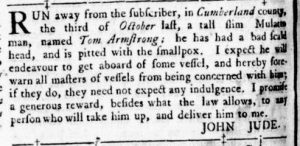
December 3

What was advertised in a colonial American newspaper 250 years ago today?

Dec 3 - 12:3:1768 Providence Gazette
Providence Gazette (December 3, 1768).

“My Son, ELISHA BROWN, has undertaken to tend my Grist-Mill in Providence.”

Elisha Brown operated a family business. Late in 1768 he placed an advertisement in the Providence Gazette to inform residents of the city and its surroundings that his son, also named Elisha Brown, “has undertaken to tend my Grist-Mill.” Rather than the younger Brown advertise on his own behalf, the elder Brown realized that perhaps he possessed more authority to convince prospective clients to patronize the mill.

To that end, the elder Brown acknowledged that readers may not have had much knowledge of the new mill operation and, as a result, might be hesitant to entrust processing their grain to him. “Those who are unacquainted with his Character,” the father proclaimed, “may satisfy themselves by enquiring of the Neighbourhood up Street, where he used to live, or of DANIEL JENCKES and JAMES ANGELL, Esquires, down Street.” Rather than take the elder Brown’s word that the son was a fair dealer, potential clients were encouraged to speak with others familiar with “his Character.”

Realizing that this might not be enough to overcome the hesitation of some, the elder Brown also underscored that he continued to oversee the business, but only when necessary. “In case of any just Reason for Complain, either of bad Meal, Loss of Part, or Change of Bags,” he explained, unsatisfied clients “first are desired to apply to the Miller.” The younger Brown was a responsible entrepreneur who would remedy any concerns. However, just in case anyone had lingering doubts or required more security, the elder Brown did present the option that if his son “fail[ed] to give Satisfaction, it shall be given by applying to me.” Prospective clients continued to have recourse to the more established and more experienced miller, if circumstances warranted.

When he took a significant step in passing along the family business to the next generation, the elder Brown not only trained his son in its operations but also cultivated the community of prospective clients who might avail themselves of the mill’s services. His advertisement provided assurances that anyone who sent their grain to the mill would be well served.

December 2

What was advertised in a colonial American newspaper 250 years ago today?

Dec 2 - 12:2:1768 New-Hampshire Gazette
New-Hampshire Gazette (December 2, 1768).

“AMES’s Almanack will be publish’d in a few Days.”

Daniel Fowle and Robert Fowle, printers of the New-Hampshire Gazette, frequently inserted advertisements for books, pamphlets, stationery, and other items they sold. In the December 2, 1768, edition, they ran a short notice to encourage readers to purchase almanacs: “JUST PUBLISHED, And to be Sold at the Printing-Office, in Portsmouth; Bickerstaff’s & West’s Almanacks for the Year 1769.” Like other printers and booksellers, they offered several titles, realizing that customers developed loyalties for their favorites.

In addition to listing the two almanacs they already stocked, the Fowles concluded with a nota bene about another that would soon be available: “N.B. AMES’s Almanack will be publish’d in a few Days.” They did not provide any additional information about this almanac. Readers who also perused any of the newspapers from Boston that week may have known about an altercation among printers who sold Ames’s almanac. William McAlpine published legitimate copies, but Richard Draper, Edes and Gill, and T. and J. Fleet collaborated to print, market, and sell a pirated edition. Their marketing efforts included inserting notices in the newspapers they published – the Boston Weekly News-Letter, the Boston-Gazette, and the Boston Evening-Post, respectively – that had the appearance of news items warning consumers against purchasing a “counterfeit Ames’s ALMANACK” that contained “above twenty Errors in the Sittings of the Courts” and bore William McAlpine’s name in the imprint.

What about the almanac advertised and sold by the Fowles? According to the American Antiquarian Society’s catalog, the Fowles sold copies that bore these imprints: “Printed for, and sold by, D. and R. Fowle, at Portsmouth, New-Hampshire” and “Printed by William M‘Alpine, for D. and R. Fowle, at Portsmouth.” Both were typographically identical with those having an imprint stating “Printed and sold by William M‘Alpine.” The Fowles had not launched their own pirated edition to compete with the printers in Boston, nor had they joined the cabal that printed and distributed the actual counterfeit. Instead, they cooperated with McAlpine to distribute legitimate editions in their own market.

Slavery Advertisements Published December 2, 1768

GUEST CURATOR:  Gregory Patient

The Slavery Adverts 250 Project chronicles the role of newspaper advertising in perpetuating slavery in the era of the American Revolution. The project seeks to reveal the ubiquity of slavery in eighteenth-century life from New England to Georgia by republishing advertisements for slaves – for sale, wanted to purchase, runaways, captured fugitives – in daily digests on this site as well as in real time via the @SlaveAdverts250 Twitter feed, utilizing twenty-first-century media to stand in for the print media of the eighteenth century.

The project aims to provide modern audiences with a sense of just how often colonists encountered these advertisements in their daily lives. Enslaved men, women, and children appeared in print somewhere in the colonies almost every single day. Those advertisements served as a constant backdrop for social, cultural, economic, and political life in colonial and revolutionary America. Colonists who did not own slaves were still confronted with slavery as well as invited to maintain the system by purchasing slaves or assisting in the capture of runaways. The frequency of these newspaper advertisements suggests just how embedded slavery was in colonial and revolutionary American culture in everyday interactions beyond the printed page.

These advertisements also testify to the experiences of enslaved men, women, and children, though readers must consider that those experiences have been remediated through descriptions offered by slaveholders rather than the slaves themselves. Often unnamed in the advertisements, enslaved men, women, and children were not invisible or unimportant in early America.

During the week of December 2-8, 2018, the Slavery Adverts 250 Project is guest curated by Gregory Patient (2019), a History major at Assumption College in Worcester, Massachusetts.

These advertisements appeared in colonial American newspapers 250 years ago today.

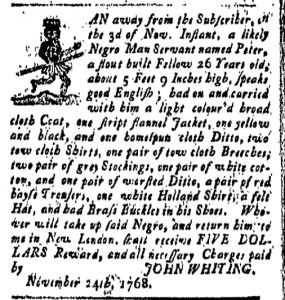
Dec 2 - New-Hampshire Gazette Slavery 1
New-Hampshire Gazette (December 2, 1768).

**********

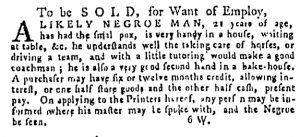
Dec 2 - New-London Gazette Slavery 1
New-London Gazette (December 2, 1768).

December 1

What was advertised in a colonial American newspaper 250 years ago today?

Dec 1 - 12:1:1768 South-Carolina Gazette
South-Carolina Gazette and Country Journal (December 1, 1768).

“EUROPEAN GOODS”

Two days after their advertisement for “A LARGE AND COMPLEAT ASSORTMENT OF EUROPEAN GOODS” dominated the front page of the South-Carolina Gazette and Country Journal, Webb and Doughty inserted the same advertisement in the December 1, 1768, edition of the South-Carolina Gazette. The advertisements featured identical copy but variations in typography. The most significant aspect of the advertisement’s format, however, carried over from one newspaper to the other. Webb and Doughty’s advertisement spanned two columns, distinguishing it from all others on the same page.

For most eighteenth-century newspaper notices the advertiser wrote the copy but the compositor determined the format. Some advertisers placed the same notice, at least as far as the copy was concerned, in multiple newspapers, but those notices varied in appearance as the result of decisions made by compositors. Advertisements that retained particular features across multiple publications, such as the decorative border that enclosed Jolley Allen’s advertisements, testify to explicit instructions given by advertisers. Most advertisers seemed content to entrust the graphic design to the printing office, but it was possible for advertisers to exert more control over the appearance of notices they paid to insert in colonial newspapers.

It appears that Webb and Doughty did offer instructions to the compositors at the South-Carolina Gazette and the South-Carolina Gazette and Country Journal. It seems unlikely that the two would have independently made the same decision to create advertisements that spanned two columns. (Unfortunately, Webb and Doughty did not place the same advertisement in the South-Carolina and American General Gazette. Perhaps they tried but the printer rejected any special instructions.) The compositors still exercised the discretion to make other decisions about the format of Webb and Doughty’s advertisement. The list of goods appeared as a paragraph in the South-Carolina Gazette and Country Journal, but as three narrow columns in the South-Carolina Gazette. The names of the merchants appeared in the largest font in the South-Carolina Gazette and Country Journal, but “EUROPEAN GOODS” appeared as the most prominent headline in the South-Carolina Gazette.

Although Webb and Doughty’s advertisement was the only one that spanned two columns on its page, two notices on the front page also spanned two columns. One for “SALES by the Provost-Marshal” was a somewhat regular feature. The headline enclosed in a decorative border occasionally graced advertisements of various lengths. The other, an advertisement for “A COMPLEAT ASSORTMENT OF GOODS” placed by Mansell, Corbett, and Roberts,” had the same format as Webb and Doughty’s advertisement. It spanned two columns. The list of goods was organized into three columns. What explains its appearance? Did Mansell, Corbett, and Roberts see Webb and Doughty’s advertisement in the South-Carolina Gazette and Country Journal and choose to adopt its format themselves? Or did the compositor at the South-Carolina Gazette decide to experiment with that format in other advertisements of sufficient length?

Slavery Advertisements Published December 1, 1768

GUEST CURATOR:  Ceara Morse

The Slavery Adverts 250 Project chronicles the role of newspaper advertising in perpetuating slavery in the era of the American Revolution. The project seeks to reveal the ubiquity of slavery in eighteenth-century life from New England to Georgia by republishing advertisements for slaves – for sale, wanted to purchase, runaways, captured fugitives – in daily digests on this site as well as in real time via the @SlaveAdverts250 Twitter feed, utilizing twenty-first-century media to stand in for the print media of the eighteenth century.

The project aims to provide modern audiences with a sense of just how often colonists encountered these advertisements in their daily lives. Enslaved men, women, and children appeared in print somewhere in the colonies almost every single day. Those advertisements served as a constant backdrop for social, cultural, economic, and political life in colonial and revolutionary America. Colonists who did not own slaves were still confronted with slavery as well as invited to maintain the system by purchasing slaves or assisting in the capture of runaways. The frequency of these newspaper advertisements suggests just how embedded slavery was in colonial and revolutionary American culture in everyday interactions beyond the printed page.

These advertisements also testify to the experiences of enslaved men, women, and children, though readers must consider that those experiences have been remediated through descriptions offered by slaveholders rather than the slaves themselves. Often unnamed in the advertisements, enslaved men, women, and children were not invisible or unimportant in early America.

During the week of November 25 – December 1, 2018, the Slavery Adverts 250 Project is guest curated by Ceara Morse (2019), a History major at Assumption College in Worcester, Massachusetts.

These advertisements appeared in colonial American newspapers 250 years ago today.

Dec 1 - New-York Journal Slavery 1
New-York Journal (December 1, 1768).

**********

Dec 1 - Pennsylvania Gazette Supplement Slavery 1
Supplement to the Pennsylvania Gazette (December 1, 1768).

**********

Dec 1 - Pennsylvania Gazette Supplement Slavery 2
Supplement to the Pennsylvania Gazette (December 1, 1768).

**********

Dec 1 - Pennsylvania Gazette Supplement Slavery 3
Supplement to the Pennsylvania Gazette (December 1, 1768).

**********

Dec 1 - Pennsylvania Gazette Supplement Slavery 4
Supplement to the Pennsylvania Gazette (December 1, 1768).

**********

Dec 1 - South-Carolina Gazette Slavery 1
South-Carolina Gazette (December 1, 1768).

**********

Dec 1 - South-Carolina Gazette Slavery 2
South-Carolina Gazette (December 1, 1768).

**********

Dec 1 - South-Carolina Gazette Slavery 3
South-Carolina Gazette (December 1, 1768).

**********

Dec 1 - South-Carolina Gazette Slavery 4
South-Carolina Gazette (December 1, 1768).

**********

Dec 1 - South-Carolina Gazette Slavery 5
South-Carolina Gazette (December 1, 1768).

**********

Dec 1 - South-Carolina Gazette Slavery 6
South-Carolina Gazette (December 1, 1768).

**********

Dec 1 - South-Carolina Gazette Slavery 7
South-Carolina Gazette (December 1, 1768).

**********

Dec 1 - South-Carolina Gazette Slavery 8
South-Carolina Gazette (December 1, 1768).

**********

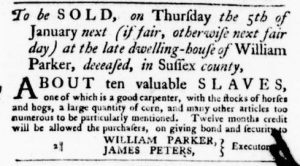
Dec 1 - Virginia Gazette Purdie and Dixon Slavery 1
Virginia Gazette [Purdie & Dixon] (December 1, 1768).

**********

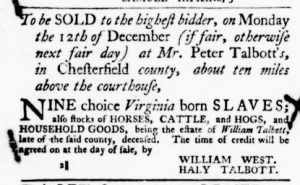
Dec 1 - Virginia Gazette Purdie and Dixon Slavery 2
Virginia Gazette [Purdie & Dixon] (December 1, 1768).

**********

Dec 1 - Virginia Gazette Purdie and Dixon Slavery 3
Virginia Gazette [Purdie & Dixon] (December 1, 1768).

**********

Dec 1 - Virginia Gazette Purdie and Dixon Slavery 4
Virginia Gazette [Purdie & Dixon] (December 1, 1768).

**********

Dec 1 - Virginia Gazette Purdie and Dixon Slavery 5
Virginia Gazette [Purdie & Dixon] (December 1, 1768).

**********

Dec 1 - Virginia Gazette Purdie and Dixon Slavery 6
Virginia Gazette [Purdie & Dixon] (December 1, 1768).

**********

Dec 1 - Virginia Gazette Purdie and Dixon Slavery 7
Virginia Gazette [Purdie & Dixon] (December 1, 1768).

**********

Dec 1 - Virginia Gazette Purdie and Dixon Slavery 8
Virginia Gazette [Purdie & Dixon] (December 1, 1768).

**********

Dec 1 - Virginia Gazette Purdie and Dixon Slavery 9
Virginia Gazette [Purdie & Dixon] (December 1, 1768).

**********

Dec 1 - Virginia Gazette Purdie and Dixon Slavery 10
Virginia Gazette [Purdie & Dixon] (December 1, 1768).

**********

Dec 1 - Virginia Gazette Rind Slavery 1
Virginia Gazette [Rind] (December 1, 1768).

**********

Dec 1 - Virginia Gazette Rind Slavery 2
Virginia Gazette [Rind] (December 1, 1768).

**********

Dec 1 - Virginia Gazette Rind Slavery 3
Virginia Gazette [Rind] (December 1, 1768).

**********

Dec 1 - Virginia Gazette Rind Slavery 4
Virginia Gazette [Rind] (December 1, 1768).

**********

Dec 1 - Virginia Gazette Rind Slavery 5
Virginia Gazette [Rind] (December 1, 1768).

**********

Dec 1 - Virginia Gazette Rind Slavery 6
Virginia Gazette [Rind] (December 1, 1768).

**********

Dec 1 - Virginia Gazette Rind Slavery 7
Virginia Gazette [Rind] (December 1, 1768).

**********

Dec 1 - Virginia Gazette Rind Slavery 8
Virginia Gazette [Rind] (December 1, 1768).

**********

Dec 1 - Virginia Gazette Rind Slavery 9
Virginia Gazette [Rind] (December 1, 1768).

**********

Dec 1 - Virginia Gazette Rind Slavery 10
Virginia Gazette [Rind] (December 1, 1768).

**********

Dec 1 - Virginia Gazette Rind Slavery 11
Virginia Gazette [Rind] (December 1, 1768).

**********

Dec 1 - Virginia Gazette Rind Slavery 12
Virginia Gazette [Rind] (December 1, 1768).

**********

Dec 1 - Virginia Gazette Rind Slavery 13
Virginia Gazette [Rind] (December 1, 1768).

**********

Dec 1 - Virginia Gazette Rind Slavery 14
Virginia Gazette [Rind] (December 1, 1768).