September 24

What was advertised in a colonial American newspaper 250 years ago today?

New-York Gazette and Weekly Mercury (September 24, 1770).

“He has made a considerable Improvement in the Construction of those Shears.”

When he started a new business in 1770, Cornelius Atherton placed an advertisement to alert prospective customers.  He deployed several appeals to entice them to purchase the clothier’s shears that he manufactured.

Readers of the New-York Gazette and Weekly Mercury learned that Atherton claimed his shears were “equal in Goodness to any imported, and are sold upon as good Terms.”   New York’s merchants had resumed trading with their counterparts on the other side of the Atlantic earlier in the year, following the repeal of most of the duties imposed on imported goods by the Townshend Acts.  Entrepreneurs like Atherton, however, did not surrender to the influx of manufactured goods from England, often perceived as being higher quality, but instead defended their role in the American marketplace.  A movement to encourage “domestic manufactures” accompanied the nonimportation agreements adopted in the late 1760s.  Atherton and others who made goods in the colonies heeded that call and then continued to promote their wares when trade resumed.  When it came to quality and price, Atherton proclaimed, his clothier’s shears could not be beat by imported alternatives.  He hoped that would be “an Inducement” to buy from him.

If that was not sufficient, Atherton offered another reason.  He devoted the second half of his advertisement to describing an innovation in the construction of his shears.  Emphasizing innovation was the most innovative part of his advertisement.  Atherton explained that he “has made a considerable Improvement in the Construction of these Shears, so that they may be taken a part with a Screw, to be ground without putting them out of their proper Order.”  This required “additional Workmanship” (that did not make the shears more expensive than imported ones), but resulted in “great Conveniency” when it came to maintenance and durability.  This innovative construction made Atherton’s shears “something higher than the Common.”  Such ingenuity merited attention from prospective customers.

In as short advertisement for clothier’s shears made in the colonies, Atherton brought together multiple marketing appeals.  He resorted to some of the most common, quality and price, but expressed them in comparison to imported alternatives.  In turn, this supported an implicit “Buy American” argument that would have been familiar to consumers in the late 1760s and early 1770s because it had been so frequently made, both implicitly and explicitly, in the public prints, including in advertisements.  Atherton may have considered the innovation in constructing his shears the most compelling of the appeals he presented to prospective customers.  That innovation contributed to quality and durability while also yielding greater convenience for his customers.

Slavery Advertisements Published September 24, 1770

GUEST CURATOR:  AJ Crawford

The Slavery Adverts 250 Project chronicles the role of newspaper advertising in perpetuating slavery in the era of the American Revolution. The project seeks to reveal the ubiquity of slavery in eighteenth-century life from New England to Georgia by republishing advertisements for slaves – for sale, wanted to purchase, runaways, captured fugitives – in daily digests on this site as well as in real time via the @SlaveAdverts250 Twitter feed, utilizing twenty-first-century media to stand in for the print media of the eighteenth century.

The project aims to provide modern audiences with a sense of just how often colonists encountered these advertisements in their daily lives. Enslaved men, women, and children appeared in print somewhere in the colonies almost every single day. Those advertisements served as a constant backdrop for social, cultural, economic, and political life in colonial and revolutionary America. Colonists who did not own slaves were still confronted with slavery as well as invited to maintain the system by purchasing slaves or assisting in the capture of runaways. The frequency of these newspaper advertisements suggests just how embedded slavery was in colonial and revolutionary American culture in everyday interactions beyond the printed page.

These advertisements also testify to the experiences of enslaved men, women, and children, though readers must consider that those experiences have been remediated through descriptions offered by slaveholders rather than the slaves themselves. Often unnamed in the advertisements, enslaved men, women, and children were not invisible or unimportant in early America.

These advertisements appeared in colonial American newspapers 250 years ago today.

Sep 24 1770 - Boston Evening-Post Slavery 1
Boston Evening-Post (September 24, 1770).

**********

Boston Evening-Post (September 24, 1770).

**********

Sep 24 1770 - Boston-Gazette Slavery 1
Boston-Gazette (September 24, 1770).

**********

Sep 24 1770 - Boston-Gazette Slavery 2
Boston-Gazette (September 24, 1770).

**********

Sep 24 1770 - Masssachusetts Gazette and Boston Post-Boy Slavery 1
Massachusetts Gazette and Boston Post-Boy (September 24, 1770).

**********

Sep 24 1770 - New-York Gazette and Weekly Mercury Slavery 1
New-York Gazette and Weekly Mercury (September 24, 1770).

**********

Sep 24 1770 - New-York Gazette and Weekly Mercury Slavery 2
New-York Gazette and Weekly Mercury (September 24, 1770).

**********

Sep 24 1770 - New-York Gazette and Weekly Mercury Slavery 3
New-York Gazette and Weekly Mercury (September 24, 1770).

**********

Sep 24 1770 - New-York Gazette and Weekly Mercury Slavery 4
New-York Gazette and Weekly Mercury (September 24, 1770).

**********

Sep 24 1770 - New-York Gazette and Weekly Mercury Slavery 5
New-York Gazette and Weekly Mercury (September 24, 1770).

**********

Sep 24 1770 - New-York Gazette and Weekly Mercury Slavery 6
New-York Gazette and Weekly Mercury (September 24, 1770).

**********

Sep 24 1770 - South-Carolina and American General Gazette Slavery 1
South-Carolina and American General Gazette (September 24, 1770).

**********

Sep 24 1770 - South-Carolina and American General Gazette Slavery 2
South-Carolina and American General Gazette (September 24, 1770).

**********

Sep 24 1770 - South-Carolina and American General Gazette Slavery 3
South-Carolina and American General Gazette (September 24, 1770).

**********

Sep 24 1770 - South-Carolina and American General Gazette Slavery 4
South-Carolina and American General Gazette (September 24, 1770).

September 23

What was advertised in a colonial American newspaper 250 years ago this week?

Pennsylvania Gazette (September 20, 1770).

“POOR RICHARD’s ALMANACK, for the Year 1771.”

With the arrival of fall in 1770 came the season for advertising almanacs for 1771.  A few advertisements for almanacs appeared in various newspapers during the summer months, but they had not yet become regular features.  In late September, those advertisements began appearing in greater numbers.  Newspaper readers would have been accustomed to the seasonal pattern, expecting to encounter more and more advertisements for almanacs in October, November, and December and then a gradual tapering off in the new year as printers attempted to rid themselves of surplus stock before the contents became obsolete.  Almanacs were big business for printers, both those who published newspapers and those who did not.  These inexpensive pamphlets found their way into households from the most grand to the most humble.  Readers could select among a variety of titles, likely choosing favorites and developing customer loyalty over the years.

The compositor of the Pennsylvania Gazette conveniently placed four advertisements for six almanacs together in the September 20, 1770, edition.  The first announced that Hall and Sellers had just published the popular Poor Richard’s Almanack as well as the Pocket Almanack.  That advertisement, the longest of the four, appeared first, not coincidentally considering that Hall and Sellers printed the Pennsylvania Gazette.  The printers accepted advertisements from competitors, but that did not prevent them from giving their own advertisement a privileged place.  In the other three advertisements, local printers hawked other almanacs.  John Dunlap published and sold Father Abraham’s Almanack.  From Joseph Crukshank, readers could acquire Poor Will’s Almanack.  William Evitt supplied both the Universal Almanack and Poor Robin’s Almanack.  Hall and Sellers took advantage of their ability to insert advertisements gratis in their own newspaper by composing a notice twice the length of the others.  They listed far more of the contents as a means of inciting demand among prospective customers.

This was the first concentration of advertisements for almanacs in the fall of 1770, but others would soon follow in newspapers published throughout the colonies.  If the advertising campaigns launched in previous years were any indication, readers could expect to see even more elaborate notices than the one published by Hall and Sellers as well as many others that simply made short announcements that almanacs were available from printers and booksellers.  Such advertisements were a sign of the season in eighteenth-century America.

September 22

What was advertised in a colonial American newspaper 250 years ago today?

Providence Gazette (September 22, 1770).

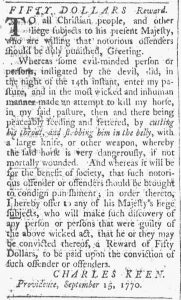
Cutting his throat, and stabbing him in the belly.”

The advertising section of the Providence Gazette in the early 1770s sometimes read like a late nineteenth-century police blotter.  Consider the September 22, 1770, edition.  Among the advertisements for consumer goods and services, legal notices, and one advertisement offering a good price for a flying squirrel, several other advertisements relayed stories of thefts and worse crimes.

The first recorded a theft, its tone suggesting unpleasant consequences for the thief.  An anonymous advertiser suggested that the “Person who took a new Beaver Hat out of the Court-House” on the previous Thursday evening “will do well to leave it” at the printing office for the owner to retrieve.  By doing so, the thief “may thereby prevent the disagreeable Circumstance of a personal Application.”  Whether or not the advertiser actually knew the identity of the thief, he suggested that he did.  The prospect of a “personal Application” suggested retribution for refusing to voluntarily return the hat.

In an advertisement that had already been running for many weeks, Seth Wetmore of Middletown, Connecticut, described how his house “was broke open … by some Person or Persons unknown” at the beginning of July.  The burglars absconded with a variety of clothing and other personal articles.  Wetmore suspected that they may have been the same men who escaped from the jail in New Haven the previous night, John Armstrong and John Galloway, and their accomplice, James Burne.  Wetmore offered a reward for the return of his goods “or the greater Part of them” and the capture of the “Felons” over and above the reward offered by the jailer.

In the most disturbing of these advertisements, Charles Keen of Providence described the depraved acts of “notorious offenders … instigated by the devil.”  An “evil-minded person or persons” had entered his pasture in the dead of night and attempted to kill his horse.  The unfortunate horse had been “peaceably feeding and fettered” when the perpetrators set about “cutting his throat, and stabbing him in the belly, with a large knife, or other weapon.”  The horse initially survived the ordeal, but Keen suspected that he could still die of the wounds.  Keen offered a substantial reward to anybody “who will make such discovery of any person or persons that were guilty of the above wicked act.”

When it came to crime reporting, from a hat nicked at the courthouse to a brutal attack on a horse in the middle of the night, the advertisements in this issue of the Providence Gazette carried far more news than the rest of the newspaper.

Slavery Advertisements Published September 22, 1770

GUEST CURATOR:  AJ Crawford

The Slavery Adverts 250 Project chronicles the role of newspaper advertising in perpetuating slavery in the era of the American Revolution. The project seeks to reveal the ubiquity of slavery in eighteenth-century life from New England to Georgia by republishing advertisements for slaves – for sale, wanted to purchase, runaways, captured fugitives – in daily digests on this site as well as in real time via the @SlaveAdverts250 Twitter feed, utilizing twenty-first-century media to stand in for the print media of the eighteenth century.

The project aims to provide modern audiences with a sense of just how often colonists encountered these advertisements in their daily lives. Enslaved men, women, and children appeared in print somewhere in the colonies almost every single day. Those advertisements served as a constant backdrop for social, cultural, economic, and political life in colonial and revolutionary America. Colonists who did not own slaves were still confronted with slavery as well as invited to maintain the system by purchasing slaves or assisting in the capture of runaways. The frequency of these newspaper advertisements suggests just how embedded slavery was in colonial and revolutionary American culture in everyday interactions beyond the printed page.

These advertisements also testify to the experiences of enslaved men, women, and children, though readers must consider that those experiences have been remediated through descriptions offered by slaveholders rather than the slaves themselves. Often unnamed in the advertisements, enslaved men, women, and children were not invisible or unimportant in early America.

These advertisements appeared in colonial American newspapers 250 years ago today.

Sep 22 1770 - Providence Gazette Slavery 1
Providence Gazette (September 22, 1770).

September 21

What was advertised in a colonial American newspaper 250 years ago today?

New-London Gazette (September 21, 1770).

“The Paper will then be one of the cheapest of its Size, printed in America.”

Newspaper printers collected two revenue streams: subscriptions and advertising.  Most did not, however, frequently note in print how much they charged for either subscriptions or advertising.  A few inserted such information in the colophon on the final page of each issue, but even those printers tended to list the prices for one or the other but not both.  Timothy Green, the printer of the New-London Gazette, was among those printers who did not regularly publish his prices for either subscriptions or advertising.  In a notice in the September 21, 1770, edition, however, he informed readers that he was raising the price for subscriptions.

Following an “Enlargement” of the New-London Gazette to a larger sheet, Green determined that “the Labour and Expence of Paper is so greatly Augmented” that he could not continue to operate the newspaper at the current rates except at “a manifest Loss.”  Accordingly, he planned to raise the price by eight pence per year, bringing the total to six shillings and eight pence.  This represented an increase of eleven percent, yet Green presented it as “so small that it’s presumed no one will think much of allowing it.”  To further convince current subscribers and future customers that they should not think much of the new price, Green explained that the New-London Gazette would still be “one of the cheapest of its Size, printed in America.”  Compared to other newspapers, the New-London Gazette was still a bargain at a total of eighty pence per year.  Still, Green realized that not all subscribers would be satisfied with this explanation.  He pledged that “Some further Improvements will shortly be made in the Paper,” though he did not offer any particulars.  He concluded by pledging “the greatest Care constantly taken to render” the New-London Gazette “beneficial to the Customers.”

Apparently Green did not consider it necessary to raise his rates for advertising to help defray the expenses of acquiring larger sheets and setting more type for the enlarged New-London Gazette.  Even if he at least listed his current rates, that would have revealed the relative prices for subscriptions and advertising.  Still, notices like this one help to reconstruct some of the expenses incurred by readers who subscribed to newspapers in eighteenth-century America.

September 20

What was advertised in a colonial American newspaper 250 years ago today?

South-Carolina Gazette (September 20, 1770).

“Such Articles as the Resolutions of the Inhabitants of this Province will admit of.”

As summer turned to fall in 1770, Brian Cape advertised “a tolerable Assortment of Goods” for sale in the South-Carolina Gazette.  This unusual description, “a tolerable Assortment,” had at least two meanings.  Like their counterparts in Boston, New York, and Philadelphia, the merchants of South Carolina enacted nonimportation agreements to protest duties imposed on certain imported goods by the Townshend Acts.  Cape assured prospective customers that he carried “such Articles as the Resolutions of the Inhabitants of this Province will admit of.”  In that sense, his merchandise was “tolerable” according to the standards adopted by the community.  It was also “tolerable” in the sense that it was as extensive as could be expected under the circumstances.  Consumers grew accustomed to vast arrays of choices in the eighteenth century.  Nonimportation agreements constrained those choices, but Cape suggested that the ability and pick and choose had not been eliminated at his shop.

He also vowed that prospective customers would not encounter exorbitant prices for his “tolerable Assortment of Goods” as the result of scarcity caused by the nonimportation agreement.  Indeed, scarcity may have been a relative term since many merchants and shopkeepers seized the opportunity to sell inventory that had lingered on their shelves and in their storerooms.  Cape asserted that he sold his wares “at moderate Prices” that were fair to consumers.  He also included a nota bene that offered a special bargain: “Ten per Cent will be discounted for ready Money.”  In other words, he rewarded customers who paid in cash rather than credit with significant savings.  Credit was one of the primary features that made the consumer revolution possible in the eighteenth century, yet it could be tricky to manage.  Merchants and shopkeepers frequently placed advertisements calling on customers to settle accounts or face legal action.  Cape presented an opportunity to avoid future troubles by paying with “ready Money” from the start.
Compared to modern marketing campaigns, eighteenth-century advertisements have sometimes been dismissed for being so straightforward as to be merely announcements of goods for sale.  That approach underestimates the appeals that advertisers worked into their notices in their attempts to entice customers to visit their shops.  Cape addressed both price and politics in his advertisement in 1770, incorporating issues that resonated with consumers at the time.

Slavery Advertisements Published September 20, 1770

GUEST CURATOR:  AJ Crawford

The Slavery Adverts 250 Project chronicles the role of newspaper advertising in perpetuating slavery in the era of the American Revolution. The project seeks to reveal the ubiquity of slavery in eighteenth-century life from New England to Georgia by republishing advertisements for slaves – for sale, wanted to purchase, runaways, captured fugitives – in daily digests on this site as well as in real time via the @SlaveAdverts250 Twitter feed, utilizing twenty-first-century media to stand in for the print media of the eighteenth century.

The project aims to provide modern audiences with a sense of just how often colonists encountered these advertisements in their daily lives. Enslaved men, women, and children appeared in print somewhere in the colonies almost every single day. Those advertisements served as a constant backdrop for social, cultural, economic, and political life in colonial and revolutionary America. Colonists who did not own slaves were still confronted with slavery as well as invited to maintain the system by purchasing slaves or assisting in the capture of runaways. The frequency of these newspaper advertisements suggests just how embedded slavery was in colonial and revolutionary American culture in everyday interactions beyond the printed page.

These advertisements also testify to the experiences of enslaved men, women, and children, though readers must consider that those experiences have been remediated through descriptions offered by slaveholders rather than the slaves themselves. Often unnamed in the advertisements, enslaved men, women, and children were not invisible or unimportant in early America.

These advertisements appeared in colonial American newspapers 250 years ago today.

Sep 20 1770 - Maryland Gazette Slavery 1
Maryland Gazette (September 20, 1770).

**********

Sep 20 1770 - Maryland Gazette Slavery 2
Maryland Gazette (September 20, 1770).

**********

Sep 20 1770 - Maryland Gazette Slavery 3
Maryland Gazette (September 20, 1770).

**********

Sep 20 1770 - Maryland Gazette Slavery 4
Maryland Gazette (September 20, 1770).

**********

Sep 20 1770 - Massachusetts Gazette and Boston Weekly News-Letter Slavery 1
Massachusetts Gazette and Boston Weekly Mercury (September 20, 1770).

**********

Sep 20 1770 - Massachusetts Gazette and Boston Weekly News-Letter Slavery 2
Massachusetts Gazette and Boston Weekly Mercury (September 20, 1770).

**********

Sep 20 1770 - Massachusetts Gazette and Boston Weekly News-Letter Slavery 3
Massachusetts Gazette and Boston Weekly Mercury (September 20, 1770).

**********

Sep 20 1770 - New-York Journal Slavery 1
New-York Journal (September 20, 1770).

**********

Sep 20 1770 - South-Carolina Gazette Slavery 1
South-Carolina Gazette (September 20, 1770).

**********

Sep 20 1770 - South-Carolina Gazette Slavery 2
South-Carolina Gazette (September 20, 1770).

**********

Sep 20 1770 - South-Carolina Gazette Slavery 3
South-Carolina Gazette (September 20, 1770).

**********

Sep 20 1770 - South-Carolina Gazette Slavery 4
South-Carolina Gazette (September 20, 1770).

**********

Sep 20 1770 - South-Carolina Gazette Slavery 5
South-Carolina Gazette (September 20, 1770).

**********

Sep 20 1770 - South-Carolina Gazette Slavery 6
South-Carolina Gazette (September 20, 1770).

**********

Sep 20 1770 - South-Carolina Gazette Slavery 7
South-Carolina Gazette (September 20, 1770).

**********

Sep 20 1770 - South-Carolina Gazette Supplement Slavery 1
Supplement to the South-Carolina Gazette (September 20, 1770).

**********

Sep 20 1770 - South-Carolina Gazette Supplement Slavery 2
Supplement to the South-Carolina Gazette (September 20, 1770).

**********

Sep 20 1770 - South-Carolina Gazette Supplement Slavery 3
Supplement to the South-Carolina Gazette (September 20, 1770).

**********

Sep 20 1770 - South-Carolina Gazette Supplement Slavery 4
Supplement to the South-Carolina Gazette (September 20, 1770).

**********

Sep 20 1770 - Virginia Gazette Purdie & Dixon Slavery 1
Virginia Gazette [Purdie and Dixon] (September 20, 1770).

**********

Sep 20 1770 - Virginia Gazette Purdie & Dixon Slavery 2
Virginia Gazette [Purdie and Dixon] (September 20, 1770).

**********

Sep 20 1770 - Virginia Gazette Purdie & Dixon Slavery 3
Virginia Gazette [Purdie and Dixon] (September 20, 1770).

**********

Sep 20 1770 - Virginia Gazette Purdie & Dixon Slavery 4
Virginia Gazette [Purdie and Dixon] (September 20, 1770).

**********

Sep 20 1770 - Virginia Gazette Purdie & Dixon Slavery 5
Virginia Gazette [Purdie and Dixon] (September 20, 1770).

**********

Sep 20 1770 - Virginia Gazette Purdie & Dixon Slavery 6
Virginia Gazette [Purdie and Dixon] (September 20, 1770).

**********

Sep 20 1770 - Virginia Gazette Purdie & Dixon Slavery 7
Virginia Gazette [Purdie and Dixon] (September 20, 1770).

**********

Sep 20 1770 - Virginia Gazette Rind Slavery 1
Virginia Gazette [Rind] (September 20, 1770).

**********

Sep 20 1770 - Virginia Gazette Rind Slavery 2
Virginia Gazette [Rind] (September 20, 1770).

**********

Sep 20 1770 - Virginia Gazette Rind Slavery 3
Virginia Gazette [Rind] (September 20, 1770).

**********

Sep 20 1770 - Virginia Gazette Rind Slavery 4
Virginia Gazette [Rind] (September 20, 1770).

**********

Sep 20 1770 - Virginia Gazette Rind Slavery 5
Virginia Gazette [Rind] (September 20, 1770).

**********

Sep 20 1770 - Virginia Gazette Rind Slavery 6
Virginia Gazette [Rind] (September 20, 1770).

**********

Sep 20 1770 - Virginia Gazette Rind Slavery 7
Virginia Gazette [Rind] (September 20, 1770).

Welcome, Guest Curator Andrew Crawford

Andrew Crawford, known as “AJ” to most, graduated from Assumption College in 2020 with a major in History and a minor in Education. He is especially interested in the history of the twentieth century, especially the World Wars and their legacies in the present day.  He served as a resident assistant.  AJ hopes to become a Special Education teacher.  He conducted the research for his contributions as guest curator for the Slavery Adverts 250 Project when he was enrolled in HIS 400 – Research Methods: Vast Early America in Spring 2020.

Welcome, guest curator Andrew “AJ” Crawford.

September 19

What was advertised in a colonial American newspaper 250 years ago this week?

Newport Mercury (September 17, 1770).

“The ACADEMY in LEEDS … in England.”

Readers of the Newport Mercury likely recognized many or even most of the names that appeared among the advertisements for goods and services in the early 1770s.  Such advertising tended to be local in nature, though local could be broadly defined since colonial newspapers tended to serve regions rather than just the towns where they were printed.  One of two newspapers printed in Rhode Island, for instance, the Newport Mercury served all of the southern portions of the colony.  The Providence Gazette provided news and advertising throughout the north.  Thomas Green, Paul Mumford, Gideon Sisson, and Nicholas Tillinghast all ran businesses in Newport and placed advertisements in the Newport Mercury.  John Borden operated a ferry between nearby Portsmouth and Bristol.  He also placed advertisements in the Newport Mercury.

Most advertisements did not come from places outside of the region that the Newport Mercury served, though occasional exceptions did find their way into the pages of that newspaper.  A. Grinshaw’s notice in the September 17, 1770, edition was one such exception.  Grinshaw, a schoolmaster, promoted his “ACADEMY in LEEDS, Which is pleasantly situated in the County of York, in England.”  He made arrangements from the other side of the Atlantic to place his advertisement in the Newport Mercury, hoping to attract pupils for his boarding school from among the merchant elite who resided in the busy port.  The appearance of Grinshaw’s advertisement raises questions about printing and bookkeeping practices.  Colonial printers frequently ran notices calling on their customers, including advertisers, to settle their accounts or face legal consequences.  Did Solomon Southwick, the printer of the Newport Mercury, extend credit to an advertiser so far away?  Or did he insist that Grinshaw pay in full before printing his advertisement?  Did Grinshaw deal directly with Southwick?  Or did he work through an associate who traveled between England and the colonies?  Did Grinshaw ever see his advertisement in print?  Did that even matter to him?  Did the schoolmaster find a receptive audience in Newport?  Did he gain any new students as a result of placing it?  Other sources may reveal the answers to some of these questions, but the advertisement itself does not.