Slavery Advertisements Published November 20, 1770

GUEST CURATOR:  Kevin Nguyễn

The Slavery Adverts 250 Project chronicles the role of newspaper advertising in perpetuating slavery in the era of the American Revolution. The project seeks to reveal the ubiquity of slavery in eighteenth-century life from New England to Georgia by republishing advertisements about enslaved people – for sale as individuals or in groups, wanted to purchase or for hire for short periods, runaways who liberated themselves, and those who were subsequently captured and confined in jails and workhouses – in daily digests on this site as well as in real time via the @SlaveAdverts250 Twitter feed, utilizing twenty-first-century media to stand in for the print media of the eighteenth century.

The project aims to provide modern audiences with a sense of just how often colonists encountered these advertisements in their daily lives. Enslaved men, women, and children appeared in print somewhere in the colonies almost every single day. Those advertisements served as a constant backdrop for social, cultural, economic, and political life in colonial and revolutionary America. Colonists who did not purport to own enslaved people were still confronted with slavery as well as invited to maintain the system by purchasing enslaved men, women, and children or assisting in the capture of so-called “runaways” who sought to free themselves from bondage. The frequency of these newspaper advertisements suggests just how embedded slavery was in colonial and revolutionary American culture in everyday interactions beyond the printed page.

These advertisements also testify to the experiences of enslaved men, women, and children, though readers must consider that those experiences have been remediated through descriptions offered by enslavers rather than enslaved people themselves. Often unnamed in the advertisements, enslaved men, women, and children were not invisible or unimportant in early America.

These advertisements appeared in colonial American newspapers 250 years ago today.

Nov 20 1770 - Essex Gazette Slavery 1
Essex Gazette (November 20, 1770).

**********

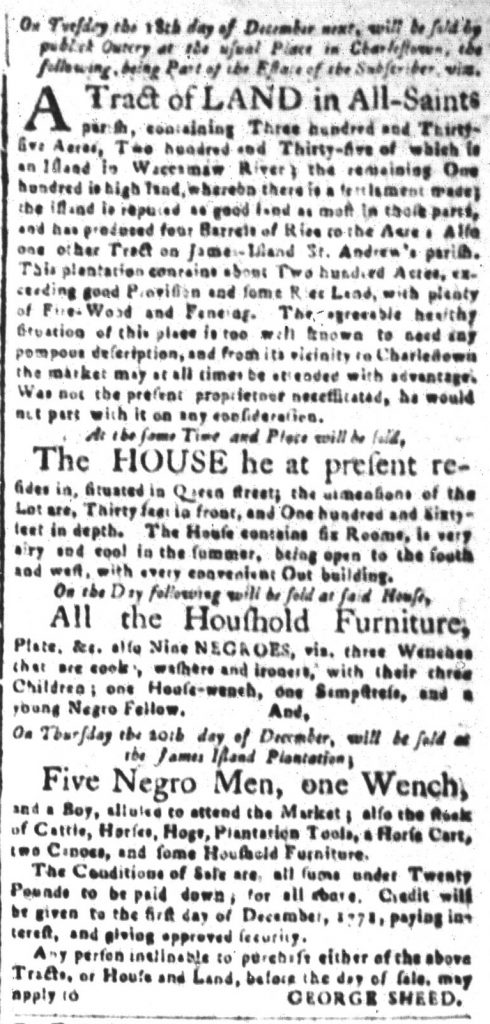
Nov 20 1770 - South-Carolina and American General Gazette Slavery 1
South-Carolina and American General Gazette (November 20, 1770).

**********

Nov 20 1770 - South-Carolina and American General Gazette Slavery 2
South-Carolina and American General Gazette (November 20, 1770).

**********
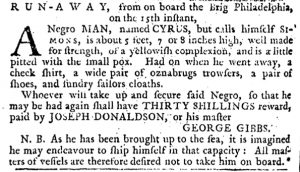
Nov 20 1770 - South-Carolina and American General Gazette Slavery 3
South-Carolina and American General Gazette (November 20, 1770).

**********

Nov 20 1770 - South-Carolina and American General Gazette Slavery 4
South-Carolina and American General Gazette (November 20, 1770).

**********

Nov 20 1770 - South-Carolina and American General Gazette Slavery 5
South-Carolina and American General Gazette (November 20, 1770).

**********

Nov 20 1770 - South-Carolina and American General Gazette Slavery 6
South-Carolina and American General Gazette (November 20, 1770).

**********

Nov 20 1770 - South-Carolina and American General Gazette Slavery 7
South-Carolina and American General Gazette (November 20, 1770).

**********

South-Carolina and American General Gazette (November 20, 1770).

**********

Nov 20 1770 - South-Carolina and American General Gazette Slavery 8
South-Carolina and American General Gazette (November 20, 1770).

**********
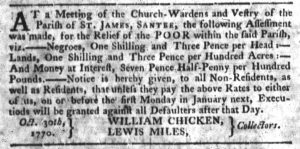
Nov 20 1770 - South-Carolina and American General Gazette Slavery 9
South-Carolina and American General Gazette (November 20, 1770).

**********

Nov 20 1770 - South-Carolina and American General Gazette Slavery 10
South-Carolina and American General Gazette (November 20, 1770).

**********

Nov 20 1770 - South-Carolina and American General Gazette Slavery 11
South-Carolina and American General Gazette (November 20, 1770).

**********

Nov 20 1770 - South-Carolina Gazette and Country Journal Slavery 1
South-Carolina Gazette and Country Journal (November 20, 1770).

**********

Nov 20 1770 - South-Carolina Gazette and Country Journal Slavery 2
South-Carolina Gazette and Country Journal (November 20, 1770).

**********

Nov 20 1770 - South-Carolina Gazette and Country Journal Slavery 3
South-Carolina Gazette and Country Journal (November 20, 1770).

**********

Nov 20 1770 - South-Carolina Gazette and Country Journal Slavery 4
South-Carolina Gazette and Country Journal (November 20, 1770).

**********

Nov 20 1770 - South-Carolina Gazette and Country Journal Slavery 5
South-Carolina Gazette and Country Journal (November 20, 1770).

**********

Nov 20 1770 - South-Carolina Gazette and Country Journal Slavery 6
South-Carolina Gazette and Country Journal (November 20, 1770).

**********

Nov 20 1770 - South-Carolina Gazette and Country Journal Slavery 7
South-Carolina Gazette and Country Journal (November 20, 1770).

**********

Nov 20 1770 - South-Carolina Gazette and Country Journal Supplement Slavery 1
Supplement to the South-Carolina Gazette and Country Journal (November 20, 1770).

**********

Nov 20 1770 - South-Carolina Gazette and Country Journal Supplement Slavery 2
Supplement to the South-Carolina Gazette and Country Journal (November 20, 1770).

**********

Nov 20 1770 - South-Carolina Gazette and Country Journal Supplement Slavery 3
Supplement to the South-Carolina Gazette and Country Journal (November 20, 1770).

**********

Nov 20 1770 - South-Carolina Gazette and Country Journal Supplement Slavery 4
Supplement to the South-Carolina Gazette and Country Journal (November 20, 1770).

**********

Nov 20 1770 - South-Carolina Gazette and Country Journal Supplement Slavery 5
Supplement to the South-Carolina Gazette and Country Journal (November 20, 1770).

**********

Nov 20 1770 - South-Carolina Gazette and Country Journal Supplement Slavery 6
Supplement to the South-Carolina Gazette and Country Journal (November 20, 1770).

November 19

What was advertised in a colonial American newspaper 250 years ago today?

Boston Evening-Post (November 19, 1770).

“Ames’s ALMANACK is now in the Press, and will be published in a few Days.”

Was it news or advertising or both?  Thomas Fleet and John Fleet, printers of the Boston Evening-Post, noted that “Ames’s ALMANACK is now in the Press, and will be published in a few Days” in the November 19, 1770, edition.  This note was one of several items collected together as news from Boston.  The various items from the city amounted to more than a column, but a short section included brief reports about local deaths, ships in port, and Ames’s almanac.  The Fleets informed readers of the death of Elizabeth Langdon, widow of Deacon Josiah Langdon, and advised that the funeral and procession would take place the next day “if the Weather be fair.”  The printers also made note of the death of Mary Collson, the wife of leather dresser Adam Collson and daughter of Solomon Kneeland.  They reported that the “Glasgow Man of War arrived her from the same Place” and the “Mermaid Man of War was to Winter at Halifax.”  The Fleets concluded this list of brief updates with the note about Ames’s almanac, adorning it with a manicule to enhance its visibility.

That was the end of the news in that edition of the Boston Evening-Post.  Paid notices comprised the remainder of the contents.  The Fleets did not present the notice about the almanac as a freestanding advertisement, but they did treat is as a transition from news items they selected for publication and advertisements submitted by merchants, shopkeepers, artisans, auctioneers, and others.  The strategic placement may have allowed them to capture the attention of readers who perused the issue for news without intending to examine the advertisements, position it as a final news items before the advertisements commenced.  This served their own interests as entrepreneurs.  Several variations of the popular Ames’s Astronomical Diary or Almanack for the Year of Our Lord Christ 1771 hit the market in the fall of 1770, but this was probably the version with an imprint that stated it was “Printed and Sold by the Printers and Booksellers” of Boston.  Within the next several weeks, Richard Draper would advertise it in the Massachusetts Gazette and Boston Weekly News-Letter, Edes and Gill would advertise it in the Boston-Gazette, and the Fleets would advertise it in the Boston-Evening Post.  At that time, the Fleets devised a freestanding advertisement that ran among other advertisements rather than placing a notice within or adjacent to the news.

In advance of the almanac’s publication, the Fleets alerted prospective customers that an edition of Ames’s almanac would soon be available for sale at their printing office.  They used their access to the press to craft an announcement that appeared to be news even as it promoted a product that the printers had an interest in supplying to the public.  The placement of the notice as a transition between news and advertising was strategic.

Slavery Advertisements Published November 19, 1770

GUEST CURATOR:  Kevin Nguyễn

The Slavery Adverts 250 Project chronicles the role of newspaper advertising in perpetuating slavery in the era of the American Revolution. The project seeks to reveal the ubiquity of slavery in eighteenth-century life from New England to Georgia by republishing advertisements about enslaved people – for sale as individuals or in groups, wanted to purchase or for hire for short periods, runaways who liberated themselves, and those who were subsequently captured and confined in jails and workhouses – in daily digests on this site as well as in real time via the @SlaveAdverts250 Twitter feed, utilizing twenty-first-century media to stand in for the print media of the eighteenth century.

The project aims to provide modern audiences with a sense of just how often colonists encountered these advertisements in their daily lives. Enslaved men, women, and children appeared in print somewhere in the colonies almost every single day. Those advertisements served as a constant backdrop for social, cultural, economic, and political life in colonial and revolutionary America. Colonists who did not purport to own enslaved people were still confronted with slavery as well as invited to maintain the system by purchasing slaves or assisting in the capture of runaways who sought to free themselves from bondage. The frequency of these newspaper advertisements suggests just how embedded slavery was in colonial and revolutionary American culture in everyday interactions beyond the printed page.

These advertisements also testify to the experiences of enslaved men, women, and children, though readers must consider that those experiences have been remediated through descriptions offered by enslavers rather than enslaved people themselves. Often unnamed in the advertisements, enslaved men, women, and children were not invisible or unimportant in early America.

These advertisements appeared in colonial American newspapers 250 years ago today.

Nov 19 1770 - Boston-Gazette Slavery 1
Boston-Gazette (November 19, 1770).

**********

Nov 19 1770 - Boston-Gazette Slavery 2
Boston-Gazette (November 19, 1770).

**********

Nov 19 1770 - Boston-Gazette Slavery 3
Boston-Gazette (November 19, 1770).

**********

Nov 19 1770 - New-York Gazette and Weekly Mercury Slavery 1
New-York Gazette and Weekly Mercury (November 19, 1770).

**********

Nov 19 1770 - New-York Gazette and Weekly Mercury Slavery 2
New-York Gazette and Weekly Mercury (November 19, 1770).

**********

Nov 19 1770 - New-York Gazette and Weekly Mercury Slavery 3
New-York Gazette and Weekly Mercury (November 19, 1770).

**********

Nov 19 1770 - New-York Gazette and Weekly Mercury Slavery 4
New-York Gazette and Weekly Mercury (November 19, 1770).

**********

Nov 19 1770 - Pennsylvania Chronicle Slavery 1
Pennsylvania Chronicle (November 19, 1770).

November 18

What was advertised in a colonial American newspaper 250 years ago this week?

South-Carolina Gazette (November 15, 1770).

“ABSENTED herself … a tall stout NEGRO … named LUCY.”

Many of the advertisements in the November 15, 1770, edition of the South-Carolina Gazette offered enslaved men, women, and children for sale, but several others countered those stories of exploitation with stories of liberation.  That was not how Mordecai Myers, John Beale, or James Roulain saw it when they described the Black people known to them as Lucy, Sue, and Agrippa who had “ABSENTED” themselves or “RUN AWAY,” as their advertisements proclaimed in capital letters to catch the attention of readers.  Yet Lucy, Sue, Agrippa, and countless other enslaved people knew that they had not “RUN AWAY.”  Instead, they liberated themselves from the enslavers who held them in bondage.

Yet claiming freedom was not as easy as putting distance between themselves and those who treated them as commodities.  Myers, Beale, and Roulain placed advertisements in a newspaper that circulated in Charleston, throughout South Carolina, and beyond.  They provided descriptions of Lucy, Sue, and Agrippa.  They offered rewards for capturing and returning them as well as rewards for information that led to the conviction of anyone, white or Black, who helped or “harboured” Lucy, Sue, and Agrippa.  Beale and Roulain warned “Masters of Vessels” not to transport these fugitives seeking freedom to other colonies.

Myers, Beale, and Roulain suggested some of the strategies that Lucy, Sue, and Agrippa deployed to make good on their escape from bondage.  Myers noted that Lucy wore “a Callico Petticoat and Jacket,” but suspected that she would change her clothing to elude detection since he “took other Cloaths with her.”  Beale suspected that Sue had the assistance of an enslaved man, Mingo, since the two had been spotted together in Charleston.  For his part, Roulain could not conceive of Agrippa desiring liberty for himself.  He asserted that “some malicious Person” persuaded the enslaved man to depart since Agrippa “always behaved himself extremely well” over the course of eighteenth years laboring on Roulain’s schooner.

These enslavers and many others throughout the colonies who placed such advertisements attempted to enlist others in a culture of surveillance that helped to maintain slavery.  They presented descriptions with the intention that readers, whether or not they were enslavers, would scrutinize Black people they encountered, carefully assessing their bodies, clothing, and comportment.  They offered rewards as a means of enticing assistance in capturing enslaved people who liberated themselves and returning them to bondage while simultaneously threatening legal action against anyone who exhibited the courage, compassion, or character to aid enslaved men and women who seized their own liberty.  The press that so often promoted liberty for white colonists in the era of the American Revolution was also an important tool in curtailing liberty for enslaved Africans and African Americans.

November 17

What was advertised in a colonial American newspaper 250 years ago today?

Providence Gazette (November 17, 1770).

“A Collection of HYMNS for social Worship … By that eminent and illustrious Servant of Christ, the late Rev. GEORGE WHITEFIELD.”

In the weeks after George Whitefield’s death in Newburyport, Massachusetts, on September 30, 1770, printers, booksellers, and others supplied the grieving public with commemorative items that honored the memory of one of the most influential ministers associated with the religious revivals now known as the Great Awakening.  The commodification of Whitefield’s death was widespread.  Advertisements for broadsides and books appeared in newspapers from New England to South Carolina.  As colonists joined together in mourning the minister, they also joined together to participate in a culture of consumption inspired by his death.

Garrat Noel, a bookseller in New York, advertised titles by Whitefield already in his inventory.  John Carter, the printer of the Providence Gazette, on the other hand, saw an opportunity to turn a profit by reprinting Whitefield’s popular Collection of Hymns for Social Worship.  He inserted a subscription notice in the November 17 edition of the Providence Gazette, calling on prospective buyers to indicate their interest by “subscribing” for their own copies.  Subscription notices helped printers assess demand for proposed publications.  As Carter explained in his advertisement, “As soon as a Sufficiency of Subscriptions are obtained barely to defray the Charge of Printing, the Work will be prepared for the Press.”  If he did not attract enough subscribers then he would not lose money on the enterprise.  As a means of confirming their commitment, Carter asked subscribers to pay half “at subscribing” and the other half upon delivery.

Carter made several marketing appeals to entice subscribers to reserve their copies.  They should acquire it, he argued, as a means of religious edification.  “This valuable Work,” the printer stated, “forms of itself a Body of Divinity, and ought to be in the Hands of every Christian.”  Furthermore, it was a bargain.  The previous twelve editions printed in London sold for twice as much as Carter charged for his American edition.  If that was not reason enough, then prospective subscribers needed to take into account the politics of making this purchase.  Carter asserted that the hymnal would be printed on “good Paper, of the Manufacture of America,” rather than imported paper that had been subject to duties under the Townshend Acts until only very recently.  Subscribers could demonstrate their righteousness in honoring the memory of Whitefield while simultaneously encouraging domestic production that served as an alternative to relying on imported goods.

Slavery Advertisements Published November 17, 1770

GUEST CURATOR:  Kevin Nguyễn

The Slavery Adverts 250 Project chronicles the role of newspaper advertising in perpetuating slavery in the era of the American Revolution. The project seeks to reveal the ubiquity of slavery in eighteenth-century life from New England to Georgia by republishing advertisements about enslaved people – for sale as individuals or in groups, wanted to purchase or for hire for short periods, runaways who liberated themselves, and those who were subsequently captured and confined in jails and workhouses – in daily digests on this site as well as in real time via the @SlaveAdverts250 Twitter feed, utilizing twenty-first-century media to stand in for the print media of the eighteenth century.

The project aims to provide modern audiences with a sense of just how often colonists encountered these advertisements in their daily lives. Enslaved men, women, and children appeared in print somewhere in the colonies almost every single day. Those advertisements served as a constant backdrop for social, cultural, economic, and political life in colonial and revolutionary America. Colonists who did not purport to own enslaved people were still confronted with slavery as well as invited to maintain the system by purchasing slaves or assisting in the capture of runaways who sought to free themselves from bondage. The frequency of these newspaper advertisements suggests just how embedded slavery was in colonial and revolutionary American culture in everyday interactions beyond the printed page.

These advertisements also testify to the experiences of enslaved men, women, and children, though readers must consider that those experiences have been remediated through descriptions offered by enslavers rather than enslaved people themselves. Often unnamed in the advertisements, enslaved men, women, and children were not invisible or unimportant in early America.

These advertisements appeared in colonial American newspapers 250 years ago today.

Nov 17 1770 - Providence Gazette Slavery 1
Providence Gazette (November 17, 1770).

**********

Nov 17 1770 - Providence Gazette Slavery 2
Providence Gazette (November 17, 1770).

**********

Nov 17 1770 - Providence Gazette Slavery 3
Providence Gazette (November 17, 1770).

November 16

What was advertised in a colonial American newspaper 250 years ago today?

New-Hampshire Gazette (November 16, 1770).

“A most celebrated Discourse on the Death of the Rev. and renown’d GEORGE WHITEFIELD.”

George Whitefield, one of the most prominent ministers associated with the eighteenth-century religious revivals now known as the Great Awakening, died in Newburyport, Massachusetts, on September 30, 1770.  Newspapers in Boston carried the first reports the following day.  Over the course of the next several weeks, news radiated out.  Printers in other towns reprinted articles from Boston’s newspapers and added their own coverage of reactions in their local communities.  Amateur poets penned tributes to the deceased minister and submitted them to newspapers.  Like news reports, those poems were reprinted from one publication to another.  Although news and poems related to Whitefield’s death originally moved from New England to other places in the colonies, eventually the culture of reprinting caused newspapers in New England to carry short articles about local reaction to Whitefield’s death in New York and Philadelphia.

Nearly seven weeks had elapsed since the minister’s death when the New-Hampshire Gazette reprinted an article and poem about Whitefield from the New-York Gazette and Weekly Mercury.  It filled half a page, a significant amount of space in a newspaper comprised of only four pages.  In the same issue, Daniel Fowle and Robert Fowle, the printers of the New-Hampshire Gazette, inserted an advertisement for a sermon preached by Jonathan Parsons, a “most celebrated Discourse on the Death of the Rev. and renown’d GEORGE WHITEFIELD.”  The lengthy advertisement extended half a column.  Between the item reprinted from the New-York Gazette and the advertisement for the sermon, content associated with the minister’s death accounted for two of the twelve columns in the November 16, 1770, edition of the New-Hampshire Gazette.

Parson’s sermon was not the first item memorializing Whitefield offered for sale to the public.  Nearly as soon as newspapers began running articles about the minister’s death, they also suggested that funeral sermons would soon be going to press.  Booksellers found renewed interest in hawking books by Whitefield, capitalizing on current events.  Printers marketed a variety of broadsides with poems, accounts of the funeral, and visual images of Whitefield lying in repose.  The advertisement for this newest commemorative item included a lengthy remembrance from Parsons, reflecting on the first time he met Whitefield and extolling the minister’s work over the past three decades.  The Fowles likely sought to incite greater interest in the pamphlet by whetting the appetites of prospective buyers with that excerpt.

The loss of the beloved minister led to widespread mourning, but it also prompted widespread commodification.  Advertisements for Whitefield memorabilia ran in newspapers from New England to South Carolina, though they were most heavily concentrated in newspaper published in Massachusetts and New Hampshire.  Purchasing commemorative items likely gave colonists opportunities to express their grief and feel connected to the minister and fellow mourners, but the production of those items also represented business opportunities for printers, booksellers, and others who stood to generate revenues from the commodification of Whitefield’s death.

Slavery Advertisements Published November 16, 1770

GUEST CURATOR:  Kevin Nguyễn

The Slavery Adverts 250 Project chronicles the role of newspaper advertising in perpetuating slavery in the era of the American Revolution. The project seeks to reveal the ubiquity of slavery in eighteenth-century life from New England to Georgia by republishing advertisements about enslaved people – for sale as individuals or in groups, wanted to purchase or for hire for short periods, runaways who liberated themselves, and those who were subsequently captured and confined in jails and workhouses – in daily digests on this site as well as in real time via the @SlaveAdverts250 Twitter feed, utilizing twenty-first-century media to stand in for the print media of the eighteenth century.

The project aims to provide modern audiences with a sense of just how often colonists encountered these advertisements in their daily lives. Enslaved men, women, and children appeared in print somewhere in the colonies almost every single day. Those advertisements served as a constant backdrop for social, cultural, economic, and political life in colonial and revolutionary America. Colonists who did not purport to own enslaved people were still confronted with slavery as well as invited to maintain the system by purchasing slaves or assisting in the capture of runaways who sought to free themselves from bondage. The frequency of these newspaper advertisements suggests just how embedded slavery was in colonial and revolutionary American culture in everyday interactions beyond the printed page.

These advertisements also testify to the experiences of enslaved men, women, and children, though readers must consider that those experiences have been remediated through descriptions offered by enslavers rather than enslaved people themselves. Often unnamed in the advertisements, enslaved men, women, and children were not invisible or unimportant in early America.

These advertisements appeared in colonial American newspapers 250 years ago today.

Nov 16 1770 - New-London Gazette Slavery 1
New-London Gazette (November 16, 1770).

**********

Nov 16 1770 - New-London Gazette Slavery 2
New-London Gazette (November 16, 1770).

November 15

What was advertised in a colonial American newspaper 250 years ago today?

South-Carolina Gazette (November 15, 1770).

“ELIXIRS … PILLS … WATERS.”

The partnership of Carne and Poinsett sold a variety of medicines and medical supplies at their shop on Elliott Street in Charleston.  In a newspaper advertisement that ran for six weeks in the late fall of 1770, they advised prospective clients of a “LARGE Parcel of DRUGS and MEDICINES” and “INSTRUMENTS” they had just imported.  Like apothecaries and others who sold popular patent medicines, they provided a list for consumers to examine in advance of visiting their shop.  Carne and Poinsett, however, adopted an innovative approach to organizing their “COMPOLETE ASSORTMENT” of “FAMILY MEDICINES” within their advertisement.

Most advertisers simply listed the various patent medicines in paragraphs of dense text, expecting readers to sort through all of them.  A smaller number of advertisers enumerated one remedy per line, often dividing their notices into two columns, thus allowing readers to peruse their inventory more easily.  Still, they did not impose any particular organizing principle on the merchandise in their advertisements.

Carne and Poinsett categorized their medicines and grouped them together for the convenience of prospective clients who encountered their advertisement in the South-Carolina Gazette.  Rather than have Fraunces’s Female Elixir, Hooper’s Pills, and Stewart’s Tincture appear one after another, they instead listed all of the elixirs together, all of the pills together, and all of the tinctures together.  They did the same for waters and essences.  Rather than clutter the advertisement by repeating the words “elixir,” “pills,” “tincture,” and “water,” they instead inserted those words just once, along with printing ornaments that made clear they identified categories of medicines.  Doing so created more white space within the advertisement, which further enhanced its readability.

In their efforts to market patent medicines to prospective clients, Carne and Poinsett produced an organized catalog condensed to fit within a newspaper advertisement.  While compositors usually exercised discretion when it came to the format of notices, that does not seem to have been the case with Carne and Poinsett’s advertisement.  They placed the same notice in the South-Carolina and American General Gazette, featuring the same graphic design.  That would have been too much of a coincidence to attribute to the creativity of the compositors of the two newspapers.  Carne and Poinsett certainly submitted copy with instructions for how it should appear in print.

Slavery Advertisements Published November 15, 1770

GUEST CURATOR:  Kevin Nguyễn

The Slavery Adverts 250 Project chronicles the role of newspaper advertising in perpetuating slavery in the era of the American Revolution. The project seeks to reveal the ubiquity of slavery in eighteenth-century life from New England to Georgia by republishing advertisements about enslaved people – for sale as individuals or in groups, wanted to purchase or for hire for short periods, runaways who liberated themselves, and those who were subsequently captured and confined in jails and workhouses – in daily digests on this site as well as in real time via the @SlaveAdverts250 Twitter feed, utilizing twenty-first-century media to stand in for the print media of the eighteenth century.

The project aims to provide modern audiences with a sense of just how often colonists encountered these advertisements in their daily lives. Enslaved men, women, and children appeared in print somewhere in the colonies almost every single day. Those advertisements served as a constant backdrop for social, cultural, economic, and political life in colonial and revolutionary America. Colonists who did not purport to own enslaved people were still confronted with slavery as well as invited to maintain the system by purchasing slaves or assisting in the capture of runaways who sought to free themselves from bondage. The frequency of these newspaper advertisements suggests just how embedded slavery was in colonial and revolutionary American culture in everyday interactions beyond the printed page.

These advertisements also testify to the experiences of enslaved men, women, and children, though readers must consider that those experiences have been remediated through descriptions offered by enslavers rather than enslaved people themselves. Often unnamed in the advertisements, enslaved men, women, and children were not invisible or unimportant in early America.

These advertisements appeared in colonial American newspapers 250 years ago today.

Nov 15 1770 - Maryland Gazette Slavery 1
Maryland Gazette (November 15, 1770).

**********

Nov 15 1770 - Maryland Gazette Slavery 2
Maryland Gazette (November 15, 1770).

**********

Nov 15 1770 - New-York Journal Slavery 1
New-York Journal (November 13, 1770).

**********

Nov 15 1770 - New-York Journal Slavery 2
New-York Journal (November 13, 1770).

**********

Nov 15 1770 - New-York Journal Slavery 3
New-York Journal (November 13, 1770).

**********

Nov 15 1770 - New-York Journal Slavery 4
New-York Journal (November 13, 1770).

**********

Nov 15 1770 - Pennsylvania Gazette Slavery 1
Pennsylvania Gazette (November 13, 1770).

**********

Nov 15 1770 - Pennsylvania Journal Slavery 1
Pennsylvania Journal (November 13, 1770).

**********

Nov 15 1770 - Pennsylvania Journal Slavery 2
Pennsylvania Journal (November 13, 1770).

**********

Nov 15 1770 - Pennsylvania Journal Slavery 3
Pennsylvania Journal (November 13, 1770).

**********

Nov 15 1770 - Pennsylvania Journal Slavery 4
Pennsylvania Journal (November 13, 1770).

**********

Nov 15 1770 - South-Carolina Gazette Slavery 1
South-Carolina Gazette (November 13, 1770).

**********

Nov 15 1770 - South-Carolina Gazette Slavery 2
South-Carolina Gazette (November 13, 1770).

**********

Nov 15 1770 - South-Carolina Gazette Slavery 3
South-Carolina Gazette (November 13, 1770).

**********

Nov 15 1770 - South-Carolina Gazette Slavery 4
South-Carolina Gazette (November 13, 1770).

**********

Nov 15 1770 - South-Carolina Gazette Slavery 5
South-Carolina Gazette (November 13, 1770).

**********

Nov 15 1770 - South-Carolina Gazette Slavery 6
South-Carolina Gazette (November 13, 1770).

**********

Nov 15 1770 - South-Carolina Gazette Slavery 7
South-Carolina Gazette (November 13, 1770).

**********

Nov 15 1770 - South-Carolina Gazette Slavery 8
South-Carolina Gazette (November 13, 1770).

**********

Nov 15 1770 - South-Carolina Gazette Slavery 9
South-Carolina Gazette (November 13, 1770).

**********

Nov 15 1770 - South-Carolina Gazette Slavery 10
South-Carolina Gazette (November 13, 1770).

**********

Nov 15 1770 - South-Carolina Gazette Slavery 11
South-Carolina Gazette (November 13, 1770).

**********

Nov 15 1770 - South-Carolina Gazette Supplement Slavery 1
Supplement to the South-Carolina Gazette (November 13, 1770).

**********

Nov 15 1770 - South-Carolina Gazette Supplement Slavery 2
Supplement to the South-Carolina Gazette (November 13, 1770).

**********

Nov 15 1770 - South-Carolina Gazette Supplement Slavery 3
Supplement to the South-Carolina Gazette (November 13, 1770).

**********

Nov 15 1770 - South-Carolina Gazette Supplement Slavery 4
Supplement to the South-Carolina Gazette (November 13, 1770).

**********

Nov 15 1770 - South-Carolina Gazette Supplement Slavery 5
Supplement to the South-Carolina Gazette (November 13, 1770).

**********

Nov 15 1770 - Virginia Gazette Rind Slavery 1
Virginia Gazette [Rind] (November 13, 1770).

**********

Nov 15 1770 - Virginia Gazette Rind Slavery 2
Virginia Gazette [Rind] (November 13, 1770).

**********

Nov 15 1770 - Virginia Gazette Rind Slavery 3
Virginia Gazette [Rind] (November 13, 1770).

**********

Nov 15 1770 - Virginia Gazette Rind Slavery 4
Virginia Gazette [Rind] (November 13, 1770).

**********

Nov 15 1770 - Virginia Gazette Rind Slavery 5
Virginia Gazette [Rind] (November 13, 1770).

**********

Nov 15 1770 - Virginia Gazette Rind Slavery 6
Virginia Gazette [Rind] (November 13, 1770).

**********

Nov 15 1770 - Virginia Gazette Rind Slavery 7
Virginia Gazette [Rind] (November 13, 1770).

**********

Nov 15 1770 - Virginia Gazette Rind Slavery 8
Virginia Gazette [Rind] (November 13, 1770).