February 9

What was advertised in a colonial American newspaper 250 years ago today?
Providence Gazette (February 9, 1771).

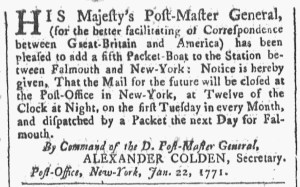
“HIS Majesty’s Post-Master General … has been pleased to add a fifth Packet-Boat to the Station between Falmouth and New-York.”

In January and February 1771, an advertisement that ran in newspapers published in several colonies informed colonists of an improvement to the communications infrastructure that connected them to Britain.  The postmaster general added “a fifth Packet-Boat to the Station between Falmouth and New-York” for the purpose of “better facilitating … Correspondence between Great-Britain and America.”  The advertisement gave notice that the mail “will be closed at the Post-Office in New-York … on the first Tuesday in every Month” and then “dispatched by a Packet the next Day for Falmouth.”

Dated “New-York, Jan. 22, 1771,” this advertisement appeared in the January 28 edition of the New-York Gazette and Weekly Mercury.  The notice next ran in the New-York Journal, the Pennsylvania Gazette, and the Pennsylvania Journal on January 31.  (It may have been in the January 24 edition of the New-York Journal; a page is missing from the digitized copy.)  The advertisement soon found its way into the Providence Gazette on February 2 and the Massachusetts Gazette and Boston Post-Boy on February 4.  By then, it ran in the New-York Gazette and Weekly Mercury a second time, though it did not run in every newspaper more than once.  The advertisement next appeared in the Maryland Gazette on February 7 and the New-Hampshire Gazette on February 8.  Additional newspapers in Boston carried it on February 11, including the Boston Evening-Post and the Boston-Gazette.  The Essex Gazette ran the notice on February 12, as did Purdie and Dixon’s Virginia Gazette and Rind’s Virginia Gazette on February 14.  It made a surprising late appearance in the Pennsylvania Chronicle on February 18 (though it may have been in that newspaper on February 4, an issue not available via the databases of digitized newspapers).  Unfortunately, several issues of newspapers published in North Carolina, South Carolina, and Georgia in the ensuing weeks have not survived, making it impossible to determine when or if readers in those colonies encountered the same advertisement.

Throughout the Middle Colonies, New England, and the Chesapeake, however, colonists had access to the notice within a matter of weeks.  It did not appear in every newspaper, but it did run in newspapers in the major newspapers published in the largest port cities as well as several minor newspapers in smaller towns.  Although formatting shifted from one newspaper to another, the copy remained the same.  In each case, the first appearance of the advertisement benefited from a privileged place on the page, often positioned immediately after news items and before other advertisements.  That likely increased the chances that readers uninterested in perusing the advertisements would at least see the notice about the additional packet boat that transported mail across the Atlantic.  Its placement allowed it to operate as both news and advertisement.  Newspapers, one vital component of colonial communications networks, kept readers informed about improvements to the postal system, another important component.

February 8

What was advertised in a colonial American newspaper 250 years ago today?

New-Hampshire Gazette (February 8, 1771).

“Parents and Masters may depend upon being as well used by sending their Children and Servants, as if present themselves.”

Edward Emerson took to the pages of the New-Hampshire Gazette to advertise “ENGLISH and West India GOODS,” tea, coffee, sugar, spices, and tobacco available at his shop “Opposite the Town House in YORK,” a coastal town in the portion of Massachusetts that became Maine half a century later.  In 1771, fewer than thirty newspapers served the colonies that eventually declared independence.  Accordingly, most newspapers operated on a regional scale.  As a result, the New-Hampshire Gazette, printed in Portsmouth, was the local newspaper for Emerson and other residents of York.

Emerson emphasized both price and customer service in his advertisement, proclaiming that he was “determined to sell” his wares “at the lowest Cash price.”  He also anticipated receiving new inventory “which will be Sold as low as possible.”  When it came to customer service, consumers did not need to visit Emerson’s shops themselves.  Instead, they could send representatives, especially children and servants, to do their shopping without concern that Emerson would dismiss them or treat them unfairly.  “Parents and Masters,” the shopkeeper declared, “may depend upon being as well used by sending their Children and Servants, as if present themselves.”  That was a variation on promises that other shopkeepers sometimes made to prospective customers who preferred to place orders via the post.  Shopkeepers often served consumers who lived at a distance, offering assurances in their advertisements that they would be treated as well as if they visited in person.  This presumably applied to receiving both quality merchandise and the best prices.

Few eighteenth-century newspapers advertisements appeared flashy by today’s standards.  Emerson’s advertisement was not even flashy by the standards of the time, but perhaps that was not necessary in order to be effective.  Emerson sought to establish trust with prospective customers.  He offered low prices.  He allowed his clients to choose among a variety of quantities for most of his wares.  He promised to treat both customers and their representatives well rather than taking advantage of them.  If Emerson regularly perused the pages of the New-Hampshire Gazette and other newspapers that circulated in the area, he certainly read advertisements with more sophisticated marketing strategies that he could have adapted for his own business.  Yet he did not.  Perhaps Emerson considered the appeals he did advance sufficient for establishing relationships with consumers seeking trustworthy purveyors of goods.

February 7

Who was the subject of an advertisement in a colonial American newspaper 250 years ago today?

South-Carolina Gazette (February 7, 1771).

“No one is to hire his Negro Man ABRAHAM, a Bricklayer, without his Consent.”

Advertisements about enslaved people were ubiquitous in newspapers publishing during the era of the American Revolution, as the Slavery Adverts 250 Project seeks to demonstrate.  Most of those advertisements fell into one of two categories:  offering enslaved men, women, and children for sale or offering rewards for the capture and return of enslaved people who liberated themselves from bondage.  Less frequently, advertisements about enslaved people reported on suspected “runaways” confined to jails or workhouses until their enslavers claimed them or hiring out practices, a system for temporarily employing enslaved men and women in which the enslavers ultimately received the wages.

These advertisements, especially those concerning Black men and women confined in jails and workhouses and those describing Africans and African Americans who liberated themselves, served as mechanisms of surveillance and control.  Enslavers placed such advertisements to reassert their authority and attempt to return to what they considered appropriate good order.  They also encouraged all colonists, whether enslavers or not, to participate in the perpetuation of the system by scrutinizing every Black person they encountered to determine if they matched the descriptions published in the newspapers.  By default, Black men and women not under the immediate supervision of enslavers were suspect.

Alternately, advertisements about disorder also testified to resistance by enslaved men and women.  Runaway notices often documented acts of defiance that occurred before Black people liberated themselves.  In addition to actions, they cataloged attitudes that enslavers found frustrating or insubordinate.  In the process of liberating themselves, perhaps the most significant act of resistance, Black people often appropriated multiple articles of clothing in order to disguise themselves.  They also sometimes took horses or weapons.  Many enslavers surmised that enslaved people who liberated themselves received assistance from others, including other enslaved people, free Black men and women, and sympathetic white colonists.  They warned that anyone offering aid would face prosecution.

Less frequently, some advertisements told other stories of resistance, though that was not the intention of the men and women who placed them.  Consider the notice that Lionel Chalmers inserted in the February 7, 1771, edition of the South-Carolina Gazette.  The enslaver asserted that “no one is to hire his Negro Man ABRAHAM, a Bricklayer, without his Consent.”  Furthermore, they were not “to pay the Negro any Wages for his Work.”  As was the case with many enslaved people hired out in busy urban ports, Abraham may have experienced some level of quasi-autonomy, as Douglas R. Egerton demonstrated was the case for Gabriel, the leader of a failed revolt in Richmond, Virginia, in 1800.  Abraham may have been choosing his own employers, socializing with whomever he saw fit, and keeping some portion of his wages, a situation that Chalmers may have initially endorsed but eventually found untenable because it undermined his authority.  Chalmers may not have even been aware of who currently employed Abraham, declaring that said person “is hereby desired to deliver him, immediately to his Master, unless he be determined to make himself liable.”

Like so many other advertisements about enslaved people, this advertisement sought to reestablish order by restoring the authority of the enslaver who placed it.  Chalmers told a partial story, one that certainly deviated from how Abraham would have told it if he had the opportunity.  Still, Chalmers revealed enough details to reveal that Abraham, a skilled artisan, exercised his own will by engaging in acts of resistance so bold that the enslaver had to resort to publishing an advertisement in an effort to regain his authority.

Slavery Advertisements Published February 7, 1771

The Slavery Adverts 250 Project chronicles the role of newspaper advertising in perpetuating slavery in the era of the American Revolution. The project seeks to reveal the ubiquity of slavery in eighteenth-century life from New England to Georgia by republishing advertisements about enslaved people – for sale as individuals or in groups, wanted to purchase or for hire for short periods, runaways who liberated themselves, and those who were subsequently captured and confined in jails and workhouses – in daily digests on this site as well as in real time via the @SlaveAdverts250 Twitter feed, utilizing twenty-first-century media to stand in for the print media of the eighteenth century.

The project aims to provide modern audiences with a sense of just how often colonists encountered these advertisements in their daily lives. Enslaved men, women, and children appeared in print somewhere in the colonies almost every single day. Those advertisements served as a constant backdrop for social, cultural, economic, and political life in colonial and revolutionary America. Colonists who did not purport to own enslaved people were still confronted with slavery as well as invited to maintain the system by purchasing enslaved men, women, and children or assisting in the capture of so-called “runaways” who sought to free themselves from bondage. The frequency of these newspaper advertisements suggests just how embedded slavery was in colonial and revolutionary American culture in everyday interactions beyond the printed page.

These advertisements also testify to the experiences of enslaved men, women, and children, though readers must consider that those experiences have been remediated through descriptions offered by enslavers rather than enslaved people themselves. Often unnamed in the advertisements, enslaved men, women, and children were not invisible or unimportant in early America.

These advertisements appeared in colonial American newspapers 250 years ago today.

Maryland Gazette (February 7, 1771).

**********

Maryland Gazette (February 7, 1771).

**********

Maryland Gazette (February 7, 1771).

**********

Massachusetts Gazette and Boston Weekly News-Letter (February 7, 1771).

**********

Massachusetts Gazette and Boston Weekly News-Letter (February 7, 1771).

**********

New-York Journal (February 7, 1771).

**********

New-York Journal (February 7, 1771).

**********

Pennsylvania Gazette (February 7, 1771).

**********

Pennsylvania Gazette (February 7, 1771).

**********

Pennsylvania Journal (February 7, 1771).

**********

Pennsylvania Journal (February 7, 1771).

**********

South-Carolina Gazette (February 7, 1771).

**********

South-Carolina Gazette (February 7, 1771).

**********

South-Carolina Gazette (February 7, 1771).

**********

South-Carolina Gazette (February 7, 1771).

**********

South-Carolina Gazette (February 7, 1771).

**********

South-Carolina Gazette (February 7, 1771).

**********

South-Carolina Gazette (February 7, 1771).

**********

South-Carolina Gazette (February 7, 1771).

**********

South-Carolina Gazette (February 7, 1771).

**********

South-Carolina Gazette (February 7, 1771).

**********

South-Carolina Gazette (February 7, 1771).

**********

South-Carolina Gazette (February 7, 1771).

**********

South-Carolina Gazette (February 7, 1771).

**********

South-Carolina Gazette (February 7, 1771).

**********

South-Carolina Gazette (February 7, 1771).

**********

Virginia Gazette [Purdie and Dixon] (February 7, 1771).

**********

Virginia Gazette [Purdie and Dixon] (February 7, 1771).

**********

Virginia Gazette [Purdie and Dixon] (February 7, 1771).

**********

Virginia Gazette [Purdie and Dixon] (February 7, 1771).

**********

Virginia Gazette [Purdie and Dixon] (February 7, 1771).

**********

Virginia Gazette [Purdie and Dixon] (February 7, 1771).

**********

Virginia Gazette [Purdie and Dixon] (February 7, 1771).

**********

Virginia Gazette [Purdie and Dixon] (February 7, 1771).

**********

Virginia Gazette [Purdie and Dixon] (February 7, 1771).

**********

Virginia Gazette [Purdie and Dixon] (February 7, 1771).

**********

Virginia Gazette [Purdie and Dixon] (February 7, 1771).

**********

Virginia Gazette [Purdie and Dixon] (February 7, 1771).

**********

Virginia Gazette [Rind] (February 7, 1771).

**********

Virginia Gazette [Rind] (February 7, 1771).

**********

Virginia Gazette [Rind] (February 7, 1771).

**********

Virginia Gazette [Rind] (February 7, 1771).

**********

Virginia Gazette [Rind] (February 7, 1771).

**********

Virginia Gazette [Rind] (February 7, 1771).

**********

Virginia Gazette [Rind] (February 7, 1771).

**********

Virginia Gazette [Rind] (February 7, 1771).

**********

Virginia Gazette [Rind] (February 7, 1771).

February 6

What was advertised in a colonial American newspaper 250 years ago this week?

Supplement to the Boston-Gazette (February 4, 1771).

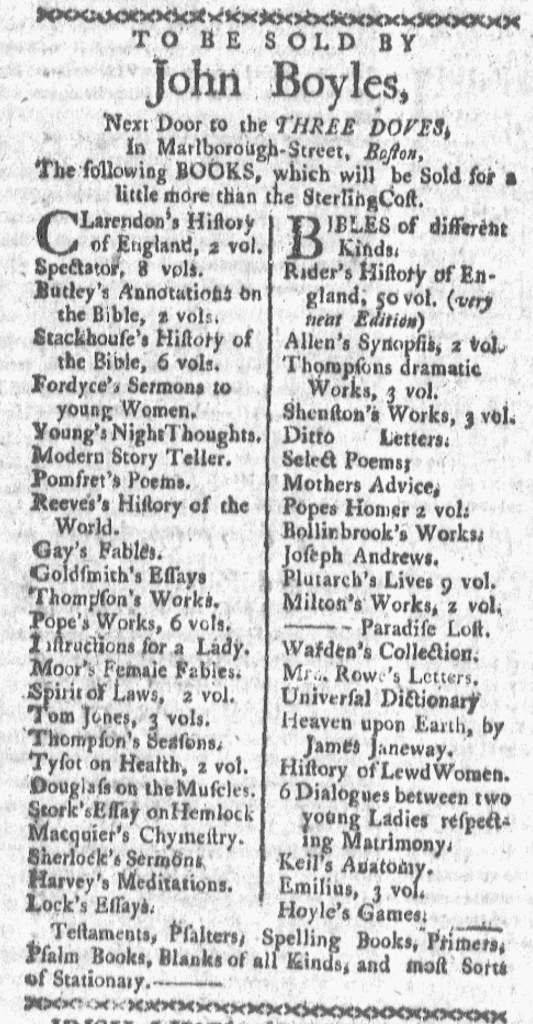
“Next Door to the THREE DOVES.”

In an advertisement in the supplement that accompanied the February 4, 1771, edition of the Boston-Gazette, Thomas Knight advised prospective customers that he sold window glass and bottles “at the Three Kings in Cornhill.”  A short notice in the standard issue informed the public that the “Sale of Sugars, which was advertised to be at the Bunch of Grapes To-Morrow, is postpon’d.”  John Boyles advertised several dozen books in the supplement, listing the titles in two columns.  He also made reference to a shop sign in order to direct readers to his location.  The bookseller gave his location as “Next Door to the THREE DOVES, In Marlborough-Street, Boston.”

Like other major urban ports, Boston did not adopt street numbers until the very end of the eighteenth century and the beginning of the nineteenth.  Prior to that, advertisers and others resorted to a variety of means of describing locations.  For instance, they indicated street names and mentioned nearby landmarks.  Shop signs also helped when giving directions, not only for those at the locations marked by the signs but also for others in close proximity.  Boyles apparently had not commissioned his own sign for his bookshop, but that did not prevent him from using a sign affiliated with another business as a landmark for finding his location.

Some proprietors deployed their shop signs as brands representing their businesses, regularly naming them in their newspaper advertisements and sometimes inserting woodcuts depicting them.  The most ambitious eighteenth-century advertisers also distributed trade cards and billheads that made reference to their shop signs and included images.  Yet other entrepreneurs considered those shop signs a form of public property rather than the sole domain of the businesses they marked.  Boyles, for instance, did not seem to believe that the Three Doves belonged exclusively to his neighbor’s business.  He appropriated the shop sign in his own marketing efforts, using it as an efficient means of directing his own customers to his bookshop.

February 5

What was advertised in a colonial American newspaper 250 years ago today?

South-Carolina and American General Gazette (February 5, 1771).

“A FUNERAL SERMON … on the much lamented Death of the Rev. Mr. GEORGE WHITEFIELD.”

Robert Wells, bookseller and printer of the South-Carolina and American General Gazette, placed an advertisement for “NEW BOOKS” in the February 5, 1771, edition of his newspaper.  The advertisement extended an entire column, listing dozens of titles and concluding with “TOBLER’s ALMANACK” and “A FUNERAL SERMON” in memory of George Whitefield.  With the latter, Wells presented consumers an opportunity to participate in commemorations of the prominent minister that occurred from New England to Georgia.  Commodification of Whitefield’s death made it possible for colonists to purchase mementos that testified to their grief and regard for the minister; simultaneously, such commodification generated revenues for printers, booksellers, and others.

Whitefield, one of the most influential ministers associated with the eighteenth-century religious revivals now known as the Great Awakening, died in Newburyport, Massachusetts, on September 30 1770.  The next day news appeared in several newspapers published in Boston and from there quickly spread to other towns and other colonies.  Within a month, residents of Georgia learned of the minister’s death.  Wells advertised a sermon delivered in Whitefield’s memory “at Savannah, in Georgia, November 1, 1770 … By J.J. ZUBLY, Minister of an English and German Congregation.”  According to the imprint, James Johnston, printer of the Georgia Gazette, printed and sold the sermon.  He most likely advertised it in his own newspaper, but few editions of the Georgia Gazette from late 1770 and beyond survive.  Johnston apparently dispatched copies to Charleston in hopes of capturing another market.

Yet the advertisement for Zubly’s sermon was not the only appearance Whitefield made among the advertisements in the February 5 edition of the South-Carolina and American General Gazette.  John Fleeming’s subscription notice for an annotated “FAMILY BIBLE” filled two columns on the front page, the second of those columns devoted almost entirely to an endorsement Whitefield penned for an earlier edition.  Fleeming leveraged the minister’s notes of approbation written years earlier into a posthumous testimonial for his proposed project.  He distributed that advertisement widely in newspapers published in New England, but this was the first time it appeared in any of the newspapers published in South Carolina.  Fleeming and his local agents updated it to indicate that “Subscriptions for said laudable Undertaking, are taken in at Charlestown by ROBERT WELLS, at the Old Printing-House, Great Stationary and Book Store; In Savannah by JAMES JOHNSTON, at his Printing-Office.”

The frequency of advertisements for Whitefield memorabilia tapered off by the end of 1770 as the immediacy of the minister’s death faded, but a couple of months later they experienced a resurgence as printers and booksellers renewed their efforts to provide commemorative items to consumers who wished to feel connected to such a significant event.  Much of this resurgence occurred beyond New England, the center for most, but not all, of the marketing for Whitefield paraphernalia in the first few months after his death.  Just as news spread, reprinted from newspaper to newspaper, so did the commodification of the Whitefield’s death.

Slavery Advertisements Published February 5, 1771

The Slavery Adverts 250 Project chronicles the role of newspaper advertising in perpetuating slavery in the era of the American Revolution. The project seeks to reveal the ubiquity of slavery in eighteenth-century life from New England to Georgia by republishing advertisements about enslaved people – for sale as individuals or in groups, wanted to purchase or for hire for short periods, runaways who liberated themselves, and those who were subsequently captured and confined in jails and workhouses – in daily digests on this site as well as in real time via the @SlaveAdverts250 Twitter feed, utilizing twenty-first-century media to stand in for the print media of the eighteenth century.

The project aims to provide modern audiences with a sense of just how often colonists encountered these advertisements in their daily lives. Enslaved men, women, and children appeared in print somewhere in the colonies almost every single day. Those advertisements served as a constant backdrop for social, cultural, economic, and political life in colonial and revolutionary America. Colonists who did not purport to own enslaved people were still confronted with slavery as well as invited to maintain the system by purchasing enslaved men, women, and children or assisting in the capture of so-called “runaways” who sought to free themselves from bondage. The frequency of these newspaper advertisements suggests just how embedded slavery was in colonial and revolutionary American culture in everyday interactions beyond the printed page.

These advertisements also testify to the experiences of enslaved men, women, and children, though readers must consider that those experiences have been remediated through descriptions offered by enslavers rather than enslaved people themselves. Often unnamed in the advertisements, enslaved men, women, and children were not invisible or unimportant in early America.

These advertisements appeared in colonial American newspapers 250 years ago today.

South-Carolina and American General Gazette (February 5, 1771).

**********

South-Carolina and American General Gazette (February 5, 1771).

**********

South-Carolina and American General Gazette (February 5, 1771).

**********

South-Carolina and American General Gazette (February 5, 1771).

**********

South-Carolina and American General Gazette (February 5, 1771).

**********

South-Carolina and American General Gazette (February 5, 1771).

**********

South-Carolina and American General Gazette (February 5, 1771).

**********

South-Carolina and American General Gazette (February 5, 1771).

**********

South-Carolina and American General Gazette (February 5, 1771).

**********

South-Carolina and American General Gazette (February 5, 1771).

**********

South-Carolina and American General Gazette (February 5, 1771).

**********

South-Carolina and American General Gazette (February 5, 1771).

**********

South-Carolina and American General Gazette (February 5, 1771).

**********

South-Carolina and American General Gazette (February 5, 1771).

**********

South-Carolina and American General Gazette (February 5, 1771).

**********

South-Carolina and American General Gazette (February 5, 1771).

**********

South-Carolina and American General Gazette (February 5, 1771).

February 4

What was advertised in a colonial American newspaper 250 years ago today?

New-York Gazette and Weekly Mercury (February 4, 1771).

“He intends to CONTINUE his PERFORMANCES a few Nights.”

When Hyman Saunders, an illusionist, arrived in New York from Europe in the fall of 1770, he placed an advertisement in the New-York Journal to introduce himself and invite colonists to attend performances “at the house of Mr. Hyer, on Hunter’s Quay” or schedule a “private exhibition.”  Saunders encouraged the curious to see his show as soon as possible or risk missing it because his “stay in this city will be but a few weeks.”  Itinerant performers often deployed that strategy for inciting interest in the spectacles they offered to prospective audiences.  They created a form of scarcity when they stated that they would remain in town for only a limited time.

Sometimes itinerant performers did move to the next town fairly quickly.  Consider, for instance, the series of advertisements placed by an unnamed performer “who has Read and Sung in most of the great Towns in America” in the Providence, Boston, Salem, and Portsmouth in less than two months in the fall of 1769.  He offered a few performances in each place before moving along to the next.  Other performers attempted to encourage interest by proclaiming that they would soon depart for other places, but then remained much longer.  Such was the case for Saunders.  On February 4, 1771, he inserted an advertisement in the New-York Gazette and Weekly Mercury.  He no longer included his first name, perhaps believing that he achieved sufficient local celebrity in the three months he already spent in New York to dispense with such a detail.  He also eliminated the description of “variety of entertaining as well as surprising tricks” that appeared in earlier advertisements.  Instead, he simply announced that he “intends to CONTINUE his PERFORMANCES a few Nights … longer in NEW-YORK.”  That he remained in the city at that time was not by his own design but instead in response to the “PARTICIULAR DESIRE of several Ladies and Gentlemen,” or so he claimed.  Saunders sought to give the public what they wanted.  To that end, he also continued offering private shows “to any select Company,” suggesting another trajectory of demand for his “astonishing performances in the dexterity of hand.”

When they advertised, itinerant performers often emphasized that they would be in town for only a limited time so colonists needed to catch their shows before they were gone or else miss out on the popular culture experiences enjoyed by other members of their communities.  Performers often delayed their departures in order to offer additional shows.  Some, like Saunders who remained in New York for months, may not have planned to leave after a short time at all, but others did move along fairly quickly.  Even though he already remained in town for three months, Saunders attempted to leverage uncertainty about his departure in order to incite demand for his upcoming performances.

Slavery Advertisements Published February 4, 1771

The Slavery Adverts 250 Project chronicles the role of newspaper advertising in perpetuating slavery in the era of the American Revolution. The project seeks to reveal the ubiquity of slavery in eighteenth-century life from New England to Georgia by republishing advertisements about enslaved people – for sale as individuals or in groups, wanted to purchase or for hire for short periods, runaways who liberated themselves, and those who were subsequently captured and confined in jails and workhouses – in daily digests on this site as well as in real time via the @SlaveAdverts250 Twitter feed, utilizing twenty-first-century media to stand in for the print media of the eighteenth century.

The project aims to provide modern audiences with a sense of just how often colonists encountered these advertisements in their daily lives. Enslaved men, women, and children appeared in print somewhere in the colonies almost every single day. Those advertisements served as a constant backdrop for social, cultural, economic, and political life in colonial and revolutionary America. Colonists who did not purport to own enslaved people were still confronted with slavery as well as invited to maintain the system by purchasing enslaved men, women, and children or assisting in the capture of so-called “runaways” who sought to free themselves from bondage. The frequency of these newspaper advertisements suggests just how embedded slavery was in colonial and revolutionary American culture in everyday interactions beyond the printed page.

These advertisements also testify to the experiences of enslaved men, women, and children, though readers must consider that those experiences have been remediated through descriptions offered by enslavers rather than enslaved people themselves. Often unnamed in the advertisements, enslaved men, women, and children were not invisible or unimportant in early America.

These advertisements appeared in colonial American newspapers 250 years ago today.

Boston Evening Post (February 4, 1771).

**********

Boston-Gazette (February 4, 1771).

**********

New-York Gazette and Weekly Mercury (February 4, 1771).

**********

New-York Gazette and Weekly Mercury (February 4, 1771).

**********

New-York Gazette and Weekly Mercury (February 4, 1771).

February 3

What was advertised in a colonial American newspaper 250 years ago this week?

Maryland Gazette (January 31, 1771).

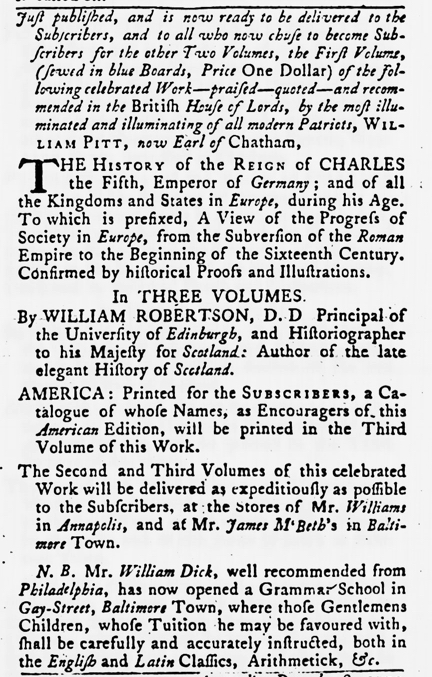
“AMERICA:  Printed for the SUBSCRIBERS.”

When Robert Bell published an American edition of “THE HISTORY of the REIGN of CHARLES the Fifth, Emperor of Germany” in 1771, he placed advertisements and subscription notices in multiple newspapers in several colonies.  Printer-publishers regularly adopted that strategy, especially prior to the American Revolution, because local markets did not necessarily support the publication of American editions as alternatives to imported ones.  To generate sufficient demand to make American editions viable ventures, Bell and his counterparts had to engage consumers across large regions rather than just in their own towns.

Bell, one of the most famous and influential American booksellers both before and after independence, made innovations to the practice of reprinting the same advertisements and subscription notices from one newspaper to another.  Rather than submitting identical copy to multiple newspapers, updating only the names of the local sellers and subscription agents, he devised a series of notices that varied from publication to publication.  Each contained some of the especially elaborate, even by eighteenth-century standards, language that became one of Bell’s trademarks.  He opened his advertisement in the January 31 edition of the Maryland Gazette, for instance, with a proclamation that he had “Just published … the following celebrated Work – praised – quoted – and recommended in the British House of Lords, by the most illuminated and illuminating of all modern Patriots, WILLIAM PITT, now Earl of Chatham.”  Pitt became popular among American colonists for defending their interests against attempts by Parliament to regulate commerce and other impositions.  In particular, he vigorously opposed the Stamp Act, arguing that it was unconstitutional to impose taxes on the colonies.  It was not merely Pitt’s testimonial regarding “THE HISTORY of the REIGN of CHARLES the Fifth, Emperor of Germany” that Bell expected would resonate with consumers but also his reputation as an advocate for the colonies.

Bell also included a version of the imprint in his advertisement: “AMERICA:  Printed for the SUBSCRIBERS, a Catalogue of whose Names, as Encouragers of this American Edition, will be printed in the Third Volume of this Work.”  He did not follow the usual practice of listing a city.  This was not, after all, a book printed in Philadelphia, but instead an American production that demonstrated the literary culture of the colonies considered collectively.  Bell worked to create a sense of community among subscribers who purchased copies, an imagined community, to use the phrase coined by Benedict Anderson, constructed with print and extending great distances.  Despite those distances, the subscribers had a common meeting place in the “Catalogue” of names printed in the final volume.  Publishing a list of subscribers who made a publication possible was not new, but Bell presented the opportunity for prospective buyers to be included as a testament to their patriotism and support for the American cause rather than merely an indication of their status and good taste.

The advertisement concluded with a quirky nota bene in which Bell recommended a schoolmaster from Philadelphia who recently moved to Baltimore, an endorsement seemingly unrelated to the remainder of notice.  It may have been less expensive for Bell to append the nota bene rather than insert a separate advertisement.  Whatever the reason, the nota bene fit well with Bell’s pattern of deviating from expectations and setting his own standards, both within his advertisements and in his eccentric behavior at book auctions.  His advertisement deployed familiar “Buy American” appeals, but did so in especially exuberant language, invited prospective subscribers to become part of a community of citizen-readers, and ended with a recommendation for a schoolmaster.  Bell presented consumers some of the appeals they came to expect from him as well as at least one surprise, a pattern for engaging with customers and audiences that he further developed over the next several decades.