February 12

What was advertised in a colonial American newspaper 250 years ago today?

South-Carolina and American General Gazette (February 12, 1772).

“A SECOND-HAND SPINNET cheap, and of very fine tone.”

James Juhan offered a variety of services to colonizers in Charleston who were interested in learning to play musical instruments.  In an advertisement in the February 12, 1772, edition of the South-Carolina and American General Gazette, he informed prospective pupils that he gave lessons on the “Violin, German Flute and Guittar.”  In addition, he also sold instruments and supplies, including violins, bows, and strings.

His inventory included a “SECOND-HAND SPINNET,” a small harpsichord.  Juhan informed prospective buyers that the spinet possessed “very fine tone,” attempting to reassure them that even though it previously had been played in another home it was not defective.  In addition, Juhan described the price as “cheap,” a word that meant inexpensive in the eighteenth century but did not yet have negative associations with poor quality.  A family could acquire, play, and display the spinet in their home for a bargain price, a good investment for anyone looking for accessories to testify to their good taste, gentility, and status.  For those not yet committed to owning a spinet, even a secondhand one, Juhan also advertised “Spinnets in good order to let.”  Rather than make a major purchase, colonizers could participate in the rental market.

Whether they bought or rented their musical instruments, residents of Charleston could turn to Juhan for assistance in maintaining them.  He tuned “HARPSICHORDS, SPINNETS, FORTE-PIANOS, GUITTARS,” and other stringed instruments “with care and diligence.”  He also repaired “all kinds of Musical instruments … in the neatest manner,” setting his rates “on as reasonable terms as they can be done in this place.”  Colonizers who needed musical instruments tuned or repaired would not find better bargains than those offered by Juhan.

One of the largest urban ports in the colonies, Charleston was as cosmopolitan as New York and Philadelphia.  Merchants like Mansell and Corbett hawked a “Very neat Assortment of the most fashionable” foods imported from England, while goldsmith Philip Tidyman promoted a “Most ELEGANT ASSORTMENT” of jewelry.  In addition to acquiring and displaying garments, adornments, and housewares, colonizers had opportunities to signal their gentility and status through learning to play musical instruments and performing when guests visited their homes.  In particular, this allowed families to demonstrate that wives and daughters possessed both grace and the leisure time necessary to learn to play musical instruments.

Slavery Advertisements Published February 12, 1772

GUEST CURATOR: Declan Dunbar

The Slavery Adverts 250 Project chronicles the role of newspaper advertising in perpetuating slavery in the era of the American Revolution. The project seeks to reveal the ubiquity of slavery in eighteenth-century life from New England to Georgia by republishing advertisements about enslaved people – for sale as individuals or in groups, wanted to purchase or for hire for short periods, runaways who liberated themselves, and those who were subsequently captured and confined in jails and workhouses – in daily digests on this site as well as in real time via the @SlaveAdverts250 Twitter feed, utilizing twenty-first-century media to stand in for the print media of the eighteenth century.

The project aims to provide modern audiences with a sense of just how often colonizers encountered these advertisements in their daily lives. Enslaved men, women, and children appeared in print somewhere in the colonies almost every single day. Those advertisements served as a constant backdrop for social, cultural, economic, and political life in colonial and revolutionary America. Colonizers who did not purport to own enslaved people were still confronted with slavery as well as invited to maintain the system by purchasing enslaved men, women, and children or assisting in the capture of so-called “runaways” who sought to free themselves from bondage. The frequency of these newspaper advertisements suggests just how embedded slavery was in colonial and revolutionary American culture in everyday interactions beyond the printed page.

These advertisements also testify to the experiences of enslaved men, women, and children, though readers must consider that those experiences have been remediated through descriptions offered by enslavers rather than enslaved people themselves. Often unnamed in the advertisements, enslaved men, women, and children were not invisible or unimportant in early America.

These advertisements appeared in colonial American newspapers 250 years ago today.

South-Carolina and American General Gazette (February 12, 1772).

**********

South-Carolina and American General Gazette (February 12, 1772).

**********

South-Carolina and American General Gazette (February 12, 1772).

**********

South-Carolina and American General Gazette (February 12, 1772).

**********

South-Carolina and American General Gazette (February 12, 1772).

**********

South-Carolina and American General Gazette (February 12, 1772).

**********

South-Carolina and American General Gazette (February 12, 1772).

**********

South-Carolina and American General Gazette (February 12, 1772).

**********

South-Carolina and American General Gazette (February 12, 1772).

**********

South-Carolina and American General Gazette (February 12, 1772).

**********

South-Carolina and American General Gazette (February 12, 1772).

**********

South-Carolina and American General Gazette (February 12, 1772).

**********

South-Carolina and American General Gazette (February 12, 1772).

**********

South-Carolina and American General Gazette (February 12, 1772).

February 11

Who were the subjects of advertisements in a colonial American newspaper 250 years ago today?

Essex Gazette (February 11, 1772).

“A Negro Man named Prince … A Negro Man named Cesar.”

Colonizers placed advertisements in the Essex Gazette, published in Salem, Massachusetts, for a variety of purposes.  In the February 11, 1772, edition, for instance, John Appleton, Andrew Daglish, Weld Gardner, and James Hastie each advertised consumer goods for sale at their stores and shops.  Hastie proclaimed that he carried “An ASSORTMENT of English and India GOODS, suitable to all Seasons of the Year.”  The other merchants and shopkeepers made similar appeals to prospective customers.  Joseph Hiller called on “ALL Persons indebted to, or that have any Demands on the Estate of the Widow ABIGAIL TARBOX, late of Gloucester,” to settle accounts, while John Pratt and John Bacheller, Jr., who described themselves as “Guardians” of Thomas Parker of Reading, cautioned “all Persons from trading” with Parker because they “will not pay any Debts he shall contract.”  Samuel Field sought a family to rent a house that he owned.  An anonymous advertisers offered for sale a “Tavern-House in a goof Place.”

Interspersed among those advertisements, several others concerned enslaved people and contributed to the slave trade and the perpetuation of slavery in New England.  An unnamed advertiser instructed anyone who could supply “a Negro Boy, between 8 and 14 Years old” to “Enquire of the Printer.”  Nicholas Bartlett of Marblehead offered “A Negro Man named Cesar” for sale.  Having been enslaved in a community that depended on maritime trades, Cesar “well understands the Shoreman’s Business of making Fish,” but he possessed other skills as well.  Bartlett described Cesar as “a prime Chimney-Sweeper,” but also reported that he “can work on a Farm very well.”  In another advertisement, Christopher Bubier of Marblehead reported that “a Negro Man named Prince” liberated himself from his enslaver by running away.  Bubier provided a brief description of Prince, encouraging readers to engage in surveillance of any Black men they encountered, and offered a reward for his capture and return.

Like other eighteenth-century newspapers, the Essex Gazette did not organize or classify advertisements according to their purpose or genre.  As a result, advertisements about enslaved men, women, and children were intermixed with other notices about commerce and real estate.  Their dispersal throughout the pages of the Essex Gazette and other newspapers testifies to the extent that slavery was part of everyday life, even in New England, in the colonies on the eve of the American Revolution.

Slavery Advertisements Published February 11, 1772

GUEST CURATOR: Declan Dunbar

The Slavery Adverts 250 Project chronicles the role of newspaper advertising in perpetuating slavery in the era of the American Revolution. The project seeks to reveal the ubiquity of slavery in eighteenth-century life from New England to Georgia by republishing advertisements about enslaved people – for sale as individuals or in groups, wanted to purchase or for hire for short periods, runaways who liberated themselves, and those who were subsequently captured and confined in jails and workhouses – in daily digests on this site as well as in real time via the @SlaveAdverts250 Twitter feed, utilizing twenty-first-century media to stand in for the print media of the eighteenth century.

The project aims to provide modern audiences with a sense of just how often colonizers encountered these advertisements in their daily lives. Enslaved men, women, and children appeared in print somewhere in the colonies almost every single day. Those advertisements served as a constant backdrop for social, cultural, economic, and political life in colonial and revolutionary America. Colonizers who did not purport to own enslaved people were still confronted with slavery as well as invited to maintain the system by purchasing enslaved men, women, and children or assisting in the capture of so-called “runaways” who sought to free themselves from bondage. The frequency of these newspaper advertisements suggests just how embedded slavery was in colonial and revolutionary American culture in everyday interactions beyond the printed page.

These advertisements also testify to the experiences of enslaved men, women, and children, though readers must consider that those experiences have been remediated through descriptions offered by enslavers rather than enslaved people themselves. Often unnamed in the advertisements, enslaved men, women, and children were not invisible or unimportant in early America.

These advertisements appeared in colonial American newspapers 250 years ago today.

Essex Gazette (February 11, 1772).

**********

Essex Gazette (February 11, 1772).

**********

Essex Gazette (February 11, 1772).

**********

South-Carolina Gazette and Country Journal (February 11, 1772).

**********

South-Carolina Gazette and Country Journal (February 11, 1772).

**********

South-Carolina Gazette and Country Journal (February 11, 1772).

**********

South-Carolina Gazette and Country Journal (February 11, 1772).

**********

South-Carolina Gazette and Country Journal (February 11, 1772).

**********

South-Carolina Gazette and Country Journal (February 11, 1772).

**********

South-Carolina Gazette and Country Journal (February 11, 1772).

**********

South-Carolina Gazette and Country Journal (February 11, 1772).

**********

South-Carolina Gazette and Country Journal (February 11, 1772).

**********

South-Carolina Gazette and Country Journal (February 11, 1772).

**********

Supplement to the South-Carolina Gazette and Country Journal (February 11, 1772).

**********

Supplement to the South-Carolina Gazette and Country Journal (February 11, 1772).

**********

Supplement to the South-Carolina Gazette and Country Journal (February 11, 1772).

**********

Supplement to the South-Carolina Gazette and Country Journal (February 11, 1772).

**********

Supplement to the South-Carolina Gazette and Country Journal (February 11, 1772).

**********

Supplement to the South-Carolina Gazette and Country Journal (February 11, 1772).

**********

Supplement to the South-Carolina Gazette and Country Journal (February 11, 1772).

February 10

What was advertised in a colonial American newspaper 250 years ago today?

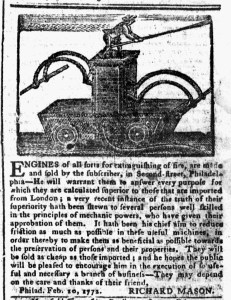
Pennsylvania Chronicle (February 10, 1772).

“ENGINES of all sorts for extinguishing of fire.”

Richard Mason constructed and sold “ENGINES of all sorts for extinguishing of fire” at his workshop in Philadelphia in the early 1770s.  In an advertisement in the Pennsylvania Chronicle, he advised the public that he designed and built his engines “to answer every purpose for which they are calculated superior to those that are imported from London.”  Yet he did not expect readers simply to take his word for it.  Instead, he confided that “a very recent instance of the truth of their superiority hath been shewn to several persons well skilled in the principles of mechanic powers, who have given their approbation of them.”

To that end, Mason declared, “It hath been his chief aim to reduce friction as much as possible in these useful machines, in order thereby to make them as beneficial as possible towards the preservation of the persons and their properties.”  Reducing friction mattered because colonizers pumped these engines by hand after rolling them to the location of a fire.  An image that accompanied Mason’s advertisement depicted an engine shooting a stream of water at an unseen fire, but did not fully capture the number of people and the amount of labor required to operate it.  The wooden engine consisted of a pump enclosed within a tower mounted on a chassis.  Handles on either side of the tower worked the pump.  A leather hose fed the pump with water via a connection on the chassis.  Pumping the engine forced a stream of water to spray from an inflexible metal tube attached to the top of the tower.  As others worked the pump, an operator standing atop the tower manipulated the position of that tube, pointing it in the right direction and adjusting its position, in an effort to douse the fire.

Fire constituted a significant hazard in cities like Philadelphia with so many buildings made of wood crowded closely together.  Just a few years after Mason published his advertisement, a fire destroyed a large portion of New York.  Municipal fire departments did not yet exist.  Instead, colonizers formed their own companies.  Mason sought customers for his “ENGINES of all sorts for extinguishing of fire” among his fellow residents of Philadelphia rather than the local government.

Watch a brigade operate a replica of an eighteenth-century fire engine at Colonial Williamsburg.

Slavery Advertisements Published February 10, 1772

GUEST CURATOR: Declan Dunbar

The Slavery Adverts 250 Project chronicles the role of newspaper advertising in perpetuating slavery in the era of the American Revolution. The project seeks to reveal the ubiquity of slavery in eighteenth-century life from New England to Georgia by republishing advertisements about enslaved people – for sale as individuals or in groups, wanted to purchase or for hire for short periods, runaways who liberated themselves, and those who were subsequently captured and confined in jails and workhouses – in daily digests on this site as well as in real time via the @SlaveAdverts250 Twitter feed, utilizing twenty-first-century media to stand in for the print media of the eighteenth century.

The project aims to provide modern audiences with a sense of just how often colonizers encountered these advertisements in their daily lives. Enslaved men, women, and children appeared in print somewhere in the colonies almost every single day. Those advertisements served as a constant backdrop for social, cultural, economic, and political life in colonial and revolutionary America. Colonizers who did not purport to own enslaved people were still confronted with slavery as well as invited to maintain the system by purchasing enslaved men, women, and children or assisting in the capture of so-called “runaways” who sought to free themselves from bondage. The frequency of these newspaper advertisements suggests just how embedded slavery was in colonial and revolutionary American culture in everyday interactions beyond the printed page.

These advertisements also testify to the experiences of enslaved men, women, and children, though readers must consider that those experiences have been remediated through descriptions offered by enslavers rather than enslaved people themselves. Often unnamed in the advertisements, enslaved men, women, and children were not invisible or unimportant in early America.

These advertisements appeared in colonial American newspapers 250 years ago today.

Boston-Gazette (February 10, 1772).

**********

Boston-Gazette (February 10, 1772).

**********

Boston-Gazette (February 10, 1772).

**********

New-York Gazette and Weekly Mercury (February 10, 1772).

**********

New-York Gazette and Weekly Mercury (February 10, 1772).

**********

Supplement to the New-York Gazette and Weekly Mercury (February 10, 1772).

**********

Supplement to the New-York Gazette and Weekly Mercury (February 10, 1772).

**********

Supplement to the New-York Gazette and Weekly Mercury (February 10, 1772).

**********

Pennsylvania Chronicle (February 10, 1772).

**********

Supplement to the Pennsylvania Packet (February 10, 1772).

**********

Supplement to the Pennsylvania Packet (February 10, 1772).

February 9

What was advertised in a colonial American newspaper 250 years ago this week?

Massachusetts Spy (February 6, 1772).

“MANCHESTER GOODS.”

Samuel Partridge offered many choices to consumers at his shop on Marlborough Street in Boston.  In an advertisement in the February 6, 1772, edition of the Massachusetts Spy, he demonstrated the extent of choices available, listing dozens of items from an “assortment of superfine and low prized Broad-Cloths” and “an assortment of womens and childrens black Cloth coloured and crimson worsted Gloves and Mitts” to “large printed cotton Handkerchiefs” and “a compleat assortment of fashionable Ribbons” to “Cambricks” and “Calamancoes of all colours.”  His inventory was so extensive that his advertisement filled almost an entire column on the final page of the newspaper.

Partridge deployed a marketing strategy common among merchants and shopkeepers in Boston and other colonial cities and towns.  He encouraged prospective customers to imagine themselves purchasing and wearing, displaying, or using his merchandise by presenting them with many options.  Repeatedly inserting the word “assortment” underscored the number of choices.  However, he also differentiated his advertisement from others by using headings to categorize his wares and direct readers to items that most interested them.  He incorporated six headings, each of them in all capitals and centered.  At a glance, readers identified sections for “CLOTHS,” “HOSIERY,” “MANCHESTER GOODS,” “SILKS,” “INDIA GOODS,” and “STUFFS.”  Following a heading for “ALSO,” Partridge named additional items, that part of the advertisement resembling the format of most others placed by his competitors.  He listed most items, however, under the various headings.

Though enmeshed within newspapers rather than printed separately, such advertisements served as catalogs.  For Partridge’s advertisement, the headings made that even more the case.  Those headers helped readers navigate the contents.  Such an innovation suggests that Partridge did not merely announce that he had imported goods for sale but instead consciously considered how to most effectively engage consumers in hopes of inciting demand and convincing them to make their purchases at his shop.

February 8

What was advertised in a colonial American newspaper 250 years ago today?

Providence Gazette (February 8, 1772).

“It would be more for his Advantage to supply the Bellies, rather than the Backs of his Customers.”

Eighteenth-century newspapers often carried references that readers presumably found amusing yet confound modern readers, even historians who have immersed themselves, as much as possible, in the culture of the period.  Such references usually appeared among the news and commentary, but they sometimes found their way into advertisements as well.

That seems to have been the case in an advertisement that Robert Nesbitt ran in the Providence Gazette in January and February 1772.  Nesbitt informed the public that he ran a shop at the location formerly occupied by Benoni Pearce.  Rather than simply state that was the case, he provided a lengthy introduction likely meant to entertain readers.  “BENONI PEARCE,” the shopkeeper proclaimed, “thinking it would be more for his Advantage to supply the Bellies, rather than the Backs of his Customers, has prudently left off Shopkeeping, and applied himself to baking Gingerbread.”  Nesbitt deployed a clever turn of phrase in referring to Pearce’s decision to change occupations from selling textiles and garments to baking bread, though saying that Pearce “prudently” did so may have been a dig at the shopkeeper-turned-baker and his success as a retailer.  Whatever the case, Benoni Pearce and Elijah Bacon announced that they had “opened a BAKE-HOUSE” in the October 27, 1770, edition of the Providence Gazette, more than a year earlier.  Next came a reference that Nesbitt might have intended to be humorous … or an insult.  He declared that Pearce sold his “best Quality” gingerbread, a rather specific item, “upon advantageous Terms to – himself.”  What initially seemed to be an endorsement using the formulaic language of eighteenth-century advertisements became some sort of joke.  Nesbitt may have meant it as a lighthearted observation that the baked goods that came out of Pearce’s oven were so good that the baker could not resist eating them himself.  If Pearce was known as large man with a good-natured attitude about his size, the comment might have been friendly banter.  On the other hand, Nesbitt may have intended for the entire introduction to mock Pearce.  Perhaps it quickly became apparent that Pearce was not a skilled baker.  In early August, Hope Still McNeal advertised that he “carries on the BAKING BUSINESS … at the Bake House lately occupied by Pearce and Bacon.”  Either Pearce moved to a new location or did not last long in his new occupation.

Nesbitt did inject some jocularity into other portions of his advertisement.  In promoting his “Neat ASSORTMENT of GOODS,” he asserted that they “are good, but he thinks Cash much better; for which Reason he thinks proper to inform the Public, that for a few Spanish milled Dollars (of which he is very fond) they may have any Article.”  He almost certainly did not mean to depict himself as avaricious.  Instead, Nesbitt sought to make clear that he wanted to make deals and offered bargains to his customers for the benefit of all involved.  Saying that he was “very fond” of “Spanish milled Dollars” may have been a clever way of telling customers that he preferred cash rather than extending credit.  He made his wares affordable, selling them “almost at their own Price” without significantly marking up what he had paid.  That meant some really good deals; Nesbitt claimed that he set prices “some Twenty per Cent. lower than they are generally sold for in Great-Britain.”

Nesbitt incorporated humor into his advertisement for imported goods.  Although it likely resonated with readers at the time, not all of the shopkeeper’s quips translate well for modern readers.  All the same, he deployed humor, a staple of modern advertising, to an extent not present in most eighteenth-century advertisements.

February 7

What was advertised in a colonial American newspaper 250 years ago today?

New-Hampshire Gazette (February 7, 1772).

“Ames’s Almanack, for 1772, may be had at the Printing-Office.”

Colonial printers usually began advertising almanacs for the coming year in the fall, first alerting prospective customers of their intentions to take certain popular titles to press and later informing them that they could purchase copies.  Occasionally printers made initial announcements in the summer, but most appeared in colonial newspapers in October and November.  Starting in November, printers proclaimed that they “just published” almanacs and called on consumers to acquire copies of their favorites.  Many also offered discounts to retailers who bought in bulk.  Not surprisingly, the greatest number of advertisements for almanacs ran in newspapers in November and December as the new year approached.  During those months, practically every issue of every newspaper printed in the colonies carried at least one advertisement for almanacs, those published by the printer of that newspaper, and many carried multiple advertisements.  Almanacs generated significant revenues for printers.

Advertising for almanacs continued in January, but tapered off over time.  By February, most advertisements disappeared, though some printers continued to run short notices to attract stragglers.  Daniel Fowle and Robert Fowle, printers of the New-Hampshire Gazette, inserted a brief notice in the February 7, 1772, edition.  It announced, “Ames’s Almanack, for1772, may be had at the Printing-Office.”  The Fowles apparently had surplus copies that reduced any profit they earned on the venture.  They exercised their prerogative as printers in making decisions about the format and placement of the advertisement.  Even though it extended only two lines, the words “Ames’s Almanack” featured some of the largest type on the final page of the newspaper.  The Fowles placed the notice at the top of the center column, likely in an attempt to draw even more attention to it.  In contrast, their advertisement for “BLANKS of most Sorts, for respective Counties, sold by the Printers” ran at the very bottom of the final column on the third page, seemingly filler as much as intentional marketing.  The advertisement for “Ames’s Almanack” may have functioned in part as filler as well, but its format and placement suggest that the Fowles made deliberate decisions beyond merely seeking to complete a column or fill a page.

Slavery Advertisements Published February 7, 1772

GUEST CURATOR: Declan Dunbar

The Slavery Adverts 250 Project chronicles the role of newspaper advertising in perpetuating slavery in the era of the American Revolution. The project seeks to reveal the ubiquity of slavery in eighteenth-century life from New England to Georgia by republishing advertisements about enslaved people – for sale as individuals or in groups, wanted to purchase or for hire for short periods, runaways who liberated themselves, and those who were subsequently captured and confined in jails and workhouses – in daily digests on this site as well as in real time via the @SlaveAdverts250 Twitter feed, utilizing twenty-first-century media to stand in for the print media of the eighteenth century.

The project aims to provide modern audiences with a sense of just how often colonizers encountered these advertisements in their daily lives. Enslaved men, women, and children appeared in print somewhere in the colonies almost every single day. Those advertisements served as a constant backdrop for social, cultural, economic, and political life in colonial and revolutionary America. Colonizers who did not purport to own enslaved people were still confronted with slavery as well as invited to maintain the system by purchasing enslaved men, women, and children or assisting in the capture of so-called “runaways” who sought to free themselves from bondage. The frequency of these newspaper advertisements suggests just how embedded slavery was in colonial and revolutionary American culture in everyday interactions beyond the printed page.

These advertisements also testify to the experiences of enslaved men, women, and children, though readers must consider that those experiences have been remediated through descriptions offered by enslavers rather than enslaved people themselves. Often unnamed in the advertisements, enslaved men, women, and children were not invisible or unimportant in early America.

These advertisements appeared in colonial American newspapers 250 years ago today.

New-Hampshire Gazette (February 7, 1772).