Slavery Advertisements Published March 26, 1772

GUEST CURATOR: Catherine Hurlburt

The Slavery Adverts 250 Project chronicles the role of newspaper advertising in perpetuating slavery in the era of the American Revolution. The project seeks to reveal the ubiquity of slavery in eighteenth-century life from New England to Georgia by republishing advertisements about enslaved people – for sale as individuals or in groups, wanted to purchase or for hire for short periods, runaways who liberated themselves, and those who were subsequently captured and confined in jails and workhouses – in daily digests on this site as well as in real time via the @SlaveAdverts250 Twitter feed, utilizing twenty-first-century media to stand in for the print media of the eighteenth century.

The project aims to provide modern audiences with a sense of just how often colonizers encountered these advertisements in their daily lives. Enslaved men, women, and children appeared in print somewhere in the colonies almost every single day. Those advertisements served as a constant backdrop for social, cultural, economic, and political life in colonial and revolutionary America. Colonizers who did not purport to own enslaved people were still confronted with slavery as well as invited to maintain the system by purchasing enslaved men, women, and children or assisting in the capture of so-called “runaways” who sought to free themselves from bondage. The frequency of these newspaper advertisements suggests just how embedded slavery was in colonial and revolutionary American culture in everyday interactions beyond the printed page.

These advertisements also testify to the experiences of enslaved men, women, and children, though readers must consider that those experiences have been remediated through descriptions offered by enslavers rather than enslaved people themselves. Often unnamed in the advertisements, enslaved men, women, and children were not invisible or unimportant in early America.

These advertisements appeared in colonial American newspapers 250 years ago today.

Maryland Gazette (March 26, 1772).

**********

Maryland Gazette (March 26, 1772).

**********

Maryland Gazette (March 26, 1772).

**********

South-Carolina Gazette (March 26, 1772).

**********

South-Carolina Gazette (March 26, 1772).

**********

South-Carolina Gazette (March 26, 1772).

**********

South-Carolina Gazette (March 26, 1772).

**********

South-Carolina Gazette (March 26, 1772).

**********

Virginia Gazette [Purdie and Dixon] (March 26, 1772).

**********

Virginia Gazette [Purdie and Dixon] (March 26, 1772).

**********

Virginia Gazette [Purdie and Dixon] (March 26, 1772).

**********

Virginia Gazette [Purdie and Dixon] (March 26, 1772).

**********

Virginia Gazette [Purdie and Dixon] (March 26, 1772).

**********

Virginia Gazette [Purdie and Dixon] (March 26, 1772).

**********

Virginia Gazette [Purdie and Dixon] (March 26, 1772).

**********

Virginia Gazette [Purdie and Dixon] (March 26, 1772).

**********

Virginia Gazette [Purdie and Dixon] (March 26, 1772).

**********

Virginia Gazette [Purdie and Dixon] (March 26, 1772).

**********

Virginia Gazette [Rind] (March 26, 1772).

March 25

What was advertised in a colonial American newspaper 250 years ago this week?

Boston-Gazette (March 23, 1772).

“Elizabeth Coleman … Continues the Brewing-Business.”

Women who advertised that they provided goods and services usually fell into one of several occupational groups. Female shopkeepers promoted a variety of imported goods, especially textiles and accessories for making clothing. Milliners and seamstresses advertised the hats and garments they made for clients.  Schoolmistresses invited prospective students and their parents to lessons that included reading, writing, and sewing.

On occasion, however, women who pursued other occupations ran advertisements in the public prints.  Elizabeth Coleman, for instance, informed the public that she “Continues the Brewing-Business” in a notice that ran in the March 23, 1772, edition of the Boston-Gazette.  She pledged to “serve with Dispatch, the best of double and single Malt and Spruce Beer in as large or small quantities as is wanted.”  No order was too large or too small for Coleman!  Furthermore, she set prices “at as reasonable Rate as good Beer can be afforded.”

Although Coleman operated a “Brewing-Business,” she may have been the proprietor and employer rather a brewer herself.  She indicated that she “now employed a Person brought up to the Business.”  Perhaps that employee’s knowledge, skill, and experience supplemented her own, expanding the number of brewers affiliated with Coleman’s business.  Perhaps as a woman in a predominantly male occupation she sought to downplay her own contributions as brewer in favor by giving credit to an employee “brought up to the Business,” believing that strategy would attract more customers.

Whatever the extent of Coleman’s active participation as a brewer, she was an entrepreneur who ran her own business and sought visibility for it in the public prints.  In addition to selling beers produced by her “Brewing-Business,” she also marketed “the best of Philadelphia and Baltimore Beer” imported from other colonial ports.  Her customers could choose from among a selection of beers to suit their tastes and budgets.  They could even enjoy their beverages, perhaps with some food, at Coleman’s establishment.  She declared that she “keeps good Entertainment for Man and Horses.”  In addition to retailing beer, she ran a tavern with access to a stable as part of her larger operation.  That made her as industrious an entrepreneur as any of the male merchants, shopkeepers, and artisans who also placed advertisements in the Boston-Gazette.

March 24

What was advertised in a colonial American newspaper 250 years ago today?

Essex Gazette (March 24, 1772).

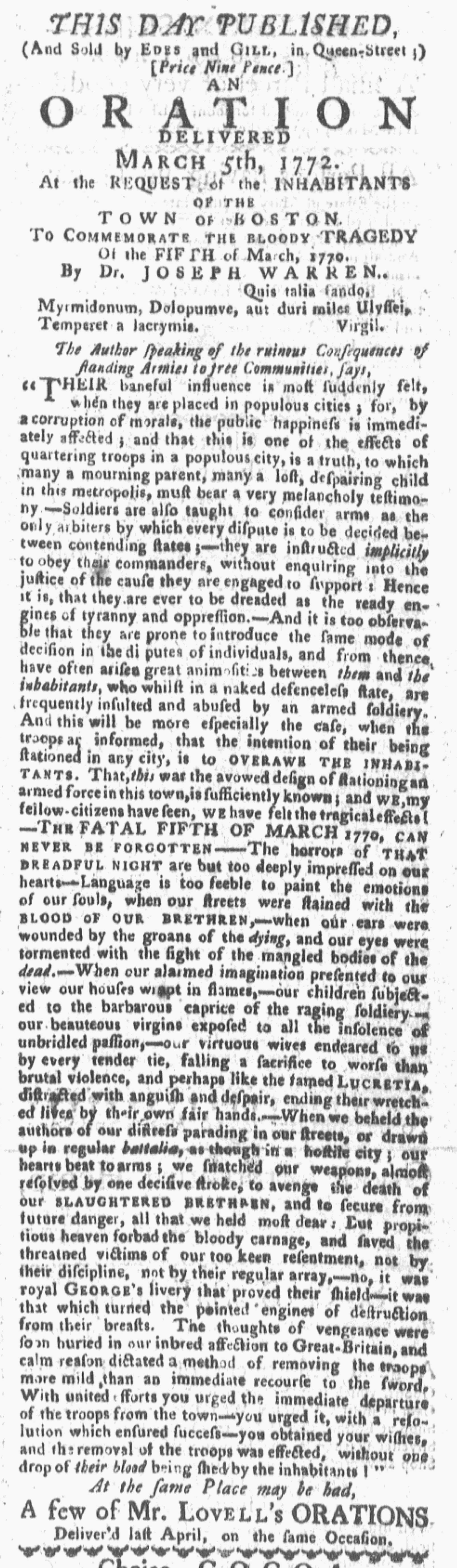
“Yesterday was published in Boston … An ORATION … to commemorate the BLOODY TRAGEDY.”

As soon as Benjamin Edes and John Gill informed readers of the Boston-Gazette that they published an oration that Joseph Warren delivered to commemorate the second anniversary of the “BLOODY TRAGEDY Of the FIFTH of March, 1770,” the printers of the Essex Gazette ran their own advertisement.  “Yesterday was published in Boston, and now to be sold by Samuel Hall, in Salem,” the notice announced, “An ORATION, delivered March 5th, 1772, at the Request of the Inhabitants of the Town of Boston, to commemorate the BLOODY TRAGEDY of the Fifth of March, 1770.  By Dr. JOSEPH WARREN.”  That advertisement did not include the lengthy excerpt from the address that Edes and Gill included in their notice, but it did encourage consumers to participate in commemorating the Boston Massacre by purchasing their own copy of Warren’s remarks.

Not surprisingly, given its location, the Essex Gazette engaged in the most extensive remembrances of “Preston’s Massacre–in King-Street … In which Five Persons were killed, and Six wounded” of any newspaper published outside of Boston.  On the occasion of the second anniversary, the Halls devoted the entire first page of their newspaper to a memorial that honored the patriots who gave their lives and listed grievances against the “British Ministry” that “contrived and effected the Establishment of the late Standing Army” in Massachusetts.  In addition to such memorials, the Essex Gazette carried advertisements for commemorative items connected to the Boston Massacre.  Nearly a year before promoting Warren’s address, the Essex Gazette carried an advertisement for “A few of Mr. Lovell’s ORATIONS on the Massacre in Boston, to be sold by the Printer hereof.”  Residents of Salem and surrounding towns had an opportunity to purchase the same commemorative pamphlet printed and sold in Boston.  The commodification and marketing of the Boston Massacre helped to create a culture of commemoration of the Boston Massacre throughout the colony.  Colonizers who did not live in the busy port and could not witness Warren’s oration themselves read the Essex Gazette and the various newspapers printed in Boston.  When they did so, they read coverage of the commemorative events and encountered invitations to purchase their own copies of orations and other items related to the Boston Massacre, opportunities to partake in civic participation through consumption even if they could not attend in person.

Slavery Advertisements Published March 24, 1772

GUEST CURATOR: Catherine Hurlburt

The Slavery Adverts 250 Project chronicles the role of newspaper advertising in perpetuating slavery in the era of the American Revolution. The project seeks to reveal the ubiquity of slavery in eighteenth-century life from New England to Georgia by republishing advertisements about enslaved people – for sale as individuals or in groups, wanted to purchase or for hire for short periods, runaways who liberated themselves, and those who were subsequently captured and confined in jails and workhouses – in daily digests on this site as well as in real time via the @SlaveAdverts250 Twitter feed, utilizing twenty-first-century media to stand in for the print media of the eighteenth century.

The project aims to provide modern audiences with a sense of just how often colonizers encountered these advertisements in their daily lives. Enslaved men, women, and children appeared in print somewhere in the colonies almost every single day. Those advertisements served as a constant backdrop for social, cultural, economic, and political life in colonial and revolutionary America. Colonizers who did not purport to own enslaved people were still confronted with slavery as well as invited to maintain the system by purchasing enslaved men, women, and children or assisting in the capture of so-called “runaways” who sought to free themselves from bondage. The frequency of these newspaper advertisements suggests just how embedded slavery was in colonial and revolutionary American culture in everyday interactions beyond the printed page.

These advertisements also testify to the experiences of enslaved men, women, and children, though readers must consider that those experiences have been remediated through descriptions offered by enslavers rather than enslaved people themselves. Often unnamed in the advertisements, enslaved men, women, and children were not invisible or unimportant in early America.

These advertisements appeared in colonial American newspapers 250 years ago today.

Connecticut Courant (March 24, 1772).

**********

South-Carolina Gazette and Country Journal (March 24, 1772).

**********

South-Carolina Gazette and Country Journal (March 24, 1772).

**********

South-Carolina Gazette and Country Journal (March 24, 1772).

**********

South-Carolina Gazette and Country Journal (March 24, 1772).

**********

South-Carolina Gazette and Country Journal (March 24, 1772).

**********

South-Carolina Gazette and Country Journal (March 24, 1772).

**********

South-Carolina Gazette and Country Journal (March 24, 1772).

**********

Supplement to the South-Carolina Gazette and Country Journal (March 24, 1772).

**********

Supplement to the South-Carolina Gazette and Country Journal (March 24, 1772).

**********

Supplement to the South-Carolina Gazette and Country Journal (March 24, 1772).

**********

Supplement to the South-Carolina Gazette and Country Journal (March 24, 1772).

**********

Supplement to the South-Carolina Gazette and Country Journal (March 24, 1772).

**********

Supplement to the South-Carolina Gazette and Country Journal (March 24, 1772).

**********

Supplement to the South-Carolina Gazette and Country Journal (March 24, 1772).

**********

Supplement to the South-Carolina Gazette and Country Journal (March 24, 1772).

**********

Supplement to the South-Carolina Gazette and Country Journal (March 24, 1772).

**********

Supplement to the South-Carolina Gazette and Country Journal (March 24, 1772).

**********

Supplement to the South-Carolina Gazette and Country Journal (March 24, 1772).

**********

Supplement to the South-Carolina Gazette and Country Journal (March 24, 1772).

**********

Supplement to the South-Carolina Gazette and Country Journal (March 24, 1772).

**********

Supplement to the South-Carolina Gazette and Country Journal (March 24, 1772).

**********

Supplement to the South-Carolina Gazette and Country Journal (March 24, 1772).

March 23

What was advertised in a colonial American newspaper 250 years ago today?

Boston-Gazette (March 23, 1772).

“AN ORATION … TO COMMEMORATE THE BLOODY TRAGEDY.”

Commemoration and commodification of the Boston Massacre commenced just weeks after British soldiers killed several colonizers when they fired into a crowd of protesters on March 5, 1770.  Paul Revere advertised “A PRINT containing a Representation of the late horrid Massacre in King-Street” in the March 26, 1770, edition of the Boston-Gazette.  He appropriated the image from a sketch done by Henry Pelham.  A week later, Pelham advertised “The Fruits of Arbitrary Power, An Original Print, representing the late horrid Massacre in King Street, taken from the Spot” in the April 2 edition of the Boston-Gazette.  A year later, colonizers in Boston determined that public orations should mark the event.  On April 2, 1771, James Lovell delivered “AN Oration … At the Request of the Inhabitants of the Town of Boston; To Commemorate the Bloody Tragedy of the Fifth of March, 1770.”  Not long after that, an advertisement in the April 15 edition of the Boston-Gazette promoted copies for colonizers to purchase.

In subsequent years, the annual oration occurred on March 5.  From 1771 through 1783, this commemorative event attracted more attention in Boston than Independence Day, but after the Treaty of Paris brought the Revolutionary War to an end July 4 became more widely recognized.  On the second anniversary of the Boston Massacre, Joseph Warren gave “AN ORATION … At the REQUEST of the INHABITANTS OF THE TOWN OF BOSTON TO COMMEMORATE THE BLOODY TRAGEDY Of the FIFTH of March, 1770.”  An advertisement quickly appeared in the March 23 edition of the Boston-Gazette, filling nearly two-thirds of a column.  The advertisement occupied so much space because Benjamin Edes and John Gill, the patriot printers of both the Boston-Gazette and the oration, included an extensive excerpt about “the ruinous Consequences of standing Armies to free Communities.”  The printers hoped that by giving prospective customers a taste of what Warren had to say about the “tyranny and oppression” of an “armed soldiery” who “frequently insulted and abused” the residents of Boston that would entice them to purchase the oration and read more.  Doing so also gave them an opportunity to remember the “horrors of THAT DREADFUL NIGHT” and venerate “the mangled bodies of the dead” who perished as a result of the “barbarous caprice of the raging soldiery.”

At the end of the advertisement, Edes and Gill noted that they also stocked “A few of Mr. LOVELL’S ORATIONS Deliver’d last April, on the same Occasion.”  They made it easy for patriotic consumers to collect memorabilia associated with the Boston Massacre.  Commemoration and commodification of that event occurred simultaneously in the years before the colonies declared independence.

Slavery Advertisements Published March 23, 1772

GUEST CURATOR: Catherine Hurlburt

The Slavery Adverts 250 Project chronicles the role of newspaper advertising in perpetuating slavery in the era of the American Revolution. The project seeks to reveal the ubiquity of slavery in eighteenth-century life from New England to Georgia by republishing advertisements about enslaved people – for sale as individuals or in groups, wanted to purchase or for hire for short periods, runaways who liberated themselves, and those who were subsequently captured and confined in jails and workhouses – in daily digests on this site as well as in real time via the @SlaveAdverts250 Twitter feed, utilizing twenty-first-century media to stand in for the print media of the eighteenth century.

The project aims to provide modern audiences with a sense of just how often colonizers encountered these advertisements in their daily lives. Enslaved men, women, and children appeared in print somewhere in the colonies almost every single day. Those advertisements served as a constant backdrop for social, cultural, economic, and political life in colonial and revolutionary America. Colonizers who did not purport to own enslaved people were still confronted with slavery as well as invited to maintain the system by purchasing enslaved men, women, and children or assisting in the capture of so-called “runaways” who sought to free themselves from bondage. The frequency of these newspaper advertisements suggests just how embedded slavery was in colonial and revolutionary American culture in everyday interactions beyond the printed page.

These advertisements also testify to the experiences of enslaved men, women, and children, though readers must consider that those experiences have been remediated through descriptions offered by enslavers rather than enslaved people themselves. Often unnamed in the advertisements, enslaved men, women, and children were not invisible or unimportant in early America.

These advertisements appeared in colonial American newspapers 250 years ago today.

Boston Evening-Post (March 23, 1772).

**********

New-York Gazette and Weekly Mercury (March 23, 1772).

**********

New-York Gazette and Weekly Mercury (March 23, 1772).

**********

Pennsylvania Packet (March 23, 1772).

**********

South-Carolina and American General Gazette (March 23, 1772).

**********

South-Carolina and American General Gazette (March 23, 1772).

**********

South-Carolina and American General Gazette (March 23, 1772).

**********

South-Carolina and American General Gazette (March 23, 1772).

**********

South-Carolina and American General Gazette (March 23, 1772).

**********

South-Carolina and American General Gazette (March 23, 1772).

**********

South-Carolina and American General Gazette (March 23, 1772).

**********

South-Carolina and American General Gazette (March 23, 1772).

**********

South-Carolina and American General Gazette (March 23, 1772).

**********

South-Carolina and American General Gazette (March 23, 1772).

**********

South-Carolina and American General Gazette (March 23, 1772).

**********

South-Carolina and American General Gazette (March 23, 1772).

**********

South-Carolina and American General Gazette (March 23, 1772).

**********

South-Carolina and American General Gazette (March 23, 1772).

**********

South-Carolina and American General Gazette (March 23, 1772).

March 22

What was advertised in a colonial American newspaper 250 years ago this week?

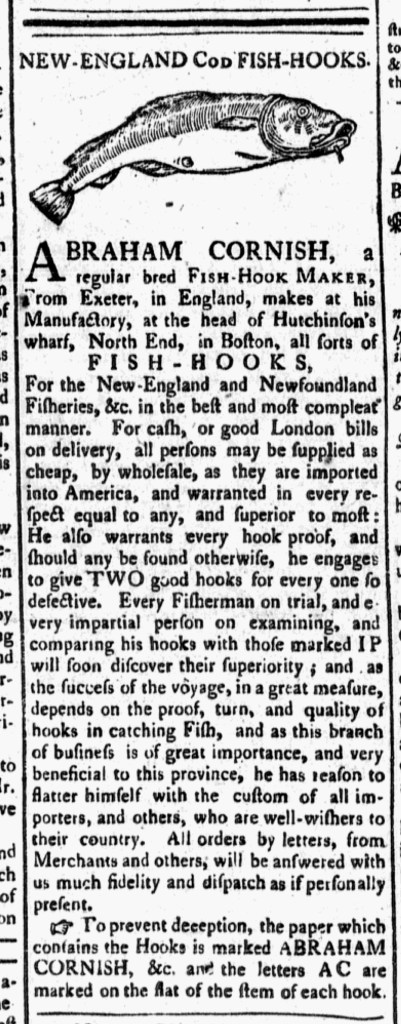
Massachusetts Spy (March 19, 1772).

“To prevent deception, the paper which contains the Hooks is marked ABRAHAM CORNISH.”

Abraham Cornish deployed a variety of marketing strategies for the “NEW ENGLAND COD FISH-HOOKS” that he made in the North End of Boston.  In an advertisement that appeared in the March 19, 1772, edition of the Massachusetts Spy, he described himself as “a regular bred FISH-HOOK MAKER, From Exeter, in England,” who produced “all sorts of FISH-HOOKS … warranted in every respect equal to any, and superior to most,” whether imported or made in the colonies.  Cornish was so certain of the quality of his hooks that offered a guarantee, stating that he “warrants every hook proof, and should any be found otherwise, he engages to give TWO good hooks for every one so defective.”  That two-for-one replacement policy testified to his confidence in the quality of his product.

Cornish also challenged prospective customers to compare his hooks to those of a competitor who marked hooks with the initials “IP.”  He asserted that “Every Fisherman” who did such a “trial” as well as “every impartial person” who performed a similar examination “would soon discover” the “superiority” of his hooks.  The success of voyages to New England and Newfoundland fisheries depended in part on the “quality of hooks in catching Fish,” so “Every Fisherman” should outfit themselves with hooks that Cornish made “in the best and most compleat manner.”

Cornish also cautioned buyers to be cautious about counterfeits, especially if they acquired hooks from retailers rather than directly from him.  “To prevent deception,” he instructed, “the paper which contains the Hooks is marked ABRAHAM CORNISH, &c. and the letters AC are marked on the flat of the stem of each hook.”  Both the hooks and the packaging attributed the hooks to Cornish.  Marking each hook with “AC” served as an enduring advertisement for his work, even after buyers separated the hooks from their package.  Cornish used “&c.” (an abbreviation for et cetera) in describing the packaging.  What else did it include?  His newspaper advertisement featured a woodcut depicting a fish.  Did the packaging also have a visual image to make it distinctive and memorable?  Did the packaging include Cornish’s location?  Did it include the guarantee that he promoted in the newspaper?  Whatever might have appeared on the packaging, Cornish used it as an additional means of marketing his product.

March 21

What was advertised in a colonial American newspaper 250 years ago today?

The Censor (March 21, 1772).

“This Paper may be had once a Week, Price Two Pence per Number to Subscribers.”

The colophon for The Censor, a political newspaper-magazine published in Boston by Ezekiel Russell for a few months in late 1771 and early 1772, appeared immediately below the masthead on the front page rather than on the final page. While the placement was unusual, it was not unique.  Both newspapers printed in New York at the time adopted the same format, drawing attention to the printers as soon as readers glanced at the front page.  Starting with the March 7 issue, Russell did include more information in the colophon for The Censor than the New York printers listed in the colophons for their newspapers.  The colophon for the New-York Journal simply stated, “PRINTED AND PUBLISHED BY JOHN HOLT, ON HUNTER’S-QUAY, ROTTON-ROW.”  The colophon for the New-York Gazette and Weekly Mercury was only slightly more elaborate: “Printed by HUGH GAINE, Printer, Bookseller, and Stationer, at the Bible and Crown, in HANOVER-SQUARE.”

Russell initially included the same information, printer and location, in a short colophon that declared “Published by E. RUSSELL, at his Printing-Office, in Marlborough-Street.”  He eventually added, “Where this Paper may be had once a Week, Price Two Pence per Number to Subscribers.”  Even though he recently began accepting advertising to publish in a supplement, the Postscript to the Censor, Russell did not indicate how much he charged to publish advertisements.  Although some printers mentioned subscription prices or advertising fees or both in their colophons, most did not regularly provide that information in their weekly publications.  The information that Russell incorporated into the colophon for The Censor indicated that he adopted a different business model than other printers.  Others charged annual subscription rates rather than by the issue or “per Number.”  Why did Russell choose a different method for his weekly publication?  Perhaps he wished to make The Censor seem less expensive to prospective subscribers.  After all, “Two Pence per Number” amounted to eight shillings and eight pence over a year.  None of the newspapers printed in Boston at the time published their subscription rates, but the colophon for the Essex Gazette, published in Salem, listed the price at “Six Shillings and Eight Pence per Annum.”  If printers in Boston charged similar amounts for their newspapers, that made an annual subscription to The Censor more expensive than any of the local newspapers.  The Censor quickly folded, largely because it rehearsed unpopular political opinions, but the cost “per Number” may have been a factor in the publication’s demise as well.

Slavery Advertisements Published March 21, 1772

GUEST CURATOR: Catherine Hurlburt

The Slavery Adverts 250 Project chronicles the role of newspaper advertising in perpetuating slavery in the era of the American Revolution. The project seeks to reveal the ubiquity of slavery in eighteenth-century life from New England to Georgia by republishing advertisements about enslaved people – for sale as individuals or in groups, wanted to purchase or for hire for short periods, runaways who liberated themselves, and those who were subsequently captured and confined in jails and workhouses – in daily digests on this site as well as in real time via the @SlaveAdverts250 Twitter feed, utilizing twenty-first-century media to stand in for the print media of the eighteenth century.

The project aims to provide modern audiences with a sense of just how often colonizers encountered these advertisements in their daily lives. Enslaved men, women, and children appeared in print somewhere in the colonies almost every single day. Those advertisements served as a constant backdrop for social, cultural, economic, and political life in colonial and revolutionary America. Colonizers who did not purport to own enslaved people were still confronted with slavery as well as invited to maintain the system by purchasing enslaved men, women, and children or assisting in the capture of so-called “runaways” who sought to free themselves from bondage. The frequency of these newspaper advertisements suggests just how embedded slavery was in colonial and revolutionary American culture in everyday interactions beyond the printed page.

These advertisements also testify to the experiences of enslaved men, women, and children, though readers must consider that those experiences have been remediated through descriptions offered by enslavers rather than enslaved people themselves. Often unnamed in the advertisements, enslaved men, women, and children were not invisible or unimportant in early America.

These advertisements appeared in colonial American newspapers 250 years ago today.

Providence Gazette (March 21, 1772).

March 20

GUEST CURATOR: Catherine Hurlburt

What was advertised in a colonial American newspaper 250 years ago today?

Connecticut Journal (March 20, 1772).

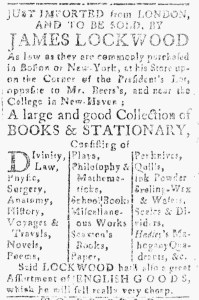
“Penknives, Quills, Ink Powder, Sealing-Wax & Wafers.”

In this advertisement, James Lockwood put up for sale an array of books on various subjects, as well as different writing tools. Lockwood emphasized that these commodities were English, “JUST IMPORTED from LONDON,” which may have been enticing to some colonists. Even though in 1772 the relationship between Britain and the colonies was deteriorating, many colonists still considered themselves to be British, and having English goods was considered a sign of status throughout the colonies, making these goods more desirable.[1]

Today, some readers might find that the writing utensils pique their interest and become curious about writing in the eighteenth century. Colonists mixed their own ink from ink powder and wrote with pens made by sharpening quills with penknives. Lockwood sold all of those items that are so different from the writing tools we use today. Another interesting difference between then and now is the age at which people who learned to write began their lessons. According to Rachel Bartgis, reading education began around age four and lasted until age seven, but writing did not occur until around age nine. This is because writing with a quill took higher fine motor ability than using today’s pen or pencil. In contrast, children learn reading and writing at the same time today. In addition, colonists learned “cursive” because “print,” named after the script on the printing press, was only used for special purposes, such as labelling parcels.

**********

ADDITIONAL COMMENTARY:  Carl Robert Keyes

In the advertisement that Catherine selected to feature today, James Lockwood updated a notice that he first published in the Connecticut Journal more than two months earlier.  He began 1772 by placing an advertisement to advise consumers in New Haven and the nearby towns that he “is now opening, at a new Store, … a great Assortment of English & India GOODS, BOOKS, and all kinds of STATIONARY.”  He pledged that he sold his merchandise “Wholesale or Retail, at least as cheap as any of his Neighbours.”

As Lockwood settled in at his new store, he decided to emphasize his “large and good Collection of BOOKS & STATIONARY” in his next advertisement, mentioning his “great Assortment of ENGLISH GOODS” only after listing the various kinds of books he had in stock.  He did not mention any titles, but instead announced that he carried “Divinity, Law, Physic, Surgery, Anatomy, History, Voyages& Travels, Novels, Poems, Plays, Philosophy & Mathematicks, School Books, Miscellaneous Works, [and] Seaman’s Books.”  Each genre received its own line in a portion of the advertisements divided into three columns.  That made the list easier for readers to peruse and areas of interest more visible to prospective customers.  The unique format also distinguished Lockwood’s advertisement from others on the page.  The third column included the various writing implements that Catherine examined.

Lockwood continued to promote his low prices, though he further enhanced that appeal.  Rather than claiming that he set process “at least as cheap as any of his Neighbours,” he instead looked to competitors in Boston and New York.  Lockwood declared that his customers acquired books, stationery, and “ENGLISH GOODS” from him “As low as they are commonly purchased” in those larger ports.  Prospective customers did not need to travel or send away to merchants and shopkeepers in those cities.  Instead, they could find the best bargains right in New Haven.

Lockwood’s proximity to “the College in New-Haven” (now Yale University) may have inspired him to publish an updated advertisement that focused on books and stationery.  He did not rely on a single newspaper notice to attract customers to his new Store.  Instead, he tried different methods of marketing his wares and generating name recognition among readers of the Connecticut Journal.

**********

[1] T.H. Breen, “An Empire of Goods: The Anglicization of Colonial America, 1690-1776,” Journal of British Studies 25, no. 4 (October 1986): 476.