Slavery Advertisements Published April 13, 1772

GUEST CURATOR: Victoria Ostrowski

The Slavery Adverts 250 Project chronicles the role of newspaper advertising in perpetuating slavery in the era of the American Revolution. The project seeks to reveal the ubiquity of slavery in eighteenth-century life from New England to Georgia by republishing advertisements about enslaved people – for sale as individuals or in groups, wanted to purchase or for hire for short periods, runaways who liberated themselves, and those who were subsequently captured and confined in jails and workhouses – in daily digests on this site as well as in real time via the @SlaveAdverts250 Twitter feed, utilizing twenty-first-century media to stand in for the print media of the eighteenth century.

The project aims to provide modern audiences with a sense of just how often colonizers encountered these advertisements in their daily lives. Enslaved men, women, and children appeared in print somewhere in the colonies almost every single day. Those advertisements served as a constant backdrop for social, cultural, economic, and political life in colonial and revolutionary America. Colonizers who did not purport to own enslaved people were still confronted with slavery as well as invited to maintain the system by purchasing enslaved men, women, and children or assisting in the capture of so-called “runaways” who sought to free themselves from bondage. The frequency of these newspaper advertisements suggests just how embedded slavery was in colonial and revolutionary American culture in everyday interactions beyond the printed page.

These advertisements also testify to the experiences of enslaved men, women, and children, though readers must consider that those experiences have been remediated through descriptions offered by enslavers rather than enslaved people themselves. Often unnamed in the advertisements, enslaved men, women, and children were not invisible or unimportant in early America.

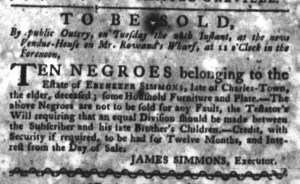
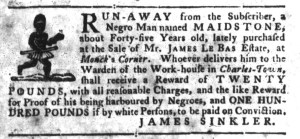
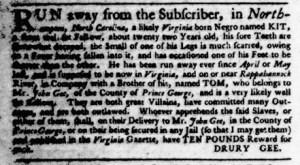
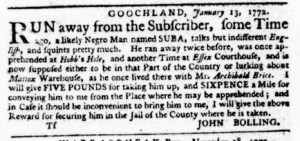
These advertisements appeared in colonial American newspapers 250 years ago today.

New-York Gazette and Weekly Mercury (April 13, 1772).

**********

New-York Gazette and Weekly Mercury (April 13, 1772).

**********

Supplement to the New-York Gazette and Weekly Mercury (April 13, 1772).

**********

Supplement to the New-York Gazette and Weekly Mercury (April 13, 1772).

**********

Supplement to the New-York Gazette and Weekly Mercury (April 13, 1772).

**********

South-Carolina and American General Gazette (April 13, 1772).

**********

South-Carolina and American General Gazette (April 13, 1772).

**********

South-Carolina and American General Gazette (April 13, 1772).

**********

South-Carolina and American General Gazette (April 13, 1772).

**********

South-Carolina and American General Gazette (April 13, 1772).

**********

South-Carolina and American General Gazette (April 13, 1772).

**********

South-Carolina and American General Gazette (April 13, 1772).

**********

South-Carolina and American General Gazette (April 13, 1772).

**********

South-Carolina and American General Gazette (April 13, 1772).

**********

South-Carolina and American General Gazette (April 13, 1772).

**********

South-Carolina and American General Gazette (April 13, 1772).

**********

South-Carolina and American General Gazette (April 13, 1772).

**********

South-Carolina and American General Gazette (April 13, 1772).

**********

South-Carolina and American General Gazette (April 13, 1772).

**********

South-Carolina and American General Gazette (April 13, 1772).

**********

South-Carolina and American General Gazette (April 13, 1772).

**********

South-Carolina and American General Gazette (April 13, 1772).

**********

South-Carolina and American General Gazette (April 13, 1772).

April 12

What was advertised in a colonial American newspaper 250 years ago this week?

Massachusetts Gazette and Boston Weekly News-Letter (April 9, 1772).

“The Second Edition.”

In the spring of 1772, Benjamin Edes and John Gill marked the second anniversary of the Boston Massacre by printing “AN ORATION DELIVERED MARCH 5th … TO COMMEMORATE THE BLOODY TRAGEDY Of the FIFTH of March, 1770.”  Dr. Joseph Warren gave the address to “the INHABITANTS OF THE TOWN OF BOSTON.”  Edes and Gill advertised the pamphlet widely, starting with a lengthy notice in their own Boston-Gazette on March 23.  The next day, the Essex Gazette carried an advertisement alerting readers in Salem and nearby towns that Samuel Hall stocked copies of Warren’s oration “published in Boston.”  Over the next week, Edes and Gill ran advertisements in other newspapers, including the Massachusetts Gazette and Boston Weekly News-Letter on March 26 and the Boston Evening-Post on April 1.

Did those advertisements work?  Perhaps.  Edes and Gill sold enough copies of Warren’s oration that they printed a second edition and began advertising it in the Massachusetts Gazette and Boston Weekly News-Letter on April 9.  Their new advertisement, much more extensive than the one that previously appeared in that newspaper, proclaimed that “The Second Edition” was “THIS DAY PUBLISHED … by EDES and GILL.”  It informed prospective customers that they could acquire the address for nine pence.  It also included two other details that appeared in Edes and Gill’s original advertisement in the Boston-Gazette but not in subsequent advertisements in other newspapers, a quotation in Latin by Virgil and a note that the printers also had on hand “A few of Mr. LOVELL’S ORATIONS Deliver’d last April, on the same Occasion.”  Why did Edes and Gill decide to include Lovell’s address from the first anniversary of the Boston Massacre in this new advertisement?  Did they believe that the advertisements in several newspapers incited such demand for the address that Warren recently delivered that they had a good chance of selling surplus copies of Lovell’s oration?  That Edes and Gill expanded their advertising campaign for “The Second Edition” of Warren’s oration suggests that they considered their first round of notices successful and effective.

April 11

What was advertised in a colonial American newspaper 250 years ago today?

Postscript to the Censor (April 11, 1772).

“Jackson’s VARIETY-STORE.”

Ezekiel Russell continued publication of the Censor, a political newssheet that expressed Tory sympathies that lasted only a few months, in April 1772.  He inserted this introduction in the April 11 edition: “As the Petition of the CLERGY, &c. for a repeal of the THIRTY-NINE ARTICLES, has been a subject of much speculation in England as well as America, we now offer our Readers said Petition with the Debates in the HOUSE OF COMMONS thereon, not doubting but it will be acceptable to many of them.”  The debate concerned the doctrinal positions adopted by the Anglican Church during the English Reformation.  At the conclusion of the petition, Russell informed readers that “The Proceedings of the House of Commons upon the above Petition are in the Postscript.”

He referred to the Postscript to the Censor, a half sheet that much more resembled a newspaper than the Censor did.  The format accounted for some of the distinction.  Russell organized the content in the Postscript into two columns per page, but did not use multiple columns in the Censor.  In addition, the Postscript also carried advertisements, a defining feature of early American newspapers.  No advertisements appeared in the Censor.  When Russell first distributed the Postscriptwith the Censor, most of the advertisements promoted goods and services available at his printing office.  He gradually managed to cultivate a more substantial clientele of advertisers, though never the numbers who placed notices in the several newspapers published in Boston in the early 1770s.

Still, the number of advertisements and the amount of space they occupied on April 11 exceeded any of the previous issues.  Fourteen advertisements filled nearly two of the four pages of the Postscript.  Only a couple sought to incite interest in goods sold at Russell’s printing office.  George Deblois, Smith and Atkinson, and others who advertised regularly in other newspapers took a chance on seeking customers who read the Postscript, though political sympathies may have played a role in that decision for William Jackson, the Loyalist who ran a shop at the Brazen Head.  Russell might have gained additional advertisers over time had he not ceased publication of the Censor three weeks later.  He seemed to gain advertisers though not enough readers to sustain his newssheet, prompting him to indefinitely suspend it.  For a short period in the spring of 1772, residents of Boston had access to six weekly publications that disseminated advertising, more than in any other urban port in the colonies.

Slavery Advertisements Published April 11, 1772

GUEST CURATOR: Victoria Ostrowski

The Slavery Adverts 250 Project chronicles the role of newspaper advertising in perpetuating slavery in the era of the American Revolution. The project seeks to reveal the ubiquity of slavery in eighteenth-century life from New England to Georgia by republishing advertisements about enslaved people – for sale as individuals or in groups, wanted to purchase or for hire for short periods, runaways who liberated themselves, and those who were subsequently captured and confined in jails and workhouses – in daily digests on this site as well as in real time via the @SlaveAdverts250 Twitter feed, utilizing twenty-first-century media to stand in for the print media of the eighteenth century.

The project aims to provide modern audiences with a sense of just how often colonizers encountered these advertisements in their daily lives. Enslaved men, women, and children appeared in print somewhere in the colonies almost every single day. Those advertisements served as a constant backdrop for social, cultural, economic, and political life in colonial and revolutionary America. Colonizers who did not purport to own enslaved people were still confronted with slavery as well as invited to maintain the system by purchasing enslaved men, women, and children or assisting in the capture of so-called “runaways” who sought to free themselves from bondage. The frequency of these newspaper advertisements suggests just how embedded slavery was in colonial and revolutionary American culture in everyday interactions beyond the printed page.

These advertisements also testify to the experiences of enslaved men, women, and children, though readers must consider that those experiences have been remediated through descriptions offered by enslavers rather than enslaved people themselves. Often unnamed in the advertisements, enslaved men, women, and children were not invisible or unimportant in early America.

These advertisements appeared in colonial American newspapers 250 years ago today.

Postscript to the Censor (April 11, 1772).

April 10

What was advertised in a colonial American newspaper 250 years ago today?

Connecticut Journal (April 10, 1772).

“The Printers hereof earnestly request all those who are indebted to them for Newspapers, Advertisements, Blanks, or in any other Way … to make speedy Payment.”

Colonial printers regularly called on customers to settle accounts, placing notices in their own newspapers for that purpose.  The appearance of those notices often coincided with an anniversary; as printers completed one year of publication and commenced another, they requested that customers make payments.  Thomas Green and Samuel Green, however, did so halfway through their fifth year of publishing the Connecticut Journal.  They inserted a notice in the April 10, 1772, edition to inform readers that “THIS Day’s Paper (No. 234) completes Four Years and an Half since the first Publication of the CONNECTICUT JOURNAL, and NEW-HAVEN POST-BOY.”  They then lamented that “many of the Subscribers for it, have not paid a single Farthing, and others are indebted for Two or Three Year’s Papers.”

The Greens focused most of their attention on subscribers who had fallen behind or never paid, but they did not limit their efforts to collecting from those customers.  Instead, they “earnestly request all those who are indebted to them for News Papers, Advertisements, Blanks, or in any other Way, (whose Accounts are of more than a Year’s standing) to make speedy Payment.”  They continued to allow credit for those whose accounts did not extend more than a year, but they wanted others to pay their bills because “Printing a Weekly News-Paper, and carrying on the other Branches of the Printing-Business is attended with great Expence.”  While some printers may have considered advertising the more significant source of revenue and required that advertisers pay for notices in advance while extending credit to subscribers, that was not always the case.  For a time in the early 1770s, the colophon for the Providence Gazette, printed by John Carter, stated that “ADVERTISEMENTS of a moderate Length (accompanied with the Pay) are inserted in this Paper three weeks.”  Ebenezer Watson, printer of the Connecticut Courant in Hartford, apparently updated his policy about paying for advertisements in advance of publication.  On February 25, 1772, he informed readers that “No Advertisements will for the future be published in this paper, without the money is first paid, unless it be for such persons as have open accounts with The Printer.”  Watson continued to accept advertisements without payment from existing customers in good standing, but no longer did so for new advertisers.  The Greens did not change their policy, but their notice did indicate that they extended credit for advertisements as well as subscriptions.  Payment in advance was not always required for publishing advertisements in early American newspapers.

Slavery Advertisements Published April 10, 1772

GUEST CURATOR: Victoria Ostrowski

The Slavery Adverts 250 Project chronicles the role of newspaper advertising in perpetuating slavery in the era of the American Revolution. The project seeks to reveal the ubiquity of slavery in eighteenth-century life from New England to Georgia by republishing advertisements about enslaved people – for sale as individuals or in groups, wanted to purchase or for hire for short periods, runaways who liberated themselves, and those who were subsequently captured and confined in jails and workhouses – in daily digests on this site as well as in real time via the @SlaveAdverts250 Twitter feed, utilizing twenty-first-century media to stand in for the print media of the eighteenth century.

The project aims to provide modern audiences with a sense of just how often colonizers encountered these advertisements in their daily lives. Enslaved men, women, and children appeared in print somewhere in the colonies almost every single day. Those advertisements served as a constant backdrop for social, cultural, economic, and political life in colonial and revolutionary America. Colonizers who did not purport to own enslaved people were still confronted with slavery as well as invited to maintain the system by purchasing enslaved men, women, and children or assisting in the capture of so-called “runaways” who sought to free themselves from bondage. The frequency of these newspaper advertisements suggests just how embedded slavery was in colonial and revolutionary American culture in everyday interactions beyond the printed page.

These advertisements also testify to the experiences of enslaved men, women, and children, though readers must consider that those experiences have been remediated through descriptions offered by enslavers rather than enslaved people themselves. Often unnamed in the advertisements, enslaved men, women, and children were not invisible or unimportant in early America.

These advertisements appeared in colonial American newspapers 250 years ago today.

New-Hampshire Gazette (April 10, 1772).

**********

New-London Gazette (April 10, 1772).

April 9

GUEST CURATOR: Drew Nunnemacher

Who was the subject of an advertisement in a colonial American newspaper 250 years ago today?

New-York Journal (April 9, 1772).

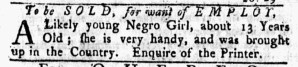
“A Likely young Negro Girl.”

We do not know much about this “Likely young Negro Girl” advertised in the New-York Journal except that she was around 13 years old and had been “brought up in the Country” and not in New York City.  She may have been separated from her mother and other members of her family at a young age.  Even if that was not the case, being sold would separate her from family and friends.  According to Heather Andrea Williams in an article about “How Slavery Affected African American Families,” enslaved people “lived with the perpetual possibility of separation through the sale of one or more family members.”  She also states, “Young children, innocently unaware of the possibilities, learned quickly of the pain that such separations could cost.”  This advertisement was about one girl, but it helps to tell the stories of many more children and their families who were separated because of slavery and the slave trade during the era of the American Revolution.

**********

ADDITIONAL COMMENTARY: Carl Robert Keyes

Like his peers in my Revolutionary America class, Drew had an opportunity to select any newspaper advertisement to examine in greater detail from his week as guest curator of the Adverts 250 Project and the Slavery Adverts 250 Project.  That meant that he selected from hundreds of advertisements for consumer goods and services and dozens of advertisements about enslaved men, women, and children.  In total, he identified sixty advertisements about enslaved people published in newspapers from New Hampshire to South Carolina from April 3 through April 9, 1772.  The vast majority of those ran in newspapers in the Chesapeake and the Lower South, but a significant number of them, like this advertisement for a “Likely young Negro Girl,” appeared in newspapers published in Pennsylvania, New York, and New England.  Drew could have chosen any of those advertisements to research for his entry on the Adverts 250 Project.

I suspect that he decided on an advertisement about an enslaved girl published in New York in part because he and his classmates were dismayed to learn about the extent of slavery in New England and the Middle Atlantic before, during, and after the American Revolution.  They were accustomed to thinking of slavery as a southern institution in the nineteenth century, not an integral part of daily life throughout the colonies during the eighteenth century.  Working on the Slavery Adverts 250 Project, examining entire issues of approximately two dozen newspapers published in the early 1770s, allowed them to witness the reality of slavery in New England, New York, and Pennsylvania.  This advertisement about a “Likely young Negro Girl” was not some sort of exceptional example.  It appeared immediately below another advertisement for a “Likely Negro Man, about 20 years of age.”  The same day, the Pennsylvania Gazette and the Pennsylvania Journal both carried advertisements about enslaved people.  Throughout the week, similar advertisements appeared in the Boston Evening-Post, the New-Hampshire Gazette, the New-London Gazette, and the New-York Gazette and Weekly Mercury as well as in several newspapers in the Chesapeake and the Lower South.  As an instructor, I could have gathered together examples to share with my students, but I believe that examining the primary sources themselves, seeing these advertisements in the context of the newspapers that carried them, more fully testifies to the presence of slavery and enslaved people in early America.

Welcome, Guest Curator Drew Nunnemacher

Drew Nunnemacher is a sophomore at Assumption University in Worcester, Massachusetts. He is majoring in History and Secondary Education.  He plans to become a high school history teacher. Drew is very passionate about his interests, including bringing his therapy dog, Maggie, to the local nursing homes for community service. Drew spends his summers on Cape Cod where he lifeguards on the ocean for the National Park Service and works as a bouncer at the Beachcomber.  Drew made his contributions to the Adverts 250 Project and the Slavery Adverts 250 Project while enrolled in HIS 359 Revolutionary America, 1763-1815, in Fall 2021.

Welcome, guest curator Drew Nunnemacher!

Slavery Advertisements Published April 9, 1772

GUEST CURATOR: Drew Nunnemacher

The Slavery Adverts 250 Project chronicles the role of newspaper advertising in perpetuating slavery in the era of the American Revolution. The project seeks to reveal the ubiquity of slavery in eighteenth-century life from New England to Georgia by republishing advertisements about enslaved people – for sale as individuals or in groups, wanted to purchase or for hire for short periods, runaways who liberated themselves, and those who were subsequently captured and confined in jails and workhouses – in daily digests on this site as well as in real time via the @SlaveAdverts250 Twitter feed, utilizing twenty-first-century media to stand in for the print media of the eighteenth century.

The project aims to provide modern audiences with a sense of just how often colonizers encountered these advertisements in their daily lives. Enslaved men, women, and children appeared in print somewhere in the colonies almost every single day. Those advertisements served as a constant backdrop for social, cultural, economic, and political life in colonial and revolutionary America. Colonizers who did not purport to own enslaved people were still confronted with slavery as well as invited to maintain the system by purchasing enslaved men, women, and children or assisting in the capture of so-called “runaways” who sought to free themselves from bondage. The frequency of these newspaper advertisements suggests just how embedded slavery was in colonial and revolutionary American culture in everyday interactions beyond the printed page.

These advertisements also testify to the experiences of enslaved men, women, and children, though readers must consider that those experiences have been remediated through descriptions offered by enslavers rather than enslaved people themselves. Often unnamed in the advertisements, enslaved men, women, and children were not invisible or unimportant in early America.

These advertisements appeared in colonial American newspapers 250 years ago today.

Maryland Gazette (April 9, 1772).

**********

Maryland Gazette (April 9, 1772).

**********

Maryland Gazette (April 9, 1772).

**********

New-York Journal (April 9, 1772).

**********

New-York Journal (April 9, 1772).

**********

Pennsylvania Gazette (April 9, 1772).

**********

Pennsylvania Journal (April 9, 1772).

**********

South-Carolina Gazette (April 9, 1772).

**********

South-Carolina Gazette (April 9, 1772).

**********

South-Carolina Gazette (April 9, 1772).

**********

South-Carolina Gazette (April 9, 1772).

**********

South-Carolina Gazette (April 9, 1772).

**********

South-Carolina Gazette (April 9, 1772).

**********

South-Carolina Gazette (April 9, 1772).

**********

Virginia Gazette [Purdie and Dixon] (April 9, 1772).

**********

Virginia Gazette [Purdie and Dixon] (April 9, 1772).

**********

Virginia Gazette [Purdie and Dixon] (April 9, 1772).

**********

Virginia Gazette [Purdie and Dixon] (April 9, 1772).

**********

Virginia Gazette [Purdie and Dixon] (April 9, 1772).

April 8

What was advertised in a colonial American newspaper 250 years ago this week?

New-York Gazette and Weekly Mercury (April 6, 1772).

“He is to be spoke with at Mr. Samuel Prince’s, Cabinet-maker, at the Sign of the Chest of Drawers.”

Newspaper notices accounted for the vast majority of advertising in eighteenth-century America, but not all advertisers resorted to the public prints.  Some posted broadsides or distributed handbills, trade cards, and billheads.  Some artisans affixed labels to furniture produced in their shops.  Others did not use printed media at all.  Instead, they relied on shop signs to mark their locations and communicate to prospective customers what kinds of goods and services they provided.

Far fewer shop signs survive than newspaper advertisements, but various sources suggest that colonizers encountered a rich visual landscape of shop signs as they traversed the streets in towns from New England to Georgia.  The April 6, 1772, edition of the New-York Gazette and Weekly Mercury testifies to some of the shop signs in the city during the era of the American Revolution.  In the colophon, incorporated into the masthead, Hugh Gaine declared that he printed the newspaper “at the Bible and Crown, in HANOVER-SQUARE.”  Elsewhere in the newspaper, John Sheiuble, an “ORGAN BUILDER, from PHILADELPHIA,” informed readers that they could speak with him “at Mr. Samuel Prince’s, Cabinet-maker, at the Sign of the Chest of Drawers, in New-York.”  Prince’s shop sign made it into the public prints because a fellow artisan used it as a point of reference in his advertisement.  Whether or not they read the New-York Gazette and Weekly Mercury, many colonizers likely associated the Sign of the Chest of Drawers with Prince and the furniture produced in his shop.  Sheiuble believed that the device was so widely recognized in the city that he did not need to mention the name of the street or any nearby landmarks to direct readers to Prince’s shop.

Sheiuble’s advertisement did not include a depiction of the Sign of the Chest of Drawers.  Merely mentioning the sign likely evoked an image in the minds of those who had seen it, but left others to rely on their imaginations.  On occasion, advertisers did adorn their newspaper notices (or trade cards and billheads) with images that replicated their shop signs.  For the most part, however, short descriptions, like the Sign of the Chest of Drawers, account for how much we know about the images colonizers glimpsed in the windows or hanging above the doors of eighteenth-century shops.