April 18

GUEST CURATOR: Lizzie Peterson

What was advertised in a colonial American newspaper 250 years ago today?

Postscript to the Censor (April 18, 1772).

“WOOL and TOW CARDS.”

While examining advertisements to research for this project, this one about wool and tow cards caught my eye, I wanted to learn about what “cards” and “carding” meant in early America.  According to Laurel Thatcher Ulrich in “Wheels, Looms, and the Gender Division of Labor in Eighteenth-Century New England,” women participated in “the endless work of carding, combing, spinning, reeling, doubling, dyeing, bleaching, spooling, warping, and weaving,” suggesting that “cards” and “carding” had something to do with preparing textiles, since all of the of the other verbs deal with preparing textiles or making clothes.[1]

I learned that the term “card” is not a type of card we know today like a greeting card or playing card. “Cards” and “carding” during the eighteenth century referred to the tool and process people used to spin and prepare textiles. Wool and tow are both types of fibers made into textiles. Tow comes from flax or hemp and wool is hair from animals, particularly sheep.  According to the National Museum of American History at the Smithsonian Institution, “The carding process is part of preparing will for spinning into yarn. Wool is brushed between two hand carders to align fibers in the same direction.”  Ulrich points out that women did this work.

Eighteenth-century wool card. Courtesy National Museum of American History.

**********

ADDITIONAL COMMENTARY: Carl Robert Keyes

Colonizers knew exactly what James Longden sold when they saw his advertisement for “ALL SORTS OF WOOL and TOW CARDS” in the Postscript to the Censor in the spring of 1772.  They knew the intended purpose of wool and tow cards.  Most had probably used cards themselves or observed others using them.  Colonizers encountered wool and tow cards as they went about their daily lives.  What were once such familiar items prior to the Industrial Revolution, however, no longer remain so familiar to most people, including students in my Revolutionary America classes.  That is why I do not assign advertisements to them when they serve as guest curators but instead instruct them to choose advertisements that look interesting to them.  I especially encourage them to find advertisements that confuse them because they do not know what kinds of products were being sold.  They then have to do the detective work, the historical research, to make meaning of their advertisements.  Throughout the process, we have conversations that further enhance their understanding of the historical context.

Lizzie did an exemplary job in selecting an advertisement and doing the research to understand it, even locating a photo of an eighteenth-century wool card similar to those advertised by Longden.  This certainly enhanced discussions from class, especially our focus on how women participated in politics during the era of the American Revolution even though they could not vote or hold office.  In particular, we examined women’s roles as producers and consumers.  We discussed spinning bees as public rituals as well as less visible labor that took place within households as women made homespun garments as alternatives to imported goods.  Colonizers acknowledged that women fulfilled their patriotic duty through their everyday labors.  In addition, women participated in politics through the decisions they made as consumers, especially when nonimportation and nonconsumption agreements were in effect.  Longden offered women wool and tow cards “made in this Province,” promising that they were “as cheap, or cheaper than can be imported” as well as “equal to any in Great-Britain.”  The politics of purchasing and using wool and tow cards made by Longden, however, remained just a little bit more abstract without knowing the purpose of those items.  As a result of Lizzie’s choice of advertisement, she and her classmates gained a better understanding of both women’s domestic labor and how women participated in politics.

**********

[1] Laurel Thatcher Ulrich, “Wheels, Looms, and the Gender Division of Labor in Eighteenth-Century New England,” William and Mary Quarterly, 3rd ser., 55, no. 1 (January 1998): 20.

Welcome Back, Guest Curator Lizzie Peterson

Elizabeth “Lizzie” Peterson is a senior at Assumption University in Worcester, Massachusetts. She is a History and Elementary Education double major. Her hometown is Foxboro, Massachusetts. Lizzie is involved in several campus activities. She is a member of the Education Club, Student Ambassadors Club, and Residence Hall Association. Her history interests include Revolutionary America, the Civil War, and World War II. This is Lizzie’s second time acting as guest curator for the Adverts 250 Project and the Slavery Adverts 250 Project, having previously worked on the projects when enrolled in HIS 400 Research Methods: Vast Early America in Spring 2021. She made her current contributions to the project when enrolled in HIS 359 Revolutionary America, 1763-1815, in Fall 2021. She is very excited to become involved with this project again!

Welcome back, guest curator Lizzie Peterson!

April 17

What was advertised in a colonial American newspaper 250 years ago today?

Connecticut Journal (April 17, 1772).

“He continues to cut and dress Gentlemen and Ladies Hair in Taste, either antient or modern.”

Amos Morrisson described himself as a “Peruke-Maker and Dresser.”  He made wigs and styled hair for colonizers in and near New Haven in the early 1770s.  He placed an advertisement in the April 17, 1772, edition of the Connecticut Journal to inform current and prospective clients that he “lately removed from the Place where he formerly work’d, to a new Shop on the Church Land, next to Mr. Fairchild’s.”  That amounted to sufficient direction for patrons to find his new location.

Morrisson incorporated several marketing appeals into the remainder of his advertisement.  He addressed fashion and customer satisfaction simultaneously when he stated that he “continues to cut and dress Gentlemen and Ladies Hair in Taste, either antient or modern.”  In so doing, he hinted at debates about hairstyles that colonizers took seriously during the era of the American Revolution.  Men and women who adopted “modern” styles faced accusations that they indulged in luxury at the expense of good character.  Women wore high rolls, their hair and extensions elaborately arranged atop their heads.  Some men adopted a similar style, prompting critics to refer to them as “macaronis” as a critique of hairstyles, garments, and comportment associated with Italy.  Morrisson did not take a position in the debate.  Instead, he signaled that he was proficient in the “modern” style for those who wished to wear it, but he also served clients who preferred more conservative or “antient” styles.  Either way, his clients could depend on having their hair done “in Taste” at his shop.

In addition to styling hair, Morrisson “carried on Wigg-Making in all its Branches.”  He once again emphasized customer service, promising that “Gentlemen (both of Town and Country) … may depend upon being used in the best Manner.”  He constructed his wigs “of the best Materials” and set lower prices than prospective clients would find anywhere in the vicinity.  Morrisson declared that he sold his wigs “much cheaper … than has formerly been sold in Town.”  He also highlighted his experience and roots in the community, referencing clients “that have favoured him with their good Custom” in the past and inviting them to “continue the same.”

Morrisson’s advertisement was not particularly lengthy, but he managed to include a variety of appeals to incite demand for his services.  In so doing, he replicated aspects of advertisements placed by his counterparts in larger urban ports like New York and Philadelphia.  Fashion was not the province of the elite in those places.  Instead, purveyors of goods and services, including a “Peruke-Maker and Dresser” like Morrisson, served consumers throughout the colonies.

Slavery Advertisements Published April 17, 1772

GUEST CURATOR: Elizabeth Peterson

The Slavery Adverts 250 Project chronicles the role of newspaper advertising in perpetuating slavery in the era of the American Revolution. The project seeks to reveal the ubiquity of slavery in eighteenth-century life from New England to Georgia by republishing advertisements about enslaved people – for sale as individuals or in groups, wanted to purchase or for hire for short periods, runaways who liberated themselves, and those who were subsequently captured and confined in jails and workhouses – in daily digests on this site as well as in real time via the @SlaveAdverts250 Twitter feed, utilizing twenty-first-century media to stand in for the print media of the eighteenth century.

The project aims to provide modern audiences with a sense of just how often colonizers encountered these advertisements in their daily lives. Enslaved men, women, and children appeared in print somewhere in the colonies almost every single day. Those advertisements served as a constant backdrop for social, cultural, economic, and political life in colonial and revolutionary America. Colonizers who did not purport to own enslaved people were still confronted with slavery as well as invited to maintain the system by purchasing enslaved men, women, and children or assisting in the capture of so-called “runaways” who sought to free themselves from bondage. The frequency of these newspaper advertisements suggests just how embedded slavery was in colonial and revolutionary American culture in everyday interactions beyond the printed page.

These advertisements also testify to the experiences of enslaved men, women, and children, though readers must consider that those experiences have been remediated through descriptions offered by enslavers rather than enslaved people themselves. Often unnamed in the advertisements, enslaved men, women, and children were not invisible or unimportant in early America.

These advertisements appeared in colonial American newspapers 250 years ago today.

New-London Gazette (April 17, 1772).

April 16

What was advertised in a colonial American newspaper 250 years ago today?

Massachusetts Gazette and Boston Weekly News-Letter (April 16, 1772).

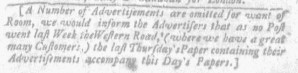
Last Thursday’s Paper containing their Advertisements accompany this Day’s Papers.”

Advertisements accounted for important revenue for colonial printers.  That was certainly the case for Richard Draper, printer of the Massachusetts Gazette and Boston Weekly News-Letter.  So many colonizers submitted advertisements for inclusion in the April 16, 1772, edition, that he resorted to distributing a half sheet supplement devoted almost exclusively to paid notices.  That helped, but still did not provide enough space for all of the advertisements that he should have published that week.  That prompted him to insert a brief note to address the situation.  “A Number of Advertisements,” Draper stated, “are omitted for want of Room.”  He then tried to convince advertisers that they did not need to be concerned because “no Post went last Week” along “the Western Road, (where we have a great many Customers)” so that meant that “last Thursday’s Paper containing their Advertisements accompany this Day’s Papers.”

Would that mollify advertisers who expected to see their notices in print?  Draper did the best he could to give a favorable impression of the situation, assuring advertisers that readers would indeed see their notices that week even if they did not happen to appear in the most recent edition or its supplement.  He did not, however, attempt to explain why they should not be concerned that delivery of the previous edition had been delayed by a week, perhaps because everyone understood he had less control over the post than his press.  He simply expected advertisers to accept that their notices had not been distributed as widely as they anticipated as soon as they intended.  What truly mattered, he sought to convince them, was that their advertisements were now before the eyes of readers.  Interestingly, Draper’s note explicitly addressed advertisers, not subscribers.  He made no apology to subscribers outside of Boston that they had to wait a week to receive either news or notices.  Through that omission, he once again positioned delivery as further beyond his control than the contents of his newspaper.  In this instance, maintaining good relationships with customers and safeguarding an important revenue stream meant focusing on the concerns of advertisers.

Slavery Advertisements Published April 16, 1772

GUEST CURATOR: Victoria Ostrowski

The Slavery Adverts 250 Project chronicles the role of newspaper advertising in perpetuating slavery in the era of the American Revolution. The project seeks to reveal the ubiquity of slavery in eighteenth-century life from New England to Georgia by republishing advertisements about enslaved people – for sale as individuals or in groups, wanted to purchase or for hire for short periods, runaways who liberated themselves, and those who were subsequently captured and confined in jails and workhouses – in daily digests on this site as well as in real time via the @SlaveAdverts250 Twitter feed, utilizing twenty-first-century media to stand in for the print media of the eighteenth century.

The project aims to provide modern audiences with a sense of just how often colonizers encountered these advertisements in their daily lives. Enslaved men, women, and children appeared in print somewhere in the colonies almost every single day. Those advertisements served as a constant backdrop for social, cultural, economic, and political life in colonial and revolutionary America. Colonizers who did not purport to own enslaved people were still confronted with slavery as well as invited to maintain the system by purchasing enslaved men, women, and children or assisting in the capture of so-called “runaways” who sought to free themselves from bondage. The frequency of these newspaper advertisements suggests just how embedded slavery was in colonial and revolutionary American culture in everyday interactions beyond the printed page.

These advertisements also testify to the experiences of enslaved men, women, and children, though readers must consider that those experiences have been remediated through descriptions offered by enslavers rather than enslaved people themselves. Often unnamed in the advertisements, enslaved men, women, and children were not invisible or unimportant in early America.

These advertisements appeared in colonial American newspapers 250 years ago today.

Maryland Gazette (April 16, 1772).

**********

New-York Journal (April 16, 1772).

**********

New-York Journal (April 16, 1772).

**********

Pennsylvania Gazette (April 16, 1772).

**********

Pennsylvania Gazette (April 16, 1772).

**********

South-Carolina Gazette (April 16, 1772).

**********

South-Carolina Gazette (April 16, 1772).

**********

South-Carolina Gazette (April 16, 1772).

**********

South-Carolina Gazette (April 16, 1772).

**********

South-Carolina Gazette (April 16, 1772).

**********

South-Carolina Gazette (April 16, 1772).

**********

South-Carolina Gazette (April 16, 1772).

**********

South-Carolina Gazette (April 16, 1772).

**********

South-Carolina Gazette (April 16, 1772).

**********

Supplement to the South-Carolina Gazette (April 16, 1772).

**********

Supplement to the South-Carolina Gazette (April 16, 1772).

**********

Supplement to the South-Carolina Gazette (April 16, 1772).

**********

Supplement to the South-Carolina Gazette (April 16, 1772).

**********

Virginia Gazette [Purdie and Dixon] (April 16, 1772).

**********

Virginia Gazette [Purdie and Dixon] (April 16, 1772).

**********

Virginia Gazette [Purdie and Dixon] (April 16, 1772).

**********

Virginia Gazette [Purdie and Dixon] (April 16, 1772).

April 15

What was advertised in a colonial American newspaper 250 years ago this week?

New-York Gazette and Weekly Mercury (April 13, 1772).

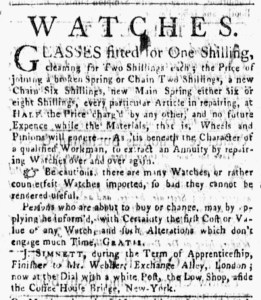
“Such Alterations which don’t engage much Time, GRATIS.”

John Simnet, a watchmaker, placed rather colorful newspaper advertisements over the course of several years in the late 1760s and 1770s, first in the New-Hampshire Gazette and later in newspapers published in New York.  During the time that he resided in New Hampshire, he engaged in nasty feud with a fellow watchmaker, Nathaniel Sheaff Griffith.  Having trained and worked in London, Simnet accused Griffith of not possessing the same level of skill and suggested that Griffith actually damaged the watches he attempted to repair.  In a series of advertisements, Simnet denigrated Griffith’s character, intellect, and skill.

That rivalry may have played a part in Simnet’s decision to relocate to New York.  He once again turned to the public prints to promote his business.  For a time, he focused primarily on his own credentials and expertise, but old habits died hard.  Simnet eventually found himself embroiled in another feud with a fellow watchmaker, though James Yeoman appears to have been the first to pursue their disagreement in print with an advertisement that seemed to critique Simnet’s credentials without naming him.  Given his personality, Simnet may have initiated the insults in person before the dispute moved into advertisements in the newspapers.  Regardless of who started it, Simnet had extensive experience demeaning a competitor in print.  In March 1772, he deployed some of the same strategies that he used against Griffith a few years earlier.

Even though he could not resist placing negative advertisements about Yeoman, Simnet may have learned from his experience in New Hampshire that consumers did not respond well to marketing campaigns that revolved entirely around disparaging others.  In his next advertisement, published in the April 13, 1772, edition of the New-York Gazette and Weekly Mercury, he returned to the kinds of appeals that he incorporated into his notices when he first arrived in New York.  He gave prospective customers a careful accounting of how much they could expect to pay for various goods and services, such as “a new Chain Six Shillings” and “the Price of joining a broken Spring or Chain Two Shillings.”  He also promoted his prices while offering a guarantee, stating that he set rates for “every particular Article in repairing, at HALF the Price charg’d by any other, and no future Expence while the Materials, that is, Wheels and Pinions will endure.”  Simnet declared that it was “beneath the Character of a qualified Workman, to extract an Annuity by repairing Watches over and over again.”  That may have been a subtle critique of his many competitors, but not a targeted attack on Yeoman or any other watchmaker in New York.  To draw customers to his shop, Simnet also offered “such Alterations which don’t engage much Time, GRATIS.”

Simnet has been a fascinating character to track over the past three years, in large part because he deviated so significantly from one of the standard advertising practices of the period.  He sometimes placed advertisements that vilified his rivals rather than focusing on his expertise and experience.  Yet Simnet did not always go negative.  He also published advertisements that incorporated the tone and appeals usually found in newspaper notices by artisans.  In some cases, he also crafted innovative appeals, including free services to entice prospective customers into his shop in hopes of establishing relationships with them.  As an advertiser, he covered a greater range of appeals, positive and negative, than just about anyone else marketing their goods and services in the colonies in the decade before the American Revolution.

April 14

Who was the subject of an advertisement in a colonial American newspaper 250 years ago today?

Supplement to the South-Carolina Gazette and Country Journal (April 14, 1772).

Ten Shillings per Day will be paid to every able Male Slave.”

Roads and bridges needed repair.  That was the message in a notice that ran in the April 14, 1772, edition of the South-Carolina Gazette and Country Journal.  Henry Ravenel informed readers that two bridges in St. John’s Parish “are both in Want of great and immediate Repairs.”  He called on “any Person or Persons, who will repair both, or either of the said Bridges” to submit Proposals to the Board of Commissioners in Monck’s Corner.  In addition to the bridges, “Part of the high Road leading from Goose Creek to Monck’s Corner, stands in great and immediate Want of Repair.”  Ravenel did not request proposals for that job.  Instead, he declared that “Ten Shillings per Day will be paid to every able Male Slave” who worked on repairing the road.

Readers knew that was an impolite fiction.  The enslaved men who did the repairs would not receive ten shillings for each day they labored.  Instead, the Board of Commissioners would pay those funds directly to the enslavers.  This advertisement testified to yet another contribution beyond agricultural labor that enslaved men and women made to the colonial economy.  They participated in building and maintaining infrastructure.  Other advertisements in the same issue of the South-Carolina Gazette and Country Journal concerned a “NEGRO WAITING BOY, who also understands the Management of Horses,” an enslaved cooper, enslaved tanners, an enslaved “House Carpenter,” enslaved sawyers, and enslaved domestic servants.  Some of those enslaved men and women may have also hired out, like the enslaved men who repaired the road between Goose Creek and Monck’s Corner, and their enslavers may have allowed them to keep a small portion of their earnings, but they almost certainly did not retain their entire wages for the work they performed.  Those enslaved men and women undertook all kinds of labor, much of it requiring specialized skills and expertise, in the colonial economy.  Their contributions extended far beyond cultivating rice, indigo, and other crops.

Slavery Advertisements Published April 14, 1772

GUEST CURATOR: Victoria Ostrowski

The Slavery Adverts 250 Project chronicles the role of newspaper advertising in perpetuating slavery in the era of the American Revolution. The project seeks to reveal the ubiquity of slavery in eighteenth-century life from New England to Georgia by republishing advertisements about enslaved people – for sale as individuals or in groups, wanted to purchase or for hire for short periods, runaways who liberated themselves, and those who were subsequently captured and confined in jails and workhouses – in daily digests on this site as well as in real time via the @SlaveAdverts250 Twitter feed, utilizing twenty-first-century media to stand in for the print media of the eighteenth century.

The project aims to provide modern audiences with a sense of just how often colonizers encountered these advertisements in their daily lives. Enslaved men, women, and children appeared in print somewhere in the colonies almost every single day. Those advertisements served as a constant backdrop for social, cultural, economic, and political life in colonial and revolutionary America. Colonizers who did not purport to own enslaved people were still confronted with slavery as well as invited to maintain the system by purchasing enslaved men, women, and children or assisting in the capture of so-called “runaways” who sought to free themselves from bondage. The frequency of these newspaper advertisements suggests just how embedded slavery was in colonial and revolutionary American culture in everyday interactions beyond the printed page.

These advertisements also testify to the experiences of enslaved men, women, and children, though readers must consider that those experiences have been remediated through descriptions offered by enslavers rather than enslaved people themselves. Often unnamed in the advertisements, enslaved men, women, and children were not invisible or unimportant in early America.

These advertisements appeared in colonial American newspapers 250 years ago today.

South-Carolina Gazette and Country Journal (April 14, 1772).

**********

South-Carolina Gazette and Country Journal (April 14, 1772).

**********

South-Carolina Gazette and Country Journal (April 14, 1772).

**********

South-Carolina Gazette and Country Journal (April 14, 1772).

**********

South-Carolina Gazette and Country Journal (April 14, 1772).

**********

South-Carolina Gazette and Country Journal (April 14, 1772).

**********

South-Carolina Gazette and Country Journal (April 14, 1772).

**********

South-Carolina Gazette and Country Journal (April 14, 1772).

**********

South-Carolina Gazette and Country Journal (April 14, 1772).

**********

South-Carolina Gazette and Country Journal (April 14, 1772).

**********

Supplement to the South-Carolina Gazette and Country Journal (April 14, 1772).

**********

Supplement to the South-Carolina Gazette and Country Journal (April 14, 1772).

**********

Supplement to the South-Carolina Gazette and Country Journal (April 14, 1772).

**********

Supplement to the South-Carolina Gazette and Country Journal (April 14, 1772).

**********

Supplement to the South-Carolina Gazette and Country Journal (April 14, 1772).

**********

Supplement to the South-Carolina Gazette and Country Journal (April 14, 1772).

**********

Supplement to the South-Carolina Gazette and Country Journal (April 14, 1772).

**********

Supplement to the South-Carolina Gazette and Country Journal (April 14, 1772).

April 13

What was advertised in a colonial American newspaper 250 years ago today?

Boston Evening-Post (April 13, 1772).

“A Select Collection of Letters Of the late Reverend GEORGE WHITEFIELD.”

It was one of the biggest news stories of the year.  George Whitefield died in Newburyport, Massachusetts, on September 30, 1770.  The next day, newspapers in Boston informed colonizers of the death of one of the most influential ministers associated with the eighteenth-century religious revivals now known as the Great Awakening.  Over the next several weeks, news spread throughout New England and to other colonies as printers exchanged newspapers and reprinted coverage from one to another.  Those printers also sensed an opportunity to generate revenues by producing and marketing broadsides, funeral sermons, and books that commemorated the minister’s death.  Throughout the colonies, but especially in New England, New York, and Pennsylvania, printers advertised commemorative items as they continued to publish updates about how colonizers near and far reacted to the news of Whitefield’s death.

Such advertising declined by the end of the year, but experienced a resurgence in the spring of 1771 when ships from England arrived in American ports with commemorative books and pamphlets published on the other side of the Atlantic.  Printers and booksellers encouraged colonizers to participate in another round of commodifying Whitefield.  That lasted for a couple of months before mentions of the minister faded from advertisements in the public print.  That did not mean, however, that entrepreneurs believed that the market for such commodities had disappeared, only that it was no longer so robust.  In the spring of 1772, Thomas Fleet and John Fleet, printers of the Boston Evening-Post, advertised “A Select Collection of Letters Of the late Reverend GEORGE WHITEFIELD … Written to his most intimate Friends, and Persons of Distinction, in England, Scotland, Ireland, and America.”  The minister wrote those letters between 1734 and 1770, “including the whole of his Ministry.”  In addition, the three-volume set contained “an Account of the Orphan House in Georgia” founded by Whitefield.  In an advertisement in the April 13, 1772, editions of the Boston Evening-Post and the Boston-Gazette, the Fleets indicated that they “Just received” the books “by the last Ship from London.”  Printers in England continued producing Whitefield memorabilia.  Apparently believing that demand existed or could be cultivated for such materials on both sides of the Atlantic, they presented consumers with another opportunity to acquire printed items associated with the minister.