June 19

What was advertised in a colonial American newspaper 250 years ago today?

Providence Gazette (June 19, 1773).

“Equal to any made in America, and far superior to any imported from Europe.”

For several weeks in the summer of 1773, John Waterman and Company ran advertisements for “Clothiers Press-Papers” in both the Newport Mercury and the Providence Gazette.  Waterman and Company informed prospective customers that they made the press papers “at the Paper-Mill, in Providence.”  Anyone interested in acquiring a supply could make purchases at the mill or, for their convenience, from local agents in three towns in Rhode Island.  Thurber and Cahoon stocked the press papers at their shop at the Sign of the Bunch of Grapes in the north end of Providence.  Thomas Aldrich also carried them in East Greenwich, as did Solomon Southwick in the printing office where he published the Newport Mercury.  Given that both newspapers circulated throughout the colony and beyond, Waterman and Company offered multiple options for clothiers to identify the location that best suited their needs.

In addition to providing convenient options for clothiers to purchase press papers from local agents, Waterman and Company deployed another marketing strategy.  They promoted domestic manufactures, the production of goods in the colonies as an alternative to imported items, in their efforts to convince clothiers to choose their press papers.  Waterman and Company first declared that their press papers were “equal to any made in America” and then added that they were “far superior to any imported from Europe.”  In so doing, they established a hierarchy that suggested that clothiers should consider any press papers made in the colonies better than imported ones.  Furthermore, discerning clothiers did not have to settle for a better product but could acquire the best product when they purchased press papers made by Waterman and Company.  Such “Buy American” appeals appeared regularly in newspapers advertisements in the 1760s and 1770s.  Advertisers most often made such appeals when disputes between the colonies and Parliament intensified, especially when colonizers implemented nonimportation agreements, but they did not disappear during periods of relative calm.  Savvy entrepreneurs often encouraged prospective customers, including clothiers who needed supplies to operate their businesses, to “Buy American” before thirteen colonies declared independence from Britain.

June 18

What was advertised in a colonial American newspaper 250 years ago today?

New-Hampshire Gazette (June 18, 1773).

“(6 w.)”

In the spring and summer of 1773, George Deblois ran an advertisement to inform readers of the New-Hampshire Gazettethat he stocked a ‘GENERAL ASSORTMENT of English, India and Hard Ware GOODS” at his shop in Newburyport, Massachusetts.  Like many other merchants and shopkeepers of the era, he listed a variety of items in an effort to demonstrate the array of choices he made available to consumers.  One element of his advertisement, however, was not intended for prospective customers.  A notation, “(6 w.),” on the final line provided the compositor and others working in the printing office information about how long Deblois’s advertisement should appear in the New-Hampshire Gazette.  The merchants made arrangements for it to run for six weeks.

Curiously, the advertisement did not appear in six consecutive issues.  Dated May 5, it first ran in the May 14 edition.  It then appeared in the next two issues on May 21 and May 28, but did not run on June 4 and June 11.  The newspaper revived the advertisement for another three consecutive issues, June 18, June 25, and July 2, before discontinuing it following the sixth insertion.  One the type had been set, the compositor could include the advertisement (or not) and move it around within each edition.  An error, “the SIGN of the GOLNEN EAGLE,” remained consistent throughout the run of the advertisement.

The publication history of this advertisement raises questions about the business of advertising and communications between advertisers and printing offices.  Did Deblois intend for his advertisement to appear in six consecutive issues?  Or did he send instructions to Daniel Fowle, the printer of the New-Hampshire Gazette, that he wished for it to run six times over the course of a couple of months but not necessarily for six consecutive weeks?  Did Deblois consult the New-Hampshire Gazette each week to confirm whether his advertisement appeared?  If so, did he note the error in the name of his shop sign?  How accommodating would the printing office have been to fixing such an error at the request of an advertiser, especially one who placed such a lengthy advertisement for so many weeks?  What kind of bookkeeping system did the Fowle and others in the printing office use to keep track of how many times each advertisement appeared?  What kind of system, such as entering that information into a ledger or adding it to a running list of recent advertisements, became part of the weekly ritual of publishing the New-Hampshire Gazette?  When it came to adding and removing advertisements, what kind of coordination among the printer and other workers occurred within the printing office? Surviving primary sources may provide partial answers to some of these questions, but other aspects of the day-to-day operations of colonial printing offices, especially the business of advertising, may never have definitive answers.

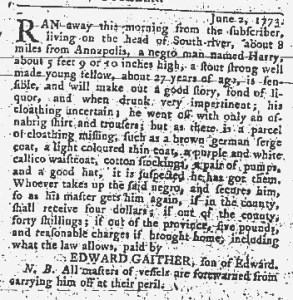
Slavery Advertisements Published June 18, 1773

The Slavery Adverts 250 Project chronicles the role of newspaper advertising in perpetuating slavery in the era of the American Revolution. The project seeks to reveal the ubiquity of slavery in eighteenth-century life from New England to Georgia by republishing advertisements about enslaved people – for sale as individuals or in groups, wanted to purchase or for hire for short periods, runaways who liberated themselves, and those who were subsequently captured and confined in jails and workhouses – in daily digests on this site as well as in real time via the @SlaveAdverts250 Twitter feed, utilizing twenty-first-century media to stand in for the print media of the eighteenth century.

The project aims to provide modern audiences with a sense of just how often colonizers encountered these advertisements in their daily lives. Enslaved men, women, and children appeared in print somewhere in the colonies almost every single day. Those advertisements served as a constant backdrop for social, cultural, economic, and political life in colonial and revolutionary America. Colonizers who did not purport to own enslaved people were still confronted with slavery as well as invited to maintain the system by purchasing enslaved men, women, and children or assisting in the capture of so-called “runaways” who sought to free themselves from bondage. The frequency of these newspaper advertisements suggests just how embedded slavery was in colonial and revolutionary American culture in everyday interactions beyond the printed page.

These advertisements also testify to the experiences of enslaved men, women, and children, though readers must consider that those experiences have been remediated through descriptions offered by enslavers rather than enslaved people themselves. Often unnamed in the advertisements, enslaved men, women, and children were not invisible or unimportant in early America.

These advertisements appeared in colonial American newspapers 250 years ago today.

New-Hampshire Gazette (June 18, 1773).

June 17

What was advertised in a colonial American newspaper 250 years ago today?

Rivington’s New-York Gazetteer (June 17, 1773).

“A Rogue!  A Rogue!  A Rogue!”

The headline set one advertisement apart from others that appeared in the June 17, 1773, edition of Rivington’s New-York Gazetteer.  Some of those others had headlines like “TO BE SOLD,” “IMPORTED,” “TO BE LETT,” or “WANTED.”  Many deployed the name of the advertiser as the headline, including “ABRAHAM DURYEE,” “ENNIS GRAHAM,” “THOMAS HAZARD,” and “JOSEPH PEARSALL.”  Even the printer used his own name, “JAMES RIVINGTON,” as the headline for his advertisement.  A few headlines provided more specific details, such as “DELAWARE LOTTERY,” “HORSEMANSHIP,” “INDIGO,” “THEATRE,” and “WATCHES.”

One distinctive advertisement paired two headlines, “FIVE POUNDS REWARD” and “A Rogue!  A Rogue!  A Rogue!” The first frequently appeared in advertisements describing and offering rewards for the capture and return of apprentices and indentured servants who ran away from their masters and enslaved people who liberated themselves from their enslavers.  In contrast, the repetition of “A Rogue!  A Rogue!  A Rogue!” set the advertisement apart from any of the others and likely demanded the attention of readers, inciting curiosity about what kind of offenses merited such a headline.

When they set about learning more, readers discovered that the rogue was an “atrocious villain, known by the name of Isaac Vanden Velden” who had recently “imposed on several persons in this city, with bills of exchange, which he has forged in the name of Mr. Paul Hogstraffer, of Albany.”  Even before those incidents, Vanden Velden had a reputation for misconduct in both Philadelphia and Albany, according to the advertisement, and sometimes “pretends to have large rights in land on the Mississippi.  The con artist “talks fast, and affects a good deal of propriety in his conversation,” so much so that he “has a very good address, and appears capable of executing any artful piece of fraud.”  Readers might detect Vander Velden, “a German,” from his speech; although he “speak good English,” he retained “a little of his own country accent.”

A nota bene indicated that the rogue was headed in the direction of Philadelphia.  Given the circulation of Rivington’s New-York Gazetteer well beyond the city, the advertiser hoped that readers put on alert about Vanden Velden would capture and “secure the above impostor in any of his Majesty’s jails, so that he may be brought to justice.”  In this instance, the advertisement with its extraordinary headline served as a public service announcement and a supplement to the news that ran elsewhere in the newspaper.

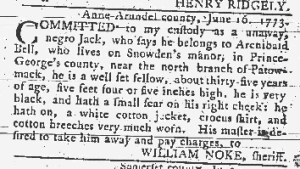
Slavery Advertisements Published June 17, 1773

The Slavery Adverts 250 Project chronicles the role of newspaper advertising in perpetuating slavery in the era of the American Revolution. The project seeks to reveal the ubiquity of slavery in eighteenth-century life from New England to Georgia by republishing advertisements about enslaved people – for sale as individuals or in groups, wanted to purchase or for hire for short periods, runaways who liberated themselves, and those who were subsequently captured and confined in jails and workhouses – in daily digests on this site as well as in real time via the @SlaveAdverts250 Twitter feed, utilizing twenty-first-century media to stand in for the print media of the eighteenth century.

The project aims to provide modern audiences with a sense of just how often colonizers encountered these advertisements in their daily lives. Enslaved men, women, and children appeared in print somewhere in the colonies almost every single day. Those advertisements served as a constant backdrop for social, cultural, economic, and political life in colonial and revolutionary America. Colonizers who did not purport to own enslaved people were still confronted with slavery as well as invited to maintain the system by purchasing enslaved men, women, and children or assisting in the capture of so-called “runaways” who sought to free themselves from bondage. The frequency of these newspaper advertisements suggests just how embedded slavery was in colonial and revolutionary American culture in everyday interactions beyond the printed page.

These advertisements also testify to the experiences of enslaved men, women, and children, though readers must consider that those experiences have been remediated through descriptions offered by enslavers rather than enslaved people themselves. Often unnamed in the advertisements, enslaved men, women, and children were not invisible or unimportant in early America.

These advertisements appeared in colonial American newspapers 250 years ago today.

Maryland Gazette (June 17, 1773).

**********

Maryland Gazette (June 17, 1773).

**********

Massachusetts Gazette and Boston Weekly Mercury (June 17, 1773).

**********

Supplement to the Massachusetts Gazette and Boston Weekly Mercury (June 17, 1773).

**********

Supplement to the Massachusetts Gazette and Boston Weekly Mercury (June 17, 1773).

**********

New-York Journal (June 17, 1773).

**********

Supplement to the New-York Journal (June 17, 1773).

**********

Rivington’s New-York Gazetteer (June 17, 1773).

**********

Rivington’s New-York Gazetteer (June 17, 1773).

**********

Virginia Gazette [Purdie & Dixon] (June 17, 1773).

**********

Virginia Gazette [Purdie & Dixon] (June 17, 1773).

**********

Virginia Gazette [Purdie & Dixon] (June 17, 1773).

**********

Virginia Gazette [Purdie & Dixon] (June 17, 1773).

**********

Virginia Gazette [Rind] (June 17, 1773).

**********

Virginia Gazette [Rind] (June 17, 1773).

**********

Supplement to the Virginia Gazette [Rind] (June 17, 1773).

June 16

What was advertised in a colonial American newspaper 250 years ago today?

Pennsylvania Journal (June 16, 1773).

“The CONVENIENT BATH [and] The MINERAL SPRING (similar to the German Spaw).”

Newspaper advertisements promoted a nascent leisure and tourism industry in the late eighteenth century.  For instance, an advertisement for the “CONVENIENT BATH” at Perth Amboy, New Jersey, intended to run for two months during the summer of 1773 made its first appearance in the Pennsylvania Gazette and the Pennsylvania Journal on June 16.  The proprietors informed prospective guests that their facilities were “put in very good order for the reception of such as incline to BATH in SEA WATER.”  In addition, they also opened the “MINERAL SPRING (similar to the German Spaw).”  Visitors to the bath and mineral spring could arrange for “Genteel Lodgings” with “private families” in the town.

To entice colonizers in Philadelphia to travel to Perth Amboy, the proprietors confided that “several persons last year received great benefit” from bathing in sea water.  In addition, a combination of bath and spa “proved efficatious to scorbutic, and other disorders.”  They expected that prospective clients might remember advertisements published the previous summer, notices that went into greater detail about the health benefits associated with partaking in the services offered at their facilities.  In an advertisement in the New York Journal, for instance, the proprietors explained that their “Bath will be more beneficial, as at about two Miles Distance is a Mineral Water” and “its proper Distance procuring moderate Exercise after bathing, has proved in many Instances very assistant to the Medicinal Quality of the Waters.” They also asserted that the regimen had been “well examined by several Physicians of Ability, and frequently recommended by them” after observing “great Success” among those who visited the bath and “spaw.”

The proprietors did not provide as many details in the advertisement they ran in the summer of 1773 compared to the one that announced their inaugural season in 1772.  Perhaps they believed that word-of-mouth recommendations helped to enhance the reputation of the facility among the cohort of consumers with the leisure time and resources that would allow them to visit the shore during the summer, making it unnecessary to go into more specifics in their latest advertisement.  They may have considered the weekly repetition of the shorter advertisement over two months sufficient to create a buzz among the better sorts most likely to avail themselves of the bath and spa services in Perth Amboy.

Slavery Advertisements Published June 16, 1773

The Slavery Adverts 250 Project chronicles the role of newspaper advertising in perpetuating slavery in the era of the American Revolution. The project seeks to reveal the ubiquity of slavery in eighteenth-century life from New England to Georgia by republishing advertisements about enslaved people – for sale as individuals or in groups, wanted to purchase or for hire for short periods, runaways who liberated themselves, and those who were subsequently captured and confined in jails and workhouses – in daily digests on this site as well as in real time via the @SlaveAdverts250 Twitter feed, utilizing twenty-first-century media to stand in for the print media of the eighteenth century.

The project aims to provide modern audiences with a sense of just how often colonizers encountered these advertisements in their daily lives. Enslaved men, women, and children appeared in print somewhere in the colonies almost every single day. Those advertisements served as a constant backdrop for social, cultural, economic, and political life in colonial and revolutionary America. Colonizers who did not purport to own enslaved people were still confronted with slavery as well as invited to maintain the system by purchasing enslaved men, women, and children or assisting in the capture of so-called “runaways” who sought to free themselves from bondage. The frequency of these newspaper advertisements suggests just how embedded slavery was in colonial and revolutionary American culture in everyday interactions beyond the printed page.

These advertisements also testify to the experiences of enslaved men, women, and children, though readers must consider that those experiences have been remediated through descriptions offered by enslavers rather than enslaved people themselves. Often unnamed in the advertisements, enslaved men, women, and children were not invisible or unimportant in early America.

These advertisements appeared in colonial American newspapers 250 years ago today.

Pennsylvania Journal (June 16, 1773).

**********

Pennsylvania Journal (June 16, 1773).

**********

Pennsylvania Journal (June 16, 1773).

**********

Pennsylvania Journal (June 16, 1773).

June 15

What was advertised in a colonial American newspaper 250 years ago today?

Essex Gazette (June 15, 1773).

“His present determination is to go home to London in the Fall; he is therefore determined to sell off the whole of his Goods … at the very lowest Rate.”

In the summer of 1773, Samuel Flagg took to the pages of the Essex Gazette to promote the “general Assortment of English and India GOODS” that he recently received via “the last Shops from London and Bristol.”  He directed prospective customers interested in “Hosery of all sorts,” “men’s and boys felt Hats of all sizes,” “a good assortment of Paper Hangings,” “an assortment of Ship-Chandlery,” and “almost every other Article usually enquired for” to visit his shop “two Doors below the Town-House” in Salem.

To entice consumers, Flagg declared that he parted with his imported goods “as low as they can be bought at any Store on the Continent, without any Exception.”  It was a bold claim.  The merchant not only compared his prices to prices set by competitors in Salem and nearby Boston but also to prices found anywhere in Britain’s mainland colonies.  To back up this claim, Flagg explained that “his present Determination is to go home to London in the Fall.”  Accordingly, “he is therefore determined to sell off the whole of his Goods … at the very lowest Rate, by Wholesale and Retail.”  Flagg sought to demonstrate that he did not make idle promises about his prices.  Instead, his plans to return to London motivated him to liquidate his merchandise over the course of the next several months.

Although he did not deploy the same phrases that marketers would come to use in the twentieth and twenty-first centuries, Flagg experimented with a strategy eventually known as a liquidation sale, selling his inventory at a significant discount in order to generate cash in advance of closing his business.  At the same time, he encouraged former customers and other associates indebted to him to settle accounts “for the above Reason,” departing for London, so he would be ready to travel in the fall.

Other advertisers offered their wares “very cheap for Cash or short Credit” or “at the very lowest Rate,” but did not provide assurances or explanations.  Nathaniel Sparhawk declared that he sold his imported goods “as cheap for Cash or short Credit as at any Store in this Town (without Exception),” but did not offer any comments about why prospective customers should trust that proclamation.  In the June 15 edition of the Essex Gazette, only James Grant took an approach that resembled Flagg’s strategy, declaring that he “will sell for the sterling Cost and Charges,— as he intends going into some other Business.”  In colonial Salem, some entrepreneurs experimented with marketing strategies, such as liquidation sales, that became much more common more than a century later.

Slavery Advertisements Published June 15, 1773

The Slavery Adverts 250 Project chronicles the role of newspaper advertising in perpetuating slavery in the era of the American Revolution. The project seeks to reveal the ubiquity of slavery in eighteenth-century life from New England to Georgia by republishing advertisements about enslaved people – for sale as individuals or in groups, wanted to purchase or for hire for short periods, runaways who liberated themselves, and those who were subsequently captured and confined in jails and workhouses – in daily digests on this site as well as in real time via the @SlaveAdverts250 Twitter feed, utilizing twenty-first-century media to stand in for the print media of the eighteenth century.

The project aims to provide modern audiences with a sense of just how often colonizers encountered these advertisements in their daily lives. Enslaved men, women, and children appeared in print somewhere in the colonies almost every single day. Those advertisements served as a constant backdrop for social, cultural, economic, and political life in colonial and revolutionary America. Colonizers who did not purport to own enslaved people were still confronted with slavery as well as invited to maintain the system by purchasing enslaved men, women, and children or assisting in the capture of so-called “runaways” who sought to free themselves from bondage. The frequency of these newspaper advertisements suggests just how embedded slavery was in colonial and revolutionary American culture in everyday interactions beyond the printed page.

These advertisements also testify to the experiences of enslaved men, women, and children, though readers must consider that those experiences have been remediated through descriptions offered by enslavers rather than enslaved people themselves. Often unnamed in the advertisements, enslaved men, women, and children were not invisible or unimportant in early America.

These advertisements appeared in colonial American newspapers 250 years ago today.

Connecticut Courant (June 15, 1773).

**********

Connecticut Courant (June 15, 1773).

**********

South-Carolina Gazette and Country Journal (June 15, 1773).

**********

South-Carolina Gazette and Country Journal (June 15, 1773).

**********

South-Carolina Gazette and Country Journal (June 15, 1773).

**********

South-Carolina Gazette and Country Journal (June 15, 1773).

**********

South-Carolina Gazette and Country Journal (June 15, 1773).

**********

South-Carolina Gazette and Country Journal (June 15, 1773).

**********

South-Carolina Gazette and Country Journal (June 15, 1773).

**********

South-Carolina Gazette and Country Journal (June 15, 1773).

**********

South-Carolina Gazette and Country Journal (June 15, 1773).

June 14

What was advertised in a colonial American newspaper 250 years ago today?

Supplement to the South-Carolina Gazette (June 14, 1773).

“A Variety of Cabinet-Work … of the newest Fashion and neatest Construction, such as were never offered for Sale in this Province before.”

Richard Magrath’s upcoming furniture sale was going to be an event, at least according to the advertisement that appeared in the supplement that accompanied the June 14, 1773, edition of the South-Carolina Gazette.  The venue, “Mr. PIKE’s LONG ROOM,” where the dancing master gave lessons and hosted balls, set the tone for the sale of a “Variety of Cabinet-Work” that included “SOPHAS, French Chairs, Conversation Stools, and Easy-Chairs, of the newest Fashion and neatest Construction.”

Magrath aimed to generate excitement and interest by creating a buzz about the sale.  He proclaimed that “the Gentry may be assured, that it will be the greatest Sale of neat Cabinet-Work ever known in this Place,” a spectacle not to be missed because furniture of such elegance and quality had “never [been] offered for Sale in this Province before.”  Magrath included an eighteenth-century version of humblebragging to entice prospective customers to attend the sale.  “The Subscriber omits giving any further Encomiums on the Construction and Neatness of the different Articles,” he proclaimed, “as he doubts not of meeting with general Approbation, from the great Encouragement and repeated Favours he has already received from most of the First Families in the Province.”  In other words, Magrath declared that he had already earned a reputation among “the Gentry” for providing them with furniture of the highest quality and the most current tastes.  He also suggested that prospective customers could enhance their status by acquiring furniture at his sale, thus joining the “First Families” or most genteel and elite colonizers in South Carolina.

Magrath also laid the groundwork for future sales, confiding that he “intends to have a Sale of neat Cabinent-Work annually.”  He demanded that readers to take note, pledging that he “will always be supplied with the newest Fashions in this Branch” as a result of “his Connection in London,” the most cosmopolitan city in the empire.  For the moment, prospective buyers could examine the items offered at the upcoming sale during viewings at Magrath’s house, selecting which they hoped to purchase at the auction in Pike’s Long Room.  Through both advertisements and viewings, Magrath wanted to generate excitement about his elegant furniture, hoping that the excitement would compound itself before and during the sale.