The Slavery Adverts 250 Project chronicles the role of newspaper advertising in perpetuating slavery in the era of the American Revolution. The project seeks to reveal the ubiquity of slavery in eighteenth-century life from New England to Georgia by republishing advertisements about enslaved people – for sale as individuals or in groups, wanted to purchase or for hire for short periods, runaways who liberated themselves, and those who were subsequently captured and confined in jails and workhouses – in daily digests on this site as well as in real time via the @SlaveAdverts250 Twitter feed, utilizing twenty-first-century media to stand in for the print media of the eighteenth century.
The project aims to provide modern audiences with a sense of just how often colonizers encountered these advertisements in their daily lives. Enslaved men, women, and children appeared in print somewhere in the colonies almost every single day. Those advertisements served as a constant backdrop for social, cultural, economic, and political life in colonial and revolutionary America. Colonizers who did not purport to own enslaved people were still confronted with slavery as well as invited to maintain the system by purchasing enslaved men, women, and children or assisting in the capture of so-called “runaways” who sought to free themselves from bondage. The frequency of these newspaper advertisements suggests just how embedded slavery was in colonial and revolutionary American culture in everyday interactions beyond the printed page.
These advertisements also testify to the experiences of enslaved men, women, and children, though readers must consider that those experiences have been remediated through descriptions offered by enslavers rather than enslaved people themselves. Often unnamed in the advertisements, enslaved men, women, and children were not invisible or unimportant in early America.
These advertisements appeared in colonial American newspapers 250 years ago today.
What was advertised in a colonial American newspaper 250 years ago today?
Massachusetts Spy (June 24, 1773).
“SUBSCRIPTIONS are taken in by I. THOMAS the printer and publisher.”
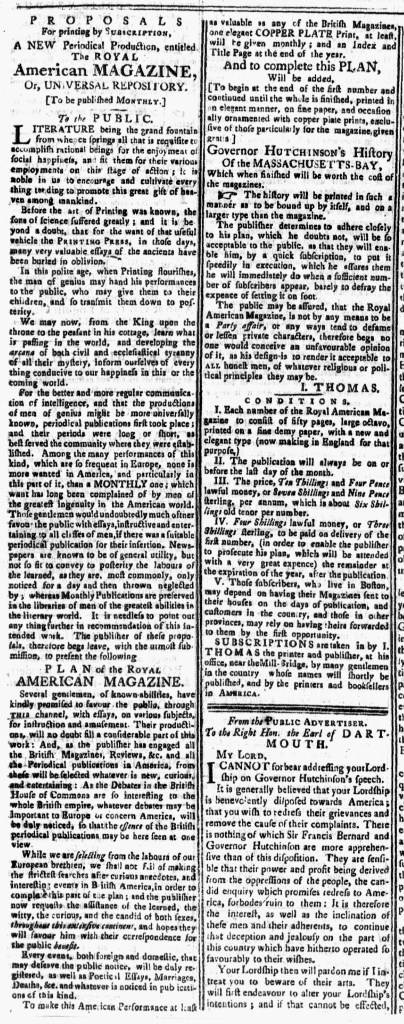
Near the end of May 1773, Isaiah Thomas, the printer of the Massachusetts Spy, placed a notice in his own newspaper to announce that the following week he would publish “PROPOSALS for printing by Subscription, The ROYAL American MAGAZINE.” He may have meant that he would distribute the proposals as as a broadside or handbill separate from the newspaper or he may have meant that they would appear in the next issue of the Massachusetts Spy. Perhaps he did print separate subscription papers, though none have survived. I frequently argue that newspaper notices provide evidence of a greater number of advertising ephemera circulating in eighteenth-century America than have been preserved in research libraries, historical societies, and private collections. On the other hand, the busy printer may have delayed publishing the proposals by several weeks. When they did appear in the Massachusetts Spy on June 24, they ran on the front page. The savvy printer gave the proposals a privileged place.
Extending nearly two columns, the proposals included Thomas’s purpose for publishing the new magazine, a “PLAN” for the contents, and the “CONDITIONS” or details about the price, the paper, the type, and delivery options. Subscription proposals for books, newspapers, and magazines usually included all those elements, though not necessarily at such great length. Thomas, however, exerted significant effort in convincing readers to subscribe. In explaining his purpose for publishing the magazine, for instance, he declared that “Newspapers are known to be of general utility, but not so fit to convey to posterity the labours of the learned, as they are, most commonly, only noticed for a day and then thrown neglected by.” In contrast, “Monthly Publications are preserved in the libraries of men of the greatest abilities in the literary world.” In the last decades of the eighteenth century, many magazine subscribers in America saved each issue for six months and then had them bound into a single volume to display on the bookshelves of their permanent libraries. Thomas acknowledged how subscribers treated magazines and their specialized content differently than newspapers in that regard.
In outlining the “PLAN,” Thomas described how he would go about acquiring items to publish in the Royal American Magazine. He declared that he “has engaged all the British Magazines, Reviews, &c. and all the Periodical publications in America” and “from those will be selected whatever is new, curious, and entertaining.” He did not intend merely to reprint content from those “British Magazines.” Instead, he emphasized a process of discernment in “selecting from the labours of our European brethren,” but promised prospective subscribers that he “shall not fail of making the strictest searches after curious anecdotes, and interesting events in British America.” To that end, he engaged in an eighteenth-century version of crowdsourcing: “the publisher now requests the assistance of the learned, the witty, the curious, and the candid of both sexes, throughout this extensive continent, and hopes they will favour him with their correspondence for the public benefit.” Although the magazine would carry some European content, Thomas aimed to produce a distinctively American publication.
In addition, Thomas offered a premium or gift to subscribers “to complete this PLAN,” a free copy of “Governor HUTCHINSON’S History Of the MASSACHUSETTS-BAY.” That book alone “will be worth the cost of the magazine.” However, subscribers would not receive a copy at the outset. Instead, they would receive a portion of the book with each issue of the magazine, “printed in such a manner as to be bound up by itself, and on a larger type than the magazine.” Thomas planned to insert the first pages of Hutchinson’s History “at the end of the first number” or issue and continue “until the whole is finished.” To make the premium even more enticing, subscribers would also receive, gratis, “copper plate prints, exclusive of those particularly for the magazine.” Thomas hoped that the free gift would make subscribing to the magazine even more attractive.
Although the subscription proposals for the Royal American Magazine included many of the same elements as proposals for books, newspapers, and magazines that circulated in the colonies in the eighteenth century, Thomas introduced innovative methods of encouraging colonizers to subscribe. Among those, he pledged to make pieces written in America a priority for publication. He also promoted a premium for subscribers, asserting that the free gift alone covered the cost of a subscription. Even with these marketing efforts, it took some time for Thomas to launch the magazine. He published the first issue in January 1774.
The Slavery Adverts 250 Project chronicles the role of newspaper advertising in perpetuating slavery in the era of the American Revolution. The project seeks to reveal the ubiquity of slavery in eighteenth-century life from New England to Georgia by republishing advertisements about enslaved people – for sale as individuals or in groups, wanted to purchase or for hire for short periods, runaways who liberated themselves, and those who were subsequently captured and confined in jails and workhouses – in daily digests on this site as well as in real time via the @SlaveAdverts250 Twitter feed, utilizing twenty-first-century media to stand in for the print media of the eighteenth century.
The project aims to provide modern audiences with a sense of just how often colonizers encountered these advertisements in their daily lives. Enslaved men, women, and children appeared in print somewhere in the colonies almost every single day. Those advertisements served as a constant backdrop for social, cultural, economic, and political life in colonial and revolutionary America. Colonizers who did not purport to own enslaved people were still confronted with slavery as well as invited to maintain the system by purchasing enslaved men, women, and children or assisting in the capture of so-called “runaways” who sought to free themselves from bondage. The frequency of these newspaper advertisements suggests just how embedded slavery was in colonial and revolutionary American culture in everyday interactions beyond the printed page.
These advertisements also testify to the experiences of enslaved men, women, and children, though readers must consider that those experiences have been remediated through descriptions offered by enslavers rather than enslaved people themselves. Often unnamed in the advertisements, enslaved men, women, and children were not invisible or unimportant in early America.
These advertisements appeared in colonial American newspapers 250 years ago today.
What was advertised in a colonial American newspaper 250 years ago today?
Pennsylvania Gazette (June 23, 1773).
“Now selling at prime coast, at the house of the late Mrs. MARY SYMONDS, deceased.”
In June 1773, James Reynolds, the executor of the estate, ran a newspaper notice concerning the sale of a “LARGE and general assortment of MILLINERY and other GOODS” at “the house of the late Mrs. MARY SYMONDS, deceased,” in Philadelphia. While many female shopkeepers, milliners, seamstresses, and other entrepreneurs did not promote their businesses in the public prints in the eighteenth century, Symonds was an exception who regularly advertised her wares. Compared to the brief estate notice that listed about a dozen items and summarized the rest of her inventory as “a great variety of other genteel articles,” Symonds published extensive advertisements that rivaled in length those of her male competitors. In March 1766 and May 1768, she inserted advertisements that each included an extensive catalog of her merchandise in the Pennsylvania Gazette.
Symonds did not limit her marketing efforts to newspaper notices. She also distributed an engraved trade card, one of the finest known example of this format belonging to a woman who ran her own business in eighteenth-century America. In Boston, Jane Eustis also provided her customers with engraved trade cards. The only known copy of Symonds’s trade card survives among the Cadwalader Papers at the Historical Society of Pennsylvania because Symonds used the reverse to write a receipted bill for purchases made by Elizabeth Lloyd Cadwalader in October and November 1770. Based on those manuscript additions, Symonds’s trade card has been dated to circa 1770. The text so closely replicated her advertisements that appeared in the Pennsylvania Gazette in May 1768 (or perhaps the text of the newspaper advertisement closely replicated the trade card) that it seems almost certain that Symonds commissioned the trade card by the late 1760s and distributed it to customers for several years. In so doing, she joined the ranks of other entrepreneurs, most of them men, who demonstrated the elegance and sophistication of their goods and services with marketing materials – engraved trade cards and billheads – that resembled those that commonly circulated in London, the cosmopolitan center of the empire. The notice about the estate sale that her executor placed in the Pennsylvania Gazettedid not do justice to Symonds’s acumen as a marketer responsible for promoting her own business during her lifetime.
The Slavery Adverts 250 Project chronicles the role of newspaper advertising in perpetuating slavery in the era of the American Revolution. The project seeks to reveal the ubiquity of slavery in eighteenth-century life from New England to Georgia by republishing advertisements about enslaved people – for sale as individuals or in groups, wanted to purchase or for hire for short periods, runaways who liberated themselves, and those who were subsequently captured and confined in jails and workhouses – in daily digests on this site as well as in real time via the @SlaveAdverts250 Twitter feed, utilizing twenty-first-century media to stand in for the print media of the eighteenth century.
The project aims to provide modern audiences with a sense of just how often colonizers encountered these advertisements in their daily lives. Enslaved men, women, and children appeared in print somewhere in the colonies almost every single day. Those advertisements served as a constant backdrop for social, cultural, economic, and political life in colonial and revolutionary America. Colonizers who did not purport to own enslaved people were still confronted with slavery as well as invited to maintain the system by purchasing enslaved men, women, and children or assisting in the capture of so-called “runaways” who sought to free themselves from bondage. The frequency of these newspaper advertisements suggests just how embedded slavery was in colonial and revolutionary American culture in everyday interactions beyond the printed page.
These advertisements also testify to the experiences of enslaved men, women, and children, though readers must consider that those experiences have been remediated through descriptions offered by enslavers rather than enslaved people themselves. Often unnamed in the advertisements, enslaved men, women, and children were not invisible or unimportant in early America.
These advertisements appeared in colonial American newspapers 250 years ago today.
What was advertised in a colonial American newspaper 250 years ago today?
Connecticut Courant (June 22, 1773).
“PROPOSALS, For PUBLISHING, upon a PLAN entirely new, a Periodical PAPER.”
For several years, three newspapers served residents of Connecticut, the New-London Gazette (established as the Connecticut Gazette in November 1763), the Connecticut Courant (established October 1764), published in Hartford, and the Connecticut Journal and New-Haven Post-Boy (founded October 1767). In addition, the Newport Mercury, the Providence Gazette, and several newspapers published in New York circulated in Connecticut. In 1773, Alexander Robertson, James Robertson, and John Trumbull made plans to launch a fourth newspaper in the colony. To that end, they distributed subscription proposals for the “NORWICH PACKET, OR THE CONNECTICUT, MASSACHUSETTS, NEW-HAMPSHIRE, AND RHODE-ISLAND INTELLIGENCER, AND WEEKLY ADVERTISER.” They intended for their newspaper to serve a region that extended far beyond the town where they published it.
As was the case with the Maryland Journal (published in Baltimore) and Rivington’s New-York Gazetteer, it took some time for the printers to amass a sufficient number of subscribers to commence publication. The Robertsons and Trumbull stated that the “first Paper will be published as soon as a competent Number of Subscribers are procured.” They printed the first issue in October 1773, the Norwich Packet became the third new newspaper in the colonies that year. That brought the total to thirty-three newspapers throughout the colonies, most of them in English along with two in German published in Pennsylvania. By the end of the year, the New-York Gazette or Weekly Post-Boy folded, while Isaiah Thomas and Henry-Walter Tinges established the Essex Journal in Newburyport, Massachusetts. Even as a few newspapers, such as the Boston Chronicle, went out of business in the early 1770s, colonizers gained access to a greater variety of newspapers in the years just before the American Revolution. Overall, the total number rose from twenty-six in 1765 to thirty-one in 1770 to forty-three in 1775. During the Revolutionary War, several of those newspapers ceased or paused publication. Printers founded others to supply colonizers with information about the war, commerce, and other news.
The Norwich Packet continued publication throughout most of the war, though suspended from late September 1782 through late October 1783. The Robertsons and Trumbull, however, parted ways. In May 1776, Trumbull became the sole publisher when the Robertsons, who were Loyalists, relocated to New York. In their subscription proposals, the three printers asserted that they planned to publish a “succinct detail of the Proceedings of the Parliament of Great-Britain, especially such as relate to America, and the political Manoeuvres of the Statesmen in and out of Administration.” How to interpret and respond to those “Proceedings” and “Manoeuvres” eventually resulted in such deep fissures that some colonizers declared and fought for independence while others remained loyal to Britain. When the Robertsons and Trumbull established the Norwich Packet, the updates and editorials in the newspaper helped shape public discourse about the relationship between the colonies and Parliament. Within just a couple of years, the Norwich Packet related and recorded many of the events of the Revolutionary War. In order to publish “the most recent Advices of every remarkable Event,” however, the printers first had to convince “THE PUBLIC” to subscribe.
The Slavery Adverts 250 Project chronicles the role of newspaper advertising in perpetuating slavery in the era of the American Revolution. The project seeks to reveal the ubiquity of slavery in eighteenth-century life from New England to Georgia by republishing advertisements about enslaved people – for sale as individuals or in groups, wanted to purchase or for hire for short periods, runaways who liberated themselves, and those who were subsequently captured and confined in jails and workhouses – in daily digests on this site as well as in real time via the @SlaveAdverts250 Twitter feed, utilizing twenty-first-century media to stand in for the print media of the eighteenth century.
The project aims to provide modern audiences with a sense of just how often colonizers encountered these advertisements in their daily lives. Enslaved men, women, and children appeared in print somewhere in the colonies almost every single day. Those advertisements served as a constant backdrop for social, cultural, economic, and political life in colonial and revolutionary America. Colonizers who did not purport to own enslaved people were still confronted with slavery as well as invited to maintain the system by purchasing enslaved men, women, and children or assisting in the capture of so-called “runaways” who sought to free themselves from bondage. The frequency of these newspaper advertisements suggests just how embedded slavery was in colonial and revolutionary American culture in everyday interactions beyond the printed page.
These advertisements also testify to the experiences of enslaved men, women, and children, though readers must consider that those experiences have been remediated through descriptions offered by enslavers rather than enslaved people themselves. Often unnamed in the advertisements, enslaved men, women, and children were not invisible or unimportant in early America.
These advertisements appeared in colonial American newspapers 250 years ago today.
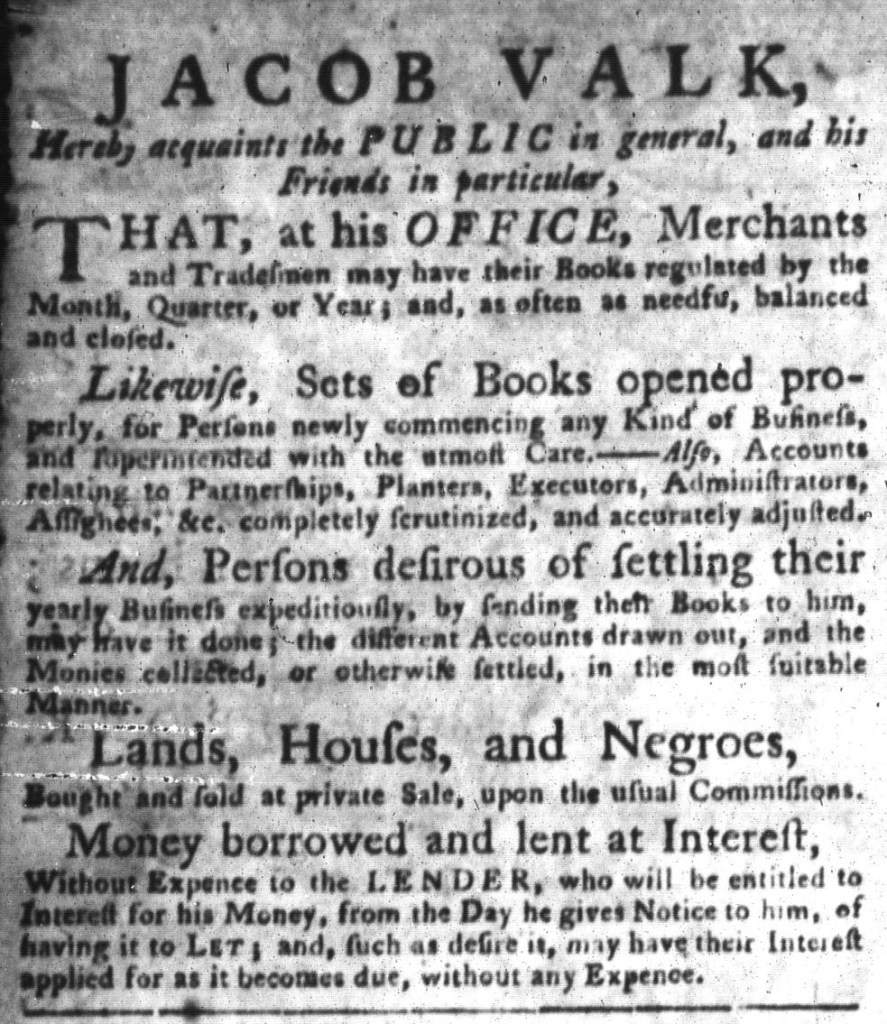
Connecticut Courant (June 22, 1773).
**********
Connecticut Courant (June 22, 1773).
**********
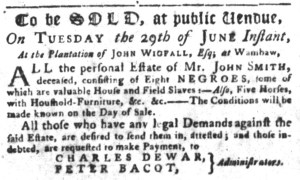
South-Carolina Gazette and Country Journal (June 22, 1773).
**********
South-Carolina Gazette and Country Journal (June 22, 1773).
**********
South-Carolina Gazette and Country Journal (June 22, 1773).
**********
South-Carolina Gazette and Country Journal (June 22, 1773).
**********
South-Carolina Gazette and Country Journal (June 22, 1773).
What was advertised in a colonial American newspaper 250 years ago today?
Supplement to the Pennsylvania Packet (June 21, 1773).
“Esteemed to be a paper of as good credit and utility as any extant.”
As Samuel F. Parker and John Anderson prepared to take over publishing the New-York Gazette or Weekly Post-Boy when the lease held by Samuel Inslee and Anthony Car came to an end in August 1773, they placed notices in both the New-York Journal and the Pennsylvania Packet. They hoped to attract local subscribers in New York and nearby towns as well as distant subscribers in Pennsylvania, Delaware, Maryland, and New Jersey, just as James Rivington had successfully solicited subscriptions for Rivington’s New-York Gazetteer or Connecticut, New-Jersey, Hudson’s-River, and Quebec Weekly Advertiser from far beyond the bustling urban port in recent months.
To entice prospective subscribers, Parker and Anderson emphasized that they intended to publish content “for the especial service of the commercial interest” in addition to articles “for the amusement and information of private families.” They realized that merchants in Philadelphia and other towns served by the Pennsylvania Packet benefitted from various features that regularly appeared in newspapers published in New York, including prices current for commodities, entries about vessels arriving and departing from the customs house, and news about the location and progress of ships as reported by captains and others when they arrived in port. Even paid notices, such as advertisement for consumer goods and legal notices, provided valuable intelligence for merchants keeping track of markets.
Parker and Anderson boasted about the reputation of the New-York Gazette or Weekly Post-Boy when Parker’s father previously published it, declaring that it was “esteemed to be a paper of as good credit and utility as any extant.” The printers suggested that under their management the newspaper would rival any of the others published in New York, making it as good or better a choice for merchants in Philadelphia who wished to consult newspapers from that city. Parker and Anderson did not invest as much effort in marketing their newspaper to prospective subscribers and other readers in neighboring colonies as Rivington did, but their advertisements in the Pennsylvania Packet demonstrates that they recognized the potential to increase their circulation by acquiring subscribers beyond New York.
The Slavery Adverts 250 Project chronicles the role of newspaper advertising in perpetuating slavery in the era of the American Revolution. The project seeks to reveal the ubiquity of slavery in eighteenth-century life from New England to Georgia by republishing advertisements about enslaved people – for sale as individuals or in groups, wanted to purchase or for hire for short periods, runaways who liberated themselves, and those who were subsequently captured and confined in jails and workhouses – in daily digests on this site as well as in real time via the @SlaveAdverts250 Twitter feed, utilizing twenty-first-century media to stand in for the print media of the eighteenth century.
The project aims to provide modern audiences with a sense of just how often colonizers encountered these advertisements in their daily lives. Enslaved men, women, and children appeared in print somewhere in the colonies almost every single day. Those advertisements served as a constant backdrop for social, cultural, economic, and political life in colonial and revolutionary America. Colonizers who did not purport to own enslaved people were still confronted with slavery as well as invited to maintain the system by purchasing enslaved men, women, and children or assisting in the capture of so-called “runaways” who sought to free themselves from bondage. The frequency of these newspaper advertisements suggests just how embedded slavery was in colonial and revolutionary American culture in everyday interactions beyond the printed page.
These advertisements also testify to the experiences of enslaved men, women, and children, though readers must consider that those experiences have been remediated through descriptions offered by enslavers rather than enslaved people themselves. Often unnamed in the advertisements, enslaved men, women, and children were not invisible or unimportant in early America.
These advertisements appeared in colonial American newspapers 250 years ago today.
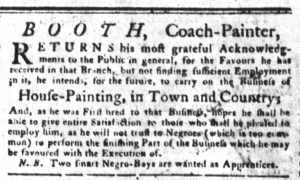
Supplement to the Boston Evening-Post (June 21, 1773).
**********
Newport Mercury (June 21, 1773).
**********
New-York Gazette and Weekly Mercury (June 21, 1773).
**********
New-York Gazette and Weekly Mercury (June 21, 1773).
**********
Supplement to the New-York Gazette and Weekly Mercury (June 21, 1773).
**********
Supplement to the New-York Gazette and Weekly Mercury (June 21, 1773).
**********
Supplement to the New-York Gazette and Weekly Mercury (June 21, 1773).
**********
Supplement to the New-York Gazette and Weekly Mercury (June 21, 1773).
**********
Pennsylvania Packet (June 21, 1773).
**********
Pennsylvania Packet (June 21, 1773).
**********
Pennsylvania Packet (June 21, 1773).
**********
Supplement to the Pennsylvania Packet (June 21, 1773).
**********
Supplement to the Pennsylvania Packet (June 21, 1773).
**********
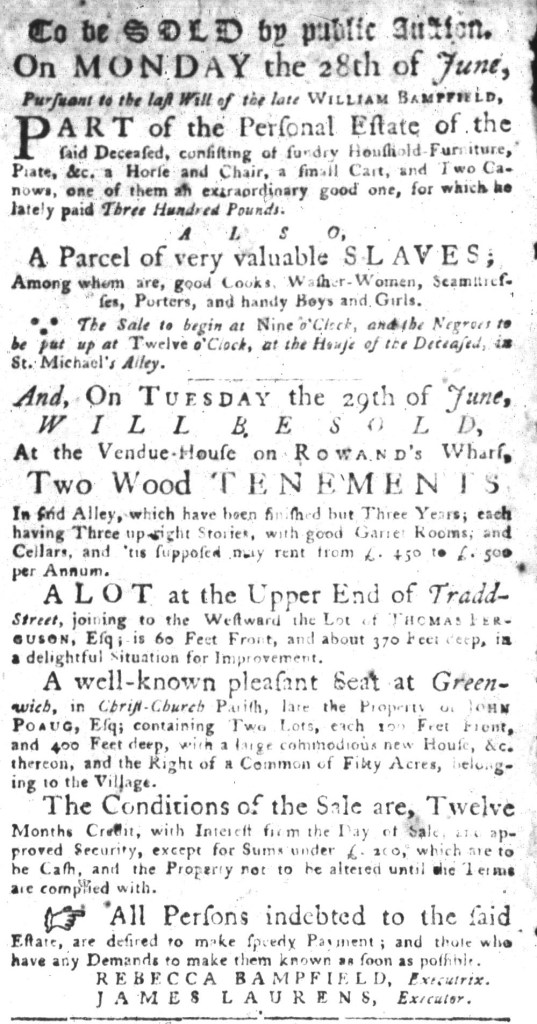
South-Carolina Gazette (June 21, 1773).
**********
South-Carolina Gazette (June 21, 1773).
**********
South-Carolina Gazette (June 21, 1773).
**********
South-Carolina Gazette (June 21, 1773).
**********
South-Carolina Gazette (June 21, 1773).
**********
South-Carolina Gazette (June 21, 1773).
**********
South-Carolina Gazette (June 21, 1773).
**********
South-Carolina Gazette (June 21, 1773).
**********
South-Carolina Gazette (June 21, 1773).
**********
South-Carolina Gazette (June 21, 1773).
**********
South-Carolina Gazette (June 21, 1773).
**********
Supplement to the South-Carolina Gazette (June 21, 1773).
**********
Supplement to the South-Carolina Gazette (June 21, 1773).
**********
Supplement to the South-Carolina Gazette (June 21, 1773).
**********
Supplement to the South-Carolina Gazette (June 21, 1773).
**********
Supplement to the South-Carolina Gazette (June 21, 1773).
**********
Supplement to the South-Carolina Gazette (June 21, 1773).
**********
Supplement to the South-Carolina Gazette (June 21, 1773).
**********
Supplement to the South-Carolina Gazette (June 21, 1773).
**********
Supplement to the South-Carolina Gazette (June 21, 1773).
What was advertised in a colonial American newspaper 250 years ago this week?
Supplement to the Boston-Gazette (June 14, 1773).
“UMBRILLOES.”
Isaac Greenwood may not have believed that imitation was the sincerest form of flattery when John Cutler decided to run advertisements adorned with a woodcut that closely replicated the image of genteel woman shaded by an umbrella that he had included in many of his advertisements for the past couple of years. Greenwood first used the image in May 1771 and continued incorporating it into his newspaper notices in 1772 and 1773. In the summer of 1773, he launched a new advertising campaign that featured the woodcut and the headline “NOT IMPORTED” to underscore that he made the “UMBRILLOES” he sold while simultaneously encouraging consumers to support domestic manufactures by choosing them over imported alternatives.
Boston Evening-Post (June 14, 1773).
Cutler also made “Umbrilloes of all sorts for Ladies and Gentlemen … in the best Manner.” In addition, he “mended and covered” old umbrellas. As Greenwood’s latest advertisement with the image of the woman and umbrella appeared in supplement that accompanied the June 14 edition of the Boston-Gazette, Cutler debuted his strikingly similar woodcut in an advertisement in the Boston Evening-Post on the same day. He then took the rather extraordinary step of having the woodcut transferred to the printing offices of the Massachusetts Gazette and Boston Weekly News-Letter in time to run in the June 17 edition. Such transfers continued for the next several weeks as Cutler increased the exposure for the image by inserting it in more than one newspaper.
Massachusetts Gazette and Boston Weekly News-Letter (June 17, 1773).
Some prospective customers may have considered the woman depicted in Cutler’s advertisements more elegant than the one in Greenwood’s notices. Both wore necklaces. In the original image, the necklace hugged the woman’s chin, making it difficult to distinguish, while in the imitation the necklace hung lower on the woman’s neck and featured a pendant that enhanced it. The original image offered a view of the woman’s decolletage, while the imitation placed greater emphasis on embroidery and other adornments. The hairstyles differed as well. The woman in the original image wore a high roll, but some viewers may have mistaken it for a turban. In the imitation, the woman had her hair pile high upon her head, but the image suggested elaborate curls and even a tendril that hung below her right ear to frame her face.
In several ways, Cutler’s new image was superior to the familiar one that Greenwood had circulated for more than two years. Cutler could have chosen another image to represent his business in the public prints. After all, he advised prospective customers that he made umbrellas “at the Golden Cock, in Marlborough Street.” Some advertisers experimented with branding and logos in the late eighteenth century, consistently associating an image with their shops and their goods. Greenwood may not have been very happy that Cutler devised an image that so closely resembled the one that already represented his business.