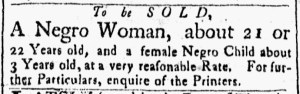
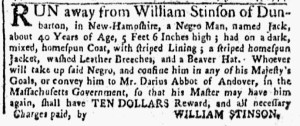
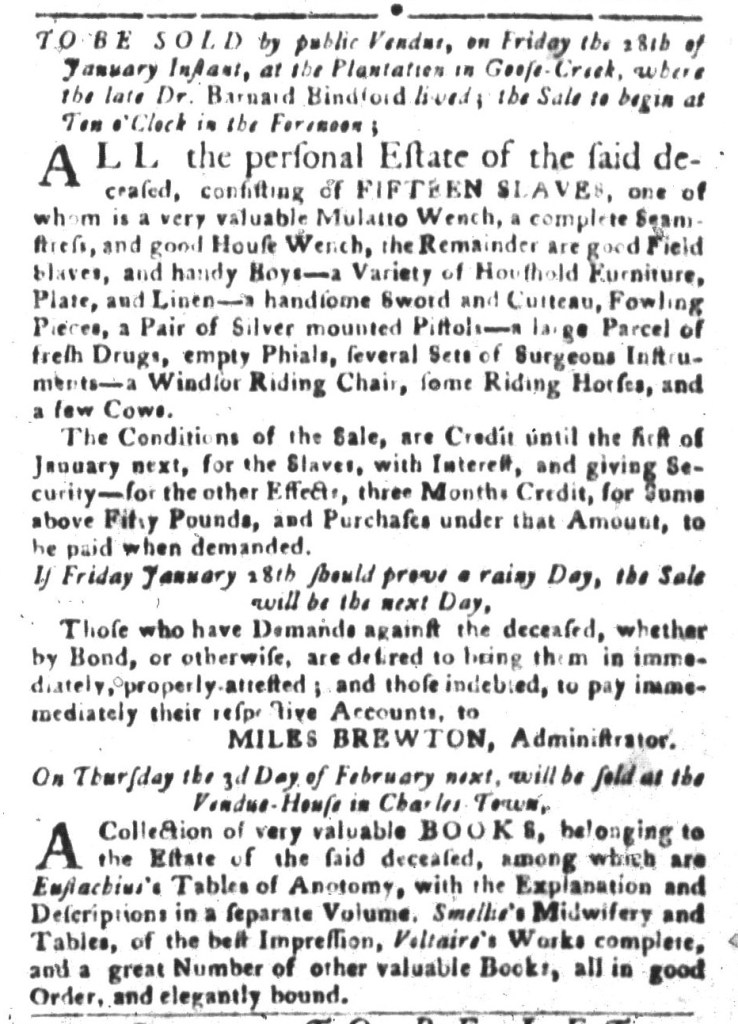
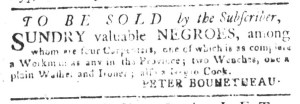
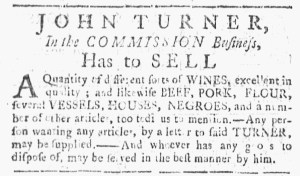
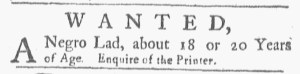
Slavery Advertisements Published January 27, 1774

GUEST CURATOR:  Kendra Apicella

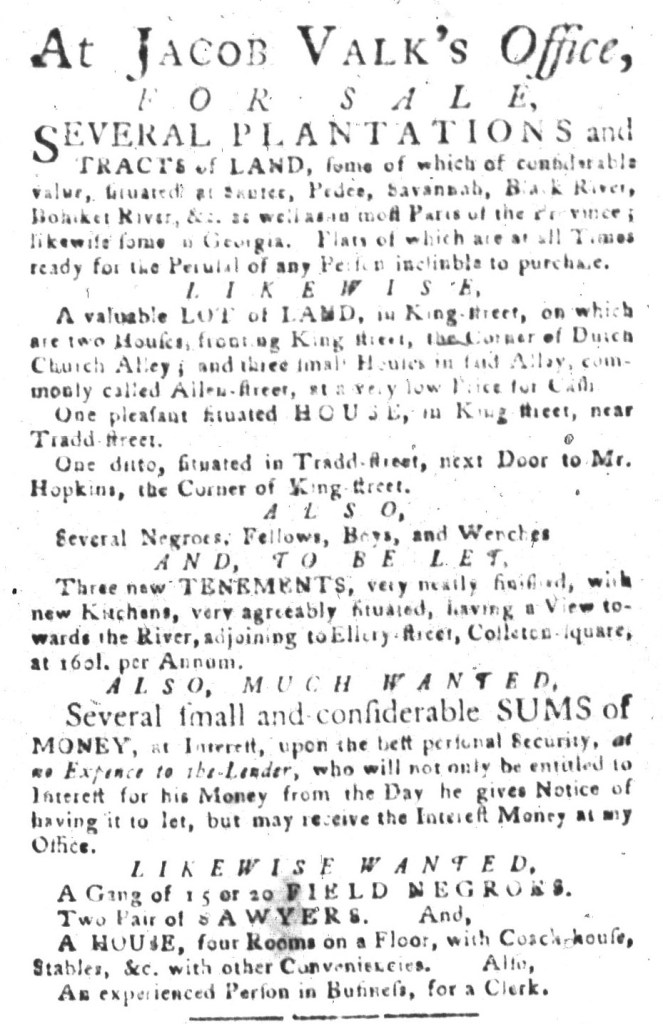
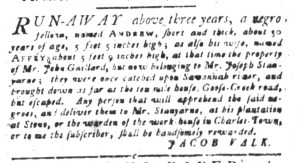
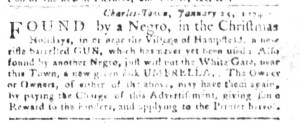
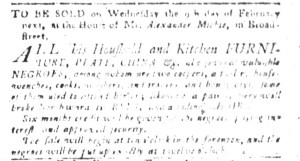
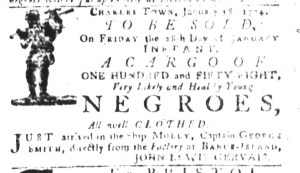
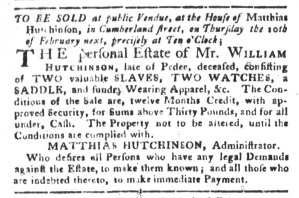
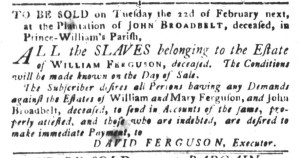
The Slavery Adverts 250 Project chronicles the role of newspaper advertising in perpetuating slavery in the era of the American Revolution. The project seeks to reveal the ubiquity of slavery in eighteenth-century life from New England to Georgia by republishing advertisements about enslaved people – for sale as individuals or in groups, wanted to purchase or for hire for short periods, runaways who liberated themselves, and those who were subsequently captured and confined in jails and workhouses – in daily digests on this site as well as in real time via the @SlaveAdverts250 Twitter feed, utilizing twenty-first-century media to stand in for the print media of the eighteenth century.

The project aims to provide modern audiences with a sense of just how often colonizers encountered these advertisements in their daily lives. Enslaved men, women, and children appeared in print somewhere in the colonies almost every single day. Those advertisements served as a constant backdrop for social, cultural, economic, and political life in colonial and revolutionary America. Colonizers who did not purport to own enslaved people were still confronted with slavery as well as invited to maintain the system by purchasing enslaved men, women, and children or assisting in the capture of so-called “runaways” who sought to free themselves from bondage. The frequency of these newspaper advertisements suggests just how embedded slavery was in colonial and revolutionary American culture in everyday interactions beyond the printed page.

These advertisements also testify to the experiences of enslaved men, women, and children, though readers must consider that those experiences have been remediated through descriptions offered by enslavers rather than enslaved people themselves. Often unnamed in the advertisements, enslaved men, women, and children were not invisible or unimportant in early America.

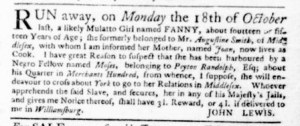
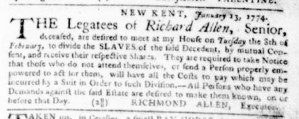
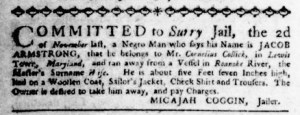
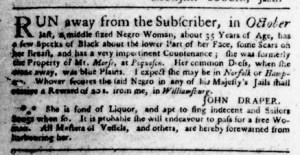
These advertisements appeared in colonial American newspapers 250 years ago today.
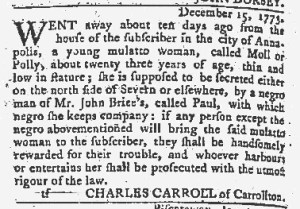
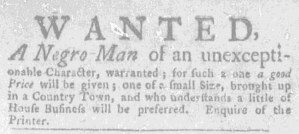
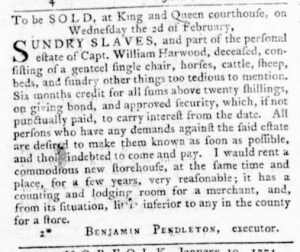
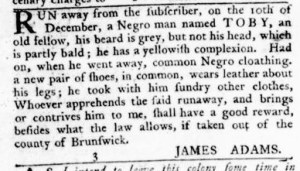
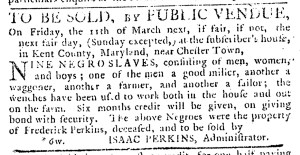
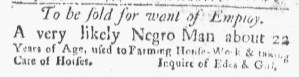
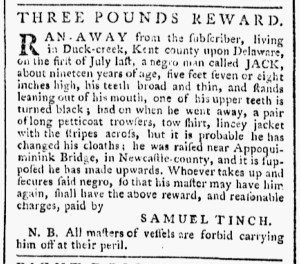
Maryland Gazette (January 27, 1774).

**********
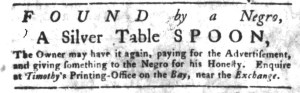
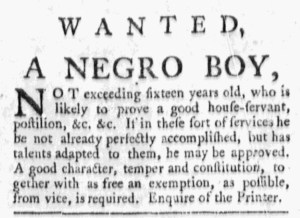
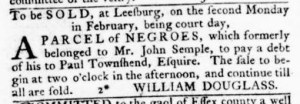
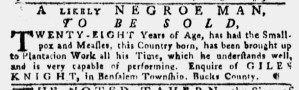
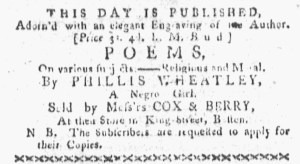
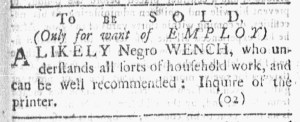
Massachusetts Gazette and Boston Weekly News-Letter (January 27, 1774).

**********
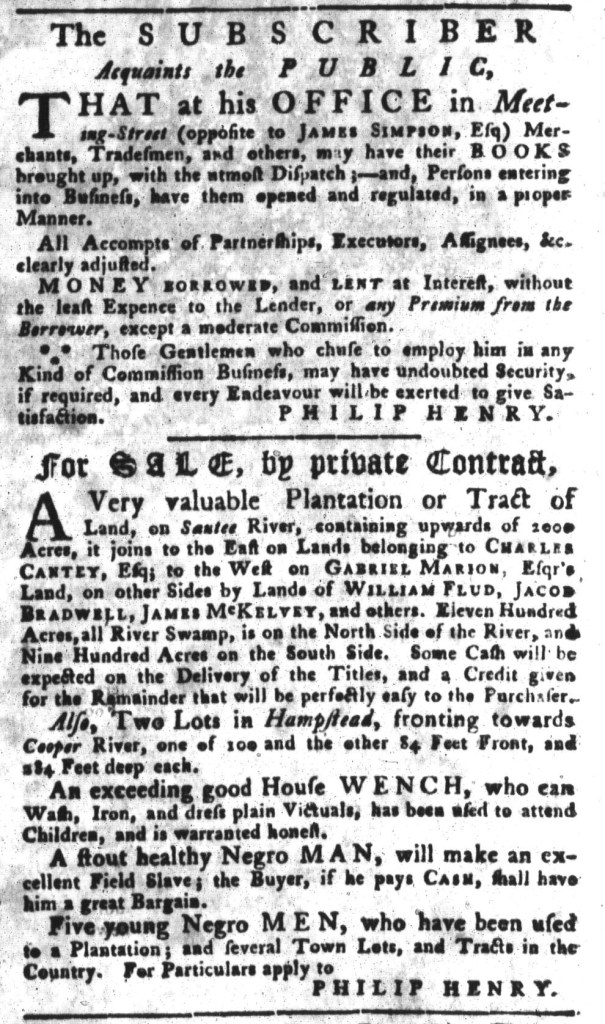
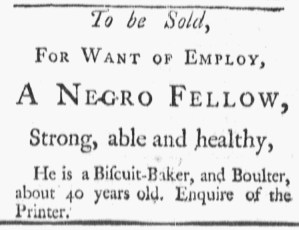
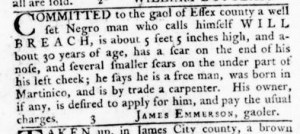
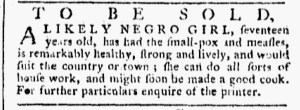
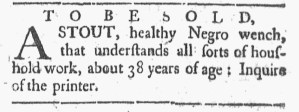
Rivington’s New-York Gazetteer (January 27, 1774).

**********
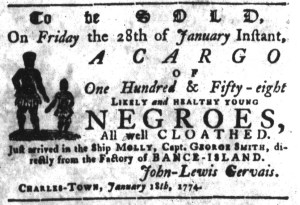
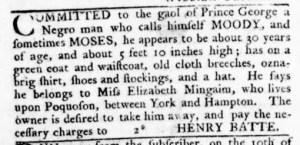
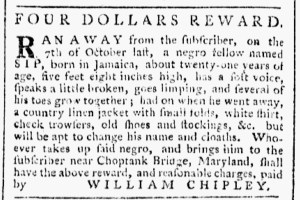
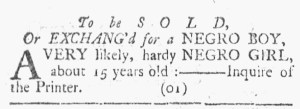
Rivington’s New-York Gazetteer (January 27, 1774).

**********
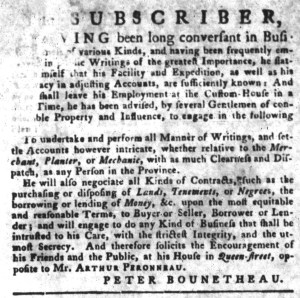
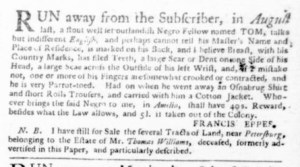
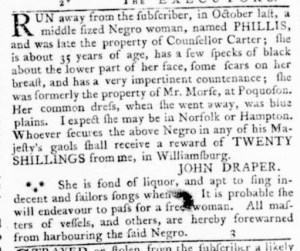
Virginia Gazette [Purdie and Dixon] (January 27, 1774).

**********
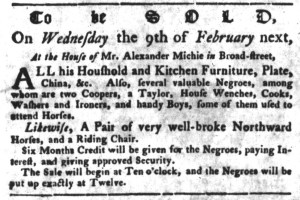
Virginia Gazette [Purdie and Dixon] (January 27, 1774).

**********
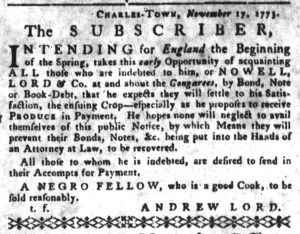
Virginia Gazette [Purdie and Dixon] (January 27, 1774).

**********
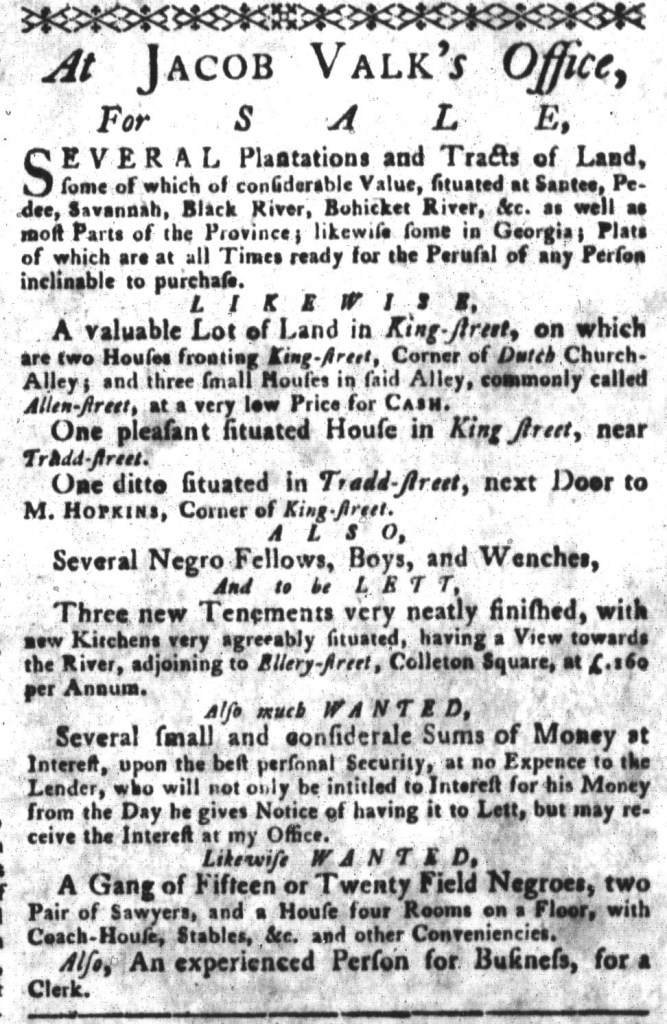
Virginia Gazette [Purdie and Dixon] (January 27, 1774).

**********
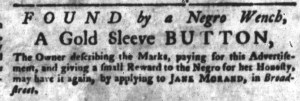
Virginia Gazette [Purdie and Dixon] (January 27, 1774).

**********
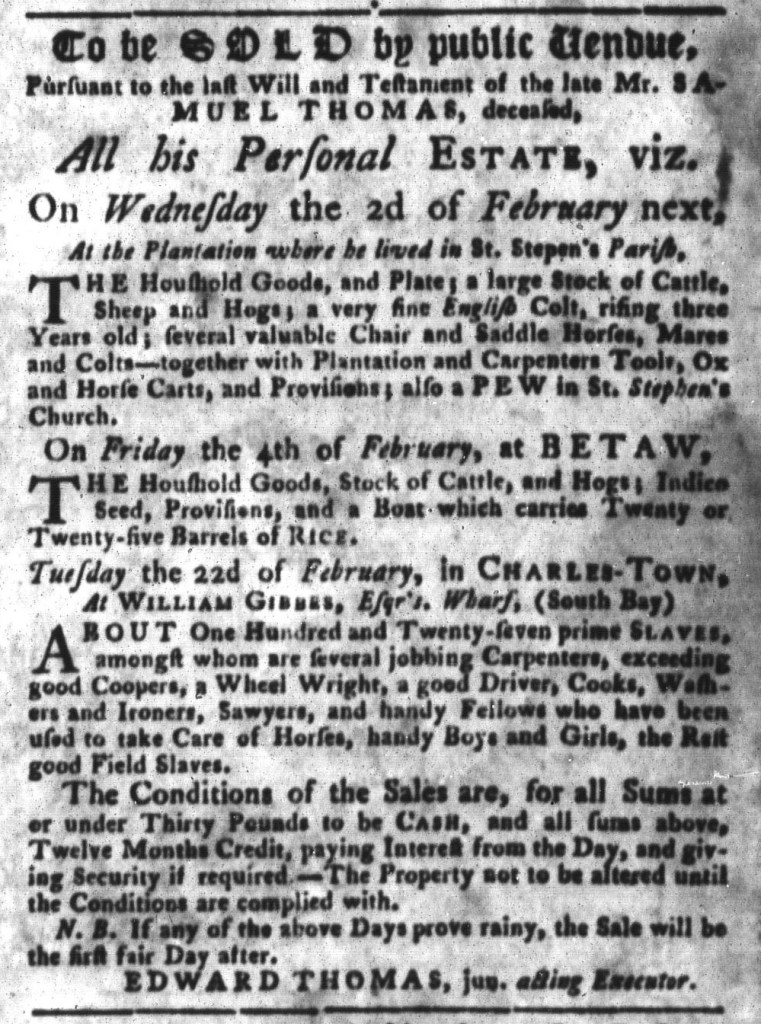
Virginia Gazette [Purdie and Dixon] (January 27, 1774).

**********
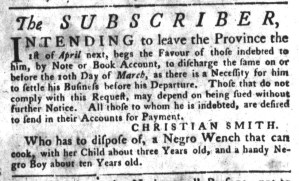
Virginia Gazette [Purdie and Dixon] (January 27, 1774).

**********
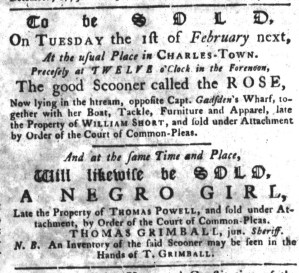
Virginia Gazette [Purdie and Dixon] (January 27, 1774).

**********
Virginia Gazette [Purdie and Dixon] (January 27, 1774).

**********

Virginia Gazette [Rind] (January 27, 1774).

**********

Virginia Gazette [Rind] (January 27, 1774).

**********

Virginia Gazette [Rind] (January 27, 1774).

**********

Virginia Gazette [Rind] (January 27, 1774).

**********

Virginia Gazette [Rind] (January 27, 1774).

**********

Virginia Gazette [Rind] (January 27, 1774).

January 26

What was advertised in a colonial American newspaper 250 years ago today?

Pennsylvania Journal (January 26, 1774).

“THOMAS & MARY GRIFFITH, Are removed from Christian-street, to … Sixth-street.”

When Thomas Griffith and Mary Griffith took the pages of the Pennsylvania Gazette at the end of January 1774, they incorporated the same headline they used in their advertisement the previous August.  They promoted their services “TO THE LADIES” of Philadelphia and nearby towns, Thomas his “FAN-MAKING business” and Mary cleaning various kinds of laces “to look like new.  The Griffiths had recently “removed from Christian-street” and now operated their businesses on Sixth Street, occasioning the new advertisement.

Despite deploying the same headline, this notice was shorter than the other one.  Perhaps the Griffiths felt that they had established their reputations in Philadelphia and did not need to provide as much information for a clientele that they wished to follow them to their new location as they had when they introduced themselves upon arriving in a new city.  Thomas had described himself as a “Fan-Maker from London, but last from Charlestown,” but did not do so in the new advertisement, nor did he go into any detail except to say that he “intends to continue the FAN-MAKING business in general.”  Similarly, Mary provided only a brief overview, but did not mention her “new method” for cleaning laces to entice prospective customers.  The Griffiths did “return thanks to the Ladies for the encouragement they received,” another suggestion that they had cultivated a clientele over the last six months.

The secondary headline for their new advertisement included both their names, “THOMAS & MARY GRIFFITH,” whereas Thomas’s name alone ran as the secondary headline in their other advertisement.  This time, Mary’s contribution to the household economy received the same visibility as Thomas’s “FAN-MAKING business,” though his enterprise still received top billing.  It may have been that publishing a shorter advertisement prompted this change, though the Griffiths may have also realized that Mary’s enterprise brought as many or more of “THE LADIES” to the shop in their house as the fans that Thomas made and sold.  Whatever convinced them to take a new approach, they apparently considered their previous newspaper advertisements effective enough to merit investing in a new advertisement when they moved to a new location.

Slavery Advertisements Published January 26, 1774

GUEST CURATOR:  Kendra Apicella

The Slavery Adverts 250 Project chronicles the role of newspaper advertising in perpetuating slavery in the era of the American Revolution. The project seeks to reveal the ubiquity of slavery in eighteenth-century life from New England to Georgia by republishing advertisements about enslaved people – for sale as individuals or in groups, wanted to purchase or for hire for short periods, runaways who liberated themselves, and those who were subsequently captured and confined in jails and workhouses – in daily digests on this site as well as in real time via the @SlaveAdverts250 Twitter feed, utilizing twenty-first-century media to stand in for the print media of the eighteenth century.

The project aims to provide modern audiences with a sense of just how often colonizers encountered these advertisements in their daily lives. Enslaved men, women, and children appeared in print somewhere in the colonies almost every single day. Those advertisements served as a constant backdrop for social, cultural, economic, and political life in colonial and revolutionary America. Colonizers who did not purport to own enslaved people were still confronted with slavery as well as invited to maintain the system by purchasing enslaved men, women, and children or assisting in the capture of so-called “runaways” who sought to free themselves from bondage. The frequency of these newspaper advertisements suggests just how embedded slavery was in colonial and revolutionary American culture in everyday interactions beyond the printed page.

These advertisements also testify to the experiences of enslaved men, women, and children, though readers must consider that those experiences have been remediated through descriptions offered by enslavers rather than enslaved people themselves. Often unnamed in the advertisements, enslaved men, women, and children were not invisible or unimportant in early America.

These advertisements appeared in colonial American newspapers 250 years ago today.

Pennsylvania Gazette (January 26, 1774).

**********

Pennsylvania Journal (January 26, 1774).

January 25

What was advertised in a colonial American newspaper 250 years ago today?

South-Carolina Gazette and Country Journal (January 25, 1774).

“Lists of Public Officers; Members of the Commons House of Assembly; Days for holding Courts in South-Carolina and Georgia.”

Charles Crouch, the printer of the South-Carolina Gazette and Country Journal, also published almanacs.  Most newspaper printers did so.  Almanacs, those popular pamphlets, represented an important revenue stream for any printing office, yet publishing them could be a tricky business.  Printers aimed to produce enough copies to meet demand, but not so many that they had a significant number of leftovers that cut into their profits.

As January 1774 neared its end, Crouch seemed to have a surplus of “THOMAS MORE’s ALMANACK, for the Year 1774” that he needed to move out of his printing office on Elliott Street in Charleston.  On January 25, he ran an advertisement that offered the almanacs for sale “Wholesale and Retail, with good Allowance to those who take a Quantity.”  In other words, he offered a discount to shopkeepers, peddlers, and others who bought in volume.  He placed the notice at the top of the center column on the first page, enhancing its visibility in that issue of the South-Carolina Gazette and Country Journal.  The introduction to the advertisement proclaimed, “Just published,” but that probably was not the case.  Crouch previously inserted the same advertisement as the new year approached.  As was common practice, he likely inserted the notice once again, type already set, without making revisions.

With each passing day, some of the contents became obsolete, including “the Sun and Moon’s Rising and Setting,” “Length of Days and Nights,” and “Judgment of the Weather.”  Other items, however, remained relevant.  Crouch relied on these “useful Particulars” in marketing the almanac.  Its pages contained “Lists of Public Officers; Members of the Commons House of Assembly; [and] Days for holding Courts in South-Carolina and Georgia.”  For those who might have occasion to travel to other colonies by land rather than by ship, the almanac included “Descriptions of the Roads throughout the Continent.”  Throughout their advertising campaigns, printers highlighted the various contents of the almanacs they published and sold.  Each year, the “useful Particulars” beyond what many described as the “usual Astronomical Calculations” (though Crouch did not happen to use that phrase) became increasingly important in marketing almanacs in January, February, and March.

Slavery Advertisements Published January 25, 1774

GUEST CURATOR:  Kendra Apicella

The Slavery Adverts 250 Project chronicles the role of newspaper advertising in perpetuating slavery in the era of the American Revolution. The project seeks to reveal the ubiquity of slavery in eighteenth-century life from New England to Georgia by republishing advertisements about enslaved people – for sale as individuals or in groups, wanted to purchase or for hire for short periods, runaways who liberated themselves, and those who were subsequently captured and confined in jails and workhouses – in daily digests on this site as well as in real time via the @SlaveAdverts250 Twitter feed, utilizing twenty-first-century media to stand in for the print media of the eighteenth century.

The project aims to provide modern audiences with a sense of just how often colonizers encountered these advertisements in their daily lives. Enslaved men, women, and children appeared in print somewhere in the colonies almost every single day. Those advertisements served as a constant backdrop for social, cultural, economic, and political life in colonial and revolutionary America. Colonizers who did not purport to own enslaved people were still confronted with slavery as well as invited to maintain the system by purchasing enslaved men, women, and children or assisting in the capture of so-called “runaways” who sought to free themselves from bondage. The frequency of these newspaper advertisements suggests just how embedded slavery was in colonial and revolutionary American culture in everyday interactions beyond the printed page.

These advertisements also testify to the experiences of enslaved men, women, and children, though readers must consider that those experiences have been remediated through descriptions offered by enslavers rather than enslaved people themselves. Often unnamed in the advertisements, enslaved men, women, and children were not invisible or unimportant in early America.

These advertisements appeared in colonial American newspapers 250 years ago today.

Essex Gazette (January 25, 1774).

**********

Essex Gazette (January 25, 1774).

**********

South-Carolina Gazette and Country Journal (January 25, 1774).

**********

South-Carolina Gazette and Country Journal (January 25, 1774).

**********

South-Carolina Gazette and Country Journal (January 25, 1774).

**********

South-Carolina Gazette and Country Journal (January 25, 1774).

**********

South-Carolina Gazette and Country Journal (January 25, 1774).

**********

South-Carolina Gazette and Country Journal (January 25, 1774).

**********

South-Carolina Gazette and Country Journal (January 25, 1774).

**********

South-Carolina Gazette and Country Journal (January 25, 1774).

**********

South-Carolina Gazette and Country Journal (January 25, 1774).

January 24

What was advertised in a colonial American newspaper 250 years ago today?

Boston-Gazette (January 24, 1774).

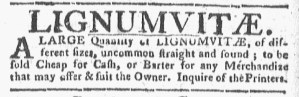
“A LARGE Quantity of LIGNUMVITAE.”

In selecting this advertisement, I collaborated with Kendra Apicella, a student in my Revolutionary America class in Fall 2023.  Kendra spotted the notice when she undertook her responsibilities as guest curator for the Slavery Adverts 250 Project.  She was not with familiar with lignum vitae.  Neither was I.  That provided an opportunity for student and professor to learn together as we looked for more information about this commodity that appeared in the pages of the January 24, 1774, edition of the Boston-Gazette.  Lignum vitae, we discovered, referred to a tree indigenous to the Caribbean as well as wood and resin obtained from the tree and medicines derived from the resin.

Lignum vitae translates from Latin as “wood of life,” a name given to the tree because of its medicinal qualities.  The advertisement in the Boston-Gazette did not seem to market “A LARGE Quantity of LIGNUMVITAE” as a remedy.  Instead, the “different sizes, uncommon straight and sound,” suggests pieces of wood intended for furniture and decorative items.  On behalf of the St. John Historical Society, Eleanor Gibney provides a history of the commodification of the tree in the early modern period in “Lignum vitae: Beauty, Strength, and the Fallibility of Medicine.”  She explains that lignum vitae “is among the hardest and heaviest of all commercial woods.”  Furthermore, “[w]hat makes lignum vitae wood so valuable is not the density alone, but the combination with the oily resin that permeates the wood, lubricating and making it almost indestructible.”

Gibney also notes that a Moravian missionary, C.G.A. Oldendorp, recorded some thoughts about lignum vitae during his time in the Virgin Islands.  In 1767, he described the wood as “difficult to work with, both on account of its hardness and its crooked growth.”  That hardness meant durability.  Iron would rust away more quickly than building timbers made of lignum vitae would rot, he asserted.  Oldendorp further described the wood as “expensive” and “exported to Europe in considerable quantities.”  It also found its way to British colonies in North America.  The anonymous seller who advertised in the Boston-Gazette acknowledged the wood’s reputation for “crooked growth” when describing the pieces available as “uncommon straight and sound.”  The advertiser also banked on widespread familiarity with the wood’s “hardness” and durability, not considering it necessary to elaborate on those qualities.

Eighteenth-century readers, immersed in the language of consumer culture of the era, recognized “LIGNUMVITAE” when they saw it advertised among the notices in the Boston-Gazette, yet many modern readers do not have any immediate associations with the tree, its appearance and other qualities, and the various uses of the wood.  I often tell my students that colonizers spoke their own language, no matter how much it looks like English to us, and that we have to translate the words that they wrote and published.  Sometimes that is because the meanings of words have shifted over time or words commonly used in the eighteenth century are no longer part of everyday speech.  In this instance, like so many others involving consumer culture (including all the different kinds of textiles listed in countless advertisements!), a once-popular commodity no longer has the demand it did in the early modern era.  Kendra and I both learned more about commerce and consumption in the Atlantic World thanks to our curiosity about this advertisement for lignum vitae.

Slavery Advertisements Published January 24, 1774

GUEST CURATOR:  Kendra Apicella

The Slavery Adverts 250 Project chronicles the role of newspaper advertising in perpetuating slavery in the era of the American Revolution. The project seeks to reveal the ubiquity of slavery in eighteenth-century life from New England to Georgia by republishing advertisements about enslaved people – for sale as individuals or in groups, wanted to purchase or for hire for short periods, runaways who liberated themselves, and those who were subsequently captured and confined in jails and workhouses – in daily digests on this site as well as in real time via the @SlaveAdverts250 Twitter feed, utilizing twenty-first-century media to stand in for the print media of the eighteenth century.

The project aims to provide modern audiences with a sense of just how often colonizers encountered these advertisements in their daily lives. Enslaved men, women, and children appeared in print somewhere in the colonies almost every single day. Those advertisements served as a constant backdrop for social, cultural, economic, and political life in colonial and revolutionary America. Colonizers who did not purport to own enslaved people were still confronted with slavery as well as invited to maintain the system by purchasing enslaved men, women, and children or assisting in the capture of so-called “runaways” who sought to free themselves from bondage. The frequency of these newspaper advertisements suggests just how embedded slavery was in colonial and revolutionary American culture in everyday interactions beyond the printed page.

These advertisements also testify to the experiences of enslaved men, women, and children, though readers must consider that those experiences have been remediated through descriptions offered by enslavers rather than enslaved people themselves. Often unnamed in the advertisements, enslaved men, women, and children were not invisible or unimportant in early America.

These advertisements appeared in colonial American newspapers 250 years ago today.

Boston-Gazette (January 24, 1774).

**********

Boston-Gazette (January 24, 1774).

**********

Dunlap’s Pennsylvania Packet (January 24, 1774).

**********

Postscript to Dunlap’s Pennsylvania Packet (January 24, 1774).

**********

Postscript to Dunlap’s Pennsylvania Packet (January 24, 1774).

**********

Newport Mercury (January 24, 1774).

**********

Newport Mercury (January 24, 1774).

**********

Newport Mercury (January 24, 1774).

**********

Newport Mercury (January 24, 1774).

**********

New-York Gazette and Weekly Mercury (January 24, 1774).

**********

South-Carolina Gazette (January 24, 1774).

**********

South-Carolina Gazette (January 24, 1774).

**********

South-Carolina Gazette (January 24, 1774).

**********

South-Carolina Gazette (January 24, 1774).

**********

South-Carolina Gazette (January 24, 1774).

**********

South-Carolina Gazette (January 24, 1774).

**********

South-Carolina Gazette (January 24, 1774).

**********

South-Carolina Gazette (January 24, 1774).

**********

South-Carolina Gazette (January 24, 1774).

**********

South-Carolina Gazette (January 24, 1774).

**********

South-Carolina Gazette (January 24, 1774).

January 23

What was advertised in a colonial American newspaper 250 years ago this week?

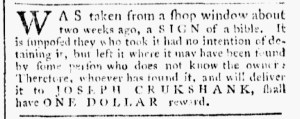
Dunlap’s Pennsylvania Packet (January 17, 1774).

“WAS taken from a shop window … a SIGN of a bible.”

Joseph Crukshank ran a printing office and sold books at the “SIGN of a bible” in Philadelphia … some of the time.  According to an advertisement that he placed in the January 17, 1774, edition of Dunlap’s Pennsylvania Packet, his sign went missing sometime around the beginning of the year.  When he started in the trade, Crukshank did an apprenticeship with Andrew Steuart “at the Bible-in-Heart.”[1]  Perhaps he chose a similar device to mark his location as a means of encouraging an association in the minds of prospective customers familiar with his former master’s work.

“WAS taken from a shop window about two weeks ago,” Crukshank stated, “a SIGN of a bible.”  In that notice, the printer and bookseller provided information that testified to the visual culture of advertising that colonizers encountered when they traversed the streets of Philadelphia.  Although some eighteenth-century trade cards depict shop signs hanging from poles, presumably outside and perhaps perpendicular to the building so pedestrians could see them from a distance, Crukshank apparently positioned his sign in a window, facing into the street.  That gave it less visibility, but likely required less maintenance by protecting it from the weather.  Unfortunately, Crukshank did not indicate the size of the sign, though it must have been small enough for whoever took it to carry away without attracting notice.

The printer and bookseller did not believe that the culprit kept the sign but instead played a trick by abandoning it somewhere.  “It is supposed they who took it had no intention of detaining it,” he declared, “but left it where it may have been found by some person who does not know the owner.”  With that statement, Crukshank confessed the limits of deploying an image to represent his business.  Colonizers who lived in his neighborhood almost certainly recognized the “SIGN of a bible” that identified his shop, as did many others who had resided in the city for some time.  Yet he did not consider the image universally known among the denizens of the busy port.  His advertisement may have aided to establish a connection between Crukshank’s shop and his sign in the minds of those readers, a helpful bit of branding if he managed to recover the sign or replaced it.

**********

[1] Isaiah Thomas, The History of Printing in America: With a Bibliography of Printers and an Account of Newspapers (1810; New York: Weathervane Books, 1970), 386.

January 22

What was advertised in a colonial American newspaper 250 years ago today?

Providence Gazette (January 22, 1774).

“Every other Article usually imported, too many to be enumerated in this Week’s Paper.”

The proprietor of “HILL’s Variety Store” at “the Sign of the ELEPHANT” advertised a “compleat Assortment of English, Scotch and India GOODS” in the January 22, 1774, edition of the Providence Gazette.  To incite interest in his wares, Hill proclaimed that he set prices “as low as can be purchased at any Shop or Store in Boston,” provided that customers paid cash rather than buying on credit.  Boston was a larger port that welcomed a greater number of vessels carrying imported goods, but that did not mean that shoppers there benefitted from better bargains than Hill made available in Providence.  The shopkeeper also listed several items, including several textiles, “new-fashioned Galloshes,” and “low-priced scarlet Broadcloths for Ladies Cloaks,” and promised “every other Article usually imported, too many to be enumerated in this Week’s Paper.”

That suggested that perhaps the printer, John Carter, abbreviated an advertisement received in the printing office due to lack of space.  Though that happened rarely, printers sometimes exercised such editorial discretion, especially when merchants and shopkeeper submitted their notices just before the newspaper went to press.  Alternately, Hill may not have prepared a longer advertisement intended for the January 22 edition but instead wanted to alert local consumers that his “Variety Store” was open for business, planning to compose an advertisement with a more complete inventory in time for the next issue.  On January 29, however, a slightly revised notice ran in the Providence Gazette.  The list of merchandise now concluded: “with every other Article usually imported, Wholesale and Retail.”  The same copy appeared on February 5.

It was not until February 12 that a longer advertisement ran in the Providence Gazette.  That one featured a far greater number of items, divided into two columns, that extended nearly an entire column.  In addition to listing dozens of items, it revised the name of the business to “HILL’s ready Money Variety Store,” underscoring that the proprietor did not allow credit.  The sequence of these advertisements suggests that it was not lack of space that resulted in the note about “too many [items] to be enumerated in this Week’s Paper” the first time the notice ran.  Hill may have had grand designs for updating his advertisement soon after it first appeared, but did not do so.  Once he submitted the copy, however, the longer advertisement ran for six consecutive weeks before he updated it once again on March 26, that time adding a woodcut depicting an elephant to match the sign that marked the location of the “ready Money Variety Store.”  The Adverts 250 Project will feature that advertisement in a future entry.

Slavery Advertisements Published January 22, 1774

GUEST CURATOR:  Kendra Apicella

The Slavery Adverts 250 Project chronicles the role of newspaper advertising in perpetuating slavery in the era of the American Revolution. The project seeks to reveal the ubiquity of slavery in eighteenth-century life from New England to Georgia by republishing advertisements about enslaved people – for sale as individuals or in groups, wanted to purchase or for hire for short periods, runaways who liberated themselves, and those who were subsequently captured and confined in jails and workhouses – in daily digests on this site as well as in real time via the @SlaveAdverts250 Twitter feed, utilizing twenty-first-century media to stand in for the print media of the eighteenth century.

The project aims to provide modern audiences with a sense of just how often colonizers encountered these advertisements in their daily lives. Enslaved men, women, and children appeared in print somewhere in the colonies almost every single day. Those advertisements served as a constant backdrop for social, cultural, economic, and political life in colonial and revolutionary America. Colonizers who did not purport to own enslaved people were still confronted with slavery as well as invited to maintain the system by purchasing enslaved men, women, and children or assisting in the capture of so-called “runaways” who sought to free themselves from bondage. The frequency of these newspaper advertisements suggests just how embedded slavery was in colonial and revolutionary American culture in everyday interactions beyond the printed page.

These advertisements also testify to the experiences of enslaved men, women, and children, though readers must consider that those experiences have been remediated through descriptions offered by enslavers rather than enslaved people themselves. Often unnamed in the advertisements, enslaved men, women, and children were not invisible or unimportant in early America.

These advertisements appeared in colonial American newspapers 250 years ago today.

Providence Gazette (January 22, 1774).