Kendra Apicella is a senior at Assumption University in Worcester, Massachusetts. She is majoring in History with a minor in Political Science. She plans to become a museum curator with an interest in preserving early American and nineteenth-century European documents and artifacts. She is currently an intern at the Barnes Museum in her hometown of Southington, Connecticut, where she works as a docent. She made her contributions to the Slavery Adverts 250 Project while enrolled in HIS 401 Revolutionary America, 1763-1815, in Fall 2023.
What was advertised in a colonial American newspaper 250 years ago today?
Connecticut Gazette (January 21, 1774).
“Greatly contribute towards the elevation and enlivening of Literary Manufactures.”
Both before and after the American Revolution, Robert Bell, one of the most influential publishers and booksellers of the eighteenth century, set about creating an American market for books. That did not always mean publications by American authors but rather editions printed in America for American readers. More than any other printer, publisher, or bookseller, Bell devised advertising campaigns that spanned the colonies in the early 1770s, distributing subscription proposals and inserting notices in newspapers from New England to South Carolina. His advertisement addressing “SAGES and STUDENTS of the LAW, in AMERICA,” for instance, appeared in newspapers in several colonies, promoting “American editions” of “celebrated works” undertaken by “ROBERT BELL, Printer and Bookseller, of Philadelphia.”
Readers of the Connecticut Gazette, published in New London, encountered Bell’s “SAGES and STUDENTS” advertisement in the January 21, 1774, edition. By then, the advertisement had been in circulation in various newspapers for several months as Bell attempted to cultivate a community of readers and consumers not bounded by local geography but instead defined by their common interest in “the elevation and enlivening of Literary Manufactures in America.” To that end, readers in New London and other places near and far had “had an opportunity of seeing at most of the booksellers shops in the capital towns and cities on the Continent, printed proposals with conditions and specimens” for “American editions” of several books, including “BACON’s new abridgment of the law,” “FERGUSON’s essay on the history of Civil Society,” and “A second American edition of Judge BLACKSTONE’s Commentaries on the laws of England.” For some of those books, Bell asserted that they matched “page for page with the last London edition,” yet he charged only half the price for the American edition. The savvy publisher wedded bargain prices and supporting American industry at a time when relations with Parliament deteriorated in the wake of the Tea Act.
To learn more about subscribing to these various American editions, prospective customers could view the conditions in the printed proposals as well as examine specimens (or samples) to confirm that the quality of the type, paper, and printing was not inferior to imported editions. Bell’s marketing efforts thus incorporated several media, not newspaper advertisements alone. Bell cultivated a network of printers and booksellers to disseminate his various forms of advertising in the public prints and in their printing offices and bookshops, enlisting distant associates in the project of encouraging a market for American editions of important and popular books.
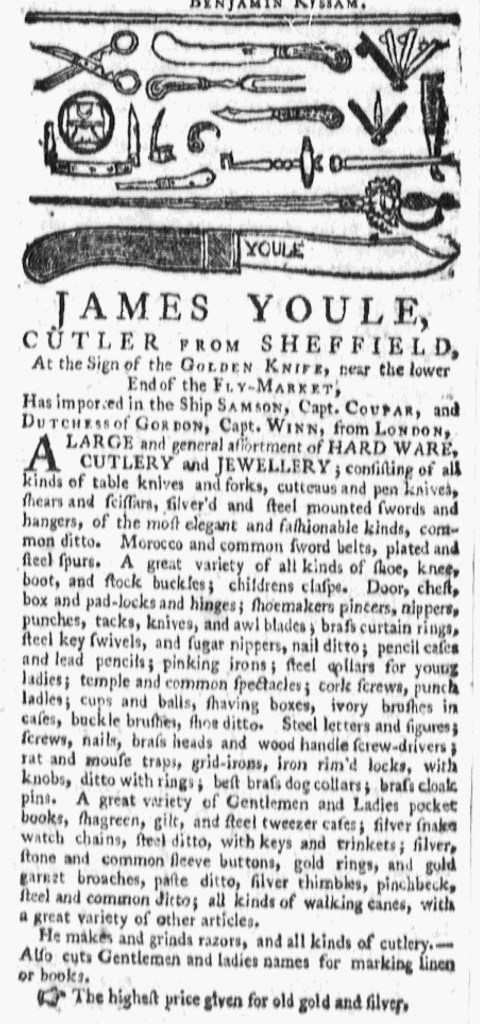
“JAMES YOULE, CUTLER FROM SHEFFIELD, At the Sign of the GOLDEN KNIFE.”
James Youle, a “CUTLER FROM SHEFFIELD,” ran a shop “At the Sign of the GOLDEN KNIFE” in New York in the 1770s. He advertised a “LARGE and general assortment of HARDWARE, CUTLERY and JEWELLERY” in the January 20, 1774, edition of Rivington’s New-York Gazetteer. In addition to the dozens of items he listed in that notice, Youle declared that he “makes and grinds razors, and all kinds of cutlery.” Even given the length of Youle’s advertisement, many readers likely considered the woodcut that adorned it the most significant feature. It depicted more than a dozen items that the cutler made or sold at his shop, including shears, a fork, a table knife, a pocketknife, and a sword. The image rivaled the decorative borders that enclosed other advertisements in the same issue.
Youle had some experience incorporating similar woodcuts into his advertisements. Nearly three years earlier, the partnership of Bailey and Youle included a similar image in their advertisements in the New-York Gazette and Weekly Mercury in March 1771. In the summer of 1772, Youle updated the image to feature his name alone. The partnership having dissolved, Bailey ran advertisements for his own shop “At the Sign of the Cross Swords.” The woodcut that accompanied his advertisement showed several items arrayed around two crossed swords. In the early 1770s, other cutlers in New York, including Richard Sause and Lucas and Shephard, devised similar images for their advertisements, apparently deciding that remaining competitive in their trade required visual images in their notices as well as skill in their shops.
When he returned to pairing advertising copy with a woodcut in 1774, Youle revived the image that he first used when partnered with Bailey and later on his own, though he made one significant alteration. The cutler added a large knife, perhaps a machete, below the sword. The blade bore the name “YOULE,” just as Richard Sause previously included his last name on the blades of both a knife and a sword in his woodcut. Perhaps this new addition was the “GOLDEN KNIFE” from Youle’s sign, a new means of identifying his shop since his earlier advertisements with woodcuts. The cutler may have crafted the woodcut himself. Near the end of his advertisement, he noted that he “cuts Gentlemen and ladies names for marking linen or books. He may have applied the same skill to enhancing his own newspaper advertisements.
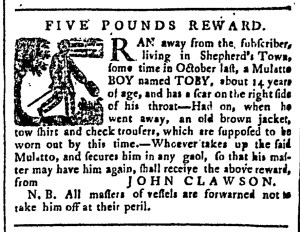
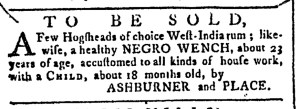
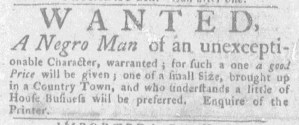
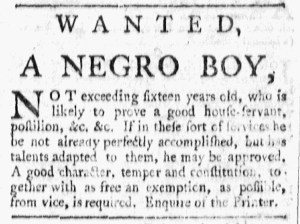
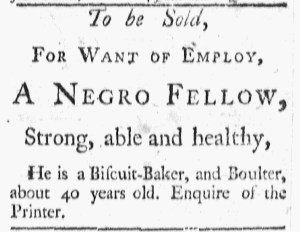
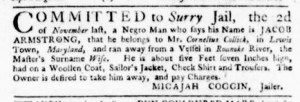
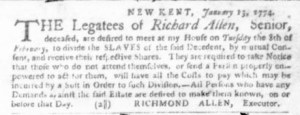
The Slavery Adverts 250 Project chronicles the role of newspaper advertising in perpetuating slavery in the era of the American Revolution. The project seeks to reveal the ubiquity of slavery in eighteenth-century life from New England to Georgia by republishing advertisements about enslaved people – for sale as individuals or in groups, wanted to purchase or for hire for short periods, runaways who liberated themselves, and those who were subsequently captured and confined in jails and workhouses – in daily digests on this site as well as in real time via the @SlaveAdverts250 Twitter feed, utilizing twenty-first-century media to stand in for the print media of the eighteenth century.
The project aims to provide modern audiences with a sense of just how often colonizers encountered these advertisements in their daily lives. Enslaved men, women, and children appeared in print somewhere in the colonies almost every single day. Those advertisements served as a constant backdrop for social, cultural, economic, and political life in colonial and revolutionary America. Colonizers who did not purport to own enslaved people were still confronted with slavery as well as invited to maintain the system by purchasing enslaved men, women, and children or assisting in the capture of so-called “runaways” who sought to free themselves from bondage. The frequency of these newspaper advertisements suggests just how embedded slavery was in colonial and revolutionary American culture in everyday interactions beyond the printed page.
These advertisements also testify to the experiences of enslaved men, women, and children, though readers must consider that those experiences have been remediated through descriptions offered by enslavers rather than enslaved people themselves. Often unnamed in the advertisements, enslaved men, women, and children were not invisible or unimportant in early America.
These advertisements appeared in colonial American newspapers 250 years ago today.
What was advertised in a colonial American newspaper 250 years ago today?
Pennsylvania Journal (January 19, 1774).
“JEDIDIAH SNOWDEN … carries on his business of Cabinet and Windsor Chair-Making … The MILLINARY BUSINESS is carried on as usual, by ANN SNOWDEN.”
Jedidiah Snowden and Ann Snowden pursued different lines of business, but they placed a joint advertisement in the January 19, 1774, edition of the Pennsylvania Journal. Jedidiah informed the public that he moved from Market Street to Front Street, “where he carries on his business of Cabinet and Windsor Chair-Making, and sells them at the most reasonable rates.” For her part, Ann declared that the “MILLARY BUSINESS is carried on as usual” and she “has imported a large and general assortment of MILLINARY.” She then listed dozens of items among her inventory, including “a genteel assortment of figured and plain ribbands,” “mens, womens, boys and girls white and coloured gloves,” “pearl, French and English white wax necklaces,” and “India, ivory, bone, and black fans.”
The Snowdens did not specify their relationship to each other in their advertisement. Most likely they were husband and wife, though they could have been father and daughter, mother and son, brother and sister, cousins, or some other relations. Whatever the case, Jedidiah was the head of household, so his name and information about his business came first. Although Ann’s name ran in the same size font as Jedidiah’s name, “Cabinet and Windsor Chair-Making” appeared as a secondary headline, also in a larger font than the rest of the advertisement, while “MILLINARY BUSINESS” merely appeared in capital letters integrated into the regular copy rather than treated as another headline. Still, Ann’s portion of the advertisement occupied the most space on the page, approximately four times as much as Jedidiah’s portion. The Snowdens made a much larger investment in promoting Ann’s “MILLINARY BUSINESS” than Jedidiah’s “Cabinet and Windsor Chair-Making.” Perhaps Jedidiah believed that he had established such a reputation for his work that he did not need to provide more details beyond telling readers that he had moved and sold the furniture he made “at the most reasonable rates.” Ann, on the other hand, competed with merchants, shopkeepers, and milliners who constantly imported new wares and updated their advertisements in the several newspapers published in Philadelphia. Demonstrating that she offered the same selection of merchandise as her competitors may have been imperative to the milliner. Advertisements jointly placed by husbands and wives or other male and female relations rarely listed the female entrepreneur first, but no matter their format they did reveal that both advertisers contributed to the household economy through their participation in the marketplace.
Isaiah Thomas, patriot printer and founder of the American Antiquarian Society, was born on January 19 (New Style) in 1749 (or January 8, 1748/49, Old Style). It’s quite an historical coincidence that the three most significant printers in eighteenth-century America — Benjamin Franklin, Isaiah Thomas, and Mathew Carey — were all born in January.
Isaiah Thomas (January 30, 1739 – April 4, 1831). American Antiquarian Society.
The Adverts 250 Project is possible in large part due to Thomas’s efforts to collect as much early American printed material as he could, originally to write his monumental History of Printing in America. The newspapers, broadsides, books, almanacs, pamphlets, and other items he gathered in the process eventually became the initial collections of the American Antiquarian Society. That institution’s ongoing mission to acquire at least one copy of every American imprint through 1876 has yielded an impressive collection of eighteenth-century advertising materials, including newspapers, magazine wrappers, trade cards, billheads, watch papers, book catalogs, subscription notices, broadsides, and a variety of other items. Exploring the history of advertising in early America — indeed, exploring any topic related to the history, culture, and literature of early America at all — has been facilitated for more than two centuries by the vision of Isaiah Thomas and the dedication of the curators and other specialists at the American Antiquarian Society over the years.
Thomas’s connections to early American advertising were not limited to collecting and preserving the items created on American presses during the colonial, Revolutionary, and early national periods. Like Mathew Carey, he was at the hub of a network he cultivated for distributing newspapers, books, and other printed goods — including advertising to stimulate demand for those items. Sometimes this advertising was intended for dissemination to the general public (such as book catalogs and subscription notices), but other times it amounted to trade advertising (such as circular letters and exchange catalogs intended only for fellow printers, publishers, and booksellers).
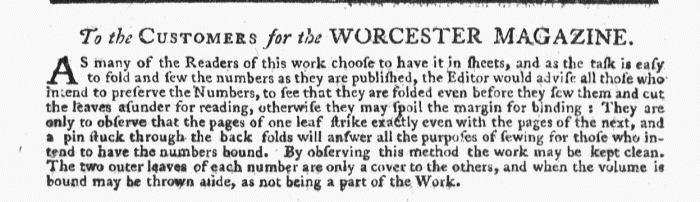
Thomas also experimented with advertising on wrappers that accompanied his Worcester Magazine, though he acknowledged to subscribers that these wrappers were ancillary to the publication: “The two outer leaves of each number are only a cover to the others, and when the volume is bound may be thrown aside, as not being a part of the Work.”[1]
Detail of Advertising Wrapper, Worcester Magazine (Second Week of April, 1786).
Thomas’s patriotic commitment to freedom of the press played a significant role in his decision to develop advertising wrappers. As Thomas relays in his History of Printing in America, he discontinued printing his newspaper, the Massachusetts Spy, after the state legislature passed a law that “laid a duty of two-thirds of a penny on newspapers, and a penny on almanacs, which were to be stamped.” Such a move met with strong protest since it was too reminiscent of the Stamp Act imposed by the British two decades earlier, prompting the legislature to repeal it before it went into effect. On its heels, however, “another act was passed, which imposed a duty on all advertisements inserted in the newspapers” printed in Massachusetts. Thomas vehemently rejected this law as “an improper restraint on the press. He, therefore, discontinued the Spy during the period that this act was in force, which was two years. But he published as a substitute a periodical work, entitled ‘The Worcester Weekly Magazine,’ in octavo.”[2] This weekly magazine lasted for two years; Thomas discontinued it and once again began printing the Spy after the legislature repealed the objectionable act.
Third Page of Advertising Wrapper, Worcester Magazine (Fourth Week of May, 1786).
Isaiah Thomas was not interested in advertising for its own sake to the same extent as Mathew Carey, but his political concerns did help to shape the landscape of early American advertising. Furthermore, his vision for collecting American printed material preserved a variety of advertising media for later generations to admire, analyze, ponder, and enjoy. Happy 275th birthday, Isaiah Thomas!
**********
[1] Isaiah Thomas, “To the CUSTOMERS for the WORCESTER MAGAZINE,” Worcester Magazine, wrapper, second week of April, 1786.
[2] Isaiah Thomas, The History of Printing in America: With a Biography of Printers, and an Account of Newspapers, vol. 2 (Worcester, MA: Isaac Sturtevant, 1810), 267-268.
The Slavery Adverts 250 Project chronicles the role of newspaper advertising in perpetuating slavery in the era of the American Revolution. The project seeks to reveal the ubiquity of slavery in eighteenth-century life from New England to Georgia by republishing advertisements about enslaved people – for sale as individuals or in groups, wanted to purchase or for hire for short periods, runaways who liberated themselves, and those who were subsequently captured and confined in jails and workhouses – in daily digests on this site as well as in real time via the @SlaveAdverts250 Twitter feed, utilizing twenty-first-century media to stand in for the print media of the eighteenth century.
The project aims to provide modern audiences with a sense of just how often colonizers encountered these advertisements in their daily lives. Enslaved men, women, and children appeared in print somewhere in the colonies almost every single day. Those advertisements served as a constant backdrop for social, cultural, economic, and political life in colonial and revolutionary America. Colonizers who did not purport to own enslaved people were still confronted with slavery as well as invited to maintain the system by purchasing enslaved men, women, and children or assisting in the capture of so-called “runaways” who sought to free themselves from bondage. The frequency of these newspaper advertisements suggests just how embedded slavery was in colonial and revolutionary American culture in everyday interactions beyond the printed page.
These advertisements also testify to the experiences of enslaved men, women, and children, though readers must consider that those experiences have been remediated through descriptions offered by enslavers rather than enslaved people themselves. Often unnamed in the advertisements, enslaved men, women, and children were not invisible or unimportant in early America.
These advertisements appeared in colonial American newspapers 250 years ago today.
What was advertised in a colonial American newspaper 250 years ago today?
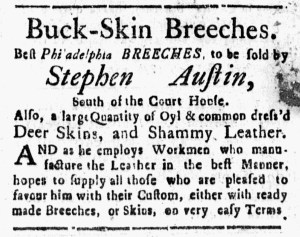
Connecticut Courant (January 18, 1774).
“He employs Workmen who manufacture the Leather in the best Manner.”
Stephen Austin sold “Buck-Skin Breeches” as well as “dress’d Deer Skins, and Shammy Leather” at his shop “South of the Court House” in Hartford. In an advertisement that he placed in the January 18, 1774, edition of the Connecticut Courant, he not only highlighted the quality of his products but also the skill of those who labored in his shop. Austin informed prospective customers that he “employs Workmen who manufacture the Leather in the best Manner.” Among his competitors, Cotton Murray, a tailor, also ran an advertisement in the Connecticut Courant. The tailor focused primarily on the services that he performed, but also added a nota bene about an employee who dressed leather. Murray declared that he “carries on Leather Breeches making in all its branches, has a quantity of Leather of the best kind, and has employed a Workman in that business who serv’d his time in Europe.”
Both Austin and Murray promoted contributions that employees made to their businesses. Artisans often relied on various assistants, whether employees, apprentices, or family members, but such workers did not regularly appear in newspaper advertisements. Instead, the proprietors personified their shops, especially in an era that most businesses did not have names. Austin’s shop, for instance, did not have a name. Instead, his own name and one of the products he sold appeared as headlines. For Murray, it was his name and occupation in the headlines. Even artisans who ran shops identified by signs, like Daniel King, a brass founder “At the Sign of the Bell and Brand” in Philadelphia, deployed their own names rather than the sign that doubled as a shop’s name in the headlines of their advertisements. Such methods emphasized work undertaken by the proprietor while obscuring the labor of others in a shop. Artisans often considered such name recognition the best strategy for building their own reputations and the reputations of their businesses, but occasionally some of them saw benefits in marketing the skills of their employees. Austin and Murray both hoped that doing so would help convince customers to select them over their competitors.
The Slavery Adverts 250 Project chronicles the role of newspaper advertising in perpetuating slavery in the era of the American Revolution. The project seeks to reveal the ubiquity of slavery in eighteenth-century life from New England to Georgia by republishing advertisements about enslaved people – for sale as individuals or in groups, wanted to purchase or for hire for short periods, runaways who liberated themselves, and those who were subsequently captured and confined in jails and workhouses – in daily digests on this site as well as in real time via the @SlaveAdverts250 Twitter feed, utilizing twenty-first-century media to stand in for the print media of the eighteenth century.
The project aims to provide modern audiences with a sense of just how often colonizers encountered these advertisements in their daily lives. Enslaved men, women, and children appeared in print somewhere in the colonies almost every single day. Those advertisements served as a constant backdrop for social, cultural, economic, and political life in colonial and revolutionary America. Colonizers who did not purport to own enslaved people were still confronted with slavery as well as invited to maintain the system by purchasing enslaved men, women, and children or assisting in the capture of so-called “runaways” who sought to free themselves from bondage. The frequency of these newspaper advertisements suggests just how embedded slavery was in colonial and revolutionary American culture in everyday interactions beyond the printed page.
These advertisements also testify to the experiences of enslaved men, women, and children, though readers must consider that those experiences have been remediated through descriptions offered by enslavers rather than enslaved people themselves. Often unnamed in the advertisements, enslaved men, women, and children were not invisible or unimportant in early America.
These advertisements appeared in colonial American newspapers 250 years ago today.
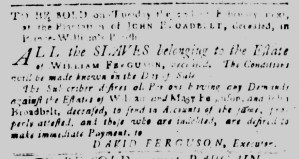
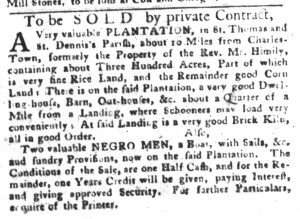
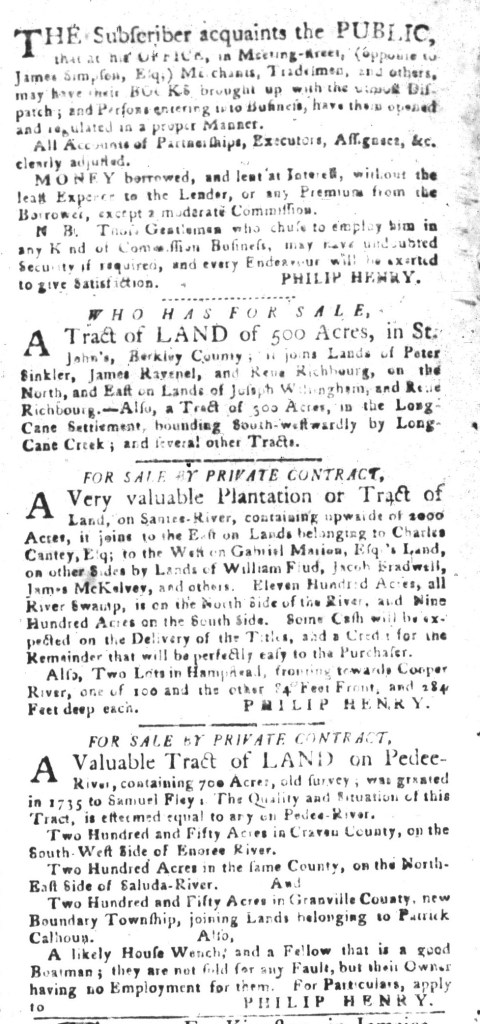
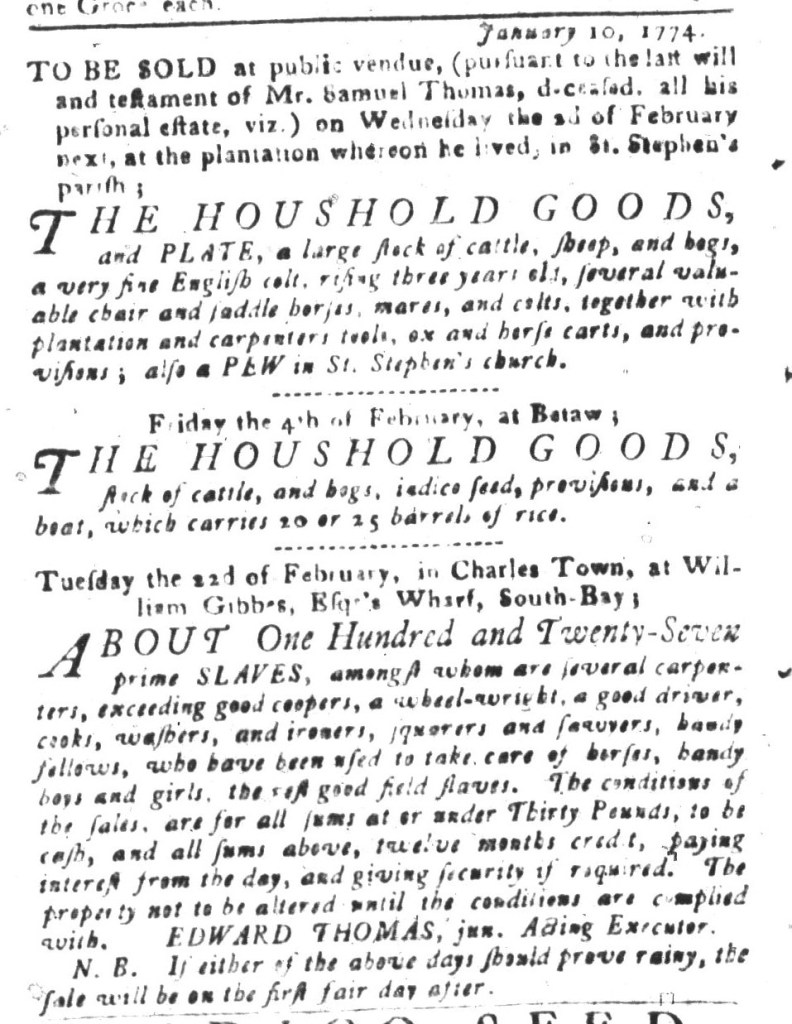
South-Carolina Gazette and Country Journal (January 18, 1774).
**********
South-Carolina Gazette and Country Journal (January 18, 1774).
**********
South-Carolina Gazette and Country Journal (January 18, 1774).
**********
South-Carolina Gazette and Country Journal (January 18, 1774).
**********
South-Carolina Gazette and Country Journal (January 18, 1774).
**********
South-Carolina Gazette and Country Journal (January 18, 1774).
**********
South-Carolina Gazette and Country Journal (January 18, 1774).
What was advertised in a colonial American newspaper 250 years ago today?
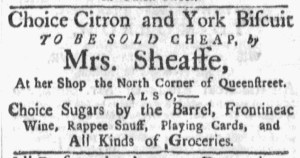
Boston Evening-Post (January 17, 1774).
“TO BE SOLD CHEAP, by Mrs. Sheaffe.”
Mrs. Sheaffe placed this advertisement in the Boston Evening-Post. She ran a shop where she sold a variety of items, including choice citron (referring to citrus fruits), sugar, wine, and “All Kinds of Groceries.” Mrs. Sheaffe ambitiously invested to integrate herself into life as a businessowner as her advertisements appear twice in Massachusetts newspapers during the week of January 14-20, 1774, appearing in both the Boston Evening-Post and the Boston-Gazette. According to Gloria Main in “Gender, Work, and Wages in Colonial New England,” “most women in retailing were widows who had taken over a deceased husband’s shop.”[1] As this woman went by “Mrs. Sheaffe” it is likely that she was a widow and opened her shop to support herself and her family. Mrs. Sheaffe’s investments in advertising her shop in multiple newspapers demonstrates her industriousness and desire to establish herself as a businessowner of Boston. During the Revolutionary Era, the role of women in business extended far beyond just buying goods, many of them acting as retailers themselves.
**********
ADDITIONAL COMMENTARY: Carl Robert Keyes
David convincingly suggests that Mrs. Sheaffe may have been a widow responsible for supporting herself and perhaps others in her household. When other female entrepreneurs placed advertisements in newspapers published in Boston, they tended to use their full names, just as their male counterparts did. Mrs. Sheaffe’s decision to go by “Mrs. Sheaffe” may have been intended to remind those who knew her of her circumstances as a widow. She may have also meant for that to justify her role in the marketplace as a shopkeeper rather than as a consumer. Although some women ran businesses, as their advertisements attest, doing so was often depicted as a masculine endeavor, one better suited to men than women.
Mrs. Sheaffe attained a certain level of visibility in Boston, thanks in part to her frequent advertisements. Other women certainly assisted in running family businesses, even when they were not considered proprietors or mentioned in advertisements. When Herman Brimmer and Andrew Brimmer advertised “An Assortment of Mens, Womens & Childrens Hose” and other garments in the same edition of the Boston Evening-Post that Mrs. Sheaffe promoted her wares, they sought female customers, recognizing the role that women played as consumers. Their advertisement, like so many others, may have hidden the role that wives, daughters, and other female relations played in helping to run their shop “next Door to the Sign of the Lamb.”
Other female entrepreneurs did not achieve the same visibility in the marketplace as Mrs. Sheaffe because women were less likely to place newspaper advertisements compared to men who ran businesses. That same issue of the Boston Evening-Post included a notice calling on “All Persons indebted to the Estate of the late Mrs. Ruth Sinclair, Shopkeeper,” to settle accounts. According to a list of recent deaths in the December 27, 1773, edition of the Boston Evening-Post, she was the “Widow of the late Capt. Sinclair.” He died thirteen years earlier, a notice about settling his estate in the August 25, 1760, edition of the Boston-Gazette listing his widow as “sole Executrix.” Although she was apparently known to residents of Boston as a shopkeeper, Ruth Sinclair did not publish any advertisements. Instead, she may have relied on foot traffic and recommendations from loyal customers.
Mrs. Sheaffe was not alone as a proprietor of her own business during the era of the American Revolution. Other women ran businesses and an even greater number participated in the marketplace as more than consumers, assisting in shops run by husbands, fathers, brothers, and others. Yet Mrs. Sheaffe did make her role as a female entrepreneur much more visible in the public prints than most other women. Her advertisements testify to what was possible for women, though not usual.
**********
[1] Gloria L. Main, “Gender, Work, and Wages in Colonial New England,” William and Mary Quarterly, 3rd ser., 51, no. 1 (January 1994): 58.