Slavery Advertisements Published May 3, 1774

GUEST CURATOR:  Caroline Branch

The Slavery Adverts 250 Project chronicles the role of newspaper advertising in perpetuating slavery in the era of the American Revolution. The project seeks to reveal the ubiquity of slavery in eighteenth-century life from New England to Georgia by republishing advertisements about enslaved people – for sale as individuals or in groups, wanted to purchase or for hire for short periods, runaways who liberated themselves, and those who were subsequently captured and confined in jails and workhouses – in daily digests on this site as well as in real time via the @SlaveAdverts250 Twitter feed, utilizing twenty-first-century media to stand in for the print media of the eighteenth century.

The project aims to provide modern audiences with a sense of just how often colonizers encountered these advertisements in their daily lives. Enslaved men, women, and children appeared in print somewhere in the colonies almost every single day. Those advertisements served as a constant backdrop for social, cultural, economic, and political life in colonial and revolutionary America. Colonizers who did not purport to own enslaved people were still confronted with slavery as well as invited to maintain the system by purchasing enslaved men, women, and children or assisting in the capture of so-called “runaways” who sought to free themselves from bondage. The frequency of these newspaper advertisements suggests just how embedded slavery was in colonial and revolutionary American culture in everyday interactions beyond the printed page.

These advertisements also testify to the experiences of enslaved men, women, and children, though readers must consider that those experiences have been remediated through descriptions offered by enslavers rather than enslaved people themselves. Often unnamed in the advertisements, enslaved men, women, and children were not invisible or unimportant in early America.

These advertisements appeared in colonial American newspapers 250 years ago today.
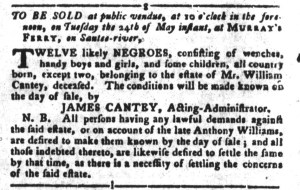
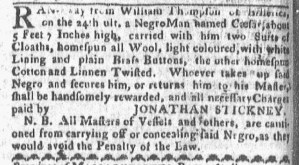
Connecticut Courant (May 3, 1774).

**********

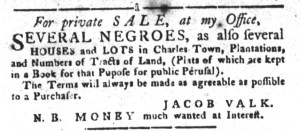
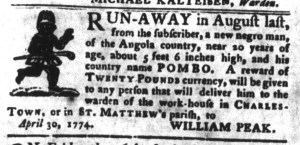
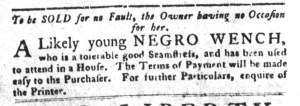
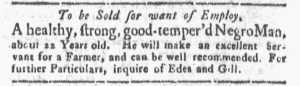
South-Carolina Gazette and Country Journal (May 3, 1774).

**********

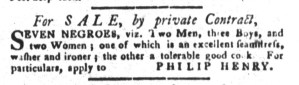
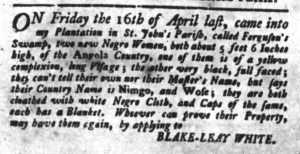
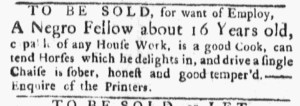
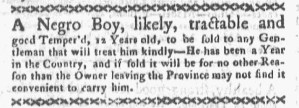
South-Carolina Gazette and Country Journal (May 3, 1774).

**********

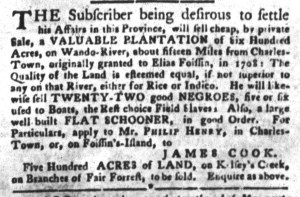
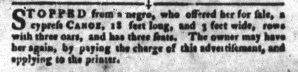
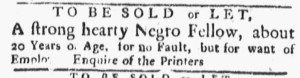
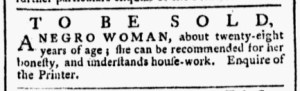
South-Carolina Gazette and Country Journal (May 3, 1774).

**********

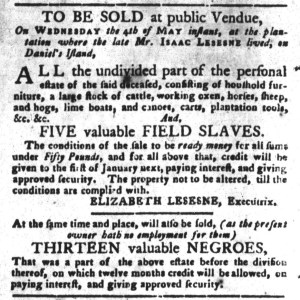
South-Carolina Gazette and Country Journal (May 3, 1774).

**********

South-Carolina Gazette and Country Journal (May 3, 1774).

**********

South-Carolina Gazette and Country Journal (May 3, 1774).

**********

South-Carolina Gazette and Country Journal (May 3, 1774).

**********

South-Carolina Gazette and Country Journal (May 3, 1774).

**********

South-Carolina Gazette and Country Journal (May 3, 1774).

**********

South-Carolina Gazette and Country Journal (May 3, 1774).

**********

South-Carolina Gazette and Country Journal (May 3, 1774).

**********

South-Carolina Gazette and Country Journal (May 3, 1774).

**********

South-Carolina Gazette and Country Journal (May 3, 1774).

**********

South-Carolina Gazette and Country Journal (May 3, 1774).

**********

South-Carolina Gazette and Country Journal (May 3, 1774).

**********

South-Carolina Gazette and Country Journal (May 3, 1774).

**********

South-Carolina Gazette and Country Journal (May 3, 1774).

**********

South-Carolina Gazette and Country Journal (May 3, 1774).

**********

South-Carolina Gazette and Country Journal (May 3, 1774).

**********

South-Carolina Gazette and Country Journal (May 3, 1774).

May 2

What was advertised in a colonial American newspaper 250 years ago today?

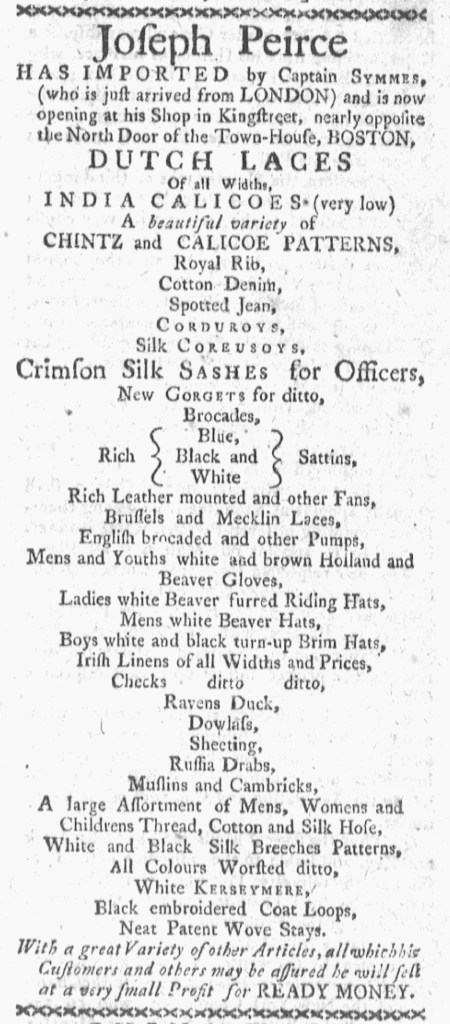
Boston-Gazette (May 2, 1774).

{ Blue }
Rich { Black and } Sattins
{ White }

Joseph Peirce’s advertisement on the front page of the May 2, 1774, edition of the Boston-Gazette stood out thanks to its unique graphic design.  The shopkeeper provided a list of merchandise that he recently imported from London, but rather than arrange it in a dense paragraph, as in most advertisements, or create columns with one item per line, as in some advertisements, this one featured one item per line with each line centered.  As a result, the text created an irregular shape with a lot of white space on either side.  That certainly distinguished the advertisement from the news in the column to the right, justified on both sides.

Advertisers usually generated copy, while compositors made most decisions about format.  When merchants and shopkeepers ran advertisements with identical copy in multiple newspapers, variations in fonts, capitalization, italics, font size, and other design elements testified to the creative work done by the compositors in each printing office.  Advertisers likely submitted general instructions with the copy for advertisements that arranged goods in columns, but that may not have always been the case.  M.B. Goldthwait’s advertisement for “DRUGS and MEDICINES” in the April 28, 1774, edition of the Massachusetts Spy, for instance, listed a variety of patent medicines in a paragraph, while his advertisement in the May 2 edition of the Massachusetts Gazette and Boston Post-Boy separated them into side-by-side columns.

Peirce seems to have submitted specific instructions with the copy for his advertisement.  It had the same format in the May 2 editions of the Boston Evening-Post and the Massachusetts Gazette and Boston Post-Boy and the May 5 edition of the Massachusetts Gazette and Boston Weekly News-Letter.  They even gave the same treatment to three lines for:

{ Blue }
Rich { Black and } Sattins
{ White }

That indicates that the compositors incorporated the format that Peirce sketched when he composed the copy.  Curiously, the advertisements in the Boston-Gazette, the Boston Evening-Post and the Massachusetts Gazette and Boston Weekly News-Letter appear identical, as though the printing offices shared type set in one and transferred to the others.  If that was indeed the case, it raises questions about day-to-day operating practices and collaboration among printers in Boston. Even if some printing office shared type, Pierce’s advertisements in the Boston-Gazette and the Massachusetts Gazette and Boston Post-Boy had minor variations while retaining the same format.  That suggests that Peirce provided his vision for his advertisement to at least two printing offices, taking an active role in designing as well as writing his notice.

Left to right: Boston-Gazette (May 2, 1774); Boston Evening-Post (May 2, 1774); Massachusetts Gazette and Boston Weekly News-Letter (May 5, 1774).

Slavery Advertisements Published May 2, 1774

GUEST CURATOR:  Caroline Branch

The Slavery Adverts 250 Project chronicles the role of newspaper advertising in perpetuating slavery in the era of the American Revolution. The project seeks to reveal the ubiquity of slavery in eighteenth-century life from New England to Georgia by republishing advertisements about enslaved people – for sale as individuals or in groups, wanted to purchase or for hire for short periods, runaways who liberated themselves, and those who were subsequently captured and confined in jails and workhouses – in daily digests on this site as well as in real time via the @SlaveAdverts250 Twitter feed, utilizing twenty-first-century media to stand in for the print media of the eighteenth century.

The project aims to provide modern audiences with a sense of just how often colonizers encountered these advertisements in their daily lives. Enslaved men, women, and children appeared in print somewhere in the colonies almost every single day. Those advertisements served as a constant backdrop for social, cultural, economic, and political life in colonial and revolutionary America. Colonizers who did not purport to own enslaved people were still confronted with slavery as well as invited to maintain the system by purchasing enslaved men, women, and children or assisting in the capture of so-called “runaways” who sought to free themselves from bondage. The frequency of these newspaper advertisements suggests just how embedded slavery was in colonial and revolutionary American culture in everyday interactions beyond the printed page.

These advertisements also testify to the experiences of enslaved men, women, and children, though readers must consider that those experiences have been remediated through descriptions offered by enslavers rather than enslaved people themselves. Often unnamed in the advertisements, enslaved men, women, and children were not invisible or unimportant in early America.

These advertisements appeared in colonial American newspapers 250 years ago today.

Boston Evening-Post (May 2, 1774).

**********

Boston Evening-Post (May 2, 1774).

**********

Boston-Gazette (May 2, 1774).

**********

Boston-Gazette (May 2, 1774).

**********

Boston-Gazette (May 2, 1774).

**********

Boston-Gazette (May 2, 1774).

**********

Dunlap’s Pennsylvania Packet (May 2, 1774).

**********

Newport Mercury (May 2, 1774).

**********

Supplement to the New-York Gazette and Weekly Mercury (May 2, 1774).

**********

Supplement to the New-York Gazette and Weekly Mercury (May 2, 1774).

**********

Supplement to the New-York Gazette and Weekly Mercury (May 2, 1774).

May 1

What was advertised in a colonial American newspaper 250 years ago this week?

Massachusetts Spy (May 28, 1774).

“Medicine Boxes … are put up in the neatest Manner.”

The woodcut that adorned John Joy’s advertisement in the April 28, 1774, edition of the Massachusetts Spy alerted readers to the type of merchandise that the apothecary sold before they even read the copy.  It depicted a lion wearing a crown and working a mortar and pestle atop a column.  The woodcut ran the entire length of the advertisement, as if Joy or the compositor or perhaps the two working together intentionally designed the image and copy to fit together that way.  A sign with a similar image may or may not have marked Joy’s location at “the North-Corner of William’s Court, BOSTON,” but he did not make specific mention of a sign.  Other advertisers who commissioned woodcuts for their newspaper notices often did so when the image matched the device customers saw at their shop.  Whatever the case, the image made Joy’s advertisement much more visible to prospective customers than M.B. Goldthwait’s notice about a “fresh supply of DRUGS and MEDICINES” and “SURGEONS INSTRUMENTS, Of all Kinds.”

Massachusetts Spy (April 28, 1774).

The copy declared that Joy “Has just received from LONDON, A large and compleat Assortment of Drugs and Medicines, Of the best Quality.”  The lion with the crown asserted both those imperial connections and the quality of the remedies that Joy sold.  In addition, he stocked “Surgeons Instruments, of every Kind, finished in the neatest Manner” as well as “a full Assortment of Groceries and Dye Stuffs.”  Not unlike modern retail pharmacies, Joy diversified his enterprise to cultivate multiple revenue streams, including medicines, medical equipment, home health care supplies, and groceries.  To that end, he also prepared “Medicine Boxes of various Prices, for Ships or private Families,” pledging that they “are put up in the neatest Manner.”  Goldthwait also prepared “Doctor’s Boxes … for Masters of Vessels and private Families” and included “every necessary direction” for using the contents.  These first aid kits included both medicine and supplies.  Selling them allowed apothecaries to enhance their revenues since buyers acquired a variety of items that they did not yet need and might never use but purchased against the chance of injury or illness.  After all, it was better to have them on hand than not at all.  Joy also operated a precursor to the mail order pharmacy, alerting “Prac[ti]tioners and others” that they may be supplied with large or small Quantities, by Letter or otherwise [such as sending a servant enslaved messenger], as well as though they were present.”  Joy and other apothecaries frequently promoted such convenience as part of their marketing efforts.  Like the image of the crowned lion working a mortar and pestle, that appeal distinguished Joy’s advertisement from the notice placed by his competitor.